analytic continuation
Also known as: meromorphic continuation.
The unique extension of a complex-differentiable function from a smaller region to a larger domain, locked in place by the identity theorem.
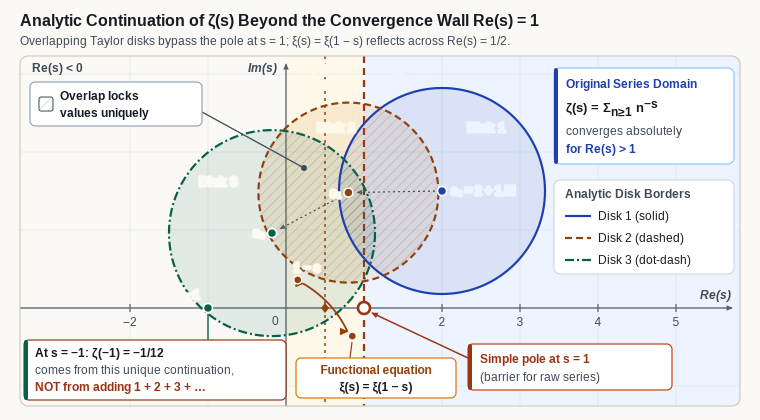
Level 1 — First-Principles
Suppose a formula works only on part of the two-dimensional grid of real and imaginary coordinatescomplex plane. For example, the geometric unending suminfinite series
Because complex-differentiable functions are completely determined by their values on any tiny open patch, there is at most one complex-differentiable way to extend a function onto a larger connected region (allowing isolated blow-up points called poles). That unique extension is analytic continuation (or meromorphic continuation when poles are permitted). For the master function defined initially by
Limits of the intuition
Imagining analytic continuation as smoothly extending a real graph is misleading in two opposite ways. On one hand, a smooth real function on
Level 2 — Undergrad Bridge
The uniqueness of analytic continuation rests on the Identity Theorem: if two holomorphic functions
Riemann constructed this continuation via the Jacobi theta function
Because
Level 3 — Formal Lean Contract
Mathlib4 implements this continuation in Mathlib.NumberTheory.LSeries.DirichletContinuation and Mathlib.NumberTheory.LSeries.RiemannZeta using Mellin transforms of theta functions (completedHurwitzZetaEven, completedHurwitzZetaOdd, completedRiemannZeta, and DirichletCharacter.completedLFunction). Upstream src/Statements.lean:3 uses public import Mathlib (transitively bringing in Mathlib.NumberTheory.LSeries.DirichletContinuation), guaranteeing that riemannZeta and DirichletCharacter.LFunction denote these globally continued meromorphic functions rather than the raw LSeries sum. (Upstream's parallel formal-conjectures statement module, comparator/FormalConjecturesStatement.lean, is archived on alpoge@c900e67c2 pending re-integration on condensed main.) See the page's live verification banner (audit/verification-status.json) for the currently pinned upstream snapshot and local Lean build status (build_status: unverified-locally).
Where this analogy breaks
Comparing analytic continuation to drawing a smooth curve through data points suggests many possible continuations; for complex-differentiable functions, the extension to a connected domain is rigid and unique, though it can hit isolated poles or impassable natural boundaries.
Related Concepts
- complex plane — The two-dimensional coordinate plane of numbers s = σ + it, where the horizontal coordinate σ = Re(s) sets decay rate and the vertical coordinate t = Im(s) sets oscillation frequency.
- infinite series — A limit of partial sums formed by adding infinitely many terms; in number theory, weighting terms by n⁻ˢ produces a Dirichlet series that turns integer arithmetic into a smooth function.
- Riemann zeta function — The meromorphic function ζ(s) extending ∑ n⁻ˢ to all of ℂ ∖ {1}, linking prime numbers via its Euler product to zeros in the complex plane.
- trivial zero — A zero at a non-positive integer forced purely by poles of the gamma factor in the functional equation, carrying no hidden information about prime fluctuations.
Referenced By
- Stage: Stage 00 — Formal Statements & Challenge Contracts
- Concept: complex plane
- Concept: Dirichlet L-function
- Concept: infinite series
- Concept: Landau's lemma
- Concept: Riemann zeta function
- Concept: trivial zero
Authoritative Sources
- Complex Analysis (book) — L. V. Ahlfors, 3rd ed., McGraw-Hill (1979), Chapter 8: Global Analytic Functions.
- Complex Analysis (book) — E. M. Stein and R. Shakarchi, Princeton Lectures in Analysis II, Princeton University Press (2003), Chapters 2 and 6.
- Mathlib4: DirichletContinuation (mathlib) — Mathlib.NumberTheory.LSeries.DirichletContinuation (
riemannZeta,DirichletCharacter.LFunction, pinned mathlib rev 31ce06eaadf4a200c0e1407c5f10953cf606b8f8).
Page Glossary
- complex plane
- The two-dimensional coordinate plane of numbers s = σ + it, where the horizontal coordinate σ = Re(s) sets decay rate and the vertical coordinate t = Im(s) sets oscillation frequency.
- infinite series
- A limit of partial sums formed by adding infinitely many terms; in number theory, weighting terms by n⁻ˢ produces a Dirichlet series that turns integer arithmetic into a smooth function.
- Riemann zeta function
- The meromorphic function ζ(s) extending ∑ n⁻ˢ to all of ℂ ∖ {1}, linking prime numbers via its Euler product to zeros in the complex plane.
- trivial zero
- A zero at a non-positive integer forced purely by poles of the gamma factor in the functional equation, carrying no hidden information about prime fluctuations.