Weyl gauge
Also known as: p-adic gauge, B-short, ramified source form.
The p-adic coordinate norm of an algebraic modular form measured in the g-twisted Weyl lattice, paired with Galois-conjugate archimedean bounds to define B-short spanning sets and ramified source forms.
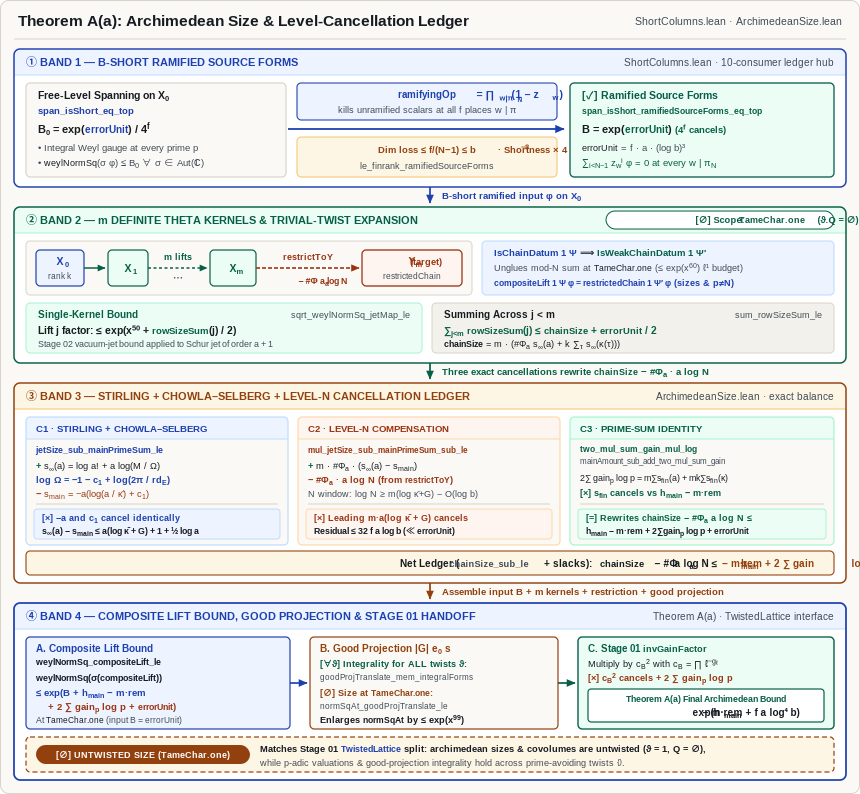
Level 1 — First-Principles
An algebraic modular form
The subtlety is that different points
With both rulers in hand, we can ask whether a space of modular forms has a well-conditioned spanning set rather than an arbitrarily skewed basis. A form span_isShort_eq_top) that for any free level subgroup
Stage 03's upper chain of integral transforms carrying automorphic forms along a ladder of unitary groupstheta correspondence cannot act on arbitrary source forms: its seesaw match and symmetry-adapted multivariate derivative divisibility boundsSchur jet require forms that are genuinely ramified at every prime span_isShort_ramifiedSourceForms_eq_top).
Finally, the GaugeLe.zpow_neg_smul). Performing this rescaling across all small non-split primes cancels their prime-power weights from the archimedean bound without ever breaking integrality.
Limits of the intuition
Thinking of the Weyl gauge as a simple entrywise weylRep κ e (g⁻¹) before reading coordinates, so integrality tracks the GaugeLe d c φ evaluate the lattice at GaugeLe.zpow_neg_smul restores integrality from a real-valued bound
Level 2 — Undergrad Bridge
Let
Weyl gauge and B-short forms (
IsShort): Fix a primeand an embedding ( PadicPlace p). At, the Weyl gauge of a coordinate vector is For a fixed base shift
and real bound , GaugeLe d c φassertsfor all . A form is B-short ( IsShort B φ) if:- for every prime
and every PadicPlace p,GaugeLe 1 1 φholds (integrality in Weyl's lattice at every); and - for every
and every , .
- for every prime
Spanning by B-short delta forms (
span_isShort_eq_top): Supposeis a free level subgroup ( for all ). At each double coset , choosing invertible matrices with and integral over and entries bounded by ( shortBasisConst E n N_E, where) yields coordinate vectors satisfying
( norm_weylRep_mulVec_det_smul_weylEval_le_one) and( weylNormSq_det_smul_weylRep_mulVec_weylEval_le) for. Turning these into delta forms ( isShort_deltaForm) spans the entire level space by B-short forms for every. Ramified source forms (
ramifiedSourceForms,span_isShort_ramifiedSourceForms_eq_top): For admissible datawith prime level ( ), each place has residue field and a chosen norm-one finite idele that is integral, equal to off , and has order modulo . Acting by scalar matrices gives D.centralRep z_wwith. The submodule of ramified source forms is (
ramifiedSourceForms_eq_range). Because each kernelhas dimension at most ( finrank_ker_one_sub_scalingGenerator_le) and, Since each difference operator
multiplies shortness by ( IsShort.sub_translate,isShort_ramifyingOp), applyingD.ramifyingOp univto the-short spanning set ( New.Data.span_isShort_eq_top, where) spans D.ramifiedSourceFormsby-short forms. Ultrametricity and gauge rescaling (
GaugeLe.zpow_neg_smul): Because the-adic gauge is ultrametric ( GaugeLe.add), monotone in the exponent (GaugeLe.rpow_mono), and scales byunder ( GaugeLe.smul), any form satisfyingGaugeLe d (p ^ r) φand any integerobey Applied to the local divisibility bound
GaugeLe 1 (p ^ (allowedLoss p - gain p)) (compositeLift ϑ Ψ φ), this converts real-valued divisibility exponents into exact integer prime powers that divide out of the lifted form while preserving global integrality.
Level 3 — Formal Lean Contract
Stage 03 extracts IsShort, span_isShort_eq_top, ramifiedSourceForms, and span_isShort_ramifiedSourceForms_eq_top into skeleton/03_upper_bound/short_columns.lean (from upstream src/New/UpperBound/Size/ShortColumns.lean), and the gauge rescaling calculus into skeleton/03_upper_bound/local_divisibility.lean (from upstream src/New/UpperBound/Divisibility/LocalDivisibility.lean):
03_upper_bound/short_columns.lean#New.IsShort(upstreamsrc/New/UpperBound/Size/ShortColumns.lean:157-161):leandef New.IsShort (B : ℝ) (φ : AlgForm n κ e) : Prop03_upper_bound/short_columns.lean#New.span_isShort_eq_top(upstreamsrc/New/UpperBound/Size/ShortColumns.lean:366-433):leanlemma New.span_isShort_eq_top {K : Subgroup (Gf E n)} [IsLevel K] [Nonempty n] (free : ∀ g : Gf E n, classAut stdRatPoints K g = ⊥) {N M : ℕ} [NeZero N] (hN_diff : ↑N ∈ differentIdeal ℤ (𝓞 E)) (hM : Fintype.card n * Fintype.card (InfinitePlace E) + boxes κ (Fintype.card n) ≤ M) {B : ℝ} (hB : (shortBasisConst E n N : ℝ) ^ (6 * M) ≤ B) : span ℂ {φ : levelSpace (algFormRep κ e) K | IsShort B φ.val} = ⊤03_upper_bound/short_columns.lean#New.Data.ramifiedSourceForms(upstreamsrc/New/UpperBound/Size/ShortColumns.lean:743-746):leandef New.Data.ramifiedSourceForms {P : Parameters} (D : Data P) : Submodule ℂ D.SourceForm03_upper_bound/short_columns.lean#New.Data.span_isShort_ramifiedSourceForms_eq_top(upstreamsrc/New/UpperBound/Size/ShortColumns.lean:1008-1020):leanlemma New.Data.span_isShort_ramifiedSourceForms_eq_top {P : Parameters} (D : Data P) : span ℂ {φ : D.ramifiedSourceForms | IsShort D.errorUnit.exp (φ : D.SourceForm).val} = ⊤03_upper_bound/local_divisibility.lean#New.GaugeLe.zpow_neg_smul(upstreamsrc/New/UpperBound/Divisibility/LocalDivisibility.lean:115-125):leanlemma New.GaugeLe.zpow_neg_smul {r : ℝ} {β : ℤ} {φ : AlgForm (E := E) n κ e} (hφ : GaugeLe d (p ^ r) φ) (hβ : β ≤ -r) : GaugeLe d 1 ((p : ℂ) ^ (-β) • φ)
Notice how span_isShort_eq_top feeds New.Data.span_isShort_eq_top and span_isShort_ramifiedSourceForms_eq_top to produce short integral spanning columns for the source space, while GaugeLe.zpow_neg_smul supplies the rescaling step that turns local <VerificationBanner /> (audit/verification-status.json) for the currently pinned upstream snapshot and local Lean build status (build_status: unverified-locally).
Where this analogy breaks
Thinking of the Weyl gauge as an ordinary entrywise GaugeLe.zpow_neg_smul converts a real-valued gauge bound
Formal Lean Anchors
def New.IsShort — Upstream source (src/New/UpperBound/Size/ShortColumns.lean L157-L161)
/-- A form φ is B-short if each value φ(g) is integral for Weyl's lattice at g at every p-adic
embedding, and all conjugates of φ(g) under Aut(ℂ) have squared norm at most B. -/
def New.IsShort (B : ℝ) (φ : AlgForm n κ e) : Prop := by
sorry -- [EXTRACTED_STUB upstream=src/New/UpperBound/Size/ShortColumns.lean:157-161 commit=41c2716658c42ba08eb0648994a2efe83082a95c body_lines=2 body_sha256=45ada46b13b7b1fec9db22f757714f98279abe038869e8c84db9a9308de1ff7e]lemma New.span_isShort_eq_top — Upstream source (src/New/UpperBound/Size/ShortColumns.lean L366-L433)
/-- Consider algebraic forms on the finite adelic unitary group G_f of rank n over E, of weight (κ,
e): at the infinite place τ the Young diagram has κ τ h columns of height h, and e τ is the power of
the determinant. Let K be a level that is free: Γ ∩ gKg⁻¹ is trivial for every g, where Γ is the
group of rational points. Let N ≠ 0 be a natural number in the different of E, f the number of
infinite places, and M at least n·f plus the number of boxes of κ in columns of height below n. If
B ≥ C^(6M), where C = 6N(fn)² is `New.Space.shortBasisConst` E n N, the forms fixed by K are spanned
by the B-short ones. -/
lemma New.span_isShort_eq_top {K : Subgroup (Gf E n)} [IsLevel K] [Nonempty n]
    (free : ∀ g : Gf E n, classAut stdRatPoints K g = ⊥)
    {N M : ℕ} [NeZero N] (hN_diff : ↑N ∈ differentIdeal ℤ (𝓞 E))
    (hM : Fintype.card n * Fintype.card (InfinitePlace E) + boxes κ (Fintype.card n) ≤ M) {B : ℝ}
    (hB : (shortBasisConst E n N : ℝ) ^ (6 * M) ≤ B) :
span ℂ {φ : levelSpace (algFormRep κ e) K | IsShort B φ.val} = ⊤ := by
sorry -- [EXTRACTED_STUB upstream=src/New/UpperBound/Size/ShortColumns.lean:366-433 commit=41c2716658c42ba08eb0648994a2efe83082a95c body_lines=56 body_sha256=6c5d22571a98ad2358488e384a290f13fcf4cfb871cfd0c1aad13ede6f3125af]def New.Data.ramifiedSourceForms — Upstream source (src/New/UpperBound/Size/ShortColumns.lean L743-L746)
/-- The ramified source forms: those for which, at each `w ∣ π`, the translates by the powers
`z_w ^ i`, `0 ≤ i < N - 1`, of the chosen scaling `z_w = D.scalingGenerator w` have sum `0`. -/
def New.Data.ramifiedSourceForms {P : Parameters} (D : Data P) : Submodule ℂ D.SourceForm := by
sorry -- [EXTRACTED_STUB upstream=src/New/UpperBound/Size/ShortColumns.lean:743-746 commit=41c2716658c42ba08eb0648994a2efe83082a95c body_lines=1 body_sha256=5946e89b6bac39b5761b2ca79d0c335a48ee6763c823c040d010d0b0a4f15536]lemma New.Data.span_isShort_ramifiedSourceForms_eq_top — Upstream source (src/New/UpperBound/Size/ShortColumns.lean L1008-L1020)
/-- The ramified source forms `D.ramifiedSourceForms` are spanned by those that are `B`-short for
`B = exp D.errorUnit`: their values are `p`-adically integral for every `p`, and all conjugates of
the values have squared norm at most `B`. -/
lemma New.Data.span_isShort_ramifiedSourceForms_eq_top {P : Parameters} (D : Data P) :
span ℂ {φ : D.ramifiedSourceForms | IsShort D.errorUnit.exp (φ : D.SourceForm).val} = ⊤ := by
sorry -- [EXTRACTED_STUB upstream=src/New/UpperBound/Size/ShortColumns.lean:1008-1020 commit=41c2716658c42ba08eb0648994a2efe83082a95c body_lines=9 body_sha256=3c4dc27a121e9ce4c28aff010646770197d5502a0b7081cd4622d4fbd8c7e470]lemma New.GaugeLe.zpow_neg_smul — Upstream source (src/New/UpperBound/Divisibility/LocalDivisibility.lean L115-L125)
/-- Let `p ^ r` bound, for a fixed adelic point `d` and every `g`, the `p`-adic gauge of the value
`φ g` at `g * d` (`New.GaugeLe`), and let `β` be an integer with `β ≤ -r`. Then `p ^ (-β) • φ` has
these gauges at most `1`. -/
lemma New.GaugeLe.zpow_neg_smul {r : ℝ} {β : ℤ} {φ : AlgForm (E := E) n κ e} (hφ : GaugeLe d (p ^ r) φ)
(hβ : β ≤ -r) : GaugeLe d 1 ((p : ℂ) ^ (-β) • φ) := by
sorry -- [EXTRACTED_STUB upstream=src/New/UpperBound/Divisibility/LocalDivisibility.lean:115-125 commit=41c2716658c42ba08eb0648994a2efe83082a95c body_lines=7 body_sha256=b4c9640f205097407b437442337b1ee1e082d949057046b6844450da16c6e79b]Related Concepts
- prime number — A whole number greater than 1 whose only positive whole-number divisors are 1 and itself; every integer above 1 factors uniquely into a product of them.
- arithmetic height — A logarithmic measure combining ordinary archimedean size with prime-by-prime p-adic divisibility, locked together by the product formula so a nonzero algebraic quantity cannot be simultaneously small at every place.
- theta correspondence — An integral transform built from a two-variable theta kernel that carries automorphic forms from one unitary group to another, iterated along a ladder of Hermitian spaces and packaged via admissible chain data.
- Schur jet — The evaluation at the origin of a symmetry-adapted Schur differential operator on a theta function's multivariate Taylor expansion, whose prime-by-prime divisibility is controlled through minor products and matched by an explicit sharpness construction.
- Hecke operator — An averaging operator that sums values of an automorphic form over neighboring sublattices—indexed by cosets of a parahoric subgroup—which Stage 03 scales by powers of a prime to eliminate collision losses in the composite theta lift.
- elementary divisor — The invariant prime-power factors diagonalizing a linear map between integral lattices—generalized over the non-noetherian valuation domain embValRing via determinant-divisibility colength and bounded for edge Hecke operators through a modulo-
near inverse.
Referenced By
- Stage: Chain Determinant Factorization and Two-Grid Auxiliary Forms
- Stage: Prime-by-Prime Divisibility & Elementary Divisors of Edge Hecke Operators
- Stage: Short Ramified Columns & Archimedean Size Cancellation
- Stage: Stage 03 — Upper Bound: A Composite Theta Lift (Theorem A)
- Stage: Stage 05 — Lower Bound: The Determinant (Theorem C, Part 1)
- Stage: Target Dimension, Multiplicity Equality, and One Good Translate
- Stage: The Iterated Seesaw Identity
- Stage: Three Exchanges, the Carrier Form, and Divided-Lattice Gluing
- Concept: auxiliary spanning form
- Concept: divided-lattice gluing
- Concept: elementary divisor
- Concept: Hecke operator
- Concept: seesaw duality
- Concept: theta correspondence
Authoritative Sources
- Algebraic modular forms (paper) — B. H. Gross, Israel J. Math. 113 (1999).
- Lattice methods for algebraic modular forms on classical groups (paper) — M. Greenberg & J. Voight, Contemp. Math. 624 (2014).
- Representations of Algebraic Groups (book) — J. C. Jantzen, 2nd ed., AMS (2003).
Page Glossary
- arithmetic height
- A logarithmic measure combining ordinary archimedean size with prime-by-prime p-adic divisibility, locked together by the product formula so a nonzero algebraic quantity cannot be simultaneously small at every place.
- prime number
- A whole number greater than 1 whose only positive whole-number divisors are 1 and itself; every integer above 1 factors uniquely into a product of them.
- theta correspondence
- An integral transform built from a two-variable theta kernel that carries automorphic forms from one unitary group to another, iterated along a ladder of Hermitian spaces and packaged via admissible chain data.
- Schur jet
- The evaluation at the origin of a symmetry-adapted Schur differential operator on a theta function's multivariate Taylor expansion, whose prime-by-prime divisibility is controlled through minor products and matched by an explicit sharpness construction.
- Hecke operator
- An averaging operator that sums values of an automorphic form over neighboring sublattices—indexed by cosets of a parahoric subgroup—which Stage 03 scales by powers of a prime to eliminate collision losses in the composite theta lift.
- elementary divisor
- The invariant prime-power factors diagonalizing a linear map between integral lattices—generalized over the non-noetherian valuation domain embValRing via determinant-divisibility colength and bounded for edge Hecke operators through a modulo-$w^c$ near inverse.