Stage 04 — Spanning: Second Moment (Theorem B)
Stage 04 supplies the missing half of the upper side of Stage 01's main inequality: Theorem B (D.enough_forms). In Stage 03, the seesaw identity and definite theta lifts produced source forms whose lifted images are both short in archimedean size and heavily divisible at every small non-split prime—yet Stage 03 deliberately stopped short of proving that those lifted images are nonzero or span a large subspace of the target space. Stage 04 closes that gap by proving a sharp second-moment estimate on the Poincaré map New.Data.isSpread_goodPoincare).
Level 1 — First-Principles
Think back to the three-way tension driving Stage 01. Theorem A (Stage 03) produces lifted target vectors that are extraordinarily short once their prime-power divisibility is divided out. Theorem C (Stage 05 and Stages 06–07) sets an arithmetic floor on the squared parallelotope volume of any spanning family of integral target vectorsGram determinant. If every short vector from Theorem A pointed along the same line—or collapsed to zero altogether—its volume would be zero and no contradiction could ever follow. To trigger the cancellation in star_inequality, the proof must guarantee that a small collection of group translates of the Poincaré map spreads out across almost the entire target space of dimension
Stage 04 solves this spanning problem through a four-stage analytic funnel:
- Counting the target space without touching it directly (
equal_multiplicities): The target forms live on an indefinite unitary space, where non-compactness prevents counting directly. By projecting onto good forms with a orthogonal projection built from finite-field polynomial labels including at least one primitive polynomialcentral idempotent, every local test function becomes cuspidal at a split finite place. That unlocks matching traces of commuting averaging operators between two spaces that share all finite primes and differ only in real signaturetrace comparison from to the definite space , where the congruence level acts freely and total dimension is an exact product . - Unfolding overlaps into block matrices (
moments): Measuring how two translatesand overlap in root-sum-of-squares Frobenius operator normHilbert–Schmidt norm unfolds into class-indexed sums of archimedean correlation integrals over double cosetsBessel orbital integral. Near the Bessel subgroup , the operator closely tracks an explicit unitary Bessel translate , forcing . Factoring the level across two distinct primesprime number lets Stage 04 bound the bad-type projection loss one prime at a time, proving that the good-forms map is a near isometry (error ). - Splitting the whole-group second moment into two analytic engines (
energy_estimate,remaining_terms_sum): Across all, generic elements in the big Bruhat cell are bounded with sharp leading constant by the inductive one-sided Poisson summation sieve pairing archimedean band-limited kernels with finite Kloosterman densitiesKloosterman sieve. Every cross-link pair, degenerate determinant term, and non-open reduction is crushed far below the main term using common-link sublattices counted via Siegel's lemma and a weighted Schur testlink lattice. - Welch-style spreading and greedy covering (
spanning_theoremStage 01): Multiplying the target-dimension ceiling by the whole-group second moment cancels identically, yielding This nearly saturates the Welch bound. Cauchy–Schwarz in the operator space forces the spreading property New.Data.isSpread_goodPoincare: against any subspaceoccupying share of the target space, some translate adds at least roughly fresh dimensions. In Stage 01, Wolsey's greedy covering lemma ( FewTranslates.lean) repeats that steptimes to span at least dimensions ( D.enough_forms).
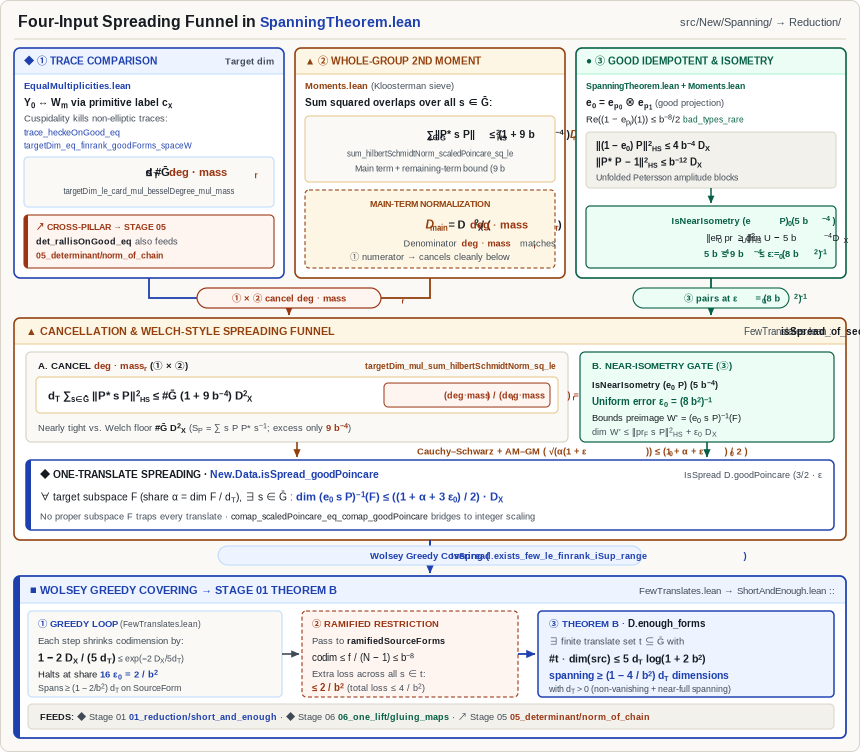
Dual cross-pillar role of Stage 04: Stage 04 does not feed only Theorem B. Its two top-level landmarks export results to three downstream stages:
04_spanning/spanning_theoremfeeds01_reduction/short_and_enough(Theorem B:D.enough_forms) and Stage 06 (06_one_lift/gluing_maps) (single-lift comparison operators in Theorem C).04_spanning/equal_multiplicitiesfeeds04_spanning/spanning_theorem(viatargetDim_eq_finrank_goodForms_spaceW) and Stage 05 (05_determinant/norm_of_chain, viadet_rallisOnGood_eq, transferring the determinant of the Rallis inner-product operator across signatures for Theorem C).
Explore Stage 04 across its three landmark essays, return to Stage 03 — Upper Bound (Theorem A) or Stage 01 — The Theorem and Its Reduction, or zoom out to the Full Proof Journey & Alpöge's 20-Step Map:
- Target Dimension, Multiplicity Equality, and One Good Translate —
EqualMultiplicitiesandSpanningTheorem: cuspidal trace comparison betweenand , Rallis determinant equality, rarity of bad polynomial types, near-isometry, Welch-style spreading ( New.Data.isSpread_goodPoincare), and the handoff to Stage 01'sD.enough_forms. - Relative-Trace Unfolding, Bessel Translates, and the Two Moment Bounds —
Moments:HasAmplitudeBlocks, the unitary Bessel translate, near- near-isometry, the whole-group second moment, why two level primes isolate the induced unipotent character mean , and full-vs-cut discrete-series Bessel vectors. - The Big-Cell Kloosterman Sieve and Remaining-Term Link Bounds —
EnergyEstimateandRemainingTerms/Sum: open reductions in the big Bruhat cell, Siegel's step, one-sided Poisson summation, transparent full statements for the 3let-type stub truncations inenergy_estimate.lean, and link-lattice counting via Bombieri–Vaaler Siegel's lemma and the weighted Schur test.
Where this analogy breaks
Describing Stage 04 as "proving that shifted copies of one subspace spread evenly across a bigger space like an almost-tight frame" captures the exact Hilbert–Schmidt Cauchy–Schwarz mechanism in SpanningTheorem.lean and FewTranslates.lean, but conceals where 85 of the 90 upstream Lean files live. The linear-algebraic spreading step itself takes only two files (FewTranslates.lean and SpanningTheorem.lean); virtually all of the analytic weight sits underneath it in proving that the unfolded Poincaré operators actually achieve
Level 2 — Undergrad Bridge
Stage 04 is the largest pillar in src/New/, spanning 90 upstream Lean files under src/New/Spanning/ organized into seven subdirectories — SecondMoment/ (3), Multiplicities/ (2), Bessel/ (12), Unfolding/ (19), RemainingTerms/ (22), MainTerm/ (10), and Frames/ (22) — together with the 9-file archimedean discrete-series supplement in src/New/Appendix/DiscreteSeries/. In dag/dag.json, the pillar condenses into 5 landmark nodes (119 declarations total; 3 let-in-type stub truncations in energy_estimate.lean) arranged in a clean two-branch DAG:
Tracing the exact quantitative chain across the five landmarks:
- Multiplicity equality (
Multiplicities/EqualMultiplicities.lean, 17 decls): For any two Hermitian spacesof rank for whose signatures D.paramWhas gapD.gap, every good label familycarries a primitive degree- polynomial at some chosen split place ( exists_isPrimitivePolynomial). Its local idempotentyields a cuspidal test function, so trace_heckeOnGood_eqequatesfor all . Consequences: equal characteristic polynomials and determinants ( charpoly_heckeOnGood_eq,det_heckeOnGood_eq), equal eigensystem multiplicities (finrank_goodForms_inf_eigenPart_eq), equal Rallis determinants (det_rallisOnGood_eq, consumed by05_determinant/norm_of_chain), and( targetDim_eq_finrank_goodForms_spaceW). - Main-term big-cell sieve (
MainTerm/EnergyEstimate.lean, 15 decls, 3 stub truncations): Open reductionsforce every rational term over to have nonvanishing proper leading frame minors ( IsOpenElement.leadingMinor_ne_zero). Siegel's step (IsFillingData.mul_sum_norm_sum_cosetAmplitude_sq_le) pairs the archimedean band-limited Bessel Gram matrix (prod_bandLimit_eq_gram) against finite-place Kloosterman densitiesG.lastEntryDensity / Y.massRatio, with the global product formula canceling intermediate head powers (gramScalar_mul_headDensity). Entry-by-entry one-sided Poisson summation (GlobalSieve.lean::sieve) and constant assembly (prod_poissonConst_eq,sieve_constant_le) provelinkSecondMoment_isOpenElement_le: - Remaining-term link-lattice bounds (
RemainingTerms/Sum.lean, 26 decls): For near pairsover an agreeing block , pairDiscriminant_sq_legainsin the common-link discriminant , while corank_le_and_pairDiscriminant_lekeeps corankand . Combining the weighted Schur test ( SchurTest.lean) with Bombieri–Vaaler Siegel's lemma (SiegelLemma.lean) crushes all cross-link andpairs to ( sum_termSize_mul_not_inSameLinkClass_lesecondMoment_remainingTerms_le), and crushes same-linkpairs over reductions with meetNorm s ≥ zto( sum_termSize_mul_inSameLinkClass_lelinkSecondMoment_le_of_le_meetNorm). - Unfolding and the two moments (
Unfolding/Moments.lean, 40 decls): UnderHasAmplitudeBlocks, the scaled Poincaré mapsatisfies: - near-
error ( sum_hilbertSchmidtNorm_sub_besselTranslate_sq_le)( hilbertSchmidtNorm_sub_one_sq_le); - whole-group second moment
( sum_hilbertSchmidtNorm_sq_le); - two-prime bad-type projection loss
( hilbertSchmidtNorm_one_sub_piTensorElem_comp_sq_le, usingsum_norm_reducedCharMean_sq_le:), yielding isNearIsometry_piTensorElem_compwith error.
- near-
- Target dimension and spreading (
SecondMoment/SpanningTheorem.lean, 21 decls): Counting principal-level forms on the definite spacegives ( targetDim_le_card_mul_besselDegree_mul_mass), so( targetDim_mul_sum_hilbertSchmidtNorm_sq_le). Combining this withisNearIsometry_e₀_comp_scaledPoincare(error) inside FewTranslates.lean::isSpread_of_second_momentyieldsNew.Data.isSpread_goodPoincare(IsSpread D.goodPoincare (3 / 2 * (8 * D.b ^ 2)⁻¹)), which Stage 01 converts into Theorem B (D.enough_forms) viaIsSpread.exists_few_le_finrank_iSup_range.
Level 3 — Formal Lean Contract
Stage 04 covers 90 upstream files under src/New/Spanning/, represented in the condensed 41-landmark DAG (dag/dag.json) by 5 extracted landmark skeletons totaling 119 declarations and 3 stub truncations, derived from pinned upstream commit 41c2716658c42ba08eb0648994a2efe83082a95c (41c2716658c4, leanprover/lean4:v4.37.0-rc1, Mathlib rev 31ce06eaadf4a200c0e1407c5f10953cf606b8f8):
| Skeleton File | Upstream Path | Declarations (Truncations) | Direct Landmark Dependencies (dag/dag.json) | Direct Landmark Consumers (dag/dag.json) | Headline Declarations |
|---|---|---|---|---|---|
04_spanning/equal_multiplicities.lean | src/New/Spanning/Multiplicities/EqualMultiplicities.lean | 17 (0) | 02_derivatives/integral_vacuum | 04_spanning/spanning_theorem, 05_determinant/norm_of_chain | New.Data.trace_heckeOnGood_eq, New.Data.charpoly_heckeOnGood_eq, New.Data.det_rallisOnGood_eq, New.Data.finrank_goodForms_inf_eigenPart_eq, New.Data.targetDim_eq_finrank_goodForms_spaceW |
04_spanning/spanning_theorem.lean | src/New/Spanning/SecondMoment/SpanningTheorem.lean | 21 (0) | 02_derivatives/integral_vacuum, 03_upper_bound/short_columns, 04_spanning/equal_multiplicities, 04_spanning/moments | 01_reduction/short_and_enough, 06_one_lift/gluing_maps | New.Data.targetDim_le_card_mul_besselDegree_mul_mass, New.Data.hasAmplitudeBlocks_scaledPoincare, New.Data.bad_types_rare, New.Data.isNearIsometry_e₀_comp_scaledPoincare, New.Data.sum_hilbertSchmidtNorm_scaledPoincare_sq_le, New.Data.isSpread_goodPoincare |
04_spanning/moments.lean | src/New/Spanning/Unfolding/Moments.lean | 40 (0) | 04_spanning/energy_estimate, 04_spanning/remaining_terms_sum | 04_spanning/spanning_theorem | New.Filling.HasAmplitudeBlocks, New.Filling.besselTranslate, New.Filling.HasAmplitudeBlocks.sum_hilbertSchmidtNorm_sub_besselTranslate_sq_le, New.Filling.HasAmplitudeBlocks.hilbertSchmidtNorm_sub_one_sq_le, New.Filling.HasAmplitudeBlocks.sum_hilbertSchmidtNorm_sq_le, New.Filling.sum_norm_reducedCharMean_sq_le, New.Filling.HasAmplitudeBlocks.hilbertSchmidtNorm_one_sub_piTensorElem_comp_sq_le, New.Filling.HasAmplitudeBlocks.isNearIsometry_piTensorElem_comp |
04_spanning/energy_estimate.lean | src/New/Spanning/MainTerm/EnergyEstimate.lean | 15 (3*) | 02_derivatives/integral_vacuum | 04_spanning/moments | New.Filling.IsOpenElement.leadingMinor_ne_zero, New.Filling.prod_poissonConst_eq, New.Filling.sieve_constant_le, New.Filling.sum_norm_sum_cosetAmplitude_sq_le, New.Filling.linkSecondMoment_isOpenElement_le |
04_spanning/remaining_terms_sum.lean | src/New/Spanning/RemainingTerms/Sum.lean | 26 (0) | (none — imports src/Lib/ and local RemainingTerms/ & Unfolding/ helpers) | 04_spanning/moments | New.Filling.IsNearPairOverAgreeingBlock.pairDiscriminant_sq_le, New.Filling.InSameLinkClass, New.Filling.sum_termSize_mul_not_inSameLinkClass_le, New.Filling.sum_termSize_mul_inSameLinkClass_le, New.Filling.secondMoment_remainingTerms_le, New.Filling.linkSecondMoment_le_of_le_meetNorm |
* Stub-truncation honesty notice (energy_estimate.lean): Three let-in-type intermediate lemmas in skeleton/04_spanning/energy_estimate.lean (New.Filling.gramScalar_mul_headDensity at L127, New.Filling.prod_bandLimit_eq_gram at L145, and New.Filling.IsFillingData.mul_sum_norm_sum_cosetAmplitude_sq_le at L180) are truncated at their first let ... := binding by rh-extract's depth-0 := splitter. Their exact full upstream statements from src/New/Spanning/MainTerm/EnergyEstimate.lean:371–510 are quoted verbatim in The Big-Cell Kloosterman Sieve and Remaining-Term Link Bounds. All 12 remaining declarations in energy_estimate.lean and all 104 declarations across the other four Stage 04 skeletons extract untruncated.
Verification status (audit/verification-status.json): Local Lean compilation and kernel replay remain build_status: unverified-locally at pinned upstream commit 41c2716658c42ba08eb0648994a2efe83082a95c (41c2716658c4, leanprover/lean4:v4.37.0-rc1, Mathlib rev 31ce06eaadf4a200c0e1407c5f10953cf606b8f8). Static token scanning currently has scan_scope: entry, covering only Challenge.lean, src/Main.lean, and src/Statements.lean (0 forbidden tokens in solution files and 5 expected sorry tokens in Challenge.lean). None of the Stage 04 proof files under src/New/Spanning/ have been locally compiled, kernel-checked, or statically scanned here; every theorem signature, dependency edge, and mathematical summary above reflects direct inspection of the pinned upstream source files and extracted skeletons.
- SpanningTheorem (landmark) —
src/New/Spanning/SecondMoment/SpanningTheorem.lean(depends on:02_derivatives/integral_vacuum,03_upper_bound/short_columns,04_spanning/equal_multiplicities,04_spanning/moments) - EqualMultiplicities (landmark) —
src/New/Spanning/Multiplicities/EqualMultiplicities.lean(depends on:02_derivatives/integral_vacuum) - Moments (landmark) —
src/New/Spanning/Unfolding/Moments.lean(depends on:04_spanning/energy_estimate,04_spanning/remaining_terms_sum) - EnergyEstimate (landmark) —
src/New/Spanning/MainTerm/EnergyEstimate.lean(depends on:02_derivatives/integral_vacuum) - Sum (landmark) —
src/New/Spanning/RemainingTerms/Sum.lean(depends on: none)
Page Glossary
- Gram determinant
- The determinant of the matrix of pairwise inner products of a family of vectors, measuring the squared volume of the parallelotope they span and controlled by Hadamard's and Fischer's inequalities.
- central idempotent
- A class-function element of a finite group algebra satisfying z² = z that acts as a G-equivariant orthogonal projection, splitting good cuspidal types from rare bad types across two level primes.
- trace comparison
- Matching traces of spherical Hecke operators between an indefinite unitary group and its definite inner form via a cuspidal local test function—proving equal eigensystem multiplicities, Rallis determinant equality, and the target-dimension bound.
- Hilbert–Schmidt norm
- The Frobenius-style root-sum-of-squares norm on linear maps whose second moment over group translates, paired with near-isometry on the good subspace, proves Welch-style spreading and Wolsey greedy covering for Theorem B.
- Bessel orbital integral
- An archimedean correlation integral ∫ β_c(y) β_{c'}(γ⁻¹ y) W(y) ⊗ W(γ⁻¹ y)* dy unfolding Petersson inner products P* ρ(s) P into class-indexed amplitude blocks.
- prime number
- A whole number greater than 1 whose only positive whole-number divisors are 1 and itself; every integer above 1 factors uniquely into a product of them.
- Kloosterman sieve
- A global entry-by-entry one-sided Poisson summation engine pairing archimedean band-limited Bessel Gram matrices with finite Kloosterman densities to bound the big-cell second moment by (1 + b⁻⁴) b⁻⁶ᵏ|S_g| D_main ν².
- link lattice
- The Hermitian sublattice shared by two rational filling terms over one reduction block, whose discriminant and Bombieri–Vaaler Siegel's lemma counts crush cross-link and non-open terms via a weighted Schur test.