Target Dimension, Multiplicity Equality, and One Good Translate
This page explains the top two landmarks of Stage 04 — src/New/Spanning/Multiplicities/EqualMultiplicities.lean (04_spanning/equal_multiplicities, 17 declarations, 0 stub truncations) and src/New/Spanning/SecondMoment/SpanningTheorem.lean (04_spanning/spanning_theorem, 21 declarations, 0 stub truncations) — together with the linear-algebraic spreading and greedy-covering engine in src/New/Spanning/SecondMoment/FewTranslates.lean and its consumption by Theorem B (New.Data.enough_forms) in Stage 01. Return to the Stage 04 Overview, or continue to Relative-Trace Unfolding & Second Moments and Kloosterman Sieve & Remaining Terms.
Level 1 — First-Principles
Before Stage 04 can prove that a few translates of the Poincaré map fill almost all of the target space D.targetForms, it faces two immediate obstacles:
- How big is the target space? The target forms live on the indefinite unitary space
. Because is indefinite, there is no simple finite-sum formula for counting directly. - How do you turn an average overlap bound into spanning? Even if you know the average overlap of translates
across the finite group , you still need to rule out a conspiracy in which every translate lands inside the same proper subspace .
EqualMultiplicities.lean solves the first obstacle, and SpanningTheorem.lean solves the second:
Step 1: Counting EqualMultiplicities.lean)
Imagine two finite-dimensional spaces
Stage 04 applies this matching of traces across spaces that share all finite primes and differ only in real signaturetrace comparison between the indefinite space
That single transfer pays two separate dividends:
- For Stage 04 (Theorem B): Taking
equates . Because is definite and the principal congruence level acts freely on , all principal-level forms on have exact dimension , immediately giving the target-dimension ceiling . - For Stage 05 (Theorem C): Realizing the Rallis inner-product series of a unitary dual-pair lift between automorphic formstheta correspondence as a spherical Hecke operator proves
det_rallisOnGood_eq—the Rallis operator has the exact same determinant on the good forms ofand , feeding directly into 05_determinant/norm_of_chain.
Step 2: Combining four inputs into one good translate (SpanningTheorem.lean)
With SpanningTheorem.lean combines four ingredients measured in root-sum-of-squares Frobenius operator normHilbert–Schmidt norm:
- Rarity of bad polynomial labels (
bad_types_rare): Each prime-factor good idempotentrejects only a tiny Plancherel share . - Good-forms near-isometry (
isNearIsometry_e₀_comp_scaledPoincare): Combiningbad_types_rarewith unfolded Petersson amplitude blocksBessel orbital integral fromMoments.leanshows thatpreserves the squared energy of every source subspace up to : . - Whole-group second moment (
sum_hilbertSchmidtNorm_scaledPoincare_sq_le): Summing squared overlaps across allgives , where . - Cancellation of
: Multiplying the target-dimension ceiling by the second-moment bound cancels identically:
By Cauchy–Schwarz, the left-hand side can never fall significantly below New.Data.isSpread_goodPoincare, with
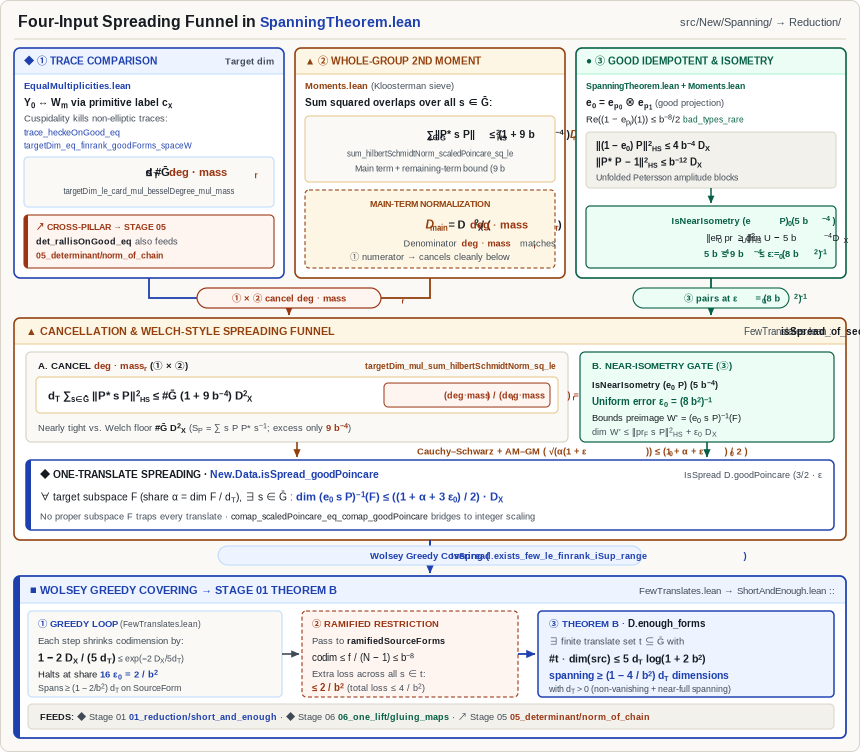
Step 3: Handoff to Stage 01 (FewTranslates.lean ShortAndEnough.lean)
Stage 04 finishes at the one-translate spreading property New.Data.isSpread_goodPoincare. In Stage 01 (01_reduction/short_and_enough.lean::New.Data.enough_forms), Wolsey's greedy covering lemma (FewTranslates.lean::New.IsSpread.exists_few_le_finrank_iSup_range) iteratively adds one good translate at a time: while more than a share D.ramifiedSourceForms, codimension
Where this analogy breaks
Comparing EqualMultiplicities.lean to equating two finite matrices by their traces and SpanningTheorem.lean to scattering subspaces near the Welch bound is structurally faithful, but omits two load-bearing hypotheses. First, trace_heckeOnGood_eq requires both the indefinite and definite signatures to satisfy (toHCParam s (D.paramW v)).HasGap D.gap at every infinite place—without that discrete-series gap, the trace comparison would fail—and requires a primitive polynomial label at a split place in D.goodTupleFamilies to force cuspidality. Second, New.Data.goodPoincare s carries the scalar #Ḡ (matching ShortAndEnough.lean's integer scaling) whereas D.scaledPoincare carries (vol J · ν)^{-1/2} (making comap_scaledPoincare_eq_comap_goodPoincare bridges the two only because nonzero scalars preserve preimage dimensions.
Level 2 — Undergrad Bridge
1. Trace comparison and Rallis determinants (EqualMultiplicities.lean, 17 declarations)
Let D.paramW satisfying HasGap D.gap for both sign tuples
- Primitive witness and label decomposition (
exists_isPrimitivePolynomial,trace_heckeOnGood_eq_sum): Everyhas a primitive degree- polynomial over at some chosen place above or . Expanding gives - Cuspidal comparison (
trace_mul_tupleIdem_eqtrace_heckeOnGood_eq): At the split placewhere is primitive, the local matrix coefficient for is supercuspidal, so New.trace_eq_of_isCuspidalAtequates each summand betweenand , yielding for every spherical Hecke operator away from . - Characteristic polynomials, determinants, and eigenspace dimensions:
- Applying
trace_heckeOnGood_eqto all powersgives equal characteristic polynomials via Newton's identities ( charpoly_heckeOnGood_eq) and equal determinants (det_heckeOnGood_eq). - Selecting an indicator operator
equal to on eigenPart V qandon all other eigensystems ( trace_heckeOnGood_eq_finrank) provesfinrank_goodForms_inf_eigenPart_eq: every joint eigensystemoccurs with the exact same multiplicity on goodForms VandgoodForms V'. - Setting
with and ( ) gives targetDim_eq_finrank_goodForms_spaceW:.
- Applying
- Rallis operator transfer for Stage 05 (
exists_heckeAlgebra_inner_eq_inner_translatedet_rallisOnGood_eq): Every off-level translateaverages over -cosets to a single spherical Hecke operator independent of ( exists_heckeAlgebra_inner_eq_inner_translate). Hence every termD.rallisTerm ϑ j W z y iof Rallis' inner-product formula is a matrix coefficient of one( exists_rallisTerm_eq_inner), and summing the series on bothand produces a single operator acting as D.rallisOperator ϑ jon both spaces (exists_heckeAlgebra_eq_mul_inner_of_hasSum_rallisTerm,exists_hecke_eq_rallisOperator). Restricting to good forms definesD.rallisOnGoodand givesNew.Data.det_rallisOnGood_eq:
2. Target dimension and Welch-style spreading (SpanningTheorem.lean, 21 declarations)
- Free principal level on
( finrank_principalForms_spaceWtargetDim_le_card_mul_besselDegree_mul_mass): On the definite space, D.chosenLevelhas trivial class stabilizers (classAut = ⊥) and indexinside the maximal compact level (whose class sum is mass D.E D.r). Each local weight space has dimension equal to the compact formal degreevia Weyl's dimension polynomial. Therefore and combining with targetDim_eq_finrank_goodForms_spaceWyields - Scaling, unfolding, and rare bad types (
scaledPoincare,hasAmplitudeBlocks_scaledPoincare,bad_types_rare): Scaling the Poincaré map byD.poincareScaleputs it into HasAmplitudeBlocks(hasAmplitudeBlocks_scaledPoincare). DefiningD.goodIdempotentAbove i() above each level prime proves bad_types_rare: eachis a central idempotent, acts as D.e₀, and. - Feeding
Moments.leanintoFewTranslates.lean:Moments.lean::isNearIsometry_piTensorElem_compgivesisNearIsometry_e₀_comp_scaledPoincare:IsNearIsometry (e₀ ∘ₗ P) (5 * b⁻⁴).Moments.lean::sum_hilbertSchmidtNorm_sq_legivessum_hilbertSchmidtNorm_scaledPoincare_sq_le:- Multiplying by
targetDim_le_card_mul_besselDegree_mul_masscancelsand gives targetDim_mul_sum_hilbertSchmidtNorm_sq_le: - Since
, both hypotheses of FewTranslates.lean::isSpread_of_second_momenthold with error. For any target subspace of share , Cauchy–Schwarz on and AM–GM ( ) yield some with ; near-isometry on the preimage forces - Transferring across nonzero scalars and
D.sourceFormCoords(comap_scaledPoincare_eq_comap_goodPoincare) provesNew.Data.isSpread_goodPoincare:IsSpread D.goodPoincare (3 / 2 * (8 * D.b ^ 2)⁻¹).
3. Exact handoff to Stage 01 (ShortAndEnough.lean::enough_forms)
In src/New/Reduction/ShortAndEnough.lean:349–392, Stage 01 invokes D.isSpread_goodPoincare.exists_few_le_finrank_iSup_range (from FewTranslates.lean:483–524) with
- First, greedy covering picks
with whose goodPoincare simages span at leastdimensions. - Second, restricting from
D.SourceFormtoD.ramifiedSourceForms(viafinrank_biSup_range_le, using codimensionfrom Stage 03's short_columns.lean) loses at mostdimensions, yielding New.Data.enough_forms:and .
Level 3 — Formal Lean Contract
The extracted skeletons skeleton/04_spanning/equal_multiplicities.lean (17 declarations, 0 truncations) and skeleton/04_spanning/spanning_theorem.lean (21 declarations, 0 truncations) mirror src/New/Spanning/Multiplicities/EqualMultiplicities.lean and src/New/Spanning/SecondMoment/SpanningTheorem.lean at pinned upstream commit 41c2716658c42ba08eb0648994a2efe83082a95c.
Headline Theorem Signatures
From skeleton/04_spanning/equal_multiplicities.lean (upstream EqualMultiplicities.lean:273–415):
theorem New.Data.trace_heckeOnGood_eq [hs : ∀ v : D.Φ, (toHCParam s (D.paramW v)).HasGap D.gap]
    [hs' : ∀ v : D.Φ, (toHCParam s' (D.paramW v)).HasGap D.gap] (T : D.heckeAlgebra) :
    trace ℂ (D.goodForms V) (D.heckeOnGood V T) =
      trace ℂ (D.goodForms V') (D.heckeOnGood V' T)

theorem New.Data.det_rallisOnGood_eq [hs : ∀ v : D.Φ, (toHCParam s (D.paramW v)).HasGap D.gap]
    [hs' : ∀ v : D.Φ, (toHCParam s' (D.paramW v)).HasGap D.gap] (ϑ : D.TameChar) (j : ℕ) :
    (D.rallisOnGood V ϑ j).det = (D.rallisOnGood V' ϑ j).det

theorem New.Data.finrank_goodForms_inf_eigenPart_eq
    [hs : ∀ v : D.Φ, (toHCParam s (D.paramW v)).HasGap D.gap]
    [hs' : ∀ v : D.Φ, (toHCParam s' (D.paramW v)).HasGap D.gap] (q : FinPlace D.E × ℕ → ℂ) :
    finrank ℂ (D.goodForms V ⊓ D.eigenPart V q : Submodule ℂ (D.principalForms V)) =
      finrank ℂ (D.goodForms V' ⊓ D.eigenPart V' q : Submodule ℂ (D.principalForms V'))

theorem New.Data.targetDim_eq_finrank_goodForms_spaceW (j : D.LiftIndex) :
    D.targetDim = finrank ℂ (D.goodForms (D.spaceW j))
From skeleton/04_spanning/spanning_theorem.lean (upstream SpanningTheorem.lean:91–359):
theorem New.Data.targetDim_le_card_mul_besselDegree_mul_mass :
    D.targetDim ≤ Nat.card D.chosenGL * D.filling.besselDegree * mass D.E D.r

theorem New.Data.bad_types_rare :
    (∀ i : Fin 2, IsCentralProj (D.goodIdempotentAbove i)) ∧
    D.levelRepresentation.asAlgebraHom (piTensorElem D.goodIdempotentAbove) =
      (D.principalRep (D.spaceY 0)).asAlgebraHom D.e₀ ∧
    ∀ i : Fin 2, ((1 - D.goodIdempotentAbove i).coeff 1).re ≤ (D.b ^ 8)⁻¹ / 2

theorem New.Data.isNearIsometry_e₀_comp_scaledPoincare :
    IsNearIsometry ((D.principalRep (D.spaceY 0)).asAlgebraHom D.e₀ ∘ₗ D.scaledPoincare)
      (5 * (D.b ^ 4)⁻¹)

theorem New.Data.sum_hilbertSchmidtNorm_scaledPoincare_sq_le [Fintype D.chosenGL] :
    ∑ s : D.chosenGL,
        hilbertSchmidtNorm (D.scaledPoincare.adjoint ∘ₗ D.principalRep (D.spaceY 0) s ∘ₗ
          D.scaledPoincare) ^ 2 ≤
      (1 + 9 / D.b ^ 4) * D.filling.mainSecondMoment

theorem New.Data.isSpread_goodPoincare : IsSpread D.goodPoincare (3 / 2 * (8 * D.b ^ 2)⁻¹)- Verification status (
audit/verification-status.json): Local Lean compilation and kernel replay remainbuild_status: unverified-locallyat pinned commit41c2716658c42ba08eb0648994a2efe83082a95c(41c2716658c4). Static token scanning hasscan_scope: entry, covering onlyChallenge.lean,src/Main.lean, andsrc/Statements.lean(0forbidden tokens in solution files,5expectedsorrytokens inChallenge.lean). NeitherEqualMultiplicities.leannorSpanningTheorem.leanhas been locally compiled, kernel-checked, or statically scanned here.
lemma New.Data.exists_isPrimitivePolynomial — Upstream source (src/New/Spanning/Multiplicities/EqualMultiplicities.lean L57-L69)
/-- A family `c` in `D.goodTupleFamilies` consists of a polynomial `c x` over the residue field of
each chosen place `x`. Above each of the primes `p₀`, `p₁` these polynomials are monic of degree
`r = card D.RowIndex`, all allowed (`New.IsAllowedPolynomial`), and one of them is primitive. In
particular, some `c x` is primitive: irreducible, with a root that generates the units of the
extension of degree `r` of the residue field. -/
lemma New.Data.exists_isPrimitivePolynomial
    {c : ∀ x : (i : Fin 2) × D.ChosenPlace i, Polynomial (ResField (D.chosenPlace x))}
    (hc : c ∈ D.goodTupleFamilies) :
    ∃ x : (i : Fin 2) × D.ChosenPlace i, IsPrimitivePolynomial (Fintype.card D.RowIndex) (c x) := by
  sorry -- [EXTRACTED_STUB upstream=src/New/Spanning/Multiplicities/EqualMultiplicities.lean:57-69 commit=41c2716658c42ba08eb0648994a2efe83082a95c body_lines=5 body_sha256=f738dcc78fc85e30ae2d45c14e9a0e5b71f1b06943a20146fd9f40cea6cc3586]
lemma New.Data.exists_heckeAlgebra_inner_eq_inner_translate — Upstream source (src/New/Spanning/Multiplicities/EqualMultiplicities.lean L71-L124)
/-- Let `γ` be a finite point of the unitary group whose component is `1` at each place
`D.chosenPlace x`. There is a spherical Hecke operator `p` away from these places with
`⟪z, p y⟫ = ⟪z, γ y⟫` for every space `W` and all forms `z`, `y` on `W` of principal level. -/
lemma New.Data.exists_heckeAlgebra_inner_eq_inner_translate {γ : Gf D.E D.RowIndex}
    (hγ : γ ∈ D.offLevelGroup) :
    ∃ p : D.heckeAlgebra, ∀ {s : D.RowIndex → ℤˣ} (W : Space D.E D.RowIndex s)
      (z y : D.principalForms W),
      inner ℂ z (p.val W y) = inner ℂ z.val (W.formRep (typeKernel D.paramW s) γ y) := by
  sorry -- [EXTRACTED_STUB upstream=src/New/Spanning/Multiplicities/EqualMultiplicities.lean:71-124 commit=41c2716658c42ba08eb0648994a2efe83082a95c body_lines=47 body_sha256=93a031438360fa4a8664fdfad9559251356084cc5aa25064b1180fda39b1cf5f]
lemma New.Data.exists_rallisTerm_eq_inner — Upstream source (src/New/Spanning/Multiplicities/EqualMultiplicities.lean L126-L147)
/-- A term `D.rallisTerm ϑ j W z y i` of Rallis' inner product formula is a vacuum coefficient of
the Weil representation times `⟪z, γ y⟫`, for a representative `γ` of `i`, over the number of
matrices modulo the modulus of the twist. It is a matrix coefficient `⟪z, p y⟫` of a spherical Hecke
operator `p` away from the level `D.M`, the same for all spaces `W`. -/
lemma New.Data.exists_rallisTerm_eq_inner (ϑ : D.TameChar) (j : ℕ)
    (i : Gf D.E D.RowIndex ⧸ localLevel D.RowIndex (D.twistModulus ϑ 1).places.conjClosureᶜ) :
    ∃ p : D.heckeAlgebra, ∀ {s : D.RowIndex → ℤˣ} (W : Space D.E D.RowIndex s)
      (z y : D.principalForms W), D.rallisTerm ϑ j W z y i = inner ℂ z (p.val W y) := by
  sorry -- [EXTRACTED_STUB upstream=src/New/Spanning/Multiplicities/EqualMultiplicities.lean:126-147 commit=41c2716658c42ba08eb0648994a2efe83082a95c body_lines=15 body_sha256=7245a33688b28ed4950711e73028872bf6856f3d497ea48df6ad1dcedb02912f]
lemma New.Data.exists_heckeAlgebra_eq_mul_inner_of_hasSum_rallisTerm — Upstream source (src/New/Spanning/Multiplicities/EqualMultiplicities.lean L151-L209)
/-- Let the doubled parameter `D.paramW` have gap `D.gap` for the signs of `V` and of `V'`: at each
infinite place its entries are distinct and have the parity of `card D.RowIndex - 1`, and entries
with different signs are at least `2 * D.gap` apart. Let `D.rallisTerm ϑ j` be the terms of Rallis'
inner product formula for the tame character `ϑ` and the descent pair `D.descentPair ϑ j`. Suppose
that for all forms `z`, `y` of principal level the series of these terms times `a` sums to `B z y`
on `V`, and times `a'` sums to `B' z y` on `V'`. Then one spherical Hecke operator `p` gives
`B z y = a ⟪z, p y⟫` on `V` and `B' z y = a' ⟪z, p y⟫` on `V'`. -/
lemma New.Data.exists_heckeAlgebra_eq_mul_inner_of_hasSum_rallisTerm
    [hs : ∀ v : D.Φ, (toHCParam s (D.paramW v)).HasGap D.gap]
    [hs' : ∀ v : D.Φ, (toHCParam s' (D.paramW v)).HasGap D.gap]
    (ϑ : D.TameChar) (j : ℕ) {a a' : ℂ}
    {B : D.principalForms V → D.principalForms V → ℂ}
    {B' : D.principalForms V' → D.principalForms V' → ℂ}
    (hB : ∀ z y : D.principalForms V, HasSum
      (fun i : Gf D.E D.RowIndex ⧸ localLevel D.RowIndex (D.twistModulus ϑ 1).places.conjClosureᶜ ↦
        a * D.rallisTerm ϑ j V z y i) (B z y))
    (hB' : ∀ z y : D.principalForms V', HasSum
      (fun i : Gf D.E D.RowIndex ⧸ localLevel D.RowIndex (D.twistModulus ϑ 1).places.conjClosureᶜ ↦
        a' * D.rallisTerm ϑ j V' z y i) (B' z y)) :
    ∃ p : D.heckeAlgebra,
      (∀ z y : D.principalForms V, B z y = a * inner ℂ z (p.val V y)) ∧
      ∀ z y : D.principalForms V', B' z y = a' * inner ℂ z (p.val V' y) := by
  sorry -- [EXTRACTED_STUB upstream=src/New/Spanning/Multiplicities/EqualMultiplicities.lean:151-209 commit=41c2716658c42ba08eb0648994a2efe83082a95c body_lines=38 body_sha256=99016bfedb46803ec01d9d3d18f29937c0decd22a8a1f901e201bd119491479a]
lemma New.Data.trace_heckeOnGood_eq_sum — Upstream source (src/New/Spanning/Multiplicities/EqualMultiplicities.lean L212-L230)
/-- Let the parameter `D.paramW` have gap `D.gap` for the signs of `V`. As `e₀` projects onto the
good forms and is the sum of the idempotents `e_c = tupleIdem D.RowIndex c` of the good families `c`
of labels, the trace of a spherical Hecke operator `T` on good forms is the sum of the traces of
`T e_c` on all forms of principal level. -/
lemma New.Data.trace_heckeOnGood_eq_sum [hs : ∀ v : D.Φ, (toHCParam s (D.paramW v)).HasGap D.gap]
    (T : D.heckeAlgebra) :
    trace ℂ (D.goodForms V) (D.heckeOnGood V T) = ∑ c ∈ D.goodTupleFamilies,
      trace ℂ (D.principalForms V)
        (T.val V * (D.principalRep V).asAlgebraHom (tupleIdem D.RowIndex c)) := by
  sorry -- [EXTRACTED_STUB upstream=src/New/Spanning/Multiplicities/EqualMultiplicities.lean:212-230 commit=41c2716658c42ba08eb0648994a2efe83082a95c body_lines=11 body_sha256=fd4956b91351b820d505e7ed3c75da3df91a0175e6ff7a44795bd39e546b995a]
lemma New.Data.trace_mul_tupleIdem_eq — Upstream source (src/New/Spanning/Multiplicities/EqualMultiplicities.lean L233-L271)
/-- Let the doubled parameter `D.paramW` have gap `D.gap` for the signs of `V` and of `V'`: at each
infinite place its entries are distinct and have the parity of `card D.RowIndex - 1`, and entries
with different signs are at least `2 * D.gap` apart. Let `c` be a good family of
labels: a polynomial `c x` of degree `r = card D.RowIndex` over the residue field of each chosen
place `x`, subject to the conditions of `D.goodTupleFamilies`. The product of the label idempotents
of the `c x` is an idempotent `e_c = tupleIdem D.RowIndex c` in the group algebra of the product of
the finite groups `GL_r`. For a spherical Hecke operator `T`, the operator `T e_c` has the same
trace on the forms of principal level of `V` and of `V'`: its test function is cuspidal at a place
`x` where the polynomial `c x` is primitive. -/
lemma New.Data.trace_mul_tupleIdem_eq [hs : ∀ v : D.Φ, (toHCParam s (D.paramW v)).HasGap D.gap]
    [hs' : ∀ v : D.Φ, (toHCParam s' (D.paramW v)).HasGap D.gap] (T : D.heckeAlgebra)
    {c : ∀ x : (i : Fin 2) × D.ChosenPlace i, Polynomial (ResField (D.chosenPlace x))}
    (hc : c ∈ D.goodTupleFamilies) :
    trace ℂ (D.principalForms V)
        (T.val V * (D.principalRep V).asAlgebraHom (tupleIdem D.RowIndex c)) =
      trace ℂ (D.principalForms V')
        (T.val V' * (D.principalRep V').asAlgebraHom (tupleIdem D.RowIndex c)) := by
  sorry -- [EXTRACTED_STUB upstream=src/New/Spanning/Multiplicities/EqualMultiplicities.lean:233-271 commit=41c2716658c42ba08eb0648994a2efe83082a95c body_lines=23 body_sha256=0d6499ad2d43a1dfd47a69cfe57ca6f4b68689ef55624c0a39d52e3be6687b72]
theorem New.Data.trace_heckeOnGood_eq — Upstream source (src/New/Spanning/Multiplicities/EqualMultiplicities.lean L273-L280)
/-- Let the parameter `D.paramW` have gap `D.gap` for the signs of `V` and of `V'`. Then a spherical
Hecke operator away from `M` has the same trace on the good forms of `V` and of `V'`. -/
theorem New.Data.trace_heckeOnGood_eq [hs : ∀ v : D.Φ, (toHCParam s (D.paramW v)).HasGap D.gap]
    [hs' : ∀ v : D.Φ, (toHCParam s' (D.paramW v)).HasGap D.gap] (T : D.heckeAlgebra) :
    trace ℂ (D.goodForms V) (D.heckeOnGood V T) =
      trace ℂ (D.goodForms V') (D.heckeOnGood V' T) := by
  sorry -- [EXTRACTED_STUB upstream=src/New/Spanning/Multiplicities/EqualMultiplicities.lean:273-280 commit=41c2716658c42ba08eb0648994a2efe83082a95c body_lines=3 body_sha256=e2c7a514fe1d3e7f679fe5b01d807f3b35945b3f898ae69be37db0562dbac14b]
theorem New.Data.charpoly_heckeOnGood_eq — Upstream source (src/New/Spanning/Multiplicities/EqualMultiplicities.lean L282-L291)
/-- Let the parameter `D.paramW` have gap `D.gap` for the signs of `V` and of `V'`. Then a spherical
Hecke operator away from `M` has the same characteristic polynomial on the good forms of `V` and of
`V'`, as the traces of all its powers agree. -/
theorem New.Data.charpoly_heckeOnGood_eq [hs : ∀ v : D.Φ, (toHCParam s (D.paramW v)).HasGap D.gap]
    [hs' : ∀ v : D.Φ, (toHCParam s' (D.paramW v)).HasGap D.gap] (T : D.heckeAlgebra) :
    (D.heckeOnGood V T).charpoly = (D.heckeOnGood V' T).charpoly := by
  sorry -- [EXTRACTED_STUB upstream=src/New/Spanning/Multiplicities/EqualMultiplicities.lean:282-291 commit=41c2716658c42ba08eb0648994a2efe83082a95c body_lines=5 body_sha256=9a4b054716fe40f9f6c893f3d966e4070129aca75395de75310d74b4707b3ed6]
theorem New.Data.det_heckeOnGood_eq — Upstream source (src/New/Spanning/Multiplicities/EqualMultiplicities.lean L293-L299)
/-- Let the parameter `D.paramW` have gap `D.gap` for the signs of `V` and of `V'`. Then a spherical
Hecke operator away from `M` has the same determinant on the good forms of `V` and of `V'`. -/
theorem New.Data.det_heckeOnGood_eq [hs : ∀ v : D.Φ, (toHCParam s (D.paramW v)).HasGap D.gap]
    [hs' : ∀ v : D.Φ, (toHCParam s' (D.paramW v)).HasGap D.gap] (T : D.heckeAlgebra) :
    (D.heckeOnGood V T).det = (D.heckeOnGood V' T).det := by
  sorry -- [EXTRACTED_STUB upstream=src/New/Spanning/Multiplicities/EqualMultiplicities.lean:293-299 commit=41c2716658c42ba08eb0648994a2efe83082a95c body_lines=3 body_sha256=45ee71a4825a241eb95ace3c651b163d67617c7f450a0bedbb00796479fde540]
theorem New.Data.exists_hecke_eq_rallisOperator — Upstream source (src/New/Spanning/Multiplicities/EqualMultiplicities.lean L301-L321)
/-- Let the parameter `D.paramW` have gap `D.gap` for the signs of `V` and of `V'`. One spherical
Hecke operator acts on the forms of principal level of both spaces as `D.rallisOperator ϑ j`, the
operator whose matrix coefficient `⟪z, R y⟫` is the series of Rallis' formula for the tame
character `ϑ` and the descent pair `D.descentPair ϑ j` without its normalisation: the sum over the
cosets `i` of `N` times `D.rallisTerm ϑ j V z y i`, where `N` is the number of matrices over the
residue ring of `D.twistModulus ϑ 1` with rows `D.Y 1` and columns `D.RowIndex`. -/
theorem New.Data.exists_hecke_eq_rallisOperator [hs : ∀ v : D.Φ, (toHCParam s (D.paramW v)).HasGap D.gap]
    [hs' : ∀ v : D.Φ, (toHCParam s' (D.paramW v)).HasGap D.gap] (ϑ : D.TameChar) (j : ℕ) :
    ∃ p : D.heckeAlgebra,
      p.val V = D.rallisOperator ϑ j V ∧ p.val V' = D.rallisOperator ϑ j V' := by
  sorry -- [EXTRACTED_STUB upstream=src/New/Spanning/Multiplicities/EqualMultiplicities.lean:301-321 commit=41c2716658c42ba08eb0648994a2efe83082a95c body_lines=12 body_sha256=e36736b9ab135335b9deb90e44e03fd43c7fe18dc7a381ac5aa16d7117179037]
def New.Data.rallisOnGood — Upstream source (src/New/Spanning/Multiplicities/EqualMultiplicities.lean L323-L331)
/-- Let the parameter `D.paramW` have gap `D.gap` for the signs of `V`. The series of Rallis'
formula (`New.Data.rallisOperator`) preserves the good forms of `V`, as it acts as a spherical Hecke
operator. This is its restriction to the good forms. -/
noncomputable def New.Data.rallisOnGood [hs : ∀ v : D.Φ, (toHCParam s (D.paramW v)).HasGap D.gap]
    (ϑ : D.TameChar) (j : ℕ) : End ℂ (D.goodForms V) := by
  sorry -- [EXTRACTED_STUB upstream=src/New/Spanning/Multiplicities/EqualMultiplicities.lean:323-331 commit=41c2716658c42ba08eb0648994a2efe83082a95c body_lines=4 body_sha256=a2a73bb28fb54b40f993325dfaafbedf5e24c45fa40cbbc8fc7160eb6f87a7bc]
lemma New.Data.coe_rallisOnGood_apply — Upstream source (src/New/Spanning/Multiplicities/EqualMultiplicities.lean L333-L336)
lemma New.Data.coe_rallisOnGood_apply [hs : ∀ v : D.Φ, (toHCParam s (D.paramW v)).HasGap D.gap]
    (ϑ : D.TameChar) (j : ℕ) (y : D.goodForms V) :
    (D.rallisOnGood V ϑ j y : D.principalForms V) = D.rallisOperator ϑ j V y := by
  sorry -- [EXTRACTED_STUB upstream=src/New/Spanning/Multiplicities/EqualMultiplicities.lean:333-336 commit=41c2716658c42ba08eb0648994a2efe83082a95c body_lines=1 body_sha256=8fd55f0f44bbc477f43ecdbab9916420f312d687b202a5a69fcfd2d701c19bde]
theorem New.Data.det_rallisOnGood_eq — Upstream source (src/New/Spanning/Multiplicities/EqualMultiplicities.lean L338-L351)
/-- Let `V`, `V'` be hermitian spaces with signs `s`, `s'`, and let the parameter `D.paramW` have
gap `D.gap` for both. Let `D.rallisOnGood V ϑ j` be the series of Rallis' formula for the tame
character `ϑ` and the descent pair `D.descentPair ϑ j`, restricted to the good forms of `V`. It has
the same determinant as the corresponding operator on the good forms of `V'`. -/
theorem New.Data.det_rallisOnGood_eq [hs : ∀ v : D.Φ, (toHCParam s (D.paramW v)).HasGap D.gap]
    [hs' : ∀ v : D.Φ, (toHCParam s' (D.paramW v)).HasGap D.gap] (ϑ : D.TameChar) (j : ℕ) :
    (D.rallisOnGood V ϑ j).det = (D.rallisOnGood V' ϑ j).det := by
  sorry -- [EXTRACTED_STUB upstream=src/New/Spanning/Multiplicities/EqualMultiplicities.lean:338-351 commit=41c2716658c42ba08eb0648994a2efe83082a95c body_lines=8 body_sha256=e75265c9b03a504d77a09e4d9928e375c8f852ee552f41c712ebe828d0c77e9d]
lemma New.Data.trace_heckeOnGood_eq_finrank — Upstream source (src/New/Spanning/Multiplicities/EqualMultiplicities.lean L354-L374)
/-- Let `V` be a hermitian space with signs `s`, such that for each `v : D.Φ` the doubled parameter
`toHCParam s (D.paramW v)` has gap `D.gap` (`HasGap`). If `T` in `D.heckeAlgebra`, a spherical Hecke
operator away from the level, is `1` on `D.eigenPart V q` and `0` on `D.eigenPart V d` for `d ≠ q`,
then its trace on the good forms is the dimension of the good forms in `D.eigenPart V q`. -/
lemma New.Data.trace_heckeOnGood_eq_finrank [hs : ∀ v : D.Φ, (toHCParam s (D.paramW v)).HasGap D.gap]
    {T : D.heckeAlgebra} {q : FinPlace D.E × ℕ → ℂ}
    (hT : ∀ d : FinPlace D.E × ℕ → ℂ, ∀ y ∈ D.eigenPart V d, T.val V y = if d = q then y else 0) :
    trace ℂ (D.goodForms V) (D.heckeOnGood V T) =
      finrank ℂ (D.goodForms V ⊓ D.eigenPart V q : Submodule ℂ (D.principalForms V)) := by
  sorry -- [EXTRACTED_STUB upstream=src/New/Spanning/Multiplicities/EqualMultiplicities.lean:354-374 commit=41c2716658c42ba08eb0648994a2efe83082a95c body_lines=13 body_sha256=4c6fb4f853cb3824fce4fa832ff9e14b5ac4c59c79f6daf81ad675e2a5e5cce5]
theorem New.Data.finrank_goodForms_inf_eigenPart_eq — Upstream source (src/New/Spanning/Multiplicities/EqualMultiplicities.lean L376-L401)
/-- Let `V`, `V'` be hermitian spaces with signs `s`, `s'`, which may differ, and let the parameter
`D.paramW` have gap `D.gap` for both. For each eigensystem `q`, the good forms with eigensystem `q`
on `V` and on `V'` make up spaces of the same dimension. -/
theorem New.Data.finrank_goodForms_inf_eigenPart_eq
    [hs : ∀ v : D.Φ, (toHCParam s (D.paramW v)).HasGap D.gap]
    [hs' : ∀ v : D.Φ, (toHCParam s' (D.paramW v)).HasGap D.gap] (q : FinPlace D.E × ℕ → ℂ) :
    finrank ℂ (D.goodForms V ⊓ D.eigenPart V q : Submodule ℂ (D.principalForms V)) =
      finrank ℂ (D.goodForms V' ⊓ D.eigenPart V' q : Submodule ℂ (D.principalForms V')) := by
  sorry -- [EXTRACTED_STUB upstream=src/New/Spanning/Multiplicities/EqualMultiplicities.lean:376-401 commit=41c2716658c42ba08eb0648994a2efe83082a95c body_lines=19 body_sha256=42c402b64bb477a7ac4043b11447ef276d65c90eed60c9f96429b9da5dc7141d]
lemma New.Data.goodForms_inf_eigenPart_eq_bot_of_eq_bot — Upstream source (src/New/Spanning/Multiplicities/EqualMultiplicities.lean L403-L409)
/-- Let the parameter `D.paramW` have gap `D.gap` for the signs of `V` and of `V'`. An eigensystem
`q` that does not occur in the good forms of `V'` does not occur in those of `V`. -/
lemma New.Data.goodForms_inf_eigenPart_eq_bot_of_eq_bot
    [hs : ∀ v : D.Φ, (toHCParam s (D.paramW v)).HasGap D.gap]
    [hs' : ∀ v : D.Φ, (toHCParam s' (D.paramW v)).HasGap D.gap] {q : FinPlace D.E × ℕ → ℂ}
    (h_bot : D.goodForms V' ⊓ D.eigenPart V' q = ⊥) : D.goodForms V ⊓ D.eigenPart V q = ⊥ := by
  sorry -- [EXTRACTED_STUB upstream=src/New/Spanning/Multiplicities/EqualMultiplicities.lean:403-409 commit=41c2716658c42ba08eb0648994a2efe83082a95c body_lines=2 body_sha256=34fe053b8df5dffe7322ec2077ae0a48d595bc0c117f5105452a39f49fc2d149]
theorem New.Data.targetDim_eq_finrank_goodForms_spaceW — Upstream source (src/New/Spanning/Multiplicities/EqualMultiplicities.lean L411-L415)
/-- For `1 ≤ j ≤ m` the good forms on `W_j = D.spaceW j` have dimension `D.targetDim`, which is the
dimension of the good forms on `Y_0 = D.spaceY 0`: the identity has the same trace on both. -/
theorem New.Data.targetDim_eq_finrank_goodForms_spaceW (j : D.LiftIndex) :
    D.targetDim = finrank ℂ (D.goodForms (D.spaceW j)) := by
  sorry -- [EXTRACTED_STUB upstream=src/New/Spanning/Multiplicities/EqualMultiplicities.lean:411-415 commit=41c2716658c42ba08eb0648994a2efe83082a95c body_lines=2 body_sha256=c60af54844d3c4a4271f1395acd9d7d743dbbaffe646918167a1bf699a789c67]
lemma New.Data.finrank_principalForms_spaceW — Upstream source (src/New/Spanning/SecondMoment/SpanningTheorem.lean L62-L89)
/-- The forms of principal level on the definite space `D.spaceW D.m`, where the level is free, have
dimension `#Ḡ · deg · mass_r`, where `Ḡ = D.chosenGL`, `deg = D.filling.besselDegree` and
`mass_r = mass D.E D.r`. -/
lemma New.Data.finrank_principalForms_spaceW :
    (Module.finrank ℂ (D.principalForms (D.spaceW D.m)) : ℝ) =
      Nat.card D.chosenGL * D.filling.besselDegree * mass D.E D.r := by
  sorry -- [EXTRACTED_STUB upstream=src/New/Spanning/SecondMoment/SpanningTheorem.lean:62-89 commit=41c2716658c42ba08eb0648994a2efe83082a95c body_lines=23 body_sha256=8176f7a0055eddf9d3e13ca08b045cda6a3542bf64b6810d7fb86238222ff295]
theorem New.Data.targetDim_le_card_mul_besselDegree_mul_mass — Upstream source (src/New/Spanning/SecondMoment/SpanningTheorem.lean L91-L102)
/-- **Dimension of the target.** For admissible data `D`, the dimension `D.targetDim` of the space
of good forms on `Y₀` is at most `#Ḡ · deg · mass_r`. -/
theorem New.Data.targetDim_le_card_mul_besselDegree_mul_mass :
    D.targetDim ≤ Nat.card D.chosenGL * D.filling.besselDegree * mass D.E D.r := by
  sorry -- [EXTRACTED_STUB upstream=src/New/Spanning/SecondMoment/SpanningTheorem.lean:91-102 commit=41c2716658c42ba08eb0648994a2efe83082a95c body_lines=9 body_sha256=31db0ddda7dd7fb7458283b6161c4c112d034926657fe77fee4ba2fc5b31e37b]
def New.Data.goodPoincare — Upstream source (src/New/Spanning/SecondMoment/SpanningTheorem.lean L112-L116)
/-- The map `#Ḡ · e₀ s P` from all source forms to the target forms. Here `Ḡ = D.chosenGL`, the map
`P = D.poincare` is the unscaled Poincaré map and `e₀ = D.e₀` projects onto the good forms. As `e₀`
is central, it is the translate by `s` of `#Ḡ · e₀ P`. -/
noncomputable def New.Data.goodPoincare (s : D.chosenGL) : D.SourceForm →ₗ[ℂ] D.targetForms := by
  sorry -- [EXTRACTED_STUB upstream=src/New/Spanning/SecondMoment/SpanningTheorem.lean:112-116 commit=41c2716658c42ba08eb0648994a2efe83082a95c body_lines=1 body_sha256=90c0a8aa233e1d70407dcbf62f5f7b5e99029acbc99b198b832cd5254da81afa]
def New.Data.levelRepresentation — Upstream source (src/New/Spanning/SecondMoment/SpanningTheorem.lean L118-L122)
/-- The action of the finite group `Ḡ` on the forms of principal level, with the chosen places
sorted by the level prime below them. -/
noncomputable def New.Data.levelRepresentation :
    Representation ℂ D.filling.ResidueGL (D.principalForms (D.spaceY 0)) := by
  sorry -- [EXTRACTED_STUB upstream=src/New/Spanning/SecondMoment/SpanningTheorem.lean:118-122 commit=41c2716658c42ba08eb0648994a2efe83082a95c body_lines=1 body_sha256=05596b7f0d74ea157ff504aa12449ad555ec44d7c04c6e866f26f4eb498c1eec]
lemma New.Data.levelRepresentation_apply — Upstream source (src/New/Spanning/SecondMoment/SpanningTheorem.lean L124-L129)
/-- The representation `D.levelRepresentation` sends an element `s` of `D.filling.ResidueGL`, the
finite group with the chosen places sorted by the level prime below them, to the action under
`D.principalRep (D.spaceY 0)` of its uncurried form `Sigma.uncurry s`. -/
lemma New.Data.levelRepresentation_apply (s : D.filling.ResidueGL) :
    D.levelRepresentation s = D.principalRep (D.spaceY 0) (Sigma.uncurry s) := by
  sorry -- [EXTRACTED_STUB upstream=src/New/Spanning/SecondMoment/SpanningTheorem.lean:124-129 commit=41c2716658c42ba08eb0648994a2efe83082a95c body_lines=1 body_sha256=8fd55f0f44bbc477f43ecdbab9916420f312d687b202a5a69fcfd2d701c19bde]
lemma New.Data.inner_levelRepresentation — Upstream source (src/New/Spanning/SecondMoment/SpanningTheorem.lean L131-L134)
/-- The representation `D.levelRepresentation` is unitary. -/
lemma New.Data.inner_levelRepresentation (s : D.filling.ResidueGL) (x y : D.principalForms (D.spaceY 0)) :
    inner ℂ (D.levelRepresentation s x) (D.levelRepresentation s y) = inner ℂ x y := by
  sorry -- [EXTRACTED_STUB upstream=src/New/Spanning/SecondMoment/SpanningTheorem.lean:131-134 commit=41c2716658c42ba08eb0648994a2efe83082a95c body_lines=1 body_sha256=a37f126932e56e3a46d7b282df1f107f28ede3db410fc436969e3238951d3296]
def New.Data.poincareScale — Upstream source (src/New/Spanning/SecondMoment/SpanningTheorem.lean L136-L139)
/-- The factor `(vol J · ν) ^ (-1/2)` that makes the Poincaré map almost an isometry. Here `J` is
the principal level and `ν` the covolume of its unipotent points. -/
noncomputable def New.Data.poincareScale : ℝ := by
  sorry -- [EXTRACTED_STUB upstream=src/New/Spanning/SecondMoment/SpanningTheorem.lean:136-139 commit=41c2716658c42ba08eb0648994a2efe83082a95c body_lines=1 body_sha256=ac29a0e4cb873bc73d7b99627cf127d84435d5a23e222b4b097c4c8c3262b86b]
lemma New.Data.poincareScale_pos — Upstream source (src/New/Spanning/SecondMoment/SpanningTheorem.lean L141-L144)
/-- The scale of the Poincaré map is positive, as the principal level has positive volume. -/
lemma New.Data.poincareScale_pos : 0 < D.poincareScale := by
  sorry -- [EXTRACTED_STUB upstream=src/New/Spanning/SecondMoment/SpanningTheorem.lean:141-144 commit=41c2716658c42ba08eb0648994a2efe83082a95c body_lines=2 body_sha256=1e69d376c4fe27bd23eaca4a8efc3ad0dd997d5f3128ad31fa8431bfa9d051b3]
def New.Data.scaledPoincare — Upstream source (src/New/Spanning/SecondMoment/SpanningTheorem.lean L146-L151)
/-- The Poincaré map times `D.poincareScale`, in the coordinates `D.sourceFormCoords` of the source
forms, whose standard inner product serves as the inner product of the source. -/
noncomputable def New.Data.scaledPoincare :
    EuclideanSpace ℂ (D.filling.Classes × D.filling.BesselCoord) →ₗ[ℂ]
      D.principalForms (D.spaceY 0) := by
  sorry -- [EXTRACTED_STUB upstream=src/New/Spanning/SecondMoment/SpanningTheorem.lean:146-151 commit=41c2716658c42ba08eb0648994a2efe83082a95c body_lines=1 body_sha256=0511322837fb737d711e2fb182860d59f5b0db719450112f7decf5dcae036df6]
theorem New.Data.hasAmplitudeBlocks_scaledPoincare — Upstream source (src/New/Spanning/SecondMoment/SpanningTheorem.lean L153-L173)
/-- **Unfolding.** Let `S = D.filling` and let `P = D.scaledPoincare` be the scaled Poincaré map.
Let `s` lie in `S.ResidueGL`, the product of the general linear groups over the residue fields at
the chosen places above each of the two level primes. For classes `c, c'` and Bessel coordinates
`i, j`, with basis vectors `e` of the source, `⟪s P e_(c', j), P e_(c, i)⟫ = ν⁻¹ ∑_γ A_γ(i, j)`. The
sum is over the rational `γ` such that `h_c⁻¹ γ h_c'` is integral with reduction `s` (`S.termsOver`,
where `h_c = S.classRep c`). The amplitude `A_γ = S.amplitude .full c c' γ` is an integral over the
infinite places of `W(y) ⊗ W(γ⁻¹ y)^*` against cutoffs, where `.full` selects the Bessel function
`W` itself and not its cut. The explicit number `ν = S.unipotentCovolume` is the covolume, the same
for all `c`, of the group `S.classUnipotent c` of rational unipotent points in the real unipotent
group. -/
theorem New.Data.hasAmplitudeBlocks_scaledPoincare :
    D.filling.HasAmplitudeBlocks D.levelRepresentation D.scaledPoincare := by
  sorry -- [EXTRACTED_STUB upstream=src/New/Spanning/SecondMoment/SpanningTheorem.lean:153-173 commit=41c2716658c42ba08eb0648994a2efe83082a95c body_lines=10 body_sha256=9a36517473b1fd064729189ddca831fcd450ed676504d1b63eb959a7508f5151]
def New.Data.goodIdempotentAbove — Upstream source (src/New/Spanning/SecondMoment/SpanningTheorem.lean L176-L182)
/-- The idempotent `e_{p_i}` for the level prime `p_i = D.levelPrime i`: the sum of the
`⊗_w e_{c_w}` over the tuples `c` of allowed polynomials of degree `r` at the chosen places above
`p_i` that have a primitive member. -/
noncomputable def New.Data.goodIdempotentAbove (i : Fin 2) :
    MonoidAlgebra ℂ (∀ w : D.filling.chosenPlaces i, GL D.RowIndex (ResField w.val)) := by
  sorry -- [EXTRACTED_STUB upstream=src/New/Spanning/SecondMoment/SpanningTheorem.lean:176-182 commit=41c2716658c42ba08eb0648994a2efe83082a95c body_lines=2 body_sha256=2532b54684a762d9c28eaa009959bdd7877022a546308234b3d3be93c098a284]
lemma New.Data.isCentralProj_goodIdempotentAbove — Upstream source (src/New/Spanning/SecondMoment/SpanningTheorem.lean L184-L188)
/-- The element `e_{p_i} = D.goodIdempotentAbove i` is a central idempotent of the group algebra at
the level prime `p_i`. -/
lemma New.Data.isCentralProj_goodIdempotentAbove (i : Fin 2) : IsCentralProj (D.goodIdempotentAbove i) := by
  sorry -- [EXTRACTED_STUB upstream=src/New/Spanning/SecondMoment/SpanningTheorem.lean:184-188 commit=41c2716658c42ba08eb0648994a2efe83082a95c body_lines=3 body_sha256=6097eefa175b6412dec3ad2a3df7b17a2bc9d7ab8967ca94f94272df7041171f]
lemma New.Data.levelRepresentation_goodIdempotentAbove_eq — Upstream source (src/New/Spanning/SecondMoment/SpanningTheorem.lean L190-L211)
/-- The tensor product of the two idempotents `D.goodIdempotentAbove i` acts through
`D.levelRepresentation` as the projector `D.e₀` onto the good forms. -/
lemma New.Data.levelRepresentation_goodIdempotentAbove_eq :
    D.levelRepresentation.asAlgebraHom (piTensorElem D.goodIdempotentAbove) =
      (D.principalRep (D.spaceY 0)).asAlgebraHom D.e₀ := by
  sorry -- [EXTRACTED_STUB upstream=src/New/Spanning/SecondMoment/SpanningTheorem.lean:190-211 commit=41c2716658c42ba08eb0648994a2efe83082a95c body_lines=18 body_sha256=4255641618e871783cfc72e749ba58e81c2243196cfcbc6cb20ed6646b51cf99]
lemma New.Data.re_coeff_one_sub_goodIdempotentAbove_le — Upstream source (src/New/Spanning/SecondMoment/SpanningTheorem.lean L213-L232)
/-- The share of the bad types, those that the idempotent `e_{p_i} = D.goodIdempotentAbove i` kills,
is small at the level prime `p_i = D.levelPrime i`: the coefficient of `1 - e_{p_i}` at the identity
has real part at most `b⁻⁸ / 2`, where `b = D.b` is the weight at the places `D.bPlaces`. -/
lemma New.Data.re_coeff_one_sub_goodIdempotentAbove_le (i : Fin 2) :
    ((1 - D.goodIdempotentAbove i).coeff 1).re ≤ (D.b ^ 8)⁻¹ / 2 := by
  sorry -- [EXTRACTED_STUB upstream=src/New/Spanning/SecondMoment/SpanningTheorem.lean:213-232 commit=41c2716658c42ba08eb0648994a2efe83082a95c body_lines=16 body_sha256=1529b0d9b1aac430c55a26cbb011a750e6598a5d3bfa89dce4e77392a2db48d3]
theorem New.Data.bad_types_rare — Upstream source (src/New/Spanning/SecondMoment/SpanningTheorem.lean L234-L245)
/-- **Bad types are rare.** The two elements `e_{p_i} = D.goodIdempotentAbove i` of the group
algebras at the level primes `p_i` are central idempotents. Their tensor product
`piTensorElem D.goodIdempotentAbove` acts through `D.levelRepresentation` as the projector `D.e₀`
onto the good forms. The share of the bad types, those that `e_{p_i}` kills, is small: the
coefficient of `1 - e_{p_i}` at the identity has real part at most `b⁻⁸ / 2`, where `b = D.b`. -/
theorem New.Data.bad_types_rare :
    (∀ i : Fin 2, IsCentralProj (D.goodIdempotentAbove i)) ∧
    D.levelRepresentation.asAlgebraHom (piTensorElem D.goodIdempotentAbove) =
      (D.principalRep (D.spaceY 0)).asAlgebraHom D.e₀ ∧
    ∀ i : Fin 2, ((1 - D.goodIdempotentAbove i).coeff 1).re ≤ (D.b ^ 8)⁻¹ / 2 := by
  sorry -- [EXTRACTED_STUB upstream=src/New/Spanning/SecondMoment/SpanningTheorem.lean:234-245 commit=41c2716658c42ba08eb0648994a2efe83082a95c body_lines=2 body_sha256=d9f41312a290225a02b08ce997b8c9b91d52f3a5e90b6938e48f17581e6408eb]
theorem New.Data.isNearIsometry_e₀_comp_scaledPoincare — Upstream source (src/New/Spanning/SecondMoment/SpanningTheorem.lean L247-L259)
/-- **Good forms.** The composite `e₀ P` of the scaled Poincaré map `P = D.scaledPoincare` with the
projector `e₀ = D.e₀` onto the good forms on `Y₀` is almost an isometry in mean square
(`IsNearIsometry`): `‖e₀ P pr_U‖² ≥ dim U - 5 b⁻⁴ D_X` for every subspace `U` of the source. Here
`‖·‖` is the Hilbert–Schmidt norm, `pr_U` the orthogonal projection onto `U`, `b = D.b`, and `D_X`
is the dimension of the source. -/
theorem New.Data.isNearIsometry_e₀_comp_scaledPoincare :
    IsNearIsometry ((D.principalRep (D.spaceY 0)).asAlgebraHom D.e₀ ∘ₗ D.scaledPoincare)
      (5 * (D.b ^ 4)⁻¹) := by
  sorry -- [EXTRACTED_STUB upstream=src/New/Spanning/SecondMoment/SpanningTheorem.lean:247-259 commit=41c2716658c42ba08eb0648994a2efe83082a95c body_lines=6 body_sha256=ca24fdea94ef6c1f242774fcdb2ba9ce3f730e20e2c39e32446fd7129fc7c783]
theorem New.Data.sum_hilbertSchmidtNorm_scaledPoincare_sq_le — Upstream source (src/New/Spanning/SecondMoment/SpanningTheorem.lean L261-L276)
/-- **Second moment.** For the scaled Poincaré map `P = D.scaledPoincare`, the sum over `s` in
`Ḡ = D.chosenGL` of the squared Hilbert–Schmidt norm `hilbertSchmidtNorm` of `P* s P` is at most
`1 + 9 b⁻⁴` times `D.filling.mainSecondMoment = D_X² / (deg · mass_r)`, where `D_X` is the dimension
of the source. -/
theorem New.Data.sum_hilbertSchmidtNorm_scaledPoincare_sq_le [Fintype D.chosenGL] :
    ∑ s : D.chosenGL,
        hilbertSchmidtNorm (D.scaledPoincare.adjoint ∘ₗ D.principalRep (D.spaceY 0) s ∘ₗ
          D.scaledPoincare) ^ 2 ≤
      (1 + 9 / D.b ^ 4) * D.filling.mainSecondMoment := by
  sorry -- [EXTRACTED_STUB upstream=src/New/Spanning/SecondMoment/SpanningTheorem.lean:261-276 commit=41c2716658c42ba08eb0648994a2efe83082a95c body_lines=8 body_sha256=7831b805982044ba2ea62fac0567986c480e11de56c059ca341e0c375a29a2d8]
lemma New.Data.targetDim_mul_sum_hilbertSchmidtNorm_sq_le — Upstream source (src/New/Spanning/SecondMoment/SpanningTheorem.lean L278-L298)
/-- The second moment with the bound for the dimension of the target: `D.targetDim` times the sum
over `s` in `D.chosenGL` of `‖L* s L‖²` is at most
`#D.chosenGL (1 + 9 / D.b ^ 4) D.filling.sourceDim²`. Here `L = D.scaledPoincare` is the Poincaré
map times `D.poincareScale`, and `L*` is its adjoint. `‖·‖` is the Hilbert–Schmidt norm, `D.b` is
the scale `b` of the data, and `D.filling.sourceDim` is the dimension of the source. -/
lemma New.Data.targetDim_mul_sum_hilbertSchmidtNorm_sq_le [Fintype D.chosenGL] :
    D.targetDim * ∑ s : D.chosenGL,
        hilbertSchmidtNorm (D.scaledPoincare.adjoint ∘ₗ D.principalRep (D.spaceY 0) s ∘ₗ
          D.scaledPoincare) ^ 2 ≤
      card D.chosenGL * ((1 + 9 / D.b ^ 4) * D.filling.sourceDim ^ 2) := by
  sorry -- [EXTRACTED_STUB upstream=src/New/Spanning/SecondMoment/SpanningTheorem.lean:278-298 commit=41c2716658c42ba08eb0648994a2efe83082a95c body_lines=12 body_sha256=686c2d0499b383dfdcf08beb6c00214f8700658a429337c6de56d4204bdee437]
lemma New.Data.finrank_targetForms_ne_zero — Upstream source (src/New/Spanning/SecondMoment/SpanningTheorem.lean L300-L303)
/-- The target is not zero, as the almost isometry `e₀ P` from the source has a range of positive
dimension. -/
lemma New.Data.finrank_targetForms_ne_zero : finrank ℂ D.targetForms ≠ 0 := by
  sorry -- [EXTRACTED_STUB upstream=src/New/Spanning/SecondMoment/SpanningTheorem.lean:300-303 commit=41c2716658c42ba08eb0648994a2efe83082a95c body_lines=1 body_sha256=1c84c467b5e5b68296c2505d83d7ae65cf7aee1933ac9db010fc9af2fc5bb879]
lemma New.Data.comap_scaledPoincare_eq_comap_goodPoincare — Upstream source (src/New/Spanning/SecondMoment/SpanningTheorem.lean L305-L325)
/-- Let `s` lie in the finite group `D.chosenGL`, let `e₀ = D.e₀` be the projector onto the target
forms and let `P = D.scaledPoincare` be the scaled Poincaré map. A space `F` of target forms has the
same preimage under `e₀ s P` as under `D.goodPoincare s` read in the coordinates
`D.sourceFormCoords` of the source: the two maps differ only by nonzero factors. -/
lemma New.Data.comap_scaledPoincare_eq_comap_goodPoincare (s : D.chosenGL) (F : Submodule ℂ D.targetForms) :
    F.comap (((D.principalRep (D.spaceY 0)).asAlgebraHom D.e₀).rangeRestrict ∘ₗ
        D.principalRep (D.spaceY 0) s ∘ₗ D.scaledPoincare) =
      (F.comap (D.goodPoincare s)).comap D.sourceFormCoords.symm.toLinearMap := by
  sorry -- [EXTRACTED_STUB upstream=src/New/Spanning/SecondMoment/SpanningTheorem.lean:305-325 commit=41c2716658c42ba08eb0648994a2efe83082a95c body_lines=14 body_sha256=f59fedbbf546937866d14320af5e95a75525a7e5dcabbb0cd594937afba1ecfd]
theorem New.Data.isSpread_goodPoincare — Upstream source (src/New/Spanning/SecondMoment/SpanningTheorem.lean L327-L359)
/-- **One translate.** For `s` in the finite group `Ḡ = D.chosenGL`, the map `D.goodPoincare s` is
`#Ḡ · e₀ s Π`: the unscaled Poincaré map `Π = D.poincare` from the source forms `D.SourceForm` to
the forms on `Y₀`, then the translation by `s`, then the projector `e₀ = D.e₀` onto the target
forms. These maps spread (`IsSpread`): for every space `F` of target forms, with share `α` of the
dimension of the target, the preimage of `F` under one of them has dimension at most
`(1 + α + 3 ε₀) / 2 · D_X`, where `ε₀ = b⁻² / 8`. Here `b = D.b` is the weight at the places
`D.bPlaces`, and `D_X` is the dimension of `D.SourceForm`. -/
theorem New.Data.isSpread_goodPoincare : IsSpread D.goodPoincare (3 / 2 * (8 * D.b ^ 2)⁻¹) := by
  sorry -- [EXTRACTED_STUB upstream=src/New/Spanning/SecondMoment/SpanningTheorem.lean:327-359 commit=41c2716658c42ba08eb0648994a2efe83082a95c body_lines=26 body_sha256=af0fb7810d379fd82e20ac4ced3abb6d23a04dd111d7df57e41007f4b0ca3cf3]
Page Glossary
- trace comparison
- Matching traces of spherical Hecke operators between an indefinite unitary group and its definite inner form via a cuspidal local test function—proving equal eigensystem multiplicities, Rallis determinant equality, and the target-dimension bound.
- central idempotent
- A class-function element of a finite group algebra satisfying z² = z that acts as a G-equivariant orthogonal projection, splitting good cuspidal types from rare bad types across two level primes.
- Hecke operator
- An averaging operator that sums values of an automorphic form over neighboring sublattices—indexed by cosets of a parahoric subgroup—which Stage 03 scales by powers of a prime to eliminate collision losses in the composite theta lift.
- theta correspondence
- An integral transform built from a two-variable theta kernel that carries automorphic forms from one unitary group to another, iterated along a ladder of Hermitian spaces and packaged via admissible chain data.
- Hilbert–Schmidt norm
- The Frobenius-style root-sum-of-squares norm on linear maps whose second moment over group translates, paired with near-isometry on the good subspace, proves Welch-style spreading and Wolsey greedy covering for Theorem B.
- Bessel orbital integral
- An archimedean correlation integral ∫ β_c(y) β_{c'}(γ⁻¹ y) W(y) ⊗ W(γ⁻¹ y)* dy unfolding Petersson inner products P* ρ(s) P into class-indexed amplitude blocks.
- tight frame
- A balanced, possibly overcomplete family of vectors with integer multiplicities whose projections reconstruct the exact standard inner product—allowing integral root-of-unity spokes to pull back one-dimensional elliptic theta sections into high-dimensional integral theta functions.
- Weyl gauge
- The p-adic coordinate norm of an algebraic modular form measured in the g-twisted Weyl lattice, paired with Galois-conjugate archimedean bounds to define B-short spanning sets and ramified source forms.