The Main Inequality & Theorems A and B
This page explains how New.star_inequality (src/New/Reduction/MainInequality.lean) turns three structural inputs—shortness and small index (Theorem A), near-full-rank spanning (Theorem B), and a lower bound on integral lifts (Theorem C, supplied by Stages 05–07)—into an upper bound on the weighted prime-sum remainder D.totalRemainder, and how ShortAndEnough.lean and PrimeSums.lean assemble the upper-bound half of that comparison. Return to the Stage 01 Overview, see Landau's Lemma & the One-Sided Criterion for how this bound rules out off-line zeros, and continue to Twisted Lattices & A Twist for Each Prime for the lattice-and-height engine behind Theorem C.
Level 1 — First-Principles
Imagine stacking
- A ceiling (upper bound): each crate is individually small, so by multiplying their individual sizes you get an upper bound on the total volume they enclose. Moreover, whenever a weighted sum over indivisible whole numbers greater than
prime number drifts too far upward, the crates shrink even faster—lowering the ceiling by an extra penalty proportional to that drift. - A floor (lower bound): because the crates nearly align with an integer grid, geometry forbids squashing them flat. As long as your
crates fill a substantial fraction of the warehouse's directions, their total volume (after paying a small fee for how far they miss the exact grid) cannot fall below a fixed geometric floor.
Crucially, the ceiling and the floor share the exact same gigantic baseline term—called the main amount. When you place the floor beneath the ceiling, that enormous baseline cancels out completely. What remains is a direct inequality: the upward drift of the prime-sum remainder cannot exceed the sum of the small approximation errors. Plugging that one-sided upper bound into the positivity test that forbids a pole-free series with nonnegative weights from having zeros to the right of
Building the ceiling requires solving two distinct engineering problems at once (Theorems A and B):
- Making the crates short without breaking integrality (Theorem A). Raw vectors built from source data carry huge extra divisibility at small primes, but they are initially too large in ordinary length. Multiplying every vector by a carefully engineered rational rescaling factor
trades that extra prime-power divisibility for smaller Euclidean size—like exchanging heavy coins for lighter bills of the same value. The trade is exact up to a small rounding fee (an "index loss") tracked inside a grid structure that monitors divisibility across many auxiliary versions of the space at oncetwisted lattice. Once each vector is short, the squared -dimensional volume of a family of vectors, bounded above by the product of their squared lengthsGram determinant obeys an explicit ceiling per dimension. - Preventing dimensional collapse (Theorem B). Having millions of short vectors does no good if they all lie inside one narrow plane; the floor only kicks in when you span nearly the entire warehouse. Theorem B proves that only a modest number of group translates suffices to sweep out at least
independent directions of the target space. Because the number of translates stays small, the per-translate index fee stays tiny compared to the signal, while guarantees you can safely divide both sides of the volume comparison by .
Finally, how does this geometric inequality see the prime sums used in the companion positivity-reduction page? Each vector's prime-power divisibility is governed by the step weight putting
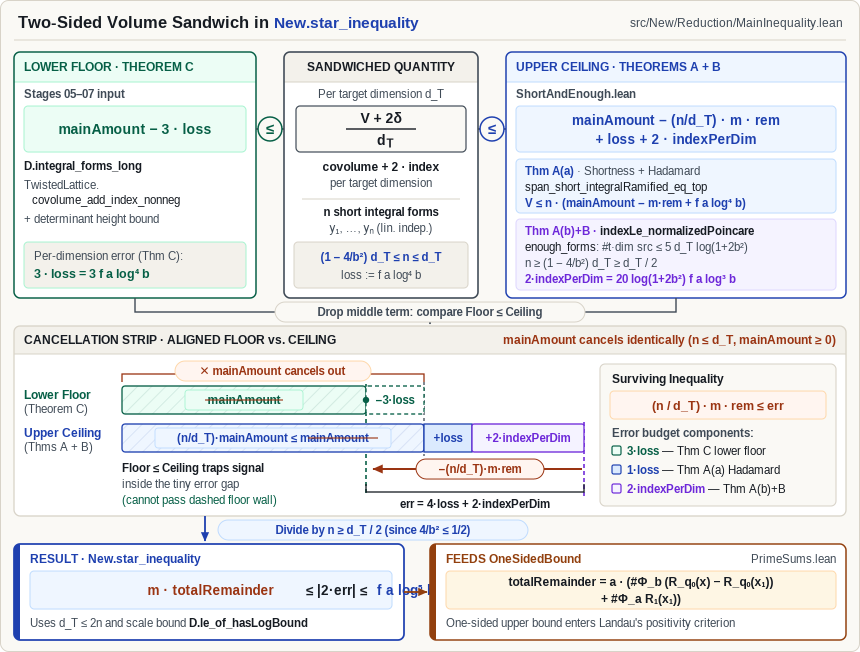
Where this analogy breaks
A single warehouse with ordinary real coordinates hides three features that make the formal proof work. First, the vectors live in vector spaces over the two-dimensional system of real and imaginary coordinatescomplex plane, and the upper bound on each vector's length must hold simultaneously under every field automorphism integral_forms_long) is not proved inside Stage 01: Stage 01 constructs the abstract twisted lattice machinery (see the companion page on prime-by-prime twists) and executes the comparison in New.star_inequality, while Stages 05–07 supply the determinant and height estimates that prove Theorem C.
Level 2 — Undergrad Bridge
1. The two-sided sandwich in New.star_inequality
Fix parameters src/New/Reduction/MainInequality.lean:99-101):
where
The proof of New.star_inequality (D.m * D.totalRemainder ≤ D.f * D.a * D.logB ^ 5) runs in five steps:
Select a spanning basis of short integral images. By Theorem B (
D.enough_forms),and there is a finite set with where
. By Theorem A (a) ( D.span_short_integralRamified_eq_top), the subsetof integral ramified source forms satisfying for all and spans . Taking a basis of produces linearly independent vectors with . Upper bound on covolume (Hadamard). Each
has for every , so TwistedLattice.covolumeLe_of_normSqAt_legivesUpper bound on index (Theorems A (b) + B). Since each
lies in for some , Theorem A (b) ( D.indexLe_normalizedPoincare) yields an index bound of. Combining this with Theorem B's bound on gives Comparison against Theorem C (Stage 05–07 input) and cancellation of
mainAmount. Applying Theorem C (D.integral_forms_long, proved in Stages 05–07 from the twisted-lattice product formulaTwistedLattice.covolume_add_index_nonnegand the determinant height boundheightLe_chainDeterminant_one_div) to the familyproduces the lower bound Because
( D.mainAmount_nonneg),, and , we have Substituting
cancels cleanly from both sides and leaves The three per-dimension error terms contributing to
are: Source Theorem Per-dimension amount Archimedean size Theorem A (a) Doubled index Theorems A (b) & B Covolume lower bound Theorem C (Stages 05–07) Division by
. From the scale bounds, , so Theorem B implies Since
, we have . Dividing by and using the asymptotic scale inequality ( D.le_of_hasLogBound) gives
2. Inside ShortAndEnough.lean: trading divisibility for size (Theorem A) and guaranteeing spread (Theorem B)
The map from ramified source forms to target forms is built in three layers (src/New/Reduction/ShortAndEnough.lean:43-143):
- Seesaw scaling (
seesawConst,scaledInclusion):D.seesawConst : ℂˣis the nonzero constantwitnessing D.seesaw_identity, absorbed intoscaledInclusionasso that for every twist there exists a chain datum with ( exists_lowerChain_poincare_eq). HereprojectedPoincare sis. - Divisibility rescaling (
gainExponent,invGainFactor): For each prime, define the integer exponent ( D.gainExponent l, where), and form the positive rational number - Normalized Poincaré map (
normalizedPoincare): For, define
This single rational factor
Archimedean trade-off — Theorem A (a) (
span_short_integralRamified_eq_top): Becauseis fixed by every , normSqAt_normalizedPoincarescales every conjugate squared norm by: Taking logarithms and using
, together with (since ), , and the floor-rounding bound ( sum_log_smallNonsplitPrimes_union_le), giveslog_invGainFactor_le:For every short source form
in the spanning set span_isShort_ramifiedSourceForms_eq_top, the seesaw identity andweylNormSq_compositeLift_lebound the trivial-twist lift exponent by, where ; passing to #Ḡ · e₀ sadds. Adding cancels the entire gain sum , and yields for all . -adic integrality and index — Theorem A (b) ( indexLe_normalizedPoincare): At any prime, norm_invGainFactorshows(since outside ). Thus whenever a ramified source form has -adic valuation of at least for all twists coprime to , multiplying by clears and ensures ( normalizedPoincare_mem_integralVectors). Local divisibility (exists_colengthDvd_gaugeLe_compositeLift) supplies a submoduleof colength dividing with on which that valuation bound holds, where ( finrank_sourceForm_le_two_mul, using). Feeding into TwistedLattice.indexLe_of_colengthDvdgives per-translate index( indexLe_of_mem_image_normalizedPoincare), and summing overvia TwistedLattice.indexLe_card_mulproduces Theorem A (b):Dimensional spread — Theorem B (
enough_forms): The spanning theoremD.isSpread_goodPoincare.exists_few_le_finrank_iSup_rangeapplied withprovides a finite subset satisfying using
five_halves_mul_one_add_log_lefor the first inequality. Becauseand are nonzero, (D.normalizedPoincare s).range = D.ramifiedSourceForms.map (D.goodPoincare s)(range_normalizedPoincare). Passing from allSourceFormto the subspaceramifiedSourceFormsdrops at mostdimensions per translate, for a cumulative loss of at most Subtracting this from
leaves at least independent dimensions inside , while #t * dim src ≤ #t * D_X ≤ 5 d_T log (1 + 2 b²)holds immediately. Together withtargetDim_pos(), this proves D.enough_forms.
3. Connecting totalRemainder to PrimeSums.lean)
At each infinite place
and its expected value over the
When mem_aPlaces_iff_of_mul_mem_bPlaces), and for each such card_filter_mem_bPlaces). Summing sum_aPlaces_primeSum) therefore separates into a modulus-f_eq_card_aPlaces_mul), the product card_aPlaces_mul_mainPrimeSum) equals the exact main term of sum_aPlaces_primeSum, so subtracting them yields totalRemainder_eq (src/New/Reduction/PrimeSums.lean:180-185):
This identity directly feeds New.star_inequality into the one-sided remainder bound of Landau's Lemma & the One-Sided Criterion.
Level 3 — Formal Lean Contract
The extracted Stage 01 skeletons below correspond verbatim to src/New/Reduction/MainInequality.lean (lines 86–160) and src/New/Reduction/ShortAndEnough.lean (lines 43–392) at pinned upstream commit 41c2716658c42ba08eb0648994a2efe83082a95c (short 41c2716658c4), with proof bodies replaced by deterministic extraction stubs recording upstream line ranges and SHA-256 digests. In the dependency graph, New.star_inequality consumes D.enough_forms, D.span_short_integralRamified_eq_top, and D.indexLe_normalizedPoincare from Stage 01, TwistedLattice.covolumeLe_of_normSqAt_le from Twisted Lattices & A Twist for Each Prime, and D.integral_forms_long (Theorem C) from Stages 05–07 (New.Determinant.Twist.LongForms).
Verification status (audit/verification-status.json): Local Lean build verification is unverified-locally (scan_scope: entry, pinned commit 41c2716658c42ba08eb0648994a2efe83082a95c, 0 forbidden tokens in src/Main.lean, 5 expected sorry tokens in root Challenge.lean).
theorem New.star_inequality — Upstream source (src/New/Reduction/MainInequality.lean L86-L160)
/-- **Main inequality.** For the data `D` we have `m rem ≤ f a log⁵ b`.

The parameters `P` are a multiple `q₀` of `18480` and a prime `d ≡ q₀/2 - 1 mod q₀`. The scales are
integers with `(log b) ^ 100 ≤ x`, `x ^ 10⁶ ≤ x₁`, `x₁ ^ 10⁶ ≤ b` and
`log log b ≥ 10¹² P.constantBound`. -/
theorem New.star_inequality {P : Parameters} (D : Data P) :
    D.m * D.totalRemainder ≤ D.f * D.a * D.logB ^ 5 := by
  sorry -- [EXTRACTED_STUB upstream=src/New/Reduction/MainInequality.lean:86-160 commit=41c2716658c42ba08eb0648994a2efe83082a95c body_lines=69 body_sha256=cde0f3bc9eb800f9098dc961079d5a2c98bf8e28e4ade62850a8390426038a8b]
def New.Data.gainExponent — Upstream source (src/New/Reduction/ShortAndEnough.lean L43-L45)
/-- The integer `g_l = ⌊gain_l - err_l⌋`. For a prime `l` it vanishes unless `l` is non-split and
below `x₁` or `l = N`. -/
def New.Data.gainExponent (l : ℕ) : ℤ := by
  sorry -- [EXTRACTED_STUB upstream=src/New/Reduction/ShortAndEnough.lean:43-45 commit=41c2716658c42ba08eb0648994a2efe83082a95c body_lines=1 body_sha256=f7b858b9513cea80d261418401b707bfd5877098a5da6e4136bf2c737cea9e8a]
def New.Data.invGainFactor — Upstream source (src/New/Reduction/ShortAndEnough.lean L47-L49)
/-- The positive rational number `c_B = ∏ l ^ (-g_l)`, the product taken over the non-split primes
below `x₁` and the level `N`. -/
def New.Data.invGainFactor : ℚ := by
  sorry -- [EXTRACTED_STUB upstream=src/New/Reduction/ShortAndEnough.lean:47-49 commit=41c2716658c42ba08eb0648994a2efe83082a95c body_lines=1 body_sha256=53f00b91b5bac0c4e568734c7fe9efe341b5c67241183322408fad4b3a3dc2eb]
lemma New.Data.prime_of_mem_smallNonsplitPrimes_union — Upstream source (src/New/Reduction/ShortAndEnough.lean L51-L60)
/-- Every `l` in `D.smallNonsplitPrimes ∪ {D.N}`, the set of primes indexing the product
`c_B = D.invGainFactor`, is prime. The non-split primes below `x₁` are prime by definition, and the
level `N` is prime. -/
lemma New.Data.prime_of_mem_smallNonsplitPrimes_union {l : ℕ} (hl : l ∈ D.smallNonsplitPrimes ∪ {D.N}) :
    l.Prime := by
  sorry -- [EXTRACTED_STUB upstream=src/New/Reduction/ShortAndEnough.lean:51-60 commit=41c2716658c42ba08eb0648994a2efe83082a95c body_lines=6 body_sha256=78dd3d929b4385855957e1d1158c2c0602d28943bdfb6158a5b54f9b6823e955]
lemma New.Data.invGainFactor_pos — Upstream source (src/New/Reduction/ShortAndEnough.lean L62-L63)
lemma New.Data.invGainFactor_pos : 0 < D.invGainFactor := by
  sorry -- [EXTRACTED_STUB upstream=src/New/Reduction/ShortAndEnough.lean:62-63 commit=41c2716658c42ba08eb0648994a2efe83082a95c body_lines=1 body_sha256=0bfc69fe9982ff4747d5c9a87da0e5763d9a55d918ef62ee68ea102c1e104c7b]
lemma New.Data.sum_log_smallNonsplitPrimes_union_le — Upstream source (src/New/Reduction/ShortAndEnough.lean L65-L79)
/-- The sum of `log l` over the non-split primes `l` below `x₁` and `l = N` is at most the
weight `b = D.b`, which is `exp D.logB`. It bounds the loss from rounding the exponents `g_l` down
to integers. -/
lemma New.Data.sum_log_smallNonsplitPrimes_union_le : ∑ l ∈ D.smallNonsplitPrimes ∪ {D.N}, log l ≤ D.b := by
  sorry -- [EXTRACTED_STUB upstream=src/New/Reduction/ShortAndEnough.lean:65-79 commit=41c2716658c42ba08eb0648994a2efe83082a95c body_lines=12 body_sha256=8f92709fcc05d420da17e0b9cdf1174a7261b60224ef56934cdaf4dac6439281]
lemma New.Data.log_invGainFactor_le — Upstream source (src/New/Reduction/ShortAndEnough.lean L81-L105)
/-- The number `c_B = D.invGainFactor` satisfies `log c_B ≤ -∑ gain_l log l + f a log³ b + b`, the
sum taken over the non-split primes `l` below the cut-off `x₁ = D.x₁`. -/
lemma New.Data.log_invGainFactor_le :
    log D.invGainFactor ≤ -∑ l ∈ D.smallNonsplitPrimes, D.gain l * log l + D.errorUnit + D.b := by
  sorry -- [EXTRACTED_STUB upstream=src/New/Reduction/ShortAndEnough.lean:81-105 commit=41c2716658c42ba08eb0648994a2efe83082a95c body_lines=22 body_sha256=c92ae11b02234de7e88cfc6bb3d78720b21c9a089c67ac98f1a9d34792cd5983]
lemma New.Data.norm_invGainFactor — Upstream source (src/New/Reduction/ShortAndEnough.lean L107-L122)
/-- For a prime `l`, the absolute value in `ℂ_l` of `c_B = D.invGainFactor` is that of
`l ^ (-g_l)`. -/
lemma New.Data.norm_invGainFactor (l : ℕ) [hl : Fact l.Prime] :
    ‖(D.invGainFactor : ℂ_[l])‖ = ‖(l : ℂ_[l])‖ ^ (-D.gainExponent l) := by
  sorry -- [EXTRACTED_STUB upstream=src/New/Reduction/ShortAndEnough.lean:107-122 commit=41c2716658c42ba08eb0648994a2efe83082a95c body_lines=13 body_sha256=d9e4bf6d5ddba72e8de56c7212c5bc16e3a7028bd7d2f8058eabfbbd9a18f6c0]
def New.Data.seesawConst — Upstream source (src/New/Reduction/ShortAndEnough.lean L124-L126)
/-- A non-zero constant `c_ss` for which the seesaw identity `New.Data.seesaw_identity` holds with
the linear form `D.besselForm` and the archimedean point `D.besselPoint`. -/
def New.Data.seesawConst : ℂˣ := by
  sorry -- [EXTRACTED_STUB upstream=src/New/Reduction/ShortAndEnough.lean:124-126 commit=41c2716658c42ba08eb0648994a2efe83082a95c body_lines=1 body_sha256=cbfc5ea73d3ebc68f9114543fad2a286692df74fc7ce47a5d4507c3afec1bf4a]
def New.Data.scaledInclusion — Upstream source (src/New/Reduction/ShortAndEnough.lean L128-L131)
/-- The inclusion of the ramified source forms, times the number `c_ss⁻¹` of the seesaw
identity. -/
def New.Data.scaledInclusion : D.ramifiedSourceForms →ₗ[ℂ] D.SourceForm := by
  sorry -- [EXTRACTED_STUB upstream=src/New/Reduction/ShortAndEnough.lean:128-131 commit=41c2716658c42ba08eb0648994a2efe83082a95c body_lines=1 body_sha256=259c18972bcc990a121b116ee6d583a3f5ac430adcb1fbd182c40b1c4c1cf528]
abbrev New.Data.projectedPoincare — Upstream source (src/New/Reduction/ShortAndEnough.lean L133-L137)
/-- The map `φ ↦ y = #Ḡ · e₀ s z`, with `z = c_ss⁻¹ 𝒫 φ`, from the source to the target. Here
`𝒫` is the Poincaré map, `Ḡ` the finite group `D.chosenGL` and `e₀` the projection to the good
part. -/
abbrev New.Data.projectedPoincare (s : D.chosenGL) : D.ramifiedSourceForms →ₗ[ℂ] D.targetForms := by
  sorry -- [EXTRACTED_STUB upstream=src/New/Reduction/ShortAndEnough.lean:133-137 commit=41c2716658c42ba08eb0648994a2efe83082a95c body_lines=1 body_sha256=348c5420c42513703bcb80af73e993c2c1731fcde11b9cc1108a112c49a1041f]
def New.Data.normalizedPoincare — Upstream source (src/New/Reduction/ShortAndEnough.lean L139-L142)
/-- The map `φ ↦ c_B y`, with `y = #Ḡ · e₀ s c_ss⁻¹ 𝒫 φ`. It is the translate `s 𝔭` of
`𝔭 = c_B c_ss⁻¹ #Ḡ · e₀ 𝒫` (`coe_normalizedPoincare`). -/
def New.Data.normalizedPoincare (s : D.chosenGL) : D.ramifiedSourceForms →ₗ[ℂ] D.targetForms := by
  sorry -- [EXTRACTED_STUB upstream=src/New/Reduction/ShortAndEnough.lean:139-142 commit=41c2716658c42ba08eb0648994a2efe83082a95c body_lines=1 body_sha256=b6b5b0197f303621e86036ccd7b86a9a4397176083210ed6d3962affafa89385]
def New.Data.integralRamified — Upstream source (src/New/Reduction/ShortAndEnough.lean L144-L148)
/-- The ramified source forms that are integral at every `ι`, where `ι` runs over the pairs of a
prime `l` and an `l`-adic place of `ℂ` (`PrimePadicIso`). -/
def New.Data.integralRamified : Set D.ramifiedSourceForms := by
  sorry -- [EXTRACTED_STUB upstream=src/New/Reduction/ShortAndEnough.lean:144-148 commit=41c2716658c42ba08eb0648994a2efe83082a95c body_lines=2 body_sha256=9ada9b1951b52156c0b11bf61a07bf5616a5fe22367bd1f5c236941e9c1a6f2f]
lemma New.Data.exists_lowerChain_poincare_eq — Upstream source (src/New/Reduction/ShortAndEnough.lean L150-L163)
/-- The seesaw identity for `z = c_ss⁻¹ 𝒫 φ = D.poincare (D.scaledInclusion φ)`. Each twist `ϑ` has
a chain datum `Ψ` (the data of the upper chain of lifts `B_ϑ = compositeLift ϑ Ψ`) with
`ι_ϑ z = B_ϑ φ` for all ramified `φ`. Here `ι_ϑ = D.lowerChain ϑ.toTameChar` is the lower chain of
lifts, from forms on `Y₀` to forms on `Y_m`, taken for the tame character `ϑ.toTameChar` underlying
the twist. -/
lemma New.Data.exists_lowerChain_poincare_eq (ϑ : D.Twist) :
    ∃ Ψ : D.Translations →₀ ℂ, IsChainDatum ϑ Ψ ∧ ∀ φ : D.ramifiedSourceForms,
      D.lowerChain ϑ.toTameChar (D.poincare (D.scaledInclusion φ)) =
        compositeLift ϑ.toTameChar Ψ φ := by
  sorry -- [EXTRACTED_STUB upstream=src/New/Reduction/ShortAndEnough.lean:150-163 commit=41c2716658c42ba08eb0648994a2efe83082a95c body_lines=6 body_sha256=aa5729ece32dbb2d71bfb7163962d3fb1c0d23fd75d96346d30b8fa9099a7cb5]
lemma New.Data.normSqAt_normalizedPoincare — Upstream source (src/New/Reduction/ShortAndEnough.lean L165-L176)
/-- The map `D.normalizedPoincare s` is `c_B = D.invGainFactor` times `D.projectedPoincare s`, the
map `#Ḡ · e₀ s c_ss⁻¹ 𝒫` from ramified source forms to target forms. The positive rational factor
`c_B` multiplies the squared norm `‖Θ₁ ·‖_σ²` by `exp (2 log c_B)`, for every automorphism `σ` of
`ℂ`. -/
lemma New.Data.normSqAt_normalizedPoincare (s : D.chosenGL) (φ : D.ramifiedSourceForms) (σ : ℂ ≃+* ℂ) :
    (D.Θ 1 (D.normalizedPoincare s φ)).normSqAt σ =
      exp (2 * log D.invGainFactor) * (D.Θ 1 (D.projectedPoincare s φ)).normSqAt σ := by
  sorry -- [EXTRACTED_STUB upstream=src/New/Reduction/ShortAndEnough.lean:165-176 commit=41c2716658c42ba08eb0648994a2efe83082a95c body_lines=6 body_sha256=c768f0c823e9606f2607f92fdf5d5608b8d74b0d0551380a8c3584f25df4db94]
theorem New.Data.span_short_integralRamified_eq_top — Upstream source (src/New/Reduction/ShortAndEnough.lean L180-L224)
/-- **Theorem A (a).** The source is spanned by the forms `φ` that are integral at every prime `l`
and `l`-adic place of `ℂ` and satisfy `‖Θ₁ s 𝔭 φ‖_σ² ≤ exp (main - m rem + f a log⁴ b)` for all `s`
in the finite group `D.chosenGL` and all automorphisms `σ` of `ℂ`. Here
`s 𝔭 = D.normalizedPoincare s` maps the source to the target, `Θ₁ = D.Θ 1` is the chain of `m = D.m`
lifts for the trivial twist, and `‖·‖_σ²` is the squared norm of the conjugate form. In the bound:
* `main = D.mainAmount` is `m k ∑_τ (s_∞(κ(τ)) - s_fin(κ(τ), τ))`, summed over all infinite places
  `τ`, where `k = D.k` is the rank of the source, `κ` the weight, `s_∞ = D.jetSize` the size of a
  derivative of given order and `s_fin = D.primeSum` the prime sum for its divisibility;
* `rem = D.totalRemainder` is `∑ (s_fin(a, τ) - s_main)`, summed over the `a`-places `τ`, with the
  main part `s_main = D.mainPrimeSum`;
* `f = D.f` is the number of infinite places, `a = D.a` is the long order `x b`, and
  `log b = D.logB` is the logarithm of the weight `b`. -/
theorem New.Data.span_short_integralRamified_eq_top :
    span ℂ {φ ∈ D.integralRamified | ∀ (s : D.chosenGL) (σ : ℂ ≃+* ℂ),
      (D.Θ 1 (D.normalizedPoincare s φ)).normSqAt σ ≤
        exp (D.mainAmount - D.m * D.totalRemainder + D.f * D.a * D.logB ^ 4)} = ⊤ := by
  sorry -- [EXTRACTED_STUB upstream=src/New/Reduction/ShortAndEnough.lean:180-224 commit=41c2716658c42ba08eb0648994a2efe83082a95c body_lines=30 body_sha256=a2ba96ff88bec349c2d9f3cd0c2b9bde34e7cb3c22d2ef199d84bafebdda386e]
lemma New.Data.finrank_sourceForm_le_two_mul — Upstream source (src/New/Reduction/ShortAndEnough.lean L226-L234)
/-- The ramified source forms `D.ramifiedSourceForms` have at least half the dimension over `ℂ` of
all source forms `D.SourceForm`: `finrank ℂ D.SourceForm ≤ 2 * finrank ℂ D.ramifiedSourceForms`. -/
lemma New.Data.finrank_sourceForm_le_two_mul :
    finrank ℂ D.SourceForm ≤ 2 * finrank ℂ D.ramifiedSourceForms := by
  sorry -- [EXTRACTED_STUB upstream=src/New/Reduction/ShortAndEnough.lean:226-234 commit=41c2716658c42ba08eb0648994a2efe83082a95c body_lines=6 body_sha256=43420171583ea741d68c5e2cf8143077abe35fd353a766970d11bf24204b0afc]
lemma New.Data.normalizedPoincare_mem_integralVectors — Upstream source (src/New/Reduction/ShortAndEnough.lean L236-L274)
/-- Let `l = ι.1` be the prime below `ι`, let `gain_l = D.gain l` be the divisibility asked of the
chain of lifts at `l` and `err_l = D.allowedLoss l` the error allowed in it. Suppose that
`B_ϑ φ = compositeLift ϑ Ψ φ` has valuation at least `gain_l - err_l` at `ι`, for every twist `ϑ`
whose level `ϑ.normQ` is prime to `l` and every chain datum `Ψ` of `ϑ`. Then the target form
`y = s 𝔭 φ = D.normalizedPoincare s φ` is integral at `ι`: its lift `Θ_ϑ y` is integral at `ι` for
every `m`-fold twist `ϑ` of level prime to `l`. -/
lemma New.Data.normalizedPoincare_mem_integralVectors {ι : PrimePadicIso} (s : D.chosenGL)
    {φ : D.ramifiedSourceForms}
    (hφ : ∀ (ϑ : D.Twist) (Ψ : D.Translations →₀ ℂ), IsChainDatum ϑ Ψ →
      Nat.Coprime ι.1 ϑ.normQ → letI := ι.place
      GaugeLe 1 (((ι.1 : ℕ) : ℝ) ^ (D.allowedLoss ι.1 - D.gain ι.1)) (compositeLift ϑ Ψ φ)) :
    D.normalizedPoincare s φ ∈ D.targetLattice.integralVectors ι := by
  sorry -- [EXTRACTED_STUB upstream=src/New/Reduction/ShortAndEnough.lean:236-274 commit=41c2716658c42ba08eb0648994a2efe83082a95c body_lines=28 body_sha256=c96093bda0514eef5daf313b2ea6b010931c7fca367bdd7dd04801fa0d52a2f5]
lemma New.Data.indexLe_of_mem_image_normalizedPoincare — Upstream source (src/New/Reduction/ShortAndEnough.lean L276-L307)
/-- Fix `s` in the finite group `D.chosenGL`. A finite family `y` of target forms
`s 𝔭 φ = D.normalizedPoincare s φ`, with each `φ` a ramified source form integral at every `ι`, has
logarithmic index at most `δ = dim src · 2 · D.errorUnit` in `D.targetLattice`. Here `src` is the
space `D.ramifiedSourceForms`, and `D.errorUnit` is the unit of loss `D.f * D.a * D.logB ^ 3`. -/
lemma New.Data.indexLe_of_mem_image_normalizedPoincare (s : D.chosenGL) {n : ℕ} {y : Fin n → D.targetForms}
    (hy : ∀ i : Fin n, y i ∈ D.normalizedPoincare s '' D.integralRamified) :
    D.targetLattice.IndexLe y (finrank ℂ D.ramifiedSourceForms * (2 * D.errorUnit)) := by
  sorry -- [EXTRACTED_STUB upstream=src/New/Reduction/ShortAndEnough.lean:276-307 commit=41c2716658c42ba08eb0648994a2efe83082a95c body_lines=26 body_sha256=07af367d079a1478b23adfdf4b909d7297fdb22ddcc49c4dce7023eb65992794]
theorem New.Data.indexLe_normalizedPoincare — Upstream source (src/New/Reduction/ShortAndEnough.lean L309-L318)
/-- **Theorem A (b).** A finite family `y` of target forms `s 𝔭 φ = D.normalizedPoincare s φ`, with
`s` in a set `t` of translates and `φ` in the source `src = D.ramifiedSourceForms` integral at every
`ι`, has logarithmic index at most `δ = #t · dim src · 2 f a log³ b` in the target lattice. -/
theorem New.Data.indexLe_normalizedPoincare (t : Finset D.chosenGL) {n : ℕ} {y : Fin n → D.targetForms}
    (hy : ∀ i : Fin n, ∃ s ∈ t, y i ∈ D.normalizedPoincare s '' D.integralRamified) :
    D.targetLattice.IndexLe y (#t * finrank ℂ D.ramifiedSourceForms * (2 * D.errorUnit)) := by
  sorry -- [EXTRACTED_STUB upstream=src/New/Reduction/ShortAndEnough.lean:309-318 commit=41c2716658c42ba08eb0648994a2efe83082a95c body_lines=5 body_sha256=8c270f28532443dbd40442b8e26bf92a76a12aa8358e72c8f8a189ff5444abd2]
lemma New.Data.range_normalizedPoincare — Upstream source (src/New/Reduction/ShortAndEnough.lean L322-L328)
/-- The range of `D.normalizedPoincare s` (the map `s 𝔭`) is the image of the ramified source forms
`D.ramifiedSourceForms` under `D.goodPoincare s = #Ḡ · e₀ s 𝒫`, as the scalars `c_B` and `c_ss⁻¹` in
`𝔭` do not vanish. -/
lemma New.Data.range_normalizedPoincare (s : D.chosenGL) :
    (D.normalizedPoincare s).range = D.ramifiedSourceForms.map (D.goodPoincare s) := by
  sorry -- [EXTRACTED_STUB upstream=src/New/Reduction/ShortAndEnough.lean:322-328 commit=41c2716658c42ba08eb0648994a2efe83082a95c body_lines=3 body_sha256=7c9d9a61de794c8c8019c89515258f59677530aaabde9ad71f8a659dbfdb8e88]
lemma New.Data.five_halves_mul_one_add_log_le — Upstream source (src/New/Reduction/ShortAndEnough.lean L330-L340)
/-- The factor `(5/2) (1 + log (1 / (16 ε)))` in the number of translates is at most
`5 log (1 + 2 b²)` for `ε = b⁻² / 8`. -/
lemma New.Data.five_halves_mul_one_add_log_le :
    5 / 2 * (1 + log (16 * (8 * D.b ^ 2)⁻¹)⁻¹) ≤ 5 * log (1 + 2 * D.b ^ 2) := by
  sorry -- [EXTRACTED_STUB upstream=src/New/Reduction/ShortAndEnough.lean:330-340 commit=41c2716658c42ba08eb0648994a2efe83082a95c body_lines=8 body_sha256=84f7be52d7fcab1cf1f083570e69dfea86785f333af485a15a27637c01e69d3c]
lemma New.Data.targetDim_pos — Upstream source (src/New/Reduction/ShortAndEnough.lean L342-L342)
lemma New.Data.targetDim_pos : 0 < D.targetDim := by
  sorry -- [EXTRACTED_STUB upstream=src/New/Reduction/ShortAndEnough.lean:342-342 commit=41c2716658c42ba08eb0648994a2efe83082a95c body_lines=1 body_sha256=28e8181d67366fe88cfe98b5e00ed2247782f64a8933f17bd378490058fffb22]
theorem New.Data.exists_le_finrank_iSup_range_normalizedPoincare — Upstream source (src/New/Reduction/ShortAndEnough.lean L344-L380)
/-- There is a set `t` of elements of the finite group `D.chosenGL = ∏ GL_r(𝔽_w)` (product over the
chosen places `w` above the two level primes) with `#t · dim src ≤ 5 d_T log (1 + 2 b²)` such that
the spaces `s 𝔭 src`, `s ∈ t`, span at least `(1 - 4 / b²) d_T` dimensions. Here
`d_T = D.targetDim` is the dimension of the target, `b = D.b = exp D.logB` is the weight at the
`b`-places, `src` is the space of ramified source forms and `s 𝔭` is `D.normalizedPoincare s`. -/
theorem New.Data.exists_le_finrank_iSup_range_normalizedPoincare :
    ∃ t : Finset D.chosenGL,
      #t * finrank ℂ D.ramifiedSourceForms ≤ 5 * D.targetDim * log (1 + 2 * D.b ^ 2) ∧
      (1 - 4 / D.b ^ 2) * D.targetDim ≤ finrank ℂ ↥(⨆ s ∈ t, (D.normalizedPoincare s).range) := by
  sorry -- [EXTRACTED_STUB upstream=src/New/Reduction/ShortAndEnough.lean:344-380 commit=41c2716658c42ba08eb0648994a2efe83082a95c body_lines=29 body_sha256=500d7f5778ad7dd7f939a7a68b4ab8bac0015d7e6a367d269dd3cbd0156f41bd]
theorem New.Data.enough_forms — Upstream source (src/New/Reduction/ShortAndEnough.lean L382-L392)
/-- **Theorem B**, the bound on the dimension spanned by few translates. The target has dimension
`d_T = D.targetDim ≥ 1`, and there is a set `t` of elements of the finite group `D.chosenGL` with
`#t · dim src ≤ 5 d_T log (1 + 2 b²)` such that the spaces `s 𝔭 src`, `s ∈ t`, span at least
`(1 - 4 / b²) d_T` dimensions. Here `b = D.b = exp D.logB` is the weight at the `b`-places, `src`
is the space of ramified source forms and `s 𝔭` is `D.normalizedPoincare s`. -/
theorem New.Data.enough_forms :
    0 < D.targetDim ∧
    ∃ t : Finset D.chosenGL,
      #t * finrank ℂ D.ramifiedSourceForms ≤ 5 * D.targetDim * log (1 + 2 * D.b ^ 2) ∧
      (1 - 4 / D.b ^ 2) * D.targetDim ≤ finrank ℂ ↥(⨆ s ∈ t, (D.normalizedPoincare s).range) := by
  sorry -- [EXTRACTED_STUB upstream=src/New/Reduction/ShortAndEnough.lean:382-392 commit=41c2716658c42ba08eb0648994a2efe83082a95c body_lines=1 body_sha256=94c14a6e9c03294d70d47d6048206cbbcb9e87267d9a5abb2dbb185f13265f3d]
Page Glossary
- prime number
- A whole number greater than 1 whose only positive whole-number divisors are 1 and itself; every integer above 1 factors uniquely into a product of them.
- Landau's lemma
- A complex-analytic theorem stating that the Laplace or Dirichlet transform of a nonnegative function must have a singularity on the real axis at its abscissa of convergence, turning one-sided error bounds into zero-free half-planes.
- twisted lattice
- A family of linear lifts from one complex vector space into inner-product spaces—one per twist—equipped with prime-by-prime integrality lattices so each prime can pick its own allowed twist.
- Gram determinant
- The determinant of the matrix of pairwise inner products of a family of vectors, measuring the squared volume of the parallelotope they span and controlled by Hadamard's and Fischer's inequalities.
- von Mangoldt function
- The arithmetic weight Λ(n) equal to log p when n is a prime power pᵏ (k ≥ 1) and 0 otherwise, converting multiplicative prime factorizations into additive logarithms.
- quadratic twist
- Multiplying a Dirichlet character χ modulo N by the Legendre symbol (·/d) of an odd prime d coprime to N, yielding a non-principal character modulo N·d whose L-function family admits zero-density control.
- complex plane
- The two-dimensional coordinate plane of numbers s = σ + it, where the horizontal coordinate σ = Re(s) sets decay rate and the vertical coordinate t = Im(s) sets oscillation frequency.