Stage 00 — Formal Statements & Challenge Contracts
Stage 00 establishes what the Riemann Hypothesis and the Generalized Riemann Hypothesis actually assert in Lean 4, why proving nonvanishing strictly to the right of
Level 1 — First-Principles
Counting whole numbers greater than
That master function starts as an unending sum of terms weighted by
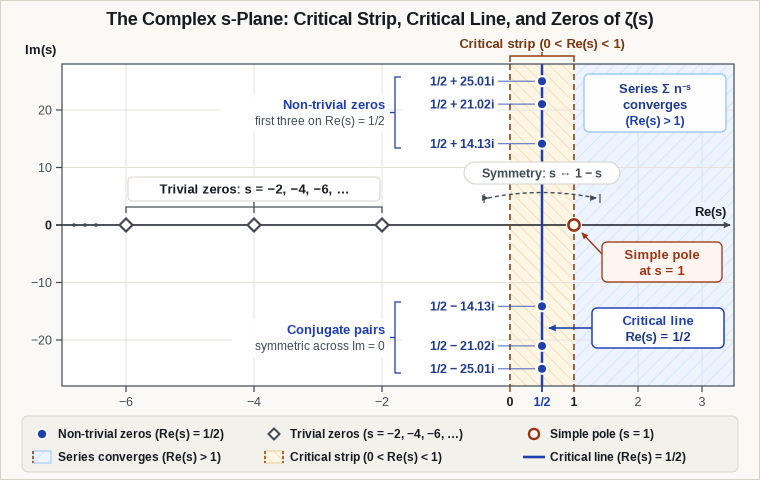
- Known predictable negative-integer zeros at
forced purely by the symmetry factortrivial zero, which carry no hidden prime fluctuations; - nontrivial zeros, all trapped inside the open vertical band
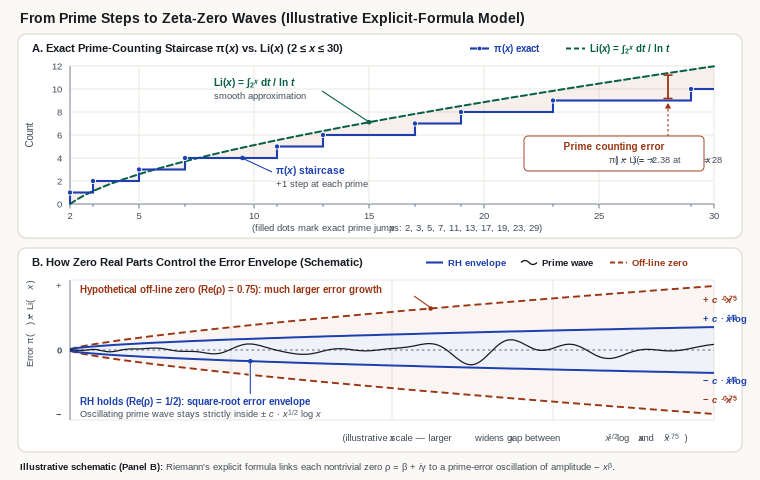
critical strip, where each zero at adds an oscillation of size to the prime-counting error.
The Riemann Hypothesis asserts that every nontrivial zero sits on the central vertical line
To track primes in arithmetic progressions—such as primes leaving remainder
Because a modern machine-checked proof can span hundreds of thousands of lines, checking every logical step in a computer kernel against explicit axiomsformal verification only settles the conjecture if the statement proved by the machine matches the classical conjecture with zero loopholes. Stage 00 examines that entire statement contract across three landmark pages, plus a bridge page mapping the full proof engine ahead:
- Full Proof Journey & Alpöge's 20-Step Map — how the eight mathematical pillars in
src/New/combine Theorems A, B, and C to driveNew.grh, and how the condensed readable edition aligns with Alpöge's original 20-step roadmap. - The Five Entry Theorems — how
src/Main.leanreduces all five headline claims to a single right-half-plane nonvanishing theorem, and how rootChallenge.leanlocks the target signatures. - Formal Statement Contracts — why each of the four predicates in
src/Statements.leancarries its exact exclusions and strip bounds. - Independent Statement Equivalence — how the
comparator/files (archived on upstream'salpogebranch while temporarily pending re-integration on condensedmain) bridge the submission's strip formulation to the externalformal-conjecturesstatements of RH and GRH.
What Stage 00 leaves out: Stage 00 treats the core proof engine New.grh (defined in src/New/Reduction/OneSidedBound.lean and imported by src/Main.lean via New.Main, whose stated type asserts nonvanishing of src/New/Appendix/DiscreteSeries/ and the 495-file literature library src/Lib/ sit outside the 41 primary landmarks and are cited directly where consumed).
Where this analogy breaks
Describing nontrivial zeros as "sound waves" building the prime-counting error accurately conveys that each zero
Level 2 — Undergrad Bridge
Stage 00 organizes the logical architecture at the summit of the proof into a short chain of implications that uses only classical complex analysis and Mathlib's
Three classical ingredients carry every arrow in Stage 00:
- Conductor reduction inside the open strip: For any character
induced by its primitive character ( ), . Because on , the finite Euler factor never vanishes in , so . - Functional-equation reflection across
: For primitive , the completed function satisfies with , and the gamma factor has no zeros in . Any zero of with therefore reflects to a zero of with , contradicting right-half-plane nonvanishing. - Whole-plane equivalence for primitive characters: Classical nonvanishing on
( LFunction_ne_zero_of_one_le_re, plusin Mathlib's pole convention) rules out zeros to the right of the strip, while reflection from to shows every zero in comes from a pole of the gamma factor—matching GRH.trivialZeros χexactly.
Everything below DirichletLNonvanishingRightOfHalf belongs to Stages 01–07; everything inside Stage 00 is a transparent, self-contained statement and reduction contract (whose local Lean/Comparator build verification remains unverified-locally, and whose formal-conjectures bridge is currently archived on upstream's alpoge branch pending re-integration on condensed main).
Level 3 — Formal Lean Contract
On November 25, 2026, upstream leanprover-community/riemann-hypothesis condensed main to the readable edition (GUIDE.md, INDEX.md, src/New/, and src/Lib/), moving Challenge.lean to the repository root and temporarily leaving comparator/ Formal Conjectures pending re-integration (archived on upstream's alpoge branch at c900e67c2fcd1fdb041685820bbd2b867fbc5a4b).
Stage 00 covers three active extracted skeleton modules derived from upstream leanprover-community/riemann-hypothesis at pinned commit 41c2716658c42ba08eb0648994a2efe83082a95c (41c2716658c4, leanprover/lean4:v4.37.0-rc1, Mathlib rev 31ce06eaadf4a200c0e1407c5f10953cf606b8f8):
| Skeleton File | Upstream Path | Role in Stage 00 |
|---|---|---|
00_statement/statements.lean | src/Statements.lean | Four Prop definitions specifying RH and GRH contracts |
00_statement/challenge.lean | Challenge.lean | Frozen Mathlib-only challenge (import Statements; 5 target theorems with sorry at lines 8, 11, 14, 17, 20) |
00_statement/main.lean | src/Main.lean | Solution entry module (public import New.Main) proving all 5 theorems from New.grh (src/New/Reduction/OneSidedBound.lean) |
Live direct-import DAG topology: In the condensed 41-landmark DAG (dag/dag.json), root Challenge.lean directly declares import Statements, so 00_statement/challenge depends directly on 00_statement/statements. Meanwhile, src/Main.lean declares public import New.Main, connecting 00_statement/main directly to 01_reduction/new_main (which in turn imports 01_reduction/one_sided_bound and 00_statement/statements).
Verification status (audit/verification-status.json): Local Lean compilation and kernel replay are currently unverified-locally. Local checks in this repository verify commit provenance (41c2716658c42ba08eb0648994a2efe83082a95c), entry-file static scanning (0 forbidden tokens across src/Statements.lean and src/Main.lean; 5 expected sorry tokens in root Challenge.lean at lines 8, 11, 14, 17, 20), and parsed root comparator.json metadata (challenge_module: "Challenge", solution_module: "Main", permitted axioms propext, Quot.sound, Classical.choice, enable_nanoda: true alongside Lean's kernel). The comparator/ Formal Conjectures harness is temporarily absent on condensed main@41c2716658c4 and remains archived on alpoge@c900e67c2fcd1fdb041685820bbd2b867fbc5a4b.
- Statements —
src/Statements.lean(depends on: none) - Challenge (landmark) —
Challenge.lean(depends on:00_statement/statements) - Main (landmark) —
src/Main.lean(depends on:01_reduction/new_main)
Page Glossary
- prime number
- A whole number greater than 1 whose only positive whole-number divisors are 1 and itself; every integer above 1 factors uniquely into a product of them.
- complex plane
- The two-dimensional coordinate plane of numbers s = σ + it, where the horizontal coordinate σ = Re(s) sets decay rate and the vertical coordinate t = Im(s) sets oscillation frequency.
- infinite series
- A limit of partial sums formed by adding infinitely many terms; in number theory, weighting terms by n⁻ˢ produces a Dirichlet series that turns integer arithmetic into a smooth function.
- analytic continuation
- The unique extension of a complex-differentiable function from a smaller region to a larger domain, locked in place by the identity theorem.
- Riemann zeta function
- The meromorphic function ζ(s) extending ∑ n⁻ˢ to all of ℂ ∖ {1}, linking prime numbers via its Euler product to zeros in the complex plane.
- trivial zero
- A zero at a non-positive integer forced purely by poles of the gamma factor in the functional equation, carrying no hidden information about prime fluctuations.
- critical strip
- The open vertical band 0 < Re(s) < 1 in the complex plane that contains every nontrivial zero of ζ(s) and of every Dirichlet L-function.
- critical line
- The vertical line Re(s) = 1/2 bisecting the critical strip—the axis of mirror symmetry s ↦ 1 − s where the Riemann Hypothesis asserts all nontrivial zeros lie.
- Dirichlet character
- A periodic multiplicative label χ : ℤ → ℂ modulo N that equals 0 when gcd(n, N) > 1, takes roots of unity when gcd(n, N) = 1, and satisfies χ(ab) = χ(a)χ(b).
- Dirichlet L-function
- The meromorphic continuation of ∑ χ(n) n⁻ˢ associated to a Dirichlet character χ, generalizing ζ(s) to track primes across residue classes modulo N.
- primitive character
- A Dirichlet character modulo q whose pattern does not come from any strictly smaller dividing modulus; its modulus q equals its minimal period (conductor).
- formal verification
- Checking every logical step of a mathematical proof by a small computer kernel against explicit axioms, paired with statement-equivalence checks ensuring the proved theorem matches the intended conjecture.
- twisted lattice
- A family of linear lifts from one complex vector space into inner-product spaces—one per twist—equipped with prime-by-prime integrality lattices so each prime can pick its own allowed twist.