complex multiplication
Also known as: CM curve, CM lattice.
Extra scaling-and-rotation symmetries of a two-dimensional lattice in ℂ preserved by the integers 𝓞_K of an imaginary quadratic field K = ℚ(√(-d)), pinning down every Galois-conjugate lattice area via the Chowla–Selberg formula.
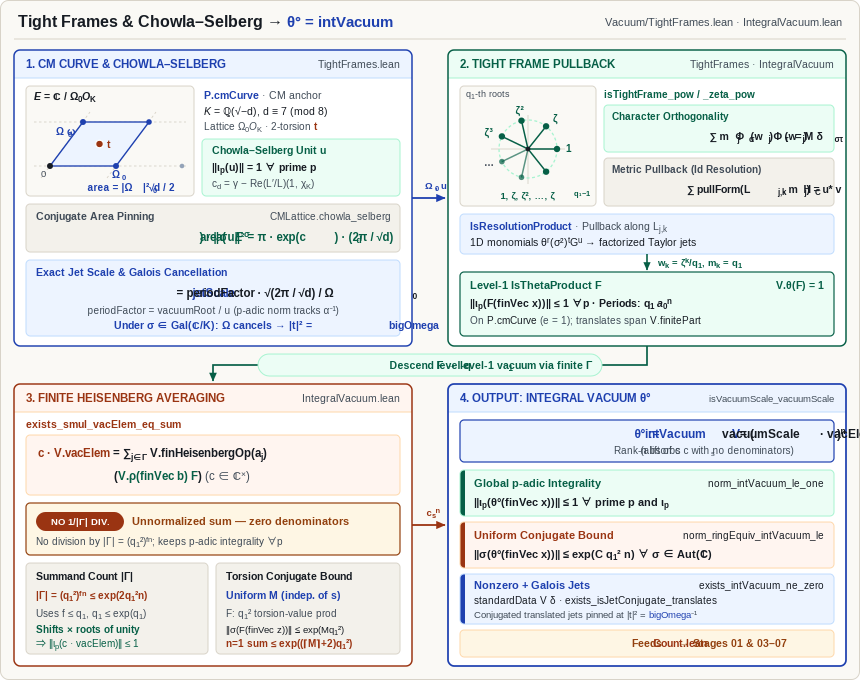
Level 1 — First-Principles
Draw a regular two-dimensional grid of points—a lattice
In Stage 02, the proof fixes an odd indivisible whole number
The second structural consequence of complex multiplication is how tightly it controls geometry across all algebraic symmetries of the complex plane. Applying any field automorphism
Limits of the intuition
Visualizing complex multiplication through the
Level 2 — Undergrad Bridge
Let
Generically
In Stage 02, cmCurve with period
Over the cyclotomic CM tower
Integral Hermitian projections land in the CM lattice. For elements
(having integral finite images under the Weil-data idele ), the CM-type Hermitian pairing lies in
( sum_mul_conj_mem_quadInt). BecausecmCurveis preserved by, multiplying any lattice point by stays inside ( mul_sum_mul_conj_mem_lattice). This is why rational shifts along a tight frame land on lattice shifts of one-variable theta sections.Uniform Galois control via Chowla–Selberg. Every automorphism
sends the CM lattice to a Galois-conjugate CM lattice ( galConjugate σ), still having CM by. By the Chowla–Selberg formula (Selberg & Chowla 1967; Gross 1978), there exists a single complex number that is a -adic unit at every prime place ( for all ) and satisfies, uniformly for all , Setting
, , and , dividing by changes no -adic valuation anywhere while canceling the conjugate lattice area at every infinite place: whenever , which is
norm_gal_periodFactor_div_mul_areaScale_sqinintegral_vacuum.lean. Together with uniform archimedean bounds on torsion values ofon cmCurve(exists_norm_gal_torsion_value_le), this gives simultaneously-adic integrality and uniform Galois-conjugate bounds for the integral vacuum and its jet series.
Level 3 — Formal Lean Contract
Stage 02 extracts the canonical CM curve, its period-scaled ideal lattice, and the Galois-uniform Chowla–Selberg area identity into skeleton/02_derivatives/tight_frames.lean from upstream src/New/Derivatives/Vacuum/TightFrames.lean:
02_derivatives/tight_frames.lean#New.Parameters.cmCurve(upstreamsrc/New/Derivatives/Vacuum/TightFrames.lean:85-88):leandef New.Parameters.cmCurve : CMLattice P.d02_derivatives/tight_frames.lean#New.Parameters.latticeModule_cmCurve(upstreamsrc/New/Derivatives/Vacuum/TightFrames.lean:96-100):leanlemma New.Parameters.latticeModule_cmCurve : P.cmCurve.latticeModule = QuadField.scaledIdeal P.d (P.cmPeriod, 1)02_derivatives/tight_frames.lean#New.Parameters.area_mul_norm_chowlaSelbergUnit_sq(upstreamsrc/New/Derivatives/Vacuum/TightFrames.lean:110-116):leanlemma New.Parameters.area_mul_norm_chowlaSelbergUnit_sq (σ : Gal(ℂ/P.K)) : (P.cmCurve.galConjugate σ).area * ‖σ P.chowlaSelbergUnit‖ ^ 2 = π * rexp (chowlaSelbergConst P.d) * (2 * π / √P.d)
Companion declarations in tight_frames.lean fix New.Parameters.cmPeriod : ℂˣ (TightFrames.lean:90-93), New.Parameters.chowlaSelbergUnit : ℂ (TightFrames.lean:102-104), its global New.Parameters.norm_iota_chowlaSelbergUnit (TightFrames.lean:106-108), and the closure lemma New.Parameters.mul_sum_mul_conj_mem_lattice (TightFrames.lean:665-672). Downstream in 02_derivatives/integral_vacuum.lean, New.Parameters.norm_gal_periodFactor_div_mul_areaScale_sq (IntegralVacuum.lean:469-489) converts area_mul_norm_chowlaSelbergUnit_sq into the exact conjugate jet-scale norm (P.bigOmega s)⁻¹. See the page's live verification banner (audit/verification-status.json) for the currently pinned upstream snapshot and local Lean build status (build_status: unverified-locally).
Where this analogy breaks
Picturing complex multiplication as a static square or hexagonal grid symmetric under
Formal Lean Anchors
def New.Parameters.cmCurve — Upstream source (src/New/Derivatives/Vacuum/TightFrames.lean L85-L88)
/-- The curve `𝓔 = ℂ / Ω₀ 𝓞_K`: a chosen CM lattice that is a complex multiple of `𝓞_K`.
See `latticeModule_cmCurve`. -/
def New.Parameters.cmCurve : CMLattice P.d := by
sorry -- [EXTRACTED_STUB upstream=src/New/Derivatives/Vacuum/TightFrames.lean:85-88 commit=41c2716658c42ba08eb0648994a2efe83082a95c body_lines=1 body_sha256=a019ac9e30c6032c3a904a09be017aefb243f5324008aa199acdd16f9382904d]lemma New.Parameters.latticeModule_cmCurve — Upstream source (src/New/Derivatives/Vacuum/TightFrames.lean L96-L100)
/-- The lattice of the CM curve `cmCurve` is `Ω₀ 𝓞_K`, the multiple by `Ω₀` of the unit ideal of
`K = ℚ(i√d)`. -/
lemma New.Parameters.latticeModule_cmCurve :
P.cmCurve.latticeModule = QuadField.scaledIdeal P.d (P.cmPeriod, 1) := by
sorry -- [EXTRACTED_STUB upstream=src/New/Derivatives/Vacuum/TightFrames.lean:96-100 commit=41c2716658c42ba08eb0648994a2efe83082a95c body_lines=1 body_sha256=29ee12eeb0720f38aba0f788f724f9859babd435ff3229d4736271c774761d59]lemma New.Parameters.area_mul_norm_chowlaSelbergUnit_sq — Upstream source (src/New/Derivatives/Vacuum/TightFrames.lean L110-L116)
/-- The Chowla–Selberg formula for the conjugates of `cmCurve`: for every automorphism `σ` of `ℂ`
over `K`, the area of the lattice conjugate by `σ`, times `‖σ u‖²` for `u = chowlaSelbergUnit`, is
`π exp(c) 2π / √d`, where `c = chowlaSelbergConst d = γ - Re L'/L(1, χ_K)`. -/
lemma New.Parameters.area_mul_norm_chowlaSelbergUnit_sq (σ : Gal(ℂ/P.K)) :
    (P.cmCurve.galConjugate σ).area * ‖σ P.chowlaSelbergUnit‖ ^ 2 =
π * rexp (chowlaSelbergConst P.d) * (2 * π / √P.d) := by
sorry -- [EXTRACTED_STUB upstream=src/New/Derivatives/Vacuum/TightFrames.lean:110-116 commit=41c2716658c42ba08eb0648994a2efe83082a95c body_lines=1 body_sha256=25ef7d402bbf6c1ef045898604f25231c5e8d896f078168c7707f9e5bf87b8f9]Related Concepts
- complex plane — The two-dimensional coordinate plane of numbers s = σ + it, where the horizontal coordinate σ = Re(s) sets decay rate and the vertical coordinate t = Im(s) sets oscillation frequency.
- prime number — A whole number greater than 1 whose only positive whole-number divisors are 1 and itself; every integer above 1 factors uniquely into a product of them.
- quadratic twist — Multiplying a Dirichlet character χ modulo N by the Legendre symbol (·/d) of an odd prime d coprime to N, yielding a non-principal character modulo N·d whose L-function family admits zero-density control.
- elliptic theta function — A quasi-periodic entire function on a CM lattice normalized at the origin, whose finite products along tight-frame projections build integral multi-variable theta functions and collapse p-adically into exponential normal forms.
- arithmetic height — A logarithmic measure combining ordinary archimedean size with prime-by-prime p-adic divisibility, locked together by the product formula so a nonzero algebraic quantity cannot be simultaneously small at every place.
Referenced By
- Stage: Formal Groups, Theta Normal Form & Prime-Counting Divisibility
- Stage: Sharpness: Proving the Valuation Bound Is Attained
- Stage: Short Ramified Columns & Archimedean Size Cancellation
- Stage: Stage 02 — Derivatives of Theta Functions
- Stage: Tight Frames, Chowla–Selberg Scaling & the Integral Vacuum
- Concept: elliptic theta function
- Concept: formal group law
- Concept: tight frame
Authoritative Sources
- Advanced Topics in the Arithmetic of Elliptic Curves (book) — J. H. Silverman, Springer Graduate Texts in Mathematics 151 (1994), Chapter II.
- On Epstein's zeta-function (paper) — A. Selberg and S. Chowla, Journal für die reine und angewandte Mathematik 227 (1967), pp. 86–110.
- On the periods of abelian varieties (paper) — B. H. Gross, Inventiones Mathematicae 45 (1978), pp. 193–211.
Page Glossary
- complex plane
- The two-dimensional coordinate plane of numbers s = σ + it, where the horizontal coordinate σ = Re(s) sets decay rate and the vertical coordinate t = Im(s) sets oscillation frequency.
- prime number
- A whole number greater than 1 whose only positive whole-number divisors are 1 and itself; every integer above 1 factors uniquely into a product of them.
- quadratic twist
- Multiplying a Dirichlet character χ modulo N by the Legendre symbol (·/d) of an odd prime d coprime to N, yielding a non-principal character modulo N·d whose L-function family admits zero-density control.
- elliptic theta function
- A quasi-periodic entire function on a CM lattice normalized at the origin, whose finite products along tight-frame projections build integral multi-variable theta functions and collapse p-adically into exponential normal forms.
- arithmetic height
- A logarithmic measure combining ordinary archimedean size with prime-by-prime p-adic divisibility, locked together by the product formula so a nonzero algebraic quantity cannot be simultaneously small at every place.