character theta lift
Also known as: four-block seesaw, integral algebraic part, multiplicative pigeonhole, rank-one test form.
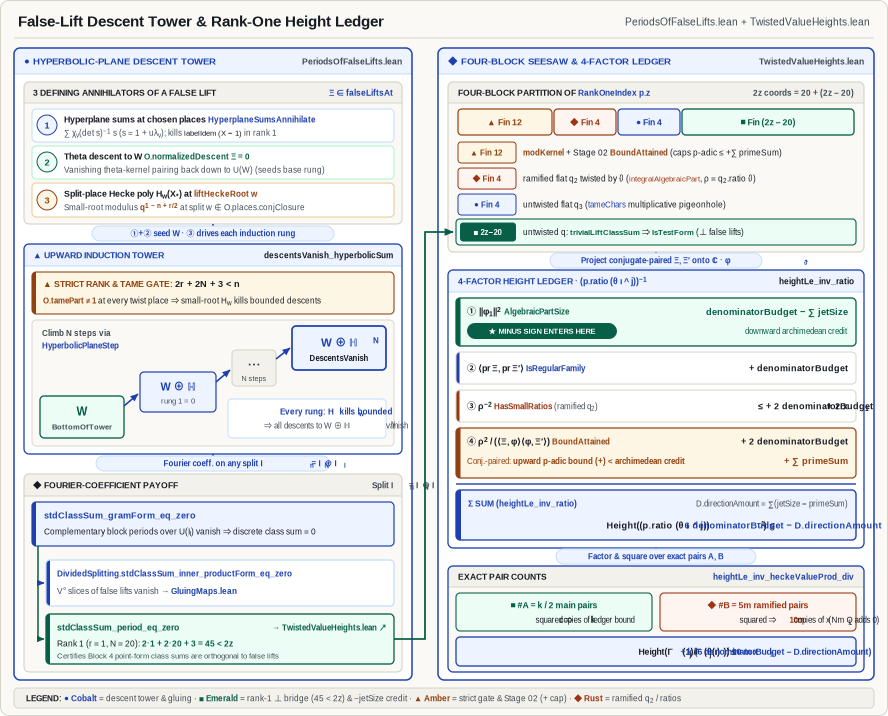
Lifting a main-pair character nu * theta from U(1) to U(2z), where a four-block seesaw (12 + 4 + 4 + (2z - 20)) builds a rank-one test form whose p-adic pairing bound combines with the untwisted lift norm to yield negative height 6 * denominatorBudget - directionAmount on (p.ratio)^-1.
Level 1 — First-Principles
To make Theorem C beat the naive
Up to an integer power of the conductor norm
where
To build a rank-one test form RankOneIndex p.z into four pieces:
- Block 1 (
Fin 12): carries a monomial derivative of a rank-one dual-pair theta kerneltheta correspondence, where Stage 02's sharpness theorem (02_derivatives/bound_attained) guarantees that some Taylor coefficient avoids excess-adic divisibility beyond localPrimeSumTotal l. - Block 2 (
Fin 4): carries the twistvia an auxiliary flat pair , contributing its integral algebraic part (and hence ). - Blocks 3 & 4 (
Fin 4andFin (2z - 20)): carry untwisted flat pairsand ; averaging over the huge fourth block via trivialLiftClassSumenforces false-lift orthogonality (isTestForm_trivialLiftClassSum_pointForm).
Choosing the untwisted characters by multiplicative pigeonhole (exists_mul_eq_norm_map_le_norm_map_mul) and character orthogonality on
contributes (this is where the minus sign enters!). contributes at most from IsRegularFamily's main-pair projection control.contributes at most from HasSmallRatios.contributes at most from Stage 02's sharpness bound.
Adding the four heights yields heightLe_inv_ratio:
because
Limits of the intuition
Treating Stage 02's sharpness theorem (BoundAttained) as the direct source of the negative height is a classic sign-ledger trap. BoundAttained bounds a denominator heightLe_norm_trivialLift_sq (AlgebraicPartSize.lean), which compares the untwisted archimedean norm of BoundAttained ensures the upward
Level 2 — Undergrad Bridge
In Yang (1997), Prasanna (2006), and Coates–Liang–Sujatha (2009), special values of CM Hecke src/New/OneLift/HeckeValues/TwistedValueHeights.lean (24 declarations, 2 let-type stub truncations) builds the rank-one height bound in four steps:
- Four-block seesaw factorization (
inner_pointForm_kernelForm,isTestForm_trivialLiftClassSum_pointForm,exists_isTestForm_inner_kernelForm_eq): At a block-diagonal pointof with datum testColumnand twist rowtwistRow p.zin Block 2, the pairing of a point form againstX.kernelForm gsplits into aFin 12modKerneltimes three flat-pair kernels (inner_pointForm_kernelForm). Summing over Block 4 againsttrivialLift hq .oneyields an integral test form orthogonal to false lifts (isTestForm_trivialLiftClassSum_pointForm, invokingstdClassSum_period_eq_zerowith). Summing over Blocks 2 and 3 yields exists_isTestForm_inner_kernelForm_eq: a test formwhose pairing against X.kernelForm gequals a multinomial factorial times the three integral algebraic parts (untwisted, twisted by ) times the Fin 12modKernel. - Pigeonhole +
orthogonality + Stage 02 sharpness ( exists_mul_eq_norm_map_le_norm_map_mul,exists_norm_le_norm_twisted_classSum,exists_root_prod_integralAlgebraicPart,exists_isTestForm_le_norm_inner_trivialLift): Taking the geometric meanover tameCharsof(conjugate size ), applying multiplicative pigeonhole to find a character factorization, using character orthogonality to isolate the class sum at , and invoking 02_derivatives/bound_attainedon theFin 12theta kernel produces a twist-independent( ) and a test form with - Conjugate pairing and 4-factor height sum (
heightLe_inv_ratio): Applyingexists_isTestForm_le_norm_inner_trivialLiftat bothand yields for Factor (4), contributing via D.sum_localPrimeSumTotal_mul_log_le. Combining withheightLe_norm_trivialLift_sq(), IsRegularFamilymain-pair projection (), and HasSmallRatiossquared () proves HeightLe (6 * D.denominatorBudget - D.directionAmount)on(p.ratio ((θ ι).powTwist j))⁻¹.
Level 3 — Formal Lean Contract
All five anchors live in skeleton/06_one_lift/twisted_value_heights.lean (24 declarations; 2 declarations—inner_pointForm_kernelForm and exists_isTestForm_inner_kernelForm_eq—are truncated at let X : LValueData ... := in the skeleton, with full verbatim upstream signatures quoted in Vanishing Periods of False Lifts and Negative Heights of Twisted L-Values):
06_one_lift/twisted_value_heights.lean#New.Data.inner_pointForm_kernelForm(upstreamTwistedValueHeights.lean:353-380) and06_one_lift/twisted_value_heights.lean#New.Data.isTestForm_trivialLiftClassSum_pointForm(upstreamTwistedValueHeights.lean:452-466).06_one_lift/twisted_value_heights.lean#New.Data.exists_isTestForm_inner_kernelForm_eq(upstreamTwistedValueHeights.lean:575-601).06_one_lift/twisted_value_heights.lean#New.Data.exists_isTestForm_le_norm_inner_trivialLift(upstreamTwistedValueHeights.lean:695-856):leantheorem New.Data.exists_isTestForm_le_norm_inner_trivialLift {j : D.LiftIndex} {p q₂ : D.CriticalPair} (hp : p.IsMainPair j) (hq₂ : q₂.HasEmptyRow (Fin 4)) : ∃ c₀ : ℂ, c₀ ≠ 0 ∧ (∀ σ : ℂ ≃+* ℂ, ‖σ c₀‖ ≤ exp (D.f * D.m / D.k * D.b + 3 * D.x ^ 34)) ∧ ∀ (l : ℕ) [Fact l.Prime] [PadicPlace l] (ϑ : D.Twist), l.Coprime ϑ.normQ → ∃ Ξ : (lValueData hp.hasLiftRank ϑ).descentPair.FormV, (lValueData hp.hasLiftRank ϑ).descentPair.IsTestForm l Ξ ∧ ‖ιₚ (c₀ * q₂.ratio ϑ)‖ * (l : ℝ) ^ (-D.localPrimeSumTotal l) ≤ ‖ιₚ (inner ℂ Ξ (CriticalPair.trivialLift hp.hasLiftRank ϑ))‖06_one_lift/twisted_value_heights.lean#New.Data.heightLe_inv_ratio(upstreamTwistedValueHeights.lean:858-971):leantheorem New.Data.heightLe_inv_ratio {θ : PrimePadicIso → D.MFoldTwist} (hθ : D.IsRegularFamily θ) (j : D.LiftIndex) (p : D.CriticalPair) (hp : p.IsMainPair j) : HeightLe (6 * D.denominatorBudget - D.directionAmount) fun ι : PrimePadicIso ↦ (p.ratio ((θ ι).powTwist j))⁻¹
See the page's live <VerificationBanner /> (audit/verification-status.json) for the pinned upstream commit and local Lean build status (build_status: unverified-locally).
Where this analogy breaks
Thinking of the rank-one sharpness theorem from Stage 02 as directly producing a negative height reverses the sign ledger: the negative term -sum jetSize comes from the archimedean height of the untwisted lift norm ||phi_1||^2 (AlgebraicPartSize), whereas Stage 02 BoundAttained enters with a PLUS sign (+sum primeSum) to cap the upward p-adic valuation penalty below that archimedean credit so the net difference -(sum jetSize - sum primeSum) = -directionAmount stays negative.
Formal Lean Anchors
theorem New.Data.inner_pointForm_kernelForm — Upstream source (src/New/OneLift/HeckeValues/TwistedValueHeights.lean L343-L435)
/-- Seesaw factorisation at one point. Let `X` be the lift data of a main pair `p`, with point
`z = p.z`, at the twist `ϑ`; its `2 z` indices form blocks of sizes `12`, `4`, `4`, `2 z - 20`. Let
`q₂`, `q₃`, `q` be flat on the last three blocks; `q₂` is taken at `ϑ`, the other two at the trivial
character. Take the point form, supported on one class of `U(2 z)(𝔸_f)`, at the block diagonal point
`diag (1, h₂, h₃, h₁)`. Its datum is `testColumn` (`x₀` on the first block) at the chosen places and
reads the row `twistRow` of the second block at the places of the modulus of `ϑ`. Its vector `c` has
as polynomial `a` times the monomial `α` in the first block. If `χ` and the characters of the last
three blocks multiply to the character of `X`, then the inner product of the point form with the
theta kernel `X.kernelForm g`, for `g ∈ U(1)(𝔸_f)`, is `a` times a product of four theta kernels at
`g`, one for each block. The first, `modKernel`, belongs to `χ`, the indicator of `x₀` and `α`. -/
theorem New.Data.inner_pointForm_kernelForm (hq : q.HasEmptyRow (Fin (2 * p.z - 20)))
(hq₂ : q₂.HasEmptyRow (Fin 4)) (hq₃ : q₃.HasEmptyRow (Fin 4)) {j : ℕ}
{α : NumberField.InfinitePlace D.E × Fin 12 × Unit →₀ ℕ} {χ : AutChar D.E}
(hp : p.IsMainPair j) (ϑ : D.Twist)
(x₀ : Matrix (Fin 12) Unit ((lValueData hp.hasLiftRank ϑ).levelModulus 1 false).ResidueRing)
{c : WeylIndex (RankOneIndex p.z) (lValueData hp.hasLiftRank ϑ).descentPair.columnCount → ℤ}
{a : ℂ}
(h_pol : (lValueData hp.hasLiftRank ϑ).descentPair.fockPoly (star ((↑) ∘ c)) =
a • renameRowsCols (Function.Embedding.trans .inl .inl : Fin 12 ↪ RankOneIndex p.z) id
(monomial α 1))
(h_char : χ * ((lValueData hq₂.hasLiftRank ϑ).descentPair.charV *
(lValueData hq₃.hasLiftRank .one).descentPair.charV) *
(lValueData hq.hasLiftRank .one).descentPair.charV =
(lValueData hp.hasLiftRank ϑ).descentPair.charV)
(g : Gf D.E Unit) (h₁ : Gf D.E (Fin (2 * p.z - 20))) (h₂ h₃ : Gf D.E (Fin 4))
(i₁ : WeylIndex (Fin (2 * p.z - 20)) (lValueData hq.hasLiftRank .one).descentPair.columnCount)
(i₂ : WeylIndex (Fin 4) (lValueData hq₂.hasLiftRank ϑ).descentPair.columnCount)
(i₃ : WeylIndex (Fin 4) (lValueData hq₃.hasLiftRank .one).descentPair.columnCount) :
let X : LValueData D.E (RankOneIndex p.z) := by
sorry -- [EXTRACTED_STUB upstream=src/New/OneLift/HeckeValues/TwistedValueHeights.lean:343-435 commit=41c2716658c42ba08eb0648994a2efe83082a95c body_lines=65 body_sha256=8e5488c8bd665d983e76b5f29767f870d7ae6c3a816a08a7fe3822bf9d2d2e73]theorem New.Data.isTestForm_trivialLiftClassSum_pointForm — Upstream source (src/New/OneLift/HeckeValues/TwistedValueHeights.lean L440-L556)
/-- Let `l` be a prime, `p` a main pair for `j` with point `z = p.z`, whose `2 z` indices form
blocks of sizes `12`, `4`, `4`, `2 z - 20`, and `ϑ` a twist. Let `q` be flat on the last block. Take
the point forms at the block diagonal points `diag (1, h₂, h₃, h₁)` of `U(2 z)(𝔸_f)` whose datum is
`testColumn` at the chosen places and reads the row `twistRow` of the second block at the twist
places. Let their integer vector `c` be fixed by `weylRep`, the representation of weight
`columnCount` twisted by the powers `detExp` of the determinant, at every family `g` over the
infinite places `D.Φ`, over a field of characteristic zero, whose columns in the first block are
those of the identity. Then their class sum `trivialLiftClassSum` over `h₁`, weighted by the values
of the untwisted lift of `q`, is a test form (`IsTestForm`): integral above `l` and orthogonal to
the false lifts, the forms in the kernel of the descent to `U(1)`, in the image of the mean over the
residue units at the chosen places, that the Hecke polynomial of a split place `w` at
`liftHeckeRoot w` kills. -/
theorem New.Data.isTestForm_trivialLiftClassSum_pointForm {l : ℕ} [Fact l.Prime]
(hq : q.HasEmptyRow (Fin (2 * p.z - 20))) {j : ℕ} (hp : p.IsMainPair j) (ϑ : D.Twist)
(x₀ : Matrix (Fin 12) Unit ((lValueData hp.hasLiftRank ϑ).levelModulus 1 false).ResidueRing)
{c : WeylIndex (RankOneIndex p.z) (lValueData hp.hasLiftRank ϑ).descentPair.columnCount → ℤ}
(h_fix : ∀ {R : Type} [Field R] [CharZero R] {g : D.Φ → GL (RankOneIndex p.z) R},
(∀ (τ : D.Φ) (a : Fin 12) (b : RankOneIndex p.z),
(g τ).val b (.inl (.inl a)) = if b = .inl (.inl a) then 1 else 0) →
weylRep (lValueData hp.hasLiftRank ϑ).descentPair.columnCount
(lValueData hp.hasLiftRank ϑ).descentPair.detExp
g *ᵥ ((↑) ∘ c) = (↑) ∘ c)
(h₂ h₃ : Gf D.E (Fin 4)) :
(lValueData hp.hasLiftRank ϑ).descentPair.IsTestForm l
(trivialLiftClassSum hq .one fun h₁ : Gf D.E (Fin (2 * p.z - 20)) ↦
pointForm (U.blockSumOne (U.blockSumOne (1, U.blockSumOne (h₂, h₃)), h₁))
(testColumn_injective hq hp ϑ x₀) (twistRow p.z) ((↑) ∘ c)) := by
sorry -- [EXTRACTED_STUB upstream=src/New/OneLift/HeckeValues/TwistedValueHeights.lean:440-556 commit=41c2716658c42ba08eb0648994a2efe83082a95c body_lines=91 body_sha256=f7437a8eb56521df790cfa6d9f010015db0303e7e3ae0af498bffbceb0f6e564]theorem New.Data.exists_isTestForm_inner_kernelForm_eq — Upstream source (src/New/OneLift/HeckeValues/TwistedValueHeights.lean L561-L642)
/-- Seesaw factorisation. Let `l` be a prime with a chosen embedding `ℂ → ℂ_l`. Let `p` be a main
pair for `j` with point `z = p.z`, and let `X` be the lift data of `p` at the twist `ϑ`, with `l`
prime to `ϑ.normQ`. Let `q₂`, `q₃`, `q` have empty row on blocks of sizes `4`, `4` and `2 z - 20`:
`q₂` is taken at `ϑ`, the other two at the trivial character. Let the monomial `α` have degree
`X.rowLength τ` at each infinite place `τ`, and let `χ` and the characters of the three blocks
multiply to that of `X`. Then there is a test form `Ξ` on `U(2 z)` at `l`. Its inner product with
the theta kernel `X.kernelForm g`, for `g ∈ U(1)(𝔸_f)`, times
`N ^ 3 * vacuumScale ^ (2 z - 20 + 8)`, is `∏ (X.rowLength τ)! / α!` times the three numbers
`integralAlgebraicPart` and the theta kernel `modKernel` of `χ`, the indicator of `x₀` and `α`. Here
`integralAlgebraicPart` is `chosenGroupOrder * denomBound ^ 2 * ‖φ‖² / N(Q) ^ (2 z' - 1)` for the
normalised lift `φ` of a pair with point `z'` at a twist of norm `N(Q)`, `N` is the class sum of `1`
over `X.chosenLevel`, `vacuumScale` scales the vacuum vector of the Weil representation of rank one
to integral values, and `x₀` is read modulo `X.levelModulus 1 false`, the product of the chosen
places. -/
theorem New.Data.exists_isTestForm_inner_kernelForm_eq {l : ℕ} [Fact l.Prime]
(hq : q.HasEmptyRow (Fin (2 * p.z - 20))) (hq₂ : q₂.HasEmptyRow (Fin 4))
(hq₃ : q₃.HasEmptyRow (Fin 4)) {j : ℕ}
{α : NumberField.InfinitePlace D.E × Fin 12 × Unit →₀ ℕ} {χ : AutChar D.E} [PadicPlace l]
(hp : p.IsMainPair j) (ϑ : D.Twist) (hl : l.Coprime ϑ.normQ)
(x₀ : Matrix (Fin 12) Unit ((lValueData hp.hasLiftRank ϑ).levelModulus 1 false).ResidueRing)
(hα : ∀ τ : NumberField.InfinitePlace D.E,
∑ i : Fin 12, α (τ, i, ()) = (lValueData hp.hasLiftRank ϑ).rowLength τ)
(h_char : χ * ((lValueData hq₂.hasLiftRank ϑ).descentPair.charV *
(lValueData hq₃.hasLiftRank .one).descentPair.charV) *
(lValueData hq.hasLiftRank .one).descentPair.charV =
(lValueData hp.hasLiftRank ϑ).descentPair.charV) :
let X : LValueData D.E (RankOneIndex p.z) := by
sorry -- [EXTRACTED_STUB upstream=src/New/OneLift/HeckeValues/TwistedValueHeights.lean:561-642 commit=41c2716658c42ba08eb0648994a2efe83082a95c body_lines=56 body_sha256=6cff8990f712c982be5452d311d6fca2cc56323a3a46f25fcb194eaa37a61c2d]theorem New.Data.exists_isTestForm_le_norm_inner_trivialLift — Upstream source (src/New/OneLift/HeckeValues/TwistedValueHeights.lean L695-L856)
/-- A form with small pairing. Let `1 ≤ j ≤ m`, let `p` be a main pair for `j` (`IsMainPair`) and
`q₂ = (ν₂, 2)` a pair with empty row on `Fin 4`. There is a number `c₀ ≠ 0` whose conjugates have
size at most `exp (f m b / k + 3 x ^ 34)` such that, for every prime `l`, every embedding
`ιₚ : ℂ → ℂ_l` (`PadicPlace l`) and every twist `ϑ` with modulus prime to `l`, some test form `Ξ` on
`U(2 p.z)` has `v ⟪Ξ, φ⟫ ≤ v(c₀ · q₂.ratio ϑ) + localPrimeSumTotal l`. Here `φ` is the normalised
lift of the character of `p` times `ϑ`, `q₂.ratio ϑ = |L(2, (ν₂ ϑ)⁻¹)| / |L(2, ν₂⁻¹)|` without the
Euler factors at the level, `localPrimeSumTotal l` is the exponent of `l` that is forced on
derivatives of order `D.weight`, summed over the infinite places, and the valuation `v` of `ιₚ` is
written with norms. -/
theorem New.Data.exists_isTestForm_le_norm_inner_trivialLift {j : D.LiftIndex} {p q₂ : D.CriticalPair}
    (hp : p.IsMainPair j) (hq₂ : q₂.HasEmptyRow (Fin 4)) :
    ∃ c₀ : ℂ, c₀ ≠ 0 ∧
      (∀ σ : ℂ ≃+* ℂ, ‖σ c₀‖ ≤ exp (D.f * D.m / D.k * D.b + 3 * D.x ^ 34)) ∧
      ∀ (l : ℕ) [Fact l.Prime] [PadicPlace l] (ϑ : D.Twist), l.Coprime ϑ.normQ →
        ∃ Ξ : (lValueData hp.hasLiftRank ϑ).descentPair.FormV,
          (lValueData hp.hasLiftRank ϑ).descentPair.IsTestForm l Ξ ∧
          ‖ιₚ (c₀ * q₂.ratio ϑ)‖ * (l : ℝ) ^ (-D.localPrimeSumTotal l) ≤
‖ιₚ (inner ℂ Ξ (CriticalPair.trivialLift hp.hasLiftRank ϑ))‖ := by
sorry -- [EXTRACTED_STUB upstream=src/New/OneLift/HeckeValues/TwistedValueHeights.lean:695-856 commit=41c2716658c42ba08eb0648994a2efe83082a95c body_lines=145 body_sha256=42b0de010611dc0e32e90b23c4db1d63881825dfb242f087b89a37739247bced]theorem New.Data.heightLe_inv_ratio — Upstream source (src/New/OneLift/HeckeValues/TwistedValueHeights.lean L858-L971)
/-- Let `θ ι` be `m`-fold twists (characters of weight zero whose first `m` powers are ramified at
every place of the modulus), one for each prime `l` and isomorphism `ι : ℂ ≃ ℚ̄_l`. Let them form a
regular family (`IsRegularFamily`): the modulus is prime to `l`, the inverse ratios of `L`-values of
ramified pairs have height at most the second cut-off `x₁ = D.x₁`, and the logarithmic denominators
of projections to lifts add up over `l` to at most `denominatorBudget`. Let `p = (ν, z)` be a main
pair for `j` (`IsMainPair`) and `p.ratio ϑ = |L(z, (ν ϑ)⁻¹)| / |L(z, ν⁻¹)|`, without the Euler
factors at the level. Then the family over `ι` of the inverse ratios at `ϑ = (θ ι) ^ j` has height
(`New.HeightLe`) at most `6 denominatorBudget - directionAmount`. Here
`denominatorBudget = f a log³ b / (m k)`. -/
theorem New.Data.heightLe_inv_ratio {θ : PrimePadicIso → D.MFoldTwist} (hθ : D.IsRegularFamily θ)
    (j : D.LiftIndex) (p : D.CriticalPair) (hp : p.IsMainPair j) :
    HeightLe (6 * D.denominatorBudget - D.directionAmount) fun ι : PrimePadicIso ↦
(p.ratio ((θ ι).powTwist j))⁻¹ := by
sorry -- [EXTRACTED_STUB upstream=src/New/OneLift/HeckeValues/TwistedValueHeights.lean:858-971 commit=41c2716658c42ba08eb0648994a2efe83082a95c body_lines=102 body_sha256=7994ba1e99847cbc13d95ad8d145dda5c475d254778976da0bfc379193af81d9]Related Concepts
- Rallis inner product formula — Relating the squared norm (and Gram determinant) of a theta lift or m-step chain of lifts to spherical Hecke operators and single-lift determinants—factoring Z(theta)/Z(1) across m lifts up to quotient L-value ratios.
- Hecke L-value ratio — The ratio |L^S(z, (nu * theta^s)^-1)| / |L^S(z, nu^-1)| of twisted to untwisted partial Hecke L-values at a critical pair (nu, z), tracking how Siegel–Weil exchange constants scale under twisting across chain quotients and grid turns.
- arithmetic height — A logarithmic measure combining ordinary archimedean size with prime-by-prime p-adic divisibility, locked together by the product formula so a nonzero algebraic quantity cannot be simultaneously small at every place.
- false-lift period — The theta period over a complementary block I_l of an algebraic form Xi that mimics a lift in level and Hecke eigenvalue yet sits orthogonal to true lifts—forced to vanish by climbing a hyperbolic-plane descent tower when 2r + 2N + 3 < n.
- regular twist family — A prime-by-prime family of m-fold anticyclotomic twists theta(iota) with modulus coprime to l, inverse L-value ratios of height at most x_1, and lift/projection denominators summing within fa(log b)^3 / (m*k).
Referenced By
- Stage: Stage 06 — Lower Bound: One Lift (Theorem C, Part 2)
- Stage: Stage 07 — Lower Bound: Congruences & Galois Representations (Theorem C, Part 3)
- Stage: The Lift Comparison Operator and Single-Lift Volume Height
- Stage: Vanishing Periods of False Lifts and Negative Heights of Twisted L-Values
- Concept: idle direction repayment
Authoritative Sources
- Theta liftings and Hecke L-functions (paper) — T. Yang, J. Reine Angew. Math. 485 (1997), 25–53.
- Integrality of a ratio of Petersson norms and level-lowering congruences (paper) — K. Prasanna, Ann. of Math. 163 (2006), 901–941.
- The Tate–Shafarevich group for elliptic curves with complex multiplication II (paper) — J. Coates, Z. Liang & R. Sujatha, J. Algebra 322 (2009), 2639–2668.
Page Glossary
- arithmetic height
- A logarithmic measure combining ordinary archimedean size with prime-by-prime p-adic divisibility, locked together by the product formula so a nonzero algebraic quantity cannot be simultaneously small at every place.
- Hecke L-value ratio
- The ratio |L^S(z, (nu * theta^s)^-1)| / |L^S(z, nu^-1)| of twisted to untwisted partial Hecke L-values at a critical pair (nu, z), tracking how Siegel–Weil exchange constants scale under twisting across chain quotients and grid turns.
- Rallis inner product formula
- Relating the squared norm (and Gram determinant) of a theta lift or m-step chain of lifts to spherical Hecke operators and single-lift determinants—factoring Z(theta)/Z(1) across m lifts up to quotient L-value ratios.
- false-lift period
- The theta period over a complementary block I_l of an algebraic form Xi that mimics a lift in level and Hecke eigenvalue yet sits orthogonal to true lifts—forced to vanish by climbing a hyperbolic-plane descent tower when 2r + 2N + 3 < n.
- theta correspondence
- An integral transform built from a two-variable theta kernel that carries automorphic forms from one unitary group to another, iterated along a ladder of Hermitian spaces and packaged via admissible chain data.
- regular twist family
- A prime-by-prime family of m-fold anticyclotomic twists theta(iota) with modulus coprime to l, inverse L-value ratios of height at most x_1, and lift/projection denominators summing within f*a*(log b)^3 / (m*k).