Frobenius cycle
Also known as: Stepanov's count, edge condition, defect threshold.
A cyclic ring of
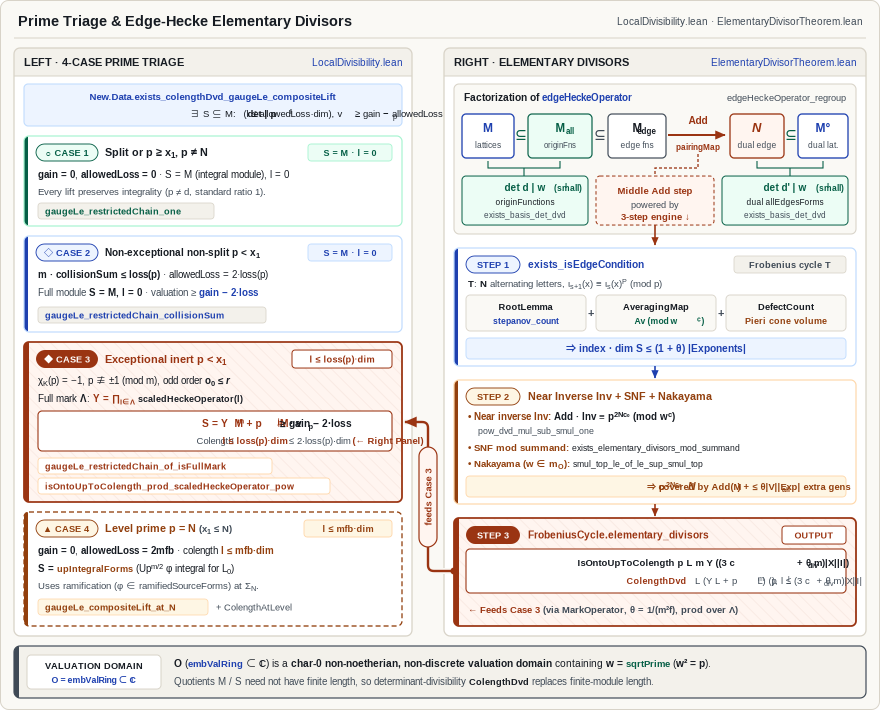
Frobenius-twisted embeddings alternating between standard and contragredient actions of , whose Stepanov zero counts and Levi-invariant averaging yield low-dimension edge conditions modulo .
Level 1 — First-Principles
Picture
Equally important, the letters strictly alternate between even and odd parities: an invertible matrix
Why build this alternating ring of embeddings? To prove that an averaging operator summing form values over neighboring sublatticesHecke operator has small prime-power invariant factors and determinant-divisibility index of a sublatticeelementary divisor, Stage 03 needs a set of edge conditions (New.FrobeniusCycle.IsEdgeCondition)—linear congruences modulo a high power
- Inclusion of global forms: Every form coming from the halfway lattices of all edges out of a vertex (
allEdgesForms) automatically obeys the edge conditions (). - An averaging map matching the edge pairing: An explicit matrix
Avpushes arbitrary edge vectors intowhile acting, against every dual-edge form in , as scalar multiplication by modulo —the engine behind the modulo- near inverse. - Tight residue-field dimension: Whenever
, the reduction of modulo the maximal ideal lands in a small residue-field subspace whose dimension satisfies .
Proving that such edge conditions exist (exists_isEdgeCondition) combines two arithmetic mechanisms. First comes Stepanov's count: if a nonzero polynomial IsLargeDegree, yielding mul_defectThreshold_le_mul_degree), the defect threshold becomes a negligible sliver of
Limits of the intuition
Thinking of a Frobenius cycle as an ordinary Galois cycle of characteristic-isEven_succ), so the defect weights carry alternating signs around the cycle. Second, Stepanov's count is not used here to count rational points on an algebraic curve; it bounds the order of vanishing of a translated auxiliary binary form at the RootLemma.lean, AveragingMap.lean, and DefectCount.lean) rather than directly proving exists_isEdgeCondition in one step. Third, the IsLargeDegree window requiring both
Level 2 — Undergrad Bridge
Let New.FrobeniusCycle N W O consists of:
ring homomorphisms ( ) satisfying for all , - an alternating parity function
with , - a square root
with .
Matrices Exponents N k n (monomials homogeneous of degree
Large-degree regime and defect-threshold inequality (
IsLargeDegree,mul_defectThreshold_le_mul_degree): For block sizeand exceptional proportion , T.IsLargeDegree k n r θrequiresBecause
( multinomialExponent_le_mul_log) and, this regime immediately implies ensuring that the defect slack divided by
is absorbed into . From Stepanov's count to edge conditions (
New.stepanov_count,IsEdgeCondition,exists_isEdgeCondition): Notice an important provenance boundary:New.stepanov_countitself lives in the upstream helper filesrc/New/UpperBound/ElementaryDivisors/RootLemma.lean(outside the five extracted Stage 03 skeleton files) and feeds intoexists_isEdgeConditionvia two intermediate upstream modules:- Root lemma (
RootLemma.lean): For any ring mapand nonzero , if for every , then ( New.stepanov_count, following Bombieri 1973). Specializing to an auxiliary polynomial tracking-translates across the cyclic letters yields defect_nonpos_of_extreme_term: any extreme term (least-adic order plus weight) has non-positive defect along every root (analogous to weight inequalities in the G-zip framework of Imai & Koskivirta 2021). - Levi-invariant averaging (
AveragingMap.lean): Substituting generic matrices across theletters and applying a Levi-conjugation-invariant linear form produces a matrix whose outputs have no Levi translate with defect above modulo , while preserving the edge pairing against up to ( exists_average_mem_defectConditions_and_dvd_sub). - Defect dimension count (
DefectCount.lean): Over the characteristic-residue field , packing forms into -th powers ( powerPacking) and applying the root-lemma defect bound along flags (cosets of the lower Iwahori subgroup) shifts leading exponents into the Pieri cone of non-positive simple-root defects. Lettingcompares the count with the cone volume inside the degree slab, proving
Assembling these three results in
exists_isEdgeConditionproducessatisfying all five fields of T.IsEdgeCondition r c θ b C S Av:allEdgesForms_le(), average_mem(), pow_dvd_pairing_average(), residue_mem(), and index_mul_finrank_le.- Root lemma (
Level 3 — Formal Lean Contract
Stage 03 extracts the large-degree predicate, defect-threshold bound, edge-condition structure, and existence theorem into skeleton/03_upper_bound/elementary_divisor_theorem.lean (from upstream src/New/UpperBound/ElementaryDivisors/ElementaryDivisorTheorem.lean), while New.stepanov_count resides in upstream helper src/New/UpperBound/ElementaryDivisors/RootLemma.lean (outside the 5 extracted skeletons, flowing via AveragingMap.lean and DefectCount.lean into exists_isEdgeCondition):
03_upper_bound/elementary_divisor_theorem.lean#New.FrobeniusCycle.IsLargeDegree(upstreamsrc/New/UpperBound/ElementaryDivisors/ElementaryDivisorTheorem.lean:385-399):leanstructure New.FrobeniusCycle.IsLargeDegree (k n r : ℕ) (θ : ℝ) : Prop where block_pos : 0 < r two_mul_block_le : 2 * r ≤ k proportion_pos : 0 < θ proportion_le_one : θ ≤ 1 degree_pow_le : n ^ 4 ≤ T.q le_degree : (N * k * Real.log T.q / θ) ^ 5 * T.P ^ (3 * r) ≤ n03_upper_bound/elementary_divisor_theorem.lean#New.FrobeniusCycle.IsLargeDegree.mul_defectThreshold_le_mul_degree(upstreamsrc/New/UpperBound/ElementaryDivisors/ElementaryDivisorTheorem.lean:577-610):leanlemma New.FrobeniusCycle.IsLargeDegree.mul_defectThreshold_le_mul_degree (h_large : T.IsLargeDegree k n r θ) : 8 * N * k * defectThreshold k (T.congruencePrecision k) * T.P ^ (2 * r) ≤ θ * n03_upper_bound/elementary_divisor_theorem.lean#New.FrobeniusCycle.IsEdgeCondition(upstreamsrc/New/UpperBound/ElementaryDivisors/ElementaryDivisorTheorem.lean:618-643):leanstructure New.FrobeniusCycle.IsEdgeCondition {N k n : ℕ} {W O : Type} [NeZero N] [CommRing W] [IsLocalRing W] [CommRing O] [IsDomain O] [ValuationRing O] (T : FrobeniusCycle N W O) (r c : ℕ) (θ : ℝ) (b : Exponents N k n → O) (C : Submodule O (Exponents N k n → O)) (S : Submodule (ResidueField O) (Exponents N k n → ResidueField O)) (Av : Matrix (Exponents N k n) (Exponents N k n) O) : Prop where allEdgesForms_le : T.allEdgesForms k n r ≤ C average_mem : ∀ h : Exponents N k n → O, Av *ᵥ h ∈ C pow_dvd_pairing_average : ∀ h : Exponents N k n → O, ∀ h' ∈ T.allEdgesForms k n r, T.sqrtPrime ^ c ∣ h' ⬝ᵥ (b * Av *ᵥ h) - (T.p : O) ^ (N * T.multinomialExponent k) * h' ⬝ᵥ (b * h) residue_mem : ∀ h : Exponents N k n → O, T.sqrtPrime ^ (c - 1) • h ∈ C → (fun β : Exponents N k n ↦ residue O (h β)) ∈ S index_mul_finrank_le : ((parahoric W (twoBlock k r)).index * finrank (ResidueField O) S : ℝ) ≤ (1 + θ) * Fintype.card (Exponents N k n)03_upper_bound/elementary_divisor_theorem.lean#New.FrobeniusCycle.exists_isEdgeCondition(upstreamsrc/New/UpperBound/ElementaryDivisors/ElementaryDivisorTheorem.lean:675-727):leantheorem New.FrobeniusCycle.exists_isEdgeCondition (hp : ¬IsUnit (T.p : O)) {r : ℕ} {θ : ℝ} (h_large : T.IsLargeDegree k n r θ) {b b' : Exponents N k n → O} (hb : T.IsEdgePairing b b') : ∃ (C : Submodule O (Exponents N k n → O)) (S : Submodule (ResidueField O) (Exponents N k n → ResidueField O)) (Av : Matrix (Exponents N k n) (Exponents N k n) O), T.IsEdgeCondition r (T.congruencePrecision k) θ b C S Av- Upstream helper citation (
src/New/UpperBound/ElementaryDivisors/RootLemma.lean:65-67, not extracted intoskeleton/03_upper_bound/):leanlemma New.stepanov_count {R W : Type} [CommRing R] [CommRing W] [IsLocalRing W] (ι : W →+* R) {Φ : R[X]} (E : ℕ) (hΦ : Φ ≠ 0) (h_zero : ∀ x : W, X ^ E ∣ taylor (ι x) Φ) : E * Nat.card (ResidueField W) ≤ Φ.natDegree
exists_isEdgeCondition feeds directly into IsEdgeCondition.pow_dvd_mul_sub_smul_one and IsEdgeCondition.exists_finset_smul_top_le_range_sup_span, completing the Frobenius-cycle input to New.FrobeniusCycle.elementary_divisors. See the page's live verification banner (audit/verification-status.json) for the currently pinned upstream snapshot and local Lean build status (build_status: unverified-locally).
Where this analogy breaks
Viewing a Frobenius cycle as an ordinary Galois cycle of embeddings isEven_succ); New.stepanov_count does not directly count points on a curve over defect_nonpos_of_extreme_term) and feeding through Frobenius-amplified Pieri-cone volumes (DefectCount.lean) and Levi-invariant averaging (AveragingMap.lean) into exists_isEdgeCondition; and the IsLargeDegree where
Formal Lean Anchors
structure New.FrobeniusCycle.IsLargeDegree — Upstream source (src/New/UpperBound/ElementaryDivisors/ElementaryDivisorTheorem.lean L385-L399)
/-- The size conditions in the theorem on elementary divisors, for the rank `k`, the degree `n`,
the size `r` of the first block and the proportion `θ` of exceptional elementary divisors. -/
structure New.FrobeniusCycle.IsLargeDegree (k n r : ℕ) (θ : ℝ) : Prop where
/-- The first block is not empty. -/
block_pos : 0 < r
/-- The first block is at most half of the rank. -/
two_mul_block_le : 2 * r ≤ k
/-- The proportion `θ` is positive. -/
proportion_pos : 0 < θ
/-- The proportion `θ` is at most `1`. -/
proportion_le_one : θ ≤ 1
/-- The residue field is large against the degree. -/
degree_pow_le : n ^ 4 ≤ T.q
/-- The degree is large against `N k log q / θ` and `P ^ r`. -/
le_degree : (N * k * Real.log T.q / θ) ^ 5 * T.P ^ (3 * r) ≤ nstructure New.FrobeniusCycle.IsEdgeCondition — Upstream source (src/New/UpperBound/ElementaryDivisors/ElementaryDivisorTheorem.lean L618-L643)
/-- Conditions modulo `w ^ c` on the value of a function at an edge. Vectors are coefficients in the
normalized monomials, and `(h, h') ↦ h' ⬝ᵥ (b * h)` is the pairing with the dual edge. The module
`C` consists of the values that satisfy the conditions, `Av` is the averaging map, and `S` contains
the reductions of the vectors `h` with `w ^ (c - 1) • h ∈ C`. -/
structure New.FrobeniusCycle.IsEdgeCondition {N k n : ℕ} {W O : Type} [NeZero N] [CommRing W] [IsLocalRing W]
[CommRing O] [IsDomain O] [ValuationRing O] (T : FrobeniusCycle N W O) (r c : ℕ) (θ : ℝ)
(b : Exponents N k n → O)
(C : Submodule O (Exponents N k n → O))
(S : Submodule (ResidueField O) (Exponents N k n → ResidueField O))
(Av : Matrix (Exponents N k n) (Exponents N k n) O) : Prop where
/-- The conditions hold for the forms in the halfway lattices of all edges from the origin. -/
allEdgesForms_le : T.allEdgesForms k n r ≤ C
/-- The values of `Av` satisfy the conditions. -/
average_mem : ∀ h : Exponents N k n → O, Av *ᵥ h ∈ C
/-- Against the forms in the halfway lattices of all edges from the origin of the dual edge, `Av`
is multiplication by `p ^ (N c₀)` modulo `w ^ c`, with `c₀ = T.multinomialExponent k`. -/
pow_dvd_pairing_average : ∀ h : Exponents N k n → O, ∀ h' ∈ T.allEdgesForms k n r,
T.sqrtPrime ^ c ∣ h' ⬝ᵥ (b * Av *ᵥ h) - (T.p : O) ^ (N * T.multinomialExponent k) * h' ⬝ᵥ
(b * h)
/-- If `w ^ (c - 1) • h` satisfies the conditions, then `h` reduces into `S`. -/
residue_mem : ∀ h : Exponents N k n → O,
T.sqrtPrime ^ (c - 1) • h ∈ C → (fun β : Exponents N k n ↦ residue O (h β)) ∈ S
/-- The number of edges into a lattice times `dim S` is at most `1 + θ` times the number of
monomials. -/
index_mul_finrank_le : ((parahoric W (twoBlock k r)).index * finrank (ResidueField O) S : ℝ) ≤
(1 + θ) * Fintype.card (Exponents N k n)theorem New.FrobeniusCycle.exists_isEdgeCondition — Upstream source (src/New/UpperBound/ElementaryDivisors/ElementaryDivisorTheorem.lean L675-L727)
/-- Let `W` be a local ring, `O` a valuation domain of characteristic zero and `T` a Frobenius cycle
with `N` letters (ring maps `W → O`). Its prime `p = T.p = w ^ 2`, `w = T.sqrtPrime`, is not a unit
of `O`, and the residue field of `W` has `q = P ^ N` elements for the power `P = T.P` of `p`. Forms
have `k` variables and degree `n` in each letter and are given by their coefficients, and
`g ∈ GL_k(W)` acts on them by the matrix `ρ(g) = T.letterRep n g`. Let `0 < r ≤ k / 2`, `0 < θ ≤ 1`,
`n ^ 4 ≤ q` and `(N k log q / θ) ^ 5 P ^ (3 r) ≤ n` (`h_large`). Let `b` be weights such that `ρ(g)`
and `ρ(gᵀ)` are adjoint for `(h, h') ↦ h' ⬝ᵥ (b * h)`, with `b * b' = p ^ (N c₀)` for
`c₀ = T.multinomialExponent k` (`hb`). Put `c = T.congruencePrecision k = 5 N c₀`, and let
`M = T.allEdgesForms k n r` be the module of forms that lie in the halfway lattices of all edges
from a lattice. Then there are
* a module `C` of forms that contains `M`,
* a matrix `Av` with values in `C` that, paired against `M`, is multiplication by `p ^ (N c₀)`
modulo `w ^ c`,
* a space `S` over the residue field of `O` that contains the reductions of the `h` with
`w ^ (c - 1) • h ∈ C`, such that `dim S` times the index in `GL_k(W)` of the parahoric subgroup
with blocks `r` and `k - r` is at most `1 + θ` times the number of monomials. -/
theorem New.FrobeniusCycle.exists_isEdgeCondition (hp : ¬IsUnit (T.p : O)) {r : ℕ} {θ : ℝ}
(h_large : T.IsLargeDegree k n r θ) {b b' : Exponents N k n → O} (hb : T.IsEdgePairing b b') :
∃ (C : Submodule O (Exponents N k n → O))
(S : Submodule (ResidueField O) (Exponents N k n → ResidueField O))
(Av : Matrix (Exponents N k n) (Exponents N k n) O),
T.IsEdgeCondition r (T.congruencePrecision k) θ b C S Av := by
sorry -- [EXTRACTED_STUB upstream=src/New/UpperBound/ElementaryDivisors/ElementaryDivisorTheorem.lean:675-727 commit=41c2716658c42ba08eb0648994a2efe83082a95c body_lines=32 body_sha256=e2268c44419e785bd0bf1841e4a046555fa142c5f2d4821df3f2c0506ce1084c]lemma New.FrobeniusCycle.IsLargeDegree.mul_defectThreshold_le_mul_degree — Upstream source (src/New/UpperBound/ElementaryDivisors/ElementaryDivisorTheorem.lean L577-L610)
/-- Let `T` be a Frobenius cycle with `N` letters and the prime power `P = T.P`, and let
`q = P ^ N`. Let the degree `n` be large: `0 < r ≤ k / 2`, `0 < θ ≤ 1`, `n ^ 4 ≤ q` and
`(N k log q / θ) ^ 5 P ^ (3 r) ≤ n`. Then `8 N k c* P ^ (2 r) ≤ θ n`, where
`c* = defectThreshold k c = 3 k c` for the precision
`c = T.congruencePrecision k = 5 N k ^ 2 log_p q`, `p = T.p`. -/
lemma New.FrobeniusCycle.IsLargeDegree.mul_defectThreshold_le_mul_degree (h_large : T.IsLargeDegree k n r θ) :
8 * N * k * defectThreshold k (T.congruencePrecision k) * T.P ^ (2 * r) ≤ θ * n := by
sorry -- [EXTRACTED_STUB upstream=src/New/UpperBound/ElementaryDivisors/ElementaryDivisorTheorem.lean:577-610 commit=41c2716658c42ba08eb0648994a2efe83082a95c body_lines=28 body_sha256=3813424b2816731d142f7e212f1ec988564ef083c9a4b0156af6f542fbc5ab2e]Related Concepts
- prime number — A whole number greater than 1 whose only positive whole-number divisors are 1 and itself; every integer above 1 factors uniquely into a product of them.
- formal group law — A power-series addition law encoding an elliptic curve's group structure near the origin, whose Lubin–Tate scaling and Frobenius congruence isolate the exact p-adic powers controlling theta-function derivatives.
- Hecke operator — An averaging operator that sums values of an automorphic form over neighboring sublattices—indexed by cosets of a parahoric subgroup—which Stage 03 scales by powers of a prime to eliminate collision losses in the composite theta lift.
- elementary divisor — The invariant prime-power factors diagonalizing a linear map between integral lattices—generalized over the non-noetherian valuation domain embValRing via determinant-divisibility colength and bounded for edge Hecke operators through a modulo-
near inverse. - arithmetic height — A logarithmic measure combining ordinary archimedean size with prime-by-prime p-adic divisibility, locked together by the product formula so a nonzero algebraic quantity cannot be simultaneously small at every place.
Referenced By
- Stage: Crystalline Lifting, Kummer Charts, and Local Dual Defect
- Stage: Prime-by-Prime Divisibility & Elementary Divisors of Edge Hecke Operators
- Stage: Stage 03 — Upper Bound: A Composite Theta Lift (Theorem A)
- Concept: elementary divisor
- Concept: Hecke operator
- Concept: Kummer chart cup orthogonality
Authoritative Sources
- Counting points on curves over finite fields (d'après S. A. Stepanov) (paper) — E. Bombieri, Séminaire Bourbaki 430 (1973).
- Automorphic vector bundles on the stack of G-zips (paper) — N. Imai & J.-S. Koskivirta, preprint (2021).
Page Glossary
- prime number
- A whole number greater than 1 whose only positive whole-number divisors are 1 and itself; every integer above 1 factors uniquely into a product of them.
- formal group law
- A power-series addition law encoding an elliptic curve's group structure near the origin, whose Lubin–Tate scaling and Frobenius congruence isolate the exact p-adic powers controlling theta-function derivatives.
- Hecke operator
- An averaging operator that sums values of an automorphic form over neighboring sublattices—indexed by cosets of a parahoric subgroup—which Stage 03 scales by powers of a prime to eliminate collision losses in the composite theta lift.
- elementary divisor
- The invariant prime-power factors diagonalizing a linear map between integral lattices—generalized over the non-noetherian valuation domain embValRing via determinant-divisibility colength and bounded for edge Hecke operators through a modulo-$w^c$ near inverse.
- arithmetic height
- A logarithmic measure combining ordinary archimedean size with prime-by-prime p-adic divisibility, locked together by the product formula so a nonzero algebraic quantity cannot be simultaneously small at every place.