Twisted Lattices & A Twist for Each Prime
This page explains the New.TwistedLattice abstraction (src/New/Reduction/Lattices/TwistedLattice.lean), the height calculus (src/New/Reduction/Lattices/Heights.lean), and the headline product-formula inequality New.TwistedLattice.covolume_add_index_nonneg ("a twist for each prime") that underpins Theorem C in the reduction. Return to the Stage 01 Overview or review how Theorem C balances against Theorems A and B in The Main Inequality & Theorems A and B.
Level 1 — First-Principles
Take any nonzero fraction
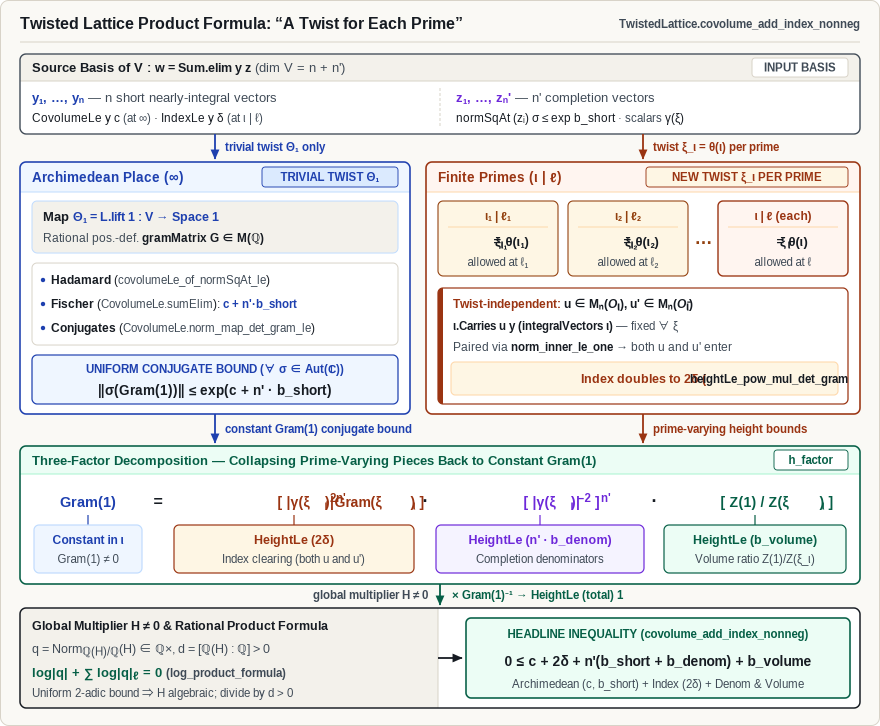
In this proof, however, no single classical integer grid works at every prime simultaneously. The automorphic lifts attached to a fixed level can misbehave at bad primes unless you switch to an auxiliary version of the space whose level avoids that prime. To handle this, the proof replaces a single integer grid with a structure that measures lengths in one fixed standard space while checking divisibility across a family of prime-dependent spacestwisted lattice:
- At infinity (ordinary size): lengths and volumes are measured once and for all in the single standard space (the "trivial twist"
), using a rational inner-product matrix so that every symmetry of the two-dimensional number system of real and imaginary partscomplex plane preserves the ruler cleanly. From this standard space we measure the squared -dimensional volume of a list of vectors, computed as the determinant of their pairwise inner productsGram determinant. - At each finite prime
: divisibility is checked across every auxiliary space ("twist") allowed at . A vector is considered integral at a prime place if its image is integral in all twists allowed at that prime.
Now suppose you have
You perform a three-way currency conversion on the basis's Gram determinant at the trivial twist,
- Switch from the trivial twist
to a prime-specific allowed twist , paying the exact geometric exchange rate between the two spaces. - Clear the denominators of the
completion vectors using a scalar , and record the cost of putting that scalar back in. - Clear the near-integrality error ("index") of the
vectors using a single prime-level clearing matrix that works simultaneously for every allowed twist at .
Because inner products pair vectors with their conjugates, the clearing matrix enters twice—once for the embedding and once for its conjugate—giving a factor of
Where this analogy breaks
Describing the exchange rate Heights.lean. The twists
Level 2 — Undergrad Bridge
1. Why a single New.TwistedLattice splits the roles
In a classical geometry-of-numbers argument, a single lattice
New.TwistedLattice V T (src/New/Reduction/Lattices/TwistedLattice.lean:113-138) axiomatizes exactly this separation:
- Twisted inner product spaces and lifts: for each
, a complex inner product space Space ξand a-linear map , together with a predicate IsAllowed l ξspecifying which twists are permitted at a prime. -adic lattices and conjugate pairing: for each PrimePadicIso—inducing the valuation subring and conjugate isomorphism ( PrimePadicIso.conj)—eachSpace ξcarries an-submodule L.lattice ξ ι. WheneverIsAllowed ι.prime ξholds, the pairing axiomnorm_inner_le_onerequiresA vector belongs to L.integralVectors ιif and only iffor every twist allowed at ( mem_integralVectors).- Rational coordinates at the trivial twist
: Space 1has finite coordinatescoord : Space 1 →ₗ[ℂ] Coord → ℂand a rational matrixgramMatrix : Matrix Coord Coord ℚwhose complexification is positive-definite (posDef_gramMatrix) and represents the inner product (inner_eq):
2. Index (IndexLe), covolume (CovolumeLe), and volume (Z(ξ))
Index (IndexLe) and why it enters with a factor of PrimePadicIso.Carries u y M a) if L.IndexLe y δ (TwistedLattice.lean:163-168) if there exist ι.Carries u y (L.integralVectors ι) (e ι.prime). Crucially, L.integralVectors ι (the intersection over all twists allowed at IndexLe is established from submodule colength bounds (ColengthDvd M (L.integralVectors ι) (l^j)) via indexLe_of_colengthDvd (which uses inv_pow_le_norm_of_dvd) and assembled across unions by block-diagonal matrices (Carries.fromBlocks, IndexLe.sumElim, indexLe_card_mul).
To see why norm_inner_le_one pairs lattice ξ ι.conj with lattice ξ ι, yielding norm_det_mul_det_gram_le_one:
When exists_matrix_elim_mem_lattice forms block-diagonal clearing matrices norm_pow_mul_det_gram_le (TwistedLattice.lean:389-419) rearranges the product into
Both clearing determinants contribute
Covolume (CovolumeLe), conjugates, Hadamard, and Fischer. For any L.conjCoord σ y := σ ∘ L.coord (L.lift 1 y) and L.normSqAt y σ := Re((conjCoord σ y)* G (conjCoord σ y)). A family L.CovolumeLe y c if CovolumeLe immediately usable:
- Galois conjugates (
CovolumeLe.norm_map_det_gram_le): Sincehas rational entries, applying to yields map_inner_lift_one:Cauchy–Schwarz on the exterior power ( norm_det_pairing_sq_le) gives, hence for every . - Hadamard's inequality (
covolumeLe_of_normSqAt_le): IfL.normSqAt (z i) σ ≤ exp hfor alland all , then L.CovolumeLe z (n * h). - Fischer's inequality (
CovolumeLe.sumElim): IfL.CovolumeLe y candL.CovolumeLe z c', then the block Gram matrix ofSum.elim y zsatisfies, giving L.CovolumeLe (Sum.elim y z) (c + c').
Volume (L.volume ξ). Assuming L.volume ξ := (L.lift ξ).normDet ^ 2 (TwistedLattice.lean:336) represents volume_ne_zero), and for any basis finrank ℂ V = n + n'), det_gram_comp gives the basis-factorization identity
3. Heights with a single global multiplier (Heights.lean) and "A Twist for Each Prime"
For a family New.HeightLe c y (src/New/Reduction/Lattices/Heights.lean:45-52) asserts the existence of a single nonzero global multiplier
for all , for all , and for every finite set of primes.
Because HeightLe.mul, HeightLe.pow, HeightLe.prod) even when each prime uses a different twist HeightLe.of_le (taking norm_pow_mul_det_gram_le gives heightLe_pow_mul_det_gram: the family
This prepares the headline theorem New.TwistedLattice.covolume_add_index_nonneg (TwistedLattice.lean:454-485): given injective lifts
we conclude
The proof is a 20-line chain of three steps:
- Exact three-factor decomposition of
( h_factor). Sincewith and , the basis determinant cancels identically at every : By heightLe_pow_mul_det_gram,hγ.pow n',hZ, andHeightLe.mul, the constant familyhas height at most . - Uniform conjugate bound on
. Combining hcwith Hadamard (covolumeLe_of_normSqAt_le hz_short) via Fischer (CovolumeLe.sumElim) andCovolumeLe.norm_map_det_gram_leyieldsfor every , while linear independence of and injectivity of give . - Product formula via
HeightLe.neg_le_of_norm_map_le. Multiplying the constant familyby the constant family (which has height by HeightLe.inv_const) producesHeightLe (c + n' b_short + 2δ + n' b_denom + b_volume) 1. InsideHeightLe.nonneg_of_one(Heights.lean:195-225), uniform-adic boundedness of the global multiplier across all forces to be algebraic over ( isAlgebraic_of_norm_complexToCp_le). Settingand , norm_algebraMap_norm_gen_leboundsand . Applying the rational log_product_formula() gives and dividing by completes the proof.
Level 3 — Formal Lean Contract
The extracted Stage 01 skeleton below reproduces the complete public API of src/New/Reduction/Lattices/TwistedLattice.lean (lines 55–485) at pinned upstream commit 41c2716658c42ba08eb0648994a2efe83082a95c (short 41c2716658c4), preserving the exact PrimePadicIso.Carries and New.TwistedLattice structure definitions while replacing proof bodies with deterministic SHA-256 extraction stubs. Together with New.HeightLe and New.log_product_formula in src/New/Reduction/Lattices/Heights.lean, New.TwistedLattice.covolume_add_index_nonneg is the exact interface invoked by Stages 05–07 (New.Determinant.Twist.LongForms) to deduce Theorem C (D.integral_forms_long) for The Main Inequality & Theorems A and B.
Verification status (audit/verification-status.json): Local Lean build verification is unverified-locally (scan_scope: entry, pinned commit 41c2716658c42ba08eb0648994a2efe83082a95c, 0 forbidden tokens in src/Main.lean, 5 expected sorry tokens in root Challenge.lean).
abbrev New.PrimePadicIso.conj — Upstream source (src/New/Reduction/Lattices/TwistedLattice.lean L55-L56)
/-- The isomorphism `ῑ`, with `ῑ z = ι z̄`. -/
abbrev New.PrimePadicIso.conj : PrimePadicIso := by
  sorry -- [EXTRACTED_STUB upstream=src/New/Reduction/Lattices/TwistedLattice.lean:55-56 commit=41c2716658c42ba08eb0648994a2efe83082a95c body_lines=1 body_sha256=de6626dffe41c1b5d910d757ddc2cda5dc70490f29891ea4f953e303aa668f76]
abbrev New.PrimePadicIso.place — Upstream source (src/New/Reduction/Lattices/TwistedLattice.lean L58-L59)
/-- The embedding `ℂ → ℂ_l` given by `ι ∣ l`. -/
abbrev New.PrimePadicIso.place : PadicPlace ι.prime := by
  sorry -- [EXTRACTED_STUB upstream=src/New/Reduction/Lattices/TwistedLattice.lean:58-59 commit=41c2716658c42ba08eb0648994a2efe83082a95c body_lines=1 body_sha256=2d8312ad6b16661b5ad943198494ba6550dd4fa6ad2d11ea533b034ae9e9229d]
abbrev New.PrimePadicIso.integers — Upstream source (src/New/Reduction/Lattices/TwistedLattice.lean L61-L62)
/-- The valuation ring `𝒪_ι` of the valuation that `ι` induces on `ℂ`. -/
abbrev New.PrimePadicIso.integers : ValuationSubring ℂ := by
  sorry -- [EXTRACTED_STUB upstream=src/New/Reduction/Lattices/TwistedLattice.lean:61-62 commit=41c2716658c42ba08eb0648994a2efe83082a95c body_lines=1 body_sha256=31cabcccb0a35d8cab8dffa56fca2bc75cc8c302c64a689975594708a86bf0a0]
lemma New.PrimePadicIso.conj_snd_apply — Upstream source (src/New/Reduction/Lattices/TwistedLattice.lean L64-L64)
lemma New.PrimePadicIso.conj_snd_apply (z : ℂ) : ι.conj.iso z = ι.iso (starRingEnd ℂ z) := by
  sorry -- [EXTRACTED_STUB upstream=src/New/Reduction/Lattices/TwistedLattice.lean:64-64 commit=41c2716658c42ba08eb0648994a2efe83082a95c body_lines=1 body_sha256=5a633da644c1afc6f5222be040e6a19d687c01104c0263cce32773e07376dfa8]
lemma New.PrimePadicIso.norm_place — Upstream source (src/New/Reduction/Lattices/TwistedLattice.lean L66-L67)
/-- The embedding `ℂ → ℂ_l` given by `ι ∣ l` induces the same absolute value on `ℂ` as `ι`. -/
lemma New.PrimePadicIso.norm_place (x : ℂ) : ‖ι.place.ιₚ x‖ = ‖ι.iso x‖ := by
  sorry -- [EXTRACTED_STUB upstream=src/New/Reduction/Lattices/TwistedLattice.lean:66-67 commit=41c2716658c42ba08eb0648994a2efe83082a95c body_lines=1 body_sha256=b14e21b810c76f35ee92ae549198603076d2b41308e65246ec1ab7ca39563794]
lemma New.PrimePadicIso.inv_pow_le_norm_of_dvd — Upstream source (src/New/Reduction/Lattices/TwistedLattice.lean L69-L75)
/-- Let `ι` consist of the prime `l = ι.prime` and the isomorphism `ι.iso : ℂ ≃ ℚ̄_l`. If `x`
divides `l ^ j` in the valuation ring `𝒪_ι`, then `‖ι x‖ ≥ l ^ (-j)`. -/
lemma New.PrimePadicIso.inv_pow_le_norm_of_dvd {x : ι.integers} {j : ℕ} (hx : x ∣ ((ι.prime : ℕ) : ι.integers) ^ j) :
    (((ι.prime : ℕ) : ℝ) ^ j)⁻¹ ≤ ‖ι.iso (x : ℂ)‖ := by
  sorry -- [EXTRACTED_STUB upstream=src/New/Reduction/Lattices/TwistedLattice.lean:69-75 commit=41c2716658c42ba08eb0648994a2efe83082a95c body_lines=4 body_sha256=42c59b856b4506d6d3986e755e2fdf8ccef045f71f605b11b8e668a34e0f69c2]
structure New.PrimePadicIso.Carries — Upstream source (src/New/Reduction/Lattices/TwistedLattice.lean L77-L84)
/-- The square matrix `u` over `𝒪_ι` carries the family `y` into `M` with loss `a`: the combinations
`∑ u_ik y_k` lie in `M`, and the valuation of `det u` at `ι` is at most `a`. -/
structure New.PrimePadicIso.Carries {S W : Type} [Fintype S] [DecidableEq S] [AddCommGroup W] [Module ι.integers W]
    (u : Matrix S S ι.integers) (y : S → W) (M : Submodule ι.integers W) (a : ℝ) : Prop where
  /-- `‖ι (det u)‖ ≥ l ^ (-a)`: the valuation of `det u` at `ι ∣ l` is at most `a`. -/
  le_norm_det : ((ι.prime : ℕ) : ℝ) ^ (-a) ≤ ‖ι.iso (u.det : ℂ)‖
  /-- The combinations `∑ u_ik y_k` lie in `M`. -/
  sum_smul_mem (i : S) : ∑ k : S, u i k • y k ∈ M
lemma New.PrimePadicIso.Carries.fromBlocks — Upstream source (src/New/Reduction/Lattices/TwistedLattice.lean L86-L102)
/-- Let `ι` consist of a prime `l` and an isomorphism `ℂ ≃ ℚ̄_l`, and let `𝒪_ι = ι.integers` be the
ring of complex numbers `x` with `‖ι x‖ ≤ 1`. If `u` carries `y` into `M` with loss `a` and `u'`
carries `y'` into `M` with loss `a'`, then the block diagonal matrix with blocks `u` and `u'`
carries the union of the two families into `M` with loss `a + a'`. -/
lemma New.PrimePadicIso.Carries.fromBlocks {ι : PrimePadicIso} {S S' W : Type} [Fintype S] [Fintype S']
    [DecidableEq S] [DecidableEq S'] [AddCommGroup W] [Module ι.integers W]
    {M : Submodule ι.integers W} {u : Matrix S S ι.integers} {u' : Matrix S' S' ι.integers}
    {y : S → W} {y' : S' → W} {a a' : ℝ}
    (hu : ι.Carries u y M a) (hu' : ι.Carries u' y' M a') :
    ι.Carries (fromBlocks u 0 0 u') (Sum.elim y y') M (a + a') := by
  sorry -- [EXTRACTED_STUB upstream=src/New/Reduction/Lattices/TwistedLattice.lean:86-102 commit=41c2716658c42ba08eb0648994a2efe83082a95c body_lines=8 body_sha256=68da4a7b7a1886301c2af3dbe5824286eef30066e2f89dbe622e4d8ae764d357]
abbrev New.conjAut — Upstream source (src/New/Reduction/Lattices/TwistedLattice.lean L106-L107)
/-- The automorphism `σ'` of `ℂ`, with `σ' z = conj (σ (conj z))`. -/
abbrev New.conjAut (σ : ℂ ≃+* ℂ) : ℂ ≃+* ℂ := by
  sorry -- [EXTRACTED_STUB upstream=src/New/Reduction/Lattices/TwistedLattice.lean:106-107 commit=41c2716658c42ba08eb0648994a2efe83082a95c body_lines=1 body_sha256=a962c946bcdd3523380dbbacd83fb66e986aeea06098f3dd3447920494778e45]
structure New.TwistedLattice — Upstream source (src/New/Reduction/Lattices/TwistedLattice.lean L109-L138)
/-- A twisted lattice on `V`, with twists `ξ : T` and trivial twist `1`: linear maps `Θ_ξ` to inner
product spaces, in each of them a module of vectors integral at `ι`, such that, if `ξ` is allowed at
the prime of `ι`, products of vectors integral at `ῑ` with vectors integral at `ι` are integral at
`ι`, and coordinates for the trivial twist in which the inner product has a rational matrix. -/
structure New.TwistedLattice (V T : Type) [AddCommGroup V] [Module ℂ V] [One T] where
  /-- The inner product space for the twist `ξ`. -/
  Space : T → Type
  [normedAddCommGroup (ξ : T) : NormedAddCommGroup (Space ξ)]
  [innerProductSpace (ξ : T) : InnerProductSpace ℂ (Space ξ)]
  /-- The map `Θ_ξ`. -/
  lift (ξ : T) : V →ₗ[ℂ] Space ξ
  /-- The twist `ξ` is allowed at the prime `l`. -/
  IsAllowed : ℕ → T → Prop
  /-- The vectors for the twist `ξ` that are integral at `ι`. -/
  lattice (ξ : T) (ι : PrimePadicIso) : Submodule ι.integers (Space ξ)
  /-- For `ξ` allowed at the prime of `ι`, the product of a vector integral at `ῑ` and a vector
  integral at `ι` is integral at `ι`. -/
  norm_inner_le_one {ξ : T} (ι : PrimePadicIso) (hξ : IsAllowed ι.prime ξ) :
    ∀ φ ∈ lattice ξ ι.conj, ∀ φ' ∈ lattice ξ ι, ‖ι.iso ⟪φ, φ'⟫_ℂ‖ ≤ 1
  /-- The set of coordinates on the space for the trivial twist. -/
  Coord : Type
  [fintypeCoord : Fintype Coord]
  /-- The coordinates of a vector. -/
  coord : Space 1 →ₗ[ℂ] Coord → ℂ
  /-- The rational matrix of the inner product in these coordinates. -/
  gramMatrix : Matrix Coord Coord ℚ
  /-- The matrix defines an inner product on all coordinate vectors. -/
  posDef_gramMatrix : (gramMatrix.map (↑) : Matrix Coord Coord ℂ).PosDef
  /-- The inner product is the one induced from coordinate vectors. -/
  inner_eq (φ φ' : Space 1) : ⟪φ, φ'⟫_ℂ = star (coord φ) ⬝ᵥ gramMatrix.map (↑) *ᵥ coord φ'
def New.TwistedLattice.integralVectors — Upstream source (src/New/Reduction/Lattices/TwistedLattice.lean L148-L152)
/-- The vectors of `V` that are integral at `ι ∣ l`: those `y` for which `Θ_ξ y` is integral at `ι`
for every twist `ξ` allowed at `l`. -/
def New.TwistedLattice.integralVectors (ι : PrimePadicIso) : Submodule ι.integers V := by
  sorry -- [EXTRACTED_STUB upstream=src/New/Reduction/Lattices/TwistedLattice.lean:148-152 commit=41c2716658c42ba08eb0648994a2efe83082a95c body_lines=2 body_sha256=1799cc896b40a9d9d78b5f625b62962cc1d0ba5c22c636f420652df60402db1d]
lemma New.TwistedLattice.mem_integralVectors — Upstream source (src/New/Reduction/Lattices/TwistedLattice.lean L154-L156)
lemma New.TwistedLattice.mem_integralVectors {L : TwistedLattice V T} {ι : PrimePadicIso} {y : V} :
    y ∈ L.integralVectors ι ↔ ∀ ξ : T, L.IsAllowed ι.prime ξ → L.lift ξ y ∈ L.lattice ξ ι := by
  sorry -- [EXTRACTED_STUB upstream=src/New/Reduction/Lattices/TwistedLattice.lean:154-156 commit=41c2716658c42ba08eb0648994a2efe83082a95c body_lines=2 body_sha256=b2e74718886c010fdfc4d1151f3ce57fc361c61e7318c7d128ae48024b6ca19d]
def New.TwistedLattice.IndexLe — Upstream source (src/New/Reduction/Lattices/TwistedLattice.lean L160-L168)
/-- The family `y` has index at most `δ`: there are numbers `δ_l = e l ≥ 0` with `∑ δ_l log l ≤ δ`,
the sum taken over primes, such that for every `ι ∣ l` some matrix over `𝒪_ι` carries the family
into the vectors integral at `ι` with loss `δ_l`. The matrix does not depend on the twist. -/
def New.TwistedLattice.IndexLe (y : S → V) (δ : ℝ) : Prop := by
  sorry -- [EXTRACTED_STUB upstream=src/New/Reduction/Lattices/TwistedLattice.lean:160-168 commit=41c2716658c42ba08eb0648994a2efe83082a95c body_lines=5 body_sha256=d81bfa501ef945a6ffb9320ed95ea505ce0d8ab335762447319346905b430a7d]
lemma New.TwistedLattice.IndexLe.mono — Upstream source (src/New/Reduction/Lattices/TwistedLattice.lean L172-L174)
lemma New.TwistedLattice.IndexLe.mono {y : S → V} {δ δ' : ℝ} (hy : L.IndexLe y δ) (hδ : δ ≤ δ') : L.IndexLe y δ' := by
  sorry -- [EXTRACTED_STUB upstream=src/New/Reduction/Lattices/TwistedLattice.lean:172-174 commit=41c2716658c42ba08eb0648994a2efe83082a95c body_lines=3 body_sha256=1ac302fcde3bbfc9510f509085bc03d4785905de75c569da9a959e31b67272a2]
lemma New.TwistedLattice.IndexLe.of_comp_equiv — Upstream source (src/New/Reduction/Lattices/TwistedLattice.lean L176-L184)
/-- Let `L` be a twisted lattice on `V`. The index does not depend on the numbering of the family:
if `y ∘ f` has index at most `δ` for a bijection `f`, then so has `y`. -/
lemma New.TwistedLattice.IndexLe.of_comp_equiv {y : S → V} {δ : ℝ} (f : S' ≃ S) (hy : L.IndexLe (y ∘ f) δ) :
    L.IndexLe y δ := by
  sorry -- [EXTRACTED_STUB upstream=src/New/Reduction/Lattices/TwistedLattice.lean:176-184 commit=41c2716658c42ba08eb0648994a2efe83082a95c body_lines=6 body_sha256=78f844e45547a96f13c192bfd09921b41723721a3f0ae2edbf6b45e6edcd5de2]
lemma New.TwistedLattice.indexLe_of_colengthDvd — Upstream source (src/New/Reduction/Lattices/TwistedLattice.lean L186-L207)
/-- Let `L` be a twisted lattice on `V`, and let `e l ≥ 0` with `∑ e l log l ≤ δ` over every finite
set of primes. Suppose that for every prime `l` and every `ι ∣ l` (so `l = ι.prime`) the family `y`
lies in an `𝒪_ι`-module `M` all of whose finite families are taken into the vectors integral at `ι`
by matrices with determinant dividing `l ^ j` (`New.ColengthDvd`), where `j ≤ e l`. Then `y` has
index at most `δ` (`IndexLe`): for some `δ_l ≥ 0` with `∑ δ_l log l ≤ δ` and each `ι ∣ l`, a matrix
`u` over `𝒪_ι` with `‖ι (det u)‖ ≥ l ^ (-δ_l)` takes `y` into the vectors integral at `ι`. -/
lemma New.TwistedLattice.indexLe_of_colengthDvd {n : ℕ} {y : Fin n → V} {δ : ℝ} {e : ℕ → ℝ}
    (he_nonneg : ∀ l : ℕ, 0 ≤ e l)
    (he_sum : ∀ U : Finset ℕ, (∀ l ∈ U, l.Prime) → ∑ l ∈ U, e l * log l ≤ δ)
    (h_local : ∀ ι : PrimePadicIso, ∃ (j : ℕ) (M : Submodule ι.integers V),
      j ≤ e ι.prime ∧ (∀ i : Fin n, y i ∈ M) ∧ ColengthDvd M (L.integralVectors ι)
        ((ι.prime : ℕ) ^ j)) :
    L.IndexLe y δ := by
  sorry -- [EXTRACTED_STUB upstream=src/New/Reduction/Lattices/TwistedLattice.lean:186-207 commit=41c2716658c42ba08eb0648994a2efe83082a95c body_lines=10 body_sha256=019d9e3f40680ec2e72cb4eea68db247cfba714b9b4e0bff682dab8590def683]
lemma New.TwistedLattice.IndexLe.sumElim — Upstream source (src/New/Reduction/Lattices/TwistedLattice.lean L209-L219)
/-- Let `L` be a twisted lattice on `V`. If two families have index at most `δ` and `δ'`, then their
union `Sum.elim y y'` has index at most `δ + δ'`. -/
lemma New.TwistedLattice.IndexLe.sumElim {y : S → V} {y' : S' → V} {δ δ' : ℝ} (hy : L.IndexLe y δ)
    (hy' : L.IndexLe y' δ') : L.IndexLe (Sum.elim y y') (δ + δ') := by
  sorry -- [EXTRACTED_STUB upstream=src/New/Reduction/Lattices/TwistedLattice.lean:209-219 commit=41c2716658c42ba08eb0648994a2efe83082a95c body_lines=8 body_sha256=37ec173327eb0f42a1c9a2eb2345b745162c1df44c267a050814f6efebd3f5ca]
lemma New.TwistedLattice.indexLe_card_mul — Upstream source (src/New/Reduction/Lattices/TwistedLattice.lean L221-L245)
/-- Let `t` be a finite set of indices, and suppose that for each `s ∈ t` every finite family in the
set `A s ⊆ V` has index at most `δ`. Then a finite family `y` with all its members in the union of
these sets has index at most `#t δ`. -/
lemma New.TwistedLattice.indexLe_card_mul {y : S → V} {δ : ℝ} {κ : Type} {A : κ → Set V} (t : Finset κ)
    (hA : ∀ s ∈ t, ∀ (n : ℕ) (z : Fin n → V), (∀ i : Fin n, z i ∈ A s) → L.IndexLe z δ)
    (hy : ∀ i : S, ∃ s ∈ t, y i ∈ A s) :
    L.IndexLe y (#t * δ) := by
  sorry -- [EXTRACTED_STUB upstream=src/New/Reduction/Lattices/TwistedLattice.lean:221-245 commit=41c2716658c42ba08eb0648994a2efe83082a95c body_lines=19 body_sha256=6f04ff7abee0c3c8d1674181c8a8062884a3f20a2fad8d9234c95e34b17643b2]
def New.TwistedLattice.conjCoord — Upstream source (src/New/Reduction/Lattices/TwistedLattice.lean L254-L255)
/-- The coordinates of `σ Θ₁ y`: those of `Θ₁ y`, with `σ` applied to each of them. -/
def New.TwistedLattice.conjCoord (σ : ℂ ≃+* ℂ) (y : V) : L.Coord → ℂ := by
  sorry -- [EXTRACTED_STUB upstream=src/New/Reduction/Lattices/TwistedLattice.lean:254-255 commit=41c2716658c42ba08eb0648994a2efe83082a95c body_lines=1 body_sha256=8901a6f7b4314f98c028603f3f0b75a8a607d5027d4454db4b796ab76e4a66d9]
def New.TwistedLattice.normSqAt — Upstream source (src/New/Reduction/Lattices/TwistedLattice.lean L257-L260)
/-- The number `‖Θ₁ y‖_σ² = ⟨σ Θ₁ y, σ Θ₁ y⟩`, with the product given by the rational matrix
`L.gramMatrix` on coordinate vectors. -/
def New.TwistedLattice.normSqAt (y : V) (σ : ℂ ≃+* ℂ) : ℝ := by
  sorry -- [EXTRACTED_STUB upstream=src/New/Reduction/Lattices/TwistedLattice.lean:257-260 commit=41c2716658c42ba08eb0648994a2efe83082a95c body_lines=1 body_sha256=a16f7ed7e5c1a5404f126bcc5c88fc9e2631d588ceac000d2b891fa612dd15a1]
def New.TwistedLattice.CovolumeLe — Upstream source (src/New/Reduction/Lattices/TwistedLattice.lean L262-L266)
/-- The family `y` has covolume at most `c`: for every automorphism `σ` of `ℂ` the determinant of
the products `⟨σ Θ₁ y_i, σ Θ₁ y_k⟩`, taken by the rational Gram matrix on the coordinate vectors
`L.conjCoord σ (y i)`, has absolute value at most `exp c`. -/
def New.TwistedLattice.CovolumeLe (y : S → V) (c : ℝ) : Prop := by
  sorry -- [EXTRACTED_STUB upstream=src/New/Reduction/Lattices/TwistedLattice.lean:262-266 commit=41c2716658c42ba08eb0648994a2efe83082a95c body_lines=1 body_sha256=46779ee3e42fe2502d47a1192e510d6233d1b0df80e43b99c9dd7a2910128fad]
lemma New.TwistedLattice.map_inner_lift_one — Upstream source (src/New/Reduction/Lattices/TwistedLattice.lean L270-L276)
/-- Since the Gram matrix `L.gramMatrix` is rational, `σ ⟪Θ₁ v, Θ₁ w⟫ = ⟨σ' Θ₁ v, σ Θ₁ w⟩`, where
`Θ₁ = L.lift 1` and `σ' = conjAut σ`, with `σ' z = conj (σ (conj z))`; the right side pairs the
coordinate vectors `L.conjCoord` by the Gram matrix. -/
lemma New.TwistedLattice.map_inner_lift_one (σ : ℂ ≃+* ℂ) (v w : V) :
    σ ⟪L.lift 1 v, L.lift 1 w⟫_ℂ =
      star (L.conjCoord (conjAut σ) v) ⬝ᵥ L.gramMatrix.map (↑) *ᵥ L.conjCoord σ w := by
  sorry -- [EXTRACTED_STUB upstream=src/New/Reduction/Lattices/TwistedLattice.lean:270-276 commit=41c2716658c42ba08eb0648994a2efe83082a95c body_lines=2 body_sha256=367b5120918f584b56b00349df53ffa2b8093f79a4d8065b7f0ec97f10d56619]
lemma New.TwistedLattice.CovolumeLe.norm_map_det_gram_le — Upstream source (src/New/Reduction/Lattices/TwistedLattice.lean L278-L299)
/-- **Gram determinants, conjugates.** Let `L` be a twisted lattice on `V`, with map `Θ₁ = L.lift 1`
for the trivial twist. For an automorphism `τ` of `ℂ`, write `τ Θ₁ v` for the coordinate vector of
`Θ₁ v` with `τ` applied to each coordinate (`conjCoord`); such vectors are paired by the rational
matrix `L.gramMatrix` of the inner product. If `y` has covolume at most `c`, that is,
`|det ⟨τ Θ₁ y_i, τ Θ₁ y_k⟩| ≤ exp c` for all `τ`, then `|σ Gram(1)| ≤ exp c` for every automorphism
`σ`, where `Gram(1) = det ⟨Θ₁ y_i, Θ₁ y_k⟩`. -/
lemma New.TwistedLattice.CovolumeLe.norm_map_det_gram_le {y : S → V} {c : ℝ} (hy : L.CovolumeLe y c) (σ : ℂ ≃+* ℂ) :
    ‖σ (gram ℂ (L.lift 1 ∘ y)).det‖ ≤ exp c := by
  sorry -- [EXTRACTED_STUB upstream=src/New/Reduction/Lattices/TwistedLattice.lean:278-299 commit=41c2716658c42ba08eb0648994a2efe83082a95c body_lines=15 body_sha256=02f3017834e9ca2c3702b81809b06fef1e2edf9630833eef2a24ae70ea874286]
lemma New.TwistedLattice.covolumeLe_of_normSqAt_le — Upstream source (src/New/Reduction/Lattices/TwistedLattice.lean L301-L310)
/-- Let `L` be a twisted lattice on `V`, with map `Θ₁ = L.lift 1` for the trivial twist. For an
automorphism `σ` of `ℂ`, apply `σ` to the coordinates of `Θ₁ v` and pair the results by the rational
Gram matrix: `L.normSqAt v σ = ‖Θ₁ v‖_σ²` is the product of such a vector with itself, and a family
has covolume at most `c` (`CovolumeLe`) if for every `σ` the determinant of these products of its
members has absolute value at most `exp c`. If `‖Θ₁ z_i‖_σ² ≤ exp h` for all `i` and `σ`, then
`z_1, …, z_n` has covolume at most `n h`. This is Hadamard's inequality. -/
lemma New.TwistedLattice.covolumeLe_of_normSqAt_le {n : ℕ} {z : Fin n → V} {h : ℝ}
    (hz : ∀ (i : Fin n) (σ : ℂ ≃+* ℂ), L.normSqAt (z i) σ ≤ exp h) :
    L.CovolumeLe z (n * h) := by
  sorry -- [EXTRACTED_STUB upstream=src/New/Reduction/Lattices/TwistedLattice.lean:301-310 commit=41c2716658c42ba08eb0648994a2efe83082a95c body_lines=1 body_sha256=8195abd389c0b80c67fb4f1f66b7c53186c37bfddc08ee9ad488f8a3fd3e5450]
lemma New.TwistedLattice.CovolumeLe.sumElim — Upstream source (src/New/Reduction/Lattices/TwistedLattice.lean L312-L325)
/-- **Gram determinants, adjoining vectors.** If two families have covolume at most `c` and
`c'`, their union has covolume at most `c + c'` by Fischer's inequality. -/
lemma New.TwistedLattice.CovolumeLe.sumElim {S' : Type} [Fintype S'] [DecidableEq S']
    {y : S → V} {z : S' → V} {c c' : ℝ} (hy : L.CovolumeLe y c) (hz : L.CovolumeLe z c') :
    L.CovolumeLe (Sum.elim y z) (c + c') := by
  sorry -- [EXTRACTED_STUB upstream=src/New/Reduction/Lattices/TwistedLattice.lean:312-325 commit=41c2716658c42ba08eb0648994a2efe83082a95c body_lines=10 body_sha256=edae3cf0717eb670961c5db9b3da7a651cd97072f01e71fe0fd0ab56cd160cd0]
def New.TwistedLattice.volume — Upstream source (src/New/Reduction/Lattices/TwistedLattice.lean L334-L336)
/-- The number `Z(ξ) = det (Θ_ξ* Θ_ξ)`, the Gram determinant of the images of an orthonormal basis
of `V`. -/
def New.TwistedLattice.volume (ξ : T) : ℂ := by
  sorry -- [EXTRACTED_STUB upstream=src/New/Reduction/Lattices/TwistedLattice.lean:334-336 commit=41c2716658c42ba08eb0648994a2efe83082a95c body_lines=1 body_sha256=e835d6ef1bf83f2c4b71f588ca817b114816db653ebaf2481038afb8e29da9ed]
lemma New.TwistedLattice.volume_ne_zero — Upstream source (src/New/Reduction/Lattices/TwistedLattice.lean L340-L341)
lemma New.TwistedLattice.volume_ne_zero {ξ : T} (h_inj : Function.Injective (L.lift ξ)) : L.volume ξ ≠ 0 := by
  sorry -- [EXTRACTED_STUB upstream=src/New/Reduction/Lattices/TwistedLattice.lean:340-341 commit=41c2716658c42ba08eb0648994a2efe83082a95c body_lines=2 body_sha256=c18f9290dec83b842508fbbfbbde03573f76f8dc3ef568d1b7be9a6dae323d2a]
lemma New.TwistedLattice.norm_det_mul_det_gram_le_one — Upstream source (src/New/Reduction/Lattices/TwistedLattice.lean L347-L359)
/-- **Gram determinants, valuations.** Let `L` be a twisted lattice on `V` with maps
`Θ_ξ = L.lift ξ`. Let `ι` consist of a prime `l` and an isomorphism `ι.iso : ℂ ≃ ℚ̄_l`, and let
`ῑ z = ι z̄`. Let `ξ` be allowed at `l`. If `u` takes the vectors `Θ_ξ w_i` to vectors integral at
`ι` and `u'` takes them to vectors integral at `ῑ`, then
`‖ι (conj (det u') · Gram(ξ) · det u)‖ ≤ 1`, where `Gram(ξ) = det ⟨Θ_ξ w_i, Θ_ξ w_k⟩`. -/
lemma New.TwistedLattice.norm_det_mul_det_gram_le_one {ι : PrimePadicIso} {ξ : T} (hξ : L.IsAllowed ι.prime ξ)
    {S : Type} [Fintype S] [DecidableEq S] {w : S → V} {u u' : Matrix S S ℂ}
    (hu : ∀ i : S, ∑ k : S, u i k • L.lift ξ (w k) ∈ L.lattice ξ ι)
    (hu' : ∀ i : S, ∑ k : S, u' i k • L.lift ξ (w k) ∈ L.lattice ξ ι.conj) :
    ‖ι.conj.iso u'.det‖ * ‖ι.iso (gram ℂ (L.lift ξ ∘ w)).det‖ * ‖ι.iso u.det‖ ≤ 1 := by
  sorry -- [EXTRACTED_STUB upstream=src/New/Reduction/Lattices/TwistedLattice.lean:347-359 commit=41c2716658c42ba08eb0648994a2efe83082a95c body_lines=4 body_sha256=39afd8ee8f413468e0b68b92b61629a9265a7f9e0fa2b2b8a3008fd4cc6d7106]
lemma New.TwistedLattice.exists_matrix_elim_mem_lattice — Upstream source (src/New/Reduction/Lattices/TwistedLattice.lean L361-L381)
/-- Let `L` be a twisted lattice with maps `Θ_ξ = L.lift ξ`, let `ι ∣ l`, and let the twist `ξ` be
allowed at `l`. Let `u` take `y` into `L.integralVectors ι`, and let the vectors `γ Θ_ξ z_i` be
integral at `ι`. Then a matrix `v` with `det v = det u · γ ^ n'` takes
`Θ_ξ y_1, …, Θ_ξ y_n, Θ_ξ z_1, …, Θ_ξ z_n'` to vectors integral at `ι`. -/
lemma New.TwistedLattice.exists_matrix_elim_mem_lattice {n n' : ℕ} {y : Fin n → V} {z : Fin n' → V}
    {ι : PrimePadicIso} {ξ : T} (hξ : L.IsAllowed ι.prime ξ) {u : Matrix (Fin n) (Fin n) ι.integers}
    (hu : ∀ i : Fin n, ∑ k : Fin n, u i k • y k ∈ L.integralVectors ι) {γ : ℂ}
    (hz : ∀ i : Fin n', γ • L.lift ξ (z i) ∈ L.lattice ξ ι) :
    ∃ v : Matrix (Fin n ⊕ Fin n') (Fin n ⊕ Fin n') ℂ,
      v.det = u.det * γ ^ n' ∧
      ∀ i : Fin n ⊕ Fin n',
        ∑ k : Fin n ⊕ Fin n', v i k • L.lift ξ (Sum.elim y z k) ∈ L.lattice ξ ι := by
  sorry -- [EXTRACTED_STUB upstream=src/New/Reduction/Lattices/TwistedLattice.lean:361-381 commit=41c2716658c42ba08eb0648994a2efe83082a95c body_lines=10 body_sha256=8598b43dcafb57d043d5c75cc2e1739f8a3113a6d462d8a00cc419cc17b32448]
lemma New.TwistedLattice.norm_pow_mul_det_gram_le — Upstream source (src/New/Reduction/Lattices/TwistedLattice.lean L383-L419)
/-- Let `L` be a twisted lattice with maps `Θ_ξ = L.lift ξ`. Let `l = ι.prime`, so that
`‖ι x‖ = ‖ι.iso x‖` is the `l`-adic absolute value of `x` under `ι.iso : ℂ ≃ ℚ̄_l`, and let
`ῑ z = ι z̄`. Let `ξ` be allowed at `l`, let `u` carry `y` into the vectors integral at `ι` and `u'`
carry `y` into those integral at `ῑ`, both with loss `a`, and let the vectors `γ Θ_ξ z_i` be
integral both at `ι` and at `ῑ`. Then `‖ι (|γ| ^ (2 n') Gram(ξ))‖ ≤ l ^ (2 a)`, where `Gram(ξ)` is
the Gram determinant of the images of `y_1, …, y_n, z_1, …, z_n'` under `Θ_ξ`. -/
lemma New.TwistedLattice.norm_pow_mul_det_gram_le {n n' : ℕ} {y : Fin n → V}
    {z : Fin n' → V} {ι : PrimePadicIso} {ξ : T} (hξ : L.IsAllowed ι.prime ξ) {a : ℝ}
    {u : Matrix (Fin n) (Fin n) ι.integers} {u' : Matrix (Fin n) (Fin n) ι.conj.integers}
    (hu : ι.Carries u y (L.integralVectors ι) a)
    (hu' : ι.conj.Carries u' y (L.integralVectors ι.conj) a) {γ : ℂ}
    (hz : ∀ i : Fin n', γ • L.lift ξ (z i) ∈ L.lattice ξ ι)
    (hz' : ∀ i : Fin n', γ • L.lift ξ (z i) ∈ L.lattice ξ ι.conj) :
    ‖ι.iso (((‖γ‖ : ℂ) ^ 2) ^ n' * (gram ℂ (L.lift ξ ∘ Sum.elim y z)).det)‖ ≤
      exp (2 * (a * log ι.prime)) := by
  sorry -- [EXTRACTED_STUB upstream=src/New/Reduction/Lattices/TwistedLattice.lean:383-419 commit=41c2716658c42ba08eb0648994a2efe83082a95c body_lines=23 body_sha256=4321be08621cfa0cd07cd365eacb974442cbfda78e86ad419d126cd8d18d2e24]
lemma New.TwistedLattice.heightLe_pow_mul_det_gram — Upstream source (src/New/Reduction/Lattices/TwistedLattice.lean L421-L440)
/-- Let `L` be a twisted lattice with maps `Θ_ξ = L.lift ξ`. Let `y` have index at most `δ`, let
`ξ_ι = θ ι` be allowed at the prime of `ι`, and let the vectors `γ_ι Θ_{ξ_ι} z_i` be integral both
at `ι` and at `ῑ`, where `ῑ z = ι z̄`. Let `Gram(ξ)` be the Gram determinant of the images of
`y_1, …, y_n, z_1, …, z_n'` under `Θ_ξ`. Then the family `x_ι = |γ_ι| ^ (2 n') Gram(ξ_ι)` has height
at most `2 δ` (`New.HeightLe`): for some common `H ≠ 0`, the bounds for `log |σ H|` over
automorphisms `σ` of `ℂ` and for `log ‖ι (H x_ι)‖` at the primes add up to at most `2 δ`. -/
lemma New.TwistedLattice.heightLe_pow_mul_det_gram {n n' : ℕ} {y : Fin n → V} {z : Fin n' → V} {δ : ℝ}
    (hδ : L.IndexLe y δ) {θ : PrimePadicIso → T}
    (hθ : ∀ ι : PrimePadicIso, L.IsAllowed ι.prime (θ ι)) {γ : PrimePadicIso → ℂ}
    (hz : ∀ (ι : PrimePadicIso) (i : Fin n'), γ ι • L.lift (θ ι) (z i) ∈ L.lattice (θ ι) ι)
    (hz' : ∀ (ι : PrimePadicIso) (i : Fin n'), γ ι • L.lift (θ ι) (z i) ∈ L.lattice (θ ι) ι.conj) :
    HeightLe (2 * δ) fun ι : PrimePadicIso ↦
      ((‖γ ι‖ : ℂ) ^ 2) ^ n' * (gram ℂ (L.lift (θ ι) ∘ Sum.elim y z)).det := by
  sorry -- [EXTRACTED_STUB upstream=src/New/Reduction/Lattices/TwistedLattice.lean:421-440 commit=41c2716658c42ba08eb0648994a2efe83082a95c body_lines=8 body_sha256=7145cfa2562dcdbf2e4a57d70480975bad4e036c0b260b8f429bada851fbee1a]
theorem New.TwistedLattice.covolume_add_index_nonneg — Upstream source (src/New/Reduction/Lattices/TwistedLattice.lean L444-L485)
/-- **A twist for each prime.** Let `L` be a twisted lattice on `V` with maps `Θ_ξ = L.lift ξ`, all
injective. Let `y_1, …, y_n, z_1, …, z_n'` be a basis of `V`, and let `ξ_ι = θ ι` be allowed at the
prime of `ι`. Suppose that
* `y` has covolume at most `c` and index at most `δ`;
* `γ(ξ) ≠ 0`, and `γ(ξ) Θ_ξ z_i` is integral at all `ι ∣ l` for `ξ` allowed at `l`;
* `⟨σ Θ₁ z_i, σ Θ₁ z_i⟩ ≤ exp b_short` for all automorphisms `σ` of `ℂ`;
* the families `|γ(ξ_ι)| ^ (-2)` and `Z(1) / Z(ξ_ι)` have height at most `b_denom` and `b_volume`
  respectively.

Then `c + 2 δ + n' (b_short + b_denom) + b_volume ≥ 0`. -/
theorem New.TwistedLattice.covolume_add_index_nonneg {n n' : ℕ} {y : Fin n → V} {z : Fin n' → V}
    (h_inj : ∀ ξ : T, Function.Injective (L.lift ξ))
    (h_indep : LinearIndependent ℂ (Sum.elim y z)) (h_card : finrank ℂ V = n + n')
    {θ : PrimePadicIso → T} (hθ : ∀ ι : PrimePadicIso, L.IsAllowed ι.prime (θ ι))
    {c δ b_volume b_short b_denom : ℝ} (hc : L.CovolumeLe y c) (hδ : L.IndexLe y δ)
    {γ : T → ℂ} (hγ_ne : ∀ ξ : T, γ ξ ≠ 0)
    (hz_int : ∀ (i : Fin n') (ι : PrimePadicIso) (ξ : T), L.IsAllowed ι.prime ξ →
      γ ξ • L.lift ξ (z i) ∈ L.lattice ξ ι)
    (hz_short : ∀ (i : Fin n') (σ : ℂ ≃+* ℂ), L.normSqAt (z i) σ ≤ exp b_short)
    (hγ : HeightLe b_denom fun ι : PrimePadicIso ↦ ((‖γ (θ ι)‖ : ℂ) ^ 2)⁻¹)
    (hZ : HeightLe b_volume fun ι : PrimePadicIso ↦ L.volume 1 / L.volume (θ ι)) :
    0 ≤ c + 2 * δ + n' * (b_short + b_denom) + b_volume := by
  sorry -- [EXTRACTED_STUB upstream=src/New/Reduction/Lattices/TwistedLattice.lean:444-485 commit=41c2716658c42ba08eb0648994a2efe83082a95c body_lines=21 body_sha256=72085c4de549567c0fa146627de0ac2e9bfd3fdb8f5111cc255cef9622ebec38]
Page Glossary
- prime number
- A whole number greater than 1 whose only positive whole-number divisors are 1 and itself; every integer above 1 factors uniquely into a product of them.
- twisted lattice
- A family of linear lifts from one complex vector space into inner-product spaces—one per twist—equipped with prime-by-prime integrality lattices so each prime can pick its own allowed twist.
- complex plane
- The two-dimensional coordinate plane of numbers s = σ + it, where the horizontal coordinate σ = Re(s) sets decay rate and the vertical coordinate t = Im(s) sets oscillation frequency.
- Gram determinant
- The determinant of the matrix of pairwise inner products of a family of vectors, measuring the squared volume of the parallelotope they span and controlled by Hadamard's and Fischer's inequalities.
- arithmetic height
- A logarithmic measure combining ordinary archimedean size with prime-by-prime p-adic divisibility, locked together by the product formula so a nonzero algebraic quantity cannot be simultaneously small at every place.