The Iterated Seesaw Identity
This page explains the seesaw landmark of Stage 03 — src/New/UpperBound/Seesaw/SeesawIdentity.lean (03_upper_bound/seesaw_identity, 23 declarations, 0 stub truncations) — together with its upstream setup in src/New/UpperBound/Objects/{Columns,Rows,RowChain,PoincareMap}.lean. Return to the Stage 03 Overview, or continue to Short Columns & Archimedean Size and Local Divisibility & Elementary Divisors.
Level 1 — First-Principles
To bound the target vectors of Stage 01, the proof needs to know both their Euclidean size and how divisible their entries are at every prime. The trouble is that those target vectors live on an indefinite unitary group
The seesaw identity resolves this mismatch by connecting two paths from the definite base space
- The lower path sends a source form
on to a form on the indefinite space via the Poincaré map , and then pushes through lifts , where the final space is definite. - The upper path keeps everything inside definite spaces, pushing
through definite lifts and then restricting the output from to the codimension- subspace .
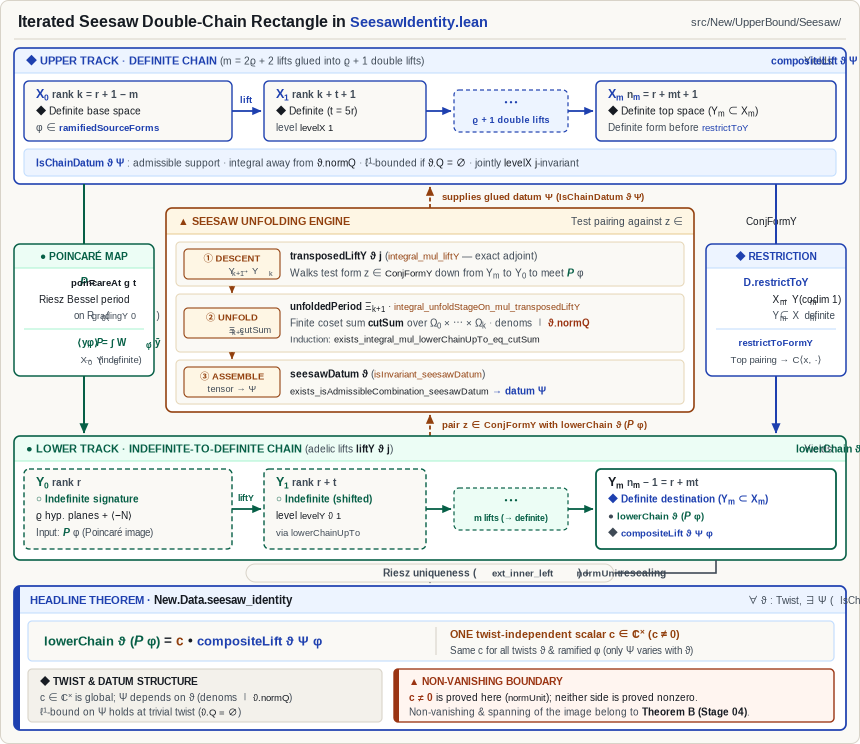
Why do these two completely different journeys land on proportional forms on
- Test against an arbitrary form on
: Two vectors in an inner-product space are equal if and only if they have the same inner product with every test vector . Pairing the output of the lower chain on with a test form turns the problem into a single global integral over . - Walk
down the lower chain by transposition: Every theta correspondence has an adjoint (its transposed lift, or descent) that moves the integral from back down to . Applying transposition times walks the test form all the way down to , where it meets . - Unfold the Poincaré map into finite coset sums: By construction, pairing a form on
with evaluates the Bessel period of . Moving that period back up the chain one lift at a time unfolds each global integral into an archimedean factor times a finite weighted sum over congruence cosets ( cutSum). The denominators introduced by these coset weights only involve primes dividing the twist modulus, so away from the twist modulus no new denominators appear. - Recognize the top integral as a definite restriction: After
unfolding steps, the remaining integral sits on the definite space . Evaluating the finite coset sum on the vacuum data produces a single chain datum for the upper definite chain, and the top integral collapses to a nonzero scalar times the inner product of with the restricted upper chain of .
This yields the headline theorem New.Data.seesaw_identity: there exists a single nonzero scalar
for every source form
What this theorem does and does not claim: New.Data.seesaw_identity proves that the proportionality constant 04_spanning).
Where this analogy breaks
Thinking of the seesaw as a simple commutative square evaluatedTensor, seesawDatum). Second, the chain datum
Level 2 — Undergrad Bridge
1. The two chains of unitary spaces and the Poincaré map (Objects/{Columns,Rows,RowChain,PoincareMap}.lean)
Fix admissible data
| Chain | Spaces and Ranks | Signatures | Maps and Levels |
|---|---|---|---|
Upper chain (Columns.lean) | Every | Definite theta lifts glued in D.restrictToY from | |
Lower chain (Rows.lean, RowChain.lean) | Adelic theta lifts liftY ϑ j, composed into lowerChainUpTo ϑ j (automorphic) and lowerChain ϑ (algebraic on |
At the base of the two chains sits the Poincaré map PoincareMap.lean), built for a fixed archimedean point inner_poincareAt, D.gradingY 0:
For any conjugate form integral_mul_poincareAt unfolds the global pairing over
2. Transposed lifts and iterated Bessel unfolding (SeesawIdentity.lean, lines 172–490)
For each ConjFormY D j. The transposed lift (descent) transposedLiftY ϑ j : ConjFormY (j + 1) →ₗ[ℂ] ConjFormY j scales the swapped theta lift by the level index
transposedLiftY_apply: expresses(transposedLiftY ϑ j z) gexplicitly as[J° : J_ξ(Y_j)]times the theta integral ofθ(ω(g, h) datumY ϑ j) * z hover. integral_mul_liftY: proves exact adjointness between lift and descent:twistedPairWeil_datumY_of_mem_levelY,hasLevel_transposedLiftY, andisRapid_conjFormY: verify thatdatumY ϑ jis fixed by(1, u)for, hence transposedLiftY ϑ j zinherits right invariance underlevelY ϑ j, and every conjugate form onis rapidly decreasing.
Next, unfoldedPeriod defines the stage-unfoldStage ϑ t φ ξ y k hk Y * z over (ξ i, y i) are the archimedean and finite parts of the outer variables at stages
integrable_unfoldStage_mulestablishes absolute convergence offor . integral_unfoldStageOn_mul_transposedLiftYgives the exact unfolding recursion: integratingunfoldStageOnagainsttransposedLiftY ϑ k zatover equals . sum_quotient_chosenLevel_eq_sum_cutPointsandintegral_mul_liftY_poincareAthandle the base case: combining integral_mul_liftY,integral_mul_poincareAt, and the level index identityrewrites as , where . exists_integral_mul_lowerChainUpTo_eq_cutSumruns the induction over: assuming factors into an archimedean function times a finite-coset function whenever and , each inductive step descends via integral_mul_liftYand converts the outer integral overinto a weighted sum over the finite cut (dividing by cutMultiplicity, whose support is controlled by lattice bounds fromhasLatticeBounds_of_unfoldStage_ne_zeroon ramified source forms). The result is a single constant independent of such that
3. Top-stage restriction, seesawDatum, and seesaw_identity (SeesawIdentity.lean, lines 69–155 and 494–665)
At the top stage D.lastGrading hM has no remaining isotropic vectors, and D.restrictToY maps forms on restrictToFormY, bridged back by lowerChain_eq_of_lowerChainUpTo_eq).
exists_integral_eq_mul_inner_restrictToFormYproves that for any linear formon Weyl values of , there is a constant such that integrating a matrix coefficient against over equals . evaluatedTensorandevaluatedTensor_mkform the pure tensor of theevaluated double-lift data translated by coset representatives c i.seesawDatum ϑis defined ascutSum ϑ (2 * D.ϱ + 2) le_rfl (evaluatedTensor ϑ).isInvariant_seesawDatumproves(seesawDatum ϑ).IsInvariant ϑ: translating cut variables by a tuplein the upper levels D.levelX j(with) leaves cutSumunchanged and matches the joint level action on each double lift.exists_lowerChainUpTo_poincareAt_eqcombinesexists_integral_mul_lowerChainUpTo_eq_cutSumatwith exists_integral_eq_mul_inner_restrictToFormYand Riesz uniqueness (ext_inner_left) to obtain a singlesuch that for all tame characters and ramified source forms , exists_isAdmissibleCombination_seesawDatumusesexists_isAdmissibleCombination_gluedVacuumandisAdmissibleCombination_cutSumto expressseesawDatum ϑas a finite sumover admissible translations with denominator dividing away from (where ) and total conjugate -norm when .
Finally, New.Data.seesaw_identity clears the scalar
- Rescaling
seesawDatum ϑbyproduces an admissible combination of translated glued vacuums supported on supportedTranslations (D.M * ϑ.normQ)with total size boundwhen , yielding a chain datum with IsChainDatum ϑ ΨandgluedTensor Ψ = (u : ℂ) • c₀ • seesawDatum ϑ. - Honesty check on
versus non-vanishing: Notice how normUnitworks in Lean (SeesawIdentity.lean:636–640): if, then ; if , then normUnit 0 = 1, so, , and u • c₀ • seesawDatum ϑ = 0gives, making both sides identically . Thus seesaw_identityguarantees(nonzero and twist-independent), and makes no claim that either side is nonzero. Non-vanishing and spanning of the Poincaré images are proved independently in Stage 04 ( 04_spanning).
Level 3 — Formal Lean Contract
The extracted skeleton skeleton/03_upper_bound/seesaw_identity.lean mirrors src/New/UpperBound/Seesaw/SeesawIdentity.lean at pinned upstream commit 41c2716658c42ba08eb0648994a2efe83082a95c (41c2716658c4, leanprover/lean4:v4.37.0-rc1, Mathlib rev 31ce06eaadf4a200c0e1407c5f10953cf606b8f8), containing 23 declarations and 0 stub truncations (part of Stage 03's 173 declarations and 0 stub truncations across 5 skeletons).
Headline Theorem Signature
From src/New/UpperBound/Seesaw/SeesawIdentity.lean:629–633 (matching skeleton/03_upper_bound/seesaw_identity.lean:271–275):
theorem New.Data.seesaw_identity {P : Parameters} {D : Data P}
    (t : (WeylIndex (D.X 0) D.columnCount → ℂ) →ₗ[ℂ] ℂ) (g : GInf D.E (D.signsY 0)) :
    ∃ c : ℂˣ, ∀ ϑ : D.Twist, ∃ Ψ : D.Translations →₀ ℂ, IsChainDatum ϑ Ψ ∧
      ∀ φ : D.ramifiedSourceForms,
lowerChain ϑ (D.poincareAt g t φ) = (c : ℂ) • compositeLift ϑ Ψ φ- Hypotheses: Admissible data
D : Data P, a linear functionalton the Weyl module of values onX_0, and an archimedean pointgofU(Y_0). - Conclusion: There exists a single unit
c : ℂˣ(hencec ≠ 0, independent ofϑandφ) such that every twistϑ : D.Twistadmits a finitely supportedΨ : D.Translations →₀ ℂsatisfyingIsChainDatum ϑ Ψ(admissible support at the level, values integral away fromϑ.normQ,conjugate bound when ϑ.Q = ∅, and level-invariance ofgluedTensor Ψ) and matchinglowerChain ϑ (D.poincareAt g t φ) = (c : ℂ) • compositeLift ϑ Ψ φon allφ : D.ramifiedSourceForms. - Non-vanishing boundary: As recorded in upstream
GUIDE.mdand visible directly in thenormUnitstep (SeesawIdentity.lean:636–640), the theorem assertsc : ℂˣ(non-zero constant) and does not assert that either side of the equality is nonzero; non-vanishing and spanning of the Poincaré images are established in Stage 04 (04_spanning).
Direct Proof Chain in seesaw_identity.lean
| Declaration | Upstream Lines | Role in the Proof |
|---|---|---|
restrictToFormY, lowerChain_eq_of_lowerChainUpTo_eq | 69–85 | Bridge D.restrictToY and lowerChain between automorphic forms and algebraic forms at |
exists_integral_eq_mul_inner_restrictToFormY | 87–154 | Pair a top-stage block-embedded matrix coefficient on |
ConjFormY, transposedLiftY, transposedLiftY_apply, integral_mul_liftY | 172–228 | Define conjugate forms on liftY. |
twistedPairWeil_datumY_of_mem_levelY, hasLevel_transposedLiftY, isRapid_conjFormY | 230–270 | Level invariance of the lift datum and descent, plus rapid decrease of conjugate forms. |
unfoldedPeriod, integrable_unfoldStage_mul, integral_unfoldStageOn_mul_transposedLiftY | 272–326 | Define the unfolded period |
sum_quotient_chosenLevel_eq_sum_cutPoints, integral_mul_liftY_poincareAt, exists_integral_mul_lowerChainUpTo_eq_cutSum | 328–490 | Base case D.integral_mul_poincareAt and induction over cutSum. |
evaluatedTensor, evaluatedTensor_mk, seesawDatum, isInvariant_seesawDatum | 494–538 | Assemble the upper-chain finite data tensor seesawDatum ϑ from the cuts and prove joint level invariance. |
exists_lowerChainUpTo_poincareAt_eq, exists_isAdmissibleCombination_seesawDatum, seesaw_identity | 540–665 | Match the lower and upper chains via Riesz uniqueness, expand seesawDatum ϑ in glued vacuums, and rescale by normUnit to produce c : ℂˣ and Ψ. |
Verification status (audit/verification-status.json): Local Lean compilation and kernel replay remain build_status: unverified-locally at pinned upstream commit 41c2716658c42ba08eb0648994a2efe83082a95c (41c2716658c4, leanprover/lean4:v4.37.0-rc1, Mathlib rev 31ce06eaadf4a200c0e1407c5f10953cf606b8f8). Static token scanning currently has scan_scope: entry, covering only Challenge.lean, src/Main.lean, and src/Statements.lean (0 forbidden tokens in solution files, 5 expected sorry tokens in Challenge.lean). SeesawIdentity.lean has not been locally compiled, kernel-checked, or statically scanned here.
def New.Data.restrictToFormY — Upstream source (src/New/UpperBound/Seesaw/SeesawIdentity.lean L69-L74)
/-- The restriction from the forms `D.FormX M` on `X_m` to the forms `D.FormY M` of the lower chain
on `Y_m`: it is `D.restrictToY`, read in automorphic forms. The index `m` is written as any number
`M` equal to it. -/
noncomputable def New.Data.restrictToFormY (hM : D.m = M) : D.FormX M →ₗ[ℂ] D.FormY M := by
  sorry -- [EXTRACTED_STUB upstream=src/New/UpperBound/Seesaw/SeesawIdentity.lean:69-74 commit=41c2716658c42ba08eb0648994a2efe83082a95c body_lines=3 body_sha256=15b82ee17aa4ee255eea69c58c8de1eea1a054b2bb939642554a6c44cd4dc2d2]
lemma New.Data.lowerChain_eq_of_lowerChainUpTo_eq — Upstream source (src/New/UpperBound/Seesaw/SeesawIdentity.lean L76-L85)
/-- If the image `lowerChainUpTo ϑ M f` of a form `f` on `Y_0` under the composite of the lifts with
twist `ϑ` is the restriction `restrictToFormY hM ψ` to `Y_m` of a form `ψ` on `X_m`, where `M = m`,
then `lowerChain ϑ f = restrictToYOfEq hM ψ`. Here `lowerChain` and `restrictToYOfEq` are the same
two maps with values in algebraic forms in place of automorphic forms. -/
lemma New.Data.lowerChain_eq_of_lowerChainUpTo_eq (hM : D.m = M) {ϑ : D.TameChar}
    {f : D.principalForms (D.spaceY 0)}
    {ψ : D.FormX M} (h_lift : lowerChainUpTo ϑ M f = restrictToFormY hM ψ) :
    lowerChain ϑ f = restrictToYOfEq hM ψ := by
  sorry -- [EXTRACTED_STUB upstream=src/New/UpperBound/Seesaw/SeesawIdentity.lean:76-85 commit=41c2716658c42ba08eb0648994a2efe83082a95c body_lines=3 body_sha256=850eb9e980416dbd1c0c43d619cb0d3673d82158fe5af6e1fdf189053994bd52]
lemma New.Data.exists_integral_eq_mul_inner_restrictToFormY — Upstream source (src/New/UpperBound/Seesaw/SeesawIdentity.lean L87-L154)
/-- Let `M = m`, the number of lifts. For every linear form `t` on the values of forms on `X_m`
there is a constant `C` as follows. Let `x` be a form on `Y_m`, `ψ` one on `X_m` and `F` a function
on `G_m = U(Y_m)`, whose signs at infinity are `D.signsY M`. The last grading `D.lastGrading hM`
identifies `Y_m` with the standard definite space on `D.InitIndex M`, the `n_m - 1` basis indices of
`X_m` other than the last, and `inclX` is the resulting map of unitary groups. Suppose that at the
image of `k` under `inclX` the value of `F` is the coefficient `t (ψ (diag (k, 1)))`. Then the
integral of `F` times the conjugate of `x` over `[G_m]` is `C` times `⟨x, res ψ⟩`, where `res` is
`restrictToFormY`. -/
lemma New.Data.exists_integral_eq_mul_inner_restrictToFormY (hM : D.m = M)
    (t : (WeylIndex (D.X M) D.columnCount → ℂ) →ₗ[ℂ] ℂ) :
    ∃ C : ℂ, ∀ (x : D.FormY M) {ψ : D.FormX M} {F : New.G D.E (D.signsY M) → ℂ}
      (_hF : ∀ k : New.G D.E (1 : D.InitIndex M → ℤˣ), F ((D.lastGrading hM).inclX k) =
        algFormCoeff 1 t ψ (.blockEmb (e := .refl (D.InitIndex M ⊕ Unit)) Sum.elim_one_one.symm
          (k, 1))),
      ∫ g : New.G D.E (D.signsY M), (F * star x.val) g ∂(D.lastGrading hM).ratBessel.quotMeasure =
        C * inner ℂ x (restrictToFormY hM ψ) := by
  sorry -- [EXTRACTED_STUB upstream=src/New/UpperBound/Seesaw/SeesawIdentity.lean:87-154 commit=41c2716658c42ba08eb0648994a2efe83082a95c body_lines=53 body_sha256=a02a1add60c13a2b08f83d3cd5ca5d418b734938037af4e9544daee5cc008f0a]
abbrev New.Data.ConjFormY — Upstream source (src/New/UpperBound/Seesaw/SeesawIdentity.lean L172-L174)
/-- Forms on `Y_j` of the conjugate type; they are paired with the forms of the lower chain. -/
abbrev New.Data.ConjFormY (D : Data P) (j : ℕ) : Type := by
  sorry -- [EXTRACTED_STUB upstream=src/New/UpperBound/Seesaw/SeesawIdentity.lean:172-174 commit=41c2716658c42ba08eb0648994a2efe83082a95c body_lines=1 body_sha256=37e2dab7b25d5739d4cf3b57282b8d3886fd1ef3ce2be92dcf561833f9dc5cac]
def New.Data.transposedLiftY — Upstream source (src/New/UpperBound/Seesaw/SeesawIdentity.lean L176-L181)
/-- The transposed lift, or descent, from `Y_{j+1}` to `Y_j`, times the index `[J° : J_ξ(Y_j)]`
that normalises the lift `liftY ϑ j`. -/
def New.Data.transposedLiftY (ϑ : D.TameChar) (j : ℕ) : D.ConjFormY (j + 1) →ₗ[ℂ] D.ConjFormY j := by
  sorry -- [EXTRACTED_STUB upstream=src/New/UpperBound/Seesaw/SeesawIdentity.lean:176-181 commit=41c2716658c42ba08eb0648994a2efe83082a95c body_lines=3 body_sha256=f47301efe7f37b25a37d2d44cbfdf4b5d19bf7ca5d1257aa3490297ec53882e7]
lemma New.Data.transposedLiftY_apply — Upstream source (src/New/UpperBound/Seesaw/SeesawIdentity.lean L183-L200)
/-- The descent as a theta integral. Let `ϑ` be a tame character, let `j < m`, and let `z` be a
conjugate form on `Y_(j+1)`. The descent of `z` at `g` is the index of the level `levelY ϑ j` in the
lattice stabiliser `stdLevel` of `Y_j`, times the integral over `h ∈ [G_(j+1)]` of `z h` times
`θ (ω (g, h) (datumY ϑ j))`. Here `datumY ϑ j` is the Schwartz function on `Hom(Y_j, Y_(j+1))` that
defines the lift, `θ` is the theta functional, `G_j = U(Y_j)`, and `ω` is the Weil representation of
`G_j × G_(j+1)` whose character on a space of rank `n` is `rankTwist` of `D.chainChar ϑ (j + 1)`:
this character of `U(1)`, formed from `ϑ ^ (j + 1)`, times `υ ^ ⌊n / 2⌋`, with `υ` the fixed
character `upsilonU1`. -/
lemma New.Data.transposedLiftY_apply (ϑ : D.TameChar) {j : ℕ} (hj : j < D.m) (z : D.ConjFormY (j + 1))
    (g : New.G D.E (D.signsY j)) :
    transposedLiftY ϑ j z g = stdLevelIndex (levelY ϑ j) *
      ∫ h : New.G D.E (D.signsY (j + 1)),
        θ ((D.spaceY j).hom (D.spaceY (j + 1)))
          (twistedPairWeil (rankTwist (D.chainChar ϑ (j + 1))) (g, h) (datumY ϑ j)) * z h
        ∂(D.spaceY (j + 1)).quotMeasure := by
  sorry -- [EXTRACTED_STUB upstream=src/New/UpperBound/Seesaw/SeesawIdentity.lean:183-200 commit=41c2716658c42ba08eb0648994a2efe83082a95c body_lines=4 body_sha256=e66cccbaa221e3f5ea3f00b975692088ca9d6ee3632ac7cc84e259951fc90ddc]
lemma New.Data.integral_mul_liftY — Upstream source (src/New/UpperBound/Seesaw/SeesawIdentity.lean L202-L228)
/-- Lift and descent are transposes of each other. Let `ϑ` be a tame character, which twists both
maps, let `j < m`, and let `f` be a form on `Y_j` and `z` a conjugate form on `Y_(j+1)`. Then the
integral over `[G_(j+1)]` of `z` times the lift `liftY ϑ j f` is the integral over `[G_j]` of the
descent `transposedLiftY ϑ j z` times `f`. Here `G_j` is the unitary group of `Y_j`. -/
lemma New.Data.integral_mul_liftY (ϑ : D.TameChar) {j : ℕ} (hj : j < D.m) (z : D.ConjFormY (j + 1))
    (f : D.FormY j) :
    ∫ h : New.G D.E (D.signsY (j + 1)), z h * liftY ϑ j f h ∂(D.spaceY (j + 1)).quotMeasure =
      ∫ g : New.G D.E (D.signsY j), transposedLiftY ϑ j z g * f g ∂(D.spaceY j).quotMeasure := by
  sorry -- [EXTRACTED_STUB upstream=src/New/UpperBound/Seesaw/SeesawIdentity.lean:202-228 commit=41c2716658c42ba08eb0648994a2efe83082a95c body_lines=20 body_sha256=85d712b3b4417ff59df3d0671da35ccf7dd0bed95597b9c2fd6069ab591a9196]
lemma New.Data.twistedPairWeil_datumY_of_mem_levelY — Upstream source (src/New/UpperBound/Seesaw/SeesawIdentity.lean L230-L251)
/-- Let `ϑ` be a tame character and `u` an element of its level `levelY ϑ j`: an integral finite
adelic point of `G_j = U(Y_j)` that reduces to `1` at the chosen places and at the places of the
modulus `ϑ.Q`. Let `datumY ϑ j` be the Schwartz function on `Hom(Y_j, Y_(j+1))` that defines the
lift from `Y_j` to `Y_(j+1)`. In the Weil representation of `G_j × G_(j+1)` for this lift, with
characters given by `rankTwist` of `D.chainChar ϑ (j + 1)`, the pair of the point `(1, u)` of `G_j`,
with archimedean part `1` and finite part `u`, and the identity of `G_(j+1)` fixes this datum. -/
lemma New.Data.twistedPairWeil_datumY_of_mem_levelY (ϑ : D.TameChar) {j : ℕ} {u : Gf D.E (D.Y j)}
    (hu : u ∈ levelY ϑ j) :
    twistedPairWeil (rankTwist (D.chainChar ϑ (j + 1))) ((1, u), 1) (datumY ϑ j) =
      datumY ϑ j := by
  sorry -- [EXTRACTED_STUB upstream=src/New/UpperBound/Seesaw/SeesawIdentity.lean:230-251 commit=41c2716658c42ba08eb0648994a2efe83082a95c body_lines=13 body_sha256=7e8d64a58a9f4e0974474336dd20aa02511c2133cf6fe8a7809db29828092c35]
lemma New.Data.hasLevel_transposedLiftY — Upstream source (src/New/UpperBound/Seesaw/SeesawIdentity.lean L253-L262)
/-- Let `ϑ` be a tame character, `j < m` and `z` a conjugate form on `Y_(j+1)`. The descent
`transposedLiftY ϑ j z` is fixed by right translation by the level `levelY ϑ j` (`HasLevel`),
because the datum of the lift is. -/
lemma New.Data.hasLevel_transposedLiftY (ϑ : D.TameChar) {j : ℕ} (hj : j < D.m) (z : D.ConjFormY (j + 1)) :
    HasLevel (transposedLiftY ϑ j z) (levelY ϑ j) := by
  sorry -- [EXTRACTED_STUB upstream=src/New/UpperBound/Seesaw/SeesawIdentity.lean:253-262 commit=41c2716658c42ba08eb0648994a2efe83082a95c body_lines=6 body_sha256=a70c5d81156752a4bfaf2d06614f9b0ad2dc8f67a30034aa9a200b24271367bd]
lemma New.Data.isRapid_conjFormY — Upstream source (src/New/UpperBound/Seesaw/SeesawIdentity.lean L264-L270)
/-- For `j < m` every conjugate form on `Y_(j+1)` is rapidly decreasing. -/
lemma New.Data.isRapid_conjFormY {j : ℕ} (hj : j < D.m) (z : D.ConjFormY (j + 1)) :
    (D.spaceY (j + 1)).IsRapid z := by
  sorry -- [EXTRACTED_STUB upstream=src/New/UpperBound/Seesaw/SeesawIdentity.lean:264-270 commit=41c2716658c42ba08eb0648994a2efe83082a95c body_lines=5 body_sha256=06da2dba3b9dc309de681e797110c96825a5909018b227bf7684c33cbe5bcebf]
def New.Data.unfoldedPeriod — Upstream source (src/New/UpperBound/Seesaw/SeesawIdentity.lean L272-L283)
/-- The integral `Ξ_{k+1}` of the product `𝒲_{k+1} z` over `R_{k+1}(F) \ G_{k+1}(𝔸)`, where
`𝒲_{k+1} = unfoldStage ϑ t φ ξ y k hk Y` is the function on `G_{k+1}` left by the first `k + 1`
steps of unfolding for the source form `φ`, the linear form `t` and the outer variables
`g_i = (ξ i, y i)`, and `R_{k+1}(F) = Y.ratBessel` consists of the rational points of the Bessel
group of `Y`. -/
def New.Data.unfoldedPeriod (ϑ : D.TameChar)
    (t : (WeylIndex (D.X 0) D.columnCount → ℂ) →ₗ[ℂ] ℂ) (φ : D.SourceForm)
    (ξ : ∀ i : ℕ, GInf D.E (D.signsY i)) (y : ∀ i : ℕ, Gf D.E (D.Y i))
    (k : ℕ) (hk : k ≤ 2 * D.ϱ + 1) {X : Type} {s : ℕ} [Fintype X] [DecidableEq X]
    (Y : Grading (D.spaceY (k + 1)) D.N X s) (z : D.ConjFormY (k + 1)) : ℂ := by
  sorry -- [EXTRACTED_STUB upstream=src/New/UpperBound/Seesaw/SeesawIdentity.lean:272-283 commit=41c2716658c42ba08eb0648994a2efe83082a95c body_lines=2 body_sha256=abfad6039a408b74e8c70979fb7e423cb701e93c0e7fcd93e5ee5b9017e16aa1]
lemma New.Data.integrable_unfoldStage_mul — Upstream source (src/New/UpperBound/Seesaw/SeesawIdentity.lean L285-L300)
/-- The integral `Ξ_{k+1}` converges absolutely. Let `k ≤ 2 ϱ + 1`, let `ϑ` be a tame character,
`φ` a form on `X_0`, `t` a linear form on its values and `(ξ i, y i)` the archimedean and finite
parts of points `g_i` of `U(Y_i)`, at which the earlier stages are evaluated. These define the
function `unfoldStage` on `G_{k+1} = U(Y_{k+1})` that is left after `k + 1` steps of unfolding. For
a grading `Y` of `Y_{k+1}`, whose Bessel group has rational points `R_{k+1}(F) = Y.ratBessel`, and a
conjugate form `z` on `Y_{k+1}`, its product with `z` is integrable over
`R_{k+1}(F) \ G_{k+1}(𝔸)`. -/
lemma New.Data.integrable_unfoldStage_mul (ϑ : D.TameChar)
    (t : (WeylIndex (D.X 0) D.columnCount → ℂ) →ₗ[ℂ] ℂ) (φ : D.SourceForm)
    (ξ : ∀ i : ℕ, GInf D.E (D.signsY i)) (y : ∀ i : ℕ, Gf D.E (D.Y i))
    {k : ℕ} (hk : k ≤ 2 * D.ϱ + 1) {X : Type} [Fintype X]
    [DecidableEq X] (Y : Grading (D.spaceY (k + 1)) D.N X (2 * D.ϱ + 1 - (k + 1)))
    (z : D.ConjFormY (k + 1)) :
    Integrable (unfoldStage ϑ t φ ξ y k hk Y * z.val) Y.ratBessel.quotMeasure := by
  sorry -- [EXTRACTED_STUB upstream=src/New/UpperBound/Seesaw/SeesawIdentity.lean:285-300 commit=41c2716658c42ba08eb0648994a2efe83082a95c body_lines=3 body_sha256=295a6679da846af669d822bb3ad4ff0684f54a3185b23c1238f4a2cfaa98b930]
lemma New.Data.integral_unfoldStageOn_mul_transposedLiftY — Upstream source (src/New/UpperBound/Seesaw/SeesawIdentity.lean L302-L326)
/-- The recursion of the iterated unfolding, for the tame character `ϑ`, the source form `φ` on
`X_0`, the linear form `t` on its values and the outer variables `g_i = (ξ i, y i)`, points of
`U(Y_i)` split into archimedean and finite part. Let `k ≤ 2 ϱ + 1`, where `m = 2 ϱ + 2` is the
number of lifts, let `Y` be a grading of `Y_{k+1}`, and let `z` be a conjugate form on `Y_{k+1}`.
The function `unfoldStageOn` on the Bessel group `R_k` of the standard grading `D.gradingY k` is the
Bessel function of `φ` for `k = 0`, and for `k > 0` the function left by `k` steps of unfolding,
translated by `g_k`. Integrate it at `r ∈ [R_k]` times the descent of `z` at `r g_k`. The result is
the index of `levelY ϑ k` in the lattice stabiliser times `Ξ_{k+1}` (`unfoldedPeriod`): the integral
of `z` times the function left by `k + 1` steps over the quotient of `U(Y_{k+1})` by the rational
Bessel group of `Y`. -/
lemma New.Data.integral_unfoldStageOn_mul_transposedLiftY (ϑ : D.TameChar)
    (t : (WeylIndex (D.X 0) D.columnCount → ℂ) →ₗ[ℂ] ℂ) (φ : D.SourceForm)
    (ξ : ∀ i : ℕ, GInf D.E (D.signsY i)) (y : ∀ i : ℕ, Gf D.E (D.Y i))
    {k : ℕ} (hk : k ≤ 2 * D.ϱ + 1) {X : Type} [Fintype X] [DecidableEq X]
    (Y : Grading (D.spaceY (k + 1)) D.N X (2 * D.ϱ + 1 - (k + 1))) (z : D.ConjFormY (k + 1)) :
    ∫ r : (gradingY k hk).besselGroup,
      unfoldStageOn ϑ t φ ξ y k hk r * transposedLiftY ϑ k z (r.val * (ξ k, y k))
        ∂(D.gradingY k hk).besselMeasure =
      stdLevelIndex (levelY ϑ k) * unfoldedPeriod ϑ t φ ξ y k hk Y z := by
  sorry -- [EXTRACTED_STUB upstream=src/New/UpperBound/Seesaw/SeesawIdentity.lean:302-326 commit=41c2716658c42ba08eb0648994a2efe83082a95c body_lines=7 body_sha256=aebd9ab679e1a98bbecaa6eb7d6ed89ea9acea37b520892a4ac439ca680b1f50]
lemma New.Data.sum_quotient_chosenLevel_eq_sum_cutPoints — Upstream source (src/New/UpperBound/Seesaw/SeesawIdentity.lean L328-L351)
/-- Let `ϑ` be a tame character and `J = levelY ϑ 0` its level on `Y_0`, a subgroup of
`J_M = D.chosenLevel`. Let `f` be a function on the finite adelic unitary group of `Y_0` that is
fixed by right translation by `J`. Then the sum of `f` over representatives of `J_M / J` is its sum
over representatives of `Ω_0 = cutPoints ϑ 0`, the classes modulo `J` of the elements of `J_M`. -/
lemma New.Data.sum_quotient_chosenLevel_eq_sum_cutPoints (ϑ : D.TameChar)
    [Fintype (D.chosenLevel ⧸ (levelY ϑ 0).subgroupOf D.chosenLevel)] {f : Gf D.E (D.Y 0) → ℂ}
    (hf : ∀ x : Gf D.E (D.Y 0), ∀ u ∈ levelY ϑ 0, f (x * u) = f x) :
    ∑ q : D.chosenLevel ⧸ (levelY ϑ 0).subgroupOf D.chosenLevel, f q.out =
      ∑ c ∈ cutPoints ϑ 0 (2 * D.ϱ + 1).zero_le, f c.out := by
  sorry -- [EXTRACTED_STUB upstream=src/New/UpperBound/Seesaw/SeesawIdentity.lean:328-351 commit=41c2716658c42ba08eb0648994a2efe83082a95c body_lines=16 body_sha256=0175412fc54618d5fafd3dc70a75c22351e21959ac6f19f19e41cbe65135716c]
lemma New.Data.integral_mul_liftY_poincareAt — Upstream source (src/New/UpperBound/Seesaw/SeesawIdentity.lean L353-L404)
/-- Let `ϑ` be a tame character, `t` a linear form on the values of forms on `X_0`, `g` an
archimedean point of `U(Y_0)` and `𝒫 φ = D.poincareAt g t φ` the Poincaré series of `φ` on `Y_0`.
Let `Y` be a grading of `Y_1` with a string of `2 ϱ` vectors. The integral of a conjugate form `z`
on `Y_1` times the first lift `liftY ϑ 0 (𝒫 φ)` is `[J° : J_M]` times the sum of the periods `Ξ_1`
over the classes `c` in `Ω_0 = cutPoints ϑ 0`. Here `J°` is the lattice stabiliser `stdLevel`,
`J_M = D.chosenLevel` is its subgroup of elements that reduce to `1` at the chosen places, and `Ω_0`
consists of the classes modulo `levelY ϑ 0` of the elements of `J_M`. The period `Ξ_1`
(`unfoldedPeriod`) is the integral, over the quotient of `U(Y_1)` by the rational Bessel group of
`Y`, of `z` times the function left by one step of unfolding of `φ` at the outer variable
`(g, c.out)` of index `0`; the others are `1`. -/
lemma New.Data.integral_mul_liftY_poincareAt (ϑ : D.TameChar)
    (t : (WeylIndex (D.X 0) D.columnCount → ℂ) →ₗ[ℂ] ℂ)
    (φ : D.SourceForm) (g : GInf D.E (D.signsY 0)) {X : Type} [Fintype X] [DecidableEq X]
    (Y : Grading (D.spaceY 1) D.N X (2 * D.ϱ)) (z : D.ConjFormY 1) :
    ∫ h : New.G D.E (D.signsY 1),
      z h * liftY ϑ 0 (D.poincareAt g t φ).val h ∂(D.spaceY 1).quotMeasure =
      stdLevelIndex (D.chosenLevel (n := D.Y 0)) * ∑ c ∈ cutPoints ϑ 0 (2 * D.ϱ + 1).zero_le,
        unfoldedPeriod ϑ t φ (update 1 0 g) (update 1 0 c.out) 0 (2 * D.ϱ + 1).zero_le Y z := by
  sorry -- [EXTRACTED_STUB upstream=src/New/UpperBound/Seesaw/SeesawIdentity.lean:353-404 commit=41c2716658c42ba08eb0648994a2efe83082a95c body_lines=35 body_sha256=ea1a398523a730cad0d49565366963964897fd8eca58462cfc979850efe8343a]
lemma New.Data.exists_integral_mul_lowerChainUpTo_eq_cutSum — Upstream source (src/New/UpperBound/Seesaw/SeesawIdentity.lean L406-L490)
/-- The outer integrals of the seesaw, one at a time. Let `t` be a linear form on the values of
forms on `X_0`, `g` an archimedean point of `U(Y_0)`, `k ≤ 2 ϱ + 1`, `Y` a grading of `Y_{k+1}`
with a string of `s = 2 ϱ + 1 - (k + 1)` vectors, and `a` a function of tuples `ξ` of archimedean
points of the groups `U(Y_i)`. There is a number `c` as follows, for every tame character `ϑ`,
ramified source form `φ` on `X_0`, conjugate form `z` on `Y_{k+1}` and function `S` of the classes
modulo `levelY ϑ i` of tuples `y` of finite points. Suppose that `unfoldedPeriod` at step `k`, the
integral of `z` times the function on `U(Y_{k+1})` left by `k + 1` steps of unfolding of `φ` at
`(ξ, y)`, is `a ξ` times `S` at the classes of `y` whenever `y 0 ∈ D.chosenLevel` and `y m = 1`,
where `m = 2 ϱ + 2`. Then the pairing of `z` with the image of the Poincaré series
`D.poincareAt g t φ` under the first `k + 1` lifts is `c` times `cutSum`: the sum of `S` over
`Ω_0 × ⋯ × Ω_k`, where `Ω_j = cutPoints ϑ j`, each term divided by the multiplicities
`cutMultiplicity` of its classes. -/
lemma New.Data.exists_integral_mul_lowerChainUpTo_eq_cutSum
    (t : (WeylIndex (D.X 0) D.columnCount → ℂ) →ₗ[ℂ] ℂ)
    (g : GInf D.E (D.signsY 0)) (k : ℕ) (hk : k ≤ 2 * D.ϱ + 1) {X : Type} [Fintype X]
    [DecidableEq X] {s : ℕ} (Y : Grading (D.spaceY (k + 1)) D.N X s)
    (hs : s = 2 * D.ϱ + 1 - (k + 1)) (a : (∀ i : ℕ, GInf D.E (D.signsY i)) → ℂ) :
    ∃ c : ℂ, ∀ (ϑ : D.TameChar) (φ : D.ramifiedSourceForms) (z : D.ConjFormY (k + 1))
      (S : (∀ i : ℕ, Gf D.E (D.Y i) ⧸ levelY ϑ i) → ℂ)
      (_h_period : ∀ (ξ : ∀ i : ℕ, GInf D.E (D.signsY i)) (y : ∀ i : ℕ, Gf D.E (D.Y i)),
        y 0 ∈ D.chosenLevel → y (2 * D.ϱ + 2) = 1 →
          unfoldedPeriod ϑ t φ ξ y k hk Y z = a ξ * S fun i : ℕ ↦ y i),
      ∫ h : New.G D.E (D.signsY (k + 1)),
        z h * lowerChainUpTo ϑ (k + 1) (D.poincareAt g t φ) h ∂(D.spaceY (k + 1)).quotMeasure =
        c * cutSum ϑ (k + 1) (Nat.succ_le_succ hk) S := by
  sorry -- [EXTRACTED_STUB upstream=src/New/UpperBound/Seesaw/SeesawIdentity.lean:406-490 commit=41c2716658c42ba08eb0648994a2efe83082a95c body_lines=61 body_sha256=84ace91eedf9eead35cbfd5ff19a4c83f77de1845043ace7567e9cf003fbba51]
def New.Data.evaluatedTensor — Upstream source (src/New/UpperBound/Seesaw/SeesawIdentity.lean L494-L498)
/-- The tensor product of the evaluated data (`evaluatedDatum`) of all double lifts, translated by
representatives of the classes `c j` of the outer variables of the lower chain. -/
def New.Data.evaluatedTensor (ϑ : D.TameChar) (c : ∀ i : ℕ, Gf D.E (D.Y i) ⧸ levelY ϑ i) :
    D.ChainTensor := by
  sorry -- [EXTRACTED_STUB upstream=src/New/UpperBound/Seesaw/SeesawIdentity.lean:494-498 commit=41c2716658c42ba08eb0648994a2efe83082a95c body_lines=1 body_sha256=6a66d1fbb600e533afd431cbc1d9e792aadd9dfca012ad6df9ae4a6639d77318]
lemma New.Data.evaluatedTensor_mk — Upstream source (src/New/UpperBound/Seesaw/SeesawIdentity.lean L500-L504)
/-- At the classes of a tuple `y` of points of `G_f`, `evaluatedTensor ϑ` is the pure tensor
`pure (evaluatedDatum ϑ y) (D.ϱ + 1)`, built from the first `D.ϱ + 1` evaluated data. -/
lemma New.Data.evaluatedTensor_mk (ϑ : D.TameChar) (y : ∀ i : ℕ, Gf D.E (D.Y i)) :
    (evaluatedTensor ϑ fun i : ℕ ↦ y i) = pure (evaluatedDatum ϑ y) (D.ϱ + 1) := by
  sorry -- [EXTRACTED_STUB upstream=src/New/UpperBound/Seesaw/SeesawIdentity.lean:500-504 commit=41c2716658c42ba08eb0648994a2efe83082a95c body_lines=2 body_sha256=3adb6d54b928b25ab79ecec213002a501a24ea01d13917345d91551642370982]
def New.Data.seesawDatum — Upstream source (src/New/UpperBound/Seesaw/SeesawIdentity.lean L506-L509)
/-- The tensor `φ_ξ` of finite data for the upper chain: the weighted sum `cutSum` over the cuts of
the lower chain of the evaluated translates `evaluatedTensor` of its data. -/
def New.Data.seesawDatum (ϑ : D.TameChar) : D.ChainTensor := by
  sorry -- [EXTRACTED_STUB upstream=src/New/UpperBound/Seesaw/SeesawIdentity.lean:506-509 commit=41c2716658c42ba08eb0648994a2efe83082a95c body_lines=1 body_sha256=7f52b9483d9d6551f3bfac677a24f58e51e06896e54255e20d97ba80b28bdeca]
lemma New.Data.isInvariant_seesawDatum — Upstream source (src/New/UpperBound/Seesaw/SeesawIdentity.lean L511-L538)
/-- The tensor `φ_ξ = seesawDatum ϑ` of finite data for the chain of lifts `X_0 → ⋯ → X_m`, where
`ϑ` is a tame character and `m = 2 ϱ + 2`, is jointly invariant for `ϑ` (`IsInvariant`): it is fixed
by every tuple `b` with `b j` in the level `D.levelX j` of `X_j` and `b m = 1`. -/
lemma New.Data.isInvariant_seesawDatum (ϑ : D.TameChar) : (seesawDatum ϑ).IsInvariant ϑ := by
  sorry -- [EXTRACTED_STUB upstream=src/New/UpperBound/Seesaw/SeesawIdentity.lean:511-538 commit=41c2716658c42ba08eb0648994a2efe83082a95c body_lines=25 body_sha256=d5d36a7ad7e760a6155dd14e6c8a3dff70921128ec793a3ab6a561857e23d6a1]
lemma New.Data.exists_lowerChainUpTo_poincareAt_eq — Upstream source (src/New/UpperBound/Seesaw/SeesawIdentity.lean L540-L585)
/-- Fix an archimedean point `g` of `U(Y_0)` and a linear form `t`, and let `m = 2 ϱ + 2`. There is
a number `c₀` such that, for every tame character `ϑ` and every ramified source form `φ` on `X_0`,
the `m` lifts along `Y_0, …, Y_m` take the Poincaré series `D.poincareAt g t φ` to `c₀` times the
restriction to `Y_m` of the image of `φ` under the chain of lifts `X_0 → ⋯ → X_m` with twist `ϑ` and
tensor of finite data `seesawDatum ϑ`. -/
lemma New.Data.exists_lowerChainUpTo_poincareAt_eq (t : (WeylIndex (D.X 0) D.columnCount → ℂ) →ₗ[ℂ] ℂ)
    (g : GInf D.E (D.signsY 0)) :
    ∃ c₀ : ℂ, ∀ (ϑ : D.TameChar) (φ : D.ramifiedSourceForms),
      lowerChainUpTo ϑ (2 * D.ϱ + 2) (D.poincareAt g t φ) =
        c₀ • restrictToFormY D.m_eq_two_mul_varrho_add_two (chainOfTensor ϑ φ (seesawDatum ϑ)) := by
  sorry -- [EXTRACTED_STUB upstream=src/New/UpperBound/Seesaw/SeesawIdentity.lean:540-585 commit=41c2716658c42ba08eb0648994a2efe83082a95c body_lines=37 body_sha256=4452abd5dcc204e1a124850a874320a46b89ecf3ab976eedaf3970910164e381]
lemma New.Data.exists_isAdmissibleCombination_seesawDatum — Upstream source (src/New/UpperBound/Seesaw/SeesawIdentity.lean L587-L613)
/-- The tensor `φ_ξ = seesawDatum ϑ` of data for the upper chain is a combination of translated
vacuum data, with bounds. There is one number `C` as follows for every tame character `ϑ`. Let `ϑ.Q`
be its modulus, a finite set of finite places, and `q = ϑ.normQ` the product of their norms. Let
`m = 2 ϱ + 2` be the number of lifts and `B = D.residueMatrixCount = D.M ^ (D.f * D.n D.m ^ 2)`,
with `D.M` the principal level and `D.n D.m` the rank of `X_m`. An element `x` of `Translations` is
a tuple of finite adelic matrices, one for each lift, and `D.gluedVacuum x` is the tensor of the
integral vacuum data translated by `x`. Then `φ_ξ` is a finite sum `∑ r x • C • D.gluedVacuum x`,
with coefficients `r x`, over `x` in `admissibleTranslations q`. Each `B ^ (2 m) * r x` is integral
at the primes not dividing `q`. If `ϑ.Q = ∅`, then `∑ ‖σ (r x)‖ ≤ B ^ (2 ϱ + 2)` for every
automorphism `σ` of `ℂ`. -/
lemma New.Data.exists_isAdmissibleCombination_seesawDatum (D : Data P) :
    ∃ C : ℂ, ∀ ϑ : D.TameChar,
      IsAdmissibleCombination (fun x : Translations (P := P) (D := D) ↦ C • D.gluedVacuum x)
        (admissibleTranslations ϑ.normQ)
        ϑ.normQ (D.residueMatrixCount ^ (2 * D.m)) (ϑ.Q = ∅) (D.residueMatrixCount ^ (2 * D.ϱ + 2))
        (seesawDatum ϑ) := by
  sorry -- [EXTRACTED_STUB upstream=src/New/UpperBound/Seesaw/SeesawIdentity.lean:587-613 commit=41c2716658c42ba08eb0648994a2efe83082a95c body_lines=12 body_sha256=5efa3324b63731ebb2f4a55bee9c899a273bf62f23f4673264d3755418a0bd9d]
theorem New.Data.seesaw_identity — Upstream source (src/New/UpperBound/Seesaw/SeesawIdentity.lean L617-L665)
/-- **Seesaw identity**. Let `D` be admissible data, with field `E = D.E`, number of lifts
`m = D.m`, and hermitian spaces `X_j` (upper chain) and `Y_j` over `E`. Let `t` be a linear form on
the values of forms on `X_0` and `g` an archimedean point of `U(Y_0)`. Then there is a number
`c ≠ 0` such that every twist `ϑ` has a chain datum `Ψ` with
`lowerChain ϑ (𝒫 φ) = c • compositeLift ϑ Ψ φ` for all ramified source forms `φ` on `X_0`, where
`𝒫 = D.poincareAt g t` is the Poincaré map from forms on `X_0` to forms on `Y_0`. The datum
`Ψ` is a finitely supported function on `D.Translations`, the tuples of finite adelic matrices, one
for each lift of the upper chain; its glued tensor is the sum of `Ψ x` times the vacuum data
translated by `x`, and `compositeLift ϑ Ψ` is the upper chain from `X_0` to `X_m` with this tensor
as data, restricted to `Y_m`. That `Ψ` is a chain datum (`IsChainDatum`) means that its support is
admissible and supported at the level, its values are integral away from the modulus of `ϑ` and
bounded if this is empty, and its glued tensor is invariant under the levels of the `X_j`. -/
theorem New.Data.seesaw_identity {P : Parameters} {D : Data P}
    (t : (WeylIndex (D.X 0) D.columnCount → ℂ) →ₗ[ℂ] ℂ) (g : GInf D.E (D.signsY 0)) :
    ∃ c : ℂˣ, ∀ ϑ : D.Twist, ∃ Ψ : D.Translations →₀ ℂ, IsChainDatum ϑ Ψ ∧
      ∀ φ : D.ramifiedSourceForms,
        lowerChain ϑ (D.poincareAt g t φ) = (c : ℂ) • compositeLift ϑ Ψ φ := by
  sorry -- [EXTRACTED_STUB upstream=src/New/UpperBound/Seesaw/SeesawIdentity.lean:617-665 commit=41c2716658c42ba08eb0648994a2efe83082a95c body_lines=33 body_sha256=2badaf8080327e7b09106b42a82ba163bb56d6f6270e5eb804d872670307e8b0]
Page Glossary
- theta correspondence
- An integral transform built from a two-variable theta kernel that carries automorphic forms from one unitary group to another, iterated along a ladder of Hermitian spaces and packaged via admissible chain data.
- seesaw duality
- A dual-pair adjunction identity that trades an iterated lower-chain theta lift of a Poincaré series for a nonzero twist-independent scalar times the restriction of an upper-chain composite theta lift.
- Weyl gauge
- The p-adic coordinate norm of an algebraic modular form measured in the g-twisted Weyl lattice, paired with Galois-conjugate archimedean bounds to define B-short spanning sets and ramified source forms.
- Gram determinant
- The determinant of the matrix of pairwise inner products of a family of vectors, measuring the squared volume of the parallelotope they span and controlled by Hadamard's and Fischer's inequalities.