trace comparison
Also known as: multiplicity equality, Jacquet–Langlands transfer, Jacquet-Langlands transfer, inner form, formal degree.
Matching traces of spherical Hecke operators between an indefinite unitary group and its definite inner form via a cuspidal local test function—proving equal eigensystem multiplicities, Rallis determinant equality, and the target-dimension bound.
Level 1 — First-Principles
Two square matrices over the two-dimensional plane of complex coordinates
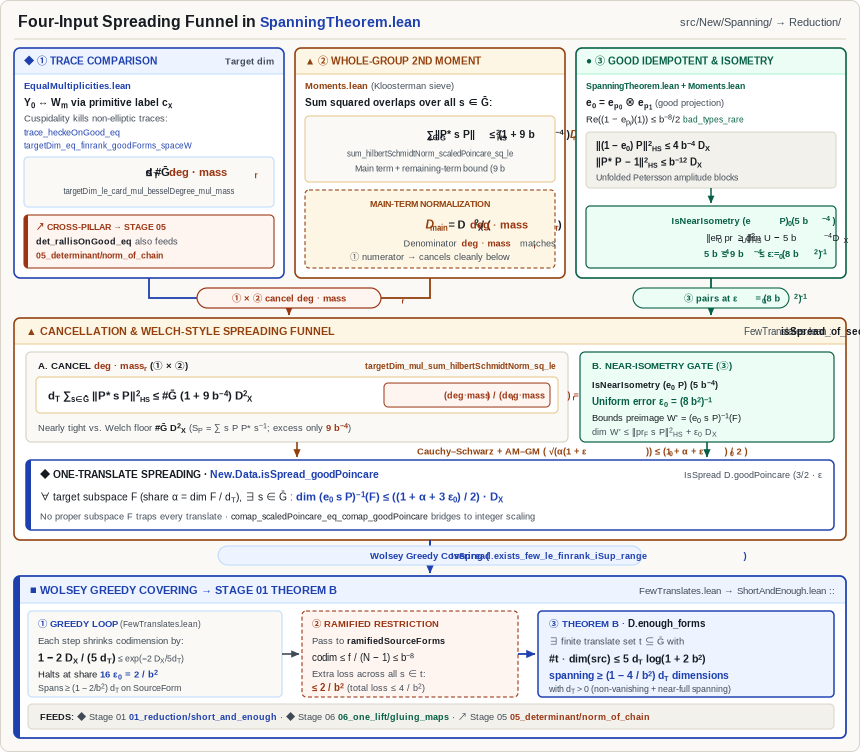
In Stage 04, the target space of Theorem B consists of good automorphic forms on the indefinite unitary space
Stage 04 bridges
- Isolate cuspidal local labels: By projecting onto good forms with a orthogonal projection built from finite-field polynomial labels including at least one primitive polynomialcentral idempotent, every component test function becomes strictly cuspidal at a split finite place above the level. Cuspidality kills all non-elliptic orbital integrals in the trace formula.
- Equate spherical Hecke traces (
trace_heckeOnGood_eq): For any spherical averaging operator built from finite matrix cosets away from the levelHecke operator, the trace of on the good forms of equals the trace of on the good forms of any companion space . - Deduce characteristic polynomials, determinants, and multiplicity equality: Because the spherical Hecke operators form a commuting algebra, equal traces on all powers of
force equal characteristic polynomials ( charpoly_heckeOnGood_eq) and equal determinants (det_heckeOnGood_eq). Takinggives targetDim_eq_finrank_goodForms_spaceW(), while taking to isolate a single eigensystem gives multiplicity equality ( finrank_goodForms_inf_eigenPart_eq). - Serve two pillars at once: Bounding the good forms on
by all principal-level forms on gives ( targetDim_le_card_mul_besselDegree_mul_mass), which plugs into the Welch-type second-moment spreading boundHilbert–Schmidt norm for Theorem B. Simultaneously, realizing the Rallis inner-product series of a unitary dual-pair lift between automorphic formstheta correspondence as a spherical Hecke operator givesdet_rallisOnGood_eq, which feeds Stage 05's determinant factorization (05_determinant/norm_of_chain) for Theorem C.
Limits of the intuition
Picturing trace comparison as checking that two finite matrices have matching traces of powers captures Newton's identities (charpoly_heckeOnGood_eq) and multiplicity equality, but omits the analytic price paid to equate traces across inner forms. Two unitary groups with different real signatures do not have identical traces on all automorphic forms: non-discrete spectrum and endoscopic terms would spoil the comparison. Equality holds in EqualMultiplicities.lean only after imposing two strict filters: the archimedean Harish-Chandra parameter D.paramW must have a large gap D.gap for both signatures (isolating discrete-series packets), and the finite-place component must lie in D.goodTupleFamilies, guaranteeing at least one primitive polynomial label whose local idempotent produces a cuspidal test function (trace_eq_of_isCuspidalAt).
Level 2 — Undergrad Bridge
The trace comparison for inner forms of unitary groups over a CM field toHCParam s (D.paramW v) and toHCParam s' (D.paramW v) both satisfy HasGap D.gap.
1. From primitive labels to equal traces (EqualMultiplicities.lean)
- Primitive polynomial witness (
exists_isPrimitivePolynomial): Every good label familyattaches a monic allowed degree- polynomial to each chosen place above , with at least one primitive (irreducible, with a root generating ). - Decomposition into label idempotents (
trace_heckeOnGood_eq_sum): Becauseprojects onto D.goodForms V, for every spherical Hecke operatoraway from , - Simple trace comparison (
trace_mul_tupleIdem_eqtrace_heckeOnGood_eq): At the placewhere is primitive, the local matrix coefficient attached to is supercuspidal ( Lib.Adelic.TraceFormula.CuspidalType), so the test function foris cuspidal at one split place. Invoking New.trace_eq_of_isCuspidalAtequates each summand onand , yielding
2. Spectral consequences and the Rallis operator
- Characteristic polynomials and determinants: Applying
trace_heckeOnGood_eqto all powers( ) and invoking Newton's identities ( TauCeti.LinearAlgebra.Matrix.Charpoly.Newton) yields(D.heckeOnGood V T).charpoly = (D.heckeOnGood V' T).charpoly(charpoly_heckeOnGood_eq) and equal determinants (det_heckeOnGood_eq). - Multiplicity equality (
finrank_goodForms_inf_eigenPart_eq): BecauseD.heckeAlgebraacts semisimply with finitely many joint eigensystems, choosing equal to on eigenPart V qandon all other eigensystems ( trace_heckeOnGood_eq_finrank) shows - Target dimension (
targetDim_eq_finrank_goodForms_spaceW+targetDim_le_card_mul_besselDegree_mul_mass): Settingwith and equates . On the definite space , the principal congruence level D.chosenLevelhas trivial class stabilizers (classAut = ⊥), indexin the maximal compact level (whose class sum is mass D.E D.r), and local weight dimension equal to the product of compact formal degreesD.filling.besselDegree(via Weyl's dimension polynomial). Hence - Cross-pillar bridge to Stage 05 (
det_rallisOnGood_eq): Each termD.rallisTerm ϑ j W z y iof Rallis' inner-product formula is realized as a matrix coefficientof a single spherical Hecke operator independent of ( exists_rallisTerm_eq_inner), and summing the series produces one operatoracting as D.rallisOperator ϑ jon bothand ( exists_hecke_eq_rallisOperator). Restricting to good forms (D.rallisOnGood) therefore yields equal determinants(D.rallisOnGood V ϑ j).det = (D.rallisOnGood V' ϑ j).det, used directly in Stage 05 (05_determinant/norm_of_chain).
Level 3 — Formal Lean Contract
Stage 04 extracts the trace comparison into skeleton/04_spanning/equal_multiplicities.lean and its target-dimension consequence into skeleton/04_spanning/spanning_theorem.lean:
04_spanning/equal_multiplicities.lean#New.Data.trace_heckeOnGood_eq(upstreamsrc/New/Spanning/Multiplicities/EqualMultiplicities.lean:273-280):leantheorem New.Data.trace_heckeOnGood_eq [hs : ∀ v : D.Φ, (toHCParam s (D.paramW v)).HasGap D.gap] [hs' : ∀ v : D.Φ, (toHCParam s' (D.paramW v)).HasGap D.gap] (T : D.heckeAlgebra) : trace ℂ (D.goodForms V) (D.heckeOnGood V T) = trace ℂ (D.goodForms V') (D.heckeOnGood V' T)04_spanning/equal_multiplicities.lean#New.Data.finrank_goodForms_inf_eigenPart_eq(upstreamsrc/New/Spanning/Multiplicities/EqualMultiplicities.lean:376-401):leantheorem New.Data.finrank_goodForms_inf_eigenPart_eq [hs : ∀ v : D.Φ, (toHCParam s (D.paramW v)).HasGap D.gap] [hs' : ∀ v : D.Φ, (toHCParam s' (D.paramW v)).HasGap D.gap] (q : FinPlace D.E × ℕ → ℂ) : finrank ℂ (D.goodForms V ⊓ D.eigenPart V q : Submodule ℂ (D.principalForms V)) = finrank ℂ (D.goodForms V' ⊓ D.eigenPart V' q : Submodule ℂ (D.principalForms V'))04_spanning/equal_multiplicities.lean#New.Data.targetDim_eq_finrank_goodForms_spaceW(upstreamsrc/New/Spanning/Multiplicities/EqualMultiplicities.lean:411-415):leantheorem New.Data.targetDim_eq_finrank_goodForms_spaceW (j : D.LiftIndex) : D.targetDim = finrank ℂ (D.goodForms (D.spaceW j))04_spanning/spanning_theorem.lean#New.Data.targetDim_le_card_mul_besselDegree_mul_mass(upstreamsrc/New/Spanning/SecondMoment/SpanningTheorem.lean:91-102):leantheorem New.Data.targetDim_le_card_mul_besselDegree_mul_mass : D.targetDim ≤ Nat.card D.chosenGL * D.filling.besselDegree * mass D.E D.r
See the page's live <VerificationBanner /> (audit/verification-status.json) for the pinned upstream commit and local Lean build status (build_status: unverified-locally).
Where this analogy breaks
Picturing trace comparison as swapping two identical finite matrices with different labels hides why an arbitrary modular form on the indefinite space Y_0 cannot be compared directly to one on the definite space W_m: the trace formula only simplifies to equal traces once the test function is strictly cuspidal at a split finite place (enforced by a primitive polynomial label in goodTupleFamilies) and the archimedean Harish-Chandra parameter has a large gap D.gap ensuring discrete-series isolation across both signatures.
Formal Lean Anchors
theorem New.Data.trace_heckeOnGood_eq — Upstream source (src/New/Spanning/Multiplicities/EqualMultiplicities.lean L273-L280)
/-- Let the parameter `D.paramW` have gap `D.gap` for the signs of `V` and of `V'`. Then a spherical
Hecke operator away from `M` has the same trace on the good forms of `V` and of `V'`. -/
theorem New.Data.trace_heckeOnGood_eq [hs : ∀ v : D.Φ, (toHCParam s (D.paramW v)).HasGap D.gap]
    [hs' : ∀ v : D.Φ, (toHCParam s' (D.paramW v)).HasGap D.gap] (T : D.heckeAlgebra) :
    trace ℂ (D.goodForms V) (D.heckeOnGood V T) =
trace ℂ (D.goodForms V') (D.heckeOnGood V' T) := by
sorry -- [EXTRACTED_STUB upstream=src/New/Spanning/Multiplicities/EqualMultiplicities.lean:273-280 commit=41c2716658c42ba08eb0648994a2efe83082a95c body_lines=3 body_sha256=e2c7a514fe1d3e7f679fe5b01d807f3b35945b3f898ae69be37db0562dbac14b]theorem New.Data.finrank_goodForms_inf_eigenPart_eq — Upstream source (src/New/Spanning/Multiplicities/EqualMultiplicities.lean L376-L401)
/-- Let `V`, `V'` be hermitian spaces with signs `s`, `s'`, which may differ, and let the parameter
`D.paramW` have gap `D.gap` for both. For each eigensystem `q`, the good forms with eigensystem `q`
on `V` and on `V'` make up spaces of the same dimension. -/
theorem New.Data.finrank_goodForms_inf_eigenPart_eq
    [hs : ∀ v : D.Φ, (toHCParam s (D.paramW v)).HasGap D.gap]
    [hs' : ∀ v : D.Φ, (toHCParam s' (D.paramW v)).HasGap D.gap] (q : FinPlace D.E × ℕ → ℂ) :
    finrank ℂ (D.goodForms V ⊓ D.eigenPart V q : Submodule ℂ (D.principalForms V)) =
finrank ℂ (D.goodForms V' ⊓ D.eigenPart V' q : Submodule ℂ (D.principalForms V')) := by
sorry -- [EXTRACTED_STUB upstream=src/New/Spanning/Multiplicities/EqualMultiplicities.lean:376-401 commit=41c2716658c42ba08eb0648994a2efe83082a95c body_lines=19 body_sha256=42c402b64bb477a7ac4043b11447ef276d65c90eed60c9f96429b9da5dc7141d]theorem New.Data.targetDim_eq_finrank_goodForms_spaceW — Upstream source (src/New/Spanning/Multiplicities/EqualMultiplicities.lean L411-L415)
/-- For `1 ≤ j ≤ m` the good forms on `W_j = D.spaceW j` have dimension `D.targetDim`, which is the
dimension of the good forms on `Y_0 = D.spaceY 0`: the identity has the same trace on both. -/
theorem New.Data.targetDim_eq_finrank_goodForms_spaceW (j : D.LiftIndex) :
D.targetDim = finrank ℂ (D.goodForms (D.spaceW j)) := by
sorry -- [EXTRACTED_STUB upstream=src/New/Spanning/Multiplicities/EqualMultiplicities.lean:411-415 commit=41c2716658c42ba08eb0648994a2efe83082a95c body_lines=2 body_sha256=c60af54844d3c4a4271f1395acd9d7d743dbbaffe646918167a1bf699a789c67]theorem New.Data.targetDim_le_card_mul_besselDegree_mul_mass — Upstream source (src/New/Spanning/SecondMoment/SpanningTheorem.lean L91-L102)
/-- **Dimension of the target.** For admissible data `D`, the dimension `D.targetDim` of the space
of good forms on `Y₀` is at most `#Ḡ · deg · mass_r`. -/
theorem New.Data.targetDim_le_card_mul_besselDegree_mul_mass :
D.targetDim ≤ Nat.card D.chosenGL * D.filling.besselDegree * mass D.E D.r := by
sorry -- [EXTRACTED_STUB upstream=src/New/Spanning/SecondMoment/SpanningTheorem.lean:91-102 commit=41c2716658c42ba08eb0648994a2efe83082a95c body_lines=9 body_sha256=31db0ddda7dd7fb7458283b6161c4c112d034926657fe77fee4ba2fc5b31e37b]Related Concepts
- complex plane — The two-dimensional coordinate plane of numbers s = σ + it, where the horizontal coordinate σ = Re(s) sets decay rate and the vertical coordinate t = Im(s) sets oscillation frequency.
- Hecke operator — An averaging operator that sums values of an automorphic form over neighboring sublattices—indexed by cosets of a parahoric subgroup—which Stage 03 scales by powers of a prime to eliminate collision losses in the composite theta lift.
- central idempotent — A class-function element of a finite group algebra satisfying z² = z that acts as a G-equivariant orthogonal projection, splitting good cuspidal types from rare bad types across two level primes.
- theta correspondence — An integral transform built from a two-variable theta kernel that carries automorphic forms from one unitary group to another, iterated along a ladder of Hermitian spaces and packaged via admissible chain data.
- Hilbert–Schmidt norm — The Frobenius-style root-sum-of-squares norm on linear maps whose second moment over group translates, paired with near-isometry on the good subspace, proves Welch-style spreading and Wolsey greedy covering for Theorem B.
Referenced By
- Stage: Chain Determinant Factorization and Two-Grid Auxiliary Forms
- Stage: Stage 04 — Spanning: Second Moment (Theorem B)
- Stage: Stage 05 — Lower Bound: The Determinant (Theorem C, Part 1)
- Stage: Target Dimension, Multiplicity Equality, and One Good Translate
- Concept: central idempotent
- Concept: Hilbert–Schmidt norm
- Concept: Rallis inner product formula
Authoritative Sources
- Conditional base change for unitary groups (paper) — M. Harris & J.-P. Labesse, Asian J. Math. 8 (2004), 653–684.
- Changement de base CM et séries discrètes (paper) — J.-P. Labesse, in On the Stabilization of the Trace Formula (2011), Thms. 5.4–5.5.
- Simple Algebras, Base Change, and the Advanced Theory of the Trace Formula (book) — J. Arthur & L. Clozel, Ann. of Math. Stud. 120, Princeton Univ. Press (1989).
Page Glossary
- complex plane
- The two-dimensional coordinate plane of numbers s = σ + it, where the horizontal coordinate σ = Re(s) sets decay rate and the vertical coordinate t = Im(s) sets oscillation frequency.
- central idempotent
- A class-function element of a finite group algebra satisfying z² = z that acts as a G-equivariant orthogonal projection, splitting good cuspidal types from rare bad types across two level primes.
- Hecke operator
- An averaging operator that sums values of an automorphic form over neighboring sublattices—indexed by cosets of a parahoric subgroup—which Stage 03 scales by powers of a prime to eliminate collision losses in the composite theta lift.
- Hilbert–Schmidt norm
- The Frobenius-style root-sum-of-squares norm on linear maps whose second moment over group translates, paired with near-isometry on the good subspace, proves Welch-style spreading and Wolsey greedy covering for Theorem B.
- theta correspondence
- An integral transform built from a two-variable theta kernel that carries automorphic forms from one unitary group to another, iterated along a ladder of Hermitian spaces and packaged via admissible chain data.