lift comparison operator
Also known as: lift compression, compressed comparison operator, comparison determinant.
A family of self-adjoint integral operators U_theta = n_Aut * hk^2 * glue_theta * glue_theta^* on V_j whose compression pr U_theta onto the lift subspace satisfies Z_j(theta) * det(pr U_theta) = C * rho_theta^d, turning the lift determinant ratio into a ratio of compressed determinants times inverse Hecke values.
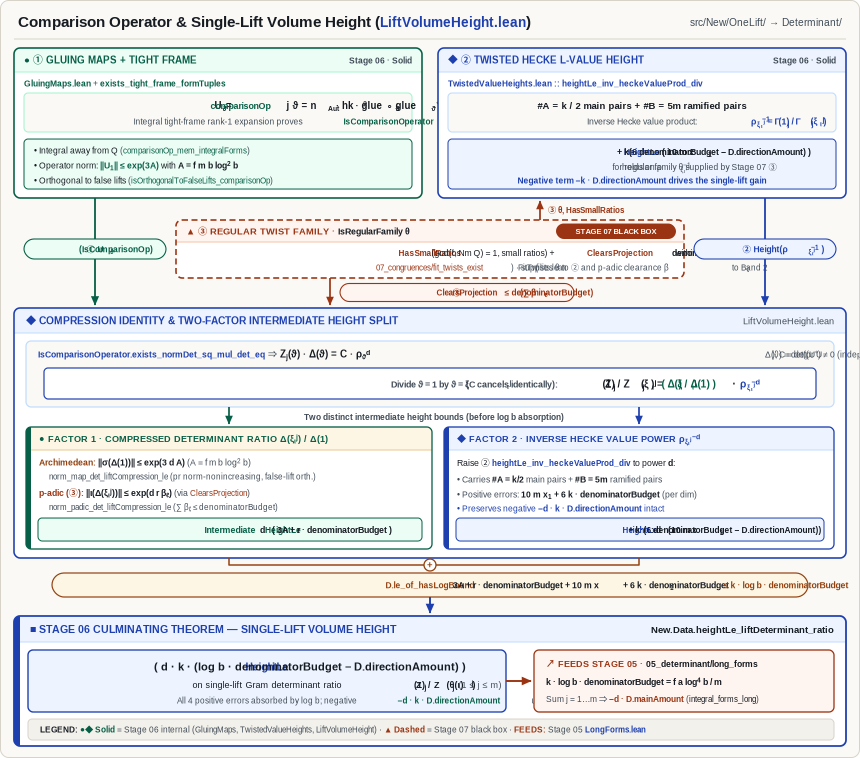
Level 1 — First-Principles
For a single lift
A lift comparison operator normDet_sq_mul_det_compression): for any injective map
Here liftCompression), also called the compressed comparison operator, and
Stage 06 builds the concrete family
where IsComparisonOperator contract?
- Twist-separated pullback: Because
is independent of and , we get for a fixed positive-definite operator independent of . Taking determinants immediately yields exists_normDet_sq_mul_det_eq:Dividing by cancels the unknown constant identically: - Integrality and smallness: Expanding
on using an overcomplete Parseval-style frametight frame of integral tuples ( exists_tight_frame_formTuples) rewritesas a finite sum of rank-one operators over glued integral forms . That makes preserve integrality at every prime ( comparisonOp_mem_integralForms) and caps the operator norm ofat ( normSqAt_comparisonOp_le). - Orthogonality to false lifts: Every image
is a scalar multiple of , so by false-lift orthogonalityfalse-lift period it is orthogonal to all false lifts. That ensures the orthogonal projection neither inflates archimedean norms at nor blows up -adic denominators beyond projection clearingregular twist family ( ClearsProjection).
Limits of the intuition
Treating IsComparisonOperator as merely a factorization trick misses why all five fields of the structure are locked together. Without isOrthogonalToFalseLifts, projecting normSqAt_starProjection_range_goodLift_le (needed for the archimedean bound on ClearsProjection (needed for the FormTuples, glue_ϑ^* alone would introduce uncontrolled denominators from the inner product on
Level 2 — Undergrad Bridge
In Hida (1981), Böcherer–Dummigan–Schulze-Pillot (2012), and Zhang (2018), congruence modules and Petersson-norm ratios of individual eigenforms are controlled by pairing against integral forms orthogonal to complementary eigenspaces. src/New/OneLift/LiftVolumeHeight.lean (29 declarations, 0 stub truncations) lifts this strategy to an entire
- Abstract compression and determinant bounds (
normDet_sq_mul_det_compression,norm_map_det_le_pow,exists_smul_mem_integralForms_maximal): If every eigenvalueof an endomorphism on a -dimensional complex space satisfies under a ring map , then . Scaling any nonzero eigenvector to -adic valuation ( exists_smul_mem_integralForms_maximal) converts integrality ofinto an eigenvalue bound. - Tight-frame expansion of
comparisonOp(exists_frame_weightRep_eq_intCast,exists_tight_frame_formTuples,comparisonOp_eq_sum): On each classof , exists_frame_weightRep_eq_intCastsupplies a frameindexed by ColumnFillingofwith , integral after , and squared norm . Assembling across TightFrameIndex jrewritesSince each is integral and glue_ϑpreserves integrality away from, preserves integralForms ι(comparisonOp_mem_integralForms). At, combining normSqAt_glue_le() with card_prod_mul_card_tightFrameIndex_mul_sq_le(, where ) yields (comparisonOp j 1 φ).normSqAt σ ≤ exp (3 * A) ^ 2 * φ.normSqAt σ(normSqAt_comparisonOp_le). - Verifying the contract and determinant cancellation (
isComparisonOperator_comparisonOp,IsComparisonOperator.exists_normDet_sq_mul_det_eq): UsingheckeValueProd_div_eq(), inner_goodLift_comparisonOp, andisOrthogonalToFalseLifts_comparisonOpprovesisComparisonOperator_comparisonOp j. ApplyingnormDet_sq_mul_det_compressiontou = D.goodLift ϑ jthen yieldswith because is positive definite ( periodLift_injective).
Level 3 — Formal Lean Contract
All five anchors live in skeleton/06_one_lift/lift_volume_height.lean (29 declarations, 0 stub truncations):
06_one_lift/lift_volume_height.lean#New.Data.IsComparisonOperator(upstreamLiftVolumeHeight.lean:172-198):leanstructure New.Data.IsComparisonOperator (j : D.LiftIndex) (U : ∀ ϑ : D.Twist, End ℂ (D.descentPair ϑ j).FormV) : Prop where ratio_ne_zero (ϑ : D.Twist) : heckeValueProd j ϑ / heckeValueProd j 1 ≠ 0 exists_inner_eq : ∃ U₀ : End ℂ (D.goodForms (D.spaceW j)), (∀ y : D.goodForms (D.spaceW j), y ≠ 0 → 0 < inner ℂ y (U₀ y)) ∧ ∀ (ϑ : D.Twist) (y' y : D.goodForms (D.spaceW j)), inner ℂ (D.goodLift ϑ j y') (U ϑ (D.goodLift ϑ j y)) = heckeValueProd j ϑ / heckeValueProd j 1 * inner ℂ y' (U₀ y) isOrthogonalToFalseLifts (ϑ : D.Twist) (z : (D.goodLift ϑ j).range) : IsOrthogonalToFalseLifts (D.descentPair ϑ j) D.e₀ (D.goodLift ϑ j).rangeᗮ (U ϑ z) mem_integralForms (ϑ : D.Twist) (l : ℕ) [Fact l.Prime] (ι : PadicPlace l) (hl : l.Coprime ϑ.normQ) : ∀ φ ∈ integralForms ι, U ϑ φ ∈ integralForms ι normSqAt_le (φ : (D.descentPair (1 : D.Twist) j).FormV) (σ : ℂ ≃+* ℂ) : (U 1 φ).normSqAt σ ≤ exp (3 * (D.f * D.m * D.b * D.logB ^ 2)) ^ 2 * φ.normSqAt σ06_one_lift/lift_volume_height.lean#New.Data.comparisonOp(upstreamLiftVolumeHeight.lean:200-206),06_one_lift/lift_volume_height.lean#New.Data.isComparisonOperator_comparisonOp(upstreamLiftVolumeHeight.lean:548-579), and06_one_lift/lift_volume_height.lean#New.Data.liftCompression(upstreamLiftVolumeHeight.lean:612-618).06_one_lift/lift_volume_height.lean#New.Data.IsComparisonOperator.exists_normDet_sq_mul_det_eq(upstreamLiftVolumeHeight.lean:622-646):leanlemma New.Data.IsComparisonOperator.exists_normDet_sq_mul_det_eq {j : D.LiftIndex} {U : ∀ ϑ : D.Twist, End ℂ (D.descentPair ϑ j).FormV} (hU : IsComparisonOperator j U) : ∃ C : ℂ, C ≠ 0 ∧ ∀ ϑ : D.Twist, (D.goodLift ϑ j).normDet ^ 2 * (liftCompression U ϑ).det = C * (heckeValueProd j ϑ / heckeValueProd j 1) ^ finrank ℂ (D.goodForms (D.spaceW j))
See the page's live <VerificationBanner /> (audit/verification-status.json) for the pinned upstream commit and local Lean build status (build_status: unverified-locally).
Where this analogy breaks
Viewing U_theta as a simple change-of-basis operator between the untwisted and twisted lift subspaces is misleading: V_j at twist theta and V_j at twist 1 carry different level structures, so U_theta acts separately on each twisted space FormV and links them only through the twist-independent quadratic form U^o on W_j and the determinant identity Z_j(theta) * Delta(theta) = C * rho_theta^d.
Formal Lean Anchors
structure New.Data.IsComparisonOperator — Upstream source (src/New/OneLift/LiftVolumeHeight.lean L172-L198)
/-- A comparison operator for the lift from `W_j`: a family of operators `U_ϑ` on the forms on `V_j`
through which the lifts `Θ_ϑ = D.goodLift ϑ j` at the twists `ϑ` are compared with the untwisted
one. In the bound, `f = D.f` is the number of infinite places, `m = D.m` the number of lifts in the
chain and `b = D.b`, with `log b = D.logB`, the weight at the infinite places in `D.bPlaces`. -/
structure New.Data.IsComparisonOperator (j : D.LiftIndex)
(U : ∀ ϑ : D.Twist, End ℂ (D.descentPair ϑ j).FormV) : Prop where
/-- The ratio of the twisted to the untwisted Hecke values of the lift is not `0`. -/
ratio_ne_zero (ϑ : D.Twist) : heckeValueProd j ϑ / heckeValueProd j 1 ≠ 0
/-- `⟨Θ_ϑ y', U_ϑ Θ_ϑ y⟩` is this ratio times `⟨y', U° y⟩`, for a positive definite operator `U°`
on the good forms that does not depend on `ϑ`. The shape of the ratio is given by
`exists_heckeValueProd_eq_mul_prod_ratio`. -/
exists_inner_eq : ∃ U₀ : End ℂ (D.goodForms (D.spaceW j)),
(∀ y : D.goodForms (D.spaceW j), y ≠ 0 → 0 < inner ℂ y (U₀ y)) ∧
∀ (ϑ : D.Twist) (y' y : D.goodForms (D.spaceW j)),
inner ℂ (D.goodLift ϑ j y') (U ϑ (D.goodLift ϑ j y)) =
heckeValueProd j ϑ / heckeValueProd j 1 * inner ℂ y' (U₀ y)
/-- `U_ϑ` takes lifts to forms that are orthogonal to the false lifts
(`IsOrthogonalToFalseLifts`). -/
isOrthogonalToFalseLifts (ϑ : D.Twist) (z : (D.goodLift ϑ j).range) :
IsOrthogonalToFalseLifts (D.descentPair ϑ j) D.e₀ (D.goodLift ϑ j).rangeᗮ (U ϑ z)
/-- `U_ϑ` keeps integrality above every prime that does not divide `ϑ.normQ`, the product
of the norms of the places in the set `Q` of `ϑ`. -/
mem_integralForms (ϑ : D.Twist) (l : ℕ) [Fact l.Prime] (ι : PadicPlace l)
(hl : l.Coprime ϑ.normQ) : ∀ φ ∈ integralForms ι, U ϑ φ ∈ integralForms ι
/-- `U_1` multiplies norms at every `σ` by at most `exp (3 f m b log² b)`. -/
normSqAt_le (φ : (D.descentPair (1 : D.Twist) j).FormV) (σ : ℂ ≃+* ℂ) :
(U 1 φ).normSqAt σ ≤ exp (3 * (D.f * D.m * D.b * D.logB ^ 2)) ^ 2 * φ.normSqAt σdef New.Data.comparisonOp — Upstream source (src/New/OneLift/LiftVolumeHeight.lean L200-L206)
/-- The operator `U_ϑ = n_Aut hk² glue_ϑ glue_ϑ*` on the forms on `V_j`. Here `glue_ϑ = glue j ϑ`
is the linear map that builds a form on `V_j` from a tuple of forms on `V°`,
`hk = hookNumberMinus j` is the hook number of the diagram `μ⁻` (the weight of the forms on `V°`),
and `n_Aut = D.chosenGroupOrder` is a multiple of the orders of all stabilisers. -/
noncomputable def New.Data.comparisonOp (j : D.LiftIndex) (ϑ : D.Twist) : End ℂ (D.descentPair ϑ j).FormV := by
sorry -- [EXTRACTED_STUB upstream=src/New/OneLift/LiftVolumeHeight.lean:200-206 commit=41c2716658c42ba08eb0648994a2efe83082a95c body_lines=2 body_sha256=fbf832488db060cab685ceec9a570b2a287b6504abc318dc379e51ad5c20f0c5]theorem New.Data.isComparisonOperator_comparisonOp — Upstream source (src/New/OneLift/LiftVolumeHeight.lean L548-L579)
/-- The operators `U_ϑ = comparisonOp j ϑ = n_Aut hk² glue_ϑ glue_ϑ*` on the forms on `V_j`, one for
each twist `ϑ`, satisfy `IsComparisonOperator`. Here `glue_ϑ = glue j ϑ` builds a form on `V_j` from
a tuple of forms on `V°`, `n_Aut = D.chosenGroupOrder` and `hk = hookNumberMinus j`. That is, for
the theta lift `Θ_ϑ = D.goodLift ϑ j` and the nonzero ratio
`ρ_ϑ = heckeValueProd j ϑ / heckeValueProd j 1` of Hecke values,
`⟨Θ_ϑ y', U_ϑ Θ_ϑ y⟩ = ρ_ϑ ⟨y', U° y⟩` with `U°` positive definite and independent of `ϑ`. Also,
`U_ϑ` takes lifts to forms orthogonal to the false lifts, which are the forms orthogonal to the
lifts with the same idempotent and Hecke conditions at a split place. `U_ϑ` keeps integrality above
the primes that do not divide `ϑ.normQ`, and `U_1` multiplies norms by at most
`exp (3 f m b log² b)`, with `f = D.f`, `m = D.m` and `b = D.b`. -/
theorem New.Data.isComparisonOperator_comparisonOp (j : D.LiftIndex) :
IsComparisonOperator j (comparisonOp j) := by
sorry -- [EXTRACTED_STUB upstream=src/New/OneLift/LiftVolumeHeight.lean:548-579 commit=41c2716658c42ba08eb0648994a2efe83082a95c body_lines=21 body_sha256=0f24aab70cbf02ea49cda7033c6380316f9c74429a58c26fa78c520853609658]def New.Data.liftCompression — Upstream source (src/New/OneLift/LiftVolumeHeight.lean L612-L618)
/-- For operators `U_ϑ` on the forms on `V_j`, the operator `pr U_ϑ` on the lifts (the range of
`D.goodLift ϑ j`), with `pr` the orthogonal projection to them. -/
noncomputable def New.Data.liftCompression {j : D.LiftIndex}
(U : ∀ ϑ : D.Twist, End ℂ (D.descentPair ϑ j).FormV) (ϑ : D.Twist) :
End ℂ (D.goodLift ϑ j).range := by
sorry -- [EXTRACTED_STUB upstream=src/New/OneLift/LiftVolumeHeight.lean:612-618 commit=41c2716658c42ba08eb0648994a2efe83082a95c body_lines=2 body_sha256=b9af267c3f57189f36a51ef1787eed3fa1cca2a5ac3f8a4116c309857a300013]lemma New.Data.IsComparisonOperator.exists_normDet_sq_mul_det_eq — Upstream source (src/New/OneLift/LiftVolumeHeight.lean L622-L646)
/-- Let `Θ_ϑ = D.goodLift ϑ j` be the theta lift at the twist `ϑ` to the forms on `V_j`. Its source
is the good forms (the image of the idempotent `D.e₀`, a space of dimension `d`) on the hermitian
space `W_j = D.spaceW j`. Let `ρ_ϑ` be the ratio of the values at `ϑ` and at `1` of
`heckeValueProd j`. Let `U` be a comparison operator, so that `⟨Θ_ϑ y', U_ϑ Θ_ϑ y⟩ = ρ_ϑ ⟨y', U° y⟩`
with `U°` positive definite. Then the Gram determinant `Θ_ϑ.normDet ^ 2 = det (Θ_ϑ* Θ_ϑ)`, times the
determinant of `pr U_ϑ = liftCompression U ϑ`, is `C ρ_ϑ ^ d` for a constant `C ≠ 0` that does not
depend on `ϑ`. -/
lemma New.Data.IsComparisonOperator.exists_normDet_sq_mul_det_eq {j : D.LiftIndex}
    {U : ∀ ϑ : D.Twist, End ℂ (D.descentPair ϑ j).FormV} (hU : IsComparisonOperator j U) :
    ∃ C : ℂ, C ≠ 0 ∧ ∀ ϑ : D.Twist,
      (D.goodLift ϑ j).normDet ^ 2 * (liftCompression U ϑ).det =
C * (heckeValueProd j ϑ / heckeValueProd j 1) ^ finrank ℂ (D.goodForms (D.spaceW j)) := by
sorry -- [EXTRACTED_STUB upstream=src/New/OneLift/LiftVolumeHeight.lean:622-646 commit=41c2716658c42ba08eb0648994a2efe83082a95c body_lines=14 body_sha256=d41f56ccc5fe0807a5216047f955bc861a49e87bfead2dccc776984b1499f197]Related Concepts
- Gram determinant — The determinant of the matrix of pairwise inner products of a family of vectors, measuring the squared volume of the parallelotope they span and controlled by Hadamard's and Fischer's inequalities.
- tight frame — A balanced, possibly overcomplete family of vectors with integer multiplicities whose projections reconstruct the exact standard inner product—allowing integral root-of-unity spokes to pull back one-dimensional elliptic theta sections into high-dimensional integral theta functions.
- divided-lattice gluing — Splitting the definite target space V_j = V'' + V^o along a congruence-glued lattice to pair a twist-carrying first factor on V'' with arbitrary forms on V^o, producing a linear map glue_theta whose adjoint isolates the twist as a single nonzero scalar in c'theta * glue_theta^* * Theta = Theta^o.
- false-lift period — The theta period over a complementary block I_l of an algebraic form Xi that mimics a lift in level and Hecke eigenvalue yet sits orthogonal to true lifts—forced to vanish by climbing a hyperbolic-plane descent tower when 2r + 2N + 3 < n.
- regular twist family — A prime-by-prime family of m-fold anticyclotomic twists theta(iota) with modulus coprime to l, inverse L-value ratios of height at most x_1, and lift/projection denominators summing within fa(log b)^3 / (m*k).
Referenced By
- Stage: Stage 06 — Lower Bound: One Lift (Theorem C, Part 2)
- Stage: The Lift Comparison Operator and Single-Lift Volume Height
- Concept: idle direction repayment
Authoritative Sources
- Yoshida lifts and Selmer groups (paper) — S. Böcherer, N. Dummigan & R. Schulze-Pillot, J. Math. Soc. Japan 64 (2012), 1353–1401.
- Special L-values and Selmer groups of Siegel modular forms of genus 2 (paper) — X. Zhang, arXiv:1811.02031 (2018).
- Congruences of cusp forms and special values of their zeta functions (paper) — H. Hida, Invent. Math. 63 (1981), 225–261.
Page Glossary
- Gram determinant
- The determinant of the matrix of pairwise inner products of a family of vectors, measuring the squared volume of the parallelotope they span and controlled by Hadamard's and Fischer's inequalities.
- divided-lattice gluing
- Splitting the definite target space V_j = V'' + V^o along a congruence-glued lattice to pair a twist-carrying first factor on V'' with arbitrary forms on V^o, producing a linear map glue_theta whose adjoint isolates the twist as a single nonzero scalar in c'_theta * glue_theta^* * Theta_{j,theta} = Theta^o.
- tight frame
- A balanced, possibly overcomplete family of vectors with integer multiplicities whose projections reconstruct the exact standard inner product—allowing integral root-of-unity spokes to pull back one-dimensional elliptic theta sections into high-dimensional integral theta functions.
- false-lift period
- The theta period over a complementary block I_l of an algebraic form Xi that mimics a lift in level and Hecke eigenvalue yet sits orthogonal to true lifts—forced to vanish by climbing a hyperbolic-plane descent tower when 2r + 2N + 3 < n.
- regular twist family
- A prime-by-prime family of m-fold anticyclotomic twists theta(iota) with modulus coprime to l, inverse L-value ratios of height at most x_1, and lift/projection denominators summing within f*a*(log b)^3 / (m*k).