Vanishing Periods of False Lifts and Negative Heights of Twisted L-Values
This page explains the two analytic engines backing Stage 06: src/New/OneLift/FalseLifts/PeriodsOfFalseLifts.lean (06_one_lift/periods_of_false_lifts, 13 declarations, 1 let-type stub truncation) — which kills complementary-block theta periods of false lifts by climbing a hyperbolic-plane descent tower — and src/New/OneLift/HeckeValues/TwistedValueHeights.lean (06_one_lift/twisted_value_heights, 24 declarations, 2 let-type stub truncations) — which uses four-block rank-one character theta lifts and Stage 02's sharpness theorem to establish the negative arithmetic height of inverse twisted Hecke
Level 1 — First-Principles
Two obstacles stand between the gluing machinery of GluingMaps.lean and a negative single-lift height in LiftVolumeHeight.lean. First, how do we ensure that glued forms built across the divided latticedivided-lattice gluing and test forms do not collide with false lifts—forms that mimic true lifts in congruence level and Hecke eigenvalue yet sit orthogonal to every lift? Second, how do we prove that the inverse Hecke value productcarrier form ratio
Stage 06 solves both problems in sequence—and uses the first solution directly inside the second.
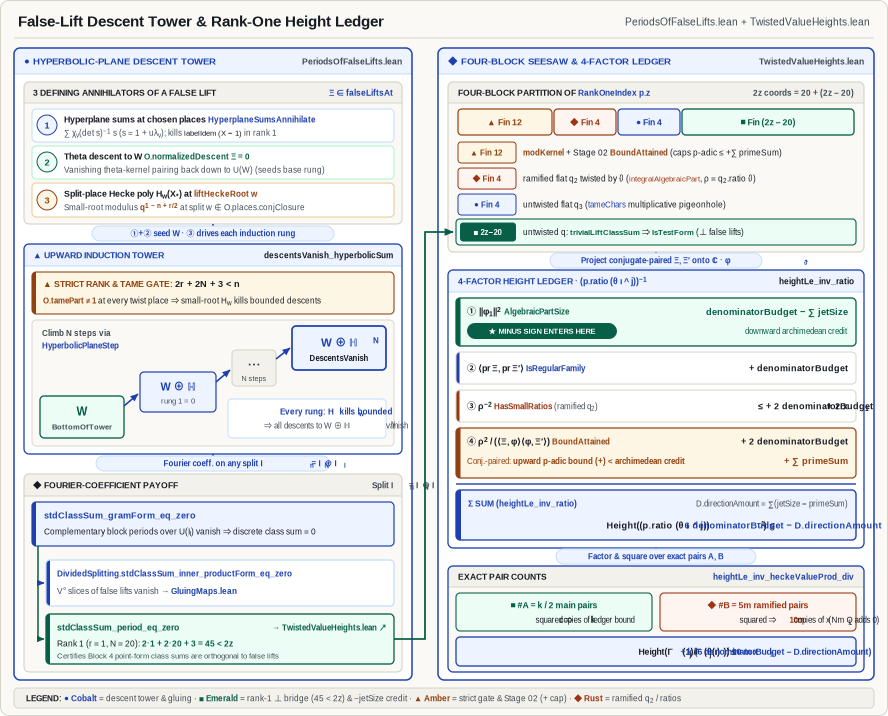
Part 1: Climbing the descent tower for false lifts (PeriodsOfFalseLifts.lean)
On a definite space
- Hyperplane sums at chosen places (
HyperplaneSumsAnnihilate): character-weighted sumsover invertible matrices (which automatically annihilate forms in the image of the good idempotentcentral idempotent , and in rank one annihilate the mean idempotent labelIdem Unit (X - 1),hyperplaneSum_apply_eq_zero_of_rank_one); - Theta descent to
( O.normalizedDescent Ξ = 0): vanishing pairing against the theta kerneltheta correspondence back down to; - Small-root Hecke vanishing (
heckePolyOnForms): annihilation by the split-place Hecke polynomialHecke operatorevaluated at liftHeckeRoot wof modulus( the residue cardinality at a split place off the level).
Assuming nontrivial residue characters O.tamePart at every twist place and the strict rank inequality
Stage 06 climbs a hyperbolic-plane descent tower from BottomOfTower (where hyperplane sums upgrade one vanishing harmonic descent lift_polyVector_blockDatum_eq_zero to all descents on HyperbolicPlaneStep to descentsVanish_hyperbolicSum): at every rung, small-root Hecke vanishing kills any bounded nonzero descent.
Once all descents to integral_conj_pairTheta_mul_algFormCoeff_eq_zero) for any split stdClassSum_gramForm_eq_zero, stdClassSum_gramForm_kernelVector_eq_zero). That single theorem feeds both consumers:
stdClassSum_period_eq_zerocertifies that four-block point-form class sums are orthogonal to false lifts inTwistedValueHeights.lean;DividedSplitting.stdClassSum_inner_productForm_eq_zerocertifies that-slices of false lifts vanish in GluingMaps.lean.
Part 2: Rank-one lifts and negative TwistedValueHeights.lean)
For each main pairHecke L-value ratio TwistedValueHeights.lean splits RankOneIndex p.z into four blocks of sizes
- Block 1 (
Fin 12): carries a degree-rowLengthmonomial on amodKernel, where Stage 02's sharpness theorem (02_derivatives/bound_attained) guarantees that some Taylor derivative avoids excess-adic divisibility beyond localPrimeSumTotal l. - Block 2 (
Fin 4): carries the twistvia a ramified flat pair , contributing its integral algebraic part and hence . - Blocks 3 & 4 (
Fin 4andFin (2z - 20)): carry untwisted flat pairsand ; summing over Block 4 via trivialLiftClassSumenforces false-lift orthogonality (isTestForm_trivialLiftClassSum_pointForm, since).
Factoring the pairing against X.kernelForm g (inner_pointForm_kernelForm exists_isTestForm_inner_kernelForm_eq), selecting untwisted characters by multiplicative pigeonhole (exists_mul_eq_norm_map_le_norm_map_mul) and exists_norm_le_norm_twisted_classSum), and plugging in Stage 02's bound_attained produces a rank-one test form exists_isTestForm_le_norm_inner_trivialLift).
Projecting New.Data.heightLe_inv_ratio:
- Factor 1 — Untwisted lift norm
( AlgebraicPartSize.lean::heightLe_norm_trivialLift_sq): contributes. This is where the minus sign on jetSizeenters. - Factor 2 — Main-pair projection
( IsRegularFamily): contributes. - Factor 3 — Auxiliary flat-pair inverse square
( HasSmallRatioson ramified): contributes . - Factor 4 — Conjugate-paired test-form denominator
( exists_isTestForm_le_norm_inner_trivialLift): contributes. Notice carefully: Stage 02's BoundAttainedenters with a plus sign; it caps the upward-adic valuation penalty below Factor 1's downward archimedean credit—never claim BoundAttainedproduces a negative height by itself!
Summing the four factors cancels heightLe_inv_ratio:
Finally, factoring heckeValueProd_eq_mul_prod_ratio_sq, exists_heckeValueProd_eq_mul_prod_ratio) splits the squared ratios into exact pair counts:
#A = k / 2main pairs (), running over on i = nonewith sign, squared to yield copies of ; #B = 5 * D.mramified pairs (at some (-1)with sign, at some 1with sign, and at nonewith sign), squared to yield copies of .
Adding these heights yields heightLe_inv_heckeValueProd_div:
Where this analogy breaks
Thinking of the four-block seesaw as a simple product of four independent charV of the main pair X, which is why Blocks 3 and 4 run over the finite character group tameChars and require multiplicative pigeonhole (exists_mul_eq_norm_map_le_norm_map_mul) plus a geometric-mean archimedean bound (exists_root_prod_integralAlgebraicPart) to pick characters without losing 12-dimensional first block is not chosen arbitrarily: Fin 12 is large enough for the Stage 02 theta-jet sharpness theorem while leaving PeriodsOfFalseLifts's strict inequality!
Level 2 — Undergrad Bridge
1. Hyperbolic-plane descent tower (PeriodsOfFalseLifts.lean, 13 decls, 1 truncation)
- Bottom of the tower (
lift_polyVector_blockDatum_eq_zero): FromO.FitsParams l₀andO.normalizedDescent Ξ = 0, real convolution spreads vanishing fromhighestVectorto every Fock polynomialpolyVector PagainstO.blockDatum.BottomOfTower.lean::descentsVanish_of_hyperplaneSumsAnnihilatethen upgradesO.blockDatumto all finite data vacuum offO.places.conjClosure. - Tower induction (
descentsVanish_hyperbolicSum): Underh_ramified : ∀ i, O.tamePart (O.twistPlace i) ≠ 1,h_hyperplane,h_theta,h_heckeatO.liftHeckeRoot w(modulus), and strict rank margin 2 * card r + 2 * card N + 3 < card n, induction viaHyperbolicPlaneStep.leanprovesDescentsVanish (hyperbolicSum N O.W) (stdSpace E n)for every vector. - From vanishing descents to class sums (
integral_conj_pairTheta_mul_algFormCoeff_eq_zero,stdClassSum_gramForm_eq_zero,stdClassSum_gramForm_kernelVector_eq_zero): Givenand , Fourier-coefficient unfolding kills the quotient integral of . Equivariant compact integration turns this into stdClassSum K f = 0for every stabilizing level. - Rank-one and divided-splitting specializations (
hyperplaneSum_apply_eq_zero_of_rank_one,stdClassSum_period_eq_zero,DividedSplitting.stdClassSum_inner_productForm_eq_zero): In rank, labelIdem Unit (X - 1)is the uniform mean over, killed by any nontrivial hyperplane sum ( hyperplaneSum_mul_labelIdem_X_sub_one), yieldingstdClassSum_period_eq_zerofor point forms (TwistedValueHeights). For divided splittings,DividedSplitting.algFormRep_conj_block_eq_selfshowsprincipalLevel l ϖfixesΞaroundL.point, yieldingDividedSplitting.stdClassSum_inner_productForm_eq_zero(GluingMaps).
2. Rank-one test forms and exact height accounting (TwistedValueHeights.lean, 24 decls, 2 truncations)
- Four-block test form construction (
trivialLiftClassSum,inner_pointForm_kernelForm,isTestForm_trivialLiftClassSum_pointForm,exists_isTestForm_inner_kernelForm_eq): OnRankOneIndex p.z, testColumnputson Block 1 and standard basis vectors on Blocks 2–4 (injective by testColumn_injective), whiletwistRow p.zreads Block 2 at twist places. SummingpointFormover Block 4 gives an integral test form orthogonal to false lifts (isTestForm_trivialLiftClassSum_pointForm, callingstdClassSum_period_eq_zerowith). Summing over Blocks 2 and 3 yields exists_isTestForm_inner_kernelForm_eq: - Pairing lower bound (
exists_norm_le_norm_twisted_classSum,exists_mul_eq_norm_map_le_norm_map_mul,exists_root_prod_integralAlgebraicPart,exists_isTestForm_le_norm_inner_trivialLift): Combining thetameCharsgeometric mean( ), multiplicative pigeonhole, character orthogonality, and 02_derivatives/bound_attainedgives( ) and a test form with . - Exact 4-factor height sum (
heightLe_inv_ratio): Usingand : - Exact pair-count aggregation (
heckeValueProd_eq_mul_prod_ratio_sq,exists_heckeValueProd_eq_mul_prod_ratio,heightLe_inv_heckeValueProd_div): With( 2 * #A = D.k, allIsMainPair j, sign) and covering at some (-1),at some 1, andat none(#B = 7(m/2) + m + m/2 = 5 * D.m, allIsRamified), squaring givesmain-pair factors and ramified factors (while adds height), proving
Level 3 — Formal Lean Contract
skeleton/06_one_lift/periods_of_false_lifts.lean (13 declarations, 1 let-type stub truncation) and skeleton/06_one_lift/twisted_value_heights.lean (24 declarations, 2 let-type stub truncations) mirror src/New/OneLift/FalseLifts/PeriodsOfFalseLifts.lean and src/New/OneLift/HeckeValues/TwistedValueHeights.lean at pinned upstream commit 41c2716658c42ba08eb0648994a2efe83082a95c.
Stub-Truncation Disclosures (3 Truncations Total Across These Two Skeletons)
Because rh-extract splits signatures from proof bodies at the first depth-0 := token, 3 declarations across these two files truncate at a let ... := binding inside their return type. Their exact untruncated signatures from the pinned upstream Lean files are quoted verbatim below:
New.Rows.stdClassSum_gramForm_eq_zero(skeleton/06_one_lift/periods_of_false_lifts.leandecl L91, truncated at L108; upstreamsrc/New/OneLift/FalseLifts/PeriodsOfFalseLifts.lean:326–345):lean-- Verbatim from upstream src/New/OneLift/FalseLifts/PeriodsOfFalseLifts.lean:326-345 theorem stdClassSum_gramForm_eq_zero (hO_fits : O.FitsParams l₀) (h_twist : ∀ i : O.TwistIndex, O.tamePart (O.twistPlace i) ≠ 1) {Ξ : O.FormV} (h_reflect : O.HyperplaneSumsAnnihilate Ξ) (hθ : O.normalizedDescent Ξ = 0) {w : FinPlace E} {hw : star w ≠ w} {hw_off : w ∉ O.places.conjClosure} (h_hecke : O.heckePolyOnForms hw hw_off (O.liftHeckeRoot w) Ξ = 0) (h_rank : 2 * card r + 2 * card N + 3 < card n) (ε : N ⊕ l ≃ n) {κ : InfinitePlace E → ℕ → ℕ} (C : (WeylIndex l κ → ℂ) →ₗ⋆[ℂ] WeylIndex n O.columnCount → ℂ) (hC : ∀ (g : GInf E (1 : n → ℤˣ)) (y : GInf E (1 : l → ℤˣ)) (ζ : WeylIndex l κ → ℂ), (∀ τ : InfinitePlace E, (g τ : GL n ℂ) = reindexGL ε (blockGL (1, y τ))) → conjWeylRep O.columnCount O.detExp g (C ζ) = C (conjWeylRep κ 0 y ζ)) (ϑ : Gf E l → WeylIndex l κ → ℂ) (h_kernels : ∀ j : WeylIndex l κ, ∃ (c : ℂ) (g : G E O.signs) (b : AutChar E) (φ : 𝒮 (O.W.hom (stdSpace E l))), projOn (O.W.hom (stdSpace E l)) O.places.conjClosureᶜ φ = φ ∧ ∀ (u : GInf E (1 : l → ℤˣ)) (h : Gf E l), conjWeylRep κ 0 u⁻¹ (ϑ h) j = c * conj (pairTheta O.W (stdSpace E l) O.charW b φ (g, u, h))) (h₁ : Gf E N) {x : Gf E n} (hx : x ∈ supportedOn n O.places) : let f (h : Gf E l) : ℂ := gramForm (C (ϑ h)) (Ξ (U.block ε (h₁, h) * x)) (∀ δ ∈ (stdSpace E l).Γ, ∀ h : Gf E l, f (δ.2 * h) = f h) ∧ ∀ (K : Subgroup (Gf E l)) [IsLevel K], K ≤ rightStabilizer f → stdClassSum K f = 0New.Data.inner_pointForm_kernelForm(skeleton/06_one_lift/twisted_value_heights.leandecl L152, truncated at L170; upstreamsrc/New/OneLift/HeckeValues/TwistedValueHeights.lean:353–380):lean-- Verbatim from upstream src/New/OneLift/HeckeValues/TwistedValueHeights.lean:353-380 theorem inner_pointForm_kernelForm (hq : q.HasEmptyRow (Fin (2 * p.z - 20))) (hq₂ : q₂.HasEmptyRow (Fin 4)) (hq₃ : q₃.HasEmptyRow (Fin 4)) {j : ℕ} {α : NumberField.InfinitePlace D.E × Fin 12 × Unit →₀ ℕ} {χ : AutChar D.E} (hp : p.IsMainPair j) (ϑ : D.Twist) (x₀ : Matrix (Fin 12) Unit ((lValueData hp.hasLiftRank ϑ).levelModulus 1 false).ResidueRing) {c : WeylIndex (RankOneIndex p.z) (lValueData hp.hasLiftRank ϑ).descentPair.columnCount → ℤ} {a : ℂ} (h_pol : (lValueData hp.hasLiftRank ϑ).descentPair.fockPoly (star ((↑) ∘ c)) = a • renameRowsCols (Function.Embedding.trans .inl .inl : Fin 12 ↪ RankOneIndex p.z) id (monomial α 1)) (h_char : χ * ((lValueData hq₂.hasLiftRank ϑ).descentPair.charV * (lValueData hq₃.hasLiftRank .one).descentPair.charV) * (lValueData hq.hasLiftRank .one).descentPair.charV = (lValueData hp.hasLiftRank ϑ).descentPair.charV) (g : Gf D.E Unit) (h₁ : Gf D.E (Fin (2 * p.z - 20))) (h₂ h₃ : Gf D.E (Fin 4)) (i₁ : WeylIndex (Fin (2 * p.z - 20)) (lValueData hq.hasLiftRank .one).descentPair.columnCount) (i₂ : WeylIndex (Fin 4) (lValueData hq₂.hasLiftRank ϑ).descentPair.columnCount) (i₃ : WeylIndex (Fin 4) (lValueData hq₃.hasLiftRank .one).descentPair.columnCount) : let X : LValueData D.E (RankOneIndex p.z) := lValueData hp.hasLiftRank ϑ let u : D.TameChar := TameChar.one innerSLFlip ℂ (X.kernelForm g) (pointForm (U.blockSumOne (U.blockSumOne (1, U.blockSumOne (h₂, h₃)), h₁)) (testColumn_injective hq hp ϑ x₀) (twistRow p.z) ((↑) ∘ c)) = a * (modKernel (stdSpace D.E Unit) (stdSpace D.E (Fin 12)) 1 χ (X.levelModulus 1 false) (Pi.single x₀ 1) (monomial α 1) (1, g) (1, 1) * (lValueData hq₂.hasLiftRank ϑ).kernelForm g h₂ i₂ * (lValueData hq₃.hasLiftRank u).kernelForm g h₃ i₃ * (lValueData hq.hasLiftRank u).kernelForm g h₁ i₁)New.Data.exists_isTestForm_inner_kernelForm_eq(skeleton/06_one_lift/twisted_value_heights.leandecl L216, truncated at L228; upstreamsrc/New/OneLift/HeckeValues/TwistedValueHeights.lean:575–601):lean-- Verbatim from upstream src/New/OneLift/HeckeValues/TwistedValueHeights.lean:575-601 theorem exists_isTestForm_inner_kernelForm_eq {l : ℕ} [Fact l.Prime] (hq : q.HasEmptyRow (Fin (2 * p.z - 20))) (hq₂ : q₂.HasEmptyRow (Fin 4)) (hq₃ : q₃.HasEmptyRow (Fin 4)) {j : ℕ} {α : NumberField.InfinitePlace D.E × Fin 12 × Unit →₀ ℕ} {χ : AutChar D.E} [PadicPlace l] (hp : p.IsMainPair j) (ϑ : D.Twist) (hl : l.Coprime ϑ.normQ) (x₀ : Matrix (Fin 12) Unit ((lValueData hp.hasLiftRank ϑ).levelModulus 1 false).ResidueRing) (hα : ∀ τ : NumberField.InfinitePlace D.E, ∑ i : Fin 12, α (τ, i, ()) = (lValueData hp.hasLiftRank ϑ).rowLength τ) (h_char : χ * ((lValueData hq₂.hasLiftRank ϑ).descentPair.charV * (lValueData hq₃.hasLiftRank .one).descentPair.charV) * (lValueData hq.hasLiftRank .one).descentPair.charV = (lValueData hp.hasLiftRank ϑ).descentPair.charV) : let X : LValueData D.E (RankOneIndex p.z) := lValueData hp.hasLiftRank ϑ let u : D.TameChar := TameChar.one ∃ Ξ : X.descentPair.FormV, (∀ g : Gf D.E Unit, inner ℂ Ξ (X.kernelForm g) * (stdClassSum X.chosenLevel 1 ^ 3 * P.vacuumScale D.towerExp ^ (2 * p.z - 20 + 8)) = (∏ τ : NumberField.InfinitePlace D.E, (X.rowLength τ)! : ℕ) / α.prod (fun _ (k : ℕ) ↦ (k ! : ℂ)) * q.integralAlgebraicPart hq.hasLiftRank u * q₃.integralAlgebraicPart hq₃.hasLiftRank u * q₂.integralAlgebraicPart hq₂.hasLiftRank ϑ * modKernel (stdSpace D.E Unit) (stdSpace D.E (Fin 12)) 1 χ (X.levelModulus 1 false) (Pi.single x₀ 1) (monomial α 1) (1, g) (1, 1)) ∧ X.descentPair.IsTestForm l Ξ
All 12 remaining declarations in periods_of_false_lifts.lean and all 22 remaining declarations in twisted_value_heights.lean (including heightLe_inv_ratio, exists_heckeValueProd_eq_mul_prod_ratio, and heightLe_inv_heckeValueProd_div) extract completely untruncated.
- Verification status (
audit/verification-status.json): Local Lean compilation and kernel replay remainbuild_status: unverified-locallyat pinned commit41c2716658c42ba08eb0648994a2efe83082a95c(41c2716658c4). Static token scanning hasscan_scope: entry, covering onlyChallenge.lean,src/Main.lean, andsrc/Statements.lean. NeitherPeriodsOfFalseLifts.leannorTwistedValueHeights.leanhas been locally compiled, kernel-checked, or statically scanned here.
lemma New.Rows.lift_polyVector_blockDatum_eq_zero — Upstream source (src/New/OneLift/FalseLifts/PeriodsOfFalseLifts.lean L78-L112)
/-- Let `O` be a descent pair `(W, I_n)` that fits the parameter `l₀` on `W`, and let the descent
`O.normalizedDescent` to `W` kill the form `Ξ` on `I_n`. Then the descent to `W`, twisted by the
character `O.charW`, of the conjugate matrix coefficient (`algFormCoeff`) of `Ξ` at the highest
vector vanishes for every datum `v_P ⊗ O.blockDatum`, where `v_P` is the Fock vector of a polynomial
`P` and `O.blockDatum` is the finite datum of the pair. -/
lemma New.Rows.lift_polyVector_blockDatum_eq_zero {l₀ : NumberField.InfinitePlace E → r → ℤ} [Nonempty r]
    (h_fits : O.FitsParams l₀) {Ξ : O.FormV} (h_theta : O.normalizedDescent Ξ = 0)
    (P : MvPolynomial (NumberField.InfinitePlace E × n × r) ℂ) :
    lift (pairThetaKer O.W (stdSpace E n) O.charW 1).swap
      (integrated (O.W.hom (stdSpace E n)) (polyVector (realSigns E (homSigns O.signs 1)) P)
        O.blockDatum.val)
      (star (algFormCoeff 1 (gramForm (highestVector O.columnCount O.paramV)) Ξ.val)) = 0 := by
  sorry -- [EXTRACTED_STUB upstream=src/New/OneLift/FalseLifts/PeriodsOfFalseLifts.lean:78-112 commit=41c2716658c42ba08eb0648994a2efe83082a95c body_lines=24 body_sha256=0311bd0f9b62da2c1a621380a115c10b69b788ad6695c1f7c217e2c34db3b9c6]
lemma New.Rows.descentsVanish_hyperbolicSum — Upstream source (src/New/OneLift/FalseLifts/PeriodsOfFalseLifts.lean L115-L185)
/-- Let the archimedean parameter `l₀` on `W` correspond to the parameter `O.paramV` on `I_n`,
compatibly with the weights of `O` (`O.FitsParams`), and let the residue characters
`χ_v = O.tamePart v` be nontrivial at the twist places. Let the algebraic form `Ξ` on `U(I_n)` be
killed by
* each product over the chosen places `v` of the sums `∑ χ_v(det s)⁻¹ s` over the invertible
  `s = 1 + u λ_v`, for rows `λ_v` that are not all zero,
* the theta descent `O.normalizedDescent` to `W`,
* the Hecke polynomial at the number `O.liftHeckeRoot w`, for a split place `w` of norm `q` off the
  level.

If `2 card r + 2 card N + 3 < card n`, then the theta descents to `W ⊕ ℍ^N` of the conjugate matrix
coefficient of `Ξ` at any vector `ζ` vanish, for all data of the Weil representation that are the
vacuum at the finite places other than those of the level and their conjugates
(`DescentsVanish`). -/
lemma New.Rows.descentsVanish_hyperbolicSum {l₀ : NumberField.InfinitePlace E → r → ℤ} [Nonempty r]
    (h_fits : O.FitsParams l₀) (h_ramified : ∀ i : O.TwistIndex, O.tamePart (O.twistPlace i) ≠ 1)
    {Ξ : O.FormV} (h_hyperplane : O.HyperplaneSumsAnnihilate Ξ)
    (h_theta : O.normalizedDescent Ξ = 0) {w : FinPlace E} {hw : star w ≠ w}
    {hw_off : w ∉ O.places.conjClosure}
    (h_hecke : O.heckePolyOnForms hw hw_off (O.liftHeckeRoot w) Ξ = 0)
    (h_rank : 2 * card r + 2 * card N + 3 < card n) (ζ : WeylIndex n O.columnCount → ℂ) :
    DescentsVanish (hyperbolicSum N O.W) (stdSpace E n) (O.charW * upsilonU1 ^ card N)
      O.places.conjClosureᶜ (star (algFormCoeff 1 (gramForm ζ) Ξ.val)) := by
  sorry -- [EXTRACTED_STUB upstream=src/New/OneLift/FalseLifts/PeriodsOfFalseLifts.lean:115-185 commit=41c2716658c42ba08eb0648994a2efe83082a95c body_lines=49 body_sha256=922abfde90578147353ef3548876cf904de4ea5d864a491db44c23eb5928a296]
lemma New.Rows.exists_projOn_eq_pairTheta_ne_zero — Upstream source (src/New/OneLift/FalseLifts/PeriodsOfFalseLifts.lean L192-L211)
/-- At every point `p` of `U(W)(𝔸) × U(V)(𝔸)` some datum `φ` in `𝒮(Hom(W, V))` has a nonzero theta
kernel `pairTheta W V a b φ p`, twisted by the characters `a` and `b`. This `φ` can be chosen fixed
by `projOn (W.hom V) T`, the mean over the Heisenberg operators of integral vectors at the places of
`T` and their conjugates. -/
lemma New.Rows.exists_projOn_eq_pairTheta_ne_zero {s : r → ℤˣ} {t : n → ℤˣ} (W : Space E r s)
    (V : Space E n t) (a b : AutChar E) (T : Set (FinPlace E)) (p : G E s × G E t) :
    ∃ φ : 𝒮 (W.hom V), projOn (W.hom V) T φ = φ ∧ pairTheta W V a b φ p ≠ 0 := by
  sorry -- [EXTRACTED_STUB upstream=src/New/OneLift/FalseLifts/PeriodsOfFalseLifts.lean:192-211 commit=41c2716658c42ba08eb0648994a2efe83082a95c body_lines=14 body_sha256=4a111d1534da4e817fdd3042805e0dd81a6b4bc45bd2d92a947b06b3171c87f2]
theorem New.Rows.integral_conj_pairTheta_mul_algFormCoeff_eq_zero — Upstream source (src/New/OneLift/FalseLifts/PeriodsOfFalseLifts.lean L214-L310)
/-- Let the archimedean parameter `l₀` on `W` correspond to the parameter `O.paramV` on `I_n`
(`O.FitsParams`), and let the residue characters `O.tamePart` be nontrivial at the twist places. A
false lift is here an algebraic form `Ξ` on the definite group `U(I_n)` with three properties. It is
killed by the hyperplane sums at the chosen places. It is killed by the theta descent
`O.normalizedDescent` to `W`. It is killed by the Hecke polynomial at a split place `w` off the
level, taken at the number `O.liftHeckeRoot w` of modulus `q^(1 - n + r / 2)`, `q` the norm of `w`.
Let `ε` split `I_n = I_N ⊕ I_l` with `2 r + 2 N + 3 < n`. Then the integral over `h₂` in the adelic
quotient of `U(I_l)` of the conjugate theta kernel of the pair `O.W, I_l` times the matrix
coefficient `algFormCoeff 1 (gramForm ζ) Ξ` at `(h₁, h₂) γ` is zero. This holds for every vector
`ζ`, every character `b` of `U(1)` twisting the kernel, all `g` and `h₁`, every finite `γ` supported
on `O.places`, and all data `φ` that are the vacuum off these places and their conjugates. -/
theorem New.Rows.integral_conj_pairTheta_mul_algFormCoeff_eq_zero (hO_fits : O.FitsParams l₀)
    (h_twist : ∀ i : O.TwistIndex, O.tamePart (O.twistPlace i) ≠ 1) {Ξ : O.FormV}
    (h_reflect : O.HyperplaneSumsAnnihilate Ξ) (hθ : O.normalizedDescent Ξ = 0)
    {w : FinPlace E} {hw : star w ≠ w} {hw_off : w ∉ O.places.conjClosure}
    (h_hecke : O.heckePolyOnForms hw hw_off (O.liftHeckeRoot w) Ξ = 0)
    (h_rank : 2 * card r + 2 * card N + 3 < card n) (ε : N ⊕ l ≃ n)
    (ζ : WeylIndex n O.columnCount → ℂ) (b : AutChar E) (g : G E O.signs) (h₁ : G E (1 : N → ℤˣ))
    {γ : Gf E n} (hγ : γ ∈ supportedOn n O.places) {φ : 𝒮 (O.W.hom (stdSpace E l))}
    (hφ : projOn (O.W.hom (stdSpace E l)) O.places.conjClosureᶜ φ = φ) :
    ∫ h₂ : G E (1 : l → ℤˣ), conj (pairTheta O.W (stdSpace E l) O.charW b φ (g, h₂)) *
      algFormCoeff 1 (gramForm ζ) Ξ.val (blockEmb (e := ε) elim_one_one.symm (h₁, h₂) * (1, γ))
      ∂(stdSpace E l).quotMeasure = 0 := by
  sorry -- [EXTRACTED_STUB upstream=src/New/OneLift/FalseLifts/PeriodsOfFalseLifts.lean:214-310 commit=41c2716658c42ba08eb0648994a2efe83082a95c body_lines=75 body_sha256=f9a2866244d5429a725807002b943257e36da86545055f2eb03eb6b9d572ca81]
theorem New.Rows.stdClassSum_gramForm_eq_zero — Upstream source (src/New/OneLift/FalseLifts/PeriodsOfFalseLifts.lean L313-L390)
/-- Let the archimedean parameter `l₀` on `W` correspond to the parameter `O.paramV` on `I_n`
(`O.FitsParams`), and let the residue characters `O.tamePart` be nontrivial at the twist places. Let
the algebraic form `Ξ` on `U(I_n)` be killed by the hyperplane sums at the chosen places. Let `Ξ`
also be killed by the theta descent `O.normalizedDescent` to `W`, and by the Hecke polynomial at the
number `O.liftHeckeRoot w` for a split place `w` off the level. Let `ε` split `I_n = I_N ⊕ I_l` with
`2 #r + 2 #N + 3 < #n`, and let `x` be supported on `O.places`. Let `ϑ` be a function on the finite
points of `U(I_l)` whose coordinates, moved by the real points, are multiples of conjugate theta
kernels of the pair `O.W, I_l` with data that are the vacuum off `O.places` and their conjugates.
Let the conjugate-linear map `C` carry its values to the space of values of `Ξ`, equivariantly for
the real points of `U(I_l)` acting by `conjWeylRep`, the representation of the given weight. Then
the invariant inner product `gramForm` of `C (ϑ h)` with `Ξ ((h₁, h) x)`, the block point being
`U.block ε (h₁, h)`, is left invariant under the rational points. Its class sum `stdClassSum` is
zero at every level `K` that fixes it. -/
theorem New.Rows.stdClassSum_gramForm_eq_zero (hO_fits : O.FitsParams l₀)
    (h_twist : ∀ i : O.TwistIndex, O.tamePart (O.twistPlace i) ≠ 1) {Ξ : O.FormV}
    (h_reflect : O.HyperplaneSumsAnnihilate Ξ) (hθ : O.normalizedDescent Ξ = 0)
    {w : FinPlace E} {hw : star w ≠ w} {hw_off : w ∉ O.places.conjClosure}
    (h_hecke : O.heckePolyOnForms hw hw_off (O.liftHeckeRoot w) Ξ = 0)
    (h_rank : 2 * card r + 2 * card N + 3 < card n) (ε : N ⊕ l ≃ n) {κ : InfinitePlace E → ℕ → ℕ}
    (C : (WeylIndex l κ → ℂ) →ₗ⋆[ℂ] WeylIndex n O.columnCount → ℂ)
    (hC : ∀ (g : GInf E (1 : n → ℤˣ)) (y : GInf E (1 : l → ℤˣ)) (ζ : WeylIndex l κ → ℂ),
      (∀ τ : InfinitePlace E, (g τ : GL n ℂ) = reindexGL ε (blockGL (1, y τ))) →
        conjWeylRep O.columnCount O.detExp g (C ζ) = C (conjWeylRep κ 0 y ζ))
    (ϑ : Gf E l → WeylIndex l κ → ℂ)
    (h_kernels : ∀ j : WeylIndex l κ, ∃ (c : ℂ) (g : G E O.signs) (b : AutChar E)
      (φ : 𝒮 (O.W.hom (stdSpace E l))),
      projOn (O.W.hom (stdSpace E l)) O.places.conjClosureᶜ φ = φ ∧
        ∀ (u : GInf E (1 : l → ℤˣ)) (h : Gf E l), conjWeylRep κ 0 u⁻¹ (ϑ h) j =
          c * conj (pairTheta O.W (stdSpace E l) O.charW b φ (g, u, h)))
    (h₁ : Gf E N) {x : Gf E n} (hx : x ∈ supportedOn n O.places) :
    let f (h : Gf E l) : ℂ := by
  sorry -- [EXTRACTED_STUB upstream=src/New/OneLift/FalseLifts/PeriodsOfFalseLifts.lean:313-390 commit=41c2716658c42ba08eb0648994a2efe83082a95c body_lines=48 body_sha256=6ec97e73f27867e404d3ad5b787507b4528766aa4852e26ff19dd3f449e4929a]
lemma New.Rows.stdClassSum_gramForm_kernelVector_eq_zero — Upstream source (src/New/OneLift/FalseLifts/PeriodsOfFalseLifts.lean L393-L451)
/-- The case of `stdClassSum_gramForm_eq_zero` in which `ϑ h` is `kernelVector O b 𝔪 Ψ κ g h`, the
vector of the values at `(g, h)` of the conjugate theta kernels of the pair `O.W, I_l`, one for each
basis polynomial of weight `κ`, with the finite datum `Ψ` modulo the ideal `𝔪`, whose places lie in
the level `O.places`. Let the archimedean parameter `l₀` on `W = O.W` correspond to that on `I_n`
(`O.FitsParams`), and let the residue characters `O.tamePart` be nontrivial at the twist places. Let
the form `Ξ` on `U(I_n)` be killed by the hyperplane sums at the chosen places, by the theta descent
to `W`, and by the Hecke polynomial at the number `O.liftHeckeRoot w` for a split place `w` off the
level. Let `ε` split `I_n = I_N ⊕ I_l` with `2 #r + 2 #N + 3 < #n`, let `C` be conjugate-linear and
equivariant for the real points of the block `I_l` acting by `conjWeylRep`, and let `x` be supported
on `O.places`. If the level `K` fixes `Ψ` and its conjugate by `x` fixes `Ξ`, then the class sum
over `K` of the invariant inner product `gramForm` of `C (ϑ h)` with `Ξ ((h₁, h) x)` is zero. -/
lemma New.Rows.stdClassSum_gramForm_kernelVector_eq_zero (hO_fits : O.FitsParams l₀)
    (h_twist : ∀ i : O.TwistIndex, O.tamePart (O.twistPlace i) ≠ 1) {Ξ : O.FormV}
    (h_reflect : O.HyperplaneSumsAnnihilate Ξ) (hθ : O.normalizedDescent Ξ = 0)
    {w : FinPlace E} {hw : star w ≠ w} {hw_off : w ∉ O.places.conjClosure}
    (h_hecke : O.heckePolyOnForms hw hw_off (O.liftHeckeRoot w) Ξ = 0)
    (h_rank : 2 * card r + 2 * card N + 3 < card n) (ε : N ⊕ l ≃ n) {κ : InfinitePlace E → ℕ → ℕ}
    (C : (WeylIndex l κ → ℂ) →ₗ⋆[ℂ] WeylIndex n O.columnCount → ℂ)
    (hC : ∀ (g : GInf E (1 : n → ℤˣ)) (y : GInf E (1 : l → ℤˣ)) (ζ : WeylIndex l κ → ℂ),
      (∀ τ : InfinitePlace E, (g τ : GL n ℂ) = reindexGL ε (blockGL (1, y τ))) →
        conjWeylRep O.columnCount O.detExp g (C ζ) = C (conjWeylRep κ 0 y ζ))
    (b : AutChar E) {𝔪 : Modulus E} (h𝔪 : 𝔪.places ⊆ O.places) {Ψ : Matrix l r 𝔪.ResidueRing → ℂ}
    (g : G E O.signs) (h₁ : Gf E N) {x : Gf E n} (hx : x ∈ supportedOn n O.places)
    {K : Subgroup (Gf E l)} [hK : IsLevel K]
    (hΨ : ∀ k : stdLevel E l, (k : Gf E l) ∈ K → ∀ T : Matrix l r 𝔪.ResidueRing,
      Ψ ((𝔪.reductionGL k⁻¹).val * T) = Ψ T)
    (hΞ : ∀ k ∈ K, algFormRep O.columnCount O.detExp (x⁻¹ * U.block ε (1, k) * x) Ξ.val = Ξ.val) :
    stdClassSum K (fun h : Gf E l ↦
      gramForm (C (kernelVector O b 𝔪 Ψ κ g h)) (Ξ (U.block ε (h₁, h) * x))) = 0 := by
  sorry -- [EXTRACTED_STUB upstream=src/New/OneLift/FalseLifts/PeriodsOfFalseLifts.lean:393-451 commit=41c2716658c42ba08eb0648994a2efe83082a95c body_lines=31 body_sha256=6860014c3709916fdb88f85da3ead9e2d6fda3bf803130b3687b5c0630ceca33]
lemma New.Rows.coeff_labelIdem_X_sub_one — Upstream source (src/New/OneLift/FalseLifts/PeriodsOfFalseLifts.lean L453-L469)
/-- In rank one the idempotent `labelIdem` that the polynomial `X - 1` labels in the group algebra
of `GL_1(k)` is the mean over the group: each coefficient is the inverse of the group order. -/
lemma New.Rows.coeff_labelIdem_X_sub_one {k : Type} [Field k] [Finite k] (g : GL Unit k) :
    (labelIdem Unit (Polynomial.X - 1 : Polynomial k)).coeff g = (Nat.card (GL Unit k) : ℂ)⁻¹ := by
  sorry -- [EXTRACTED_STUB upstream=src/New/OneLift/FalseLifts/PeriodsOfFalseLifts.lean:453-469 commit=41c2716658c42ba08eb0648994a2efe83082a95c body_lines=14 body_sha256=254aa1cb35275f1fa8f47eae7e8a5b2d4314abdebb97d124192368b832dddf1c]
lemma New.Rows.hyperplaneSum_mul_labelIdem_X_sub_one — Upstream source (src/New/OneLift/FalseLifts/PeriodsOfFalseLifts.lean L471-L486)
/-- Let `k` be a finite field, `χ ≠ 1` a character of `kˣ` and `l ≠ 0` a row of length one. The
hyperplane sum `∑ χ(det s)⁻¹ s` over the invertible `s = 1 + u l`, an element of the group algebra
of `GL_1(k)`, annihilates the idempotent of the label `X - 1`, the mean over the group. -/
lemma New.Rows.hyperplaneSum_mul_labelIdem_X_sub_one {k : Type} [Field k] [Finite k] {χ : MulChar k ℂ}
    (hχ : χ ≠ 1) {l : Unit → k} (hl : l ≠ 0) :
    hyperplaneSum χ l * labelIdem Unit (Polynomial.X - 1 : Polynomial k) = 0 := by
  sorry -- [EXTRACTED_STUB upstream=src/New/OneLift/FalseLifts/PeriodsOfFalseLifts.lean:471-486 commit=41c2716658c42ba08eb0648994a2efe83082a95c body_lines=11 body_sha256=315b227a6e4f1e9a0a43f89edea19fbeb899e8db514a5c31bab82bc52990d857]
lemma New.Rows.hyperplaneSum_apply_eq_zero_of_rank_one — Upstream source (src/New/OneLift/FalseLifts/PeriodsOfFalseLifts.lean L490-L508)
/-- Let `O` be a descent pair `(W, I_n)` with `W` a line (index type `Unit`), and let the residue
characters `χ_w = O.tamePart w` be nontrivial at the chosen places `w`. The product of the groups
`GL_1(k_w)` acts on the forms on `U(I_n)` by `O.formAction`. Let `Ξ` lie in the image of the mean
over this product, which is the idempotent `tupleIdem` of the labels `X - 1`. Then `Ξ` is killed by
every tensor product (`piTensorElem`) of hyperplane sums `∑ χ_w(det s)⁻¹ s`, over the invertible
`s = 1 + u (v w)`, in which one row `v i` is not `0`. -/
lemma New.Rows.hyperplaneSum_apply_eq_zero_of_rank_one {O : DescentPair E Unit n}
    (h_chosen : ∀ i : O.ChosenIndex, O.tamePart (O.chosenPlace i) ≠ 1) {Ξ : O.FormV}
    (hΞ : Ξ ∈ (O.groupAlgAction (tupleIdem Unit fun _ : O.ChosenIndex ↦ Polynomial.X - 1)).range)
    (i : O.ChosenIndex) (v : ∀ i : O.ChosenIndex, Unit → ResField (O.chosenPlace i))
    (hv : v i ≠ 0) :
    O.formAction.asAlgebraHom
      (piTensorElem fun i : O.ChosenIndex ↦ hyperplaneSum (O.tamePart (O.chosenPlace i)) (v i)) Ξ =
      0 := by
  sorry -- [EXTRACTED_STUB upstream=src/New/OneLift/FalseLifts/PeriodsOfFalseLifts.lean:490-508 commit=41c2716658c42ba08eb0648994a2efe83082a95c body_lines=6 body_sha256=4fbcd8596667a307406ba969e6b5200c642e621c5eb53e9ca54c849ded81ee85]
lemma New.Rows.algFormRep_conj_block_apply_eq_self — Upstream source (src/New/OneLift/FalseLifts/PeriodsOfFalseLifts.lean L511-L569)
/-- Conjugates of the second block fix forms. Let `ε` split `I_n = I_N ⊕ I_l`, with `U.block ε` the
block diagonal embedding; `reduceAt` is reduction to the residue field and `inclMatrix e` the matrix
of the columns `e` of `1`. Let `A` in the maximal level `stdLevel E n` have columns `O.incl` equal
to `Y` at the chosen places, and rows `e'`, which lie in the block `N` through `rowInBlock`, equal
to the rows `O.incl` of `1` at the twist places. If `x` is supported at the chosen places and
`x⁻¹ (1, k) x` lies in `stdLevel E n` and fixes `Y`, then right translation (`algFormRep`) by the
conjugate of `(1, k)` by `x * A` fixes every form `Ξ`. -/
lemma New.Rows.algFormRep_conj_block_apply_eq_self (Ξ : O.FormV) (ε : N ⊕ l ≃ n) {x : Gf E n}
    (hx : x ∈ supportedOn n (.range O.chosenPlace)) {e' : r ↪ n} {rowInBlock : r → N}
    (he' : ⇑e' = ε ∘ inl ∘ rowInBlock) {A : stdLevel E n}
    {Y : ∀ i : O.ChosenIndex, Matrix n r (ResField (O.placeAt (inl i)))}
    (hA_col : ∀ i : O.ChosenIndex, (stdLevel.reduceAt (O.placeAt (inl i)) A).val *
      inclMatrix (ResField (O.placeAt (inl i))) O.incl = Y i)
    (hA_row : ∀ i : O.TwistIndex, (stdLevel.reduceAt (O.placeAt (inr i)) A).valᵀ *
      inclMatrix (ResField (O.placeAt (inr i))) e' =
        inclMatrix (ResField (O.placeAt (inr i))) O.incl)
    (k : stdLevel E l) (h_mem : x⁻¹ * U.block ε (1, k) * x ∈ stdLevel E n)
    (h_fixY : ∀ i : O.ChosenIndex,
      (stdLevel.reduceAt (O.placeAt (inl i)) ⟨_, h_mem⟩).val * Y i = Y i) :
    algFormRep O.columnCount O.detExp ((x * A.val)⁻¹ * U.block ε (1, k) * (x * A.val)) Ξ.val =
      Ξ.val := by
  sorry -- [EXTRACTED_STUB upstream=src/New/OneLift/FalseLifts/PeriodsOfFalseLifts.lean:511-569 commit=41c2716658c42ba08eb0648994a2efe83082a95c body_lines=39 body_sha256=8c608507c6de03369a8db5e17db37e3d8c3f8710108172c43d0bbd58ba9221ce]
lemma New.Rows.stdClassSum_period_eq_zero — Upstream source (src/New/OneLift/FalseLifts/PeriodsOfFalseLifts.lean L572-L635)
/-- Periods against point forms vanish. Let `O` be a descent pair `(W, I_n)`; its level `O.places`
consists of the chosen places and the twist places. Let the archimedean parameter `l₀` on `W`
correspond to that on `I_n` (`O.FitsParams`), and let the residue characters `O.tamePart` be
nontrivial at the twist places. Let the form `Ξ` on `U(I_n)` be killed by three things: the
hyperplane sums (character sums over the matrices `1 + u λ`) at the chosen places, the theta descent
`O.normalizedDescent` to `W`, and the Hecke polynomial `O.heckePolyOnForms` at the number
`O.liftHeckeRoot w` for a split place `w` off the level. Let `ε` split `I_n = I_N ⊕ I_l` with
`2 #r + 2 #N + 3 < #n`. Let `C`, from vectors of weight `κ` to vectors of weight `O.columnCount`, be
conjugate-linear and equivariant (`conjWeylRep`) for the real points of the second block. Let `x` be
supported at the chosen places. Let the level `K` fix the datum `Ψ` modulo the ideal `𝔪`, and after
conjugation by `x` fix the matrices `Y i`, each with independent columns. The places of `𝔪` lie in
`O.places` and the rows `e'` in the block `I_N`. Let `f h` be the inner product of `Ξ` with the
point form at `(h₁, h) x`. This form is supported on the class of `(h₁, h) x A` with value
`C (kernelVector O b 𝔪 Ψ κ g h)` there. Here `A = pointLift hY e'` is an integral point with columns
`Y` at the chosen places. The vector `kernelVector O b 𝔪 Ψ κ g h` lists the values at `(g, h)` of
the conjugate theta kernels of the pair `W, I_l` with datum `Ψ`, twisted by `b`, one for each basis
polynomial of weight `κ`. Then the class sum of `f` over `K` (the sum over the double cosets
weighted by `1 / #Aut`) is zero. -/
lemma New.Rows.stdClassSum_period_eq_zero (hO_fits : O.FitsParams l₀)
    (h_twist : ∀ i : O.TwistIndex, O.tamePart (O.twistPlace i) ≠ 1) {Ξ : O.FormV}
    (h_reflect : O.HyperplaneSumsAnnihilate Ξ) (hθ : O.normalizedDescent Ξ = 0)
    {w : FinPlace E} {hw : star w ≠ w} {hw_off : w ∉ O.places.conjClosure}
    (h_hecke : O.heckePolyOnForms hw hw_off (O.liftHeckeRoot w) Ξ = 0)
    (h_rank : 2 * card r + 2 * card N + 3 < card n) (ε : N ⊕ l ≃ n) {κ : InfinitePlace E → ℕ → ℕ}
    {Y : ∀ i : O.ChosenIndex, Matrix n r (ResField (O.placeAt (inl i)))} {e' : r ↪ n}
    (hY : ∀ i : O.ChosenIndex, Function.Injective (Y i).mulVec)
    (C : (WeylIndex l κ → ℂ) →ₗ⋆[ℂ] WeylIndex n O.columnCount → ℂ)
    (hC : ∀ (g : GInf E (1 : n → ℤˣ)) (y : GInf E (1 : l → ℤˣ)) (ζ : WeylIndex l κ → ℂ),
      (∀ τ : InfinitePlace E, (g τ : GL n ℂ) = reindexGL ε (blockGL (1, y τ))) →
        conjWeylRep O.columnCount O.detExp g (C ζ) = C (conjWeylRep κ 0 y ζ))
    {b : AutChar E} {𝔪 : Modulus E} (h𝔪 : 𝔪.places ⊆ O.places) {Ψ : Matrix l r 𝔪.ResidueRing → ℂ}
    {g : G E O.signs} {h₁ : Gf E N} {x : Gf E n} (hx : x ∈ supportedOn n (.range O.chosenPlace))
    {K : Subgroup (Gf E l)} [hK : IsLevel K] {f : Gf E l → ℂ}
    (hf : ∀ h : Gf E l, f h = inner ℂ
      (pointForm (Y := Y) (U.block ε (h₁, h) * x) hY e' (C (kernelVector O b 𝔪 Ψ κ g h))) Ξ)
    {rowInBlock : r → N} (he' : ⇑e' = ε ∘ inl ∘ rowInBlock)
    (hK_fix : ∀ k : stdLevel E l, (k : Gf E l) ∈ K →
      (∀ T : Matrix l r 𝔪.ResidueRing, Ψ ((𝔪.reductionGL k⁻¹).val * T) = Ψ T) ∧
      ∃ h_mem : x⁻¹ * U.block ε (1, k) * x ∈ stdLevel E n, ∀ i : O.ChosenIndex,
        (stdLevel.reduceAt (O.placeAt (inl i)) ⟨_, h_mem⟩).val * Y i = Y i) :
    stdClassSum K f = 0 := by
  sorry -- [EXTRACTED_STUB upstream=src/New/OneLift/FalseLifts/PeriodsOfFalseLifts.lean:572-635 commit=41c2716658c42ba08eb0648994a2efe83082a95c body_lines=24 body_sha256=a7e62a1074d97ba08f0b66bd84913f972cae6cc4c5d06c448f2d9b0d16b62698]
lemma New.Rows.DividedSplitting.algFormRep_conj_block_eq_self — Upstream source (src/New/OneLift/FalseLifts/PeriodsOfFalseLifts.lean L638-L673)
/-- Forms are fixed by the second block near the point of a divided lattice. A `DividedSplitting`
`V` is a splitting `V.ε` of `I_n = I_N ⊕ I_l` with the indices of `W` and those of a further index
type `ι` embedded in `N`; the embedding `z` is a parameter without conditions. A divided lattice `L`
is a lattice `γ 𝒪ⁿ`, with `γ = L.point` supported at the chosen places of `O`, that lies between
`ϖ 𝒪ⁿ` and `𝒪ⁿ` there, for the idele `ϖ = O.genIdele`. Every form `Ξ` in `O.FormV` on `U(I_n)` is
fixed by right translation (`algFormRep`) by `γ⁻¹ (1, k) γ`, with `(1, k) = U.block V.ε (1, k)`, if
the integral point `k` of the second block `I_l` is `1` modulo the square of the product of the
chosen places (`O.chosenModulusSq`). -/
lemma New.Rows.DividedSplitting.algFormRep_conj_block_eq_self {z : r ↪ l} (V : DividedSplitting N l ι O z)
    {Ξ : O.FormV} (L : DividedLattice O) (k : stdLevel E l)
    (hk : O.chosenModulusSq.reductionGL k = 1) :
    algFormRep O.columnCount O.detExp (L.point⁻¹ * U.block V.ε (1, k) * L.point) Ξ.val = Ξ.val := by
  sorry -- [EXTRACTED_STUB upstream=src/New/OneLift/FalseLifts/PeriodsOfFalseLifts.lean:638-673 commit=41c2716658c42ba08eb0648994a2efe83082a95c body_lines=25 body_sha256=e2bf8559ca0bb456b598574810c78af31ee165a3632b95c9ad93a48150fcf3c6]
lemma New.Rows.DividedSplitting.stdClassSum_inner_productForm_eq_zero — Upstream source (src/New/OneLift/FalseLifts/PeriodsOfFalseLifts.lean L676-L735)
/-- Slices of false lifts are orthogonal to theta kernels. Let `O` be a descent pair `(W, I_n)`, and
let `V` split `I_n = I_N ⊕ I_l` with the indices of `W` and those of a further index type `ι`
embedded in `N`. Let `L` be a divided lattice `γ 𝒪ⁿ`, with `γ = L.point` supported at the chosen
places. Let the archimedean parameter `l₀` on `W` correspond to that on `I_n` (`O.FitsParams`), and
let the residue characters `O.tamePart` be nontrivial at the twist places. Let the form `Ξ` on
`U(I_n)` be killed by the hyperplane sums at the chosen places, by the theta descent to `W` and by
the Hecke polynomial at the number `O.liftHeckeRoot w`, for a split place `w` off the level, and let
`2 #r + 2 #N + 3 < #n`. Let `ϖ` generate the square of the product of the chosen places. The product
form `V.productForm L (x, h) y η` is supported on the class of `(x, h) γ`, with value the Cartan
product of `y`, of weight `O.colsPlus`, and `η`, of weight `O.colsMinus`. Take for `η` the conjugate
of `kernelVector … g h`, the vector of the conjugate theta kernels at `(g, h)` of the pair `W, I_l`
with any datum `Ψ` modulo `ϖ`. Then the class sum over `h`, at the principal level `ϖ` of `U(I_l)`,
of the inner product of this form with `Ξ` is zero. -/
lemma New.Rows.DividedSplitting.stdClassSum_inner_productForm_eq_zero {z : r ↪ l}
    (V : DividedSplitting N l ι O z) (hO_fits : O.FitsParams l₀)
    (h_twist : ∀ i : O.TwistIndex, O.tamePart (O.twistPlace i) ≠ 1) {Ξ : O.FormV}
    (h_reflect : O.HyperplaneSumsAnnihilate Ξ) (hθ : O.normalizedDescent Ξ = 0)
    {w : FinPlace E} {hw : star w ≠ w} {hw_off : w ∉ O.places.conjClosure}
    (h_hecke : O.heckePolyOnForms hw hw_off (O.liftHeckeRoot w) Ξ = 0)
    (h_rank : 2 * card r + 2 * card N + 3 < card n) {ϖ : RingOfIntegers E} [Fact (ϖ ≠ 0)]
    (hϖ : O.chosenModulusSq.ideal = Ideal.span {ϖ}) (L : DividedLattice O)
    (x : Gf E N) (y : WeylIndex N O.colsPlus → ℂ) (b : AutChar E)
    (Ψ : Matrix l r O.chosenModulusSq.ResidueRing → ℂ) (g : G E O.signs) :
    stdClassSum (principalLevel l ϖ) (fun h : Gf E l ↦ inner ℂ (V.productForm L (x, h) y
      (star (kernelVector O b O.chosenModulusSq Ψ O.colsMinus g h))) Ξ) = 0 := by
  sorry -- [EXTRACTED_STUB upstream=src/New/OneLift/FalseLifts/PeriodsOfFalseLifts.lean:676-735 commit=41c2716658c42ba08eb0648994a2efe83082a95c body_lines=36 body_sha256=5de8203fa877109a34c98799fe6eb71269351afec9dfe4c74b7f9893f70f6dd5]
lemma New.rationalU1_sup_integralU1_le_comap — Upstream source (src/New/OneLift/HeckeValues/TwistedValueHeights.lean L74-L94)
/-- Let `u` be a norm-one adele, rational or with integral finite part congruent to `1` at the
places of `S`, or a product of such. Let `Γ` contain the rational points of `U(1)`, and let `K`
contain the principal level at places `w i ∈ S`. Then the finite part of `u`, as a `1 × 1` matrix,
lies in `Γ ⊔ K`. -/
lemma New.rationalU1_sup_integralU1_le_comap {E κ : Type} [Field E] [CMType E]
    {w : κ → FinPlace E} {S : Finset (FinPlace E)} (hS : ∀ i : κ, w i ∈ S)
    {Γ K : Subgroup (Gf E Unit)} (hΓ : stdRatPoints ≤ Γ) (hK : levelOf w ⊥ ≤ K)
    {fin : unitary (𝔸 E) →* Gf E Unit}
    (h_entry : ∀ (u : unitary (𝔸 E)) (i j : Unit), (fin u).val i j = (u : 𝔸 E).2) :
    rationalU1 ⊔ integralU1 S ≤ (Γ ⊔ K).comap fin := by
  sorry -- [EXTRACTED_STUB upstream=src/New/OneLift/HeckeValues/TwistedValueHeights.lean:74-94 commit=41c2716658c42ba08eb0648994a2efe83082a95c body_lines=12 body_sha256=49b5c4a080c346fc43f2630de29ef95950be471e0ae512d778c9769539f113eb]
theorem New.exists_norm_le_norm_twisted_classSum — Upstream source (src/New/OneLift/HeckeValues/TwistedValueHeights.lean L97-L159)
/-- Orthogonality of characters on the classes of `U(1)(𝔸_f) = Gf E Unit`. Let `Γ` contain the
rational points, let `K` contain the principal level at the places `w i ∈ S`, let `K` be compact
open and `Γ \ U(1)(𝔸_f) / K` finite (`HasFiniteType`), and let all stabilisers be trivial, so that
`classSum Γ K` is the sum over chosen representatives of the classes. Let `l` be a prime and
`ι : ℂ → ℂ_l` an embedding. Then for every function `s` there are a translation `z` and a character
`χ` of weight zero, with tame part trivial off `S`, such that the class sum of
`g ↦ χ(det(g z)) · s(g z)`, divided by the class sum of `1`, has norm under `ι` at least that of
`s 1`. -/
theorem New.exists_norm_le_norm_twisted_classSum {l : ℕ} [Fact l.Prime] {E κ : Type}
    [Field E] [CMType E] (w : κ → FinPlace E)
    (S : Finset (FinPlace E)) (hS : ∀ i : κ, w i ∈ S) (ι : ℂ →+* ℂ_[l]) (s : Gf E Unit → ℂ)
    {Γ K : Subgroup (Gf E Unit)} (hΓ : stdRatPoints ≤ Γ) (hK : levelOf w ⊥ ≤ K) [HasFiniteType Γ K]
    (h_aut : ∀ g : Gf E Unit, classAut Γ K g = ⊥) :
    ∃ z : Gf E Unit, ∃ χ : tameChars S,
      ‖ι (s 1)‖ ≤ ‖ι
          (classSum Γ K (fun g : Gf E Unit ↦ χ.val.1.val (detFin 1 (g * z)) * s (g * z)) /
            classSum Γ K 1)‖ := by
  sorry -- [EXTRACTED_STUB upstream=src/New/OneLift/HeckeValues/TwistedValueHeights.lean:97-159 commit=41c2716658c42ba08eb0648994a2efe83082a95c body_lines=47 body_sha256=9edfca8d1d2e98fcd3c255032ab534c1286b0a3c8e1b2c021d85d34323c316f0]
theorem New.Data.exists_mul_eq_norm_map_le_norm_map_mul — Upstream source (src/New/OneLift/HeckeValues/TwistedValueHeights.lean L161-L176)
/-- Multiplicative pigeonhole. Let `V^{|G|} = ∏_χ a(χ)b(χ)` over a finite group `G`, and let `ι` be
a ring homomorphism into a normed field. Then every `ψ` has a factorisation `ψ = φχ` with
`‖ι V‖ ≤ ‖ι(a(φ)b(χ))‖`. -/
theorem New.Data.exists_mul_eq_norm_map_le_norm_map_mul {G F : Type*} [Group G] [Fintype G] [NormedField F]
    (ι : ℂ →+* F) {a b : G → ℂ} {V : ℂ} (hV : V ^ Fintype.card G = ∏ χ : G, a χ * b χ) (ψ : G) :
    ∃ φ χ : G, φ * χ = ψ ∧ ‖ι V‖ ≤ ‖ι (a φ * b χ)‖ := by
  sorry -- [EXTRACTED_STUB upstream=src/New/OneLift/HeckeValues/TwistedValueHeights.lean:161-176 commit=41c2716658c42ba08eb0648994a2efe83082a95c body_lines=11 body_sha256=4f8c14c6d30dc2b230868d8b5a3ce3f0b95ed43e3437b43c0f1c4c03137cdc59]
theorem New.Data.pointForm_mem_integralForms — Upstream source (src/New/OneLift/HeckeValues/TwistedValueHeights.lean L178-L195)
/-- The point form with vector `v`, supported on one class next to the point `h`, is integral at
`j : ℂ → ℂ_l`, for a prime `l`, if `v` has gauge at most one at `h`. The gauge `weylGauge` is the
largest `l`-adic norm of a coordinate of `h⁻¹ v`, in the representation of weight `O.columnCount`
twisted by the determinant powers `O.detExp`, with coordinates indexed by
`WeylIndex n O.columnCount`. -/
theorem New.Data.pointForm_mem_integralForms {l : ℕ} [Fact l.Prime] {E r n : Type} [Field E] [CMType E]
    [Fintype r]
    [DecidableEq r] [Fintype n] [DecidableEq n] (j : PadicPlace l) {O : DescentPair E r n}
    {h : Gf E n} {Y : ∀ i : O.ChosenIndex, Matrix n r (ResField (O.placeAt (.inl i)))}
    {hY : ∀ i : O.ChosenIndex, (Y i).mulVec.Injective} {e : r ↪ n}
    {v : WeylIndex n O.columnCount → ℂ} (hv : weylGauge (p := l) O.columnCount O.detExp h v ≤ 1) :
    pointForm h hY e v ∈ LevelPlaces.LevelForm.integralForms j := by
  sorry -- [EXTRACTED_STUB upstream=src/New/OneLift/HeckeValues/TwistedValueHeights.lean:178-195 commit=41c2716658c42ba08eb0648994a2efe83082a95c body_lines=7 body_sha256=7c89206c26f4c44e72d83b2c6d3f18e1eda425f9f5b5f39abeba9a786bfc3f12]
def New.Data.CriticalPair.trivialLiftClassSum — Upstream source (src/New/OneLift/HeckeValues/TwistedValueHeights.lean L202-L213)
/-- For a pair `q = (ν, z)` that is flat (`HasEmptyRow`: the character has weight `-z` at every
infinite place, and the index type has `2 z ≥ 4` elements) on `Fin m` and a function `F` on
`U(m)(𝔸_f)` with values in the forms for `X`, this is `D.chosenGroupOrder` times the class sum over
`h` of `d / N(Q) ^ (m - 1) * ⟨1, d • Ξ h⟩ • F h`. Here `Ξ = trivialLift H.hasLiftRank ϑ` is the
normalised lift of `ν ϑ`, `d = q.denomBound`, `N(Q) = ϑ.normQ` is the norm of the modulus of `ϑ`,
and `⟨ , ⟩` is the pairing `gramForm`. -/
def New.Data.CriticalPair.trivialLiftClassSum (H : q.HasEmptyRow (Fin m)) (ϑ : D.TameChar)
    (F : Gf D.E (Fin m) → X.descentPair.FormV) : X.descentPair.FormV := by
  sorry -- [EXTRACTED_STUB upstream=src/New/OneLift/HeckeValues/TwistedValueHeights.lean:202-213 commit=41c2716658c42ba08eb0648994a2efe83082a95c body_lines=4 body_sha256=59d5133f6c21422f71a2e69ba89e018c406d610ac01d93dc2df4a31f6a001fe3]
theorem New.Data.CriticalPair.trivialLiftClassSum_mem — Upstream source (src/New/OneLift/HeckeValues/TwistedValueHeights.lean L215-L239)
/-- Let the pair `q = (ν, z)` be flat on `Fin m`, and fix a prime `l` with an embedding `ℂ → ℂ_l`
(`PadicPlace l`), of valuation ring `embValRing`. Let `l` be prime to the norm `ϑ.normQ` of the
modulus of `ϑ`. If `F` takes values in an `embValRing`-module `N` of forms for the lift data `X`,
then `N` contains `trivialLiftClassSum hq ϑ F`, the class sum of `F` over `U(m)` weighted by the
values of the lift of `ν ϑ`. -/
theorem New.Data.CriticalPair.trivialLiftClassSum_mem {l : ℕ} [Fact l.Prime] {ϑ : D.TameChar}
    {F : Gf D.E (Fin m) → X.descentPair.FormV} (hq : q.HasEmptyRow (Fin m)) [PadicPlace l]
    (hl : l.Coprime ϑ.normQ) {N : Submodule embValRing X.descentPair.FormV}
    (hF : ∀ g : Gf D.E (Fin m), F g ∈ N) :
    trivialLiftClassSum hq ϑ F ∈ N := by
  sorry -- [EXTRACTED_STUB upstream=src/New/OneLift/HeckeValues/TwistedValueHeights.lean:215-239 commit=41c2716658c42ba08eb0648994a2efe83082a95c body_lines=16 body_sha256=174c543e0bb0ff53ca4f2f3f8da9c9bd13c5f5a02ba630d9d94401a0e315ebe5]
theorem New.Data.CriticalPair.smul_apply_trivialLiftClassSum — Upstream source (src/New/OneLift/HeckeValues/TwistedValueHeights.lean L243-L281)
/-- Let `ϑ` be a tame character, `g` a point of `Gf D.E Unit`, and `F` a map from `Gf D.E (Fin m)`
to the forms `X.descentPair.FormV`. Let the pair `q = (ν, z)` have an empty row on `Fin m`. Let a
conjugate-linear form `L` take at `F h` the value `B * (A * kernelForm g h i)`, for every `h` and
every coordinate `i` of the theta kernel at `(g, h)` of the lift data `lValueData` of `ν ϑ`. Then
`N * P.vacuumScale D.towerExp ^ m` times the value of `L` at the class sum
`trivialLiftClassSum hq ϑ F` is `B * integralAlgebraicPart * A`. Here
`N = stdClassSum chosenLevel 1` is the class sum of `1` on `U(1)` at the chosen level. -/
theorem New.Data.CriticalPair.smul_apply_trivialLiftClassSum {ϑ : D.TameChar}
    {F : Gf D.E (Fin m) → X.descentPair.FormV} (hq : q.HasEmptyRow (Fin m)) (g : Gf D.E Unit)
    {A B : ℂ} {L : X.descentPair.FormV →L⋆[ℂ] ℂ}
    (h_pair : ∀ (h : Gf D.E (Fin m))
      (i : WeylIndex (Fin m) (lValueData hq.hasLiftRank ϑ).descentPair.columnCount),
      L (F h) = B * (A * (lValueData hq.hasLiftRank ϑ).kernelForm g h i)) :
    ((stdClassSum (lValueData hq.hasLiftRank ϑ).chosenLevel 1 * P.vacuumScale D.towerExp ^ m) • L)
        (trivialLiftClassSum hq ϑ F) =
      B * integralAlgebraicPart hq.hasLiftRank ϑ * A := by
  sorry -- [EXTRACTED_STUB upstream=src/New/OneLift/HeckeValues/TwistedValueHeights.lean:243-281 commit=41c2716658c42ba08eb0648994a2efe83082a95c body_lines=24 body_sha256=f88dd2e4bd90c20c92b1905ad4ffe632014976742e99ab9da36b194ad7a46d84]
lemma New.Data.CriticalPair.kernelForm_eq_modKernelStdSpace_of_hasEmptyRow — Upstream source (src/New/OneLift/HeckeValues/TwistedValueHeights.lean L285-L304)
/-- Let the pair `q = (ν, z)` be flat on `Fin m`, let `ϑ` be a tame character and `lValueData` the
data of the lift of `ν ϑ` from `U(1)` to `U(m)`. Every coordinate of its kernel at `(g, h)` is the
theta kernel `modKernelStdSpace`, with polynomial `1` and character `charV = ν ϑ υ ^ z` (`υ` the
splitting character), of the function `residueBlockDatum`, read modulo any multiple `𝔪` of
`levelModulus 2` through the residues `levelResidueAt`. This function is zero unless the residue at
each chosen place is the standard column, and is then the product over the twist places `w` of the
tame part at `w` of the determinant of the chosen row. -/
lemma New.Data.CriticalPair.kernelForm_eq_modKernelStdSpace_of_hasEmptyRow {q : D.CriticalPair} {m : ℕ}
    (hq : q.HasEmptyRow (Fin m)) (ϑ : D.TameChar) {𝔪 : Modulus D.E}
    (h_le : 𝔪.ideal ≤ ((lValueData hq.hasLiftRank ϑ).levelModulus 2).ideal) (g : Gf D.E Unit)
    (h : Gf D.E (Fin m))
    (i : WeylIndex (Fin m) (lValueData hq.hasLiftRank ϑ).descentPair.columnCount) :
    (lValueData hq.hasLiftRank ϑ).kernelForm g h i =
      modKernelStdSpace (stdSpace D.E Unit) 1 (lValueData hq.hasLiftRank ϑ).descentPair.charV 𝔪
        (fun T : Matrix (Fin m) Unit 𝔪.ResidueRing ↦
          (lValueData hq.hasLiftRank ϑ).descentPair.residueBlockDatum
          fun w : (D.levelPlaces ϑ).ChosenIndex ⊕ (D.levelPlaces ϑ).TwistIndex ↦
            (T.map (Ideal.Quotient.factor h_le)).map (levelResidueAt w)) 1 (1, g) h := by
  sorry -- [EXTRACTED_STUB upstream=src/New/OneLift/HeckeValues/TwistedValueHeights.lean:285-304 commit=41c2716658c42ba08eb0648994a2efe83082a95c body_lines=3 body_sha256=351048585b089df6d517cfc18a45cfd6dd2e55b0e6980d0d7fa0245a1f7ff619]
def New.Data.twistRow — Upstream source (src/New/OneLift/HeckeValues/TwistedValueHeights.lean L310-L313)
/-- The chosen row of the second of the four blocks of `RankOneIndex z`, the block that carries the
twist. -/
def New.Data.twistRow (z : ℕ) : Unit ↪ RankOneIndex z := by
  sorry -- [EXTRACTED_STUB upstream=src/New/OneLift/HeckeValues/TwistedValueHeights.lean:310-313 commit=41c2716658c42ba08eb0648994a2efe83082a95c body_lines=1 body_sha256=aea9b6f5ff80ba1ab538e490ede9945c90cf4a04f1e20d2e35e4a612c93c4ee6]
def New.Data.testColumn — Upstream source (src/New/OneLift/HeckeValues/TwistedValueHeights.lean L316-L327)
/-- For a main pair `p` and a chosen place `i`, the column over the residue field at `i`, with rows
`RankOneIndex p.z`, made of the residue of `x₀` on the first block, of size `12`, and of a standard
basis vector on each of the other three blocks. -/
def New.Data.testColumn (H : q.HasEmptyRow (Fin (2 * p.z - 20))) {j : ℕ} (hE : p.IsMainPair j) (ϑ : D.Twist)
    (x₀ : Matrix (Fin 12) Unit ((lValueData hE.hasLiftRank ϑ).levelModulus 1 false).ResidueRing)
    (i : (lValueData hE.hasLiftRank ϑ).ChosenIndex) :
    Matrix (RankOneIndex p.z) Unit
      (ResField ((lValueData hE.hasLiftRank ϑ).descentPair.placeAt (.inl i))) := by
  sorry -- [EXTRACTED_STUB upstream=src/New/OneLift/HeckeValues/TwistedValueHeights.lean:316-327 commit=41c2716658c42ba08eb0648994a2efe83082a95c body_lines=4 body_sha256=92ab8b58fa6c5691a193e4f741db9157f01e03c39955cf9e651f5c89b71ff62f]
lemma New.Data.testColumn_injective — Upstream source (src/New/OneLift/HeckeValues/TwistedValueHeights.lean L329-L338)
/-- The column `testColumn` is injective as a linear map, since its last block is a standard basis
vector. -/
lemma New.Data.testColumn_injective (hq : q.HasEmptyRow (Fin (2 * p.z - 20))) {j : ℕ} (hp : p.IsMainPair j)
    (ϑ : D.Twist)
    (x₀ : Matrix (Fin 12) Unit ((lValueData hp.hasLiftRank ϑ).levelModulus 1 false).ResidueRing)
    (i : (lValueData hp.hasLiftRank ϑ).ChosenIndex) :
    (testColumn hq hp ϑ x₀ i).mulVec.Injective := by
  sorry -- [EXTRACTED_STUB upstream=src/New/OneLift/HeckeValues/TwistedValueHeights.lean:329-338 commit=41c2716658c42ba08eb0648994a2efe83082a95c body_lines=4 body_sha256=e071760ea62f8cb69906e7a0483275b74f767e3a4c55bae785e6786cbd7084c6]
theorem New.Data.inner_pointForm_kernelForm — Upstream source (src/New/OneLift/HeckeValues/TwistedValueHeights.lean L343-L435)
/-- Seesaw factorisation at one point. Let `X` be the lift data of a main pair `p`, with point
`z = p.z`, at the twist `ϑ`; its `2 z` indices form blocks of sizes `12`, `4`, `4`, `2 z - 20`. Let
`q₂`, `q₃`, `q` be flat on the last three blocks; `q₂` is taken at `ϑ`, the other two at the trivial
character. Take the point form, supported on one class of `U(2 z)(𝔸_f)`, at the block diagonal point
`diag (1, h₂, h₃, h₁)`. Its datum is `testColumn` (`x₀` on the first block) at the chosen places and
reads the row `twistRow` of the second block at the places of the modulus of `ϑ`. Its vector `c` has
as polynomial `a` times the monomial `α` in the first block. If `χ` and the characters of the last
three blocks multiply to the character of `X`, then the inner product of the point form with the
theta kernel `X.kernelForm g`, for `g ∈ U(1)(𝔸_f)`, is `a` times a product of four theta kernels at
`g`, one for each block. The first, `modKernel`, belongs to `χ`, the indicator of `x₀` and `α`. -/
theorem New.Data.inner_pointForm_kernelForm (hq : q.HasEmptyRow (Fin (2 * p.z - 20)))
    (hq₂ : q₂.HasEmptyRow (Fin 4)) (hq₃ : q₃.HasEmptyRow (Fin 4)) {j : ℕ}
    {α : NumberField.InfinitePlace D.E × Fin 12 × Unit →₀ ℕ} {χ : AutChar D.E}
    (hp : p.IsMainPair j) (ϑ : D.Twist)
    (x₀ : Matrix (Fin 12) Unit ((lValueData hp.hasLiftRank ϑ).levelModulus 1 false).ResidueRing)
    {c : WeylIndex (RankOneIndex p.z) (lValueData hp.hasLiftRank ϑ).descentPair.columnCount → ℤ}
    {a : ℂ}
    (h_pol : (lValueData hp.hasLiftRank ϑ).descentPair.fockPoly (star ((↑) ∘ c)) =
      a • renameRowsCols (Function.Embedding.trans .inl .inl : Fin 12 ↪ RankOneIndex p.z) id
        (monomial α 1))
    (h_char : χ * ((lValueData hq₂.hasLiftRank ϑ).descentPair.charV *
        (lValueData hq₃.hasLiftRank .one).descentPair.charV) *
          (lValueData hq.hasLiftRank .one).descentPair.charV =
      (lValueData hp.hasLiftRank ϑ).descentPair.charV)
    (g : Gf D.E Unit) (h₁ : Gf D.E (Fin (2 * p.z - 20))) (h₂ h₃ : Gf D.E (Fin 4))
    (i₁ : WeylIndex (Fin (2 * p.z - 20)) (lValueData hq.hasLiftRank .one).descentPair.columnCount)
    (i₂ : WeylIndex (Fin 4) (lValueData hq₂.hasLiftRank ϑ).descentPair.columnCount)
    (i₃ : WeylIndex (Fin 4) (lValueData hq₃.hasLiftRank .one).descentPair.columnCount) :
    let X : LValueData D.E (RankOneIndex p.z) := by
  sorry -- [EXTRACTED_STUB upstream=src/New/OneLift/HeckeValues/TwistedValueHeights.lean:343-435 commit=41c2716658c42ba08eb0648994a2efe83082a95c body_lines=65 body_sha256=8e5488c8bd665d983e76b5f29767f870d7ae6c3a816a08a7fe3822bf9d2d2e73]
theorem New.Data.isTestForm_trivialLiftClassSum_pointForm — Upstream source (src/New/OneLift/HeckeValues/TwistedValueHeights.lean L440-L556)
/-- Let `l` be a prime, `p` a main pair for `j` with point `z = p.z`, whose `2 z` indices form
blocks of sizes `12`, `4`, `4`, `2 z - 20`, and `ϑ` a twist. Let `q` be flat on the last block. Take
the point forms at the block diagonal points `diag (1, h₂, h₃, h₁)` of `U(2 z)(𝔸_f)` whose datum is
`testColumn` at the chosen places and reads the row `twistRow` of the second block at the twist
places. Let their integer vector `c` be fixed by `weylRep`, the representation of weight
`columnCount` twisted by the powers `detExp` of the determinant, at every family `g` over the
infinite places `D.Φ`, over a field of characteristic zero, whose columns in the first block are
those of the identity. Then their class sum `trivialLiftClassSum` over `h₁`, weighted by the values
of the untwisted lift of `q`, is a test form (`IsTestForm`): integral above `l` and orthogonal to
the false lifts, the forms in the kernel of the descent to `U(1)`, in the image of the mean over the
residue units at the chosen places, that the Hecke polynomial of a split place `w` at
`liftHeckeRoot w` kills. -/
theorem New.Data.isTestForm_trivialLiftClassSum_pointForm {l : ℕ} [Fact l.Prime]
    (hq : q.HasEmptyRow (Fin (2 * p.z - 20))) {j : ℕ} (hp : p.IsMainPair j) (ϑ : D.Twist)
    (x₀ : Matrix (Fin 12) Unit ((lValueData hp.hasLiftRank ϑ).levelModulus 1 false).ResidueRing)
    {c : WeylIndex (RankOneIndex p.z) (lValueData hp.hasLiftRank ϑ).descentPair.columnCount → ℤ}
    (h_fix : ∀ {R : Type} [Field R] [CharZero R] {g : D.Φ → GL (RankOneIndex p.z) R},
      (∀ (τ : D.Φ) (a : Fin 12) (b : RankOneIndex p.z),
        (g τ).val b (.inl (.inl a)) = if b = .inl (.inl a) then 1 else 0) →
      weylRep (lValueData hp.hasLiftRank ϑ).descentPair.columnCount
        (lValueData hp.hasLiftRank ϑ).descentPair.detExp
        g *ᵥ ((↑) ∘ c) = (↑) ∘ c)
    (h₂ h₃ : Gf D.E (Fin 4)) :
    (lValueData hp.hasLiftRank ϑ).descentPair.IsTestForm l
      (trivialLiftClassSum hq .one fun h₁ : Gf D.E (Fin (2 * p.z - 20)) ↦
        pointForm (U.blockSumOne (U.blockSumOne (1, U.blockSumOne (h₂, h₃)), h₁))
          (testColumn_injective hq hp ϑ x₀) (twistRow p.z) ((↑) ∘ c)) := by
  sorry -- [EXTRACTED_STUB upstream=src/New/OneLift/HeckeValues/TwistedValueHeights.lean:440-556 commit=41c2716658c42ba08eb0648994a2efe83082a95c body_lines=91 body_sha256=f7437a8eb56521df790cfa6d9f010015db0303e7e3ae0af498bffbceb0f6e564]
theorem New.Data.exists_isTestForm_inner_kernelForm_eq — Upstream source (src/New/OneLift/HeckeValues/TwistedValueHeights.lean L561-L642)
/-- Seesaw factorisation. Let `l` be a prime with a chosen embedding `ℂ → ℂ_l`. Let `p` be a main
pair for `j` with point `z = p.z`, and let `X` be the lift data of `p` at the twist `ϑ`, with `l`
prime to `ϑ.normQ`. Let `q₂`, `q₃`, `q` have empty row on blocks of sizes `4`, `4` and `2 z - 20`:
`q₂` is taken at `ϑ`, the other two at the trivial character. Let the monomial `α` have degree
`X.rowLength τ` at each infinite place `τ`, and let `χ` and the characters of the three blocks
multiply to that of `X`. Then there is a test form `Ξ` on `U(2 z)` at `l`. Its inner product with
the theta kernel `X.kernelForm g`, for `g ∈ U(1)(𝔸_f)`, times
`N ^ 3 * vacuumScale ^ (2 z - 20 + 8)`, is `∏ (X.rowLength τ)! / α!` times the three numbers
`integralAlgebraicPart` and the theta kernel `modKernel` of `χ`, the indicator of `x₀` and `α`. Here
`integralAlgebraicPart` is `chosenGroupOrder * denomBound ^ 2 * ‖φ‖² / N(Q) ^ (2 z' - 1)` for the
normalised lift `φ` of a pair with point `z'` at a twist of norm `N(Q)`, `N` is the class sum of `1`
over `X.chosenLevel`, `vacuumScale` scales the vacuum vector of the Weil representation of rank one
to integral values, and `x₀` is read modulo `X.levelModulus 1 false`, the product of the chosen
places. -/
theorem New.Data.exists_isTestForm_inner_kernelForm_eq {l : ℕ} [Fact l.Prime]
    (hq : q.HasEmptyRow (Fin (2 * p.z - 20))) (hq₂ : q₂.HasEmptyRow (Fin 4))
    (hq₃ : q₃.HasEmptyRow (Fin 4)) {j : ℕ}
    {α : NumberField.InfinitePlace D.E × Fin 12 × Unit →₀ ℕ} {χ : AutChar D.E} [PadicPlace l]
    (hp : p.IsMainPair j) (ϑ : D.Twist) (hl : l.Coprime ϑ.normQ)
    (x₀ : Matrix (Fin 12) Unit ((lValueData hp.hasLiftRank ϑ).levelModulus 1 false).ResidueRing)
    (hα : ∀ τ : NumberField.InfinitePlace D.E,
      ∑ i : Fin 12, α (τ, i, ()) = (lValueData hp.hasLiftRank ϑ).rowLength τ)
    (h_char : χ * ((lValueData hq₂.hasLiftRank ϑ).descentPair.charV *
        (lValueData hq₃.hasLiftRank .one).descentPair.charV) *
          (lValueData hq.hasLiftRank .one).descentPair.charV =
      (lValueData hp.hasLiftRank ϑ).descentPair.charV) :
    let X : LValueData D.E (RankOneIndex p.z) := by
  sorry -- [EXTRACTED_STUB upstream=src/New/OneLift/HeckeValues/TwistedValueHeights.lean:561-642 commit=41c2716658c42ba08eb0648994a2efe83082a95c body_lines=56 body_sha256=6cff8990f712c982be5452d311d6fca2cc56323a3a46f25fcb194eaa37a61c2d]
lemma New.Data.modKernel_div_apply — Upstream source (src/New/OneLift/HeckeValues/TwistedValueHeights.lean L646-L655)
/-- The theta kernel `modKernel` of the datum given by a function `Ψ` modulo `𝔪` and a polynomial
`Q`, with the characters `a` and `b` that twist the action, is multiplied at `(g, h)` by
`ψ (det g)` when `b`, the character of the first group, is divided by `ψ`. -/
lemma New.Data.modKernel_div_apply {E r n : Type} [Field E] [CMType E] [WeilData E] [Fintype r]
    [DecidableEq r] [Fintype n] [DecidableEq n] {s : r → ℤˣ} {s' : n → ℤˣ} (S : Space E r s)
    (T : Space E n s') (a b ψ : AutChar E) (𝔪 : Modulus E) (Ψ : Matrix n r 𝔪.ResidueRing → ℂ)
    (Q : MvPolynomial (NumberField.InfinitePlace E × n × r) ℂ) (g : G E s) (h : G E s') :
    modKernel S T a (b / ψ) 𝔪 Ψ Q g h = ψ.val g.det * modKernel S T a b 𝔪 Ψ Q g h := by
  sorry -- [EXTRACTED_STUB upstream=src/New/OneLift/HeckeValues/TwistedValueHeights.lean:646-655 commit=41c2716658c42ba08eb0648994a2efe83082a95c body_lines=3 body_sha256=43511bcf06df8a7b7c8d94e478572fde649d260423a9663221e6a8811d53cac2]
lemma New.Data.norm_map_mul_le_iff_le_div — Upstream source (src/New/OneLift/HeckeValues/TwistedValueHeights.lean L657-L662)
/-- For an embedding `ι` of `ℂ` in a normed field and `ρ ≠ 0`, the bound
`‖ι (V * ρ)‖ * a ≤ ‖ι y‖` is the bound `‖ι V‖ * a ≤ ‖ι (y / ρ)‖`. -/
lemma New.Data.norm_map_mul_le_iff_le_div {F : Type*} [NormedField F] (ι : ℂ →+* F) {V y ρ : ℂ} {a : ℝ}
    (hρ : ρ ≠ 0) : ‖ι (V * ρ)‖ * a ≤ ‖ι y‖ ↔ ‖ι V‖ * a ≤ ‖ι (y / ρ)‖ := by
  sorry -- [EXTRACTED_STUB upstream=src/New/OneLift/HeckeValues/TwistedValueHeights.lean:657-662 commit=41c2716658c42ba08eb0648994a2efe83082a95c body_lines=3 body_sha256=606dd85c0ad5a893f9ec50c4cbb66a1f1daf3541f19edeb6e15b41a218768ac6]
lemma New.Data.exists_root_prod_integralAlgebraicPart — Upstream source (src/New/OneLift/HeckeValues/TwistedValueHeights.lean L664-L693)
/-- Let `χ` run over the finite group `tameChars` of characters of `U(1)(𝔸)` of weight zero whose
tame part is trivial off the chosen places. Let the critical pairs `q₁ χ` and `q₃ χ` have empty row
(`HasEmptyRow`) on `n` and on `Fin 4`. Some geometric mean `L` over `χ` of the products of their
untwisted values `integralAlgebraicPart` is not zero, and its conjugates have size at most
`exp (x ^ 34) ^ 2`. -/
lemma New.Data.exists_root_prod_integralAlgebraicPart {n : Type} [Fintype n] [DecidableEq n]
    [Fintype (tameChars D.finite_isChosen.toFinset)]
    {q₁ q₃ : tameChars D.finite_isChosen.toFinset → D.CriticalPair}
    (hq₁ : ∀ χ : tameChars D.finite_isChosen.toFinset, (q₁ χ).HasEmptyRow n)
    (hq₃ : ∀ χ : tameChars D.finite_isChosen.toFinset, (q₃ χ).HasEmptyRow (Fin 4)) :
    ∃ L : ℂ, L ≠ 0 ∧
      L ^ card (tameChars D.finite_isChosen.toFinset) =
        ∏ χ : tameChars D.finite_isChosen.toFinset,
          (q₃ χ).integralAlgebraicPart (hq₃ χ).hasLiftRank .one *
            (q₁ χ).integralAlgebraicPart (hq₁ χ).hasLiftRank .one ∧
      ∀ σ : ℂ ≃+* ℂ, ‖σ L‖ ≤ exp (D.x ^ 34) ^ 2 := by
  sorry -- [EXTRACTED_STUB upstream=src/New/OneLift/HeckeValues/TwistedValueHeights.lean:664-693 commit=41c2716658c42ba08eb0648994a2efe83082a95c body_lines=15 body_sha256=97f2046c38d33a811636c58aa47db8d3cc3d524ac56d7c66e91cd8f514f001d4]
theorem New.Data.exists_isTestForm_le_norm_inner_trivialLift — Upstream source (src/New/OneLift/HeckeValues/TwistedValueHeights.lean L695-L856)
/-- A form with small pairing. Let `1 ≤ j ≤ m`, let `p` be a main pair for `j` (`IsMainPair`) and
`q₂ = (ν₂, 2)` a pair with empty row on `Fin 4`. There is a number `c₀ ≠ 0` whose conjugates have
size at most `exp (f m b / k + 3 x ^ 34)` such that, for every prime `l`, every embedding
`ιₚ : ℂ → ℂ_l` (`PadicPlace l`) and every twist `ϑ` with modulus prime to `l`, some test form `Ξ` on
`U(2 p.z)` has `v ⟪Ξ, φ⟫ ≤ v(c₀ · q₂.ratio ϑ) + localPrimeSumTotal l`. Here `φ` is the normalised
lift of the character of `p` times `ϑ`, `q₂.ratio ϑ = |L(2, (ν₂ ϑ)⁻¹)| / |L(2, ν₂⁻¹)|` without the
Euler factors at the level, `localPrimeSumTotal l` is the exponent of `l` that is forced on
derivatives of order `D.weight`, summed over the infinite places, and the valuation `v` of `ιₚ` is
written with norms. -/
theorem New.Data.exists_isTestForm_le_norm_inner_trivialLift {j : D.LiftIndex} {p q₂ : D.CriticalPair}
    (hp : p.IsMainPair j) (hq₂ : q₂.HasEmptyRow (Fin 4)) :
    ∃ c₀ : ℂ, c₀ ≠ 0 ∧
      (∀ σ : ℂ ≃+* ℂ, ‖σ c₀‖ ≤ exp (D.f * D.m / D.k * D.b + 3 * D.x ^ 34)) ∧
      ∀ (l : ℕ) [Fact l.Prime] [PadicPlace l] (ϑ : D.Twist), l.Coprime ϑ.normQ →
        ∃ Ξ : (lValueData hp.hasLiftRank ϑ).descentPair.FormV,
          (lValueData hp.hasLiftRank ϑ).descentPair.IsTestForm l Ξ ∧
          ‖ιₚ (c₀ * q₂.ratio ϑ)‖ * (l : ℝ) ^ (-D.localPrimeSumTotal l) ≤
            ‖ιₚ (inner ℂ Ξ (CriticalPair.trivialLift hp.hasLiftRank ϑ))‖ := by
  sorry -- [EXTRACTED_STUB upstream=src/New/OneLift/HeckeValues/TwistedValueHeights.lean:695-856 commit=41c2716658c42ba08eb0648994a2efe83082a95c body_lines=145 body_sha256=42b0de010611dc0e32e90b23c4db1d63881825dfb242f087b89a37739247bced]
theorem New.Data.heightLe_inv_ratio — Upstream source (src/New/OneLift/HeckeValues/TwistedValueHeights.lean L858-L971)
/-- Let `θ ι` be `m`-fold twists (characters of weight zero whose first `m` powers are ramified at
every place of the modulus), one for each prime `l` and isomorphism `ι : ℂ ≃ ℚ̄_l`. Let them form a
regular family (`IsRegularFamily`): the modulus is prime to `l`, the inverse ratios of `L`-values of
ramified pairs have height at most the second cut-off `x₁ = D.x₁`, and the logarithmic denominators
of projections to lifts add up over `l` to at most `denominatorBudget`. Let `p = (ν, z)` be a main
pair for `j` (`IsMainPair`) and `p.ratio ϑ = |L(z, (ν ϑ)⁻¹)| / |L(z, ν⁻¹)|`, without the Euler
factors at the level. Then the family over `ι` of the inverse ratios at `ϑ = (θ ι) ^ j` has height
(`New.HeightLe`) at most `6 denominatorBudget - directionAmount`. Here
`denominatorBudget = f a log³ b / (m k)`. -/
theorem New.Data.heightLe_inv_ratio {θ : PrimePadicIso → D.MFoldTwist} (hθ : D.IsRegularFamily θ)
    (j : D.LiftIndex) (p : D.CriticalPair) (hp : p.IsMainPair j) :
    HeightLe (6 * D.denominatorBudget - D.directionAmount) fun ι : PrimePadicIso ↦
      (p.ratio ((θ ι).powTwist j))⁻¹ := by
  sorry -- [EXTRACTED_STUB upstream=src/New/OneLift/HeckeValues/TwistedValueHeights.lean:858-971 commit=41c2716658c42ba08eb0648994a2efe83082a95c body_lines=102 body_sha256=7994ba1e99847cbc13d95ad8d145dda5c475d254778976da0bfc379193af81d9]
lemma New.Data.isMainPair_lowerPoint_exchangePair_none — Upstream source (src/New/OneLift/HeckeValues/TwistedValueHeights.lean L973-L993)
/-- Let `1 ≤ j ≤ m`, and let `exchangePair j none = (ν_j, z_*)` be the pair made from the character
of the `j`-th lift, of tame part `D.chiMLocal ^ j`, at the point
`z_* = mainPairPoint = 7 (m / 2) + k / 2`, where `m = D.m` and `k = D.r + 1 - m`. For
`7 (m / 2) < z ≤ z_*` the pair `lowerPoint z = (ν_j, z)` is a main pair for `j`. -/
lemma New.Data.isMainPair_lowerPoint_exchangePair_none (j : D.LiftIndex) {z : ℕ}
    (hz : z ∈ Ioc (7 * (D.m / 2)) D.mainPairPoint) :
      ((exchangePair j none).lowerPoint z).IsMainPair j := by
  sorry -- [EXTRACTED_STUB upstream=src/New/OneLift/HeckeValues/TwistedValueHeights.lean:973-993 commit=41c2716658c42ba08eb0648994a2efe83082a95c body_lines=15 body_sha256=61bb70c53f0d2115e3fd212ac85a80d356d21cb4dfe1f95d0b8ca698e87b8db5]
lemma New.Data.isRamified_lowerPoint_exchangePair — Upstream source (src/New/OneLift/HeckeValues/TwistedValueHeights.lean L995-L1004)
/-- For every `z`, the pair `(exchangePair j i).lowerPoint z`, which has the same character as
`exchangePair j i`, is ramified: its tame part is non-trivial exactly at the chosen places. -/
lemma New.Data.isRamified_lowerPoint_exchangePair (j : D.LiftIndex) (i : Option ℤˣ) (z : ℕ) :
    ((exchangePair j i).lowerPoint z).IsRamified := by
  sorry -- [EXTRACTED_STUB upstream=src/New/OneLift/HeckeValues/TwistedValueHeights.lean:995-1004 commit=41c2716658c42ba08eb0648994a2efe83082a95c body_lines=7 body_sha256=67399c600e7017eff49a3135c664b480fbf15ddf146c15de4a0a819e14a35018]
lemma New.Data.heckeValueProd_eq_mul_prod_ratio_sq — Upstream source (src/New/OneLift/HeckeValues/TwistedValueHeights.lean L1006-L1023)
/-- The Hecke value `heckeValueProd j ϑ` is the product, over the three pairs
`(ν_i, z_i) = exchangePair j i` for `i = none, 1, -1`, of `∏_{w ∈ S} q_w ^ (z_i ^ 2) ∏_{1 ≤ z ≤ z_i}
|L^S(z, (ν_i ϑ ^ s_i)⁻¹)|²`. Here `s_i = i.getD 1` is a sign, and `S` consists of the chosen places
and the places `ϑ.Q` of the twist `ϑ`. It equals the untwisted value `heckeValueProd j 1`, times
`ϑ.normQ ^ ∑ z_i ^ 2` (the product of the norms of the places of `ϑ.Q`), times the square of the
product of the ratios `ratio ϑ s_i = |L(z, (ν_i ϑ ^ s_i)⁻¹)| / |L(z, ν_i⁻¹)|`. These ratios are
taken for the pairs `lowerPoint z = (ν_i, z)` with `1 ≤ z ≤ z_i`. -/
lemma New.Data.heckeValueProd_eq_mul_prod_ratio_sq (j : D.LiftIndex) (ϑ : D.Twist) :
    heckeValueProd j ϑ = ϑ.normQ ^ (∑ i : Option ℤˣ, (exchangePair j i).z ^ 2) *
      (∏ i : Option ℤˣ, ∏ z ∈ Icc 1 (exchangePair j i).z,
        ((exchangePair j i).lowerPoint z).ratio ϑ (i.getD 1)) ^ 2 * heckeValueProd j 1 := by
  sorry -- [EXTRACTED_STUB upstream=src/New/OneLift/HeckeValues/TwistedValueHeights.lean:1006-1023 commit=41c2716658c42ba08eb0648994a2efe83082a95c body_lines=8 body_sha256=e307db80b6cab68343028c38452ab4b1d6cf9d0ff1565af8cb5ffc69ae391b1d]
lemma New.Data.exists_heckeValueProd_eq_mul_prod_ratio — Upstream source (src/New/OneLift/HeckeValues/TwistedValueHeights.lean L1025-L1062)
/-- Let `heckeValueProd j ϑ` be the product of the squared `L`-values at `1 ≤ z ≤ z_i` of the three
pairs `(ν_i, z_i) = exchangePair j i`, twisted by `ϑ` or its inverse, with powers of the norms of
the omitted places. It is the untwisted value times a power `e` of the norm `ϑ.normQ` of the modulus
of `ϑ` and the square of a product of ratios `(ν, z).ratio ϑ s = |L(z, (ν ϑ ^ s)⁻¹)| / |L(z, ν⁻¹)|`.
Of these `k / 2` belong to main pairs `p a` for `j` (`IsMainPair`), with `s = 1`, and `5 m` to
ramified pairs `q b`, with signs `s b`. Here `m = D.m` is the number of lifts and `k = D.r + 1 - m`.
The exponent, the pairs and the signs do not depend on `ϑ`. -/
lemma New.Data.exists_heckeValueProd_eq_mul_prod_ratio (j : D.LiftIndex) :
    ∃ (e : ℕ) (A : Finset ℕ) (B : Finset (Σ _ : Option ℤˣ, ℕ)) (p : ℕ → D.CriticalPair)
      (q : (Σ _ : Option ℤˣ, ℕ) → D.CriticalPair) (s : (Σ _ : Option ℤˣ, ℕ) → ℤˣ),
      2 * #A = D.k ∧
      #B = 5 * D.m ∧
      (∀ a ∈ A, (p a).IsMainPair j) ∧
      (∀ b : Σ _ : Option ℤˣ, ℕ, (q b).IsRamified) ∧
      ∀ ϑ : D.Twist, heckeValueProd j ϑ = ϑ.normQ ^ e *
        ((∏ a ∈ A, (p a).ratio ϑ) * ∏ b ∈ B, (q b).ratio ϑ (s b)) ^ 2 * heckeValueProd j 1 := by
  sorry -- [EXTRACTED_STUB upstream=src/New/OneLift/HeckeValues/TwistedValueHeights.lean:1025-1062 commit=41c2716658c42ba08eb0648994a2efe83082a95c body_lines=23 body_sha256=023260355b2d97e2a543256f0232c7a9e437132eaf2d84b4d3d0dd9196a00742]
theorem New.Data.heightLe_inv_heckeValueProd_div — Upstream source (src/New/OneLift/HeckeValues/TwistedValueHeights.lean L1064-L1095)
/-- Let `θ ι` be `m`-fold twists, one for each prime `l` and isomorphism `ι : ℂ ≃ ℚ̄_l`. Let them
form a regular family (`IsRegularFamily`): the modulus is prime to `l`, the inverse ratios of
`L`-values of ramified pairs have height at most the second cut-off `x₁ = D.x₁`, and the logarithmic
denominators of projections to lifts add up over `l` to at most `denominatorBudget`. Let
`1 ≤ j ≤ m`, and let `heckeValueProd j ϑ` be the product of the Hecke values `lValueProd` of the
three pairs `exchangePair j i`, twisted by `ϑ` or its inverse: the pair made from the character of
the `j`-th lift, and two flat pairs of tame parts `D.chiMLocal ^ (± j)` at the points `m` and
`m / 2`. Then the family over `ι` of the inverse ratios of its value at `(θ ι) ^ j` to its value at
`1` has height (`New.HeightLe`) at most `10 m x₁ + k (6 denominatorBudget - directionAmount)`. -/
theorem New.Data.heightLe_inv_heckeValueProd_div {θ : PrimePadicIso → D.MFoldTwist}
    (hθ : D.IsRegularFamily θ) (j : D.LiftIndex) :
    HeightLe (10 * D.m * D.x₁ + D.k * (6 * D.denominatorBudget - D.directionAmount))
      fun ι : PrimePadicIso ↦ (heckeValueProd j ((θ ι).powTwist j) / heckeValueProd j 1)⁻¹ := by
  sorry -- [EXTRACTED_STUB upstream=src/New/OneLift/HeckeValues/TwistedValueHeights.lean:1064-1095 commit=41c2716658c42ba08eb0648994a2efe83082a95c body_lines=20 body_sha256=e2a0adc8fae00255a652d077a1f7f6002f4954a8883f340bf24cd32c674dbffd]
Page Glossary
- divided-lattice gluing
- Splitting the definite target space V_j = V'' + V^o along a congruence-glued lattice to pair a twist-carrying first factor on V'' with arbitrary forms on V^o, producing a linear map glue_theta whose adjoint isolates the twist as a single nonzero scalar in c'_theta * glue_theta^* * Theta_{j,theta} = Theta^o.
- carrier form
- The fixed, nonzero, full-level holomorphic theta lift of 1 from U(0, m) to U(2m, m) onto which the first two Siegel–Weil exchanges collapse a twisted class sum, letting a third exchange turn the entire twist dependence into a scalar c(theta) controlled by the raw Hecke value product Gamma_j(theta).
- arithmetic height
- A logarithmic measure combining ordinary archimedean size with prime-by-prime p-adic divisibility, locked together by the product formula so a nonzero algebraic quantity cannot be simultaneously small at every place.
- false-lift period
- The theta period over a complementary block I_l of an algebraic form Xi that mimics a lift in level and Hecke eigenvalue yet sits orthogonal to true lifts—forced to vanish by climbing a hyperbolic-plane descent tower when 2r + 2N + 3 < n.
- central idempotent
- A class-function element of a finite group algebra satisfying z² = z that acts as a G-equivariant orthogonal projection, splitting good cuspidal types from rare bad types across two level primes.
- theta correspondence
- An integral transform built from a two-variable theta kernel that carries automorphic forms from one unitary group to another, iterated along a ladder of Hermitian spaces and packaged via admissible chain data.
- Hecke operator
- An averaging operator that sums values of an automorphic form over neighboring sublattices—indexed by cosets of a parahoric subgroup—which Stage 03 scales by powers of a prime to eliminate collision losses in the composite theta lift.
- Hecke L-value ratio
- The ratio |L^S(z, (nu * theta^s)^-1)| / |L^S(z, nu^-1)| of twisted to untwisted partial Hecke L-values at a critical pair (nu, z), tracking how Siegel–Weil exchange constants scale under twisting across chain quotients and grid turns.
- character theta lift
- Lifting a main-pair character nu * theta from U(1) to U(2z), where a four-block seesaw (12 + 4 + 4 + (2z - 20)) builds a rank-one test form whose p-adic pairing bound combines with the untwisted lift norm to yield negative height 6 * denominatorBudget - directionAmount on (p.ratio)^-1.
- Rallis inner product formula
- Relating the squared norm (and Gram determinant) of a theta lift or m-step chain of lifts to spherical Hecke operators and single-lift determinants—factoring Z(theta)/Z(1) across m lifts up to quotient L-value ratios.
- prime number
- A whole number greater than 1 whose only positive whole-number divisors are 1 and itself; every integer above 1 factors uniquely into a product of them.
- regular twist family
- A prime-by-prime family of m-fold anticyclotomic twists theta(iota) with modulus coprime to l, inverse L-value ratios of height at most x_1, and lift/projection denominators summing within f*a*(log b)^3 / (m*k).