Tight Frames, Chowla–Selberg Scaling & the Integral Vacuum
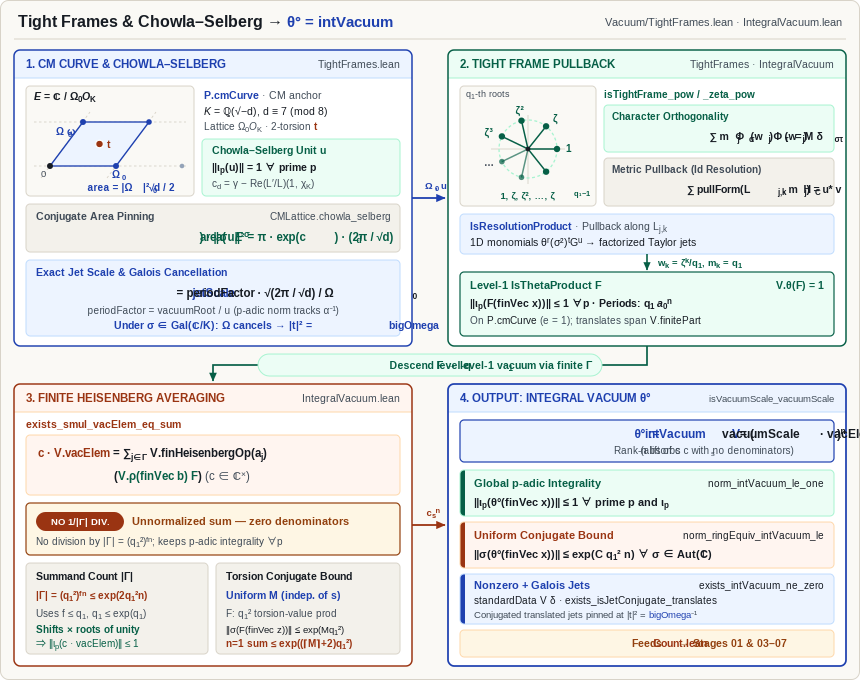
This page explains how Stage 02 transfers one-dimensional arithmetic control from a single CM elliptic curve into high-dimensional adelic theta spaces (src/New/Derivatives/Vacuum/TightFrames.lean and src/New/Derivatives/Vacuum/IntegralVacuum.lean), constructing the globally integral, conjugate-bounded vacuum
Level 1 — First-Principles
Inside the adelic theta spaces of Stage 02, the raw Gaussian vacuum vector lives in a high-dimensional space built from all infinite places of a cyclotomic field
- Fix one arithmetic anchor curve. Choose a single one-dimensional torus
carrying extra geometric symmetries coming from an imaginary quadratic ring of integerscomplex multiplication—a CM curve whose period grid is . The classical Chowla–Selberg identity pins down the area of every Galois conjugate of this CM lattice up to a single global scaling factor whose size is at every prime, linking the curve's period directly to Euler's constant and the logarithmic derivative of the quadratic -value at . - Decompose the high-dimensional geometry using roots of unity. Just as the equally spaced vertices of a regular polygon let you recover any vector's squared length as an equal-weighted sum of one-dimensional projections, the powers
of a primitive -th root of unity form a redundant collection of directions whose one-dimensional projections sum back to the exact identity metrictight frame (a resolution of the identity), simply by orthogonality of roots of unity. Pulling back one-dimensional quasi-periodic entire functions attached to a one-dimensional toruselliptic theta function along these directions multiplies one-dimensional sections into a high-dimensional theta product. Because the pulled-back one-dimensional metrics sum to the exact identity metric, the resulting multivariate Taylor expansion—its multivariate Taylor series recording all partial derivatives at the originSchur jet—factors cleanly into a product of one-dimensional Taylor series evaluated along linear forms. - Average over finite Heisenberg shifts to capture
. A theta product built from the anchor CM curve carries an extra level factor , so it is not yet the pure vacuum. Averaging it over a finite family of Heisenberg shifts projects it squarely onto a nonzero scalar multiple of the vacuum. Because every shifted copy is integral at every prime and every torsion value of the one-dimensional elliptic theta function has uniformly bounded conjugates over , the averaged sum inherits both global integrality and an explicit exponential bound on all its conjugates. Multiplying copies of this rank-one normalization produces the globally integral, conjugate-bounded vacuum . - Track Galois symmetries across all translated jets. Because the translates of that level-one theta product span the entire finite part of the space, every symmetry
over carries the jet series of any translate at the fixed period scale jetScaleto the jet series of a companion translate on the conjugate CM curve, while Chowla–Selberg forces the squared size of the conjugated scale to equal a single universal spectral constantindependent of .
Where this analogy breaks
Comparing the powers of
Likewise, calling the Heisenberg sum an "average" might suggest dividing by the group size vacuumScale. That preserves
Finally, Chowla–Selberg scaling does not make the transcendental period jetScale pairs the period
Level 2 — Undergrad Bridge
1. The anchor CM curve, Chowla–Selberg unit, and jet scaling
In src/New/Derivatives/Vacuum/TightFrames.lean (lines 85–130), the proof fixes once and for all a single CM elliptic curve attached to the imaginary quadratic field
New.Parameters.cmCurve() and New.Parameters.cmPeriod(), linked by New.Parameters.latticeModule_cmCurve: the lattice module ofP.cmCurveis. New.Parameters.chowlaSelbergUnit(), chosen from CMLattice.chowla_selbergso that:norm_iota_chowlaSelbergUnit:at every prime and every -adic embedding , and area_mul_norm_chowlaSelbergUnit_sq: for every,
- Three derived scaling constants for the cyclotomic tower level
(with infinite places and Weil idele ): Here vacuumRootis(principal branch), where is the finite-idele character attached to the Weil splitting character . Because is a -adic unit everywhere, periodFactorhas the exact same-adic norm as vacuumRoot:( norm_iota_periodFactor), which equalswhenever ( norm_iota_periodFactor_eq_one) and guaranteesfor every ( norm_periodFactor_mul_conj_le_one).
On the archimedean side, New.Parameters.norm_gal_periodFactor_div_mul_areaScale_sq (IntegralVacuum.lean:469–489) combines area_mul_norm_chowlaSelbergUnit_sq with the definition of bigOmega: whenever the conjugate lattice
Thus the transcendental period
2. Roots-of-unity tight frames, resolution products, and jet factorization
A family IsTightFrame w m M) if every
Because distinct CM embeddings disagree on a primitive eq_of_phi_eq_of_isPrimitiveRoot), orthogonality of roots of unity gives New.Parameters.isTightFrame_pow: for any primitive New.IsTightFrame.mul_left) yields New.Parameters.isTightFrame_zeta_pow, a tight frame
Given a tight frame resolutionLinearForm (b / P.areaScale) w i sending resolutionShift b w γ i
- Metric resolution (
New.Parameters.sum_pullForm_resolutionLinearForm_apply): If, pulling back the one-dimensional hermitian forms ( ) along resolutionLinearForm (b / P.areaScale) w iand summing overrecovers the standard hermitian form identically. - Pullback of monomial sections (
New.Parameters.IsResolutionProduct&exists_isResolutionProduct_of_isTightFrame): Consider one-dimensional monomial sectionsof degree (where and are the theta and sigma functions of , and is entire). For any integer with and any lattice point with , exists_isResolutionProduct_of_isTightFrameconstructs a vectorat scale satisfying: IsResolutionProduct:, and for every rational vector , - Global
-adic integrality at finite points ( IsResolutionProduct.norm_iota_apply_le_one):for every prime and , proved by recognizing finite values as products of torsion values of monomial sections. - Periodicity (
IsThetaFunction):is fixed by signed translations along (built via normalizedShift_prod_comp_of_mem_lattice).
- Jet factorization (
New.Space.taylor_line_eq_subst_jetSeries&jetSeries_eq_prod_of_entireTheta_smul): Differentiating under the Gaussian integral (iteratedDeriv_integral_exp_mul_realVac) shows that for any, the one-variable Taylor series at of equals (V.jetSeries a f)withsubstituted for each variable ( taylor_line_eq_subst_jetSeries). Since a multivariate power series overis uniquely determined by its restriction to every line ( mvPowerSeries_eq_of_forall_line), wheneverfor entire functions , jetSeries_eq_prod_of_entireTheta_smul(andIsResolutionProduct.jetSeries_translate) gives the exact power-series factorization
3. Finite-Heisenberg averaging and the integral vacuum
In src/New/Derivatives/Vacuum/IntegralVacuum.lean (lines 60–438), New.Parameters.IsThetaProduct specializes IsResolutionProduct to the tight frame theta_translate, the jet factorization jetSeries_translate, norm_le_one, and level periodicity IsThetaFunction for IsThetaProduct.theta_eq_one). Applying exists_isResolutionProduct_of_isTightFrame to P.cmCurve with period P.cmPeriod and New.Parameters.exists_isThetaProduct_cmCurve, a level-1 theta product
To descend from the level-V.vacElem, exists_smul_vac_eq_sum (specialized to IsThetaProduct.exists_smul_vacElem_eq_sum) averages over the finite Heisenberg group: there exist a nonzero scalar
together with finite shifts
Specializing to rank exists_mul_vacElem_integral_bounded, IntegralVacuum.lean:229–280):
- Integrality: Each finite Heisenberg operator multiplies values of
by roots of unity ( norm_map_selfDualAddChar) and shifts the finite argument, so-adic integrality of immediately implies at every prime . - Archimedean conjugate bound: By
exists_norm_gal_torsion_value_le, there is a constant(depending only on , not on ) bounding for all and . Each finite value of is a product of such torsion values, so . Meanwhile, sq_q₁_pow_card_infinitePlace_lebounds the number of summands usingand : Summing terms gives .
Extracting the constant vacuumBoundConst (vacuumScale (IsVacuumScale (isVacuumScale_vacuumScale), the rank-
It satisfies four core properties used throughout Stage 02 and Stage 06:
norm_intVacuum_le_one:at every prime and embedding . norm_gal_intVacuum_le&norm_ringEquiv_intVacuum_le:for every and indeed every (using exists_algEquiv_norm_eq).exists_intVacuum_ne_zero: there exists a finite adelic pointwhere . standardData V δ: the-submodule of spanned by translates of by points in integralAfter δabove—the exact module of integral theta data whose jet divisibility is bounded in Formal Groups, Theta Normal Form & Prime-Counting Divisibility.
4. Galois conjugation of translated jets
Because finitePart_le_span_translates (IntegralVacuum.lean:495–509) deduces that the translates map_zetaLinearSeries sends the frame linear form zetaLinearSeries P.cmPeriod (P.jetScale s) k j to zetaLinearSeries Ω (σ (P.periodFactor s) / Ω * P.areaScale) k j up to the permutation placePerm s σ of the infinite places. Matching the torsion shifts via exists_rational_translate_eq and IsThetaProduct.isJetConjugate_of_map_taylorAtZero_eq, and invoking norm_gal_periodFactor_div_mul_areaScale_sq for the squared norm of the conjugated scale, produces New.Parameters.exists_isJetConjugate_translates (IntegralVacuum.lean:591–654): there exists a single map
for some
Level 3 — Formal Lean Contract
The two extracted Stage 02 skeletons below reproduce the public declarations of src/New/Derivatives/Vacuum/TightFrames.lean (lines 85–911) and src/New/Derivatives/Vacuum/IntegralVacuum.lean (lines 60–654) at pinned upstream commit 41c2716658c42ba08eb0648994a2efe83082a95c (41c2716658c4), preserving the exact IsResolutionProduct, IsThetaProduct, and IsVacuumScale structures while replacing proof bodies with SHA-256 extraction stubs. Together they supply the jetScale, intVacuum (standardData, and exists_isJetConjugate_translates contracts consumed by Stage 02's divisibility count (Formal Groups, Theta Normal Form & Prime-Counting Divisibility) and sharpness theorem (Sharpness: Proving the Valuation Bound Is Attained).
Verification status (audit/verification-status.json): build_status: unverified-locally; scan_scope: entry covering only Challenge.lean, src/Main.lean, and src/Statements.lean (0 forbidden tokens in solution files, 5 expected sorry tokens in Challenge.lean) at pinned commit 41c2716658c42ba08eb0648994a2efe83082a95c (41c2716658c4). Stage 02 proof bodies have not been locally compiled or verified.
def New.Parameters.cmCurve — Upstream source (src/New/Derivatives/Vacuum/TightFrames.lean L85-L88)
/-- The curve `𝓔 = ℂ / Ω₀ 𝓞_K`: a chosen CM lattice that is a complex multiple of `𝓞_K`.
See `latticeModule_cmCurve`. -/
def New.Parameters.cmCurve : CMLattice P.d := by
  sorry -- [EXTRACTED_STUB upstream=src/New/Derivatives/Vacuum/TightFrames.lean:85-88 commit=41c2716658c42ba08eb0648994a2efe83082a95c body_lines=1 body_sha256=a019ac9e30c6032c3a904a09be017aefb243f5324008aa199acdd16f9382904d]
def New.Parameters.cmPeriod — Upstream source (src/New/Derivatives/Vacuum/TightFrames.lean L90-L93)
/-- The period of `K`: a nonzero complex number `Ω₀`, fixed once, such that the lattice of `cmCurve`
is `Ω₀ 𝓞_K`. See `latticeModule_cmCurve`. -/
def New.Parameters.cmPeriod : ℂˣ := by
  sorry -- [EXTRACTED_STUB upstream=src/New/Derivatives/Vacuum/TightFrames.lean:90-93 commit=41c2716658c42ba08eb0648994a2efe83082a95c body_lines=1 body_sha256=2c0f2e4c9bd506bab69ebf05c622d99e05ffb4b60d52bbfada4687e9f6ff1c19]
lemma New.Parameters.latticeModule_cmCurve — Upstream source (src/New/Derivatives/Vacuum/TightFrames.lean L96-L100)
/-- The lattice of the CM curve `cmCurve` is `Ω₀ 𝓞_K`, the multiple by `Ω₀` of the unit ideal of
`K = ℚ(i√d)`. -/
lemma New.Parameters.latticeModule_cmCurve :
    P.cmCurve.latticeModule = QuadField.scaledIdeal P.d (P.cmPeriod, 1) := by
  sorry -- [EXTRACTED_STUB upstream=src/New/Derivatives/Vacuum/TightFrames.lean:96-100 commit=41c2716658c42ba08eb0648994a2efe83082a95c body_lines=1 body_sha256=29ee12eeb0720f38aba0f788f724f9859babd435ff3229d4736271c774761d59]
def New.Parameters.chowlaSelbergUnit — Upstream source (src/New/Derivatives/Vacuum/TightFrames.lean L102-L104)
/-- The number `u` chosen in the Chowla–Selberg formula `CMLattice.chowla_selberg` for
`cmCurve`. See `norm_iota_chowlaSelbergUnit` and `area_mul_norm_chowlaSelbergUnit_sq`. -/
def New.Parameters.chowlaSelbergUnit : ℂ := by
  sorry -- [EXTRACTED_STUB upstream=src/New/Derivatives/Vacuum/TightFrames.lean:102-104 commit=41c2716658c42ba08eb0648994a2efe83082a95c body_lines=1 body_sha256=97bab1965dc09e60ca49489bf54655c2b2db6324bc9d4a6330f666d8af22c61c]
lemma New.Parameters.norm_iota_chowlaSelbergUnit — Upstream source (src/New/Derivatives/Vacuum/TightFrames.lean L106-L108)
lemma New.Parameters.norm_iota_chowlaSelbergUnit (p : ℕ) [Fact p.Prime] [PadicPlace p] :
    ‖ιₚ P.chowlaSelbergUnit‖ = 1 := by
  sorry -- [EXTRACTED_STUB upstream=src/New/Derivatives/Vacuum/TightFrames.lean:106-108 commit=41c2716658c42ba08eb0648994a2efe83082a95c body_lines=1 body_sha256=81d2f537005c187b068a03e81b53ffaab04318f6b8431c66a0e8ac3a1580020a]
lemma New.Parameters.area_mul_norm_chowlaSelbergUnit_sq — Upstream source (src/New/Derivatives/Vacuum/TightFrames.lean L110-L116)
/-- The Chowla–Selberg formula for the conjugates of `cmCurve`: for every automorphism `σ` of `ℂ`
over `K`, the area of the lattice conjugate by `σ`, times `‖σ u‖²` for `u = chowlaSelbergUnit`, is
`π exp(c) 2π / √d`, where `c = chowlaSelbergConst d = γ - Re L'/L(1, χ_K)`. -/
lemma New.Parameters.area_mul_norm_chowlaSelbergUnit_sq (σ : Gal(ℂ/P.K)) :
    (P.cmCurve.galConjugate σ).area * ‖σ P.chowlaSelbergUnit‖ ^ 2 =
      π * rexp (chowlaSelbergConst P.d) * (2 * π / √P.d) := by
  sorry -- [EXTRACTED_STUB upstream=src/New/Derivatives/Vacuum/TightFrames.lean:110-116 commit=41c2716658c42ba08eb0648994a2efe83082a95c body_lines=1 body_sha256=25ef7d402bbf6c1ef045898604f25231c5e8d896f078168c7707f9e5bf87b8f9]
def New.Parameters.areaScale — Upstream source (src/New/Derivatives/Vacuum/TightFrames.lean L118-L119)
/-- The number `√(2π / √d)`, as a unit of `ℂ`. -/
def New.Parameters.areaScale : ℂˣ := by
  sorry -- [EXTRACTED_STUB upstream=src/New/Derivatives/Vacuum/TightFrames.lean:118-119 commit=41c2716658c42ba08eb0648994a2efe83082a95c body_lines=1 body_sha256=e8a3e8119a53ba46b7ff49ca783035969b53bc55eac345e78b355b7f7dca344f]
def New.Parameters.periodFactor — Upstream source (src/New/Derivatives/Vacuum/TightFrames.lean L121-L126)
/-- The quotient of `vacuumRoot` by `chowlaSelbergUnit`. Here `vacuumRoot` is `(chiFin α)⁻¹ ^ (1/f)`
with the principal branch of the complex power, `f` is the number of infinite places of `E`, and
`chiFin` is the character `x ↦ υ(x) |x| ^ (-1/2)` of the finite ideles, `υ` the splitting character
of the Weil data. The denominator is a unit at every `p`-adic place of `ℂ`, so the two numbers have
the same absolute value there. -/
def New.Parameters.periodFactor : ℂ := by
  sorry -- [EXTRACTED_STUB upstream=src/New/Derivatives/Vacuum/TightFrames.lean:121-126 commit=41c2716658c42ba08eb0648994a2efe83082a95c body_lines=1 body_sha256=089920f3e551d1ede1c2c3d81a3f5f5fbe0192512c6ebbceb405a38e4d26b5c7]
def New.Parameters.jetScale — Upstream source (src/New/Derivatives/Vacuum/TightFrames.lean L128-L130)
/-- The number `periodFactor * √(2π / √d) / Ω₀`. Taylor series of theta functions are taken at
multiples of this scale. -/
def New.Parameters.jetScale : ℂ := by
  sorry -- [EXTRACTED_STUB upstream=src/New/Derivatives/Vacuum/TightFrames.lean:128-130 commit=41c2716658c42ba08eb0648994a2efe83082a95c body_lines=1 body_sha256=8397b59b76fdc06c31f3441e34de7b9de008b89e5340012d48336d469c798d9c]
lemma New.IsTightFrame.mul_left — Upstream source (src/New/Derivatives/Vacuum/TightFrames.lean L150-L155)
/-- Taking each vector of a tight frame `k` times as often multiplies its length by `k`. -/
lemma New.IsTightFrame.mul_left {E I : Type} [Field E] [CMType E] [WeilData E] [Fintype I] {w : I → E}
    {m : I → ℕ} {M : ℕ} (h_frame : IsTightFrame w m M) (k : ℕ) :
    IsTightFrame w (fun i : I ↦ k * m i) (k * M) := by
  sorry -- [EXTRACTED_STUB upstream=src/New/Derivatives/Vacuum/TightFrames.lean:150-155 commit=41c2716658c42ba08eb0648994a2efe83082a95c body_lines=3 body_sha256=cbd36e4c77c27644d24c8756dab4d99e4653b53390c139ddb4c0aa544e925f61]
lemma New.Parameters.exists_norm_adeleExtension_alpha_mul_eq_one — Upstream source (src/New/Derivatives/Vacuum/TightFrames.lean L159-L188)
/-- Let `φ : E →+* ℂ_[p]` be an embedding of the CM field `E = P.E s`, and let `adeleExtension φ` be
its extension to the finite adeles. There is an element `y` of `𝔞₀⁻¹`, the inverse of the
fractional ideal `𝔞₀` of the idele `α = P.α s`, such that the integral adele `α y` is a unit at the
place of `φ`. -/
lemma New.Parameters.exists_norm_adeleExtension_alpha_mul_eq_one {P : Parameters} {s p : ℕ} [Fact p.Prime]
    (φ : P.E s →+* ℂ_[p]) :
    ∃ y : P.E s, (P.α s).val * y ∈ Ô (P.E s) ∧ ‖adeleExtension φ ((P.α s).val * y)‖ = 1 := by
  sorry -- [EXTRACTED_STUB upstream=src/New/Derivatives/Vacuum/TightFrames.lean:159-188 commit=41c2716658c42ba08eb0648994a2efe83082a95c body_lines=24 body_sha256=43bfe06aa0b188ec528ab26222e55932985462251238daa504ea0bbb49473588]
lemma New.Parameters.coe_trace_eq_sum — Upstream source (src/New/Derivatives/Vacuum/TightFrames.lean L192-L199)
/-- The trace of `z` from `E` to `K`, as a complex number, is the sum of its images under the
embeddings of the CM type. -/
lemma New.Parameters.coe_trace_eq_sum (z : P.E s) :
    Algebra.trace P.K (P.E s) z = ∑ τ : InfinitePlace (P.E s), Φ τ z := by
  sorry -- [EXTRACTED_STUB upstream=src/New/Derivatives/Vacuum/TightFrames.lean:192-199 commit=41c2716658c42ba08eb0648994a2efe83082a95c body_lines=5 body_sha256=61f4be5c58b8995f3285a9675740529c0cb283b05e29323605cb9b660ff55e92]
lemma New.Parameters.finiteImage_id_eq_inv_alpha_mul — Upstream source (src/New/Derivatives/Vacuum/TightFrames.lean L201-L203)
/-- The finite image of `x` in `E` is the adele `α⁻¹ x`, with `α = P.α s` the idele of `𝔞₀`. -/
lemma New.Parameters.finiteImage_id_eq_inv_alpha_mul (x : P.E s) :
    finiteImage id x = (P.α s)⁻¹.val * algebraMap (P.E s) (𝔸f (P.E s)) x := by
  sorry -- [EXTRACTED_STUB upstream=src/New/Derivatives/Vacuum/TightFrames.lean:201-203 commit=41c2716658c42ba08eb0648994a2efe83082a95c body_lines=1 body_sha256=5a633da644c1afc6f5222be040e6a19d687c01104c0263cce32773e07376dfa8]
lemma New.Parameters.exists_coe_eq_trace_of_isIntegral — Upstream source (src/New/Derivatives/Vacuum/TightFrames.lean L205-L221)
/-- If `z P'(ζ)` is integral, where `P'(ζ) = relDifferentGen` generates the different of `E / K`,
then the trace of `z` from `E` to `K` is an integer of `K`. -/
lemma New.Parameters.exists_coe_eq_trace_of_isIntegral {z : P.E s}
    (hz : IsIntegral ℤ (z * (P.relDifferentGen s).val)) :
    ∃ c : 𝓞 P.K, (c : P.K) = Algebra.trace P.K (P.E s) z := by
  sorry -- [EXTRACTED_STUB upstream=src/New/Derivatives/Vacuum/TightFrames.lean:205-221 commit=41c2716658c42ba08eb0648994a2efe83082a95c body_lines=13 body_sha256=d729ca941ed348893028c06f946a6dfd0e1c56158cd09acab39e91c47e2a697a]
lemma New.Parameters.sum_mul_conj_mem_quadInt — Upstream source (src/New/Derivatives/Vacuum/TightFrames.lean L223-L248)
/-- Let `x`, `y` in the CM field `E = P.E s` lie in `𝔞₀ = E ∩ α Ô`: the finite adeles
`finiteImage id x = α⁻¹ x` and `finiteImage id y = α⁻¹ y`, with `α = P.α s`, lie in the ring `Ô E`
of integral adeles. Then the hermitian product `∑ τ, Φ τ x * conj (Φ τ y)` lies in `quadInt d`, the
ring of integers of `K` inside `ℂ`. -/
lemma New.Parameters.sum_mul_conj_mem_quadInt {x y : P.E s} (hx : finiteImage id x ∈ Ô (P.E s))
    (hy : finiteImage id y ∈ Ô (P.E s)) :
    ∑ τ : InfinitePlace (P.E s), Φ τ x * conj (Φ τ y) ∈ quadInt P.d := by
  sorry -- [EXTRACTED_STUB upstream=src/New/Derivatives/Vacuum/TightFrames.lean:223-248 commit=41c2716658c42ba08eb0648994a2efe83082a95c body_lines=20 body_sha256=40939d6f889a10e966e2a6a54945b6e18f6ebf3fdf604f6378db927a29061154]
lemma New.Parameters.adeleExtension_alpha — Upstream source (src/New/Derivatives/Vacuum/TightFrames.lean L252-L262)
/-- The image of the idele `α` of `𝔞₀` under the extension of an embedding `φ : E →+* ℂ_[p]` to the
finite adeles: it is `φ(P'(ζ))⁻¹`, with `P'(ζ) = relDifferentGen`, if the prime of `E` induced by
`φ` divides `betaKInE = (1 + √-d) / 2`, and `1` otherwise. -/
lemma New.Parameters.adeleExtension_alpha (φ : P.E s →+* ℂ_[p]) :
    adeleExtension φ (P.α s).val =
      (if P.betaKInE s ∈ (placeOfEmb φ).asIdeal then (φ (P.relDifferentGen s))⁻¹ else 1) := by
  sorry -- [EXTRACTED_STUB upstream=src/New/Derivatives/Vacuum/TightFrames.lean:252-262 commit=41c2716658c42ba08eb0648994a2efe83082a95c body_lines=6 body_sha256=ce2eef03a841eade80d60928a37d113556633b5d8dbdfbaa5a6b0d5302149256]
lemma New.Parameters.norm_iota_vacuumRoot — Upstream source (src/New/Derivatives/Vacuum/TightFrames.lean L264-L293)
/-- At a `p`-adic place `ιₚ` of `ℂ`, the absolute value of `vacuumRoot` is inverse to that of the
finite idele `α = P.α s` of the Weil data at the place of `weightEmbedding ιₚ τ : y ↦ ιₚ (τ ȳ)`, for
every `τ` in the CM type. For an embedding `φ : E →+* ℂ_[p]`, the map `adeleExtension φ` takes the
component of an adele at the prime of `E` induced by `φ` and applies the extension of `φ` to the
completion at that prime. -/
lemma New.Parameters.norm_iota_vacuumRoot (τ : P.Φ s) :
    ‖ιₚ (P.vacuumRoot s)‖ = ‖adeleExtension (weightEmbedding ιₚ τ) (P.α s).val‖⁻¹ := by
  sorry -- [EXTRACTED_STUB upstream=src/New/Derivatives/Vacuum/TightFrames.lean:264-293 commit=41c2716658c42ba08eb0648994a2efe83082a95c body_lines=24 body_sha256=2ad8faf0b6378822de20e240bdd15b1f4844968a931ff80d4cb9810857eac476]
lemma New.Parameters.span_vacuumRoot_eq — Upstream source (src/New/Derivatives/Vacuum/TightFrames.lean L295-L323)
/-- At a `p`-adic place `ιₚ` of `ℂ` with valuation ring `embValRing`, the number `vacuumRoot`
generates the module spanned by `τ(𝔞̄₀)⁻¹`, the set of the `τ ȳ` with `y` in `𝔞₀⁻¹`. -/
lemma New.Parameters.span_vacuumRoot_eq (τ : P.Φ s) :
    Submodule.span embValRing {P.vacuumRoot s} =
      Submodule.span embValRing
        {conj (Φ τ y) | (y : P.E s) (_ : (P.α s).val * y ∈ Ô (P.E s))} := by
  sorry -- [EXTRACTED_STUB upstream=src/New/Derivatives/Vacuum/TightFrames.lean:295-323 commit=41c2716658c42ba08eb0648994a2efe83082a95c body_lines=24 body_sha256=0ce5729939e979eabaae8b15047b3ef3a1ea657d786a49cf31f8456e76a5665c]
lemma New.Parameters.norm_iota_periodFactor — Upstream source (src/New/Derivatives/Vacuum/TightFrames.lean L325-L331)
/-- At a `p`-adic place `ιₚ` of `ℂ`, the absolute value of `periodFactor` equals that of
`vacuumRoot`. It is the inverse of the absolute value of the idele `P.α s` of the Weil data at the
place of `weightEmbedding ιₚ τ : y ↦ ιₚ (τ ȳ)`. -/
lemma New.Parameters.norm_iota_periodFactor (τ : P.Φ s) :
    ‖ιₚ (P.periodFactor s)‖ = ‖adeleExtension (weightEmbedding ιₚ τ) (P.α s).val‖⁻¹ := by
  sorry -- [EXTRACTED_STUB upstream=src/New/Derivatives/Vacuum/TightFrames.lean:325-331 commit=41c2716658c42ba08eb0648994a2efe83082a95c body_lines=3 body_sha256=bdd26c40ff3c8325360d94dbe1d77f8ae13d4fff962273b0752770103500b573]
lemma New.Parameters.norm_periodFactor_mul_conj_le_one — Upstream source (src/New/Derivatives/Vacuum/TightFrames.lean L333-L340)
/-- For `y` in `𝔞₀` (that is, `α⁻¹ y` is an integral adele) the coefficients
`periodFactor * conj (τ y)` of the linear form `z ↦ periodFactor * y† z` are integral at the
`p`-adic place `ιₚ` of `ℂ`. -/
lemma New.Parameters.norm_periodFactor_mul_conj_le_one {y : P.E s} (hy : finiteImage id y ∈ Ô (P.E s))
    (τ : P.Φ s) : ‖ιₚ (P.periodFactor s * conj (Φ τ y))‖ ≤ 1 := by
  sorry -- [EXTRACTED_STUB upstream=src/New/Derivatives/Vacuum/TightFrames.lean:333-340 commit=41c2716658c42ba08eb0648994a2efe83082a95c body_lines=4 body_sha256=9dc02854905a2a9eeed2e04f1768c5d5996060c1a1fe6abe64b4c89994488302]
lemma New.Parameters.norm_iota_periodFactor_eq_one — Upstream source (src/New/Derivatives/Vacuum/TightFrames.lean L343-L372)
/-- If the prime `p` does not divide `q₁ = P.q₁ s`, the order of the roots of unity that generate
`E = P.E s` over `K`, then `periodFactor` is a unit at the `p`-adic place `ιₚ` of `ℂ`. -/
lemma New.Parameters.norm_iota_periodFactor_eq_one (hp : ¬p ∣ P.q₁ s) : ‖ιₚ (P.periodFactor s)‖ = 1 := by
  sorry -- [EXTRACTED_STUB upstream=src/New/Derivatives/Vacuum/TightFrames.lean:343-372 commit=41c2716658c42ba08eb0648994a2efe83082a95c body_lines=28 body_sha256=3fb1fc007012ec27175d92f09ef5a1b9b48efd752bf6731e715f084bc782324d]
lemma New.Parameters.finiteImage_coe_mem — Upstream source (src/New/Derivatives/Vacuum/TightFrames.lean L374-L378)
/-- The integers of `P.E s` have integral finite image: for `a` in the ring of integers `𝓞 (P.E s)`,
the finite adele `α⁻¹ a` (`finiteImage id a`) lies in `Ô (P.E s)`. -/
lemma New.Parameters.finiteImage_coe_mem (a : 𝓞 (P.E s)) : finiteImage id (a : P.E s) ∈ Ô (P.E s) := by
  sorry -- [EXTRACTED_STUB upstream=src/New/Derivatives/Vacuum/TightFrames.lean:374-378 commit=41c2716658c42ba08eb0648994a2efe83082a95c body_lines=3 body_sha256=d99b4253f25aa7865b16fb8252c1d3d9a350ecb9b0843eeff88c9283f63b0b92]
lemma New.Parameters.eq_of_phi_eq_of_isPrimitiveRoot — Upstream source (src/New/Derivatives/Vacuum/TightFrames.lean L380-L387)
/-- Two embeddings `Φ σ`, `Φ τ` of the CM type that agree on a primitive `q₁`-th root of unity
belong to the same infinite place. -/
lemma New.Parameters.eq_of_phi_eq_of_isPrimitiveRoot {z : P.E s} (hz : IsPrimitiveRoot z (P.q₁ s))
    {σ τ : P.Φ s} (h_phi : Φ σ z = Φ τ z) : σ = τ := by
  sorry -- [EXTRACTED_STUB upstream=src/New/Derivatives/Vacuum/TightFrames.lean:380-387 commit=41c2716658c42ba08eb0648994a2efe83082a95c body_lines=5 body_sha256=e76c2d131d4639a568698bd72a27988bd307358fc2a929a0c6d244cd72aac4f1]
lemma New.Parameters.isTightFrame_pow — Upstream source (src/New/Derivatives/Vacuum/TightFrames.lean L389-L405)
/-- Orthogonality of characters: for parameters `P : Parameters`, `s : ℕ` and a primitive `q₁`-th
root of unity `z` of `E = P.E s`, with `q₁ = P.q₁ s`, the powers `z ^ i`, `0 ≤ i < q₁`, are a tight
frame of length `q₁` with all multiplicities `1`. -/
lemma New.Parameters.isTightFrame_pow {z : P.E s} (hz : IsPrimitiveRoot z (P.q₁ s)) :
    IsTightFrame (fun i : Fin (P.q₁ s) ↦ z ^ i.val) 1 (P.q₁ s) := by
  sorry -- [EXTRACTED_STUB upstream=src/New/Derivatives/Vacuum/TightFrames.lean:389-405 commit=41c2716658c42ba08eb0648994a2efe83082a95c body_lines=13 body_sha256=8cc94b824b95d665590e0df967c31557ba8e5ecacc0a11bcc067a2d7d3608362]
lemma New.Parameters.isTightFrame_zeta_pow — Upstream source (src/New/Derivatives/Vacuum/TightFrames.lean L408-L413)
/-- The powers `ζ ^ i`, `0 ≤ i < q₁`, each taken `k` times, form a tight frame (`IsTightFrame`) with
frame bound `k * q₁`. -/
lemma New.Parameters.isTightFrame_zeta_pow (k : ℕ) :
    IsTightFrame (fun i : Fin (P.q₁ s) ↦ P.ζ s ^ i.val) (fun _ : Fin (P.q₁ s) ↦ k)
      (k * P.q₁ s) := by
  sorry -- [EXTRACTED_STUB upstream=src/New/Derivatives/Vacuum/TightFrames.lean:408-413 commit=41c2716658c42ba08eb0648994a2efe83082a95c body_lines=2 body_sha256=57667e712acf40f11d742051c505d2c3e68aa0194f0053253e4d4fdcd6dabc1f]
lemma New.Space.iteratedDeriv_integral_exp_mul_realVac — Upstream source (src/New/Derivatives/Vacuum/TightFrames.lean L438-L471)
/-- Differentiation under the integral: for `f` in the Schwartz space `𝒮 V` of the hermitian space
`V : Space E n 1` over the CM field `E` and a continuous conjugate-linear form `L`, the `k`-th
derivative at `0` of `t ↦ ∫ exp (t * L w) * g w` is `∫ L w ^ k * g w`. Here `g w` is the Gaussian
`realVac w = exp (-|w|² / 2)` times the value of `f` at `realVec w`. The vector `realVec w` is the
adelic vector with finite part zero whose real part is `w` with its coordinates at `τ` multiplied by
`(2π Im τ(ȷ))^(-1/2)`, where `ȷ` is the element `j` of the Weil data. `normalizedVolume` is Lebesgue
measure divided by `π` to the number of coordinates. -/
lemma New.Space.iteratedDeriv_integral_exp_mul_realVac (f : 𝒮 V) (L : (InfinitePlace E × n → ℂ) →L⋆[ℂ] ℂ)
    (k : ℕ) :
    iteratedDeriv k (fun t : ℂ ↦ ∫ w : InfinitePlace E × n → ℂ,
        exp (t * L w) * (realVac w * f (realVec w)) ∂normalizedVolume (InfinitePlace E × n)) 0 =
      ∫ w : InfinitePlace E × n → ℂ,
        L w ^ k * (realVac w * f (realVec w)) ∂normalizedVolume (InfinitePlace E × n) := by
  sorry -- [EXTRACTED_STUB upstream=src/New/Derivatives/Vacuum/TightFrames.lean:438-471 commit=41c2716658c42ba08eb0648994a2efe83082a95c body_lines=22 body_sha256=3cce1a206a1acad85c7e7d6f9e954e2bb243232e4ab286cb9593af069f49ec14]
lemma New.Space.taylor_line_eq_subst_jetSeries — Upstream source (src/New/Derivatives/Vacuum/TightFrames.lean L475-L511)
/-- Let `V` be a hermitian space with all signs `1` and let `f` lie in `V.finitePart`, the span of
the translates of the vacuum under the finite Heisenberg operators. Then the Taylor series at `0` of
`t ↦ entireTheta f (a • t • v)` is obtained by substituting `v p * X` for the variable with index
`p` in `V.jetSeries a f`. Here `entireTheta f` is the function `y ↦ θ(ϱ(y) f) exp(|y|²/2)` of a real
vector `y`, where `ϱ(y) f` is the translate of `f` by `y` and `θ = V.θ` is the theta functional, a
linear form on `𝒮 V`. `V.jetSeries a f` is the series whose coefficient of `z ^ k` is `a ^ |k| / k!`
times the value of `θ` at `f` tensored at the real places with the polynomial `z ^ k`, seen as a
vector of the Fock model (the Fock vector of `z ^ k`). Here `|k| = ∑ p, k p` and
`k! = ∏ p, (k p)!`. -/
lemma New.Space.taylor_line_eq_subst_jetSeries (hf : f ∈ V.finitePart) (a : ℂ)
    (v : InfinitePlace E × n → ℂ) :
    taylorAtZero (fun t : ℂ ↦ entireTheta f (a • t • v)) =
      (V.jetSeries a f).subst fun p : InfinitePlace E × n ↦ linearSeries fun _ : Unit ↦ v p := by
  sorry -- [EXTRACTED_STUB upstream=src/New/Derivatives/Vacuum/TightFrames.lean:475-511 commit=41c2716658c42ba08eb0648994a2efe83082a95c body_lines=25 body_sha256=8dd067abe5a3a6e10bbca1279ccabf91d2c9864346814abb6809ae7cfff8b133]
lemma New.Space.eq_zero_of_jetSeries_eq_zero — Upstream source (src/New/Derivatives/Vacuum/TightFrames.lean L513-L527)
/-- For `V : Space E n 1` (all signs `1`), `f` in `V.finitePart` and `a ≠ 0`: if `V.jetSeries a f`,
the Taylor series at `0` of `z ↦ V.entireTheta f (a • z)`, vanishes, then `f = 0`. -/
lemma New.Space.eq_zero_of_jetSeries_eq_zero (hf : f ∈ V.finitePart) {a : ℂ} (ha : a ≠ 0)
    (h_jet : V.jetSeries a f = 0) : f = 0 := by
  sorry -- [EXTRACTED_STUB upstream=src/New/Derivatives/Vacuum/TightFrames.lean:513-527 commit=41c2716658c42ba08eb0648994a2efe83082a95c body_lines=12 body_sha256=8c76fbfecc57b824990e1378bf35b12cd5f3d2e3ace0167cc36ca85a46bb9b54]
lemma New.taylorAtZero_prod_comp_mul — Upstream source (src/New/Derivatives/Vacuum/TightFrames.lean L529-L538)
/-- The Taylor series at `0` of a finite product of entire functions `x ↦ G i (c i * x)` is the
product of the Taylor series of the `G i`, with `c i • X` substituted for the variable. -/
lemma New.taylorAtZero_prod_comp_mul {I : Type*} {G : I → ℂ → ℂ}
    (hG : ∀ i : I, Differentiable ℂ (G i)) (c : I → ℂ) (t : Finset I) :
    taylorAtZero (fun x : ℂ ↦ ∏ i ∈ t, G i (c i * x)) =
      ∏ i ∈ t, (taylorAtZero (G i)).subst (c i • (PowerSeries.X : PowerSeries ℂ)) := by
  sorry -- [EXTRACTED_STUB upstream=src/New/Derivatives/Vacuum/TightFrames.lean:529-538 commit=41c2716658c42ba08eb0648994a2efe83082a95c body_lines=5 body_sha256=cdaac47e19ccd0ec9117620be86bcd4183bdedbf20289a003163d1a2b202a6b3]
lemma New.mvPowerSeries_eq_of_forall_line — Upstream source (src/New/Derivatives/Vacuum/TightFrames.lean L540-L559)
/-- Two power series over `ℂ` in finitely many variables are equal if their restrictions
`rename (fun _ ↦ ()) (rescale v S)` to the line spanned by `v` agree for every vector `v`. -/
lemma New.mvPowerSeries_eq_of_forall_line {σ : Type*} [Fintype σ] {S T : MvPowerSeries σ ℂ}
    (h_line : ∀ v : σ → ℂ, rename (fun _ : σ ↦ ()) (rescale v S) =
      rename (fun _ : σ ↦ ()) (rescale v T)) : S = T := by
  sorry -- [EXTRACTED_STUB upstream=src/New/Derivatives/Vacuum/TightFrames.lean:540-559 commit=41c2716658c42ba08eb0648994a2efe83082a95c body_lines=16 body_sha256=12b29a7a1429c72aa334c8606b59909b99fc0f2f21cde4d1c4d274638bd82ef4]
lemma New.Space.entireTheta_zero — Upstream source (src/New/Derivatives/Vacuum/TightFrames.lean L561-L562)
lemma New.Space.entireTheta_zero {ε : n → ℤˣ} {V : Space E n ε} (f : 𝒮 V) : entireTheta f 0 = V.θ f := by
  sorry -- [EXTRACTED_STUB upstream=src/New/Derivatives/Vacuum/TightFrames.lean:561-562 commit=41c2716658c42ba08eb0648994a2efe83082a95c body_lines=2 body_sha256=4a98f6c0845cc8e175f36eef2a5347e98374b36b267d9e407c45c06d4c7e243b]
lemma New.Space.jetSeries_eq_prod_of_entireTheta_smul — Upstream source (src/New/Derivatives/Vacuum/TightFrames.lean L564-L599)
/-- Let `V` have all signs `1`, so that `xᴴJx` is the identity at the infinite places. Let `f` lie
in `V.finitePart`, the span of the translates of the vacuum under the finite Heisenberg operators.
Suppose that `entireTheta f (c • z) = ∏ i, G i (μ i ⬝ᵥ z)` for all `z`, with every `G i` entire.
Then `V.jetSeries c f` is the product of the Taylor series of the `G i`, evaluated at the linear
forms `linearSeries (μ i) = ∑ p, μ i p * X p`. -/
lemma New.Space.jetSeries_eq_prod_of_entireTheta_smul (hf : f ∈ V.finitePart) {I : Type*} [Fintype I]
    {G : I → ℂ → ℂ} {c : ℂ} {μ : I → InfinitePlace E × n → ℂ}
    (hG : ∀ i : I, Differentiable ℂ (G i))
    (h_prod : ∀ z : InfinitePlace E × n → ℂ, entireTheta f (c • z) = ∏ i : I, G i (μ i ⬝ᵥ z)) :
    V.jetSeries c f = ∏ i : I, (taylorAtZero (G i)).subst (linearSeries (μ i)) := by
  sorry -- [EXTRACTED_STUB upstream=src/New/Derivatives/Vacuum/TightFrames.lean:564-599 commit=41c2716658c42ba08eb0648994a2efe83082a95c body_lines=27 body_sha256=69ea55ffa7578ef6e7a5ebfd9a54cfd75577d87332410eb17766eb99d28c7119]
lemma New.Parameters.cmPeriod_mem_cmCurve_lattice — Upstream source (src/New/Derivatives/Vacuum/TightFrames.lean L616-L618)
/-- The period `cmPeriod` lies in the lattice `cmPeriod 𝓞_K` of the curve `cmCurve`. -/
lemma New.Parameters.cmPeriod_mem_cmCurve_lattice : (P.cmPeriod : ℂ) ∈ P.cmCurve.Λ := by
  sorry -- [EXTRACTED_STUB upstream=src/New/Derivatives/Vacuum/TightFrames.lean:616-618 commit=41c2716658c42ba08eb0648994a2efe83082a95c body_lines=1 body_sha256=6858da783130bd58086536866ea6e95ac3553a1d09719a893d67d44fbe38cca9]
lemma New.Parameters.norm_map_selfDualAddChar — Upstream source (src/New/Derivatives/Vacuum/TightFrames.lean L620-L624)
/-- The values of the character `selfDualAddChar` of the finite adeles have finite order, so their
images under a multiplicative map `ι` to a normed field have norm one. -/
@[simp] lemma New.Parameters.norm_map_selfDualAddChar {F R : Type*} [NormedField R] [FunLike F ℂ R]
    [MonoidHomClass F ℂ R] (ι : F) (z : 𝔸f (P.E s)) : ‖ι (selfDualAddChar (P.E s) z)‖ = 1 := by
  sorry -- [EXTRACTED_STUB upstream=src/New/Derivatives/Vacuum/TightFrames.lean:620-624 commit=41c2716658c42ba08eb0648994a2efe83082a95c body_lines=1 body_sha256=de4d8be871947c56d9f3c9f9ad90fca4b2532fd6627e90debe2b36c6a78e58df]
def New.Parameters.resolutionShift — Upstream source (src/New/Derivatives/Vacuum/TightFrames.lean L630-L633)
/-- The point `-b ⟨γ k, w j⟩` of `ℂ` for `i = (j, k)`, where
`⟨x, y⟩ = ∑ τ, Φ τ x * conj (Φ τ y)` is the sum over the CM type. -/
def New.Parameters.resolutionShift (b : ℂ) (w : I → P.E s) (γ : n → P.E s) (i : I × n) : ℂ := by
  sorry -- [EXTRACTED_STUB upstream=src/New/Derivatives/Vacuum/TightFrames.lean:630-633 commit=41c2716658c42ba08eb0648994a2efe83082a95c body_lines=1 body_sha256=831cd97f69d6824bae94a10ca5c4d2ea122a30302ead2ec9d949411a408d9101]
def New.Parameters.resolutionFormCoeff — Upstream source (src/New/Derivatives/Vacuum/TightFrames.lean L635-L638)
/-- The coefficients of the linear form `z ↦ a * ∑ τ, conj (Φ τ (w j)) * z (τ, k)` for
`i = (j, k)`. -/
def New.Parameters.resolutionFormCoeff (a : ℂ) (w : I → P.E s) (i : I × n) (y : InfinitePlace (P.E s) × n) : ℂ := by
  sorry -- [EXTRACTED_STUB upstream=src/New/Derivatives/Vacuum/TightFrames.lean:635-638 commit=41c2716658c42ba08eb0648994a2efe83082a95c body_lines=1 body_sha256=f7c6d6d95f5b41434b86cc8a68df4693fe1de0582068d81a783de9c7c7da80fa]
def New.Parameters.resolutionLinearForm — Upstream source (src/New/Derivatives/Vacuum/TightFrames.lean L640-L643)
/-- The linear form `z ↦ a * ∑ τ, conj (Φ τ (w j)) * z (τ, k)` for `i = (j, k)`. -/
def New.Parameters.resolutionLinearForm (a : ℂ) (w : I → P.E s) (i : I × n) :
    (InfinitePlace (P.E s) × n → ℂ) →L[ℂ] ℂ := by
  sorry -- [EXTRACTED_STUB upstream=src/New/Derivatives/Vacuum/TightFrames.lean:640-643 commit=41c2716658c42ba08eb0648994a2efe83082a95c body_lines=1 body_sha256=ef5f41e576df29744c01e13bf474587c13a43604297b520c0e458c89f0af802b]
lemma New.Parameters.resolutionLinearForm_apply_eq_dotProduct — Upstream source (src/New/Derivatives/Vacuum/TightFrames.lean L645-L648)
lemma New.Parameters.resolutionLinearForm_apply_eq_dotProduct (a : ℂ) (w : I → P.E s) (i : I × n)
    (z : InfinitePlace (P.E s) × n → ℂ) :
      resolutionLinearForm a w i z = resolutionFormCoeff a w i ⬝ᵥ z := by
  sorry -- [EXTRACTED_STUB upstream=src/New/Derivatives/Vacuum/TightFrames.lean:645-648 commit=41c2716658c42ba08eb0648994a2efe83082a95c body_lines=2 body_sha256=1c902d69a9d58cc6b6c16745ade51c526a5be3957bac6fc994b4f371c236f878]
lemma New.Parameters.resolutionLinearForm_realImage — Upstream source (src/New/Derivatives/Vacuum/TightFrames.lean L650-L663)
/-- For `i = (j, k)` the linear form `resolutionLinearForm a w i` is
`z ↦ a * ∑ τ, conj (Φ τ (w j)) * z (τ, k)`. The vector `realImage γ` is the image of `γ` at the
infinite places in Fock coordinates; its entry at `(τ, k)` is `P.areaScale * Φ τ (γ k)`, with
`P.areaScale = √(2π / √d)`. At this vector the form with `a = b / P.areaScale` takes the value
`b * ∑ τ, Φ τ (γ k) * conj (Φ τ (w j))`. -/
lemma New.Parameters.resolutionLinearForm_realImage {P : Parameters} {s : ℕ} {n I : Type} (b : ℂ) (w : I → P.E s)
    (γ : n → P.E s) (i : I × n) :
    resolutionLinearForm (b / P.areaScale) w i (realImage γ) =
      b * ∑ τ : InfinitePlace (P.E s), Φ τ (γ i.2) * conj (Φ τ (w i.1)) := by
  sorry -- [EXTRACTED_STUB upstream=src/New/Derivatives/Vacuum/TightFrames.lean:650-663 commit=41c2716658c42ba08eb0648994a2efe83082a95c body_lines=6 body_sha256=b30421bb2aee48b7b0cf0edd4d07ce9228bcf6b4859e6ae0b68e79ef0f78318b]
lemma New.Parameters.mul_sum_mul_conj_mem_lattice — Upstream source (src/New/Derivatives/Vacuum/TightFrames.lean L665-L672)
/-- Let `x`, `y` in `P.E s` have integral finite images `α⁻¹ x`, `α⁻¹ y` (`finiteImage id`). Then
multiplying `a ∈ C.Λ` by `x† y = ∑ τ, Φ τ y * conj (Φ τ x)` gives an element of the CM lattice
`C.Λ`. -/
lemma New.Parameters.mul_sum_mul_conj_mem_lattice {C : CMLattice P.d} {a : ℂ} {x y : P.E s} (ha : a ∈ C.Λ)
    (hy : finiteImage id y ∈ Ô (P.E s)) (hx : finiteImage id x ∈ Ô (P.E s)) :
    a * ∑ τ : InfinitePlace (P.E s), Φ τ y * conj (Φ τ x) ∈ C.Λ := by
  sorry -- [EXTRACTED_STUB upstream=src/New/Derivatives/Vacuum/TightFrames.lean:665-672 commit=41c2716658c42ba08eb0648994a2efe83082a95c body_lines=3 body_sha256=80a22f2b3937d4d11b1edf0e2d4395db53e3665c4c368304c101ce7eacf2279b]
structure New.Parameters.IsResolutionProduct — Upstream source (src/New/Derivatives/Vacuum/TightFrames.lean L674-L689)
/-- `F` is the product of the functions `f i` along the vectors `w` at scale `b`: for a rational
vector `γ`, the theta function of `V.ϱ (finVec (finiteImage γ)) F`, the translate of `F` by the
finite image of `γ`, is the product of the twisted translates of the `f i`, each evaluated at a
linear form. The factor `i = (j, k)` is translated by `resolutionShift b w γ i` in degree `m j`:
`C.twistedTranslate m l g` is `z ↦ g (z + l)` times a Gaussian factor. -/
structure New.Parameters.IsResolutionProduct [Fintype I] (V : Space (P.E s) n ε) (C : CMLattice P.d) (b : ℂ)
    (w : I → P.E s) (m : I → ℕ) (f : I × n → ℂ → ℂ) (F : 𝒮 V) : Prop where
  /-- `F` lies in the finite part of `V`. -/
  mem_finitePart : F ∈ V.finitePart
  /-- The factors are entire. -/
  differentiable (i : I × n) : Differentiable ℂ (f i)
  /-- The product formula; `P.areaScale = √(2π / √d)`. -/
  entireTheta_translate (γ : n → P.E s) (z : InfinitePlace (P.E s) × n → ℂ) :
    entireTheta (V.ϱ (finVec (finiteImage γ)) F) z =
      ∏ i : I × n, C.twistedTranslate (m i.1) (resolutionShift b w γ i) (f i)
        (resolutionLinearForm (b / P.areaScale) w i z)
lemma New.Parameters.IsResolutionProduct.theta_translate — Upstream source (src/New/Derivatives/Vacuum/TightFrames.lean L693-L699)
/-- The theta value of the translate of a resolution product `F` by the finite image of a rational
vector `γ` is the product of the values at `0` of the translated factors. -/
lemma New.Parameters.IsResolutionProduct.theta_translate {C : CMLattice P.d} {b : ℂ} {w : I → P.E s} {m : I → ℕ}
    {f : I × n → ℂ → ℂ} {F : 𝒮 V} (hF : IsResolutionProduct V C b w m f F) (γ : n → P.E s) :
    V.θ (V.ϱ (finVec (finiteImage γ)) F) =
      ∏ i : I × n, C.twistedTranslate (m i.1) (resolutionShift b w γ i) (f i) 0 := by
  sorry -- [EXTRACTED_STUB upstream=src/New/Derivatives/Vacuum/TightFrames.lean:693-699 commit=41c2716658c42ba08eb0648994a2efe83082a95c body_lines=2 body_sha256=8586868152db4430e92ea326724c262c92c15fe57601a0140b34feb47343175f]
lemma New.Parameters.IsResolutionProduct.jetSeries_translate — Upstream source (src/New/Derivatives/Vacuum/TightFrames.lean L701-L725)
/-- Let `V` be a standard space, `C` a lattice in `ℂ` with complex multiplication by the integers of
`K`, and `F` the resolution product of the entire functions `f i`: for every rational vector `γ`,
the function `entireTheta F'` of the translate `F' = V.ϱ (finVec (finiteImage γ)) F` is the product
over `i = (j, k)` of the functions `C.twistedTranslate (m j) l (f i)`, with
`l = -b * ∑ τ, Φ τ (γ k) * conj (Φ τ (w j))`, each at the linear form `z ↦ b / P.areaScale * ∑ τ,
conj (Φ τ (w j)) * z (τ, k)`. Here `C.twistedTranslate n l g` is `z ↦ exp (-n * π * (z * conj
l + |l|² / 2) / C.area) * g (z + l)`. Then `V.jetSeries c F'`, the Taylor series at `0` of
`z ↦ entireTheta F' (c • z)`, is the product of the Taylor series of these translated functions,
each evaluated at the linear form `b / P.areaScale * c * ∑ τ, conj (Φ τ (w j)) * X (τ, k)`. -/
lemma New.Parameters.IsResolutionProduct.jetSeries_translate {C : CMLattice P.d} {b : ℂ} {w : I → P.E s}
    {m : I → ℕ} {f : I × n → ℂ → ℂ} {F : 𝒮 V} [hV : V.IsStd]
    (hF : IsResolutionProduct V C b w m f F) (γ : n → P.E s) (c : ℂ) :
    V.jetSeries c (V.ϱ (finVec (finiteImage γ)) F) =
      ∏ i : I × n, (taylorAtZero (C.twistedTranslate (m i.1) (resolutionShift b w γ i) (f i))).subst
        (linearSeries (resolutionFormCoeff (b / P.areaScale * c) w i)) := by
  sorry -- [EXTRACTED_STUB upstream=src/New/Derivatives/Vacuum/TightFrames.lean:701-725 commit=41c2716658c42ba08eb0648994a2efe83082a95c body_lines=11 body_sha256=eef978a11dab8f1d8a51f11fa9b75fa333122841b889fdb05f797240e13bd9e9]
lemma New.Parameters.IsResolutionProduct.norm_iota_apply_le_one — Upstream source (src/New/Derivatives/Vacuum/TightFrames.lean L727-L766)
/-- Let `δ δ̄ = N ≠ 0` for an integer `δ` of `K`, and let `b δ̄` lie in the lattice `C.Λ`. Let each
finite adele `finiteImage w j = α⁻¹ w j`, with `α = P.α s`, lie in the ring `Ô E` of integral adeles
of `E = P.E s`; that is, `w j` lies in `𝔞₀ = E ∩ α Ô`. Suppose that `F` is the resolution product of
the monomial sections `θ ^ r * (σ ^ 2) ^ t * G ^ u` of `C` with exponents `x i = (r, t, u)`, of
degree `r + 2 t + 3 u = m i.1`: the theta function of each rational translate of `F` is the product
of twisted translates of these sections, evaluated at linear forms. Here `θ` is the theta function
and `σ` the sigma function of `C`, and `G = translatedYThetaCube` is the entire function that equals
`C.translatedY * θ ^ 3` away from the poles of `C.translatedY`. Then the value of `F` at `finVec y`,
the adelic vector with finite part `α y` and real part zero, is integral at the `p`-adic place
`ιₚ : ℂ →+* ℂ_[p]`. -/
lemma New.Parameters.IsResolutionProduct.norm_iota_apply_le_one {C : CMLattice P.d} {b : ℂ} {w : I → P.E s}
    {m : I → ℕ} {F : 𝒮 V} {x : I × n → ℕ × ℕ × ℕ} {δ : 𝓞 P.K} {N : ℕ}
    (hF : IsResolutionProduct V C b w m (fun i : I × n ↦ C.monomialSection (x i)) F) (hN_ne : N ≠ 0)
    (hN : δ * conj (δ : ℂ) = N) (hw : ∀ j : I, finiteImage w j ∈ Ô (P.E s))
    (hx : ∀ i : I × n, CMLattice.monomialDeg (x i) = m i.1) (hbδ_mem : b * conj (δ : ℂ) ∈ C.Λ)
    {p : ℕ} [Fact p.Prime] [PadicPlace p] (y : n → 𝔸f (P.E s)) : ‖ιₚ (F (finVec y))‖ ≤ 1 := by
  sorry -- [EXTRACTED_STUB upstream=src/New/Derivatives/Vacuum/TightFrames.lean:727-766 commit=41c2716658c42ba08eb0648994a2efe83082a95c body_lines=25 body_sha256=0b8b59f6b572c410261040bf87fad5a14b9e19fafc6657be8567634465d64c1b]
lemma New.Parameters.sum_pullForm_resolutionLinearForm_apply — Upstream source (src/New/Derivatives/Vacuum/TightFrames.lean L771-L798)
/-- Let `w` be a tight frame of length `M` with multiplicities `m`: each `α⁻¹ * w j` is integral,
where `α = P.α s` is the finite idele of the Weil data, and `∑ j, m j * Φ σ (w j) * conj (Φ τ (w
j)) = M δ_{σ τ}`, where `Φ` is the CM type. Let the area `C.area` of a period parallelogram of `C`
be `|b|² M √d / 2`, with `d = P.d`. The forms `m j • C.hermitianForm`, where
`C.hermitianForm l z = (π / C.area) * conj l * z`, pulled back (`pullForm`) along the linear forms
of the frame at scale `b / P.areaScale`, sum to the standard hermitian form. -/
lemma New.Parameters.sum_pullForm_resolutionLinearForm_apply {M : ℕ} (hw : IsTightFrame w m M)
    (h_area : C.area = ‖b‖ ^ 2 * M * √P.d / 2) (u v : InfinitePlace (P.E s) × n → ℂ) :
    (∑ i : I × n, pullForm (resolutionLinearForm (b / P.areaScale) w i) (m i.1 • C.hermitianForm)) u
      v =
      star u ⬝ᵥ v := by
  sorry -- [EXTRACTED_STUB upstream=src/New/Derivatives/Vacuum/TightFrames.lean:771-798 commit=41c2716658c42ba08eb0648994a2efe83082a95c body_lines=18 body_sha256=553c991d5b6d88696aa49f369b91ad97abdd0a299b70ea13ddf54b879c665cbf]
lemma New.Parameters.normalizedShift_prod_comp_of_mem_lattice — Upstream source (src/New/Derivatives/Vacuum/TightFrames.lean L801-L824)
/-- Let each `f i` be a section of degree `m i.1` of `C`: twisted translation
`C.twistedTranslate (m i.1) l` by a period `l` multiplies it by `C.multiplier l ^ m i.1`. Suppose
that the linear forms `A i` take `u` to periods, and let `B` be the sum of the pull-backs
(`pullForm`) of the forms `m i.1 • C.hermitianForm` along the `A i`. Then the normalized translation
by `u` fixes the product of the `f i ∘ A i`. -/
lemma New.Parameters.normalizedShift_prod_comp_of_mem_lattice
    (hf : ∀ (i : I × n), ∀ l ∈ C.Λ, C.twistedTranslate (m i.1) l (f i) =
      C.multiplier l ^ m i.1 • f i)
    (A : I × n → (InfinitePlace (P.E s) × n → ℂ) →L[ℂ] ℂ) {u : InfinitePlace (P.E s) × n → ℂ}
    (hu : ∀ i : I × n, A i u ∈ C.Λ) :
    ThetaTori.normalizedShift (∑ i : I × n, pullForm (A i) (m i.1 • C.hermitianForm))
      (conj (quadGen P.d) • 1) u (∏ i : I × n, f i ∘ A i) = ∏ i : I × n, f i ∘ A i := by
  sorry -- [EXTRACTED_STUB upstream=src/New/Derivatives/Vacuum/TightFrames.lean:801-824 commit=41c2716658c42ba08eb0648994a2efe83082a95c body_lines=13 body_sha256=7e3813774cd628822ac2ad4fc4cb06025a39cc8b9077af39ad5b802f4e525cf3]
lemma New.Parameters.exists_isResolutionProduct_of_isTightFrame — Upstream source (src/New/Derivatives/Vacuum/TightFrames.lean L828-L911)
/-- Let `V` be a standard space (signs `1`, point the identity). Let `δ δ̄ = N ≠ 0` for an integer
`δ` of `K`, and let `w` be a tight frame of length `M` with multiplicities `m`. Let
`x i = (r, t, u)` be exponents of degree `r + 2 t + 3 u = m i.1` (`monomialDeg`). Let `C` be a CM
lattice of area `|a|² M √d / (2 N)` that contains `a`. The monomial section of `x i` is
`θ ^ r * (σ ^ 2) ^ t * G ^ u`, with `θ` the theta function and `σ` the sigma function of `C`. Here
`G = translatedYThetaCube` is the entire function equal to `C.translatedY * θ ^ 3` away from poles.

There is a vector `F` that is the resolution product of these sections along `w` at scale `a / δ̄`.
That is, for every rational vector `γ`, the theta function of the translate of `F` by the finite
image of `γ` is the product of twisted translates of the sections, evaluated at the linear forms of
the frame. The values of `F` at finite adelic vectors are integral at every `p`-adic place `ιₚ` of
`ℂ`. Let `entireTheta F` be the theta function of `F`, as an entire function on `ℂ^(Φ × n)`. It is a
theta function for the lattice `δ̄ 𝔞₀ⁿ`. That is, it is entire and fixed by the translations
`signedShift γ` (the translation by `γ` times its sign `± 1`) along the lattice. -/
lemma New.Parameters.exists_isResolutionProduct_of_isTightFrame (V : Space (P.E s) n ε) [hV : V.IsStd] {M N : ℕ}
    {I : Type} [Fintype I] {w : I → P.E s} {m : I → ℕ} (δ : 𝓞 P.K) (hN_ne : N ≠ 0)
    (hN : δ * conj (δ : ℂ) = N) (hw : IsTightFrame w m M) (x : I × n → ℕ × ℕ × ℕ)
    (hx : ∀ i : I × n, CMLattice.monomialDeg (x i) = m i.1)
    ⦃C : CMLattice P.d⦄ ⦃a : ℂ⦄ (ha : a ∈ C.Λ) (h_area : C.area = ‖a‖ ^ 2 / N * M * √P.d / 2) :
    ∃ F : 𝒮 V,
      IsResolutionProduct V C (a / conj (δ : ℂ)) w m (fun i : I × n ↦ C.monomialSection (x i)) F ∧
      (∀ (p : ℕ) [Fact p.Prime] [PadicPlace p] (y : n → 𝔸f (P.E s)), ‖ιₚ (F (finVec y))‖ ≤ 1) ∧
      IsThetaFunction (star (algebraMap P.K (P.E s) δ) • idealLattice (P.E s) n)
        (entireTheta F) := by
  sorry -- [EXTRACTED_STUB upstream=src/New/Derivatives/Vacuum/TightFrames.lean:828-911 commit=41c2716658c42ba08eb0648994a2efe83082a95c body_lines=61 body_sha256=cc4b8a1e8f1a2caaa192e0717fdae2b981a85cbd19863e369320ddd5d37d00c8]
lemma New.Parameters.exists_norm_gal_torsion_value_le — Upstream source (src/New/Derivatives/Vacuum/IntegralVacuum.lean L60-L78)
/-- The theta function `θ` of the CM lattice `cmCurve` (the lattice `Ω₀ 𝓞_K`, `Ω₀ = cmPeriod`) is
the translate of its sigma function by a point of order two, normalised to `θ 0 = 1`. The twisted
translate `twistedTranslate 1 u θ`, of degree one, is `z ↦ exp (-π (z ū + |u|² / 2) / A) θ (z + u)`,
with `A` the area of the lattice. For the torsion points `u = x Ω₀`, `x ∈ K`, the conjugates over
`K` of its values at `z = 0` are bounded. -/
lemma New.Parameters.exists_norm_gal_torsion_value_le (P : Parameters) : ∃ M : ℝ, ∀ (σ : Gal(ℂ/K P)) (x : K P),
    ‖σ (P.cmCurve.twistedTranslate 1 (x * P.cmPeriod) P.cmCurve.θ 0)‖ ≤ M := by
  sorry -- [EXTRACTED_STUB upstream=src/New/Derivatives/Vacuum/IntegralVacuum.lean:60-78 commit=41c2716658c42ba08eb0648994a2efe83082a95c body_lines=13 body_sha256=8a4a5b164b327a25f3aa653fe33a8664bffaa1457a214b33bea532813d441d70]
lemma New.Parameters.exists_smul_vac_eq_sum — Upstream source (src/New/Derivatives/Vacuum/IntegralVacuum.lean L80-L104)
/-- Let `E` be a CM field with Weil data (the element `ȷ`, the idele `α` and the splitting character
that define the Weil representation), let `V` be standard and let `δ` be integral (in the finite
adelic integers `Ô E`) with `δ δ̄ = N ≠ 0`. Suppose that the theta functional `V.θ` takes the value
`1` at `F` and that `entireTheta F` is a theta function for `δ̄ 𝔞₀ⁿ`, that is, an entire function
fixed by the signed translations along `δ̄ 𝔞₀ⁿ`. Here `idealLattice E n = 𝔞₀ⁿ` is the lattice of
the rational vectors `γ` with `α⁻¹ γ` integral at all finite places. Then a nonzero multiple of the
vacuum is a sum of `N ^ (f n)` translates `finHeisenbergOp (a j) (ϱ(finVec b) F)`. Here `f` is the
number of infinite places, `n` the rank, `ϱ` the action of adelic vectors, and `finHeisenbergOp x`
is `ϱ(finVec x)` times the scalar `stdLattice.semichar x`. -/
lemma New.Parameters.exists_smul_vac_eq_sum {E n : Type} [Field E] [CMType E] [WeilData E] [Fintype n]
    [DecidableEq n] {ε : n → ℤˣ} {V : Space E n ε} [V.IsStd] {δ : E} {N : ℕ}
    (hδ : ↑δ ∈ Ô E) (hN_ne : N ≠ 0) (hN : δ * star δ = N) {F : 𝒮 V}
    (hF : IsThetaFunction (star δ • idealLattice E n) (entireTheta F)) (hθ : V.θ F = 1) :
    ∃ c ≠ (0 : ℂ), ∃ (Γ : Type) (_ : Fintype Γ) (a : Γ → n → 𝔸f E) (b : n → 𝔸f E),
      card Γ = N ^ card (NumberField.InfinitePlace E × n) ∧
      c • V.vacElem = ∑ j : Γ, V.finHeisenbergOp (a j) (V.ϱ (finVec b) F) := by
  sorry -- [EXTRACTED_STUB upstream=src/New/Derivatives/Vacuum/IntegralVacuum.lean:80-104 commit=41c2716658c42ba08eb0648994a2efe83082a95c body_lines=10 body_sha256=c8bdbccc6610259defdc24dcf013e8206752839fcd1a22f3a46ce667bc4ca5bb]
def New.Parameters.zetaCoord — Upstream source (src/New/Derivatives/Vacuum/IntegralVacuum.lean L106-L109)
/-- The coordinate `-u† y ∈ K` of `y ∈ E` along the vector `u = ζᵏ / q₁` of the frame of powers of
`ζ`, that is minus the trace from `E` to `K` of `y * star ζᵏ`, divided by `q₁`. -/
noncomputable def New.Parameters.zetaCoord (P : Parameters) (s : ℕ) (k : Fin (P.q₁ s)) (y : P.E s) : K P := by
  sorry -- [EXTRACTED_STUB upstream=src/New/Derivatives/Vacuum/IntegralVacuum.lean:106-109 commit=41c2716658c42ba08eb0648994a2efe83082a95c body_lines=1 body_sha256=ef16538a757cdf6517392a060d44bd9d81b6d56ec0280e309deee53d93b83679]
lemma New.Parameters.zetaCoord_smul — Upstream source (src/New/Derivatives/Vacuum/IntegralVacuum.lean L111-L114)
/-- The coordinate along a vector of the frame commutes with multiplication by elements of `K`. -/
lemma New.Parameters.zetaCoord_smul {P : Parameters} {s : ℕ} (k : Fin (P.q₁ s)) (a : K P) (y : P.E s) :
    P.zetaCoord s k (a • y) = a * P.zetaCoord s k y := by
  sorry -- [EXTRACTED_STUB upstream=src/New/Derivatives/Vacuum/IntegralVacuum.lean:111-114 commit=41c2716658c42ba08eb0648994a2efe83082a95c body_lines=2 body_sha256=d4816ae31ab088488243576ed89341f2c1aebd9acc270b8f541ae0ce26f4f753]
def New.Parameters.zetaCoordThetaTranslate — Upstream source (src/New/Derivatives/Vacuum/IntegralVacuum.lean L120-L123)
/-- The twisted translate of the theta function of the CM lattice `C` by `Ω` times the coordinate
of `y ∈ E` along the vector `ζᵏ / q₁` of the frame of powers of `ζ`. -/
def New.Parameters.zetaCoordThetaTranslate (C : CMLattice P.d) (Ω : ℂˣ) (k : Fin (P.q₁ s)) (y : P.E s) : ℂ → ℂ := by
  sorry -- [EXTRACTED_STUB upstream=src/New/Derivatives/Vacuum/IntegralVacuum.lean:120-123 commit=41c2716658c42ba08eb0648994a2efe83082a95c body_lines=1 body_sha256=f9714761c7e5958c9ee64a156aef62276845ed77bbbcbd954e53da06f1c26e43]
def New.Parameters.zetaLinearSeries — Upstream source (src/New/Derivatives/Vacuum/IntegralVacuum.lean L125-L132)
/-- The linear form along the frame vector `ζᵏ / q₁` in the coordinate `j`, for the period `Ω` and
the scale `c`: the power series `Ω / q₁ / areaScale * c * ∑ w, conj (Φ w ζᵏ) * z (w, j)` in
variables `z` indexed by infinite places of `E` and coordinates. Here `areaScale = √(2π / √d)`,
`Φ w` is the complex embedding chosen at the place `w`, and `linearSeries a` is `∑ y, a y * z y`. -/
def New.Parameters.zetaLinearSeries [DecidableEq n] (Ω : ℂˣ) (c : ℂ) (k : Fin (P.q₁ s)) (j : n) :
    MvPowerSeries (NumberField.InfinitePlace (P.E s) × n) ℂ := by
  sorry -- [EXTRACTED_STUB upstream=src/New/Derivatives/Vacuum/IntegralVacuum.lean:125-132 commit=41c2716658c42ba08eb0648994a2efe83082a95c body_lines=2 body_sha256=a02fb2fb767e8cc9859c54495c7bde57ea040d509090073a8236acc7658b41d8]
structure New.Parameters.IsThetaProduct — Upstream source (src/New/Derivatives/Vacuum/IntegralVacuum.lean L134-L160)
/-- The vector `F` is the product of copies of the theta function of `C` along the frame of the
`ζᵏ / q₁`, each taken `q₁` times, in every coordinate. The period `Ω` scales the coordinates along
the frame to complex numbers, and the level `e` gives the lattice `q₁ e 𝔞₀ⁿ` of periods, where
`𝔞₀ⁿ = idealLattice E n` consists of the rational vectors `γ` with `α⁻¹ γ` integral, `α` being the
idele of the Weil data and `q₁` the order of `ζ`. -/
structure New.Parameters.IsThetaProduct [DecidableEq n] (V : Space (P.E s) n ε) (C : CMLattice P.d) (Ω : ℂˣ)
    (e : ℕ+) (F : 𝒮 V) : Prop where
  /-- The vector lies in the finite part, the span of the translates of the vacuum by the operators
  `finHeisenbergOp`. -/
  mem_finitePart : F ∈ V.finitePart
  /-- The theta value of the translate by a rational vector `γ` is a product of values at `0` of
  twisted translates of the theta function of `C`. Here `finiteImage γ` is the finite adelic vector
  `α⁻¹ γ`, with `α` the idele of the Weil data. -/
  theta_translate (γ : n → P.E s) : V.θ (V.ϱ (finVec (finiteImage γ)) F) =
    ∏ k : Fin (P.q₁ s), ∏ j : n, zetaCoordThetaTranslate C Ω k (γ j) 0 ^ P.q₁ s
  /-- The series of jets `jetSeries c` of that translate (for a standard space, the Taylor series at
  `0` of its theta function at the scale `c`) is a product of Taylor series `taylorAtZero` at `0` of
  functions of one variable, each composed with a linear form. -/
  jetSeries_translate (γ : n → P.E s) (c : ℂ) :
    V.jetSeries c (V.ϱ (finVec (finiteImage γ)) F) = ∏ k : Fin (P.q₁ s), ∏ j : n,
      (taylorAtZero (zetaCoordThetaTranslate C Ω k (γ j))).subst (zetaLinearSeries Ω c k j) ^ P.q₁ s
  /-- The values at finite points are integral at every prime `p`, for every `p`-adic place of `ℂ`
  (a ring homomorphism `ιₚ` from `ℂ` to `ℂ_[p]`). -/
  norm_le_one (p : ℕ) [Fact p.Prime] [PadicPlace p] (x : n → 𝔸f (P.E s)) : ‖ιₚ (F (finVec x))‖ ≤ 1
  /-- The theta function of the vector is a theta function for `q₁ e 𝔞₀ⁿ`. -/
  isThetaFunction :
    IsThetaFunction (star (P.q₁ s * e : P.E s) • idealLattice (P.E s) n) (entireTheta F)
lemma New.Parameters.IsThetaProduct.theta_eq_one — Upstream source (src/New/Derivatives/Vacuum/IntegralVacuum.lean L162-L165)
/-- The theta functional takes the value `1` at a theta product. -/
lemma New.Parameters.IsThetaProduct.theta_eq_one [DecidableEq n] {V : Space (P.E s) n ε} {C : CMLattice P.d}
    {Ω : ℂˣ} {e : ℕ+} {F : 𝒮 V} (hF : IsThetaProduct V C Ω e F) : V.θ F = 1 := by
  sorry -- [EXTRACTED_STUB upstream=src/New/Derivatives/Vacuum/IntegralVacuum.lean:162-165 commit=41c2716658c42ba08eb0648994a2efe83082a95c body_lines=2 body_sha256=7d5f8efd46b5246062354e4e7dd0e21d5fe03c71ced9bff1b442b91987ede8a0]
lemma New.Parameters.exists_isThetaProduct — Upstream source (src/New/Derivatives/Vacuum/IntegralVacuum.lean L167-L190)
/-- Let `V` be standard and let `C` be a CM lattice of area `|Ω|² √d / 2` that contains a multiple
`Ω e`. Then `V` has a theta product for `C`, `Ω` and `e`. -/
lemma New.Parameters.exists_isThetaProduct [DecidableEq n] (V : Space (P.E s) n ε) [V.IsStd] {C : CMLattice P.d}
    {Ω : ℂˣ} {e : ℕ+} (he : Ω.val * e ∈ C.Λ) (h_area : C.area = ‖Ω.val‖ ^ 2 * √P.d / 2) :
    ∃ F : 𝒮 V, IsThetaProduct V C Ω e F := by
  sorry -- [EXTRACTED_STUB upstream=src/New/Derivatives/Vacuum/IntegralVacuum.lean:167-190 commit=41c2716658c42ba08eb0648994a2efe83082a95c body_lines=20 body_sha256=9d86e134800cb7abac34e158954da414844551094e471832183dfa9b552fd3d4]
lemma New.Parameters.exists_isThetaProduct_cmCurve — Upstream source (src/New/Derivatives/Vacuum/IntegralVacuum.lean L192-L197)
/-- A standard space has a theta product of level one for the lattice `cmPeriod 𝓞_K` of
`cmCurve`. -/
lemma New.Parameters.exists_isThetaProduct_cmCurve [DecidableEq n] (V : Space (P.E s) n ε) [V.IsStd] :
    ∃ F : 𝒮 V, IsThetaProduct V P.cmCurve P.cmPeriod 1 F := by
  sorry -- [EXTRACTED_STUB upstream=src/New/Derivatives/Vacuum/IntegralVacuum.lean:192-197 commit=41c2716658c42ba08eb0648994a2efe83082a95c body_lines=2 body_sha256=577c4321704c6728b48450c41b69bad3939ddc55468582ba8478c3f0e4eb23c1]
lemma New.Parameters.IsThetaProduct.exists_smul_vacElem_eq_sum — Upstream source (src/New/Derivatives/Vacuum/IntegralVacuum.lean L199-L212)
/-- A theta product of level one for `C` and `Ω` is a vector `F` of the finite part whose theta
values and jets at rational translates are those of products of the theta function of `C` along the
vectors `ζᵏ / q₁`, with `q₁` the order of `ζ`, and whose theta function is a theta function for
`q₁ 𝔞₀ⁿ`. In a standard space of rank `n`, a nonzero multiple of the vacuum is then a sum of
`(q₁ ^ 2) ^ (f n)` vectors `finHeisenbergOp (a j) (ϱ(finVec b) F)`, with `f` the number of infinite
places: each is `F` translated by the common finite vector `b`, then by `a j`, and multiplied by the
scalar `stdLattice.semichar (a j)`. -/
lemma New.Parameters.IsThetaProduct.exists_smul_vacElem_eq_sum [DecidableEq n] {V : Space (P.E s) n ε} [V.IsStd]
    {C : CMLattice P.d} {Ω : ℂˣ} {F : 𝒮 V} (hF : IsThetaProduct V C Ω 1 F) :
    ∃ c ≠ (0 : ℂ), ∃ (Γ : Type) (_ : Fintype Γ) (a : Γ → n → 𝔸f (P.E s)) (b : n → 𝔸f (P.E s)),
      card Γ = (P.q₁ s ^ 2) ^ card (NumberField.InfinitePlace (P.E s) × n) ∧
      c • V.vacElem = ∑ j : Γ, V.finHeisenbergOp (a j) (V.ϱ (finVec b) F) := by
  sorry -- [EXTRACTED_STUB upstream=src/New/Derivatives/Vacuum/IntegralVacuum.lean:199-212 commit=41c2716658c42ba08eb0648994a2efe83082a95c body_lines=2 body_sha256=f906b618b6014e936e3dd15874108469843ae7b35f00cf20e309f614b63aaf7b]
lemma New.Parameters.sq_q₁_pow_card_infinitePlace_le — Upstream source (src/New/Derivatives/Vacuum/IntegralVacuum.lean L216-L227)
/-- With `f` the number of infinite places of `E = P.E s` and `q₁ = P.q₁ s`, one has
`(q₁ ^ 2) ^ f ≤ exp (q₁) ^ (2 * q₁)`. -/
lemma New.Parameters.sq_q₁_pow_card_infinitePlace_le (P : Parameters) (s : ℕ) :
    (((P.q₁ s ^ 2) ^ card (NumberField.InfinitePlace (P.E s) × Unit) : ℕ) : ℝ) ≤
      rexp (P.q₁ s) ^ (2 * P.q₁ s) := by
  sorry -- [EXTRACTED_STUB upstream=src/New/Derivatives/Vacuum/IntegralVacuum.lean:216-227 commit=41c2716658c42ba08eb0648994a2efe83082a95c body_lines=8 body_sha256=8b733395bbf342c5bebf01a0925e842590a2658649665d4ab050c402b4c9b85c]
lemma New.Parameters.exists_mul_vacElem_integral_bounded — Upstream source (src/New/Derivatives/Vacuum/IntegralVacuum.lean L229-L280)
/-- The integral vacuum in rank one: a nonzero multiple of the vacuum has values at the finite
points `finVec x` that are integral (`ιₚ` is the map to the `p`-adic complex numbers) and whose
conjugates over `K` have modulus at most `exp (C q₁²)`, with `C` independent of `s`. -/
lemma New.Parameters.exists_mul_vacElem_integral_bounded (P : Parameters) : ∃ C : ℕ, ∀ s : ℕ, ∃ c ≠ (0 : ℂ),
    -- (a) the values are integral
    (∀ (p : ℕ) [Fact p.Prime] [PadicPlace p] (x : Unit → 𝔸f (P.E s)),
      ‖ιₚ (c * (stdSpace (P.E s) Unit).vacElem (finVec x))‖ ≤ 1) ∧
    -- (b) their conjugates are bounded
    ∀ (σ : Gal(ℂ/K P)) (x : Unit → 𝔸f (P.E s)),
      ‖σ (c * (stdSpace (P.E s) Unit).vacElem (finVec x))‖ ≤ rexp (C * P.q₁ s ^ 2) := by
  sorry -- [EXTRACTED_STUB upstream=src/New/Derivatives/Vacuum/IntegralVacuum.lean:229-280 commit=41c2716658c42ba08eb0648994a2efe83082a95c body_lines=43 body_sha256=e44afde49730bb91c3e9e6341e958f143296727039ec706c70697a763a5c18cd]
def New.Parameters.vacuumBoundConst — Upstream source (src/New/Derivatives/Vacuum/IntegralVacuum.lean L282-L284)
/-- The constant `C` in the bound `exp (C q₁²)` for the conjugates of the values of the integral
vacuum of rank one, chosen from `exists_mul_vacElem_integral_bounded`; see `IsVacuumScale`. -/
def New.Parameters.vacuumBoundConst (P : Parameters) : ℕ := by
  sorry -- [EXTRACTED_STUB upstream=src/New/Derivatives/Vacuum/IntegralVacuum.lean:282-284 commit=41c2716658c42ba08eb0648994a2efe83082a95c body_lines=1 body_sha256=f0393881e053e2dd9a48cc8237b1dac1d8002b261b409ebd1c347b6e5a371f4f]
structure New.Parameters.IsVacuumScale — Upstream source (src/New/Derivatives/Vacuum/IntegralVacuum.lean L299-L311)
/-- The scalar `c` normalises the vacuum of the standard space of rank one: it is nonzero, and the
values of `c • vacElem` at finite points are integral with bounded conjugates. -/
structure New.Parameters.IsVacuumScale (P : Parameters) (s : ℕ) (c : ℂ) : Prop where
  /-- The scalar is nonzero. -/
  ne_zero : c ≠ 0
  /-- The values of `c • vacElem` are integral at every prime. -/
  norm_le_one (p : ℕ) [Fact p.Prime] [PadicPlace p] (x : Unit → 𝔸f (P.E s)) :
    ‖ιₚ (c * (stdSpace (P.E s) Unit).vacElem (finVec x))‖ ≤ 1
  /-- Their conjugates over `K` have norm at most `exp (C * q₁ ^ 2)`, where `C` is
  `vacuumBoundConst`. -/
  norm_gal_le (σ : Gal(ℂ/P.K)) (x : Unit → 𝔸f (P.E s)) :
    ‖σ (c * (stdSpace (P.E s) Unit).vacElem (finVec x))‖ ≤
      Real.exp (P.vacuumBoundConst * P.q₁ s ^ 2)
def New.Parameters.vacuumScale — Upstream source (src/New/Derivatives/Vacuum/IntegralVacuum.lean L313-L316)
/-- The nonzero number by which the vacuum of rank one is multiplied to have integral values with
bounded conjugates, chosen from `exists_mul_vacElem_integral_bounded`. -/
def New.Parameters.vacuumScale (P : Parameters) (s : ℕ) : ℂ := by
  sorry -- [EXTRACTED_STUB upstream=src/New/Derivatives/Vacuum/IntegralVacuum.lean:313-316 commit=41c2716658c42ba08eb0648994a2efe83082a95c body_lines=1 body_sha256=89d6ac75944396d7509463c6ae740726b1923d7fcc26fa38b3efaafa270e034e]
theorem New.Parameters.isVacuumScale_vacuumScale — Upstream source (src/New/Derivatives/Vacuum/IntegralVacuum.lean L318-L321)
theorem New.Parameters.isVacuumScale_vacuumScale (P : Parameters) (s : ℕ) :
    P.IsVacuumScale s (P.vacuumScale s) := by
  sorry -- [EXTRACTED_STUB upstream=src/New/Derivatives/Vacuum/IntegralVacuum.lean:318-321 commit=41c2716658c42ba08eb0648994a2efe83082a95c body_lines=3 body_sha256=23bcd7b209db2708aaa79a6502ffb199ecf652dcb1268900dd4cf53873e96bde]
def New.Parameters.intVacuum — Upstream source (src/New/Derivatives/Vacuum/IntegralVacuum.lean L326-L327)
/-- The integral vacuum: the vacuum of a space of rank `n` times `vacuumScale ^ n`. -/
def New.Parameters.intVacuum : 𝒮 V := by
  sorry -- [EXTRACTED_STUB upstream=src/New/Derivatives/Vacuum/IntegralVacuum.lean:326-327 commit=41c2716658c42ba08eb0648994a2efe83082a95c body_lines=1 body_sha256=0bc70b3c48dc8bca1f5924b9a03a150975408b0ed168fdb28037078bd539ef40]
def New.Parameters.integralAfter — Upstream source (src/New/Derivatives/Vacuum/IntegralVacuum.lean L329-L337)
/-- The additive subgroup of vectors `x` of finite adeles that are integral after multiplication by
`δ`: all coordinates of `δ x` are integral at the places of `E` in `S`. Here `evalAt w` is the
component at the place `w`, and `v` is the valuation of the completion at `w`. -/
def New.Parameters.integralAfter (δ : 𝓞 P.K) (S : FinPlace (P.E s) → Prop) : AddSubgroup (n → 𝔸f (P.E s)) := by
  sorry -- [EXTRACTED_STUB upstream=src/New/Derivatives/Vacuum/IntegralVacuum.lean:329-337 commit=41c2716658c42ba08eb0648994a2efe83082a95c body_lines=6 body_sha256=dd908698d0101d55c5ec9a1e36bb345e06ad2d3e25def2809fc6588fd86631fc]
def New.Parameters.standardData — Upstream source (src/New/Derivatives/Vacuum/IntegralVacuum.lean L339-L343)
/-- Standard data at `p`: the span over the ring `embValRing` (the complex numbers that the
`p`-adic place sends to integers) of the translates of the integral vacuum by the points that `δ`
makes integral above `p`. -/
def New.Parameters.standardData {p : ℕ} [Fact p.Prime] [PadicPlace p] (δ : 𝓞 P.K) : Submodule embValRing (𝒮 V) := by
  sorry -- [EXTRACTED_STUB upstream=src/New/Derivatives/Vacuum/IntegralVacuum.lean:339-343 commit=41c2716658c42ba08eb0648994a2efe83082a95c body_lines=1 body_sha256=5f98a8a3effa4ac64e8b7568b452f9afc3a8262ebdcb2198f9b5b864729ec546]
lemma New.Parameters.vacuumScale_ne_zero — Upstream source (src/New/Derivatives/Vacuum/IntegralVacuum.lean L359-L360)
@[simp] lemma New.Parameters.vacuumScale_ne_zero (P : Parameters) (s : ℕ) : vacuumScale P s ≠ 0 := by
  sorry -- [EXTRACTED_STUB upstream=src/New/Derivatives/Vacuum/IntegralVacuum.lean:359-360 commit=41c2716658c42ba08eb0648994a2efe83082a95c body_lines=1 body_sha256=16d6b6c364caae32e602292d42df185f680cc68000f5da852162afb1ff1d2af5]
lemma New.Parameters.intVacuum_finVec_eq_prod — Upstream source (src/New/Derivatives/Vacuum/IntegralVacuum.lean L365-L370)
/-- At a finite point `finVec x`, the integral vacuum of a standard space is the product over the
coordinates `x i` of the values of the scaled vacuum of rank one. -/
lemma New.Parameters.intVacuum_finVec_eq_prod {x : n → 𝔸f (P.E s)} : intVacuum V (finVec x) =
    ∏ i : n, P.vacuumScale s * (stdSpace (P.E s) Unit).vacElem (finVec fun _ : Unit ↦ x i) := by
  sorry -- [EXTRACTED_STUB upstream=src/New/Derivatives/Vacuum/IntegralVacuum.lean:365-370 commit=41c2716658c42ba08eb0648994a2efe83082a95c body_lines=3 body_sha256=6a582df91faa65fba87f14e5990b58583709d9100cd361d8518136cd6852a97b]
lemma New.Parameters.norm_intVacuum_le_one — Upstream source (src/New/Derivatives/Vacuum/IntegralVacuum.lean L372-L377)
/-- The values of the integral vacuum of rank `n` at the points `finVec x`, with archimedean part
zero, are integral at every prime. -/
lemma New.Parameters.norm_intVacuum_le_one {x : n → 𝔸f (P.E s)} {p : ℕ} [Fact p.Prime] [PadicPlace p] :
    ‖ιₚ (intVacuum V (finVec x))‖ ≤ 1 := by
  sorry -- [EXTRACTED_STUB upstream=src/New/Derivatives/Vacuum/IntegralVacuum.lean:372-377 commit=41c2716658c42ba08eb0648994a2efe83082a95c body_lines=3 body_sha256=f271bfbf23920e9b391b2b922e292ca0832fcf9ff0041083338127dcf793c6a3]
lemma New.Parameters.norm_gal_intVacuum_le — Upstream source (src/New/Derivatives/Vacuum/IntegralVacuum.lean L379-L385)
/-- The conjugates over `K` of the values of the integral vacuum of rank `n` have modulus at most
`exp (C q₁² n)`, with the constant `C = vacuumBoundConst` of the case of rank one. -/
lemma New.Parameters.norm_gal_intVacuum_le {x : n → 𝔸f (P.E s)} (σ : Gal(ℂ/K P)) :
    ‖σ (intVacuum V (finVec x))‖ ≤ Real.exp (P.vacuumBoundConst * P.q₁ s ^ 2) ^ card n := by
  sorry -- [EXTRACTED_STUB upstream=src/New/Derivatives/Vacuum/IntegralVacuum.lean:379-385 commit=41c2716658c42ba08eb0648994a2efe83082a95c body_lines=4 body_sha256=420973ffcade04fa0ba5e24feb05e473fea78ce3be3c9f92b5fbd2157b7e4a41]
lemma New.Parameters.exists_algEquiv_norm_eq — Upstream source (src/New/Derivatives/Vacuum/IntegralVacuum.lean L388-L398)
/-- Every automorphism of `ℂ` has the same absolute values as some automorphism over the
imaginary quadratic field `K`. -/
lemma New.Parameters.exists_algEquiv_norm_eq (P : Parameters) (σ : ℂ ≃+* ℂ) :
    ∃ σ' : Gal(ℂ/P.K), ∀ z : ℂ, ‖σ z‖ = ‖σ' z‖ := by
  sorry -- [EXTRACTED_STUB upstream=src/New/Derivatives/Vacuum/IntegralVacuum.lean:388-398 commit=41c2716658c42ba08eb0648994a2efe83082a95c body_lines=8 body_sha256=1c7e5421b471aa627247d0f241a3a271c3aad1500541f1be221609146254e28a]
lemma New.Parameters.norm_ringEquiv_intVacuum_le — Upstream source (src/New/Derivatives/Vacuum/IntegralVacuum.lean L400-L407)
/-- All conjugates `σ (intVacuum V (finVec x))` under automorphisms `σ` of `ℂ` of the values at
`finVec x` of the integral vacuum of the standard space `V` of rank `card n` have modulus at most
`exp (C q₁²) ^ card n`. Here `q₁ = P.q₁ s` and `C = vacuumBoundConst` is the constant of the case of
rank one. -/
lemma New.Parameters.norm_ringEquiv_intVacuum_le {x : n → 𝔸f (P.E s)} (σ : ℂ ≃+* ℂ) :
    ‖σ (intVacuum V (finVec x))‖ ≤ Real.exp (P.vacuumBoundConst * P.q₁ s ^ 2) ^ card n := by
  sorry -- [EXTRACTED_STUB upstream=src/New/Derivatives/Vacuum/IntegralVacuum.lean:400-407 commit=41c2716658c42ba08eb0648994a2efe83082a95c body_lines=3 body_sha256=a09a5e3db08ef8474d301516d3ff5953e41913bb060160a6e8dd4289f1de70a7]
lemma New.Parameters.norm_dataInner_self_le — Upstream source (src/New/Derivatives/Vacuum/IntegralVacuum.lean L409-L428)
/-- Let a vector `f` of a standard space be read as the function `f y = θ(ϱ(y) f)` of an adelic
vector `y`, with `θ` the theta functional. If `|f|` is at most `M` at all points `finVec x`, whose
archimedean part is zero, then `dataInner f f`, the mean of `|f|²`, has modulus at most `M ^ 2`. -/
lemma New.Parameters.norm_dataInner_self_le {f : 𝒮 V} {M : ℝ}
    (h_bound : ∀ x : n → 𝔸f (P.E s), ‖f (finVec x)‖ ≤ M) :
    ‖V.dataInner f f‖ ≤ M ^ 2 := by
  sorry -- [EXTRACTED_STUB upstream=src/New/Derivatives/Vacuum/IntegralVacuum.lean:409-428 commit=41c2716658c42ba08eb0648994a2efe83082a95c body_lines=15 body_sha256=906bd315486ce32037802fee870064075e8851c51cfc4729cf04b5abd6bf0482]
lemma New.Parameters.exists_intVacuum_ne_zero — Upstream source (src/New/Derivatives/Vacuum/IntegralVacuum.lean L430-L438)
/-- For a standard space `V`, there is a finite adelic vector `x` such that the integral vacuum
`intVacuum V` is nonzero at the point `finVec x`. -/
lemma New.Parameters.exists_intVacuum_ne_zero : ∃ x : n → 𝔸f (P.E s), intVacuum V (finVec x) ≠ 0 := by
  sorry -- [EXTRACTED_STUB upstream=src/New/Derivatives/Vacuum/IntegralVacuum.lean:430-438 commit=41c2716658c42ba08eb0648994a2efe83082a95c body_lines=7 body_sha256=41e5db034eb184b6dd840bf1ed8b27ea1394cc6672e337a52bcc457c89e1c65f]
lemma New.Parameters.bigOmega_pos — Upstream source (src/New/Derivatives/Vacuum/IntegralVacuum.lean L453-L456)
/-- The number `bigOmega P s`, which is `exp (chowlaSelbergConst d) * 2π / rootDiscr E`, is
positive. Here `chowlaSelbergConst d` is `γ - Re L'/L(1, χ_K)`, with `γ` Euler's constant. -/
lemma New.Parameters.bigOmega_pos {P : Parameters} {s : ℕ} : 0 < bigOmega P s := by
  sorry -- [EXTRACTED_STUB upstream=src/New/Derivatives/Vacuum/IntegralVacuum.lean:453-456 commit=41c2716658c42ba08eb0648994a2efe83082a95c body_lines=2 body_sha256=429bb6ca27fa44508b49df12ba9c755cd1f44b4dd2158570957f6f8508d2b237]
lemma New.Parameters.jetScale_ne_zero — Upstream source (src/New/Derivatives/Vacuum/IntegralVacuum.lean L458-L467)
/-- The scale `jetScale = periodFactor * areaScale / cmPeriod`, at which the Taylor series of theta
functions are taken, is nonzero. -/
@[simp] lemma New.Parameters.jetScale_ne_zero {P : Parameters} {s : ℕ} : jetScale P s ≠ 0 := by
  sorry -- [EXTRACTED_STUB upstream=src/New/Derivatives/Vacuum/IntegralVacuum.lean:458-467 commit=41c2716658c42ba08eb0648994a2efe83082a95c body_lines=8 body_sha256=fb56a21c3f1636d283a42ce9a0aa488e72d855c6b258eeb0ee80539d961b545f]
lemma New.Parameters.norm_gal_periodFactor_div_mul_areaScale_sq — Upstream source (src/New/Derivatives/Vacuum/IntegralVacuum.lean L469-L489)
/-- Let `cmCurve` be the CM lattice `cmPeriod 𝓞_K` and `galConjugate σ` its conjugate by `σ`, with
`E = P.E s`, `K = K P` and `d = P.d`. If the period parallelogram of the conjugate lattice has the
area `|Ω|² √d / 2`, then the scale `σ periodFactor / Ω * areaScale` has the squared norm
`(bigOmega P s)⁻¹`. Here `bigOmega P s` is `exp (γ - Re L'/L(1, χ_K)) * 2π / rootDiscr E`, with `γ`
Euler's constant and `rootDiscr E` the root discriminant of `E`. Here `areaScale` is `√(2π / √d)`
and `periodFactor` is `vacuumRoot / chowlaSelbergUnit`. The denominator is the number chosen in the
formula of Chowla and Selberg for `cmCurve`. -/
lemma New.Parameters.norm_gal_periodFactor_div_mul_areaScale_sq (P : Parameters) (s : ℕ) {σ : Gal(ℂ/K P)} {Ω : ℂˣ}
    (h_area : (P.cmCurve.galConjugate σ).area = ‖Ω.val‖ ^ 2 * √P.d / 2) :
    ‖σ (P.periodFactor s) / Ω * P.areaScale‖ ^ 2 = (P.bigOmega s)⁻¹ := by
  sorry -- [EXTRACTED_STUB upstream=src/New/Derivatives/Vacuum/IntegralVacuum.lean:469-489 commit=41c2716658c42ba08eb0648994a2efe83082a95c body_lines=12 body_sha256=c6dd6b6e01263f3eb65a5a289615effe0ca629f8797a941de04a0ae412292c9d]
lemma New.Parameters.finitePart_le_span_translates — Upstream source (src/New/Derivatives/Vacuum/IntegralVacuum.lean L495-L509)
/-- Let `V` be a space and `F` a vector of `𝒮 V`. Suppose `c • vacElem`, with `c ≠ 0`, is a sum of
translates `finHeisenbergOp (a j) (ϱ(finVec b) F)`. Then the finite part `finitePart` (the span of
the vectors `finHeisenbergOp z vacElem`) is contained in the span of the translates `ϱ(finVec x) F`
over all finite adelic vectors `x`. -/
lemma New.Parameters.finitePart_le_span_translates {V : Space (P.E s) n ε} {F : 𝒮 V} {c : ℂ} (hc_ne : c ≠ 0)
    {Γ : Type} [Fintype Γ] {a : Γ → n → 𝔸f (P.E s)} {b : n → 𝔸f (P.E s)}
    (hc : c • V.vacElem = ∑ j : Γ, V.finHeisenbergOp (a j) (V.ϱ (finVec b) F)) :
    V.finitePart ≤ span ℂ (Set.range fun x : n → 𝔸f (P.E s) ↦ V.ϱ (finVec x) F) := by
  sorry -- [EXTRACTED_STUB upstream=src/New/Derivatives/Vacuum/IntegralVacuum.lean:495-509 commit=41c2716658c42ba08eb0648994a2efe83082a95c body_lines=8 body_sha256=d8f0760b4cf71565ad8be8fbd4eb321e25760642a0af97d5f78c9d9acb92835a]
lemma New.Parameters.map_zetaLinearSeries — Upstream source (src/New/Derivatives/Vacuum/IntegralVacuum.lean L511-L534)
/-- The series `zetaLinearSeries Ω c k j` is the linear form `Ω / q₁ / areaScale * c * ∑ w, conj (Φ
w ζᵏ) * z (w, j)` in the variables `z`, the sum being over the infinite places `w` of `E = P.E s`.
Here `ζ` is the root of unity that generates `E` over `K`, and `Φ w` is the complex embedding chosen
at `w`. An automorphism `σ` of `ℂ` over `K`, applied to the coefficients, takes this form for the
period `cmPeriod` and the scale `jetScale` to that for the period `Ω` and the scale
`σ periodFactor / Ω * areaScale`, up to the permutation `placePerm s σ` of the infinite places
induced by `σ`. Here `q₁` is the order of `ζ`, `areaScale = √(2π / √d)`,
`periodFactor = vacuumRoot / chowlaSelbergUnit` and
`jetScale = periodFactor * areaScale / cmPeriod`. -/
lemma New.Parameters.map_zetaLinearSeries (σ : Gal(ℂ/K P)) (Ω : ℂˣ) (k : Fin (P.q₁ s)) (j : n) :
    (zetaLinearSeries P.cmPeriod (P.jetScale s) k j).map (σ : ℂ →+* ℂ) =
      (zetaLinearSeries Ω (σ (P.periodFactor s) / Ω * P.areaScale) k j).rename
        (Prod.map (placePerm s σ).symm id) := by
  sorry -- [EXTRACTED_STUB upstream=src/New/Derivatives/Vacuum/IntegralVacuum.lean:511-534 commit=41c2716658c42ba08eb0648994a2efe83082a95c body_lines=12 body_sha256=b3eeec6288409ba148279d4fcd50d3ce0db350e6f18724afa5a24bee7d4b8282]
lemma New.Parameters.exists_rational_translate_eq — Upstream source (src/New/Derivatives/Vacuum/IntegralVacuum.lean L536-L558)
/-- Let `F` be a vector of the finite part, `β` a finite adele of `K` and, for each `x ∈ K`, `U x` a
neighbourhood of `β x`. For a rational vector `γ` there is `a ∈ K` such that the translates of `F`
by `β γ` and `a γ` agree and `a x` lies in `U x` for each coordinate `x = zetaCoord s k (γ i) ∈ K`
of `γ i` along a resolution vector `ζᵏ / q₁`. -/
lemma New.Parameters.exists_rational_translate_eq {V : Space (P.E s) n ε} {F : 𝒮 V} (hF_mem : F ∈ V.finitePart)
    {β : 𝔸f P.K} {U : P.K → Set (𝔸f P.K)}
    (hU : ∀ x : P.K, U x ∈ nhds (β * algebraMap P.K (𝔸f P.K) x)) (γ : n → P.E s) :
    ∃ a : P.K, V.ϱ (finVec (finAdeleIncl P.K (P.E s) β • finiteImage γ)) F =
        V.ϱ (finVec (finiteImage (a • γ))) F ∧
      ∀ (k : Fin (P.q₁ s)) (i : n),
        algebraMap P.K (𝔸f P.K) (a * P.zetaCoord s k (γ i)) ∈ U (P.zetaCoord s k (γ i)) := by
  sorry -- [EXTRACTED_STUB upstream=src/New/Derivatives/Vacuum/IntegralVacuum.lean:536-558 commit=41c2716658c42ba08eb0648994a2efe83082a95c body_lines=13 body_sha256=7352845e62cce1b1b22a280cb6fc43ca8423967bf14c1ed8e2c64fc72929bce1]
lemma New.Parameters.IsThetaProduct.isJetConjugate_of_map_taylorAtZero_eq — Upstream source (src/New/Derivatives/Vacuum/IntegralVacuum.lean L560-L587)
/-- Let `F` be a theta product for `cmCurve` with period `cmPeriod` and level `e`, and `F'` one for
the conjugate curve by `σ` with period `Ω` and level `e'`. The factors of a theta product at a
rational vector `γ` are the functions `zetaCoordThetaTranslate C Ω k (γ j)`, the twisted translates
of the theta function of `C` by `Ω` times the coordinate of `γ j` along `ζᵏ / q₁`. If `σ` takes the
Taylor series of the factors of `F` at `γ` to those of the factors of `F'` at `γ'`, then it takes
the jets of the translate of `F` by `γ` at the scale
`jetScale = periodFactor * areaScale / cmPeriod` to those of the translate of `F'` by `γ'` at the
scale `σ periodFactor / Ω * areaScale`, with the infinite places permuted by `σ`. -/
lemma New.Parameters.IsThetaProduct.isJetConjugate_of_map_taylorAtZero_eq {V : Space (P.E s) n ε}
    {σ : Gal(ℂ/K P)} {Ω : ℂˣ} {e e' : ℕ+} {F F' : 𝒮 V}
    (hF : IsThetaProduct V P.cmCurve P.cmPeriod e F)
    (hF' : IsThetaProduct V (P.cmCurve.galConjugate σ) Ω e' F') {γ γ' : n → P.E s}
    (h_series : ∀ (k : Fin (P.q₁ s)) (j : n),
      MvPowerSeries.map (σ : ℂ →+* ℂ) (taylorAtZero
        (zetaCoordThetaTranslate P.cmCurve P.cmPeriod k (γ j))) =
        taylorAtZero (zetaCoordThetaTranslate (P.cmCurve.galConjugate σ) Ω k (γ' j))) :
    IsJetConjugate σ (placePerm s σ) (P.jetScale s) (σ (P.periodFactor s) / Ω * P.areaScale)
      (V.ϱ (finVec (finiteImage γ)) F) (V.ϱ (finVec (finiteImage γ')) F') := by
  sorry -- [EXTRACTED_STUB upstream=src/New/Derivatives/Vacuum/IntegralVacuum.lean:560-587 commit=41c2716658c42ba08eb0648994a2efe83082a95c body_lines=11 body_sha256=b10c7bb4b2f7c6549f0eff666c998df9e41b9c7ea1645fd53b0486a7b33b0c32]
lemma New.Parameters.exists_isJetConjugate_translates — Upstream source (src/New/Derivatives/Vacuum/IntegralVacuum.lean L591-L654)
/-- For each automorphism `σ` of `ℂ` over `K` there is a finite adele `B σ` of `E` such that every
standard space `V` has a vector `F` of the finite part with `θ F = 1`, whose translates
`ϱ(finVec x) F` span the finite part, and, for each `σ`, a vector `F'` of the finite part and a
scale `t` with `|t|² = 1 / bigOmega` such that `σ` takes the jets of the translate of `F` by `x`, at
the scale `jetScale`, to those of the translate of `F'` by `B σ • x` at the scale `t`, with the
infinite places permuted by `σ`. Here `θ` is the theta functional of `V`, `finVec x` is the adelic
vector with finite part a fixed multiple of `x` and archimedean part zero, and `jetScale` and
`bigOmega` are the scale and the period constant attached to `P` and `s`. -/
lemma New.Parameters.exists_isJetConjugate_translates (P : Parameters) (s : ℕ) :
    ∃ B : Gal(ℂ/K P) → 𝔸f (P.E s),
    ∀ {n : Type} [Fintype n] [DecidableEq n] {ε : n → ℤˣ} (V : Space (P.E s) n ε) [V.IsStd],
      ∃ F ∈ V.finitePart, V.θ F = 1 ∧
        V.finitePart ≤ span ℂ (Set.range fun x : n → 𝔸f (P.E s) ↦ V.ϱ (finVec x) F) ∧
        ∀ σ : Gal(ℂ/K P), ∃ t : ℂ, ∃ F' ∈ V.finitePart, ‖t‖ ^ 2 = (P.bigOmega s)⁻¹ ∧
          ∀ x : n → 𝔸f (P.E s), IsJetConjugate σ (placePerm s σ) (P.jetScale s) t
            (V.ϱ (finVec x) F) (V.ϱ (finVec (B σ • x)) F') := by
  sorry -- [EXTRACTED_STUB upstream=src/New/Derivatives/Vacuum/IntegralVacuum.lean:591-654 commit=41c2716658c42ba08eb0648994a2efe83082a95c body_lines=49 body_sha256=275fecea483cc640113f2f21a6e8b5970807fd02c7be253106b62eca4b78e560]
Page Glossary
- prime number
- A whole number greater than 1 whose only positive whole-number divisors are 1 and itself; every integer above 1 factors uniquely into a product of them.
- complex plane
- The two-dimensional coordinate plane of numbers s = σ + it, where the horizontal coordinate σ = Re(s) sets decay rate and the vertical coordinate t = Im(s) sets oscillation frequency.
- complex multiplication
- Extra scaling-and-rotation symmetries of a two-dimensional lattice in ℂ preserved by the integers 𝓞_K of an imaginary quadratic field K = ℚ(√(-d)), pinning down every Galois-conjugate lattice area via the Chowla–Selberg formula.
- tight frame
- A balanced, possibly overcomplete family of vectors with integer multiplicities whose projections reconstruct the exact standard inner product—allowing integral root-of-unity spokes to pull back one-dimensional elliptic theta sections into high-dimensional integral theta functions.
- elliptic theta function
- A quasi-periodic entire function on a CM lattice normalized at the origin, whose finite products along tight-frame projections build integral multi-variable theta functions and collapse p-adically into exponential normal forms.
- Schur jet
- The evaluation at the origin of a symmetry-adapted Schur differential operator on a theta function's multivariate Taylor expansion, whose prime-by-prime divisibility is controlled through minor products and matched by an explicit sharpness construction.