false-lift period
Also known as: hyperbolic-plane descent tower, small-root Hecke vanishing, hyperplane sum, false-lift orthogonality.
The theta period over a complementary block I_l of an algebraic form Xi that mimics a lift in level and Hecke eigenvalue yet sits orthogonal to true lifts—forced to vanish by climbing a hyperbolic-plane descent tower when 2r + 2N + 3 < n.
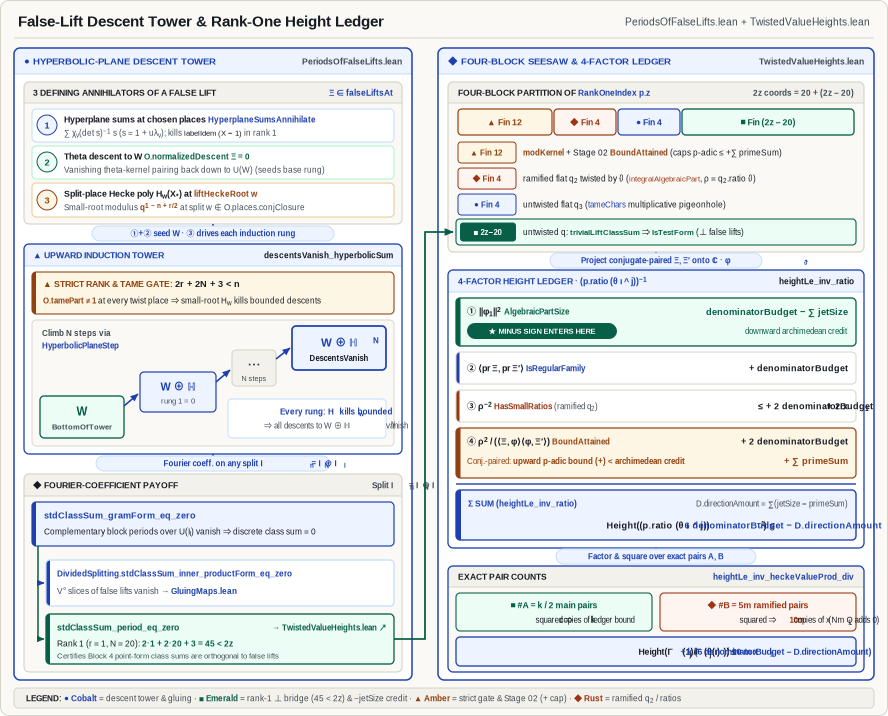
Level 1 — First-Principles
Inside Stage 06, we work on a definite unitary space
Formally, a false lift
- Hyperplane sums at chosen places (
HyperplaneSumsAnnihilate): For every nonzero row vectorat a chosen place , the group-algebra sum over invertible matrices sends to . - Theta descent to
( O.normalizedDescent Ξ = 0): Becauseis orthogonal to all lifts from , pairing back down to via the dual-pair theta kerneltheta correspondence vanishes identically. - Small-root Hecke vanishing (
heckePolyOnForms): At a split placeoff the level (of residue cardinality ), the polynomial built from unramified local averaging operatorsHecke operator evaluated at the small root liftHeckeRoot w(of modulus) kills .
Why does Stage 06 care about a false-lift period? When we split GluingMaps.lean) and the test forms built for rank-one character lifts (in TwistedValueHeights.lean) pair forms on
It proves this by climbing a hyperbolic-plane descent tower:
At the bottom rung (normalizedDescent Ξ = 0) to vanishing of all theta descents to
holds (and the tame character is nontrivial at every twist place). Once all descents to descentsVanish_hyperbolicSum), taking a Fourier coefficient kills the complementary theta integral over stdClassSum_gramForm_eq_zero) to vanish identically.
Limits of the intuition
Picturing the hyperbolic-plane descent tower as simple mathematical induction hides why the strict rank margin O.tamePart at every twist place cannot be relaxed. The induction step (HyperbolicPlaneStep.lean) compares the exponent liftHeckeRoot w against the growth rate of matrix coefficients on
Level 2 — Undergrad Bridge
In Rallis (1984), Ginzburg–Jiang–Soudry (2009), and Wu (2022), the first occurrence index of a representation in a theta tower governs the vanishing of automorphic periods on orthogonal and unitary subgroups. src/New/OneLift/FalseLifts/PeriodsOfFalseLifts.lean (13 declarations, 1 let-type stub truncation) turns this principle into an explicit class-sum orthogonality machine in five steps:
- Bottom of the tower (
lift_polyVector_blockDatum_eq_zero+BottomOfTower.lean): FromO.normalizedDescent Ξ = 0and archimedean parameter compatibilityO.FitsParams l₀, convolving with real test functions spreads vanishing from the highest-weight harmonic vector to every Fock polynomialpolyVector PagainstO.blockDatum. Combined withHyperplaneSumsAnnihilate Ξ(descentsVanish_of_hyperplaneSumsAnnihilate), this kills all theta descents ofalgFormCoefftofor data that are the vacuum off O.places.conjClosure. - Climbing the hyperbolic-plane tower (
descentsVanish_hyperbolicSum): ApplyingHyperbolicPlaneStep.lean(descentsVanish_add_planes) inductively addshyperbolic planes as long as and O.tamePart (O.twistPlace i) ≠ 1for every twist place, provingDescentsVanish (hyperbolicSum N O.W) (stdSpace E n)for every vector. - From vanishing descents to vanishing block integrals (
integral_conj_pairTheta_mul_algFormCoeff_eq_zero): Given a splittingof , absorbing the theta kernel of into the descent to via Fourier coefficients ( integral_blockEmb_eq_zero_of_descentsVanish) kills - Discretization to finite class sums (
stdClassSum_gramForm_eq_zero,stdClassSum_gramForm_kernelVector_eq_zero): For any conjugate-linear-equivariant map and kernel-coordinate vector (in particular kernelVector), integrating over the compact groupcollapses the adelic quotient integral into a weighted finite double-coset sum stdClassSum K f = 0for every stabilizing level. - Two downstream consumers (
stdClassSum_period_eq_zero,DividedSplitting.stdClassSum_inner_productForm_eq_zero):- For rank-one lifts (
, hyperplaneSum_apply_eq_zero_of_rank_one),stdClassSum_period_eq_zeroproves that class sums of point-form pairings vanish against false lifts—used directly inTwistedValueHeights.lean::isTestForm_trivialLiftClassSum_pointForm. - For divided splittings (
), DividedSplitting.stdClassSum_inner_productForm_eq_zeroproves that-slices of false lifts against productFormvanish—used directly inGluingMaps.lean::sum_slice_eq_zero_of_mem_falseLiftsAt.
- For rank-one lifts (
Level 3 — Formal Lean Contract
All five anchors live in skeleton/06_one_lift/periods_of_false_lifts.lean (13 declarations; 1 declaration—New.Rows.stdClassSum_gramForm_eq_zero—is truncated at let f (h : Gf E l) : ℂ := in the skeleton, with its full upstream statement from PeriodsOfFalseLifts.lean:326-345 quoted verbatim in Vanishing Periods of False Lifts and Negative Heights of Twisted L-Values and its complete conclusion from PeriodsOfFalseLifts.lean:343-345 excerpted below):
06_one_lift/periods_of_false_lifts.lean#New.Rows.descentsVanish_hyperbolicSum(upstreamPeriodsOfFalseLifts.lean:115-185):leanlemma New.Rows.descentsVanish_hyperbolicSum {l₀ : NumberField.InfinitePlace E → r → ℤ} [Nonempty r] (h_fits : O.FitsParams l₀) (h_ramified : ∀ i : O.TwistIndex, O.tamePart (O.twistPlace i) ≠ 1) {Ξ : O.FormV} (h_hyperplane : O.HyperplaneSumsAnnihilate Ξ) (h_theta : O.normalizedDescent Ξ = 0) {w : FinPlace E} {hw : star w ≠ w} {hw_off : w ∉ O.places.conjClosure} (h_hecke : O.heckePolyOnForms hw hw_off (O.liftHeckeRoot w) Ξ = 0) (h_rank : 2 * card r + 2 * card N + 3 < card n) (ζ : WeylIndex n O.columnCount → ℂ) : DescentsVanish (hyperbolicSum N O.W) (stdSpace E n) (O.charW * upsilonU1 ^ card N) O.places.conjClosureᶜ (star (algFormCoeff 1 (gramForm ζ) Ξ.val))06_one_lift/periods_of_false_lifts.lean#New.Rows.integral_conj_pairTheta_mul_algFormCoeff_eq_zero(upstreamPeriodsOfFalseLifts.lean:214-310).06_one_lift/periods_of_false_lifts.lean#New.Rows.stdClassSum_gramForm_eq_zero(complete conclusion from upstreamPeriodsOfFalseLifts.lean:343-345):leanlet f (h : Gf E l) : ℂ := gramForm (C (ϑ h)) (Ξ (U.block ε (h₁, h) * x)) (∀ δ ∈ (stdSpace E l).Γ, ∀ h : Gf E l, f (δ.2 * h) = f h) ∧ ∀ (K : Subgroup (Gf E l)) [IsLevel K], K ≤ rightStabilizer f → stdClassSum K f = 006_one_lift/periods_of_false_lifts.lean#New.Rows.stdClassSum_period_eq_zero(upstreamPeriodsOfFalseLifts.lean:572-635) and06_one_lift/periods_of_false_lifts.lean#New.Rows.DividedSplitting.stdClassSum_inner_productForm_eq_zero(upstreamPeriodsOfFalseLifts.lean:676-735).
See the page's live <VerificationBanner /> (audit/verification-status.json) for the pinned upstream commit and local Lean build status (build_status: unverified-locally).
Where this analogy breaks
Thinking of a false lift as an ordinary orthogonal error term whose projections automatically disappear misses why three separate annihilators and a strict rank gap are required: without the hyperplane sums at chosen places, nontrivial tame characters at twist places, small-root Hecke vanishing at a split place w, and the strict inequality 2r + 2N + 3 < n, a form in the kernel of theta descent to W could still have nonzero theta descents higher up the tower W + H^N.
Formal Lean Anchors
lemma New.Rows.descentsVanish_hyperbolicSum — Upstream source (src/New/OneLift/FalseLifts/PeriodsOfFalseLifts.lean L115-L185)
/-- Let the archimedean parameter `l₀` on `W` correspond to the parameter `O.paramV` on `I_n`,
compatibly with the weights of `O` (`O.FitsParams`), and let the residue characters
`χ_v = O.tamePart v` be nontrivial at the twist places. Let the algebraic form `Ξ` on `U(I_n)` be
killed by
* each product over the chosen places `v` of the sums `∑ χ_v(det s)⁻¹ s` over the invertible
`s = 1 + u λ_v`, for rows `λ_v` that are not all zero,
* the theta descent `O.normalizedDescent` to `W`,
* the Hecke polynomial at the number `O.liftHeckeRoot w`, for a split place `w` of norm `q` off the
level.
If `2 card r + 2 card N + 3 < card n`, then the theta descents to `W ⊕ ℍ^N` of the conjugate matrix
coefficient of `Ξ` at any vector `ζ` vanish, for all data of the Weil representation that are the
vacuum at the finite places other than those of the level and their conjugates
(`DescentsVanish`). -/
lemma New.Rows.descentsVanish_hyperbolicSum {l₀ : NumberField.InfinitePlace E → r → ℤ} [Nonempty r]
    (h_fits : O.FitsParams l₀) (h_ramified : ∀ i : O.TwistIndex, O.tamePart (O.twistPlace i) ≠ 1)
    {Ξ : O.FormV} (h_hyperplane : O.HyperplaneSumsAnnihilate Ξ)
    (h_theta : O.normalizedDescent Ξ = 0) {w : FinPlace E} {hw : star w ≠ w}
    {hw_off : w ∉ O.places.conjClosure}
    (h_hecke : O.heckePolyOnForms hw hw_off (O.liftHeckeRoot w) Ξ = 0)
    (h_rank : 2 * card r + 2 * card N + 3 < card n) (ζ : WeylIndex n O.columnCount → ℂ) :
    DescentsVanish (hyperbolicSum N O.W) (stdSpace E n) (O.charW * upsilonU1 ^ card N)
O.places.conjClosureᶜ (star (algFormCoeff 1 (gramForm ζ) Ξ.val)) := by
sorry -- [EXTRACTED_STUB upstream=src/New/OneLift/FalseLifts/PeriodsOfFalseLifts.lean:115-185 commit=41c2716658c42ba08eb0648994a2efe83082a95c body_lines=49 body_sha256=922abfde90578147353ef3548876cf904de4ea5d864a491db44c23eb5928a296]theorem New.Rows.integral_conj_pairTheta_mul_algFormCoeff_eq_zero — Upstream source (src/New/OneLift/FalseLifts/PeriodsOfFalseLifts.lean L214-L310)
/-- Let the archimedean parameter `l₀` on `W` correspond to the parameter `O.paramV` on `I_n`
(`O.FitsParams`), and let the residue characters `O.tamePart` be nontrivial at the twist places. A
false lift is here an algebraic form `Ξ` on the definite group `U(I_n)` with three properties. It is
killed by the hyperplane sums at the chosen places. It is killed by the theta descent
`O.normalizedDescent` to `W`. It is killed by the Hecke polynomial at a split place `w` off the
level, taken at the number `O.liftHeckeRoot w` of modulus `q^(1 - n + r / 2)`, `q` the norm of `w`.
Let `ε` split `I_n = I_N ⊕ I_l` with `2 r + 2 N + 3 < n`. Then the integral over `h₂` in the adelic
quotient of `U(I_l)` of the conjugate theta kernel of the pair `O.W, I_l` times the matrix
coefficient `algFormCoeff 1 (gramForm ζ) Ξ` at `(h₁, h₂) γ` is zero. This holds for every vector
`ζ`, every character `b` of `U(1)` twisting the kernel, all `g` and `h₁`, every finite `γ` supported
on `O.places`, and all data `φ` that are the vacuum off these places and their conjugates. -/
theorem New.Rows.integral_conj_pairTheta_mul_algFormCoeff_eq_zero (hO_fits : O.FitsParams l₀)
    (h_twist : ∀ i : O.TwistIndex, O.tamePart (O.twistPlace i) ≠ 1) {Ξ : O.FormV}
    (h_reflect : O.HyperplaneSumsAnnihilate Ξ) (hθ : O.normalizedDescent Ξ = 0)
    {w : FinPlace E} {hw : star w ≠ w} {hw_off : w ∉ O.places.conjClosure}
    (h_hecke : O.heckePolyOnForms hw hw_off (O.liftHeckeRoot w) Ξ = 0)
    (h_rank : 2 * card r + 2 * card N + 3 < card n) (ε : N ⊕ l ≃ n)
    (ζ : WeylIndex n O.columnCount → ℂ) (b : AutChar E) (g : G E O.signs) (h₁ : G E (1 : N → ℤˣ))
    {γ : Gf E n} (hγ : γ ∈ supportedOn n O.places) {φ : 𝒮 (O.W.hom (stdSpace E l))}
    (hφ : projOn (O.W.hom (stdSpace E l)) O.places.conjClosureᶜ φ = φ) :
    ∫ h₂ : G E (1 : l → ℤˣ), conj (pairTheta O.W (stdSpace E l) O.charW b φ (g, h₂)) *
      algFormCoeff 1 (gramForm ζ) Ξ.val (blockEmb (e := ε) elim_one_one.symm (h₁, h₂) * (1, γ))
      ∂(stdSpace E l).quotMeasure = 0 := by
  sorry -- [EXTRACTED_STUB upstream=src/New/OneLift/FalseLifts/PeriodsOfFalseLifts.lean:214-310 commit=41c2716658c42ba08eb0648994a2efe83082a95c body_lines=75 body_sha256=f9a2866244d5429a725807002b943257e36da86545055f2eb03eb6b9d572ca81]
theorem New.Rows.stdClassSum_gramForm_eq_zero — Upstream source (src/New/OneLift/FalseLifts/PeriodsOfFalseLifts.lean L313-L390)
/-- Let the archimedean parameter `l₀` on `W` correspond to the parameter `O.paramV` on `I_n`
(`O.FitsParams`), and let the residue characters `O.tamePart` be nontrivial at the twist places. Let
the algebraic form `Ξ` on `U(I_n)` be killed by the hyperplane sums at the chosen places. Let `Ξ`
also be killed by the theta descent `O.normalizedDescent` to `W`, and by the Hecke polynomial at the
number `O.liftHeckeRoot w` for a split place `w` off the level. Let `ε` split `I_n = I_N ⊕ I_l` with
`2 #r + 2 #N + 3 < #n`, and let `x` be supported on `O.places`. Let `ϑ` be a function on the finite
points of `U(I_l)` whose coordinates, moved by the real points, are multiples of conjugate theta
kernels of the pair `O.W, I_l` with data that are the vacuum off `O.places` and their conjugates.
Let the conjugate-linear map `C` carry its values to the space of values of `Ξ`, equivariantly for
the real points of `U(I_l)` acting by `conjWeylRep`, the representation of the given weight. Then
the invariant inner product `gramForm` of `C (ϑ h)` with `Ξ ((h₁, h) x)`, the block point being
`U.block ε (h₁, h)`, is left invariant under the rational points. Its class sum `stdClassSum` is
zero at every level `K` that fixes it. -/
theorem New.Rows.stdClassSum_gramForm_eq_zero (hO_fits : O.FitsParams l₀)
    (h_twist : ∀ i : O.TwistIndex, O.tamePart (O.twistPlace i) ≠ 1) {Ξ : O.FormV}
    (h_reflect : O.HyperplaneSumsAnnihilate Ξ) (hθ : O.normalizedDescent Ξ = 0)
    {w : FinPlace E} {hw : star w ≠ w} {hw_off : w ∉ O.places.conjClosure}
    (h_hecke : O.heckePolyOnForms hw hw_off (O.liftHeckeRoot w) Ξ = 0)
    (h_rank : 2 * card r + 2 * card N + 3 < card n) (ε : N ⊕ l ≃ n) {κ : InfinitePlace E → ℕ → ℕ}
    (C : (WeylIndex l κ → ℂ) →ₗ⋆[ℂ] WeylIndex n O.columnCount → ℂ)
    (hC : ∀ (g : GInf E (1 : n → ℤˣ)) (y : GInf E (1 : l → ℤˣ)) (ζ : WeylIndex l κ → ℂ),
      (∀ τ : InfinitePlace E, (g τ : GL n ℂ) = reindexGL ε (blockGL (1, y τ))) →
        conjWeylRep O.columnCount O.detExp g (C ζ) = C (conjWeylRep κ 0 y ζ))
    (ϑ : Gf E l → WeylIndex l κ → ℂ)
    (h_kernels : ∀ j : WeylIndex l κ, ∃ (c : ℂ) (g : G E O.signs) (b : AutChar E)
      (φ : 𝒮 (O.W.hom (stdSpace E l))),
      projOn (O.W.hom (stdSpace E l)) O.places.conjClosureᶜ φ = φ ∧
        ∀ (u : GInf E (1 : l → ℤˣ)) (h : Gf E l), conjWeylRep κ 0 u⁻¹ (ϑ h) j =
          c * conj (pairTheta O.W (stdSpace E l) O.charW b φ (g, u, h)))
    (h₁ : Gf E N) {x : Gf E n} (hx : x ∈ supportedOn n O.places) :
    let f (h : Gf E l) : ℂ := by
  sorry -- [EXTRACTED_STUB upstream=src/New/OneLift/FalseLifts/PeriodsOfFalseLifts.lean:313-390 commit=41c2716658c42ba08eb0648994a2efe83082a95c body_lines=48 body_sha256=6ec97e73f27867e404d3ad5b787507b4528766aa4852e26ff19dd3f449e4929a]
lemma New.Rows.stdClassSum_period_eq_zero — Upstream source (src/New/OneLift/FalseLifts/PeriodsOfFalseLifts.lean L572-L635)
/-- Periods against point forms vanish. Let `O` be a descent pair `(W, I_n)`; its level `O.places`
consists of the chosen places and the twist places. Let the archimedean parameter `l₀` on `W`
correspond to that on `I_n` (`O.FitsParams`), and let the residue characters `O.tamePart` be
nontrivial at the twist places. Let the form `Ξ` on `U(I_n)` be killed by three things: the
hyperplane sums (character sums over the matrices `1 + u λ`) at the chosen places, the theta descent
`O.normalizedDescent` to `W`, and the Hecke polynomial `O.heckePolyOnForms` at the number
`O.liftHeckeRoot w` for a split place `w` off the level. Let `ε` split `I_n = I_N ⊕ I_l` with
`2 #r + 2 #N + 3 < #n`. Let `C`, from vectors of weight `κ` to vectors of weight `O.columnCount`, be
conjugate-linear and equivariant (`conjWeylRep`) for the real points of the second block. Let `x` be
supported at the chosen places. Let the level `K` fix the datum `Ψ` modulo the ideal `𝔪`, and after
conjugation by `x` fix the matrices `Y i`, each with independent columns. The places of `𝔪` lie in
`O.places` and the rows `e'` in the block `I_N`. Let `f h` be the inner product of `Ξ` with the
point form at `(h₁, h) x`. This form is supported on the class of `(h₁, h) x A` with value
`C (kernelVector O b 𝔪 Ψ κ g h)` there. Here `A = pointLift hY e'` is an integral point with columns
`Y` at the chosen places. The vector `kernelVector O b 𝔪 Ψ κ g h` lists the values at `(g, h)` of
the conjugate theta kernels of the pair `W, I_l` with datum `Ψ`, twisted by `b`, one for each basis
polynomial of weight `κ`. Then the class sum of `f` over `K` (the sum over the double cosets
weighted by `1 / #Aut`) is zero. -/
lemma New.Rows.stdClassSum_period_eq_zero (hO_fits : O.FitsParams l₀)
    (h_twist : ∀ i : O.TwistIndex, O.tamePart (O.twistPlace i) ≠ 1) {Ξ : O.FormV}
    (h_reflect : O.HyperplaneSumsAnnihilate Ξ) (hθ : O.normalizedDescent Ξ = 0)
    {w : FinPlace E} {hw : star w ≠ w} {hw_off : w ∉ O.places.conjClosure}
    (h_hecke : O.heckePolyOnForms hw hw_off (O.liftHeckeRoot w) Ξ = 0)
    (h_rank : 2 * card r + 2 * card N + 3 < card n) (ε : N ⊕ l ≃ n) {κ : InfinitePlace E → ℕ → ℕ}
    {Y : ∀ i : O.ChosenIndex, Matrix n r (ResField (O.placeAt (inl i)))} {e' : r ↪ n}
    (hY : ∀ i : O.ChosenIndex, Function.Injective (Y i).mulVec)
    (C : (WeylIndex l κ → ℂ) →ₗ⋆[ℂ] WeylIndex n O.columnCount → ℂ)
    (hC : ∀ (g : GInf E (1 : n → ℤˣ)) (y : GInf E (1 : l → ℤˣ)) (ζ : WeylIndex l κ → ℂ),
      (∀ τ : InfinitePlace E, (g τ : GL n ℂ) = reindexGL ε (blockGL (1, y τ))) →
        conjWeylRep O.columnCount O.detExp g (C ζ) = C (conjWeylRep κ 0 y ζ))
    {b : AutChar E} {𝔪 : Modulus E} (h𝔪 : 𝔪.places ⊆ O.places) {Ψ : Matrix l r 𝔪.ResidueRing → ℂ}
    {g : G E O.signs} {h₁ : Gf E N} {x : Gf E n} (hx : x ∈ supportedOn n (.range O.chosenPlace))
    {K : Subgroup (Gf E l)} [hK : IsLevel K] {f : Gf E l → ℂ}
    (hf : ∀ h : Gf E l, f h = inner ℂ
      (pointForm (Y := Y) (U.block ε (h₁, h) * x) hY e' (C (kernelVector O b 𝔪 Ψ κ g h))) Ξ)
    {rowInBlock : r → N} (he' : ⇑e' = ε ∘ inl ∘ rowInBlock)
    (hK_fix : ∀ k : stdLevel E l, (k : Gf E l) ∈ K →
      (∀ T : Matrix l r 𝔪.ResidueRing, Ψ ((𝔪.reductionGL k⁻¹).val * T) = Ψ T) ∧
      ∃ h_mem : x⁻¹ * U.block ε (1, k) * x ∈ stdLevel E n, ∀ i : O.ChosenIndex,
        (stdLevel.reduceAt (O.placeAt (inl i)) ⟨_, h_mem⟩).val * Y i = Y i) :
    stdClassSum K f = 0 := by
  sorry -- [EXTRACTED_STUB upstream=src/New/OneLift/FalseLifts/PeriodsOfFalseLifts.lean:572-635 commit=41c2716658c42ba08eb0648994a2efe83082a95c body_lines=24 body_sha256=a7e62a1074d97ba08f0b66bd84913f972cae6cc4c5d06c448f2d9b0d16b62698]
lemma New.Rows.DividedSplitting.stdClassSum_inner_productForm_eq_zero — Upstream source (src/New/OneLift/FalseLifts/PeriodsOfFalseLifts.lean L676-L735)
/-- Slices of false lifts are orthogonal to theta kernels. Let `O` be a descent pair `(W, I_n)`, and
let `V` split `I_n = I_N ⊕ I_l` with the indices of `W` and those of a further index type `ι`
embedded in `N`. Let `L` be a divided lattice `γ 𝒪ⁿ`, with `γ = L.point` supported at the chosen
places. Let the archimedean parameter `l₀` on `W` correspond to that on `I_n` (`O.FitsParams`), and
let the residue characters `O.tamePart` be nontrivial at the twist places. Let the form `Ξ` on
`U(I_n)` be killed by the hyperplane sums at the chosen places, by the theta descent to `W` and by
the Hecke polynomial at the number `O.liftHeckeRoot w`, for a split place `w` off the level, and let
`2 #r + 2 #N + 3 < #n`. Let `ϖ` generate the square of the product of the chosen places. The product
form `V.productForm L (x, h) y η` is supported on the class of `(x, h) γ`, with value the Cartan
product of `y`, of weight `O.colsPlus`, and `η`, of weight `O.colsMinus`. Take for `η` the conjugate
of `kernelVector … g h`, the vector of the conjugate theta kernels at `(g, h)` of the pair `W, I_l`
with any datum `Ψ` modulo `ϖ`. Then the class sum over `h`, at the principal level `ϖ` of `U(I_l)`,
of the inner product of this form with `Ξ` is zero. -/
lemma New.Rows.DividedSplitting.stdClassSum_inner_productForm_eq_zero {z : r ↪ l}
    (V : DividedSplitting N l ι O z) (hO_fits : O.FitsParams l₀)
    (h_twist : ∀ i : O.TwistIndex, O.tamePart (O.twistPlace i) ≠ 1) {Ξ : O.FormV}
    (h_reflect : O.HyperplaneSumsAnnihilate Ξ) (hθ : O.normalizedDescent Ξ = 0)
    {w : FinPlace E} {hw : star w ≠ w} {hw_off : w ∉ O.places.conjClosure}
    (h_hecke : O.heckePolyOnForms hw hw_off (O.liftHeckeRoot w) Ξ = 0)
    (h_rank : 2 * card r + 2 * card N + 3 < card n) {ϖ : RingOfIntegers E} [Fact (ϖ ≠ 0)]
    (hϖ : O.chosenModulusSq.ideal = Ideal.span {ϖ}) (L : DividedLattice O)
    (x : Gf E N) (y : WeylIndex N O.colsPlus → ℂ) (b : AutChar E)
    (Ψ : Matrix l r O.chosenModulusSq.ResidueRing → ℂ) (g : G E O.signs) :
    stdClassSum (principalLevel l ϖ) (fun h : Gf E l ↦ inner ℂ (V.productForm L (x, h) y
      (star (kernelVector O b O.chosenModulusSq Ψ O.colsMinus g h))) Ξ) = 0 := by
  sorry -- [EXTRACTED_STUB upstream=src/New/OneLift/FalseLifts/PeriodsOfFalseLifts.lean:676-735 commit=41c2716658c42ba08eb0648994a2efe83082a95c body_lines=36 body_sha256=5de8203fa877109a34c98799fe6eb71269351afec9dfe4c74b7f9893f70f6dd5]
Related Concepts
- theta correspondence — An integral transform built from a two-variable theta kernel that carries automorphic forms from one unitary group to another, iterated along a ladder of Hermitian spaces and packaged via admissible chain data.
- Hecke operator — An averaging operator that sums values of an automorphic form over neighboring sublattices—indexed by cosets of a parahoric subgroup—which Stage 03 scales by powers of a prime to eliminate collision losses in the composite theta lift.
- central idempotent — A class-function element of a finite group algebra satisfying z² = z that acts as a G-equivariant orthogonal projection, splitting good cuspidal types from rare bad types across two level primes.
Referenced By
- Stage: First-Order Ribet Denominator Bounds and Existence of Regular Twist Families
- Stage: Stage 06 — Lower Bound: One Lift (Theorem C, Part 2)
- Stage: Stage 07 — Lower Bound: Congruences & Galois Representations (Theorem C, Part 3)
- Stage: The Lift Comparison Operator and Single-Lift Volume Height
- Stage: Three Exchanges, the Carrier Form, and Divided-Lattice Gluing
- Stage: Vanishing Periods of False Lifts and Negative Heights of Twisted L-Values
- Concept: character theta lift
- Concept: divided-lattice gluing
- Concept: lift comparison operator
- Concept: Ribet clearing operator
Authoritative Sources
- On the Howe duality conjecture (paper) — S. Rallis, Compositio Math. 51 (1984), 333–399.
- Poles of L-functions and theta liftings for orthogonal groups (paper) — D. Ginzburg, D. Jiang & D. Soudry, J. Inst. Math. Jussieu 8 (2009), 693–741.
- Poles of Eisenstein series and theta lifts for unitary groups (paper) — C. Wu, Pacific J. Math. 317 (2022), 209–244.
Page Glossary
- central idempotent
- A class-function element of a finite group algebra satisfying z² = z that acts as a G-equivariant orthogonal projection, splitting good cuspidal types from rare bad types across two level primes.
- theta correspondence
- An integral transform built from a two-variable theta kernel that carries automorphic forms from one unitary group to another, iterated along a ladder of Hermitian spaces and packaged via admissible chain data.
- Hecke operator
- An averaging operator that sums values of an automorphic form over neighboring sublattices—indexed by cosets of a parahoric subgroup—which Stage 03 scales by powers of a prime to eliminate collision losses in the composite theta lift.