From a One-Sided Prime Bound to a Zero-Free Half-Plane
This landmark page traces the top half of Stage 01 — from New.star_inequality through two-cutoff elimination (New.Reduction.OneSidedBound), Landau and Suzuki's one-sided criterion (New.Reduction.Zeros.Criterion), and functional-equation reflection (New.Main) to the Generalized Riemann Hypothesis and the Riemann Hypothesis. Return to the Stage 01 Overview for the full stage map, or continue to The Main Cancellation Inequality and Theorems A & B to see how New.star_inequality itself is proved.
Level 1 — First-Principles
Suppose a suspension bridge is monitored by a single pressure gauge that measures how much traffic piles up above the long-term average. If a hidden resonant wave existed inside the bridge, it would force the pressure gauge to swing wildly both above and below zero with a growing amplitude. Therefore, you do not need to cap swings in both directions: if you can prove a one-sided ceiling — showing that the pressure never spikes far above zero — no destructive wave can exist above that growth rate.
That one-sided strategy turns a statement about whole numbers greater than
Multiplying each term by the smooth taper
- Eliminating the huge second cutoff: The main inequality bounds
only after mixing it with error terms measured at a vastly larger scale . Because dwarfs , the classical Prime Number Theorem crushes the error terms below , leaving a pure upper bound for every real large enough. - Dodging unwanted zeros by choosing
: The smoothed transform of detects zeros of both the original functions — each periodic multiplicative weight modulo Dirichlet character produces a global function Dirichlet L-function — and their partners twisted by . Those two sets of zeros enter with opposite signs, so a twisted zero could accidentally cancel an untwisted zero. Because the one-sided bound holds for all primes in the chosen congruence class, Stage 01 uses a zero-density estimate to pick one prime whose twisted functions have no zeros at all inside the box reaching up to the candidate point . - Springing the one-sided trap: Once the twisted zeros are cleared from the box, every remaining pole on the real axis above
has a nonnegative sign automatically. Applying the classical analytic principle forbidding a nonnegative-coefficient transform from having a boundary pole without also exploding on the real axisLandau's lemma forces the residue at to vanish, so no modulo can equal anywhere to the right of . - Inducing and reflecting to the center line: Given any character modulo an arbitrary
, Stage 01 lifts it to modulus , applies the zero-free half-plane bound there, and divides out the finitely many extra prime factors at primes dividing . That clears the entire half-plane for every character. Finally, functional-equation reflection across the central vertical line critical line rules out zeros on the left half of the open vertical band critical strip as well, pinning every nontrivial zero of every Dirichlet L-function — and of the global function Riemann zeta function away from the predictable negative even integers trivial zero — directly onto the critical line.
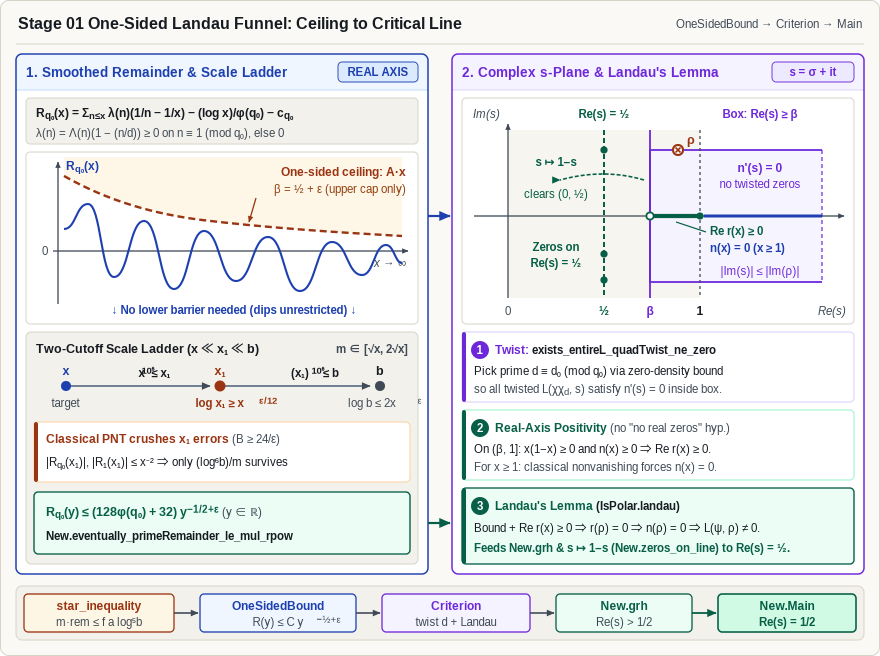
Where this analogy breaks
Comparing
Level 2 — Undergrad Bridge
1. The Smoothed Prime Remainder and Its Laplace Transform
In src/New/Reduction/Zeros/PrimeError.lean, fix a prime New.lambdaKResidueClass):
Since New.primeRemainder) is
where New.logDerivMean d q) is the mean logarithmic-derivative difference across all Dirichlet characters
with
Why smooth by the linear taper primeRemainder_eq_integral_countError_sub) shows
Integrating once by
- Slow variation: Chebyshev's bound
( abs_countError_le) immediately givesfor ( abs_primeRemainder_sub_le), which later bridges integersto all real . - Simple-pole Laplace transform (
New.isPolar_primeRemainder): Changing variables to, the Laplace integral converges absolutely on (where the Dirichlet series of equals ) and continues meromorphically to with at most simple poles, no pole at , and exact residue at every : where and .
Under the substitution
2. Why Criterion Quantifies Over All Primes
In src/New/Reduction/Zeros/Criterion.lean, New.LFunction_ne_zero_of_primeRemainder_le assumes
Why must the hypothesis hold for all primes
- A zero of an untwisted function
contributes positively to , while a zero of a twisted function contributes negatively via . - If we fixed a single
in advance, a zero of could coincide with (canceling ) or sit on the real interval (making and invalidating Landau's lemma). - To prevent both hazards,
Criterion.leancallsexists_entireL_quadTwist_ne_zero(src/Lib/Analytic/QuadraticTwist.lean), which proves by a theta-series tail integral, Hadamard's three-lines theorem, and Pólya–Vinogradov mean-square estimates that at mostprimes are "bad" (having any twisted zero in , ). Since diverges, there exists at least one good prime with entireL (quadTwist χ d) s ≠ 0throughout the entire box, .
For that chosen prime
- If
: is nonnegative, , and , so . - If
: entireL_ne_zeroguaranteesfor every , so and .
Thus h_polar.landau) then forces
3. Two-Cutoff Elimination (
src/New/Reduction/OneSidedBound.lean connects New.star_inequality (Criterion in five cleanly separated lemmas:
Isolating
( New.Data.primeRemainder_le, lines37–71): ExpandingD.totalRemainder_eqexpressesD.totalRemainderin terms of, , and . Dividing star_inequalitybyand substituting together with ( D.towerDeg_le_card_bPlaces_mul) yieldsAdmissible scale selection (
New.eventually_exists_data_scales, lines78–93): For anyand all sufficiently large integers , eventually_exists_dataproduces admissible datawith , , , and (while preserving the hierarchy , , ). Crushing the
remainders by PNT ( New.eventually_abs_primeRemainder_exp_le, lines99–121): Classical PNT in arithmetic progressions (New.eventually_abs_primeRemainder_leinPrimeNumberTheorem.lean) saves every power of the logarithm:for any and large . Choosing , any satisfies Applying this at
bounds both and . Integer-scale bound (
New.eventually_primeRemainder_natCast_le, lines129–159): Substituting the scale inequalities and thePNT bounds into Data.primeRemainder_legives:Real-variable bridge (
New.eventually_primeRemainder_le_mul_rpow, lines204–235):(Note on exact naming: the Lean theorem atsrc/New/Reduction/OneSidedBound.lean:204isNew.eventually_primeRemainder_le_mul_rpow; upstream's summary tableINDEX.md:21contains a minor typo printingeventually_primeRemainder_le_rpow.) Chooseso and , and set . For all large real : primeRemainder_sub_primeRemainder_floor_lebounds the fractional jump:. natFloor_rpow_le_two_mul_rpowconvertsto : since and , . Combining both gives
4. Assembling New.grh and Reflecting to the Critical Line
New.grh : DirichletLNonvanishingRightOfHalf (src/New/Reduction/OneSidedBound.lean:239-268) takes any modulus
- The boundary point
: Dispatched immediately by Dirichlet's theorem ( χ.LFunction_ne_zero_of_one_le_re h_pole le_rfl). - Induction to
: For , pick and set and . Then: (since ), (since ), (since is odd and ), - every prime dividing
splits in (for every prime , splits and is a square for every odd prime ), - for every prime
, dvd_two_mul_succ_and_not_dvd_succverifiesand , which is the exact divisibility requirement in Parameters.
- Applying the criterion and peeling off Euler factors: Setting
so , eventually_primeRemainder_le_mul_rpowsupplies the uniform one-sided bound with constant. LFunction_ne_zero_of_primeRemainder_lethen yields, where . Rewriting by LFunction_changeLevel _ χ h_poleexpressesas multiplied by the finite Euler-factor product . Applying left_ne_zero_of_mulconcludesdirectly — in this direction, nonvanishing of a product implies nonvanishing of its left factor without needing any separate check that the Euler factors are nonzero. - Functional-equation reflection (
src/New/Main.lean:32-44):New.zeros_on_lineappliesNew.grhto bothand via New.gammaFactor_eq_zero_or_LFunction_one_sub_eq_zeroandComplex.Gammaℝ_ne_zero_of_re_pos, ruling out bothand . New.zeta_zeros_on_linespecializesNew.grhto modulus, checks via riemannZeta_zero, and usescompletedRiemannZeta_one_subandComplex.Gammaℝ_eq_zero_iffto show every zero ofoutside has .
Level 3 — Formal Lean Contract
The three extracted skeleton modules below correspond to src/New/Reduction/Zeros/Criterion.lean, src/New/Reduction/OneSidedBound.lean, and src/New/Main.lean at pinned upstream commit 41c2716658c42ba08eb0648994a2efe83082a95c (41c2716658c4, leanprover/lean4:v4.37.0-rc1, Mathlib rev 31ce06eaadf4a200c0e1407c5f10953cf606b8f8). Note that New.eventually_primeRemainder_le_mul_rpow (src/New/Reduction/OneSidedBound.lean:204) is the live declaration name in Lean, whereas upstream's INDEX.md:21 prints eventually_primeRemainder_le_rpow.
Verification status (audit/verification-status.json): Local Lean compilation and kernel replay remain unverified-locally; local static token scanning has scan_scope: entry (covering only Challenge.lean, src/Main.lean, and src/Statements.lean), so these Stage 01 modules have not been locally compiled or statically scanned. Proof bodies in the embedded skeletons below are intentionally replaced with extraction stubs carrying exact upstream line ranges and SHA-256 digests. Continue to The Main Cancellation Inequality and Theorems A & B to examine New.star_inequality.
theorem New.LFunction_ne_zero_of_primeRemainder_le — Upstream source (src/New/Reduction/Zeros/Criterion.lean L35-L90)
/-- **One-sided criterion.** Let `q₀` be a positive multiple of `8`, let `d₀ ≡ 7` mod `8` be prime
to `q₀`, and let `β > 1/2`. Suppose that for each prime `d ≡ d₀` mod `q₀` the remainder
`primeRemainder d q₀ x = ∑_{n ≤ x} λ(n) (1/n - 1/x) - log x / φ(q₀) - c` is at most `A * x ^ (β - 1)`
for some `A` and all large `x`. Here `λ(n) = Λ(n) (1 - (n/d))` for `n ≡ 1` mod `q₀` and `0` otherwise,
and `c` is the constant for which the remainder tends to `0`. Then `L(ρ, ψ) ≠ 0` for every
character `ψ` modulo `q₀` and every `ρ ≠ 1` with `re ρ > β`. -/
theorem New.LFunction_ne_zero_of_primeRemainder_le {q₀ : ℕ} [NeZero q₀] (hq₀ : 8 ∣ q₀) {d₀ : ℕ}
    (hd₀_mod : d₀ % 8 = 7) (hd₀_cop : d₀.Coprime q₀) {β : ℝ} (hβ : 1 / 2 < β)
    (h_bound : ∀ d : Primes, (d : ℕ) ≡ d₀ [MOD q₀] →
      ∃ A : ℝ, ∀ᶠ x : ℝ in atTop, primeRemainder d q₀ x ≤ A * x ^ (β - 1))
    (ψ : DirichletCharacter ℂ q₀) {ρ : ℂ} (hρ_ne : ρ ≠ 1) (hρ_re : β < ρ.re) :
    ψ.LFunction ρ ≠ 0 := by
  sorry -- [EXTRACTED_STUB upstream=src/New/Reduction/Zeros/Criterion.lean:35-90 commit=41c2716658c42ba08eb0648994a2efe83082a95c body_lines=45 body_sha256=dee53546115f07956df438a6dd34a213cb6cb1775d14fde132a1c579e7a308de]
lemma New.Data.primeRemainder_le — Upstream source (src/New/Reduction/OneSidedBound.lean L31-L71)
/-- Let `q₀ = P.q₀` and `d = P.d` be the modulus and the prime of the parameters `P`. Let
`R_q(y) = primeRemainder d q y = ∑_{n ≤ y} λ(n) (1/n - 1/y) - log y / φ(q) - c_q`. Admissible data
`D` for `P` include scales `x = D.x`, `x₁ = D.x₁` and `b` (`D.logB = log b`) with
`(log b) ^ 100 ≤ x`, `x ^ 10⁶ ≤ x₁`, `x₁ ^ 10⁶ ≤ b` and `log log b ≥ 10¹² P.constantBound`, and an
integer `m = D.m` in `[√x, 2 √x]`. Then `R_{q₀}(x) ≤ φ(q₀) log⁶ b / m + |R_{q₀}(x₁)| + log
b · |R₁(x₁)|`. -/
lemma New.Data.primeRemainder_le {P : Parameters} (D : Data P) :
    primeRemainder P.d P.q₀ D.x ≤ P.q₀.totient * D.logB ^ 6 / D.m +
      |primeRemainder P.d P.q₀ D.x₁| + D.logB * |primeRemainder P.d 1 D.x₁| := by
  sorry -- [EXTRACTED_STUB upstream=src/New/Reduction/OneSidedBound.lean:31-71 commit=41c2716658c42ba08eb0648994a2efe83082a95c body_lines=33 body_sha256=d258e645e4a0040c279b57deae65dfb70753b2605eb548577a12e7f7a3ddbb1c]
lemma New.eventually_exists_data_scales — Upstream source (src/New/Reduction/OneSidedBound.lean L73-L93)
/-- Let `0 < ε < 1/100`. A term `D : Data P` (admissible data) bundles all the choices that the main
inequality needs, among them integer scales `x`, `x₁`, `b` with `x ^ 10⁶ ≤ x₁` and `x₁ ^ 10⁶ ≤ b`
(`D.logX₁ = log x₁`, `D.logB = log b`) and a power of two `m = D.m` in `[√x, 2 √x]`. For every large
integer `x` such data exist with `D.x = x`, `log b ≤ 2 x ^ ε`, `√x ≤ m` and
`x ^ (ε / 12) ≤ log x₁`. -/
lemma New.eventually_exists_data_scales (P : Parameters) {ε : ℝ} (hε : 0 < ε) (hε_lt : ε < 1 / 100) :
    ∀ᶠ x : ℕ in atTop, ∃ D : Data P, D.x = x ∧ D.logB ≤ 2 * (x : ℝ) ^ ε ∧
      (x : ℝ) ^ (1 / 2 : ℝ) ≤ D.m ∧ (x : ℝ) ^ (ε / 12) ≤ D.logX₁ := by
  sorry -- [EXTRACTED_STUB upstream=src/New/Reduction/OneSidedBound.lean:73-93 commit=41c2716658c42ba08eb0648994a2efe83082a95c body_lines=14 body_sha256=e856c8c488bc96ba524f493dd5e237ddf5b1856477eaa3e1e1c8bfc4d11d3dad]
lemma New.eventually_abs_primeRemainder_exp_le — Upstream source (src/New/Reduction/OneSidedBound.lean L95-L121)
/-- Let `q₀ = P.q₀` and `d = P.d` be the modulus and the prime of the parameters `P`, and let
`ε > 0`. Let `R_q(y) = primeRemainder d q y = ∑_{n ≤ y} λ(n) (1/n - 1/y) - log y / φ(q) - c_q`. For
all large integers `x` and all `l ≥ x ^ (ε / 12)`, the values `|R_{q₀}(exp l)|` and `|R₁(exp l)|`
are at most `x ^ (-2)`, by the prime number theorem. -/
lemma New.eventually_abs_primeRemainder_exp_le (P : Parameters) {ε : ℝ} (hε : 0 < ε) :
    ∀ᶠ x : ℕ in atTop, ∀ l : ℝ, (x : ℝ) ^ (ε / 12) ≤ l →
      |primeRemainder P.d P.q₀ (exp l)| ≤ (x : ℝ) ^ (-2 : ℝ) ∧
      |primeRemainder P.d 1 (exp l)| ≤ (x : ℝ) ^ (-2 : ℝ) := by
  sorry -- [EXTRACTED_STUB upstream=src/New/Reduction/OneSidedBound.lean:95-121 commit=41c2716658c42ba08eb0648994a2efe83082a95c body_lines=20 body_sha256=8ed1781b483a244eefa709c96846f45d97d50912437a759a801696609cc261c1]
lemma New.eventually_primeRemainder_natCast_le — Upstream source (src/New/Reduction/OneSidedBound.lean L123-L159)
/-- The one-sided bound at integers. Let `q₀ = P.q₀` and `d = P.d` be the modulus and the prime of
the parameters `P`, and let `0 < ε < 1/100`. Let
`R(y) = primeRemainder d q₀ y = ∑_{n ≤ y} λ(n) (1/n - 1/y) - log y / φ(q₀) - c`, where
`λ(n) = Λ(n) (1 - (n/d))` for `n ≡ 1` modulo `q₀` and `0` otherwise, `(·/d)` is the Legendre symbol,
and `c` is the constant with `R(y) → 0`. Then `R(x) ≤ (64 φ(q₀) + 3) x ^ (-1/2 + 6 ε)` for all large
integers `x`. -/
lemma New.eventually_primeRemainder_natCast_le (P : Parameters) {ε : ℝ} (hε : 0 < ε)
    (hε_lt : ε < 1 / 100) :
    ∀ᶠ x : ℕ in atTop,
      primeRemainder P.d P.q₀ x ≤ (64 * P.q₀.totient + 3) * (x : ℝ) ^ (-1 / 2 + 6 * ε) := by
  sorry -- [EXTRACTED_STUB upstream=src/New/Reduction/OneSidedBound.lean:123-159 commit=41c2716658c42ba08eb0648994a2efe83082a95c body_lines=28 body_sha256=274e16b951c6bce19c91285bcabf10a9ac2e3dfe94c23931f4d5eaa56596a9a0]
lemma New.primeRemainder_sub_primeRemainder_floor_le — Upstream source (src/New/Reduction/OneSidedBound.lean L161-L171)
/-- Let `d` be a prime, `q > 0`, and `R_q(y) = primeRemainder d q y = ∑_{n ≤ y} λ(n) (1/n - 1/y) -
log y / φ(q) - c_q`. Then `R_q(y) - R_q(⌊y⌋) ≤ 26 / y` for `y ≥ 2`. -/
lemma New.primeRemainder_sub_primeRemainder_floor_le {d : ℕ} [Fact d.Prime] {q : ℕ} [NeZero q] {y : ℝ}
    (hy : 2 ≤ y) : primeRemainder d q y - primeRemainder d q ⌊y⌋₊ ≤ 26 / y := by
  sorry -- [EXTRACTED_STUB upstream=src/New/Reduction/OneSidedBound.lean:161-171 commit=41c2716658c42ba08eb0648994a2efe83082a95c body_lines=8 body_sha256=e7dab710776a53b89f6a0336174b244f917ebff229653ed1b882e55d15a0a126]
lemma New.natFloor_rpow_le_two_mul_rpow — Upstream source (src/New/Reduction/OneSidedBound.lean L173-L185)
/-- For `y ≥ 2` and `-1 ≤ t ≤ 0` we have `⌊y⌋ ^ t ≤ 2 y ^ t`, since `y / 2 ≤ ⌊y⌋`. -/
lemma New.natFloor_rpow_le_two_mul_rpow {y t : ℝ} (hy : 2 ≤ y) (ht_ge : -1 ≤ t) (ht_le : t ≤ 0) :
    (⌊y⌋₊ : ℝ) ^ t ≤ 2 * y ^ t := by
  sorry -- [EXTRACTED_STUB upstream=src/New/Reduction/OneSidedBound.lean:173-185 commit=41c2716658c42ba08eb0648994a2efe83082a95c body_lines=11 body_sha256=a57c6095f4ff632a6c1d631e686b325f74002bd4a83886a6ec5aa84a984de515]
lemma New.dvd_two_mul_succ_and_not_dvd_succ — Upstream source (src/New/Reduction/OneSidedBound.lean L187-L199)
/-- If `q₀ > 0` is even and `d ≡ q₀ / 2 - 1` modulo `q₀`, then `q₀` divides `2 (d + 1)` but not
`d + 1`. This is the form of the congruence in `Parameters`. -/
lemma New.dvd_two_mul_succ_and_not_dvd_succ {q₀ d : ℕ} (hq₀_pos : 0 < q₀) (hq₀_even : 2 ∣ q₀)
    (hd : d ≡ q₀ / 2 - 1 [MOD q₀]) : q₀ ∣ 2 * (d + 1) ∧ ¬q₀ ∣ d + 1 := by
  sorry -- [EXTRACTED_STUB upstream=src/New/Reduction/OneSidedBound.lean:187-199 commit=41c2716658c42ba08eb0648994a2efe83082a95c body_lines=10 body_sha256=3d801da2e3a02daeaf0a23bc6123c2b1efe9061fdd7efd038cb430ad7bf6235c]
theorem New.eventually_primeRemainder_le_mul_rpow — Upstream source (src/New/Reduction/OneSidedBound.lean L201-L235)
/-- **One-sided bound.** Let `q₀ > 0` be a multiple of `18480`, let `d ≡ q₀ / 2 - 1` modulo `q₀` be
a prime, and let `ε > 0`. Then `R = primeRemainder d q₀` satisfies
`R(y) ≤ (128 φ(q₀) + 32) y ^ (-1/2 + ε)` for all large real `y`. -/
theorem New.eventually_primeRemainder_le_mul_rpow {q₀ : ℕ} [NeZero q₀] (hq₀ : 18480 ∣ q₀) {d : ℕ}
    [hd_prime : Fact d.Prime] (hd : d ≡ q₀ / 2 - 1 [MOD q₀]) {ε : ℝ} (hε : 0 < ε) :
    ∀ᶠ y : ℝ in atTop, primeRemainder d q₀ y ≤ (128 * q₀.totient + 32) * y ^ (-1 / 2 + ε) := by
  sorry -- [EXTRACTED_STUB upstream=src/New/Reduction/OneSidedBound.lean:201-235 commit=41c2716658c42ba08eb0648994a2efe83082a95c body_lines=30 body_sha256=3c83f57c4fd982274a17d7539635c9b9dde4053c2c86ead0a79ed97a76a8f4d8]
theorem New.grh — Upstream source (src/New/Reduction/OneSidedBound.lean L237-L268)
/-- **Main theorem**, in half-plane form: no Dirichlet `L`-function vanishes in `re s > 1/2`
(with `s ≠ 1` for a principal character). -/
theorem New.grh : DirichletLNonvanishingRightOfHalf := by
  sorry -- [EXTRACTED_STUB upstream=src/New/Reduction/OneSidedBound.lean:237-268 commit=41c2716658c42ba08eb0648994a2efe83082a95c body_lines=30 body_sha256=f6919e573f5b751a08605b41ab6e0d2a8f25bd43777f19ee6d6044ded6ffad55]
lemma New.zeros_on_line — Upstream source (src/New/Main.lean L29-L36)
/-- Assume `DirichletLNonvanishingRightOfHalf` (hypothesis `h`): Dirichlet L-functions do not vanish
for Re s > 1/2, the pole excepted. Then `DirichletLZerosOnLine` holds: every zero s of a Dirichlet
L-function with 0 < Re s < 1 has Re s = 1/2. -/
lemma New.zeros_on_line : DirichletLZerosOnLine := by
  sorry -- [EXTRACTED_STUB upstream=src/New/Main.lean:29-36 commit=41c2716658c42ba08eb0648994a2efe83082a95c body_lines=4 body_sha256=afe0aec70950a7e5a23a83fc1f44baf57a9cc511ec664712648fbcb512c0f6f9]
lemma New.zeta_zeros_on_line — Upstream source (src/New/Main.lean L38-L44)
/-- Assume `DirichletLNonvanishingRightOfHalf` (hypothesis `h`): Dirichlet L-functions do not vanish
for Re s > 1/2, the pole excepted. Then `RiemannZetaZerosOnLine` holds: every zero s of ζ outside
{1, −2, −4, …} has Re s = 1/2. -/
lemma New.zeta_zeros_on_line : RiemannZetaZerosOnLine := by
  sorry -- [EXTRACTED_STUB upstream=src/New/Main.lean:38-44 commit=41c2716658c42ba08eb0648994a2efe83082a95c body_lines=4 body_sha256=3417ac9fae1ad99e1dd5b30a47543acfe0a628250b3a28de3444b797e7aa902f]
Page Glossary
- prime number
- A whole number greater than 1 whose only positive whole-number divisors are 1 and itself; every integer above 1 factors uniquely into a product of them.
- complex plane
- The two-dimensional coordinate plane of numbers s = σ + it, where the horizontal coordinate σ = Re(s) sets decay rate and the vertical coordinate t = Im(s) sets oscillation frequency.
- von Mangoldt function
- The arithmetic weight Λ(n) equal to log p when n is a prime power pᵏ (k ≥ 1) and 0 otherwise, converting multiplicative prime factorizations into additive logarithms.
- quadratic twist
- Multiplying a Dirichlet character χ modulo N by the Legendre symbol (·/d) of an odd prime d coprime to N, yielding a non-principal character modulo N·d whose L-function family admits zero-density control.
- Dirichlet character
- A periodic multiplicative label χ : ℤ → ℂ modulo N that equals 0 when gcd(n, N) > 1, takes roots of unity when gcd(n, N) = 1, and satisfies χ(ab) = χ(a)χ(b).
- Dirichlet L-function
- The meromorphic continuation of ∑ χ(n) n⁻ˢ associated to a Dirichlet character χ, generalizing ζ(s) to track primes across residue classes modulo N.
- Landau's lemma
- A complex-analytic theorem stating that the Laplace or Dirichlet transform of a nonnegative function must have a singularity on the real axis at its abscissa of convergence, turning one-sided error bounds into zero-free half-planes.
- critical line
- The vertical line Re(s) = 1/2 bisecting the critical strip—the axis of mirror symmetry s ↦ 1 − s where the Riemann Hypothesis asserts all nontrivial zeros lie.
- critical strip
- The open vertical band 0 < Re(s) < 1 in the complex plane that contains every nontrivial zero of ζ(s) and of every Dirichlet L-function.
- Riemann zeta function
- The meromorphic function ζ(s) extending ∑ n⁻ˢ to all of ℂ ∖ {1}, linking prime numbers via its Euler product to zeros in the complex plane.
- trivial zero
- A zero at a non-positive integer forced purely by poles of the gamma factor in the functional equation, carrying no hidden information about prime fluctuations.