Dirichlet L-function
Also known as: Dirichlet L-series.
The meromorphic continuation of ∑ χ(n) n⁻ˢ associated to a Dirichlet character χ, generalizing ζ(s) to track primes across residue classes modulo N.
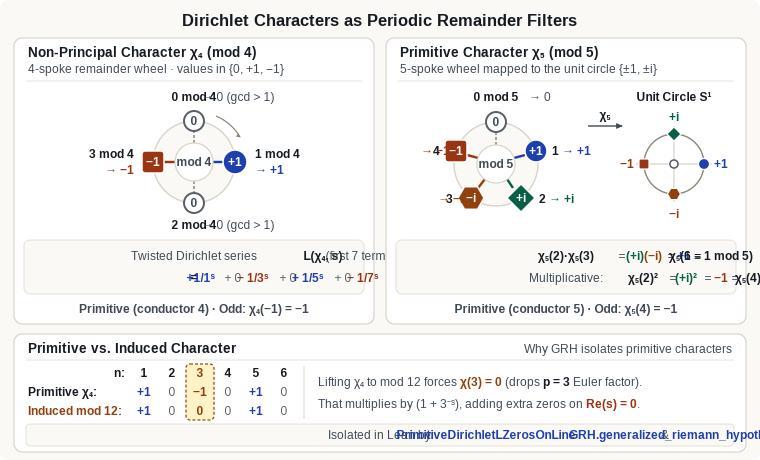
Level 1 — First-Principles
Take the sum
This weighted unending suminfinite series converges whenever
When
Limits of the intuition
Thinking of
Level 2 — Undergrad Bridge
Because
Taking the logarithmic derivative and summing over all characters modulo
For a primitive character
where DirichletLNonvanishingRightOfHalf quantifies over all characters
Level 3 — Formal Lean Contract
In Mathlib4 (Mathlib.NumberTheory.LSeries.DirichletContinuation), DirichletCharacter.LFunction χ s defines the meromorphic continuation of χ : DirichletCharacter ℂ N. For N = 1, Mathlib proves LFunction_modOne_eq : LFunction (1 : DirichletCharacter ℂ 1) = riemannZeta.
Stage 00 anchors Dirichlet
00_statement/statements.lean#DirichletLZerosOnLine(upstreamsrc/Statements.lean:14-16):leandef DirichletLZerosOnLine : Prop := ∀ (N : ℕ) [NeZero N] (χ : DirichletCharacter ℂ N) (s : ℂ), 0 < s.re → s.re < 1 → DirichletCharacter.LFunction χ s = 0 → s.re = 1 / 200_statement/main.lean#LFunction_eq_zero_re(upstreamsrc/Main.lean:19-21), proved viaNew.zeros_on_line New.grh.
See the page's live verification banner (audit/verification-status.json) for the currently pinned upstream snapshot and local Lean build status (build_status: unverified-locally).
Where this analogy breaks
Treating every Dirichlet L-function as an exact copy of
Formal Lean Anchors
def DirichletLZerosOnLine — Upstream source (src/Statements.lean L14-L16)
def DirichletLZerosOnLine : Prop :=
  ∀ (N : ℕ) [NeZero N] (χ : DirichletCharacter ℂ N) (s : ℂ),
0 < s.re → s.re < 1 → DirichletCharacter.LFunction χ s = 0 → s.re = 1 / 2theorem LFunction_eq_zero_re — Upstream source (src/Main.lean L19-L21)
/-- **The Generalized Riemann Hypothesis.** For every Dirichlet character χ, every zero of L(s, χ)
with 0 < re s < 1 has real part 1/2. -/
theorem LFunction_eq_zero_re : DirichletLZerosOnLine := by
  sorry -- [EXTRACTED_STUB upstream=src/Main.lean:19-21 commit=41c2716658c42ba08eb0648994a2efe83082a95c body_lines=1 body_sha256=7773691b674f0dbae2965ba30653c0763800339b89a38b9566afa1e5f38a6212]
Related Concepts
- infinite series — A limit of partial sums formed by adding infinitely many terms; in number theory, weighting terms by n⁻ˢ produces a Dirichlet series that turns integer arithmetic into a smooth function.
- Riemann zeta function — The meromorphic function ζ(s) extending ∑ n⁻ˢ to all of ℂ ∖ {1}, linking prime numbers via its Euler product to zeros in the complex plane.
- analytic continuation — The unique extension of a complex-differentiable function from a smaller region to a larger domain, locked in place by the identity theorem.
- Dirichlet character — A periodic multiplicative label χ : ℤ → ℂ modulo N that equals 0 when gcd(n, N) > 1, takes roots of unity when gcd(n, N) = 1, and satisfies χ(ab) = χ(a)χ(b).
- primitive character — A Dirichlet character modulo q whose pattern does not come from any strictly smaller dividing modulus; its modulus q equals its minimal period (conductor).
- critical strip — The open vertical band 0 < Re(s) < 1 in the complex plane that contains every nontrivial zero of ζ(s) and of every Dirichlet L-function.
- critical line — The vertical line Re(s) = 1/2 bisecting the critical strip—the axis of mirror symmetry s ↦ 1 − s where the Riemann Hypothesis asserts all nontrivial zeros lie.
Referenced By
- Stage: Formal Statement Contracts (
Statements.lean) - Stage: From a One-Sided Prime Bound to a Zero-Free Half-Plane
- Stage: Full Proof Journey & Alpöge's 20-Step Map
- Stage: Independent Statement Equivalence (
FormalConjecturesStatement&FormalConjecturesChallenge) - Stage: Stage 00 — Formal Statements & Challenge Contracts
- Stage: Stage 01 — The Theorem and Its Reduction
- Stage: The Five Entry Theorems (
Main.lean&Challenge.lean) - Concept: critical line
- Concept: critical strip
- Concept: Dirichlet character
- Concept: formal verification
- Concept: Hecke L-value ratio
- Concept: Landau's lemma
- Concept: primitive character
- Concept: quadratic twist
- Concept: trivial zero
- Concept: von Mangoldt function
Authoritative Sources
- Multiplicative Number Theory (book) — H. Davenport, 3rd ed., Springer Graduate Texts in Mathematics 74 (2000), Chapters 4, 9, and 12.
- Analytic Number Theory (book) — H. Iwaniec and E. Kowalski, AMS Colloquium Publications Vol. 53 (2004), Chapter 5, §§5.1–5.9.
- Mathlib4: DirichletCharacter.LFunction (mathlib) — Mathlib.NumberTheory.LSeries.DirichletContinuation (
DirichletCharacter.LFunction,DirichletCharacter.completedLFunction, pinned mathlib rev 31ce06eaadf4a200c0e1407c5f10953cf606b8f8).
Page Glossary
- Riemann zeta function
- The meromorphic function ζ(s) extending ∑ n⁻ˢ to all of ℂ ∖ {1}, linking prime numbers via its Euler product to zeros in the complex plane.
- Dirichlet character
- A periodic multiplicative label χ : ℤ → ℂ modulo N that equals 0 when gcd(n, N) > 1, takes roots of unity when gcd(n, N) = 1, and satisfies χ(ab) = χ(a)χ(b).
- infinite series
- A limit of partial sums formed by adding infinitely many terms; in number theory, weighting terms by n⁻ˢ produces a Dirichlet series that turns integer arithmetic into a smooth function.
- analytic continuation
- The unique extension of a complex-differentiable function from a smaller region to a larger domain, locked in place by the identity theorem.
- critical strip
- The open vertical band 0 < Re(s) < 1 in the complex plane that contains every nontrivial zero of ζ(s) and of every Dirichlet L-function.
- critical line
- The vertical line Re(s) = 1/2 bisecting the critical strip—the axis of mirror symmetry s ↦ 1 − s where the Riemann Hypothesis asserts all nontrivial zeros lie.
- primitive character
- A Dirichlet character modulo q whose pattern does not come from any strictly smaller dividing modulus; its modulus q equals its minimal period (conductor).
- complex plane
- The two-dimensional coordinate plane of numbers s = σ + it, where the horizontal coordinate σ = Re(s) sets decay rate and the vertical coordinate t = Im(s) sets oscillation frequency.