critical strip
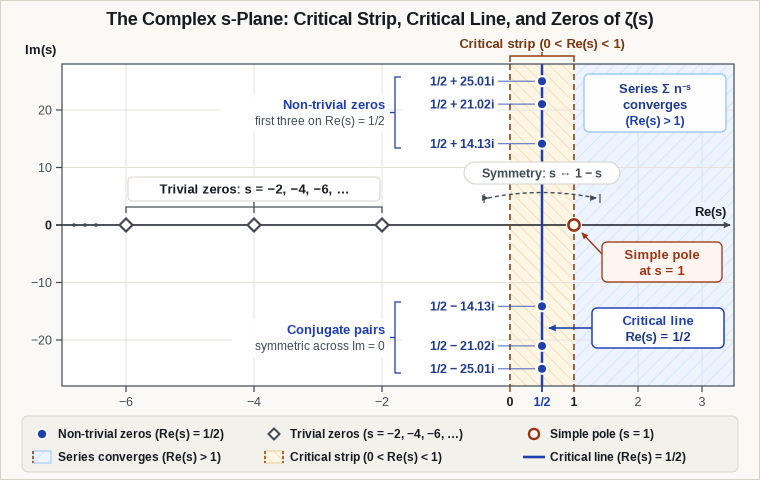
The open vertical band 0 < Re(s) < 1 in the complex plane that contains every nontrivial zero of ζ(s) and of every Dirichlet L-function.
Level 1 — First-Principles
Picture the two-dimensional grid of real and imaginary coordinatescomplex plane divided by two vertical fences: one at horizontal coordinate
The open vertical band strictly between those two fences—
Limits of the intuition
Drawing the critical strip as a small rectangle on paper captures the horizontal bounds
Level 2 — Undergrad Bridge
The open critical strip is
- Euler product (
): Absolute convergence of prevents vanishing for . - Boundary nonvanishing (
): Hadamard and de la Vallée Poussin proved (and for all , with when ): specifically, ( ) is equivalent to the Prime Number Theorem, ( ) yields Dirichlet's theorem on primes in arithmetic progressions, and nonvanishing along the entire line yields the Prime Number Theorem in arithmetic progressions. - Functional equation (
): Reflecting maps onto , showing that the completed function has no zeros for .
Within
Level 3 — Formal Lean Contract
Stage 00 encodes the critical-strip condition directly in 00_statement/statements.lean#DirichletLZerosOnLine (upstream src/Statements.lean:14-16):
def DirichletLZerosOnLine : Prop :=
  ∀ (N : ℕ) [NeZero N] (χ : DirichletCharacter ℂ N) (s : ℂ),
    0 < s.re → s.re < 1 → DirichletCharacter.LFunction χ s = 0 → s.re = 1 / 2
Restricting s to 0 < s.re and s.re < 1 automatically excludes both the Euler-product nonvanishing region (1 ≤ s.re), the pole at s = 1, all trivial zeros (s.re ≤ 0), and any imprimitive Euler-factor zeros on s.re = 0. Upstream New.zeros_on_line (src/New/Main.lean:29-36) deduces DirichletLZerosOnLine from DirichletLNonvanishingRightOfHalf by the s ↦ 1 - s symmetry of the functional equation (via New.gammaFactor_eq_zero_or_LFunction_one_sub_eq_zero). See the page's live verification banner (audit/verification-status.json) for the currently pinned upstream snapshot and local Lean build status (build_status: unverified-locally).
Where this analogy breaks
Visualizing the critical strip as a flat empty corridor between
Formal Lean Anchors
def DirichletLZerosOnLine — Upstream source (src/Statements.lean L14-L16)
def DirichletLZerosOnLine : Prop :=
  ∀ (N : ℕ) [NeZero N] (χ : DirichletCharacter ℂ N) (s : ℂ),
    0 < s.re → s.re < 1 → DirichletCharacter.LFunction χ s = 0 → s.re = 1 / 2
Related Concepts
- complex plane — The two-dimensional coordinate plane of numbers s = σ + it, where the horizontal coordinate σ = Re(s) sets decay rate and the vertical coordinate t = Im(s) sets oscillation frequency.
- Riemann zeta function — The meromorphic function ζ(s) extending ∑ n⁻ˢ to all of ℂ ∖ {1}, linking prime numbers via its Euler product to zeros in the complex plane.
- trivial zero — A zero at a non-positive integer forced purely by poles of the gamma factor in the functional equation, carrying no hidden information about prime fluctuations.
- critical line — The vertical line Re(s) = 1/2 bisecting the critical strip—the axis of mirror symmetry s ↦ 1 − s where the Riemann Hypothesis asserts all nontrivial zeros lie.
- Dirichlet L-function — The meromorphic continuation of ∑ χ(n) n⁻ˢ associated to a Dirichlet character χ, generalizing ζ(s) to track primes across residue classes modulo N.
Referenced By
- Stage: Formal Statement Contracts (
Statements.lean) - Stage: From a One-Sided Prime Bound to a Zero-Free Half-Plane
- Stage: Full Proof Journey & Alpöge's 20-Step Map
- Stage: Independent Statement Equivalence (
FormalConjecturesStatement&FormalConjecturesChallenge) - Stage: Stage 00 — Formal Statements & Challenge Contracts
- Stage: Stage 01 — The Theorem and Its Reduction
- Stage: The Five Entry Theorems (
Main.lean&Challenge.lean) - Concept: complex plane
- Concept: critical line
- Concept: Dirichlet L-function
- Concept: Riemann zeta function
- Concept: trivial zero
Authoritative Sources
- The Theory of the Riemann Zeta-Function (book) — E. C. Titchmarsh, 2nd ed., Oxford University Press (1986), Chapters 2, 3, and 9.
- Analytic Number Theory (book) — H. Iwaniec and E. Kowalski, AMS Colloquium Publications Vol. 53 (2004), Chapter 5, §§5.3–5.4.
Page Glossary
- complex plane
- The two-dimensional coordinate plane of numbers s = σ + it, where the horizontal coordinate σ = Re(s) sets decay rate and the vertical coordinate t = Im(s) sets oscillation frequency.
- trivial zero
- A zero at a non-positive integer forced purely by poles of the gamma factor in the functional equation, carrying no hidden information about prime fluctuations.
- Riemann zeta function
- The meromorphic function ζ(s) extending ∑ n⁻ˢ to all of ℂ ∖ {1}, linking prime numbers via its Euler product to zeros in the complex plane.
- Dirichlet L-function
- The meromorphic continuation of ∑ χ(n) n⁻ˢ associated to a Dirichlet character χ, generalizing ζ(s) to track primes across residue classes modulo N.
- critical line
- The vertical line Re(s) = 1/2 bisecting the critical strip—the axis of mirror symmetry s ↦ 1 − s where the Riemann Hypothesis asserts all nontrivial zeros lie.