theta normal form
Also known as: partner place, Frobenius coupling.
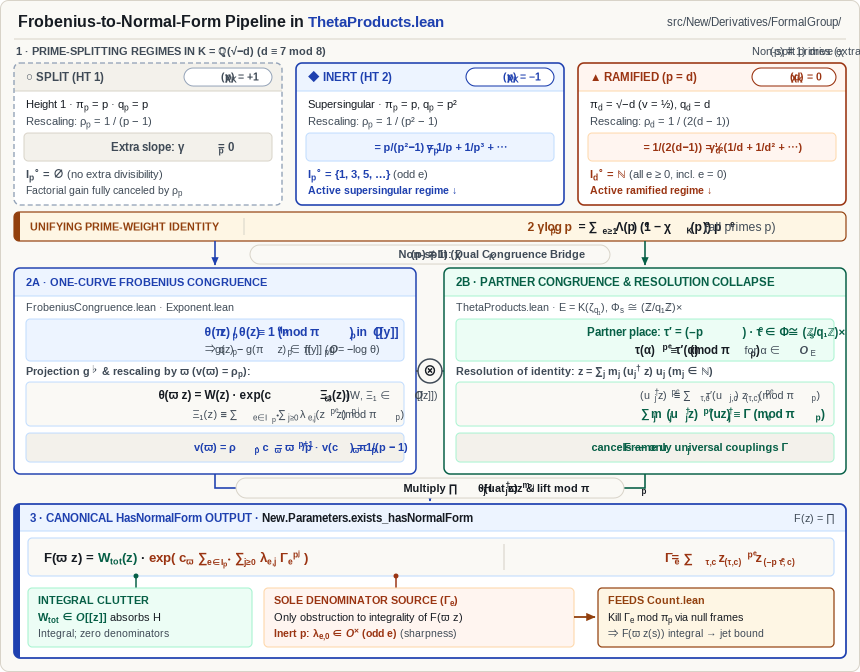
A p-adic factorization of rescaled multivariable theta products into an integral power series times an exponential of Frobenius-power couplings pairing each infinite place with its shifted partner place.
Level 1 — First-Principles
Suppose you have a complicated multivariable function built by multiplying together many copies of an analytic building block on a curved latticeelliptic theta function evaluated along different linear directions, and you want to know how divisible its high-order Taylor derivatives are by a indivisible whole number
A theta normal form achieves exactly that separation at every prime
The front factor
Why do all the tangled linear forms collapse into such simple pairwise terms? Because the vectors directing the factors form a balanced spanning family whose weighted outer products reconstruct the identity matrixtight frame: modulo the local prime element
Limits of the intuition
Comparing a theta normal form to separating a wave into a well-behaved amplitude
Level 2 — Undergrad Bridge
Fix parameters
For each exponent
defined as multiplication by the class of
and for a set of exponents
A multivariable power series HasNormalForm S partner ϖ l F if there exists an integral power series
Here
Because the HasNormalForm.of_dvd_sub).
When
Combining this with the single-curve formal-group factorization exists_hasNormalForm: every product HasNormalForm with bound_attained.lean).
The payoff arrives in Count.lean (norm_jet_minorProd_le_of_charges). Given a Young-diagram family HasNormalForm.norm_coeff_subst_le_one, the substituted series
Level 3 — Formal Lean Contract
Stage 02 extracts the partner-place map, the existence of the theta normal form, and the main counting bound with charges into skeleton/02_derivatives/theta_products.lean and skeleton/02_derivatives/count.lean (from upstream src/New/Derivatives/FormalGroup/ThetaProducts.lean and src/New/Derivatives/Divisibility/Count.lean, building on New.coupling, New.couplingSum, and New.HasNormalForm in src/New/Derivatives/Divisibility/NormalForm.lean):
02_derivatives/theta_products.lean#New.Parameters.partner(upstreamsrc/New/Derivatives/FormalGroup/ThetaProducts.lean:106-112):leannoncomputable def New.Parameters.partner (P : Parameters) (s p e : ℕ) (τ : P.Φ s) : P.Φ s02_derivatives/theta_products.lean#New.Parameters.exists_hasNormalForm(upstreamsrc/New/Derivatives/FormalGroup/ThetaProducts.lean:439-477):leanlemma New.Parameters.exists_hasNormalForm (P : Parameters) (s : ℕ) [PadicPlace p] (hp : chiK P.d p ≠ 1) : ∃ (ϖ : ℂ_[p]) (l : ℕ → ℕ → valRingCp p), ‖ϖ‖ = p ^ (-varpiValuation P.d p) ∧ (chiK P.d p = -1 → ∀ e : ℕ, Odd e → IsUnit (l e 0)) ∧ ∀ {n J : Type} [Fintype n] [DecidableEq n] [Fintype J] (u : J → n → P.E s) (m : J → ℕ), IsResolution u m → (∀ (j : J) (i : n), IsIntegralAbove p (u j i)) → ∀ H ∈ P.cmCurve.multiSeriesRing (daggerForms u), HasNormalForm (partnerExponents P.d p) (P.partner s p) ϖ l (P.cmCurve.thetaProd (daggerForms u) m * H)02_derivatives/count.lean#New.Parameters.norm_jet_minorProd_le_of_charges(upstreamsrc/New/Derivatives/Divisibility/Count.lean:641-684):Skeleton stub truncation note: Because the return type of
norm_jet_minorProd_le_of_chargesintroduces local abbreviationslet N : ℕ := card n'andlet B : ℕ := boxes κ N, the automated skeleton extractor inskeleton/02_derivatives/count.leantruncates the type right afterlet N : ℕ := by sorry. For full transparency, the complete upstream Lean statement (src/New/Derivatives/Divisibility/Count.lean:658-672) is quoted below:leantheorem New.Parameters.norm_jet_minorProd_le_of_charges [DecidableEq n'] (hp : chiK P.d p ≠ 1) (hϖ : ‖ϖ‖ = p ^ (-varpiValuation P.d p)) (hF : HasNormalForm (partnerExponents P.d p) (P.partner s p) ϖ l F) (marked : Finset (P.Φ s)) (w : P.Φ s → ℕ → n' → ℕ) (hw : ∀ e ∈ partnerExponents P.d p, ∀ (τ : P.Φ s) (h : ℕ) (b : n'), κ τ 1 ≠ 0 → κ (P.partner s p e τ) h ≠ 0 → τ ∈ marked ∨ h = 1 ∧ P.partner s p e τ ∈ marked → w τ 1 b ≠ 0 ∨ w (P.partner s p e τ) h b ≠ 0) (i' : WeylIndex n' κ) (y : P.Φ s → n → ℕ → valRingCp p) : let N : ℕ := card n' let B : ℕ := boxes κ N ‖jet ℂ_[p] (minorProd i' fun (τ : P.Φ s) (a : n) (k : ℕ) ↦ (y τ a k : ℂ_[p])) F‖ ≤ p ^ (fillingCharge w i' - (predictedDivisibility P.d p (P.partner s p) (eraseHeightOne κ marked) N + gammaPrime P.d p * (B - boxes (eraseHeightOne κ marked) N) - card (P.Φ s) * N ^ 3 * (1 + Real.logb p (max B 1 : ℕ))) : ℝ)
Here HasNormalForm S pr ϖ l F (src/New/Derivatives/Divisibility/NormalForm.lean:55-59) asserts ∃ W : MvPowerSeries (Φ × c) (valRingCp p), F.rescale (fun _ ↦ ϖ) = seriesToCp W * expSubst ((ϖ ^ (p + 1) / p) • seriesToCp (couplingSum S pr l)), and norm_jet_minorProd_le_of_hasNormalForm (the uncharged count immediately following in Count.lean:686-713) is the specialization with marked = ∅ and w = 0. See the page's live verification banner (audit/verification-status.json) for the currently pinned upstream snapshot and local Lean build status (build_status: unverified-locally).
Where this analogy breaks
Picturing a theta normal form as factoring a function into a smooth amplitude times an oscillating phase
Formal Lean Anchors
def New.Parameters.partner — Upstream source (src/New/Derivatives/FormalGroup/ThetaProducts.lean L106-L112)
/-- The partner `-p ^ e τ` of an infinite place `τ` of `E`. Here `P` fixes the prime `d` and the
modulus `q₀`, and `E = P.E s` is `K = ℚ(√-d)` with a root of unity of order `q₁ = P.q₁ s` adjoined,
`s` being the level in the tower of these fields. The infinite places `P.Φ s` of `E` form the group
`Gal(E/K) = (ℤ/q₁)ˣ`, and the partner is the product of `τ` with `P.placeOfInt s (-p ^ e)`, the
place of the class of `-p ^ e` modulo `q₁` (the identity if this class is not a unit). -/
noncomputable def New.Parameters.partner (P : Parameters) (s p e : ℕ) (τ : P.Φ s) : P.Φ s := by
sorry -- [EXTRACTED_STUB upstream=src/New/Derivatives/FormalGroup/ThetaProducts.lean:106-112 commit=41c2716658c42ba08eb0648994a2efe83082a95c body_lines=1 body_sha256=b6e981f2c6b5eeb194da9fd8055a6ac1990d615b700600686569cb146aeb97fa]lemma New.Parameters.exists_hasNormalForm — Upstream source (src/New/Derivatives/FormalGroup/ThetaProducts.lean L439-L477)
/-- Let `E = P.E s` be `K = ℚ(√-d)` with a root of unity of order `q₁ = P.q₁ s` adjoined, `p` a
prime not split in `K` (`chiK P.d p ≠ 1`), `I_p° = partnerExponents P.d p`, and for an infinite
place `τ` of `E` let its partner `τ' = -p ^ e τ` be the product of `τ` with the class of `-p ^ e` in
the group `Gal(E/K) = (ℤ/q₁)ˣ` of places. There are `ϖ` of valuation `ρ_p = varpiValuation P.d p`
and integers `λ_{e j}` of `ℂ_p`, with the `λ_{e 0}` for odd `e` units if `p` is inert, such that the
following holds. Take any resolution of the identity by vectors `u_j` of `Eⁿ`, taken `m_j` times and
integral above `p`. Then the product `∏ θ(u_j† z) ^ m_j` times an integral series in the `y(u_j† z)`
has the normal form. -/
lemma New.Parameters.exists_hasNormalForm (P : Parameters) (s : ℕ) [PadicPlace p] (hp : chiK P.d p ≠ 1) :
    ∃ (ϖ : ℂ_[p]) (l : ℕ → ℕ → valRingCp p),
    ‖ϖ‖ = p ^ (-varpiValuation P.d p) ∧
    (chiK P.d p = -1 → ∀ e : ℕ, Odd e → IsUnit (l e 0)) ∧
    ∀ {n J : Type} [Fintype n] [DecidableEq n] [Fintype J] (u : J → n → P.E s) (m : J → ℕ),
      IsResolution u m → (∀ (j : J) (i : n), IsIntegralAbove p (u j i)) →
        ∀ H ∈ P.cmCurve.multiSeriesRing (daggerForms u),
          HasNormalForm (partnerExponents P.d p) (P.partner s p) ϖ l
(P.cmCurve.thetaProd (daggerForms u) m * H) := by
sorry -- [EXTRACTED_STUB upstream=src/New/Derivatives/FormalGroup/ThetaProducts.lean:439-477 commit=41c2716658c42ba08eb0648994a2efe83082a95c body_lines=23 body_sha256=13683f6b838cae63d5052f3d5b3afcbb38c5bd6c65d341cfaf10b1f242e9a0c4]theorem New.Parameters.norm_jet_minorProd_le_of_charges — Upstream source (src/New/Derivatives/Divisibility/Count.lean L641-L684)
/-- **The count with charges.** Here `P` fixes the prime `d` of `K = ℚ(√-d)`, `P.Φ s` is the set of
infinite places of the field of level `s`, the instance `PadicPlace p` is an embedding of `ℂ` into
`ℂ_[p]`, and `κ τ h` is the number of columns of height `h` at the place `τ`. Let `p` be non-split,
let `v(ϖ) = ρ_p`, where `ρ_p = varpiValuation P.d p = v(π_p) / (q_p - 1)` for the norm `q_p` of a
prime above `p`, let `F` have the normal form for the exponents `e ∈ I_p°` (odd; all `e` if
`p = d`): `F(ϖ z)` is an integral series times the exponential of `ϖ ^ (p + 1) / p` times a
combination of powers `Γ_e ^ p ^ j` of couplings, with integral coefficients `l`. The filling `i'`
puts a row into each box of `κ` and, with the integral matrices `y_τ`, defines
`P_y = minorProd i' y`: the product over the columns of the minor of `z_τ y_τ` on the rows of the
column and the first `h` columns, `h` being its height. Let `κ°` arise from `κ` by removing the
columns of height one at the places of `marked`. Let charges `p ^ w` be given such that one of
`w τ 1 b` and `w τ' h b` is positive whenever `τ'` is a partner of `τ`, the heights `1` at `τ` and
`h` at `τ'` occur, and either `τ ∈ marked`, or `h = 1` and `τ' ∈ marked`. Then the valuation of the
jet of `F` along `P_y`, plus the sum `fillingCharge w i'` of the exponents over the boxes, is at
least the predicted divisibility of `κ°`, plus `γ_p = gammaPrime P.d p` for each removed box, less
`f N ^ 3 (1 + log_p max (B, 1))`. Here `f` is the number of infinite places, `N` the number of rows
and `B` the number of boxes of `κ` in columns of height below `N`. -/
theorem New.Parameters.norm_jet_minorProd_le_of_charges [DecidableEq n'] (hp : chiK P.d p ≠ 1)
    (hϖ : ‖ϖ‖ = p ^ (-varpiValuation P.d p))
    (hF : HasNormalForm (partnerExponents P.d p) (P.partner s p) ϖ l F)
    (marked : Finset (P.Φ s)) (w : P.Φ s → ℕ → n' → ℕ)
    (hw : ∀ e ∈ partnerExponents P.d p, ∀ (τ : P.Φ s) (h : ℕ) (b : n'),
      κ τ 1 ≠ 0 → κ (P.partner s p e τ) h ≠ 0 → τ ∈ marked ∨ h = 1 ∧ P.partner s p e τ ∈ marked →
        w τ 1 b ≠ 0 ∨ w (P.partner s p e τ) h b ≠ 0)
    (i' : WeylIndex n' κ) (y : P.Φ s → n → ℕ → valRingCp p) :
    let N : ℕ := by
  sorry -- [EXTRACTED_STUB upstream=src/New/Derivatives/Divisibility/Count.lean:641-684 commit=41c2716658c42ba08eb0648994a2efe83082a95c body_lines=19 body_sha256=7611aa7288a6f1eadd46e9074521fd340018c3a8f26c73521d51c1e1680217f2]
Related Concepts
- formal group law — A power-series addition law encoding an elliptic curve's group structure near the origin, whose Lubin–Tate scaling and Frobenius congruence isolate the exact p-adic powers controlling theta-function derivatives.
- elliptic theta function — A quasi-periodic entire function on a CM lattice normalized at the origin, whose finite products along tight-frame projections build integral multi-variable theta functions and collapse p-adically into exponential normal forms.
- tight frame — A balanced, possibly overcomplete family of vectors with integer multiplicities whose projections reconstruct the exact standard inner product—allowing integral root-of-unity spokes to pull back one-dimensional elliptic theta sections into high-dimensional integral theta functions.
- Schur jet — The evaluation at the origin of a symmetry-adapted Schur differential operator on a theta function's multivariate Taylor expansion, whose prime-by-prime divisibility is controlled through minor products and matched by an explicit sharpness construction.
- arithmetic height — A logarithmic measure combining ordinary archimedean size with prime-by-prime p-adic divisibility, locked together by the product formula so a nonzero algebraic quantity cannot be simultaneously small at every place.
Referenced By
- Stage: Formal Groups, Theta Normal Form & Prime-Counting Divisibility
- Stage: Sharpness: Proving the Valuation Bound Is Attained
- Stage: Stage 02 — Derivatives of Theta Functions
- Stage: Stage 03 — Upper Bound: A Composite Theta Lift (Theorem A)
- Concept: elliptic theta function
- Concept: formal group law
- Concept: Schur jet
- Concept: tight frame
Authoritative Sources
- Algebraic theta functions and the p-adic interpolation of Eisenstein-Kronecker numbers (paper) — K. Bannai and S. Kobayashi, Duke Mathematical Journal 153 (2010).
- Integral structures on p-adic Fourier theory (paper) — K. Bannai and S. Kobayashi, Annales de l'Institut Fourier 66 (2016).
- Congruences entre nombres de Bernoulli-Hurwitz dans le cas supersingulier (paper) — M. Chellali, Journal of Number Theory 35 (1990).
Page Glossary
- elliptic theta function
- A quasi-periodic entire function on a CM lattice normalized at the origin, whose finite products along tight-frame projections build integral multi-variable theta functions and collapse p-adically into exponential normal forms.
- prime number
- A whole number greater than 1 whose only positive whole-number divisors are 1 and itself; every integer above 1 factors uniquely into a product of them.
- formal group law
- A power-series addition law encoding an elliptic curve's group structure near the origin, whose Lubin–Tate scaling and Frobenius congruence isolate the exact p-adic powers controlling theta-function derivatives.
- tight frame
- A balanced, possibly overcomplete family of vectors with integer multiplicities whose projections reconstruct the exact standard inner product—allowing integral root-of-unity spokes to pull back one-dimensional elliptic theta sections into high-dimensional integral theta functions.
- Schur jet
- The evaluation at the origin of a symmetry-adapted Schur differential operator on a theta function's multivariate Taylor expansion, whose prime-by-prime divisibility is controlled through minor products and matched by an explicit sharpness construction.
- arithmetic height
- A logarithmic measure combining ordinary archimedean size with prime-by-prime p-adic divisibility, locked together by the product formula so a nonzero algebraic quantity cannot be simultaneously small at every place.