Kummer chart cup orthogonality
Also known as: Kummer chart, cup exponent, cup orthogonality, pairing side, Frobenius safe-move walk, tame inertial chart.
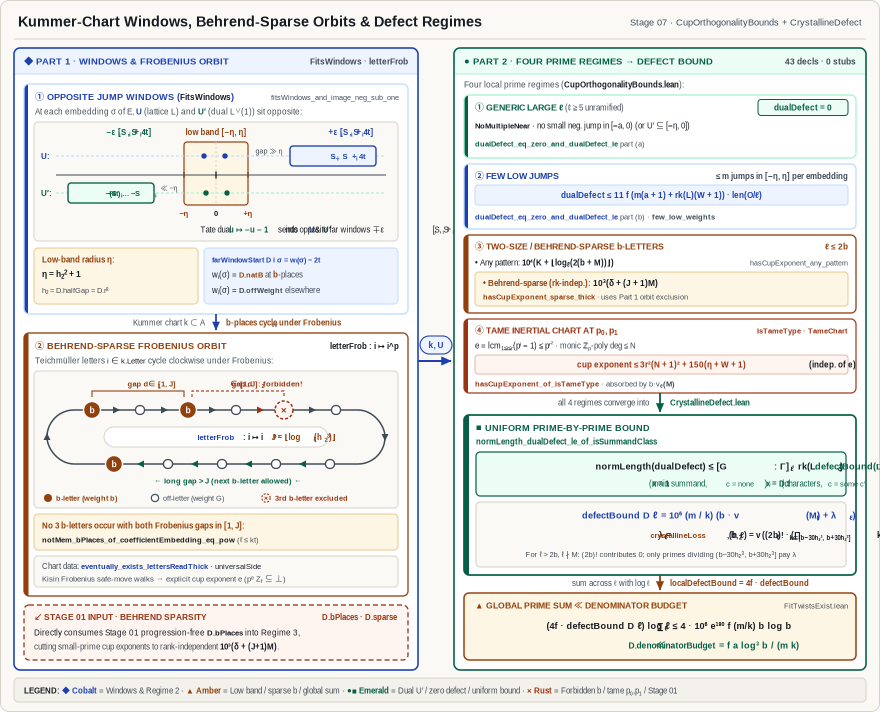
Bounding the power p^e that pushes crystalline cocycles of a p-adic Galois lattice L into the cup-product annihilator of congruent dual lattices across four weight/prime regimes using Kisin-module Frobenius-orbit walks on a Kummer chart.
Level 1 — First-Principles
In Ribet's method, congruences between modular forms produce torsion Galois cocycles modulo New/Congruences/Lifting/ uses "lifting" strictly for this
When all Hodge–Tate weights of a Galois lattice are smaller than
Kummer chart cup orthogonality (Lifting/CupOrthogonalityBounds.lean) measures this obstruction quantitatively by transferring Galois lattices onto a Kummer chart letterFrob : i ↦ i^p (much like Stage 03's cyclic Frobenius orbitsFrobenius cycle). Packaging a lattice KummerChart.universalSide) lets Kisin-module Frobenius safe-move walks (SafeMoves, CutExponentBounds, FewLowJumps) bound the smallest power HasCupExponent)—for which cupOrthogonal across four exact regimes:
- Generic large primes with no small negative jump: For
avoiding multiples near and , if avoid (or ), then dualDefect = 0—exact cup orthogonality with zero loss. - Few low jumps: Under the same generic separation, if
has at most low jumps in , dualDefectis at most. - Two-size far windows (general and Behrend-sparse): For smaller primes (
or constant CM sign) with far windows at on b-letters andelsewhere, any pattern gives cup exponent ( hasCupExponent_any_pattern), while forbidding threeb-letters along a Frobenius orbit with both gaps in—directly consuming Stage 01's Behrend sparsity of D.bPlaces!—drops the cup exponent to the rank-independent bound( hasCupExponent_sparse_thick). - Tame inertial types at level primes (
IsTameType,hasCupExponent_of_isTameType): At the level primes, inertia acts through a tame inertial chart ( TameChart) of ramification index. Descending along the chart produces a cup exponent completely independent of !
Limits of the intuition
Thinking of the cup exponent as a single uniform formula misses how sharply the four regimes trade off prime size against weight geometry. At tiny primes b-letters along letterFrob are excluded—that is the exact downstream reason Stage 01 built D.bPlaces via Behrend's progression-free sphere construction!
Level 2 — Undergrad Bridge
src/New/Congruences/Lifting/CupOrthogonalityBounds.lean (25 declarations, 0 stub truncations) translates Kisin-module bounds on PairingSides into lattice-level cup-orthogonality theorems:
- Sides, letter jumps, and opposite windows (
universalSide,mem_letterJumps,fitsWindows_letterJumps,FitsWindows.neg_add_le_of_opposite,sum_card_algHom_le_finrank,pow_smul_mem_cupOrthogonal_of_isScaledCupCoboundary): Using a rootζ : k.LetterRoot O(), each embedding maps to at most one letter via . If UandU'sit in opposite windows, Tate-dual tensor jumps -(v + v') - 1stay bounded by. - Generic primes & few low jumps (
crysCocycles_le_cupOrthogonal_of_no_small_neg_jump,dualDefect_le_of_few_low_weights,dualDefect_eq_zero_and_dualDefect_le): For unramified, , , , , and NoMultipleNear p (6(a + η + W)) (b i):- (a)
dualDefect (InClass ⊤ ⊥ U) L = 0ifavoid or ; - (b)
dualDefect ≤ 11 * k.f * (m * (a + 1) + finrank O L * (W + 1)) * length O (O / p)when.
- (a)
- Two-size far windows (
hasCupExponent_any_pattern,hasCupExponent_sparse_thick):- Arbitrary
IsBLetter(, , , , ): HasCupExponent (InClass ⊤ ⊥ U) L (10^4 * (K + p.log (2 * (b + M)))). - Sparse
IsBLetter(, , no with IsBLetterat, , for , plus depth and ): HasCupExponent (InClass ⊤ ⊥ U) L (10^3 * (δ + (J + 1) * M)).
- Arbitrary
- Tame inertial descent (
IsTameType,lcm_pow_sub_one_le,TameChart.inClass_of_pow_sub_one,exists_tameChart_e_eq_lcm,hasCupExponent_of_isTameType): Forand inertia killed by ( ) and a monic degree- polynomial over , descent along TameChartyieldsHasCupExponent (InClass F K U) L (3 * r^2 * (N + 1)^2 + 150 * (η + W + 1)).
Level 3 — Formal Lean Contract
All six anchors extract completely untruncated in skeleton/07_congruences/cup_orthogonality_bounds.lean (25 declarations, 0 stub truncations):
07_congruences/cup_orthogonality_bounds.lean#New.Lift.IsTameType(upstreamCupOrthogonalityBounds.lean:76-80).07_congruences/cup_orthogonality_bounds.lean#New.Lift.KummerChart.universalSide(upstreamCupOrthogonalityBounds.lean:89-106).07_congruences/cup_orthogonality_bounds.lean#New.Lift.KummerChart.dualDefect_eq_zero_and_dualDefect_le(upstreamCupOrthogonalityBounds.lean:346-376).07_congruences/cup_orthogonality_bounds.lean#New.Lift.KummerChart.hasCupExponent_any_pattern(upstreamCupOrthogonalityBounds.lean:378-397).07_congruences/cup_orthogonality_bounds.lean#New.Lift.KummerChart.hasCupExponent_sparse_thick(upstreamCupOrthogonalityBounds.lean:399-429).07_congruences/cup_orthogonality_bounds.lean#New.Lift.hasCupExponent_of_isTameType(upstreamCupOrthogonalityBounds.lean:513-589):leanlemma New.Lift.hasCupExponent_of_isTameType [TopologicalSpace Γ] (ho : IsOpenEmbedding Γ.overGp.toGp) (h_surj : Surjective Γ.overGp.toGp) {F : Filter Γ} {K : Γ → O[X] → Prop} (hL : InClass F (fun s : Γ ↦ K s⁻¹) U' L) (hK : ∀ s : Γ, IsWeilPair (toGp s) 0 → IsTameType p r N (K s)) {η W b : ℕ} {ε : ℤˣ} (hU : ∀ g : O →ₐ[ℤ_[p]] ℂ_[p], FitsWindows η (-ε) b W (U g)) (hU' : ∀ g : O →ₐ[ℤ_[p]] ℂ_[p], FitsWindows η ε b W (U' g)) (hp : b + 6 * (W + η) + r ^ 2 * (N + 1) ^ 2 + 2 < p) : HasCupExponent (InClass F K U) L (3 * (r ^ 2 * (N + 1) ^ 2) + 150 * (η + W + 1))
See the page's live <VerificationBanner /> (audit/verification-status.json) for the pinned upstream commit and local Lean build status (build_status: unverified-locally).
Where this analogy breaks
Thinking of Kummer chart cup orthogonality as a classical Fontaine–Laffaille exactness theorem (which requires all Hodge–Tate weights to stay below p - 1) misses the whole point of Lifting/CupOrthogonalityBounds.lean: Stage 07's far-window weights reach b = a/x, which vastly exceeds small and medium primes p, so exact vanishing (dualDefect = 0) fails below b and must be replaced by explicit cup exponents built from Frobenius-orbit safe-move walks and Behrend-sparse b-letters.
Formal Lean Anchors
abbrev New.Lift.KummerChart.universalSide — Upstream source (src/New/Congruences/Lifting/CupOrthogonalityBounds.lean L89-L106)
/-- Let the sets of the filter F contain the subgroup `k.subgroup` of the chart, and let L lie in
the class (`New.Lift.InClass`) along F with jump sets U. The side (a lattice with jump sets at the
letters and a parametrised module of cocycles) is formed by L, the parameter lattice Z_f(L) of all
crystalline cocycles, and the jump sets `New.Lift.KummerChart.letterJumps` of U at the letters.
Membership in the class makes L potentially crystalline, so Z_f(L) is finitely generated. -/
noncomputable abbrev New.Lift.KummerChart.universalSide {F : Filter Γ}
(hF : Filter.map k.subgroup.subtype ⊤ ≤ F) (h : InClass F ⊥ U L) : PairingSide ⟨O, ζ⟩ := by
sorry -- [EXTRACTED_STUB upstream=src/New/Congruences/Lifting/CupOrthogonalityBounds.lean:89-106 commit=41c2716658c42ba08eb0648994a2efe83082a95c body_lines=11 body_sha256=19bd43f21850000ef8b18172f58e5e61858971086790f72cdff2f04918de640f]lemma New.Lift.KummerChart.dualDefect_eq_zero_and_dualDefect_le — Upstream source (src/New/Congruences/Lifting/CupOrthogonalityBounds.lean L346-L376)
/-- The defect at generic primes. Let `Γ → Gp p` be an open embedding, and let the root `ζ` assign
the embeddings of `O` to the letters of the chart `k`. Let `k` be unramified, `p ≥ 5`, `η ≥ 1`, and
at each letter `i` let `b i + W + η ≤ (p - 3) a`, `6 (a + η + W) < b i`, and let `p` divide no
nonzero integer within `6 (a + η + W)` of `0` or `± b i`. Let `L` be crystalline with jumps in `U'`,
where `U` and `U'` lie at each letter in `[-η, η]` and in the opposite far windows
`∓ε i [b i, b i + W]`.
The defect `dualDefect` is the length of the crystalline cocycles of `L` modulo those orthogonal to
the crystalline lattices with jumps in `U`. It vanishes if `U` and `U'` avoid `[-a, 0)` or `U'` lies
in `[-η, 0]`. If `L` has at most `m` jumps in `[-η, η]` at each embedding, it is at most
`11 f (m (a + 1) + rank L · (W + 1))` times the length of `O / p`, where `f = k.f`. -/
lemma New.Lift.KummerChart.dualDefect_eq_zero_and_dualDefect_le [TopologicalSpace Γ] (k : KummerChart Γ)
(ζ : k.LetterRoot O) (ho : IsOpenEmbedding Γ.overGp.toGp) (hk : k.IsUnramified) (hp : 5 ≤ p)
{a η W : ℕ} {b : k.Letter → ℕ} {ε : k.Letter → ℤˣ}
(h_height : ∀ i : k.Letter, b i + W + η ≤ (p - 3) * a) (hη : 1 ≤ η)
(h_far : ∀ i : k.Letter, 6 * (a + η + W) < b i)
(h_gap : ∀ i : k.Letter, NoMultipleNear p (6 * (a + η + W)) (b i)) (hL : InClass ⊤ ⊥ U' L)
(hU : ∀ i : k.Letter, FitsWindows η (-ε i) (b i) W (k.letterJumps ζ U i))
(hU' : ∀ i : k.Letter, FitsWindows η (ε i) (b i) W (k.letterJumps ζ U' i)) :
-- (a) the defect vanishes, if `U` and `U'` avoid `[-a, 0)` or `U'` lies in `[-η, 0]`
((∀ (g : O →ₐ[ℤ_[p]] ℂ_[p]) (u : ℤ), u ∈ U g ∨ u ∈ U' g → u ∉ Ico (-a : ℤ) 0) ∨
(∀ g : O →ₐ[ℤ_[p]] ℂ_[p], U' g ⊆ Icc (-η : ℤ) 0) →
dualDefect (InClass ⊤ ⊥ U) L = 0) ∧
-- (b) a bound for the defect, if at most `m` jumps lie in `[-η, η]`
∀ m : ℕ, (∀ g : O →ₐ[ℤ_[p]] ℂ_[p], ∑ u ∈ Icc (-η : ℤ) η, jump L.ρ g u ≤ m) →
dualDefect (InClass ⊤ ⊥ U) L ≤
(11 * (k.f * (m * (a + 1) + finrank O L * (W + 1))) : ℕ) *
length O (O ⧸ Ideal.span {(p : O)}) := by
sorry -- [EXTRACTED_STUB upstream=src/New/Congruences/Lifting/CupOrthogonalityBounds.lean:346-376 commit=41c2716658c42ba08eb0648994a2efe83082a95c body_lines=3 body_sha256=b5d141ff644eeb3bc1adad0b601f4e1b3e8f97056d081794af926320630c89e9]lemma New.Lift.KummerChart.hasCupExponent_any_pattern — Upstream source (src/New/Congruences/Lifting/CupOrthogonalityBounds.lean L378-L397)
/-- Let `Γ → Gp p` be an open embedding, and let the root `ζ` assign the embeddings of `O` to the
letters of the chart `k`. Let `k` be unramified, `p ≥ 7`, `η ≥ 1` and `V + 4 η ≤ M`. Let `L` be
crystalline with jumps in `U'`, where `U` and `U'` lie at each letter in `[-η, η]` and in opposite
far windows of width `V`, which start at `b` at the b-letters (those with `IsBLetter i`) and at `G`
at the others, with `0 < G ≤ b`. If `b < K p ^ 2`, `2 G < K p` and `M ≤ K`, then
`p ^ (10⁴ (K + ⌊log_p (2 (b + M))⌋))` times any crystalline cocycle of `L` is orthogonal under cup
products to the crystalline cocycles of the crystalline lattices with jumps in `U`. -/
lemma New.Lift.KummerChart.hasCupExponent_any_pattern [TopologicalSpace Γ] (k : KummerChart Γ)
(ζ : k.LetterRoot O) (ho : IsOpenEmbedding Γ.overGp.toGp) (hk : k.IsUnramified) (hp : 7 ≤ p)
{η V M G b K : ℕ} {IsBLetter : k.Letter → Prop} [DecidablePred IsBLetter] {ε : k.Letter → ℤˣ}
(hη : 1 ≤ η) (hM : V + 4 * η ≤ M) (hL : InClass ⊤ ⊥ U' L)
(hU : ∀ i : k.Letter,
FitsWindows η (-ε i) (if IsBLetter i then b else G) V (k.letterJumps ζ U i))
(hU' : ∀ i : k.Letter,
FitsWindows η (ε i) (if IsBLetter i then b else G) V (k.letterJumps ζ U' i))
(hG_pos : 0 < G) (hGb : G ≤ b) (hbK : b < K * p ^ 2) (hGK : 2 * G < K * p) (hMK : M ≤ K) :
HasCupExponent (InClass ⊤ ⊥ U) L (10 ^ 4 * (K + p.log (2 * (b + M)))) := by
sorry -- [EXTRACTED_STUB upstream=src/New/Congruences/Lifting/CupOrthogonalityBounds.lean:378-397 commit=41c2716658c42ba08eb0648994a2efe83082a95c body_lines=3 body_sha256=1e0fac82d7e64323c42d60f41c58b3d9b6b4f95349255c6bbb40bfae3ee3eab8]lemma New.Lift.KummerChart.hasCupExponent_sparse_thick — Upstream source (src/New/Congruences/Lifting/CupOrthogonalityBounds.lean L399-L429)
/-- Let `Γ → Gp p` be an open embedding, and let the root `ζ` assign the embeddings of `O` to the
letters of the chart `k`. Let `η ≥ 1`, and let `L` be crystalline with jumps in `U'`, where `U` and
`U'` lie at each letter in `[-η, η]` and in opposite far windows of width `V`, which start at `b` at
the b-letters (those with `IsBLetter i`) and at `G` at the others, with `G + V ≤ η`; so the low
window `[-η, η]` contains the far windows of the other letters. Suppose that no three b-letters
follow one another along the orbits of `letterFrob : i ↦ i ^ p` with both gaps between `1` and
`J ≥ 1`. Suppose also that either the chart is unramified with `p ≥ 7` and `10 p ^ J η ≤ b`, or the
sign `ε` is constant and `8 e ≤ p ^ (J + 1)`. Let `2 e (b + 5 η) ≤ p ^ (J + 1) δ` and
`20 (J + 1 + d) η + ⌊log_p (2 (b + 5 η))⌋ ≤ M`, where `e = k.e` is the ramification index and
`d = k.differentBound` is `0` for `e = 1` and `v_p(e) + 1` otherwise. Then
`p ^ (10³ (δ + (J + 1) M))` times any crystalline cocycle of `L` is orthogonal under cup products to
the crystalline cocycles of the crystalline lattices with jumps in `U`. -/
lemma New.Lift.KummerChart.hasCupExponent_sparse_thick [TopologicalSpace Γ] (k : KummerChart Γ)
(ζ : k.LetterRoot O) (ho : IsOpenEmbedding Γ.overGp.toGp) {η V G b J M δ : ℕ}
{IsBLetter : k.Letter → Prop} [DecidablePred IsBLetter] {ε : k.Letter → ℤˣ} (hη : 1 ≤ η)
(hL : InClass ⊤ ⊥ U' L)
(hU : ∀ i : k.Letter,
FitsWindows η (-ε i) (if IsBLetter i then b else G) V (k.letterJumps ζ U i))
(hU' : ∀ i : k.Letter,
FitsWindows η (ε i) (if IsBLetter i then b else G) V (k.letterJumps ζ U' i))
(hG : G + V ≤ η) (hJ : 1 ≤ J)
(h_sparse : ∀ i : k.Letter, ∀ s ∈ Icc 1 J, ∀ t ∈ Icc 1 J,
IsBLetter i → IsBLetter ((k.letterFrob ^ s) i) → ¬IsBLetter ((k.letterFrob ^ (s + t)) i))
(h_unramified_or_sign : (k.IsUnramified ∧ 7 ≤ p ∧ 10 * p ^ J * η ≤ b) ∨
((∀ i i' : k.Letter, ε i = ε i') ∧ 8 * k.e ≤ p ^ (J + 1)))
(h_depth : k.e * (2 * (b + 5 * η)) ≤ p ^ (J + 1) * δ)
(hM : 20 * (J + 1 + k.differentBound) * η + p.log (2 * (b + 5 * η)) ≤ M) :
HasCupExponent (InClass ⊤ ⊥ U) L (10 ^ 3 * (δ + (J + 1) * M)) := by
sorry -- [EXTRACTED_STUB upstream=src/New/Congruences/Lifting/CupOrthogonalityBounds.lean:399-429 commit=41c2716658c42ba08eb0648994a2efe83082a95c body_lines=3 body_sha256=38c5c667a02884152164599b91b7026a6998acb8b8ec4850d99e4e13ef468f13]lemma New.Lift.hasCupExponent_of_isTameType — Upstream source (src/New/Congruences/Lifting/CupOrthogonalityBounds.lean L513-L589)
/-- Let `Γ → Gp p = Gal(ℚ̄_p / ℚ_p)` be a surjective open embedding. For each `s` in inertia let
`K s` be a tame type: it holds for `X ^ e - 1`, with `e` the least common multiple of the
`p ^ i - 1` for `1 ≤ i ≤ r`, and for a monic polynomial over `ℤ_[p]` of degree at most `N`. A
lattice lies in `InClass F K U` if its periods fixed on a neighbourhood of `1` that belongs to the
filter `F` span, its Hodge–Tate jumps at each embedding `g` of `O` lie in `U g`, and each polynomial
allowed by `K s` kills `s` on its periods, for `s` in inertia. Let `L` lie in the class for `U'` and
`s ↦ K s⁻¹`. If `U` and `U'` lie at each embedding in `[-η, η]` and in the opposite far windows
`∓ε [b, b + W]`, and `p > b + 6 (W + η) + r² (N + 1)² + 2`, then
`p ^ (3 r² (N + 1)² + 150 (η + W + 1))` times any crystalline cocycle of `L` has cup product a
coboundary with every crystalline cocycle of a lattice in `InClass F K U` paired with `L`. -/
lemma New.Lift.hasCupExponent_of_isTameType [TopologicalSpace Γ] (ho : IsOpenEmbedding Γ.overGp.toGp)
    (h_surj : Surjective Γ.overGp.toGp) {F : Filter Γ} {K : Γ → O[X] → Prop}
    (hL : InClass F (fun s : Γ ↦ K s⁻¹) U' L)
    (hK : ∀ s : Γ, IsWeilPair (toGp s) 0 → IsTameType p r N (K s)) {η W b : ℕ} {ε : ℤˣ}
    (hU : ∀ g : O →ₐ[ℤ_[p]] ℂ_[p], FitsWindows η (-ε) b W (U g))
    (hU' : ∀ g : O →ₐ[ℤ_[p]] ℂ_[p], FitsWindows η ε b W (U' g))
    (hp : b + 6 * (W + η) + r ^ 2 * (N + 1) ^ 2 + 2 < p) :
HasCupExponent (InClass F K U) L (3 * (r ^ 2 * (N + 1) ^ 2) + 150 * (η + W + 1)) := by
sorry -- [EXTRACTED_STUB upstream=src/New/Congruences/Lifting/CupOrthogonalityBounds.lean:513-589 commit=41c2716658c42ba08eb0648994a2efe83082a95c body_lines=60 body_sha256=0fec6056dc2f87b726b1708a37d7acd6ea22fc86dc7fa013968a177a5d1b5945]def New.Lift.IsTameType — Upstream source (src/New/Congruences/Lifting/CupOrthogonalityBounds.lean L76-L80)
/-- `K` holds for `X ^ e - 1`, with `e` the least common multiple of the `p ^ i - 1` for
`1 ≤ i ≤ r`, and for some monic polynomial over `ℤ_[p]` of degree at most `N`. -/
def New.Lift.IsTameType (K : O[X] → Prop) : Prop := by
  sorry -- [EXTRACTED_STUB upstream=src/New/Congruences/Lifting/CupOrthogonalityBounds.lean:76-80 commit=41c2716658c42ba08eb0648994a2efe83082a95c body_lines=2 body_sha256=c551df3653977ba752331b6113fcda1b1a1002084d8c8ee47b3beb9575083839]
Related Concepts
- prime number — A whole number greater than 1 whose only positive whole-number divisors are 1 and itself; every integer above 1 factors uniquely into a product of them.
- arithmetic height — A logarithmic measure combining ordinary archimedean size with prime-by-prime p-adic divisibility, locked together by the product formula so a nonzero algebraic quantity cannot be simultaneously small at every place.
- Frobenius cycle — A cyclic ring of
Frobenius-twisted embeddings alternating between standard and contragredient actions of , whose Stepanov zero counts and Levi-invariant averaging yield low-dimension edge conditions modulo . - Galois main summand — The fixed, twist-independent rank-r (or rank-1) l-adic Galois representation R extracted from a Hecke eigensystem whose trace, after twisting by theta^(-1) and adding the inverse-cyclotomic string sum_{e < t} chi_cyc^(-e), matches every twisted theta lift.
Referenced By
- Stage: Crystalline Lifting, Kummer Charts, and Local Dual Defect
- Stage: Stage 07 — Lower Bound: Congruences & Galois Representations (Theorem C, Part 3)
- Concept: crystalline dual defect
Authoritative Sources
- On the lifting of crystalline cohomology classes (paper) — A. Iovita & A. Marmora, Adv. Math. 270 (2015), 255–290.
- Loose crystalline lifts and overconvergence of étale (φ, τ)-modules (paper) — H. Gao & T. Liu, Compos. Math. 160 (2024), 835–872.
- Local models for Galois deformation rings and applications (paper) — D. Le, B. V. Le Hung, B. Levin & S. Morra, Invent. Math. 231 (2023), 1277–1488.
Page Glossary
- prime number
- A whole number greater than 1 whose only positive whole-number divisors are 1 and itself; every integer above 1 factors uniquely into a product of them.
- Galois main summand
- The fixed, twist-independent rank-r (or rank-1) l-adic Galois representation R extracted from a Hecke eigensystem whose trace, after twisting by theta^(-1) and adding the inverse-cyclotomic string sum_{e < t} chi_cyc^(-e), matches every twisted theta lift.
- Frobenius cycle
- A cyclic ring of $N$ Frobenius-twisted embeddings $W \to O$ alternating between standard and contragredient actions of $\mathrm{GL}_k(W)$, whose Stepanov zero counts and Levi-invariant averaging yield low-dimension edge conditions modulo $w^c$.
- arithmetic height
- A logarithmic measure combining ordinary archimedean size with prime-by-prime p-adic divisibility, locked together by the product formula so a nonzero algebraic quantity cannot be simultaneously small at every place.