complex plane
Also known as: complex number.
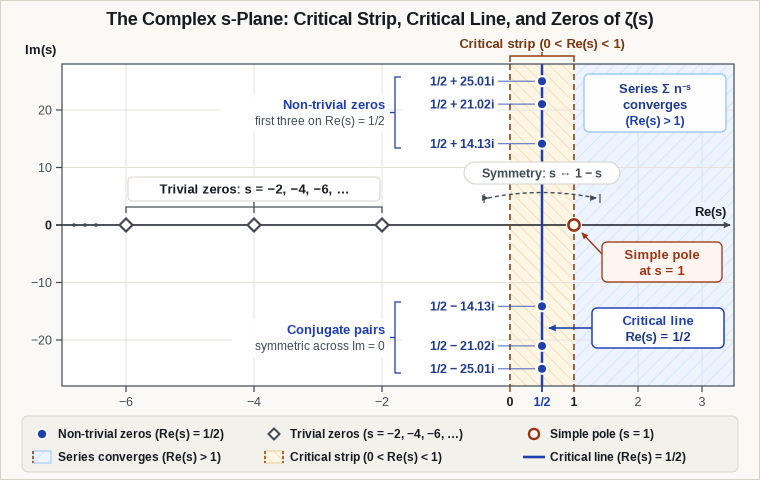
The two-dimensional coordinate plane of numbers s = σ + it, where the horizontal coordinate σ = Re(s) sets decay rate and the vertical coordinate t = Im(s) sets oscillation frequency.
Level 1 — First-Principles
Every point on the familiar number line is fixed by one coordinate. Extend that line into a flat two-dimensional grid by adding a vertical axis measured in multiples of the imaginary unit
Why does a question about whole numbers move into two dimensions? In
Limits of the intuition
Thinking of the complex plane as a flat vector grid
Level 2 — Undergrad Bridge
Algebraically,
A function
exists as
: the half-plane of absolute convergence and Euler product representation, free of zeros; : the open strip where all nontrivial zeros lie, symmetric under ; : the left half-plane determined from by the functional equation, containing only predictable zeros at non-positive integers for and primitive (whereas an imprimitive character also introduces extra Euler-factor zeros on ).
Level 3 — Formal Lean Contract
In Mathlib4 (Mathlib.Data.Complex.Basic), ℂ (Complex) is a structure with two real fields re : ℝ and im : ℝ. Every Stage 00 statement in src/Statements.lean and root Challenge.lean (lines 7–20, starting with riemannHypothesis at lines 7–8) quantifies over s : ℂ and expresses horizontal location with the projection s.re (such as 0 < s.re, s.re < 1, 1 / 2 < s.re, and the conclusion s.re = 1 / 2); upstream's comparator/FormalConjecturesChallenge.lean wrapper is archived on alpoge@c900e67c2 pending re-integration on condensed main. See the page's live verification banner (audit/verification-status.json) for the currently pinned upstream snapshot and local Lean build status (build_status: unverified-locally).
Where this analogy breaks
Viewing the complex plane purely as
Related Concepts
- infinite series — A limit of partial sums formed by adding infinitely many terms; in number theory, weighting terms by n⁻ˢ produces a Dirichlet series that turns integer arithmetic into a smooth function.
- analytic continuation — The unique extension of a complex-differentiable function from a smaller region to a larger domain, locked in place by the identity theorem.
- critical strip — The open vertical band 0 < Re(s) < 1 in the complex plane that contains every nontrivial zero of ζ(s) and of every Dirichlet L-function.
- critical line — The vertical line Re(s) = 1/2 bisecting the critical strip—the axis of mirror symmetry s ↦ 1 − s where the Riemann Hypothesis asserts all nontrivial zeros lie.
Referenced By
- Stage: Formal Statement Contracts (
Statements.lean) - Stage: From a One-Sided Prime Bound to a Zero-Free Half-Plane
- Stage: Full Proof Journey & Alpöge's 20-Step Map
- Stage: Independent Statement Equivalence (
FormalConjecturesStatement&FormalConjecturesChallenge) - Stage: Prime-by-Prime Divisibility & Elementary Divisors of Edge Hecke Operators
- Stage: Sharpness: Proving the Valuation Bound Is Attained
- Stage: Short Ramified Columns & Archimedean Size Cancellation
- Stage: Siegel–Weil Exchange and the Commuting Theta Square
- Stage: Stage 00 — Formal Statements & Challenge Contracts
- Stage: Stage 01 — The Theorem and Its Reduction
- Stage: The Five Entry Theorems (
Main.lean&Challenge.lean) - Stage: The Main Inequality & Theorems A and B
- Stage: Tight Frames, Chowla–Selberg Scaling & the Integral Vacuum
- Stage: Twisted Lattices & A Twist for Each Prime
- Concept: analytic continuation
- Concept: arithmetic height
- Concept: complex multiplication
- Concept: critical line
- Concept: critical strip
- Concept: Dirichlet character
- Concept: Dirichlet L-function
- Concept: elementary divisor
- Concept: elliptic theta function
- Concept: Gram determinant
- Concept: infinite series
- Concept: Landau's lemma
- Concept: Riemann zeta function
- Concept: Siegel–Weil exchange
- Concept: theta square law
- Concept: tight frame
- Concept: trace comparison
- Concept: twisted lattice
Authoritative Sources
- Complex Analysis (book) — L. V. Ahlfors, 3rd ed., McGraw-Hill (1979), Chapters 1–2.
- Complex Analysis (book) — E. M. Stein and R. Shakarchi, Princeton Lectures in Analysis II, Princeton University Press (2003), Chapter 1.
- Mathlib4: Complex (mathlib) — Mathlib.Data.Complex.Basic (pinned mathlib rev 31ce06eaadf4a200c0e1407c5f10953cf606b8f8).
Page Glossary
- infinite series
- A limit of partial sums formed by adding infinitely many terms; in number theory, weighting terms by n⁻ˢ produces a Dirichlet series that turns integer arithmetic into a smooth function.
- analytic continuation
- The unique extension of a complex-differentiable function from a smaller region to a larger domain, locked in place by the identity theorem.
- critical strip
- The open vertical band 0 < Re(s) < 1 in the complex plane that contains every nontrivial zero of ζ(s) and of every Dirichlet L-function.
- critical line
- The vertical line Re(s) = 1/2 bisecting the critical strip—the axis of mirror symmetry s ↦ 1 − s where the Riemann Hypothesis asserts all nontrivial zeros lie.