formal group law
Also known as: Frobenius congruence, formal parameter.
A power-series addition law encoding an elliptic curve's group structure near the origin, whose Lubin–Tate scaling and Frobenius congruence isolate the exact p-adic powers controlling theta-function derivatives.
Level 1 — First-Principles
Near the origin of the ordinary number line, adding two small numbers
When you multiply a point by
This same algebraic symmetry governs the curve's quasi-periodic analytic building block whose zeros lie on the curve's latticeelliptic theta function. Applying the endomorphism
Limits of the intuition
Thinking of a formal group law as a local Taylor approximation to curved addition explains why the identity neighborhood can be studied purely with power-series coefficients and why multiplication by
Level 2 — Undergrad Bridge
Let
have Taylor expansions at
Let
where the fact that
The rescaled formal parameter
Consequently, every series
On the theta function
For
Expanding
Finally, to pass from one variable to a multivariable theta product over the cyclotomic tower
Indeed, on
Level 3 — Formal Lean Contract
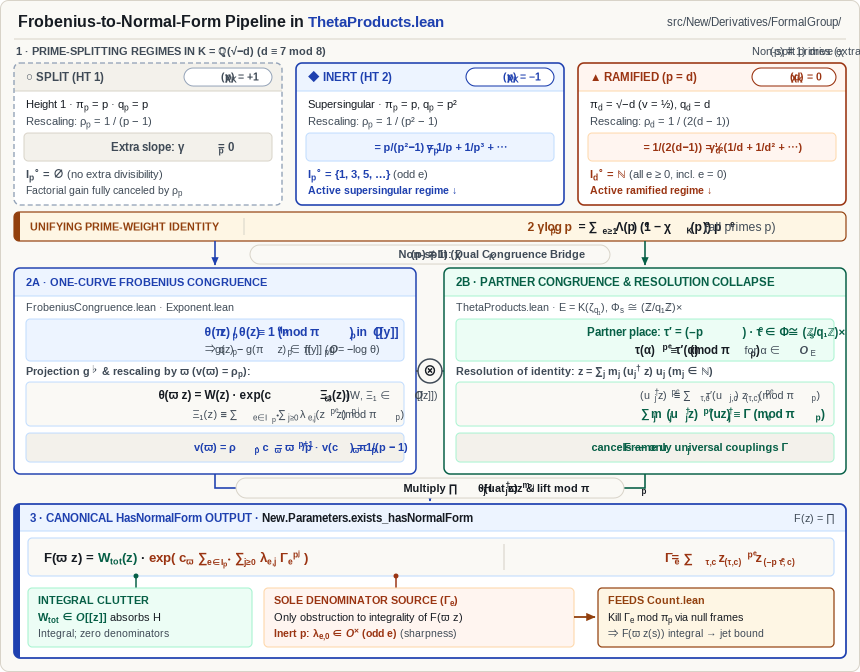
In skeleton/02_derivatives/theta_products.lean (extracted from upstream src/New/Derivatives/FormalGroup/ThetaProducts.lean, building on the single-curve formal-parameter and Frobenius-congruence modules src/Lib/CM/FormalGroup/FormalParameter.lean, src/New/Derivatives/FormalGroup/FrobeniusCongruence.lean, and src/New/Derivatives/FormalGroup/Exponent.lean), the arithmetic Frobenius congruence across places and the resulting existence of the normal form have the following signatures:
02_derivatives/theta_products.lean#New.Parameters.norm_pow_sub_conj_partner_le(upstreamsrc/New/Derivatives/FormalGroup/ThetaProducts.lean:136-178):leanlemma New.Parameters.norm_pow_sub_conj_partner_le {P : Parameters} {s p : ℕ} [Fact p.Prime] [PadicPlace p] {e : ℕ} (he : e ∈ partnerExponents P.d p) (τ : P.Φ s) (α : 𝓞 (P.E s)) : ‖ιₚ (Φ τ α) ^ p ^ e - ιₚ (conj (Φ (P.partner s p e τ) α))‖ ≤ ‖ιₚ (piPrime P.d p)‖02_derivatives/theta_products.lean#New.Parameters.exists_hasNormalForm(upstreamsrc/New/Derivatives/FormalGroup/ThetaProducts.lean:439-477):leanlemma New.Parameters.exists_hasNormalForm (P : Parameters) (s : ℕ) [PadicPlace p] (hp : chiK P.d p ≠ 1) : ∃ (ϖ : ℂ_[p]) (l : ℕ → ℕ → valRingCp p), ‖ϖ‖ = p ^ (-varpiValuation P.d p) ∧ (chiK P.d p = -1 → ∀ e : ℕ, Odd e → IsUnit (l e 0)) ∧ ∀ {n J : Type} [Fintype n] [DecidableEq n] [Fintype J] (u : J → n → P.E s) (m : J → ℕ), IsResolution u m → (∀ (j : J) (i : n), IsIntegralAbove p (u j i)) → ∀ H ∈ P.cmCurve.multiSeriesRing (daggerForms u), HasNormalForm (partnerExponents P.d p) (P.partner s p) ϖ l (P.cmCurve.thetaProd (daggerForms u) m * H)
Internally, exists_hasNormalForm invokes the single-curve formal-group theorem New.CMLattice.exists_exponent_tsum (src/New/Derivatives/FormalGroup/Exponent.lean), which factors θ(ϖ z) = W * exp(c_ϖ Ξ) using the formal parameter T = C.formalParam and the Frobenius congruence q_p g(z) - g(π_p z) ∈ π_p 𝒪[[y]], and then feeds norm_pow_sub_conj_partner_le through piPrimeInt_dvd_sum_linearSeries_sub_coupling and norm_pow_succ_div_mul_piPrimeInt (‖ϖ ^ (p + 1) / p * π_p‖ = p ^ (-1 / (p - 1))) to absorb all higher-order discrepancy terms modulo π_p into the integral prefactor W. See the page's live verification banner (audit/verification-status.json) for the currently pinned upstream snapshot and local Lean build status (build_status: unverified-locally).
Where this analogy breaks
Thinking of a formal group law as a small-angle Taylor approximation like
Formal Lean Anchors
lemma New.Parameters.norm_pow_sub_conj_partner_le — Upstream source (src/New/Derivatives/FormalGroup/ThetaProducts.lean L136-L178)
/-- Let `E = P.E s` be `K = ℚ(√-d)` (`d = P.d`) with a root of unity of order `q₁ = P.q₁ s`
adjoined, `s` being the level in the tower of these fields. Let `e` be in
`I_p° = partnerExponents P.d p`. Let `τ : P.Φ s` be an infinite place of `E`, and
`τ' = -p ^ e τ = P.partner s p e τ` its partner: the product of `τ` with the class of `-p ^ e` in
the group `Gal(E/K) = (ℤ/q₁)ˣ` of places. Then `τ(α) ^ p ^ e ≡ conj (τ'(α))` modulo `π_p` for `α` in
`𝓞 E`. -/
lemma New.Parameters.norm_pow_sub_conj_partner_le {P : Parameters} {s p : ℕ} [Fact p.Prime] [PadicPlace p] {e : ℕ}
    (he : e ∈ partnerExponents P.d p) (τ : P.Φ s) (α : 𝓞 (P.E s)) :
‖ιₚ (Φ τ α) ^ p ^ e - ιₚ (conj (Φ (P.partner s p e τ) α))‖ ≤ ‖ιₚ (piPrime P.d p)‖ := by
sorry -- [EXTRACTED_STUB upstream=src/New/Derivatives/FormalGroup/ThetaProducts.lean:136-178 commit=41c2716658c42ba08eb0648994a2efe83082a95c body_lines=35 body_sha256=7c512132aa4a0a04edb13c8ad8d099134b6aebfca8ffa6c51cd694b65e21adf0]lemma New.Parameters.exists_hasNormalForm — Upstream source (src/New/Derivatives/FormalGroup/ThetaProducts.lean L439-L477)
/-- Let `E = P.E s` be `K = ℚ(√-d)` with a root of unity of order `q₁ = P.q₁ s` adjoined, `p` a
prime not split in `K` (`chiK P.d p ≠ 1`), `I_p° = partnerExponents P.d p`, and for an infinite
place `τ` of `E` let its partner `τ' = -p ^ e τ` be the product of `τ` with the class of `-p ^ e` in
the group `Gal(E/K) = (ℤ/q₁)ˣ` of places. There are `ϖ` of valuation `ρ_p = varpiValuation P.d p`
and integers `λ_{e j}` of `ℂ_p`, with the `λ_{e 0}` for odd `e` units if `p` is inert, such that the
following holds. Take any resolution of the identity by vectors `u_j` of `Eⁿ`, taken `m_j` times and
integral above `p`. Then the product `∏ θ(u_j† z) ^ m_j` times an integral series in the `y(u_j† z)`
has the normal form. -/
lemma New.Parameters.exists_hasNormalForm (P : Parameters) (s : ℕ) [PadicPlace p] (hp : chiK P.d p ≠ 1) :
    ∃ (ϖ : ℂ_[p]) (l : ℕ → ℕ → valRingCp p),
    ‖ϖ‖ = p ^ (-varpiValuation P.d p) ∧
    (chiK P.d p = -1 → ∀ e : ℕ, Odd e → IsUnit (l e 0)) ∧
    ∀ {n J : Type} [Fintype n] [DecidableEq n] [Fintype J] (u : J → n → P.E s) (m : J → ℕ),
      IsResolution u m → (∀ (j : J) (i : n), IsIntegralAbove p (u j i)) →
        ∀ H ∈ P.cmCurve.multiSeriesRing (daggerForms u),
          HasNormalForm (partnerExponents P.d p) (P.partner s p) ϖ l
(P.cmCurve.thetaProd (daggerForms u) m * H) := by
sorry -- [EXTRACTED_STUB upstream=src/New/Derivatives/FormalGroup/ThetaProducts.lean:439-477 commit=41c2716658c42ba08eb0648994a2efe83082a95c body_lines=23 body_sha256=13683f6b838cae63d5052f3d5b3afcbb38c5bd6c65d341cfaf10b1f242e9a0c4]Related Concepts
- prime number — A whole number greater than 1 whose only positive whole-number divisors are 1 and itself; every integer above 1 factors uniquely into a product of them.
- complex multiplication — Extra scaling-and-rotation symmetries of a two-dimensional lattice in ℂ preserved by the integers 𝓞_K of an imaginary quadratic field K = ℚ(√(-d)), pinning down every Galois-conjugate lattice area via the Chowla–Selberg formula.
- elliptic theta function — A quasi-periodic entire function on a CM lattice normalized at the origin, whose finite products along tight-frame projections build integral multi-variable theta functions and collapse p-adically into exponential normal forms.
- theta normal form — A p-adic factorization of rescaled multivariable theta products into an integral power series times an exponential of Frobenius-power couplings pairing each infinite place with its shifted partner place.
- arithmetic height — A logarithmic measure combining ordinary archimedean size with prime-by-prime p-adic divisibility, locked together by the product formula so a nonzero algebraic quantity cannot be simultaneously small at every place.
Referenced By
- Stage: Formal Groups, Theta Normal Form & Prime-Counting Divisibility
- Stage: Sharpness: Proving the Valuation Bound Is Attained
- Stage: Stage 02 — Derivatives of Theta Functions
- Concept: Frobenius cycle
- Concept: theta normal form
Authoritative Sources
- The Arithmetic of Elliptic Curves (book) — J. H. Silverman, 2nd ed., Springer Graduate Texts in Mathematics 106 (2009), Chapter IV.
- Formal complex multiplication in local fields (paper) — J. Lubin and J. Tate, Annals of Mathematics 81 (1965).
- Divisibilities, congruences, and Cartier duality (paper) — N. M. Katz, Journal of the Faculty of Science, University of Tokyo 28 (1981).
- Radius of convergence of the p-adic sigma function (paper) — K. Bannai, S. Kobayashi, and T. Yasuda (2017).
Page Glossary
- prime number
- A whole number greater than 1 whose only positive whole-number divisors are 1 and itself; every integer above 1 factors uniquely into a product of them.
- complex multiplication
- Extra scaling-and-rotation symmetries of a two-dimensional lattice in ℂ preserved by the integers 𝓞_K of an imaginary quadratic field K = ℚ(√(-d)), pinning down every Galois-conjugate lattice area via the Chowla–Selberg formula.
- elliptic theta function
- A quasi-periodic entire function on a CM lattice normalized at the origin, whose finite products along tight-frame projections build integral multi-variable theta functions and collapse p-adically into exponential normal forms.
- theta normal form
- A p-adic factorization of rescaled multivariable theta products into an integral power series times an exponential of Frobenius-power couplings pairing each infinite place with its shifted partner place.
- arithmetic height
- A logarithmic measure combining ordinary archimedean size with prime-by-prime p-adic divisibility, locked together by the product formula so a nonzero algebraic quantity cannot be simultaneously small at every place.