Siegel–Weil exchange
Also known as: Siegel-Weil exchange, exchange identity, matched function, equal-rank theta ratio, complementary rank.
Comparing theta integrals to U(W) from two complementary-rank spaces V and V' on matched ramified matrix functions modulo m—agreeing up to a nonzero scalar c with |c|^2 = C * L_*(e).
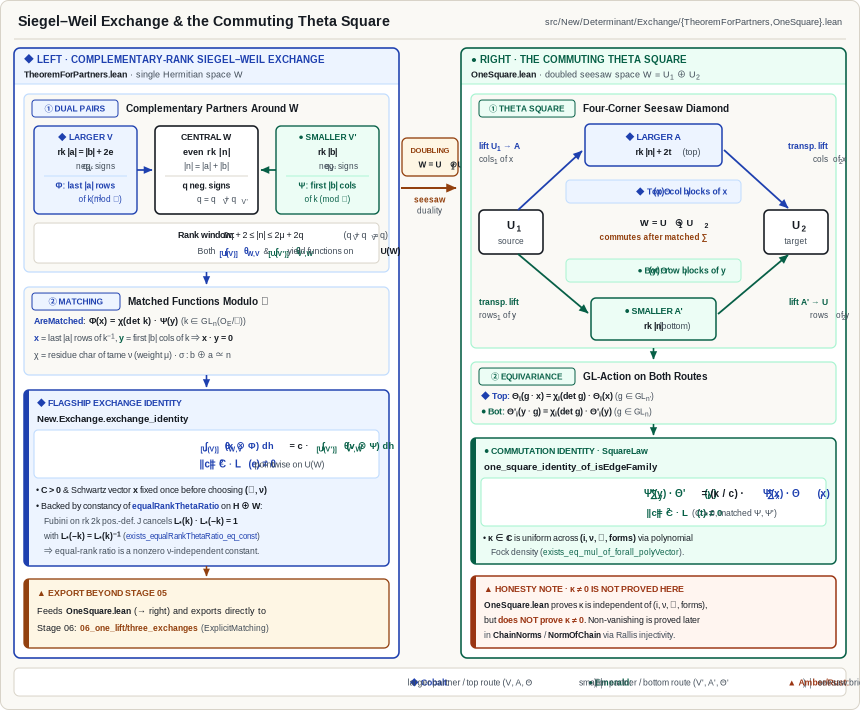
Level 1 — First-Principles
Suppose a single Hermitian space
To make that matching concrete, split the coordinates of
The exchange identity (New.Exchange.exchange_identity) then delivers three pieces at once:
- Universal real vector chosen up front: Given a real Schwartz test vector
for , there exist a constant and a real Schwartz vector for chosen before any modulus or tame character of weight is picked. - Exact proportionality of theta integrals: For every tame character
of weight ramified at with residue character , and every pair of matched functions modulo , there is a nonzero scalar (in the complex planecomplex plane) such that the theta integral over at equals times the theta integral over at pointwise on . - Explicit modulus controlled by
-values: While the phase of and the base constant are not computed explicitly, its squared norm obeys where is the set of places dividing , is the residue cardinality at , and is the partial Hecke L-value omitting the places in Hecke L-value ratio.
Why does the proof care? Because replacing a theta integral over a large space OneSquare.lean) and lets Stage 06 execute three successive exchanges inside ThreeExchanges.lean.
Limits of the intuition
Calling Siegel–Weil exchange a "swap between two complementary integrals" makes it sound symmetric and explicit, but two critical subtleties sit beneath the surface. First, the proof does not compute the constant exists_equalRankThetaRatio_eq_const). Second, the exchange holds only in the convergent/regularized sign and weight window
Level 2 — Undergrad Bridge
In classical automorphic forms, Weil's 1965 Siegel–Weil formula identifies the theta integral of a single space with a special value of an Eisenstein series, and Kudla–Rallis (1994) and Gan–Qiu–Takeda (2014) extend this to regularized first- and second-term identities comparing complementary spaces in the same Witt tower. src/New/Determinant/Exchange/TheoremForPartners.lean proves a ramified, tame-character unitary version in four stages:
- Adjoint coordinate flip (
adjointCoords,exists_localDatum_adjointDatum_eq_smul,exists_mul_thetaSmall_adjointDatum_eq_mul_integral): Switchingto (where negates the Hermitian signs) acts on finite adelic matrices by conjugate-transposition scaled by an integral unit of norm . On matched local functions with supported on left-invertible matrices, this moves thetaSmalloninto the integral of pairThetaonup to a modulus-one factor . - Descent from the top of the Witt tower (
exists_rowColExchangeIdentity_of_even_rank,thetaLarge_eq_smul_of_areMatched,exchange_of_matches): Starting from an even-rank spacewith and , exists_rowColExchangeIdentity_of_even_rankdescends from standard determinant data (stdRowDatum,stdColDatum) onby removing hyperbolic planes ( RemovingPlanes.lean), andthetaLarge_eq_smul_of_areMatchedupgrades standard data to all locally constant matched pairs. The resulting constant satisfies where lValueProdIntextendsto via . - Constancy and non-vanishing of the equal-rank theta ratio (
exists_equalRankThetaRatio_sq_eq,exists_equalRankThetaRatio_const_ne_zero,exists_equalRankThetaRatio_add_plane,exists_equalRankThetaRatio_eq_const): Applyingexchange_of_matchestwice to a positive-definite spaceof rank —once for ( exists_thetaLarge_eq_mul_quotMeasure, picking up) and once for ( exists_quotMeasure_mul_eq_mul_integral_pairTheta, picking up)—and combining by Fubini's theorem ( eq_mul_of_integral_pairTheta) cancelscompletely! Thus the square of equalRankThetaRatiois constant across all tame charactersof weight . Non-vanishing for ( exists_equalRankThetaRatio_ne_zero) plus hyperbolic-plane induction (exists_equalRankThetaRatio_add_plane,equalRankThetaRatio_eq_of_signs_eq) yields a Schwartz vectoron whose equal-rank theta ratio is a single constant for every tame character of weight . - Passage to residue rings and general splitting characters (
exists_areMatched_modDatum_eq,exchange_theorem,exchange_identity): Lifting matched functions modulo( AreMatched ⊤ σ χ Φ Ψ) to matched locally constant functions on completions (exists_areMatched_modDatum_eq), plugging in the constant-vector ( exchange_theorem), and finally allowing arbitrary splitting characterssatisfying ( spaceChar_mul_spaceChar_eq_iff) produces the flagship theoremNew.Exchange.exchange_identity.
Level 3 — Formal Lean Contract
Stage 05 extracts the complementary-rank exchange machinery into skeleton/05_determinant/theorem_for_partners.lean (27 declarations; note that 3 intermediate lemmas — exchange_of_matches, exists_quotMeasure_mul_eq_mul_integral_pairTheta, and exchange_theorem — are truncated at their let γ := bindings in the skeleton, whereas exchange_identity and exists_equalRankThetaRatio_eq_const extract untruncated; full upstream statements are documented in Siegel–Weil Exchange and the Commuting Theta Square):
05_determinant/theorem_for_partners.lean#New.Exchange.exchange_identity(upstreamsrc/New/Determinant/Exchange/TheoremForPartners.lean:1051-1113):leantheorem New.Exchange.exchange_identity (σ : b ⊕ a ≃ n) (h_signs : negCount s = negCount t + negCount t') {e : ℕ} (h_rank : card a = card b + 2 * e) (h_few_neg : 2 * negCount s + 2 ≤ card n) {μ : NumberField.InfinitePlace E → ℤ} (hμ : ∀ τ : NumberField.InfinitePlace E, card n ≤ 2 * μ τ + 2 * negCount s) {v : PairFock E t' s} (hv : IsSchwartzVector v) : ∃ C : ℝ, 0 < C ∧ ∃ x : PairFock E s t, IsSchwartzVector x ∧ ∀ (𝔪 : Modulus E) (ν : AutChar E) (χ : MulChar 𝔪.ResidueRing ℂ), IsTameFor 𝔪 ν μ χ → ∃ c : ℂ, ‖c‖ ^ 2 = C * lValueProd 𝔪.places ν e ∧ C * lValueProd 𝔪.places ν e ≠ 0 ∧ ∀ α α' : AutChar E, α.spaceChar (card a) * α'.spaceChar (card b) = ν.baseChange⁻¹ → ∀ (Φ : Matrix a n 𝔪.ResidueRing → ℂ) (Ψ : Matrix n b 𝔪.ResidueRing → ℂ), AreMatched ⊤ σ χ Φ Ψ → ∀ g : G E s, thetaIntegral W V (rankTwist ν⁻¹ n) α (modDatum W V 𝔪 Φ x) g = c * ∫ h : G E t', pairTheta V' W α' (rankTwist ν⁻¹ n) (modDatum V' W 𝔪 Ψ v) (h, g) ∂V'.quotMeasure05_determinant/theorem_for_partners.lean#New.Exchange.exists_equalRankThetaRatio_eq_const(upstreamsrc/New/Determinant/Exchange/TheoremForPartners.lean:815-852):leanlemma New.Exchange.exists_equalRankThetaRatio_eq_const (W : Space E n s) (μ : InfinitePlace E → ℤ) (k : ℕ) (h_rank : card n = 2 * k + 2 * negCount s) (hμ : ∀ w : InfinitePlace E, k ≤ μ w) : ∃ v : PairFock E (Sum.elim (hyperbolicSigns Unit) s) (Sum.elim (hyperbolicSigns Unit) s), IsSchwartzVector v ∧ ∃ C ≠ (0 : ℝ), ∀ 𝔠 : SplitTameChar E μ, equalRankThetaRatio (hyperbolicSum Unit W) 𝔠 v = C- Also anchored:
05_determinant/theorem_for_partners.lean#New.Exchange.exchange_of_matches(upstreamTheoremForPartners.lean:325-342) and05_determinant/theorem_for_partners.lean#New.Exchange.exchange_theorem(upstreamTheoremForPartners.lean:985-1003).
See the page's live <VerificationBanner /> (audit/verification-status.json) for the pinned upstream commit and local Lean build status (build_status: unverified-locally).
Where this analogy breaks
Picturing Siegel–Weil exchange as a direct change of variables between two integrals hides the asymmetric existence statement: for a given real Schwartz vector v on (V', W), the theorem constructs a matching Schwartz vector x on (W, V) once and for all before the modulus m and character nu are chosen, and it evaluates |c|^2 = C * L_*(e) only up to an uncomputed positive real constant C independent of (m, nu, chi).
Formal Lean Anchors
theorem New.Exchange.exchange_identity — Upstream source (src/New/Determinant/Exchange/TheoremForPartners.lean L1051-L1113)
/-- Let `W`, `V`, `V'` have ranks `|n| = |b| + |a|` (split by `σ`), `|a| = |b| + 2e`, `|b|`. Let `W`
have as many negative signs `q` as `V` and `V'` together, with `2q + 2 ≤ |n| ≤ 2 μ + 2q`, and let
`v` be a real Schwartz vector for `(V', W)`. There are `C > 0` and a Schwartz vector `x` for
`(W, V)`, chosen before `𝔪` and `ν`, such that every character `ν` of `[U(1)]` of weight `μ` that is
tame for `(𝔪, χ)` has a number `c` as follows. Its size is `‖c‖² = C * lValueProd 𝔪.places ν e ≠ 0`.
For all `α`, `α'` such that the characters `α.spaceChar |a|` of `V` and `α'.spaceChar |b|` of `V'`
have product inverse to the base change `x ↦ ν (x / x̄)`, and all matched functions `Φ`, `Ψ` modulo
`𝔪`, the theta integral of `(x, Φ)` over `[U(V)]` is `c` times that of `(v, Ψ)` over `[U(V')]`, as
functions on `U(W)`. The character of `W` is `rankTwist ν⁻¹ n = ν⁻¹ υ ^ (|n| / 2)`, and `modDatum`
puts a function modulo `𝔪` at the primes of `𝔪` and the vacuum at the other finite places. -/
theorem New.Exchange.exchange_identity (σ : b ⊕ a ≃ n) (h_signs : negCount s = negCount t + negCount t')
    {e : ℕ} (h_rank : card a = card b + 2 * e) (h_few_neg : 2 * negCount s + 2 ≤ card n)
    {μ : NumberField.InfinitePlace E → ℤ}
    (hμ : ∀ τ : NumberField.InfinitePlace E, card n ≤ 2 * μ τ + 2 * negCount s)
    {v : PairFock E t' s} (hv : IsSchwartzVector v) :
    ∃ C : ℝ, 0 < C ∧ ∃ x : PairFock E s t, IsSchwartzVector x ∧
      ∀ (𝔪 : Modulus E) (ν : AutChar E) (χ : MulChar 𝔪.ResidueRing ℂ), IsTameFor 𝔪 ν μ χ →
      ∃ c : ℂ,
        ‖c‖ ^ 2 = C * lValueProd 𝔪.places ν e ∧
        C * lValueProd 𝔪.places ν e ≠ 0 ∧
        ∀ α α' : AutChar E,
          α.spaceChar (card a) * α'.spaceChar (card b) = ν.baseChange⁻¹ →
          ∀ (Φ : Matrix a n 𝔪.ResidueRing → ℂ) (Ψ : Matrix n b 𝔪.ResidueRing → ℂ),
            AreMatched ⊤ σ χ Φ Ψ →
            ∀ g : G E s,
              thetaIntegral W V (rankTwist ν⁻¹ n) α (modDatum W V 𝔪 Φ x) g =
                c * ∫ h : G E t',
                  pairTheta V' W α' (rankTwist ν⁻¹ n) (modDatum V' W 𝔪 Ψ v) (h, g)
∂V'.quotMeasure := by
sorry -- [EXTRACTED_STUB upstream=src/New/Determinant/Exchange/TheoremForPartners.lean:1051-1113 commit=41c2716658c42ba08eb0648994a2efe83082a95c body_lines=35 body_sha256=2396e45bc2ed2f6b012f1855e86abf910c7cf9ccfe578ce3c15b69d6d63da09e]lemma New.Exchange.exchange_theorem — Upstream source (src/New/Determinant/Exchange/TheoremForPartners.lean L974-L1049)
/-- Let `W`, `V`, `V'` have ranks `|n| = |b| + |a|` (split by `σ`), `|a| = |b| + 2e` and `|b|`. Let
`W` have as many negative signs `q` as `V` and `V'` together, with `2q + 2 ≤ |n|`. Let the weights
satisfy `|n| ≤ 2 μ + 2q`, and let `v` be a real Schwartz vector for `(V', W)`. There are `C` and a
Schwartz `x` for `(W, V)` such that every character `ν` of `[U(1)]` of weight `μ` that is tame for
`(𝔪, χ)` (ramified exactly at the primes of `𝔪`, with residue character `χ`) has some `c ≠ 0` with
(a) and (b). (a) `‖c‖²` is `C` times `lValueProd 𝔪.places ν e`, a power of the norm of the primes of
`𝔪` times the product of the squares of the partial L-values `|L^S(z, ν)|` for `z = 1, …, e`, with
`S` the primes of `𝔪`; so `C > 0` as soon as such a `ν` exists. (b) For all matched functions `Φ`,
`Ψ` modulo `𝔪`, the theta integral of `(x, Φ)` over `[U(V)]` is `c` times that of `(v, Ψ)` over
`[U(V')]`, as functions on `U(W)`. The left side has the characters `γ` and `1`, the right side `γ`
and `γ`, with `γ = rankTwist ν⁻¹ n = ν⁻¹ υ ^ (|n| / 2)`. -/
lemma New.Exchange.exchange_theorem (σ : b ⊕ a ≃ n) (h_signs : negCount s = negCount t + negCount t') {e : ℕ}
(h_rank : card a = card b + 2 * e) (h_few_neg : 2 * negCount s + 2 ≤ card n)
{μ : NumberField.InfinitePlace E → ℤ}
(hμ : ∀ τ : NumberField.InfinitePlace E, card n ≤ 2 * μ τ + 2 * negCount s)
{v : Fock.fockSpace (realSigns E (homSigns t' s))} (hv : IsSchwartzVector v) :
∃ (C : ℝ) (x : Fock.fockSpace (realSigns E (homSigns s t))),
IsSchwartzVector x ∧
∀ (𝔪 : Modulus E) (ν : AutChar E) (χ : MulChar 𝔪.ResidueRing ℂ), IsTameFor 𝔪 ν μ χ →
let γ : AutChar E := by
sorry -- [EXTRACTED_STUB upstream=src/New/Determinant/Exchange/TheoremForPartners.lean:974-1049 commit=41c2716658c42ba08eb0648994a2efe83082a95c body_lines=57 body_sha256=433d6f1601635a43d46e259dff644a43694803df23cac5877107549cc0e3d689]lemma New.Exchange.exchange_of_matches — Upstream source (src/New/Determinant/Exchange/TheoremForPartners.lean L313-L367)
/-- Let `W₀ = H ⊕ W` with `H` a hyperbolic plane, and let `W` have even rank `rk U + rk V` (`σ`,
`h_even`) and as many negative signs as `U` and `V` together (`h_signs`). Let `z` for `(W₀, W₀)` and
`y` for `(U, W)` be real Schwartz vectors. There are `C` and a Schwartz vector `v` for `(W, V)` such
that each tame character `𝔠` of weight `μ` has a number `c` with (a) and (b). Put `ν = 𝔠.character`,
`S = 𝔠.ramifiedPlaces`, `χ = 𝔠.semilocalChar` and `γ = ν⁻¹ υ ^ (rk W / 2)`, where `υ` is the
splitting character of the Weil data on norm-one ideles (`upsilonU1`). (a) `C |c| ^ 2` is
`L_*(rk V - rk W / 2)` times the equal rank ratio `|I(z)(1)| ^ 2 / L_*(rk W₀ / 2)`, where `I(z)` is
the theta integral of `(W₀, W₀)` at `z` and `χ⁻¹(det)`, `L_*(e) = ∏_{w ∈ S} q_w ^ (e ^ 2)
∏_{1 ≤ i ≤ e} |L^S(i, ν)| ^ 2` and `L_*(-e) = L_*(e)⁻¹` (`lValueProdInt`). (b) For all matched
functions `Φ`, `Ψ` with `Ψ` locally constant, the integral over `[U(V)]` of the theta kernel of
`(W, V)` with characters `γ`, `1` at `(v, Φ)` is `c` times the integral over `[U(U)]` of the theta
kernel of `(U, W)` with characters `γ`, `γ` at `(y, Ψ)`, as functions on `U(W) = G E s`. -/
lemma New.Exchange.exchange_of_matches (W : Space E n s) (U : Space E b u) (μ : InfinitePlace E → ℤ)
(V : Space E r t) (σ : b ⊕ r ≃ n)
{z : PairFock E (hyperbolicSigns Unit ⊕ᵥ s) (hyperbolicSigns Unit ⊕ᵥ s)} {y : PairFock E u s}
(hz : IsSchwartzVector z) (hy : IsSchwartzVector y)
(h_signs : negCount s = negCount t + negCount u) (h_even : 2 ∣ card n) :
∃ (C : ℝ) (v : PairFock E s t), IsSchwartzVector v ∧ ∀ 𝔠 : SplitTameChar E μ,
let γ : AutChar E := by
sorry -- [EXTRACTED_STUB upstream=src/New/Determinant/Exchange/TheoremForPartners.lean:313-367 commit=41c2716658c42ba08eb0648994a2efe83082a95c body_lines=37 body_sha256=ea352bd4912b69586316225cf6f4538c539a4bd695662e3533e1c478369ea952]lemma New.Exchange.exists_equalRankThetaRatio_eq_const — Upstream source (src/New/Determinant/Exchange/TheoremForPartners.lean L815-L852)
/-- The value of the equal rank ratio. Let `rk W = 2 k + 2 q`, where `q` is the number of negative
signs of `W`, and `k ≤ μ` at every infinite place. There are a Schwartz vector (all Fock moments
finite) `v` for `(H ⊕ W, H ⊕ W)`, with `H` a hyperbolic plane, and `C ≠ 0` such that
`|I(v)(1)| ^ 2 / L_*(rk W / 2 + 1) = C` for every tame character `𝔠` of weight `μ`. Here `I(v)` is
the theta integral `thetaLarge` with real part `v` and the function `χ⁻¹(det)` at the ramified
places, `χ = 𝔠.semilocalChar`, and `L_*(e) = ∏_{w ∈ S} q_w ^ (e ^ 2) ∏_{1 ≤ i ≤ e} |L^S(i, ν)| ^ 2`
for `ν = 𝔠.character` and `S = 𝔠.ramifiedPlaces`. -/
lemma New.Exchange.exists_equalRankThetaRatio_eq_const (W : Space E n s) (μ : InfinitePlace E → ℤ) (k : ℕ)
    (h_rank : card n = 2 * k + 2 * negCount s) (hμ : ∀ w : InfinitePlace E, k ≤ μ w) :
    ∃ v : PairFock E (Sum.elim (hyperbolicSigns Unit) s) (Sum.elim (hyperbolicSigns Unit) s),
      IsSchwartzVector v ∧ ∃ C ≠ (0 : ℝ),
∀ 𝔠 : SplitTameChar E μ, equalRankThetaRatio (hyperbolicSum Unit W) 𝔠 v = C := by
sorry -- [EXTRACTED_STUB upstream=src/New/Determinant/Exchange/TheoremForPartners.lean:815-852 commit=41c2716658c42ba08eb0648994a2efe83082a95c body_lines=27 body_sha256=69cd52834c2ae3f79bd626b7f18403abda2f1183c97fe0407e4ca5718b6b06ee]Related Concepts
- complex plane — The two-dimensional coordinate plane of numbers s = σ + it, where the horizontal coordinate σ = Re(s) sets decay rate and the vertical coordinate t = Im(s) sets oscillation frequency.
- theta correspondence — An integral transform built from a two-variable theta kernel that carries automorphic forms from one unitary group to another, iterated along a ladder of Hermitian spaces and packaged via admissible chain data.
- seesaw duality — A dual-pair adjunction identity that trades an iterated lower-chain theta lift of a Poincaré series for a nonzero twist-independent scalar times the restriction of an upper-chain composite theta lift.
- Hecke L-value ratio — The ratio |L^S(z, (nu * theta^s)^-1)| / |L^S(z, nu^-1)| of twisted to untwisted partial Hecke L-values at a critical pair (nu, z), tracking how Siegel–Weil exchange constants scale under twisting across chain quotients and grid turns.
- theta square law — Commutation of theta lifts around a four-corner square (U_1, U_2, A, A'): summing down-then-up over matched matrix data equals (kappa / c) times summing up-then-down, with |c|^2 = C * L_*(t) != 0 and kappa independent of twist.
Referenced By
- Stage: Siegel–Weil Exchange and the Commuting Theta Square
- Stage: Stage 05 — Lower Bound: The Determinant (Theorem C, Part 1)
- Stage: Stage 06 — Lower Bound: One Lift (Theorem C, Part 2)
- Stage: Three Exchanges, the Carrier Form, and Divided-Lattice Gluing
- Concept: carrier form
- Concept: Hecke L-value ratio
- Concept: theta square law
Authoritative Sources
- Sur la formule de Siegel dans la théorie des groupes classiques (paper) — A. Weil, Acta Math. 113 (1965), 1–87.
- A regularized Siegel–Weil formula: the first term identity (paper) — S. S. Kudla & S. Rallis, Ann. of Math. 140 (1994), 1–80.
- The regularized Siegel–Weil formula (the second term identity) and the Rallis inner product formula (paper) — W. T. Gan, Y. Qiu & S. Takeda, Invent. Math. 198 (2014), 739–831.
Page Glossary
- theta correspondence
- An integral transform built from a two-variable theta kernel that carries automorphic forms from one unitary group to another, iterated along a ladder of Hermitian spaces and packaged via admissible chain data.
- complex plane
- The two-dimensional coordinate plane of numbers s = σ + it, where the horizontal coordinate σ = Re(s) sets decay rate and the vertical coordinate t = Im(s) sets oscillation frequency.
- Hecke L-value ratio
- The ratio |L^S(z, (nu * theta^s)^-1)| / |L^S(z, nu^-1)| of twisted to untwisted partial Hecke L-values at a critical pair (nu, z), tracking how Siegel–Weil exchange constants scale under twisting across chain quotients and grid turns.
- theta square law
- Commutation of theta lifts around a four-corner square (U_1, U_2, A, A'): summing down-then-up over matched matrix data equals (kappa / c) times summing up-then-down, with |c|^2 = C * L_*(t) != 0 and kappa independent of twist.