Hecke operator
Also known as: scaled Hecke operator, edge Hecke operator, parahoric subgroup.
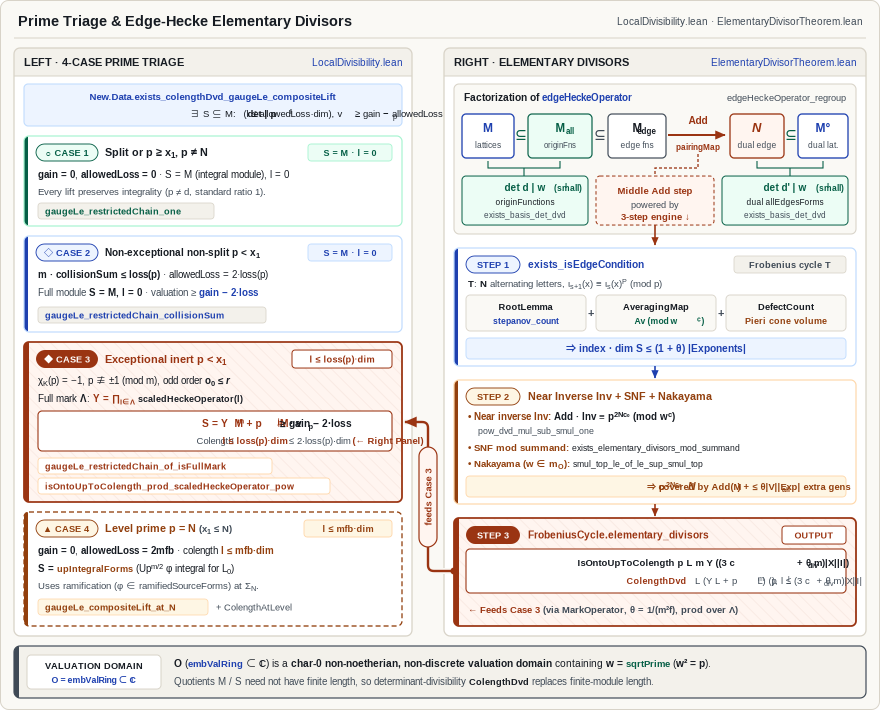
An averaging operator that sums values of an automorphic form over neighboring sublattices—indexed by cosets of a parahoric subgroup—which Stage 03 scales by powers of a prime to eliminate collision losses in the composite theta lift.
Level 1 — First-Principles
Imagine a function attached not to points on a line, but to lattices—regular grids of vectors in a higher-dimensional space. Given a indivisible whole number
How do we list every neighbor cleanly? If you change the basis of a rank-New.EdgeCoordinates). Summing a form's transported values over all incoming edges into each representative
Why does Stage 03 need Hecke operators at all? In the upper-bound proof, Stage 03 passes source forms through an
- Divisibility restoration: Applying
before the -step lift cancels the collision penalty and restores the output's divisibility exponent up to ( gaugeLe_restrictedChain_of_isFullMark). - Small loss of room: Enlarging the image of
by times all integral source forms leaves only a tiny index—measured via prime-power invariant factors and determinant-divisibility index of a sublatticeelementary divisor—bounded by ( isOntoUpToColength_prod_scaledHeckeOperator_pow), proved by reducing the edge Hecke operator to a cyclic system of prime-power twisted embeddings with alternating actionsFrobenius cycle.
Limits of the intuition
Picturing a Hecke operator as an ordinary graph adjacency average on vertices captures linearity and integrality, but breaks down in three concrete ways. First, each directed edge New.EdgeCoordinates is not merely a pair of vertices: it carries a coset originBasisChange, terminusBasisChange) factoring the group element transition e in
Level 2 — Undergrad Bridge
Let twoBlock k r : Fin k → ℕ assigns twoBlock k r is
and its coset space
Edge coordinates and the edge Hecke operator (
New.EdgeCoordinates,New.FrobeniusCycle.edgeHeckeOperator): Suppose a groupacts freely with finitely many orbits (represented by ) on pairs consisting of a rank- -lattice and a free -module of basis . An edge into records: - its origin orbit representative
, - lattice basis changes
with representing the coset (modelling ), - a transition matrix
transporting the coefficient module, - freeness (
eq_of_origin_eq): an edge is uniquely determined byand the parahoric coset of .
Given a Frobenius cycle
with letters, degree- representation , diagonal depth-power matrix (entries ), and a splitting , the edge Hecke operator acts on entrywise by where
. Under the adjoint pairing , this operator factors cleanly through edge restriction and dual-edge pairing ( edgeHeckeOperator_regroup), opening the door to the elementary-divisor theorem.- its origin orbit representative
Scaled Hecke operators, valuation gain, and colength (
gaugeLe_restrictedChain_of_isFullMark,isOntoUpToColength_prod_scaledHeckeOperator_pow): Letbe an exceptional non-split prime ( ), the number of lifts, the number of infinite places of , and the long-row length. A marked set is a set of primes of above , disjoint from its complex conjugate, each induced by an -place; it is a full mark ( D.IsFullMark Λ) if it contains one prime from every conjugate pair induced by the-places. For each , define and let
hΛ.scaledHeckeOperator lbe the Hecke operator atof index multiplied by (echoing the -adic valuation scaling of Hecke operators in Lafforgue 2011). Setting : - Valuation theorem: For every weak chain datum
for a twist with and every integral source form , where (multiplied by if ). - Colength theorem: Summing the per-dimension colength exponent
over and multiplying by stays at most ( mul_sum_heckeScalingExponent_le_loss). Consequently,preserves and satisfies meaning the index of in divides for some .
- Valuation theorem: For every weak chain datum
Level 3 — Formal Lean Contract
Stage 03 extracts the local Hecke valuation and colength theorems into skeleton/03_upper_bound/local_divisibility.lean (from upstream src/New/UpperBound/Divisibility/LocalDivisibility.lean) and the coordinate edge Hecke operator into skeleton/03_upper_bound/elementary_divisor_theorem.lean (from upstream src/New/UpperBound/ElementaryDivisors/ElementaryDivisorTheorem.lean):
03_upper_bound/local_divisibility.lean#New.Data.IsWeakChainDatum.gaugeLe_restrictedChain_of_isFullMark(upstreamsrc/New/UpperBound/Divisibility/LocalDivisibility.lean:246-285):leantheorem New.Data.IsWeakChainDatum.gaugeLe_restrictedChain_of_isFullMark (hΨ : IsWeakChainDatum ϑ Ψ) (hQ : p.Coprime ϑ.normQ) {v : D.SourceForm} (hv : v ∈ D.integralSourceForms) (hΛ : D.IsFullMark Λ) : GaugeLe 1 (p ^ (2 * D.loss p - D.gain p)) (restrictedChain ϑ Ψ (((Λ.attach.toList.map hΛ.scaledHeckeOperator).prod ^ D.m) v))03_upper_bound/local_divisibility.lean#New.Data.IsMarked.isOntoUpToColength_prod_scaledHeckeOperator_pow(upstreamsrc/New/UpperBound/Divisibility/LocalDivisibility.lean:328-357):leantheorem New.Data.IsMarked.isOntoUpToColength_prod_scaledHeckeOperator_pow (hΛ : D.IsMarked Λ) : IsOntoUpToColength ↑p D.integralSourceForms (D.collisionExponent p) ((Λ.attach.toList.map hΛ.scaledHeckeOperator).prod ^ D.m) (D.loss p * finrank ℂ D.SourceForm)03_upper_bound/elementary_divisor_theorem.lean#New.EdgeCoordinates(upstreamsrc/New/UpperBound/ElementaryDivisors/ElementaryDivisorTheorem.lean:342-368):leanstructure New.EdgeCoordinates (W O : Type) [CommRing W] [IsLocalRing W] [CommRing O] (k r : ℕ) (X H : Type*) [Fintype H] [DecidableEq H] where origin : X × ParahoricCosets W k r → X originBasisChange : X × ParahoricCosets W k r → GL (Fin k) W terminusBasisChange : ParahoricCosets W k r → GL (Fin k) W transition : X × ParahoricCosets W k r → GL H O mk_terminusBasisChange_inv : ∀ b : ParahoricCosets W k r, QuotientGroup.mk (terminusBasisChange b)⁻¹ = b eq_of_origin_eq : ∀ e e' : X × ParahoricCosets W k r, origin e = origin e' → transposeGL (originBasisChange e) * (transposeGL (originBasisChange e'))⁻¹ ∈ parahoric W (twoBlock k r) → e = e'03_upper_bound/elementary_divisor_theorem.lean#New.FrobeniusCycle.edgeHeckeOperator(upstreamsrc/New/UpperBound/ElementaryDivisors/ElementaryDivisorTheorem.lean:742-754):leandef New.FrobeniusCycle.edgeHeckeOperator (n : ℕ) (J : I ≃ Exponents N k n × H) (𝓔 : EdgeCoordinates W O k r X H) : End O (X → I → O)
Together, gaugeLe_restrictedChain_of_isFullMark and isOntoUpToColength_prod_scaledHeckeOperator_pow resolve the exceptional non-split prime case of New.Data.exists_colengthDvd_gaugeLe_compositeLift, with New.EdgeCoordinates and New.FrobeniusCycle.edgeHeckeOperator supplying the coordinate interface to the abstract elementary-divisor theorem. See the page's live verification banner (audit/verification-status.json) for the currently pinned upstream snapshot and local Lean build status (build_status: unverified-locally).
Where this analogy breaks
Thinking of a Hecke operator as a simple graph adjacency average on vertices captures why summing over neighbors acts linearly and preserves integrality, but misses three layers: the neighbor steps are cosets of a two-block parahoric subgroup of originBasisChange, terminusBasisChange) and module transitions (transition) in New.EdgeCoordinates; at an exceptional non-split prime scaledHeckeOperator (each rescaled by
Formal Lean Anchors
theorem New.Data.IsWeakChainDatum.gaugeLe_restrictedChain_of_isFullMark — Upstream source (src/New/UpperBound/Divisibility/LocalDivisibility.lean L246-L285)
/-- **Valuation.** Let `Ψ` be a weak chain datum for the twist `ϑ` (`New.Data.IsWeakChainDatum`) and
let `p` be prime to the norm of the level of `ϑ`. Let `Λ` be a full mark: a set of primes above `p`,
disjoint from its conjugate and induced by a-places, that contains the prime of each a-place or its
conjugate, where `p < x₁` is exceptional and non-split. Let `Y` be the product over `l ∈ Λ` of
`scaledHeckeOperator l`, the Hecke operator at `l` of index `D.ceilLogLifts p` scaled by
`p ^ heckeScalingExponent l`.
For an integral source form `v`, the image of `(Y ^ m) v` under the combination
`restrictedChain ϑ Ψ` of chains of `m` theta lifts has valuation at least `gain p - 2 * loss p`,
that is, `p`-adic gauge at most `p ^ (2 * loss p - gain p)`. Here `gain p` is the divisibility asked
of the chain and `loss p = f a (log b)² / p`, times `m` if `p ≡ ±1` modulo `m`. -/
theorem New.Data.IsWeakChainDatum.gaugeLe_restrictedChain_of_isFullMark (hΨ : IsWeakChainDatum ϑ Ψ)
    (hQ : p.Coprime ϑ.normQ)
    {v : D.SourceForm} (hv : v ∈ D.integralSourceForms) (hΛ : D.IsFullMark Λ) :
    GaugeLe 1 (p ^ (2 * D.loss p - D.gain p))
(restrictedChain ϑ Ψ (((Λ.attach.toList.map hΛ.scaledHeckeOperator).prod ^ D.m) v)) := by
sorry -- [EXTRACTED_STUB upstream=src/New/UpperBound/Divisibility/LocalDivisibility.lean:246-285 commit=41c2716658c42ba08eb0648994a2efe83082a95c body_lines=25 body_sha256=d33ad5e10127f66b54f435e423d0fa1cc9cf4b2ee0fe4ae4ab75f6eee4a1f0ab]theorem New.Data.IsMarked.isOntoUpToColength_prod_scaledHeckeOperator_pow — Upstream source (src/New/UpperBound/Divisibility/LocalDivisibility.lean L328-L357)
/-- **Colength.** Let `Λ` be a marked set of primes above the exceptional non-split prime `p < x₁`,
`Y` the product over `l ∈ Λ` of the Hecke operators at `l` scaled by `p ^ heckeScalingExponent l`,
and `M` the module of integral source forms. Then `Y ^ m`, with `m` the number of lifts, keeps `M`,
and the index of `Y ^ m M + p ^ j_p M` in `M` divides `p ^ c` for some natural number
`c ≤ loss p * dim (source forms)`. -/
theorem New.Data.IsMarked.isOntoUpToColength_prod_scaledHeckeOperator_pow (hΛ : D.IsMarked Λ) :
    IsOntoUpToColength ↑p D.integralSourceForms (D.collisionExponent p)
      ((Λ.attach.toList.map hΛ.scaledHeckeOperator).prod ^ D.m)
(D.loss p * finrank ℂ D.SourceForm) := by
sorry -- [EXTRACTED_STUB upstream=src/New/UpperBound/Divisibility/LocalDivisibility.lean:328-357 commit=41c2716658c42ba08eb0648994a2efe83082a95c body_lines=22 body_sha256=8fce46602760a2940e38dd18adb130422d870873e992fef4b4fdedc589871f5f]structure New.EdgeCoordinates — Upstream source (src/New/UpperBound/ElementaryDivisors/ElementaryDivisorTheorem.lean L342-L368)
/-- The edges of a Hecke operator in coordinates. The situation in mind is this: `p` is a
uniformizer of `W`, and a group `Γ` acts freely, with finitely many orbits, on pairs of a
`W`-lattice of rank `k` and a free `O`-module with a basis indexed by `H`. The points of `X` are
representatives of the orbits, each with a basis of its lattice and of its module, and
`e = (x, b)` is the edge `b` into `x`. The origin of `e` is `δ` times the representative
`origin e` for one `δ ∈ Γ`. In the chosen bases
`δ⁻¹ = originBasisChange e * diag(p⁻¹, …, p⁻¹, 1, …, 1) * terminusBasisChange b`, with `r` entries
`p⁻¹`. Only coordinates are recorded: `p`, `Γ` and `δ` are no part of the structure. -/
structure New.EdgeCoordinates (W O : Type) [CommRing W] [IsLocalRing W] [CommRing O] (k r : ℕ)
(X H : Type*) [Fintype H] [DecidableEq H] where
/-- The representative of the origin of an edge. -/
origin : X × ParahoricCosets W k r → X
/-- The matrix whose columns are a basis of the lattice of `origin e` adapted to `δ⁻¹ e`. -/
originBasisChange : X × ParahoricCosets W k r → GL (Fin k) W
/-- The change of basis at the terminus of an edge. -/
terminusBasisChange : ParahoricCosets W k r → GL (Fin k) W
/-- The matrix of `δ` from the module at `origin e` to the module at `x`. -/
transition : X × ParahoricCosets W k r → GL H O
/-- The inverse of `terminusBasisChange b` represents the coset `b`. -/
mk_terminusBasisChange_inv : ∀ b : ParahoricCosets W k r,
QuotientGroup.mk (terminusBasisChange b)⁻¹ = b
/-- An edge is determined by its origin and the coset of its transposed change of basis there;
this is where the action of `Γ` has to be free. -/
eq_of_origin_eq : ∀ e e' : X × ParahoricCosets W k r, origin e = origin e' →
transposeGL (originBasisChange e) * (transposeGL (originBasisChange e'))⁻¹ ∈ parahoric W
(twoBlock k r) →
e = e'def New.FrobeniusCycle.edgeHeckeOperator — Upstream source (src/New/UpperBound/ElementaryDivisors/ElementaryDivisorTheorem.lean L742-L754)
/-- The edge Hecke operator on functions `F : X → O ^ I`, in coordinates. Here `J` identifies `I`
with (exponents) × `H`, and the values of `F` are coefficients in the basis `(n! ^ N / β!) z ^ β`,
in which the substitution `h ↦ h ∘ g` has the matrix `ρ(g)ᵀ`, `ρ = T.letterRep n`. The value at `x`
is the sum over the edges `e = (x, b)` into `x` of the matrix `(ρ(originBasisChange e) p ^ depth
ρ(terminusBasisChange b))ᵀ ⊗ transition e` applied to `F (origin e)`. In terms of forms this is
`p ^ (N n / 2)` times the sum of the values at the origins of the edges, each carried to `x` by the
element `δ` of its edge. -/
def New.FrobeniusCycle.edgeHeckeOperator (n : ℕ) (J : I ≃ Exponents N k n × H) (𝓔 : EdgeCoordinates W O k r X H) :
End O (X → I → O) := by
sorry -- [EXTRACTED_STUB upstream=src/New/UpperBound/ElementaryDivisors/ElementaryDivisorTheorem.lean:742-754 commit=41c2716658c42ba08eb0648994a2efe83082a95c body_lines=4 body_sha256=9510076b0657735aee0c8c8fd8c146c783d24e3d961ca78fdf01c40b37bbf9b5]Related Concepts
- prime number — A whole number greater than 1 whose only positive whole-number divisors are 1 and itself; every integer above 1 factors uniquely into a product of them.
- theta correspondence — An integral transform built from a two-variable theta kernel that carries automorphic forms from one unitary group to another, iterated along a ladder of Hermitian spaces and packaged via admissible chain data.
- Weyl gauge — The p-adic coordinate norm of an algebraic modular form measured in the g-twisted Weyl lattice, paired with Galois-conjugate archimedean bounds to define B-short spanning sets and ramified source forms.
- elementary divisor — The invariant prime-power factors diagonalizing a linear map between integral lattices—generalized over the non-noetherian valuation domain embValRing via determinant-divisibility colength and bounded for edge Hecke operators through a modulo-
near inverse. - Frobenius cycle — A cyclic ring of
Frobenius-twisted embeddings alternating between standard and contragredient actions of , whose Stepanov zero counts and Levi-invariant averaging yield low-dimension edge conditions modulo . - arithmetic height — A logarithmic measure combining ordinary archimedean size with prime-by-prime p-adic divisibility, locked together by the product formula so a nonzero algebraic quantity cannot be simultaneously small at every place.
Referenced By
- Stage: Chain Determinant Factorization and Two-Grid Auxiliary Forms
- Stage: Galois Main Summands and the Anticyclotomic Selmer Twisting Theorem
- Stage: Prime-by-Prime Divisibility & Elementary Divisors of Edge Hecke Operators
- Stage: Stage 03 — Upper Bound: A Composite Theta Lift (Theorem A)
- Stage: Stage 07 — Lower Bound: Congruences & Galois Representations (Theorem C, Part 3)
- Stage: Target Dimension, Multiplicity Equality, and One Good Translate
- Stage: Vanishing Periods of False Lifts and Negative Heights of Twisted L-Values
- Concept: elementary divisor
- Concept: false-lift period
- Concept: Frobenius cycle
- Concept: Galois main summand
- Concept: Rallis inner product formula
- Concept: Taylor–Wiles prime triangle
- Concept: trace comparison
- Concept: Weyl gauge
Authoritative Sources
- Introduction to the Arithmetic Theory of Automorphic Functions (book) — G. Shimura, Princeton Univ. Press (1971), ch. 3.
- Estimées pour les valuations p-adiques des valeurs propres des opérateurs de Hecke (paper) — V. Lafforgue, Bull. SMF 139 (2011).
- Reductive groups over local fields (paper) — J. Tits, Proc. Sympos. Pure Math. 33 (1979).
Page Glossary
- prime number
- A whole number greater than 1 whose only positive whole-number divisors are 1 and itself; every integer above 1 factors uniquely into a product of them.
- theta correspondence
- An integral transform built from a two-variable theta kernel that carries automorphic forms from one unitary group to another, iterated along a ladder of Hermitian spaces and packaged via admissible chain data.
- Weyl gauge
- The p-adic coordinate norm of an algebraic modular form measured in the g-twisted Weyl lattice, paired with Galois-conjugate archimedean bounds to define B-short spanning sets and ramified source forms.
- arithmetic height
- A logarithmic measure combining ordinary archimedean size with prime-by-prime p-adic divisibility, locked together by the product formula so a nonzero algebraic quantity cannot be simultaneously small at every place.
- elementary divisor
- The invariant prime-power factors diagonalizing a linear map between integral lattices—generalized over the non-noetherian valuation domain embValRing via determinant-divisibility colength and bounded for edge Hecke operators through a modulo-$w^c$ near inverse.
- Frobenius cycle
- A cyclic ring of $N$ Frobenius-twisted embeddings $W \to O$ alternating between standard and contragredient actions of $\mathrm{GL}_k(W)$, whose Stepanov zero counts and Levi-invariant averaging yield low-dimension edge conditions modulo $w^c$.