Bessel orbital integral
Also known as: amplitude block, Bessel translate, cut Bessel function, unipotent covolume, induced unipotent character.
An archimedean correlation integral ∫ β_c(y) β_{c'}(γ⁻¹ y) W(y) ⊗ W(γ⁻¹ y)* dy unfolding Petersson inner products P* ρ(s) P into class-indexed amplitude blocks.
Level 1 — First-Principles
In Stage 03, dual-pair adjunction between lifts and restrictionsseesaw duality showed that the Poincaré map
Because
called a Bessel orbital integral. Grouping the source space by double-coset classes HasAmplitudeBlocks).
Once
- The Bessel subgroup
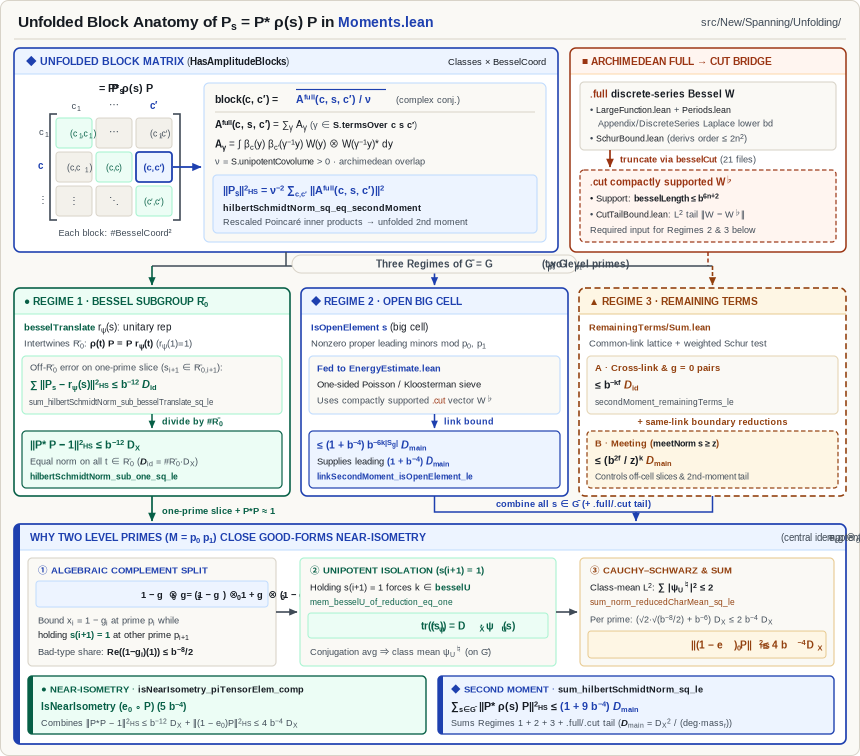
( besselTranslate): Termslying inside the Bessel subgroup itself do not mix across distant orbits; their normalized block sum forms an explicit unitary Bessel translate operator on the source space with . Whenever matches at one of the two level primes, all remaining terms outside the Bessel subgroup contribute at most , forcing ( hilbertSchmidtNorm_sub_one_sq_le) and letting Stage 04 bound the bad-type projection losscentral idempotent via the induced unipotent character mean( sum_norm_reducedCharMean_sq_le). - Open big-cell terms: Terms lying in the generic cell where all leading frame minors are nonzero feed into the one-sided Poisson summation sieve pairing archimedean band-limited kernels with finite Kloosterman densitiesKloosterman sieve, contributing the main second moment
. - Remaining degenerate and cross-link terms: Non-generic terms and pairs of orbits whose common-link sublatticeslink lattice differ or meet modulo the level are suppressed far below the main term using Siegel's lemma and a weighted Schur test.
To make the second and third estimates work with compactly supported integrands, Stage 04 also replaces the full discrete-series Bessel vector .full) by a cut Bessel function .cut) supported on bounded Bessel length
Limits of the intuition
Picturing HasAmplitudeBlocks. First, the Poincaré map unfolds verbatim to the full discrete-series Bessel vector (amplitude .full), whereas both EnergyEstimate.lean and RemainingTerms/Sum.lean operate on the compactly supported cut Bessel function (amplitude .cut), bridged back to .full by the explicit Bessel/{LargeFunction,SchurBound,CutTailBound}.lean and the Laplace-method period lower bound in src/New/Appendix/DiscreteSeries/Periods.lean. Second, HasAmplitudeBlocks encodes an exact complex-conjugate block convention (star (A(c, s, c') / ν)) whose equivariance laws P_{st} = P_s r_ψ(t) and P_{ts} = r_ψ(t) P_s are essential to collapse the near-
Level 2 — Undergrad Bridge
The unfolding identity generalizes Petersson's inner-product formula for Poincaré series (Petersson 1932) into the unitary Bessel relative trace formula framework (Liu 2014), with archimedean period lower bounds and localization informed by the orbit-method philosophy of Nelson–Venkatesh (2021).
1. Amplitude blocks and scaling (SpanningTheorem.lean, Moments.lean)
Let S.Classes of the definite subgroup S.BesselCoord. The source space is EuclideanSpace ℂ (S.Classes × S.BesselCoord) of dimension D.poincareScale D.scaledPoincare, which satisfies hasAmplitudeBlocks_scaledPoincare (HasAmplitudeBlocks): for every
where S.classCutoff c over the real unipotent group, and hilbertSchmidtNorm_sq_eq_secondMoment),
2. The Bessel translate Moments.lean, lines 157–512)
Restricting the sum inside each block to rational elements S.besselTranslate s (
for ( besselTranslate_eq_zero);- on
, is a unitary representation: , , and ; intertwines and : ( rep_comp_eq_comp_besselTranslate), giving two-sided equivarianceand .
Subtracting the Bessel-subgroup terms leaves only hilbertSchmidtNorm_sub_besselTranslate_sq). Summing over all sum_hilbertSchmidtNorm_sub_besselTranslate_sq_le:
Because le_sourceDim_div_of_card_nsmul_le) immediately gives
3. Whole-group second moment and the induced unipotent character mean (Moments.lean, lines 554–1029)
- Whole-group second moment (
sum_hilbertSchmidtNorm_sq_le): Combining the Bessel-subgroup contribution, the.fullvs..cuttail estimate, the open big-cell Kloosterman sieve (EnergyEstimate.lean), and the remaining-term link bounds (RemainingTerms/Sum.lean) bounds the entire group sum: - Induced unipotent character mean (
sum_norm_reducedCharMean_sq_le): Letbe the additive character of integral unipotent reductions extended by to , and let be its average over all conjugates of in . Rewriting as a -orbital integral ( integral_extendedBesselChar_conj_eq) yields thebound which drives the one-prime bad-type trace bound .
Level 3 — Formal Lean Contract
Stage 04 extracts the unfolding and second-moment theorems into skeleton/04_spanning/spanning_theorem.lean and skeleton/04_spanning/moments.lean:
04_spanning/spanning_theorem.lean#New.Data.hasAmplitudeBlocks_scaledPoincare(upstreamsrc/New/Spanning/SecondMoment/SpanningTheorem.lean:153-173):leantheorem New.Data.hasAmplitudeBlocks_scaledPoincare : D.filling.HasAmplitudeBlocks D.levelRepresentation D.scaledPoincare04_spanning/moments.lean#New.Filling.HasAmplitudeBlocks(upstreamsrc/New/Spanning/Unfolding/Moments.lean:86-100):leandef New.Filling.HasAmplitudeBlocks (ρ : Representation ℂ S.ResidueGL V) (P : EuclideanSpace ℂ (S.Classes × S.BesselCoord) →ₗ[ℂ] V) : Prop04_spanning/moments.lean#New.Filling.besselTranslate(upstreamsrc/New/Spanning/Unfolding/Moments.lean:157-167):leannoncomputable def New.Filling.besselTranslate (s : S.ResidueGL) : EuclideanSpace ℂ (S.Classes × S.BesselCoord) →ₗ[ℂ] EuclideanSpace ℂ (S.Classes × S.BesselCoord)04_spanning/moments.lean#New.Filling.sum_norm_reducedCharMean_sq_le(upstreamsrc/New/Spanning/Unfolding/Moments.lean:991-1029):leantheorem New.Filling.sum_norm_reducedCharMean_sq_le [ok : S.IsAdmissible] : ∑ s : S.ResidueGL, ‖S.reducedCharMean s‖ ^ 2 ≤ 204_spanning/moments.lean#New.Filling.HasAmplitudeBlocks.sum_hilbertSchmidtNorm_sq_le(upstreamsrc/New/Spanning/Unfolding/Moments.lean:554-583):leantheorem New.Filling.HasAmplitudeBlocks.sum_hilbertSchmidtNorm_sq_le [WeilData E] (hP : S.HasAmplitudeBlocks ρ P) (hρ : ∀ (s : S.ResidueGL) (x y : V), ⟪ρ s x, ρ s y⟫_ℂ = ⟪x, y⟫_ℂ) : ∑ s : S.ResidueGL, hilbertSchmidtNorm (P.adjoint ∘ₗ ρ s ∘ₗ P) ^ 2 ≤ (1 + 9 / S.b ^ 4) * S.mainSecondMoment
See the page's live <VerificationBanner /> (audit/verification-status.json) for the pinned upstream commit and local Lean build status (build_status: unverified-locally).
Where this analogy breaks
Picturing P_s = P* ρ(s) P as a block matrix whose entries are ordinary overlap integrals of translated wave packets captures why the identity regime looks diagonal and why distant elements γ oscillate away, but omits the two-step truncation at infinity: the actual Poincaré map unfolds to the full discrete-series Bessel vector (.full), whereas both the main-term sieve and remaining-term bounds require compact support modulo the Bessel subgroup via the cut Bessel function (.cut), linked back to .full through CutTailBound.lean and SchurBound.lean.
Formal Lean Anchors
theorem New.Data.hasAmplitudeBlocks_scaledPoincare — Upstream source (src/New/Spanning/SecondMoment/SpanningTheorem.lean L153-L173)
/-- **Unfolding.** Let `S = D.filling` and let `P = D.scaledPoincare` be the scaled Poincaré map.
Let `s` lie in `S.ResidueGL`, the product of the general linear groups over the residue fields at
the chosen places above each of the two level primes. For classes `c, c'` and Bessel coordinates
`i, j`, with basis vectors `e` of the source, `⟪s P e_(c', j), P e_(c, i)⟫ = ν⁻¹ ∑_γ A_γ(i, j)`. The
sum is over the rational `γ` such that `h_c⁻¹ γ h_c'` is integral with reduction `s` (`S.termsOver`,
where `h_c = S.classRep c`). The amplitude `A_γ = S.amplitude .full c c' γ` is an integral over the
infinite places of `W(y) ⊗ W(γ⁻¹ y)^*` against cutoffs, where `.full` selects the Bessel function
`W` itself and not its cut. The explicit number `ν = S.unipotentCovolume` is the covolume, the same
for all `c`, of the group `S.classUnipotent c` of rational unipotent points in the real unipotent
group. -/
theorem New.Data.hasAmplitudeBlocks_scaledPoincare :
D.filling.HasAmplitudeBlocks D.levelRepresentation D.scaledPoincare := by
sorry -- [EXTRACTED_STUB upstream=src/New/Spanning/SecondMoment/SpanningTheorem.lean:153-173 commit=41c2716658c42ba08eb0648994a2efe83082a95c body_lines=10 body_sha256=9a36517473b1fd064729189ddca831fcd450ed676504d1b63eb959a7508f5151]def New.Filling.HasAmplitudeBlocks — Upstream source (src/New/Spanning/Unfolding/Moments.lean L86-L100)
/-- Let `Ḡ = S.ResidueGL` be the product of the general linear groups over the residue fields at the
chosen places of `S`. The source is the Euclidean space with coordinates `(c, i)`, where `c` is a
class (a double coset of the definite unitary group `U(X₀)` for the level) and `i` is a coordinate
of the Bessel function `W` at the infinite places. For a representation `ρ` of `Ḡ` on `V` and a
linear map `P` from the source to `V`, this says that the block `(c, c')` of `P_s = P* ρ(s) P` is
the complex conjugate of `A(c, s, c') / ν`. Here `ν = unipotentCovolume`, and
`A(c, s, c') = amplitudeSum .full .univ c s c'` is the sum of the amplitudes
`∫ β_c(y) β_c'(γ⁻¹ y) W(y) ⊗ W(γ⁻¹ y)^* dy` over all terms, the rational `γ` such that
`h_c⁻¹ γ h_c'` is integral with reduction `s`; `h_c` represents the class `c` and
`β_c = classCutoff c`. This holds for the Poincaré map after scaling. -/
def New.Filling.HasAmplitudeBlocks (ρ : Representation ℂ S.ResidueGL V)
(P : EuclideanSpace ℂ (S.Classes × S.BesselCoord) →ₗ[ℂ] V) : Prop := by
sorry -- [EXTRACTED_STUB upstream=src/New/Spanning/Unfolding/Moments.lean:86-100 commit=41c2716658c42ba08eb0648994a2efe83082a95c body_lines=3 body_sha256=a5d7cb3624a4a2a558f978701bf06a2bfed3f1a48686d720e360f4b6e78fd7f9]def New.Filling.besselTranslate — Upstream source (src/New/Spanning/Unfolding/Moments.lean L157-L167)
/-- The operator `r_ψ(s)` on the source: its blocks are the complex conjugates of the sums of
amplitudes (`amplitudeSum`) of the terms in the Bessel subgroup, divided by `unipotentCovolume`. For
`s` in the image `R̄₀` of the Bessel subgroup it is the translation by `s`, twisted by the
character: each class `c` has a term of the Bessel subgroup over some block `(c, s, c')`
(`exists_besselS_mem_termsOver`), its matrix is given by `besselFn_mul_of_eq_embedH`, and
`besselTranslate_apply` gives the value of the operator. -/
noncomputable def New.Filling.besselTranslate (s : S.ResidueGL) :
    EuclideanSpace ℂ (S.Classes × S.BesselCoord) →ₗ[ℂ]
EuclideanSpace ℂ (S.Classes × S.BesselCoord) := by
sorry -- [EXTRACTED_STUB upstream=src/New/Spanning/Unfolding/Moments.lean:157-167 commit=41c2716658c42ba08eb0648994a2efe83082a95c body_lines=2 body_sha256=a5fa76bc225c778dea312a5ec62fd74d8fce3c907abe63fd4a0ef22bbc752ee2]theorem New.Filling.sum_norm_reducedCharMean_sq_le — Upstream source (src/New/Spanning/Unfolding/Moments.lean L991-L1029)
/-- **The induced character.** Let `S` be admissible filling data for a unitary group `G` over the
CM field `E`, which carries Weil data, and let `Ḡ = S.ResidueGL` be the product of the general
linear groups over the residue fields at the chosen places above the two level primes `p₀`, `p₁`.
Let `ψ_U = S.reducedChar` be the additive character (`unipotentChar`) of the integral block
unitriangular elements of `G`, read on their reductions in `Ḡ` and extended by `0`, and let
`ψ_U^♮(s) = S.reducedCharMean s` be its mean over the conjugates of `s`. Then `∑ |ψ_U^♮(s)|² ≤ 2`,
the sum being over all `s` in `Ḡ`. -/
theorem New.Filling.sum_norm_reducedCharMean_sq_le [ok : S.IsAdmissible] :
∑ s : S.ResidueGL, ‖S.reducedCharMean s‖ ^ 2 ≤ 2 := by
sorry -- [EXTRACTED_STUB upstream=src/New/Spanning/Unfolding/Moments.lean:991-1029 commit=41c2716658c42ba08eb0648994a2efe83082a95c body_lines=31 body_sha256=a268790e34a430687165e9aa1d7c130d3122ac77fd6c8447433aa6008fcd415f]theorem New.Filling.HasAmplitudeBlocks.sum_hilbertSchmidtNorm_sq_le — Upstream source (src/New/Spanning/Unfolding/Moments.lean L554-L583)
/-- **Second moment.** Let `S` be admissible filling data (`Filling`, `IsAdmissible`) for a unitary
group `G` over the CM field `E`, which carries Weil data (a primitive `5040`-th root of unity and a
splitting character, see `WeilData`), and let `Ḡ = S.ResidueGL` be the product of the general linear
groups over the residue fields at the chosen places above the two level primes `p₀`, `p₁`. The
source is the Euclidean space with coordinates `(c, i)`, where `c` is a class (a double coset of the
definite unitary group `U(X₀)` for the level) and `i` is a coordinate of the Bessel function `W` at
the infinite places. Let `ρ` be a unitary representation of `Ḡ` on `V` and `P` a linear map from the
source to `V`. Suppose `HasAmplitudeBlocks`: the block `(c, c')` of `P_s = P* ρ(s) P` is the
conjugate of `A(c, s, c') / ν`, where `ν = S.unipotentCovolume > 0` and `A(c, s, c')` is the sum,
over the rational `γ` in `G` such that `h_c⁻¹ γ h_c'` is integral with reduction `s`, of an integral
of `W(y) ⊗ W(γ⁻¹ y)^*` against cutoffs (`h_c` represents the class `c`). Then
`∑ ‖P_s‖² ≤ (1 + 9 b⁻⁴) 𝒟_main` in Hilbert–Schmidt norm, the sum being over all `s` in `Ḡ`. Here
`b = S.b ≥ 1000` is the size parameter of `S`, and `𝒟_main = S.mainSecondMoment` is the square of
the dimension of the source divided by the product of `S.besselDegree` (the product of the degree
constants of the local Bessel systems) and `New.mass` (the sum of `1 / #Aut` over the genus of the
standard lattice). -/
theorem New.Filling.HasAmplitudeBlocks.sum_hilbertSchmidtNorm_sq_le [WeilData E] (hP : S.HasAmplitudeBlocks ρ P)
    (hρ : ∀ (s : S.ResidueGL) (x y : V), ⟪ρ s x, ρ s y⟫_ℂ = ⟪x, y⟫_ℂ) :
    ∑ s : S.ResidueGL, hilbertSchmidtNorm (P.adjoint ∘ₗ ρ s ∘ₗ P) ^ 2 ≤
(1 + 9 / S.b ^ 4) * S.mainSecondMoment := by
sorry -- [EXTRACTED_STUB upstream=src/New/Spanning/Unfolding/Moments.lean:554-583 commit=41c2716658c42ba08eb0648994a2efe83082a95c body_lines=11 body_sha256=293cc522ef1fea7b9dffb43458107169bbd4f22ba48192c16bff930b2d7723ef]Related Concepts
- seesaw duality — A dual-pair adjunction identity that trades an iterated lower-chain theta lift of a Poincaré series for a nonzero twist-independent scalar times the restriction of an upper-chain composite theta lift.
- Hilbert–Schmidt norm — The Frobenius-style root-sum-of-squares norm on linear maps whose second moment over group translates, paired with near-isometry on the good subspace, proves Welch-style spreading and Wolsey greedy covering for Theorem B.
- central idempotent — A class-function element of a finite group algebra satisfying z² = z that acts as a G-equivariant orthogonal projection, splitting good cuspidal types from rare bad types across two level primes.
- Kloosterman sieve — A global entry-by-entry one-sided Poisson summation engine pairing archimedean band-limited Bessel Gram matrices with finite Kloosterman densities to bound the big-cell second moment by (1 + b⁻⁴) b⁻⁶ᵏ|S_g| D_main ν².
- link lattice — The Hermitian sublattice shared by two rational filling terms over one reduction block, whose discriminant and Bombieri–Vaaler Siegel's lemma counts crush cross-link and non-open terms via a weighted Schur test.
Referenced By
- Stage: Relative-Trace Unfolding, Bessel Translates, and the Two Moment Bounds
- Stage: Stage 04 — Spanning: Second Moment (Theorem B)
- Stage: Target Dimension, Multiplicity Equality, and One Good Translate
- Stage: The Big-Cell Kloosterman Sieve and Remaining-Term Link Bounds
- Concept: central idempotent
- Concept: Hilbert–Schmidt norm
- Concept: Kloosterman sieve
- Concept: link lattice
Authoritative Sources
- Über die Entwicklungskoeffizienten der automorphen Formen (paper) — H. Petersson, Acta Math. 58 (1932), 169–215.
- Relative trace formulae toward Bessel and Fourier–Jacobi periods on unitary groups (paper) — Y. Liu, Manuscripta Math. 145 (2014), 1–69.
- The orbit method and analysis of spherical functions (paper) — P. Nelson & A. Venkatesh, Acta Math. 226 (2021), 1–209.
Page Glossary
- seesaw duality
- A dual-pair adjunction identity that trades an iterated lower-chain theta lift of a Poincaré series for a nonzero twist-independent scalar times the restriction of an upper-chain composite theta lift.
- Hilbert–Schmidt norm
- The Frobenius-style root-sum-of-squares norm on linear maps whose second moment over group translates, paired with near-isometry on the good subspace, proves Welch-style spreading and Wolsey greedy covering for Theorem B.
- central idempotent
- A class-function element of a finite group algebra satisfying z² = z that acts as a G-equivariant orthogonal projection, splitting good cuspidal types from rare bad types across two level primes.
- Kloosterman sieve
- A global entry-by-entry one-sided Poisson summation engine pairing archimedean band-limited Bessel Gram matrices with finite Kloosterman densities to bound the big-cell second moment by (1 + b⁻⁴) b⁻⁶ᵏ|S_g| D_main ν².
- link lattice
- The Hermitian sublattice shared by two rational filling terms over one reduction block, whose discriminant and Bombieri–Vaaler Siegel's lemma counts crush cross-link and non-open terms via a weighted Schur test.