Riemann zeta function
Also known as: zeta function.
The meromorphic function ζ(s) extending ∑ n⁻ˢ to all of ℂ ∖ {1}, linking prime numbers via its Euler product to zeros in the complex plane.
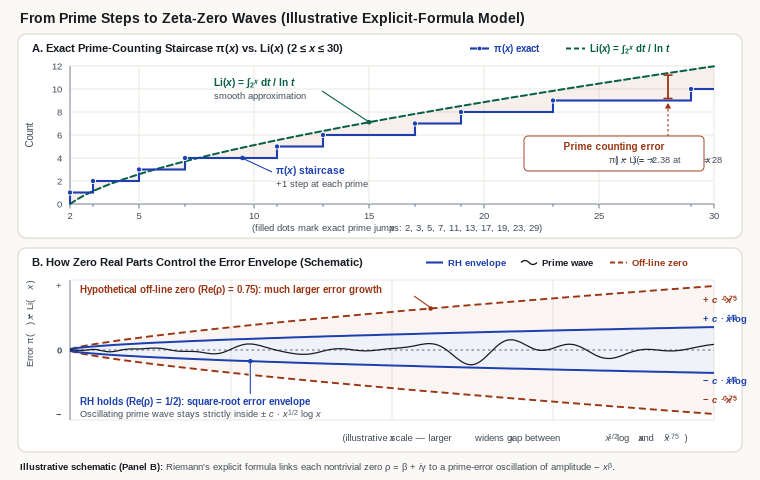
Level 1 — First-Principles
For any real number
For
In 1859, Bernhard Riemann extended this formula to the entire plane (except a single pole at
Limits of the intuition
Thinking of
Level 2 — Undergrad Bridge
For
Multiplying by the archimedean gamma factor produces the completed zeta function
which continues meromorphically to
This symmetry pairs any zero
Because
Level 3 — Formal Lean Contract
In Mathlib4 (Mathlib.NumberTheory.LSeries.RiemannZeta), riemannZeta : ℂ → ℂ is defined via the Mellin transform of the Jacobi theta function and equals completedRiemannZeta s / Gammaℝ s away from s = 0 (with riemannZeta 0 = -1 / 2; s ≠ 1 is explicitly excluded in the hypothesis so the statement stays independent of Mathlib's total-function junk value at the simple pole riemannZeta 1 to be nonzero via riemannZeta_one_ne_zero, making the guard redundant but harmless).
Stage 00 anchors this function in:
00_statement/statements.lean#RiemannZetaZerosOnLine(upstreamsrc/Statements.lean:7-8):leandef RiemannZetaZerosOnLine : Prop := ∀ s : ℂ, riemannZeta s = 0 → (¬∃ n : ℕ, s = -2 * ((n : ℂ) + 1)) → s ≠ 1 → s.re = 1 / 200_statement/main.lean#riemannZeta_eq_zero_re(upstreamsrc/Main.lean:11-12), which witnessesRiemannZetaZerosOnLinedirectly fromriemannHypothesis.
See the page's live verification banner (audit/verification-status.json) for the currently pinned upstream snapshot and local Lean build status (build_status: unverified-locally; entry static scan reports 0 forbidden tokens in solution files and 5 expected sorrys in root Challenge.lean).
Where this analogy breaks
Writing
Formal Lean Anchors
def RiemannZetaZerosOnLine — Upstream source (src/Statements.lean L7-L8)
def RiemannZetaZerosOnLine : Prop :=
∀ s : ℂ, riemannZeta s = 0 → (¬∃ n : ℕ, s = -2 * ((n : ℂ) + 1)) → s ≠ 1 → s.re = 1 / 2theorem riemannZeta_eq_zero_re — Upstream source (src/Main.lean L11-L12)
/-- Every zero of ζ other than the trivial zeros −2, −4, … (and the point 1) has real part 1/2. -/
theorem riemannZeta_eq_zero_re : RiemannZetaZerosOnLine := by
  sorry -- [EXTRACTED_STUB upstream=src/Main.lean:11-12 commit=41c2716658c42ba08eb0648994a2efe83082a95c body_lines=1 body_sha256=c7d55f018299eab5ea1f4aaf73850a06adcfb51ad7807e7bb9661a43e11f68eb]
Related Concepts
- prime number — A whole number greater than 1 whose only positive whole-number divisors are 1 and itself; every integer above 1 factors uniquely into a product of them.
- infinite series — A limit of partial sums formed by adding infinitely many terms; in number theory, weighting terms by n⁻ˢ produces a Dirichlet series that turns integer arithmetic into a smooth function.
- complex plane — The two-dimensional coordinate plane of numbers s = σ + it, where the horizontal coordinate σ = Re(s) sets decay rate and the vertical coordinate t = Im(s) sets oscillation frequency.
- analytic continuation — The unique extension of a complex-differentiable function from a smaller region to a larger domain, locked in place by the identity theorem.
- trivial zero — A zero at a non-positive integer forced purely by poles of the gamma factor in the functional equation, carrying no hidden information about prime fluctuations.
- critical strip — The open vertical band 0 < Re(s) < 1 in the complex plane that contains every nontrivial zero of ζ(s) and of every Dirichlet L-function.
- critical line — The vertical line Re(s) = 1/2 bisecting the critical strip—the axis of mirror symmetry s ↦ 1 − s where the Riemann Hypothesis asserts all nontrivial zeros lie.
Referenced By
- Stage: Formal Statement Contracts (
Statements.lean) - Stage: From a One-Sided Prime Bound to a Zero-Free Half-Plane
- Stage: Full Proof Journey & Alpöge's 20-Step Map
- Stage: Independent Statement Equivalence (
FormalConjecturesStatement&FormalConjecturesChallenge) - Stage: Stage 00 — Formal Statements & Challenge Contracts
- Stage: Stage 01 — The Theorem and Its Reduction
- Stage: The Five Entry Theorems (
Main.lean&Challenge.lean) - Concept: analytic continuation
- Concept: critical line
- Concept: critical strip
- Concept: Dirichlet L-function
- Concept: formal verification
- Concept: infinite series
- Concept: prime number
- Concept: trivial zero
- Concept: von Mangoldt function
Authoritative Sources
- Ueber die Anzahl der Primzahlen unter einer gegebenen Grösse (paper) — B. Riemann, Monatsberichte der Königlichen Preussischen Akademie der Wissenschaften zu Berlin (November 1859), pp. 671–680.
- The Theory of the Riemann Zeta-Function (book) — E. C. Titchmarsh, 2nd ed. (revised by D. R. Heath-Brown), Oxford University Press (1986), Chapters 1–2.
- Mathlib4: riemannZeta (mathlib) — Mathlib.NumberTheory.LSeries.RiemannZeta (
riemannZeta,RiemannHypothesis, pinned mathlib rev 31ce06eaadf4a200c0e1407c5f10953cf606b8f8).
Page Glossary
- complex plane
- The two-dimensional coordinate plane of numbers s = σ + it, where the horizontal coordinate σ = Re(s) sets decay rate and the vertical coordinate t = Im(s) sets oscillation frequency.
- infinite series
- A limit of partial sums formed by adding infinitely many terms; in number theory, weighting terms by n⁻ˢ produces a Dirichlet series that turns integer arithmetic into a smooth function.
- prime number
- A whole number greater than 1 whose only positive whole-number divisors are 1 and itself; every integer above 1 factors uniquely into a product of them.
- analytic continuation
- The unique extension of a complex-differentiable function from a smaller region to a larger domain, locked in place by the identity theorem.
- trivial zero
- A zero at a non-positive integer forced purely by poles of the gamma factor in the functional equation, carrying no hidden information about prime fluctuations.
- critical strip
- The open vertical band 0 < Re(s) < 1 in the complex plane that contains every nontrivial zero of ζ(s) and of every Dirichlet L-function.
- critical line
- The vertical line Re(s) = 1/2 bisecting the critical strip—the axis of mirror symmetry s ↦ 1 − s where the Riemann Hypothesis asserts all nontrivial zeros lie.