theta square law
Also known as: square law, commuting theta square, up-then-down lift, edge family.
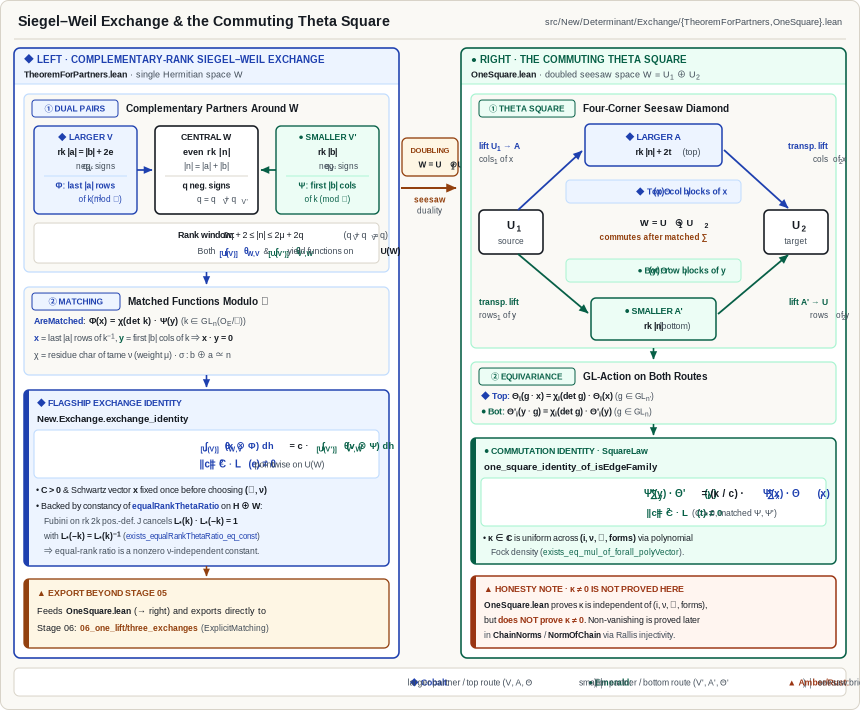
Commutation of theta lifts around a four-corner square (U_1, U_2, A, A'): summing down-then-up over matched matrix data equals (kappa / c) times summing up-then-down, with |c|^2 = C * L_*(t) != 0 and kappa independent of twist.
Level 1 — First-Principles
Imagine a diamond of four spaces of automorphic forms: a starting space
- Top route (up-then-down lift
): Lift a form from up to the larger space , then take the adjoint/reverse lift down from to , using the two column blocks of a matrix modulo . - Bottom route (down-then-up
): Descend from down to the smaller space , then lift back up from to , using the two row blocks of a matrix modulo .
The theta square law proves that these two routes commute—not matrix by matrix, but after summing over any pair of matched functions
Here
How does Stage 05 turn Siegel–Weil exchange into a commuting theta square? By the doubling trick of pairing a direct sum of two groups against one shared partner so a product of two kernels becomes a single kernel on the sumseesaw duality: set exchange_identity to the complementary triple
Both Stage 05 engines sit directly on top of this single square:
- In
NormOfChain.lean, tiling a triangular array of spaces with commuting theta squares slides every lift past every descent until the Gram form of the-step chain factors into a product of single-lift Rallis inner-product operatorsRallis inner product formula. - In
SpanningForms.lean, sweeping a path across two square grids viasquare turns transfers period integrals from the lower chain to short deep-level forms.
Limits of the intuition
Calling this a commuting theta square can mislead a reader into assuming the proportionality constant OneSquare.lean explicitly allows exchange_identity is only known to exist abstractly (approximated by polynomial Fock vectors via exists_eq_mul_of_forall_polyVector), one_square_identity_of_isEdgeFamily guarantees only that ChainNorms.lean and NormOfChain.lean (chainDeterminant_pos) from the injectivity of the first lifts in the convergent Rallis range.
Level 2 — Undergrad Bridge
src/New/Determinant/Exchange/OneSquare.lean translates the pointwise identity of TheoremForPartners.lean on SquareLaw:
- Equivariance under
modulo ( pairWeil_modDatum_single_mul_left,pairWeil_modDatum_single_mul_right,pairTransposedLift_comp_pairLift_mul,pairLift_comp_pairTransposedLift_mul): Left-multiplyingby scales by ; right-multiplying by scales by . - Factorization of kernels on
( modKernel_single_sum_left,modKernel_single_sum_right,integral_upIntegrand,integral_downIntegrand): For a product of Fock polynomialsand point-mass matrix datum (resp. ), the theta kernel on (resp. ) splits cleanly as a product of the two edge kernels on and (resp. and ) up to the character linking the two sides ( on , on ). - Extending from polynomials to arbitrary Schwartz vectors (
exists_integrable_kernel_bound,exists_upIntegrand_bound,exists_norm_integral_upIntegrand_sub_le,exists_eq_mul_of_forall_polyVector,exists_integral_upIntegrand_eq_mul_integral_lift): Becauseexchange_identityproduces a general Schwartz Fock vectorrather than a polynomial vector, OneSquare.leanboundsupIntegrandby a finite Fock momentfockMoment N w, proves Lipschitz continuity in, and passes from polynomials to all Schwartz vectors via density—producing the single twist-independent scalar (possibly ). - The square structure and edge-family specialization (
IsSquare,exists_sum_pairLift_comp_pairTransposedLift_eq_smul,equivariant_and_exists_sum_eq_of_areMatched,one_square_identity_of_isEdgeFamily):IsSquarebundles the rank gap, negative-sign additivity , the weight/sign window , tame ramification IsTameFor (𝔪 i) (ν i) μ (χ i), fourIsPairEdgeconditions, and fourspaceCharproduct identities matching. When the characters come from two edge families ( IsEdgeFamily),one_square_identity_of_isEdgeFamilypackages both-equivariance and the matched-sum identity into SquareLaw (χ i) σ (κ / c)for every formand linear functional .
Level 3 — Formal Lean Contract
Stage 05 extracts the square commutation law into skeleton/05_determinant/one_square.lean (32 declarations). Stub-truncation honesty notice: All three headline theorems (exists_sum_pairLift_comp_pairTransposedLift_eq_smul at L449, equivariant_and_exists_sum_eq_of_areMatched at L505, and one_square_identity_of_isEdgeFamily at L544), along with two integrability lemmas (exists_integrable_kernel_bound at L73, exists_norm_integral_upIntegrand_sub_le at L198), truncate at their let ... := return-type bindings in the extracted skeleton. Their complete untruncated statements from upstream src/New/Determinant/Exchange/OneSquare.lean are quoted verbatim in Siegel–Weil Exchange and the Commuting Theta Square.
05_determinant/one_square.lean#New.Exchange.IsSquare(untruncated; upstreamOneSquare.lean:684-722): bundles the 13 structural fields (negCount_eq,card_eq,negCount_lt_half,card_le_weight,tame,edge₁,edge₂,edge₁',edge₂',spaceChar_mul_up,spaceChar_mul_down,spaceChar_mul_first,spaceChar_mul_second).05_determinant/one_square.lean#New.Exchange.exists_sum_pairLift_comp_pairTransposedLift_eq_smul(upstreamOneSquare.lean:747-771): proves∃ C > 0, ∃ κ, ∀ i, ∃ c, ‖c‖^2 = C * lValueProd (𝔪 i).places (ν i) t ∧ ... ∧ ∑ y, Ψ' y • Θ' i y = (κ / c) • ∑ x, Ψ x • Θ i x.05_determinant/one_square.lean#New.Exchange.equivariant_and_exists_sum_eq_of_areMatched(upstreamOneSquare.lean:896-929): joins-equivariance of and with the matched-sum commutation identity. 05_determinant/one_square.lean#New.Exchange.one_square_identity_of_isEdgeFamily(upstreamOneSquare.lean:972-1003): specializes toIsEdgeFamilyand outputsSquareLaw (χ i) σ (κ / c).
See the page's live <VerificationBanner /> (audit/verification-status.json) for the pinned upstream commit and local Lean build status (build_status: unverified-locally).
Where this analogy breaks
Calling the theta square law a commuting diagram of linear maps hides two crucial caveats: first, individual point-datum lifts do not commute—commutation holds only after summing over matched matrix functions (Psi, Psi') modulo m; second, OneSquare.lean proves kappa is independent of the character, modulus, and forms, but does NOT compute kappa or prove kappa != 0 (non-vanishing is deduced later from Rallis injectivity in ChainNorms.lean and NormOfChain.lean).
Formal Lean Anchors
structure New.Exchange.IsSquare — Upstream source (src/New/Determinant/Exchange/OneSquare.lean L684-L722)
/-- A family of squares with the same real data. The corners are spaces `U₁`, `U₂`, `A`, `A'` with
signs `s₁`, `s₂`, `s'`, `s`, and `W = U₁ ⊕ U₂`. The pairs `(U₁, A)`, `(U₂, A)`, `(A', U₁)`,
`(A', U₂)` carry the characters `(a₁, b₁)`, `(a₂, b₂)`, `(b₁', a₁')`, `(b₂', a₂')`, which depend on
the member `i` of the family, and the polynomials `P₁`, `P₂`, `P₁'`, `P₂'`. For a character `α` of
`[U(1)]`, `α.baseChange` is the Hecke character `x ↦ α (x / x̄)`, and the splitting character of a
space of rank `m` that carries `α` is `α.spaceChar m = α.baseChange * υ⁻¹ ^ m`. -/
structure New.Exchange.IsSquare (t : ℕ) (μ : InfinitePlace E → ℤ) (𝔪 : I → Modulus E) (ν : I → AutChar E)
    (χ : ∀ i : I, MulChar (𝔪 i).ResidueRing ℂ) : Prop where
  /-- `W` has as many negative signs as `A` and `A'` together. -/
  negCount_eq : negCount (s₁ ⊕ᵥ s₂) = negCount s' + negCount s
  /-- The ranks of `A` and `A'` differ by `2 t`. -/
  card_eq : card n' = card n + 2 * t
  /-- Half the rank of `W` exceeds the number of its negative signs. -/
  negCount_lt_half : 2 * negCount (s₁ ⊕ᵥ s₂) + 2 ≤ card (n₁ ⊕ n₂)
  /-- The weights are at least this excess. -/
  card_le_weight (τ : InfinitePlace E) : card (n₁ ⊕ n₂) ≤ 2 * μ τ + 2 * negCount (s₁ ⊕ᵥ s₂)
  /-- The character `ν i` of `[U(1)]` is tame of weight `μ` for `(𝔪 i, χ i)`. -/
  tame (i : I) : IsTameFor (𝔪 i) (ν i) μ (χ i)
  /-- The pair `(U₁, A)` is an edge `e₁ → e`. -/
  edge₁ : IsPairEdge a₁ b₁ e₁ e P₁
  /-- The pair `(U₂, A)` is an edge `ē₂ → ē`. -/
  edge₂ : IsPairEdge a₂ b₂ (star e₂) (star e) P₂
  /-- The pair `(A', U₁)` is an edge `ē' → ē₁`. -/
  edge₁' : IsPairEdge b₁' a₁' (star e') (star e₁) P₁'
  /-- The pair `(A', U₂)` is an edge `e' → e₂`. -/
  edge₂' : IsPairEdge b₂' a₂' e' e₂ P₂'
  /-- On the side of `A`, the splitting characters of `U₁`, `U₂` multiply to `ν̃⁻¹`, the inverse
  base change of `ν`. -/
  spaceChar_mul_up (i : I) : (a₁ i).spaceChar (card n₁) * (a₂ i).spaceChar (card n₂) =
    (ν i).baseChange⁻¹
  /-- So do those on the side of `A'`. -/
  spaceChar_mul_down (i : I) :
    (a₁' i).spaceChar (card n₁) * (a₂' i).spaceChar (card n₂) = (ν i).baseChange⁻¹
  /-- At `U₁`, the splitting characters of `A`, `A'` multiply to `ν̃⁻¹`. -/
  spaceChar_mul_first (i : I) : (b₁ i).spaceChar (card n') * (b₁' i).spaceChar (card n) =
    (ν i).baseChange⁻¹
  /-- So do those at `U₂`. -/
  spaceChar_mul_second (i : I) :
    (b₂ i).spaceChar (card n') * (b₂' i).spaceChar (card n) = (ν i).baseChange⁻¹
theorem New.Exchange.exists_sum_pairLift_comp_pairTransposedLift_eq_smul — Upstream source (src/New/Determinant/Exchange/OneSquare.lean L726-L852)
/-- On matched functions, a transposed lift followed by a lift is a multiple, possibly zero, of a
lift followed by a transposed lift.

The family satisfies `IsSquare`: the four pairs are edges; `ν i` is tame for `𝔪 i ≠ 1`: weight `μ`
at infinity, tame part nontrivial exactly at the places dividing `𝔪 i`, defining `χ i` on the
residue ring; `card n' = card n + 2 t`; the number `N` of negative signs of `W = U₁ ⊕ U₂` is that of
`A` and `A'` together, with `2 N + 2 ≤ card (n₁ ⊕ n₂) ≤ 2 μ τ + 2 N`; the splitting characters
`x ↦ α (x / x̄) * υ x ^ (-m)` of spaces of rank `m` with character `α`, `υ` being the splitting
character of the Weil data, multiply in pairs to the inverse base change of `ν i`. Let `σ` order the
index set of `W` as that of `A'` followed by that of `A`. Let `Θ i x` be the lift from `U₁` to `A`
followed by the transposed lift to `U₂`, and `Θ' i y` the transposed lift to `A'` followed by the
lift to `U₂`, the data modulo `𝔪 i` being the indicator functions of the blocks of `x`, `y`.

There are `C > 0` and `κ`, possibly zero, and for each `i` a number `c` with
`‖c‖ ^ 2 = C * lValueProd (𝔪 i).places (ν i) t ≠ 0`, such that
`∑ Ψ' y • Θ' i y = (κ / c) • ∑ Ψ x • Θ i x` for all matched functions `Ψ`, `Ψ'` of matrices modulo
`𝔪 i`. Here `lValueProd S ν t = ∏_{w ∈ S} q_w ^ (t ^ 2) ∏_{1 ≤ z ≤ t} |L^S(z, ν)| ^ 2`, with `q_w`
the residue cardinality and `L^S(z, ν)` the Euler product of the base change of `ν` outside
`S ∪ S̄`. Matched over the whole residue ring (`⊤`) means: as `k` runs over the invertible matrices
indexed by `n₁ ⊕ n₂`, `Ψ` vanishes off the blocks `x` of rows `n'` of `k⁻¹`, `Ψ'` vanishes off the
blocks `y` of columns `n` of `k`, and `Ψ x = χ i (det k) * Ψ' y` for the two blocks of one `k`. -/
theorem New.Exchange.exists_sum_pairLift_comp_pairTransposedLift_eq_smul
    (A' : Space E n s) (A : Space E n' s') (U₁ : Space E n₁ s₁) (U₂ : Space E n₂ s₂)
    {I : Type*} {e : GInf E s' → ℂ} {e' : GInf E s → ℂ} {e₁ : GInf E s₁ → ℂ} {e₂ : GInf E s₂ → ℂ}
    {a₁ a₂ b₁ b₂ a₁' a₂' b₁' b₂' : I → AutChar E}
    {P₁ : MvPolynomial (InfinitePlace E × n' × n₁) ℂ}
    {P₂ : MvPolynomial (InfinitePlace E × n' × n₂) ℂ}
    {P₁' : MvPolynomial (InfinitePlace E × n₁ × n) ℂ}
    {P₂' : MvPolynomial (InfinitePlace E × n₂ × n) ℂ} (σ : n ⊕ n' ≃ n₁ ⊕ n₂) {t : ℕ}
    {μ : InfinitePlace E → ℤ} {𝔪 : I → Modulus E} {ν : I → AutChar E}
    {χ : ∀ i : I, MulChar (𝔪 i).ResidueRing ℂ}
    (h_square : IsSquare e e' e₁ e₂ a₁ a₂ b₁ b₂ a₁' a₂' b₁' b₂' P₁ P₂ P₁' P₂' t μ 𝔪 ν χ) :
    let Θ (i : I) (x : Matrix n' (n₁ ⊕ n₂) (𝔪 i).ResidueRing) : U₁.Form e₁ →ₗ[ℂ] U₂.Form e₂ := by
  sorry -- [EXTRACTED_STUB upstream=src/New/Determinant/Exchange/OneSquare.lean:726-852 commit=41c2716658c42ba08eb0648994a2efe83082a95c body_lines=94 body_sha256=8611c695f690118be36d72bfb536b306f5d7321093d8bfa6849240d22273741b]
theorem New.Exchange.equivariant_and_exists_sum_eq_of_areMatched — Upstream source (src/New/Determinant/Exchange/OneSquare.lean L854-L948)
/-- One square: two ways to lift forms from `U₁` to `U₂`, through `A` or through `A'`, transform by
the same character and agree on matched functions up to a constant.

Let `E` be a CM field with Weil data, which fix a splitting Hecke character `υ` of `E`. Let `A'`,
`A`, `U₁`, `U₂` be hermitian spaces over `E` with index sets `n`, `n'`, `n₁`, `n₂` and signs `s`,
`s'`, `s₁`, `s₂` at the infinite places (`A'` goes with the unprimed letters). Let `σ` order the
index set of `W = U₁ ⊕ U₂` as `n` followed by `n'`. The types `e'`, `e`, `e₁`, `e₂` are functions on
the real unitary groups (`GInf`) of the four spaces; a type prescribes the behavior of a form at the
infinite places, and `U₁.Form e₁` is the space of forms of type `e₁` on `U₁`. For `i` in a set `I`,
the pairs `(U₁, A)`, `(U₂, A)`, `(A', U₁)`, `(A', U₂)` carry the characters `(a₁ i, b₁ i)`,
`(a₂ i, b₂ i)`, `(b₁' i, a₁' i)`, `(b₂' i, a₂' i)` of `[U(1)]`, the norm-one ideles of `E` modulo
those from `E`, and the polynomials `P₁`, `P₂`, `P₁'`, `P₂'`, whose Fock vectors are the real theta
data.

The hypothesis `IsSquare` says:
* the rank of `A` is that of `A'` plus `2 t`;
* the number `N` of negative signs of `W` is that of `A` and `A'` together, and
  `2 N + 2 ≤ card (n₁ ⊕ n₂) ≤ 2 μ τ + 2 N` at every infinite place `τ`;
* `ν i` is tame for `𝔪 i ≠ 1`: it has weight `μ` at the infinite places, and its tame part is
  nontrivial exactly at the places dividing `𝔪 i` and defines the character `χ i` of the residue
  ring `R = 𝓞 E / 𝔪 i`;
* the four pairs are edges `e₁ → e`, `ē₂ → ē`, `ē' → ē₁`, `e' → e₂`, a bar being complex conjugation
  (`New.Exchange.IsPairEdge`): the characters have weights independent of `i`, and the theta
  integral lifts forms of the first type to forms of the second;
* with `α[m]` the Hecke character `x ↦ α (x / x̄) * υ x ^ (-m)`, each of the four products
  `a₁[card n₁] a₂[card n₂]`, `a₁'[card n₁] a₂'[card n₂]`, `b₁[card n'] b₁'[card n]`,
  `b₂[card n'] b₂'[card n]` at `i` is the inverse of the base change `x ↦ ν i (x / x̄)`.

For a matrix `x` over `R`, `Θ i x` is the theta lift (`pairLift`) from `U₁` to `A` followed by the
transposed lift (`pairTransposedLift`) to `U₂`; the data modulo `𝔪 i` are the indicator functions of
the two column blocks of `x`. For a matrix `y` over `R`, `Θ' i y` is the transposed lift from `U₁`
to `A'` followed by the lift to `U₂`, for the indicator functions of the two row blocks of `y`.
Then:

(a) `Θ i (g x) = χ i (det g) • Θ i x` and `Θ' i (y g) = χ i (det g) • Θ' i y` for invertible `g`.

(b) There are `C > 0` and a number `κ`, possibly zero, both independent of `i`, and for each `i` a
number `c` with `‖c‖ ^ 2 = C * lValueProd S (ν i) t ≠ 0`, such that
`∑ Ψ' y • Θ' i y = (κ / c) • ∑ Ψ x • Θ i x` for all matched `Ψ`, `Ψ'`. Here `S` is the set of places
dividing `𝔪 i`, and `lValueProd S ν t = ∏_{w ∈ S} q_w ^ (t ^ 2) ∏_{1 ≤ z ≤ t} |L^S(z, ν)| ^ 2`, with
`q_w` the residue cardinality and `L^S(z, ν)` the Euler product of the base change of `ν` outside
`S ∪ S̄`. -/
theorem New.Exchange.equivariant_and_exists_sum_eq_of_areMatched {E n n' n₁ n₂ : Type} [Field E] [CMType E]
    [WeilData E] [Fintype n] [DecidableEq n] [Fintype n'] [DecidableEq n']
    [Fintype n₁] [DecidableEq n₁] [Fintype n₂] [DecidableEq n₂]
    {s : n → ℤˣ} {s' : n' → ℤˣ} {s₁ : n₁ → ℤˣ} {s₂ : n₂ → ℤˣ}
    (A' : Space E n s) (A : Space E n' s') (U₁ : Space E n₁ s₁) (U₂ : Space E n₂ s₂) {I : Type*}
    {e : GInf E s' → ℂ} {e' : GInf E s → ℂ} {e₁ : GInf E s₁ → ℂ} {e₂ : GInf E s₂ → ℂ}
    {a₁ a₂ b₁ b₂ a₁' a₂' b₁' b₂' : I → AutChar E}
    {P₁ : MvPolynomial (InfinitePlace E × n' × n₁) ℂ}
    {P₂ : MvPolynomial (InfinitePlace E × n' × n₂) ℂ}
    {P₁' : MvPolynomial (InfinitePlace E × n₁ × n) ℂ}
    {P₂' : MvPolynomial (InfinitePlace E × n₂ × n) ℂ} (σ : n ⊕ n' ≃ n₁ ⊕ n₂) {t : ℕ}
    {μ : InfinitePlace E → ℤ} {𝔪 : I → Modulus E} {ν : I → AutChar E}
    {χ : ∀ i : I, MulChar (𝔪 i).ResidueRing ℂ}
    (h_square : IsSquare e e' e₁ e₂ a₁ a₂ b₁ b₂ a₁' a₂' b₁' b₂' P₁ P₂ P₁' P₂' t μ 𝔪 ν χ) :
    let Θ (i : I) (x : Matrix n' (n₁ ⊕ n₂) (𝔪 i).ResidueRing) : U₁.Form e₁ →ₗ[ℂ] U₂.Form e₂ := by
  sorry -- [EXTRACTED_STUB upstream=src/New/Determinant/Exchange/OneSquare.lean:854-948 commit=41c2716658c42ba08eb0648994a2efe83082a95c body_lines=38 body_sha256=db5c35252c59f9abf4869635e3c9128fcd87c240a0edbd0606f96fcc6791e41f]
lemma New.Exchange.one_square_identity_of_isEdgeFamily — Upstream source (src/New/Determinant/Exchange/OneSquare.lean L950-L1045)
/-- The case of `New.Exchange.equivariant_and_exists_sum_eq_of_areMatched` in which the characters
of `[U(1)]` come from two families `a`, `b` indexed by finite types: `a` on the pairs `(U₁, A)` and
`(A', U₂)`, `b` on `(U₂, A)` and `(A', U₁)`, with `a i p * b i q = rankTwist (ν i)⁻¹ (n₁ ⊕ n₂)`
whenever `card p + card q = card n₁ + card n₂`; here `rankTwist α N = α * upsilonU1 ^ (card N / 2)`,
with `upsilonU1` the restriction to `[U(1)]` of the fixed splitting character. A type of forms is a
function on the real unitary group (`GInf`); `k₁`, `k₂`, `k`, `k'` are pairs of conjugate types on
`U₁`, `U₂`, `A`, `A'`, the edges `h₂`, `h₁'` of the family `b` are taken at `d`, the edges `h₁`,
`h₂'` of the family `a` at `!d`, and the forms in the conclusion have types `k₁ !d`, `k₂ !d`. The
four edges are edge families: the characters of each family have fixed weights, a common tame part,
and the theta integral with the Fock vector of the given polynomial lifts forms of the type at that
edge's index (`d` or `!d`) to forms of the type at the same index. The number `N` of negative signs
of `W = U₁ ⊕ U₂` is that of `A` and `A'` together, the rank of `A` is that of `A'` plus `2 t`,
`2 N + 2 ≤ card (n₁ ⊕ n₂) ≤ 2 μ τ + 2 N` at every infinite place `τ`, and `ν i` is tame of weight
`μ` for the modulus `𝔪 i`: it has weight `μ` at infinity, and its tame part is ramified exactly at
the primes of `𝔪 i` and defines the character `χ i` of the residue ring.

Send a form `f` from `U₁` to `U₂` through `A` (`Θ i x`: lift, then transposed lift) or through `A'`
(`Θ' i y`: transposed lift, then lift), the data modulo `𝔪 i` being the indicator functions of the
blocks of `x` or `y`. There are `C` and `κ`, and for each `i` some `c ≠ 0` with
`‖c‖ ^ 2 = C * lValueProd (𝔪 i).places (ν i) t`, such that for every functional `l` the functions
`L x = l (Θ i x f)` and `L' y = l (Θ' i y f)` satisfy `New.Exchange.SquareLaw` with constant
`κ / c`: both transform by `χ i ∘ det`, and `∑ Ψ' L' = (κ / c) ∑ Ψ L` for all matched `Ψ`, `Ψ'`. -/
lemma New.Exchange.one_square_identity_of_isEdgeFamily (A' : Space E n s) (A : Space E n' s')
    (U₁ : Space E n₁ s₁) (U₂ : Space E n₂ s₂) {I : Type*}
    {k₁ : Bool → GInf E s₁ → ℂ} {k₂ : Bool → GInf E s₂ → ℂ} {d : Bool}
    {k : Bool → GInf E s' → ℂ} {Φ₁ : MvPolynomial (InfinitePlace E × n' × n₁) ℂ}
    {Φ₂ : MvPolynomial (InfinitePlace E × n' × n₂) ℂ} {k' : Bool → GInf E s → ℂ}
    {Φ₁' : MvPolynomial (InfinitePlace E × n₁ × n) ℂ}
    {Φ₂' : MvPolynomial (InfinitePlace E × n₂ × n) ℂ}
    {a b : I → ∀ (m : Type) [Fintype m], AutChar E} {ν : I → AutChar E} {𝔪 : I → Modulus E}
    {χ : ∀ i : I, MulChar (𝔪 i).ResidueRing ℂ}
    (h₂ : IsEdgeFamily b k₂ k d Φ₂) (h₁ : IsEdgeFamily a k₁ k (!d) Φ₁)
    (h₂' : IsEdgeFamily a k' k₂ (!d) Φ₂') (h₁' : IsEdgeFamily b k' k₁ d Φ₁') (σ : n ⊕ n' ≃ n₁ ⊕ n₂)
    (h_signs : negCount (s₁ ⊕ᵥ s₂) = negCount s' + negCount s) (t : ℕ)
    (h_rank : card n' = card n + 2 * t) (h_few_neg : 2 * negCount (s₁ ⊕ᵥ s₂) + 2 ≤ card (n₁ ⊕ n₂))
    {μ : InfinitePlace E → ℤ}
    (hμ : ∀ τ : InfinitePlace E, card (n₁ ⊕ n₂) ≤ 2 * μ τ + 2 * negCount (s₁ ⊕ᵥ s₂))
    (h_tame : ∀ i : I, IsTameFor (𝔪 i) (ν i) μ (χ i))
    (h_chars : ∀ (i : I) {p q : Type} [Fintype p] [Fintype q],
      card p + card q = card n₁ + card n₂ → a i p * b i q = rankTwist (ν i)⁻¹ (n₁ ⊕ n₂)) :
    let Θ (i : I) (x : Matrix n' (n₁ ⊕ n₂) (𝔪 i).ResidueRing) :
        U₁.Form (k₁ !d) →ₗ[ℂ] U₂.Form (k₂ !d) := by
  sorry -- [EXTRACTED_STUB upstream=src/New/Determinant/Exchange/OneSquare.lean:950-1045 commit=41c2716658c42ba08eb0648994a2efe83082a95c body_lines=54 body_sha256=9bdf84c798e83e55361574e231953b90d1df95a84d0a2a30514e1c6e64080177]
Related Concepts
- complex plane — The two-dimensional coordinate plane of numbers s = σ + it, where the horizontal coordinate σ = Re(s) sets decay rate and the vertical coordinate t = Im(s) sets oscillation frequency.
- theta correspondence — An integral transform built from a two-variable theta kernel that carries automorphic forms from one unitary group to another, iterated along a ladder of Hermitian spaces and packaged via admissible chain data.
- seesaw duality — A dual-pair adjunction identity that trades an iterated lower-chain theta lift of a Poincaré series for a nonzero twist-independent scalar times the restriction of an upper-chain composite theta lift.
- Siegel–Weil exchange — Comparing theta integrals to U(W) from two complementary-rank spaces V and V' on matched ramified matrix functions modulo m—agreeing up to a nonzero scalar c with |c|^2 = C * L_*(e).
- Rallis inner product formula — Relating the squared norm (and Gram determinant) of a theta lift or m-step chain of lifts to spherical Hecke operators and single-lift determinants—factoring Z(theta)/Z(1) across m lifts up to quotient L-value ratios.
Referenced By
- Stage: Chain Determinant Factorization and Two-Grid Auxiliary Forms
- Stage: Siegel–Weil Exchange and the Commuting Theta Square
- Stage: Stage 05 — Lower Bound: The Determinant (Theorem C, Part 1)
- Concept: auxiliary spanning form
- Concept: Rallis inner product formula
- Concept: Siegel–Weil exchange
Authoritative Sources
- θ-series and invariant theory (paper) — R. Howe, Proc. Sympos. Pure Math. 33 (1979), Part 1, 275–285.
- Seesaw dual reductive pairs (paper) — S. S. Kudla, in Automorphic Forms of Several Variables (Taniguchi Symposium, Katata, 1983), Progr. Math. 46, Birkhäuser (1984), 244–268.
- A proof of the Howe duality conjecture (paper) — W. T. Gan & S. Takeda, J. Amer. Math. Soc. 29 (2016), 473–493.
Page Glossary
- theta correspondence
- An integral transform built from a two-variable theta kernel that carries automorphic forms from one unitary group to another, iterated along a ladder of Hermitian spaces and packaged via admissible chain data.
- Siegel–Weil exchange
- Comparing theta integrals to U(W) from two complementary-rank spaces V and V' on matched ramified matrix functions modulo m—agreeing up to a nonzero scalar c with |c|^2 = C * L_*(e).
- complex plane
- The two-dimensional coordinate plane of numbers s = σ + it, where the horizontal coordinate σ = Re(s) sets decay rate and the vertical coordinate t = Im(s) sets oscillation frequency.
- seesaw duality
- A dual-pair adjunction identity that trades an iterated lower-chain theta lift of a Poincaré series for a nonzero twist-independent scalar times the restriction of an upper-chain composite theta lift.
- Rallis inner product formula
- Relating the squared norm (and Gram determinant) of a theta lift or m-step chain of lifts to spherical Hecke operators and single-lift determinants—factoring Z(theta)/Z(1) across m lifts up to quotient L-value ratios.