regular twist family
Also known as: regular family of twists, m-fold twist, small ratios, denominator budget, projection clearing.
A prime-by-prime family of m-fold anticyclotomic twists theta(iota) with modulus coprime to l, inverse L-value ratios of height at most x_1, and lift/projection denominators summing within fa(log b)^3 / (m*k).
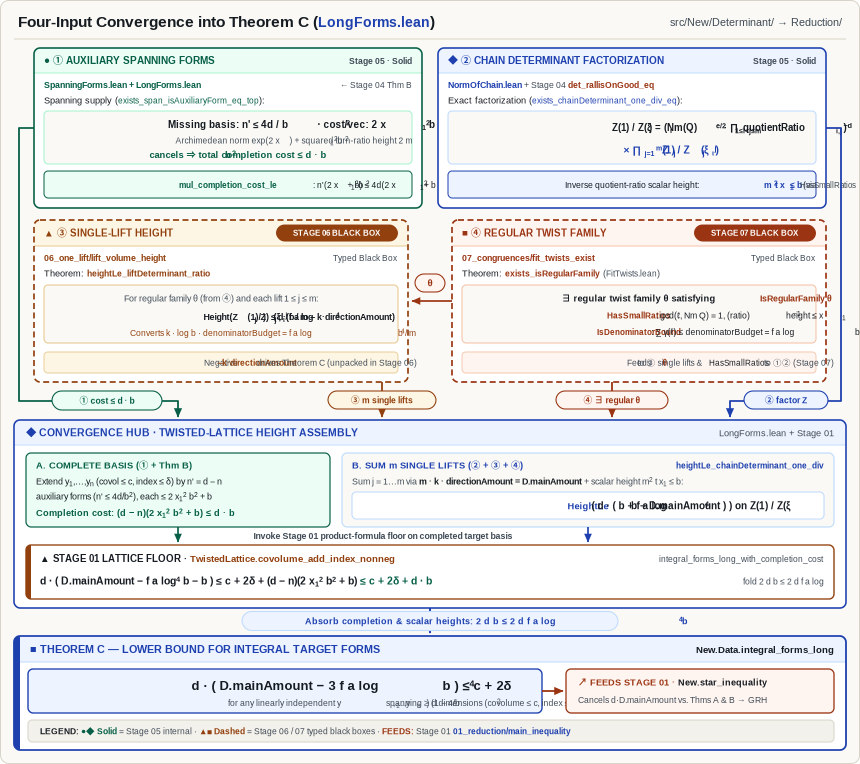
Level 1 — First-Principles
To prove Theorem C's lower bound inside Stage 01's twisted-lattice height formalismtwisted lattice, the proof must compare the untwisted chain volume
A regular twist family (New.Data.IsRegularFamily) is the exact contract specifying what makes a family of twists D.MFoldTwist)—an anticyclotomic character of
- Small ratios (
HasSmallRatios): For every primeand embedding , the norm of the twist modulus is coprime to , and for every and every ramified critical pairHecke L-value ratio, the inverse -value ratios at and have global arithmetic heightarithmetic height at most . - Denominators within budget (
IsDenominatorBound): For every lift index, there is a sequence of real numbers whose sum over every finite set of primes stays within the denominator budget such that at every the -th power satisfies two -adic bounds ( HasDenominatorsLe):- Projection clearing (
ClearsProjection): Some linear operatoron the space of good lifts from , with , clears all -adic denominators when projecting integral forms orthogonal to false lifts onto . - Main-pair projection bound: For every main pair
for , the inner product of projections of two test forms onto the line of the rank-one theta lift of has -adic norm at most .
- Projection clearing (
Notice the clean architectural separation: Stage 05 (FitTwists.lean) defines this contract (note that the file is named FitTwists.lean while the Lean predicate is IsRegularFamily—the upstream reading guide notes "fit for regular"); Stage 06 (06_one_lift) consumes it to bound the height of each single-lift determinant ratio 07_congruences) constructs such a family (exists_isRegularFamily) via Galois representations, Ribet's method, and Selmer-group twisting.
Limits of the intuition
Thinking of a regular twist family as a single "lucky character" misses the core geometric idea of TwistedLattice: no single finite-modulus twist can be coprime to every prime HeightLe sums TwistedLattice pairs the single untwisted archimedean squared volume boundGram determinant against
Level 2 — Undergrad Bridge
src/New/Determinant/Twist/FitTwists.lean is the 7-consumer interface sitting at the hub of Theorem C (consumed by norm_of_chain, spanning_forms, 06_one_lift/three_exchanges, 06_one_lift/twisted_value_heights, 07_congruences/rows_from_eigensystems, 07_congruences/denominator_bound, and 07_congruences/twisting_theorem):
- Denominator budget (
D.denominatorBudget): Defined as. Inside LongForms.lean, multiplying byyields , which matches the exact error share allotted to each of the single lifts in Stage 06 ( heightLe_liftDeterminant_ratio). - Projection clearing (
D.ClearsProjection ι ϑ j β): Letand be orthogonal projection onto . ClearsProjectionasserts the existence ofwith such that is -integral ( integralForms) for every-integral form orthogonal to the false lifts ( IsOrthogonalToFalseLifts). In arithmetic geometry, the-adic valuation of measures the congruence modulus between the theta-lift subspace and its orthogonal complement (after removing false lifts killed by split-place Hecke polynomials), which Stage 07 bounds via first-order Ribet's method and anticyclotomic Selmer groups. - Joint denominator bound (
HasDenominatorsLe,IsDenominatorBound):HasDenominatorsLe ι ϑ j βpairsClearsProjection ι ϑ j βwith the rank-one main-pair projection boundfor every main pair for and test forms . IsDenominatorBound θ j γassertsfor every finite set of primes and HasDenominatorsLe ι.2 ((θ ι).powTwist j) j (γ ι.1)for everyι : PrimePadicIso. - Negligible error sequences (
IsNegligible C e): A helper predicateused by Stage 07 to package small exceptional-prime losses whose total contribution is dwarfed by denominatorBudget. - Regularity (
HasSmallRatios,IsRegularFamily):HasSmallRatios θrequiresNat.Coprime ι.1 (θ ι).normQandHeightLe D.x₁ (fun ι ↦ (p.ratio ((θ ι).powTwist j) s)⁻¹)for all, all ramified pairs , and . IsRegularFamily θextendsHasSmallRatios θwith∀ j : D.LiftIndex, ∃ γ, D.IsDenominatorBound θ j γ.
Level 3 — Formal Lean Contract
Stage 05 extracts the entire regular-twist interface into skeleton/05_determinant/fit_twists.lean (17 declarations, 0 stub truncations):
05_determinant/fit_twists.lean#New.Data.denominatorBudget(upstreamsrc/New/Determinant/Twist/FitTwists.lean:153-157):leannoncomputable abbrev New.Data.denominatorBudget : ℝ05_determinant/fit_twists.lean#New.Data.ClearsProjection(upstreamFitTwists.lean:160-175):leandef New.Data.ClearsProjection {ℓ : ℕ} [Fact ℓ.Prime] (ι : ℂ ≃+* PadicAlgCl ℓ) (ϑ : D.Twist) (j : ℕ) (β : ℝ) : Prop05_determinant/fit_twists.lean#New.Data.IsDenominatorBound(upstreamFitTwists.lean:198-207):leanstructure New.Data.IsDenominatorBound (θ : PrimePadicIso → D.MFoldTwist) (j : D.LiftIndex) (γ : ℕ → ℝ) : Prop where sum_le (T : Finset ℕ) (hT : ∀ ℓ ∈ T, ℓ.Prime) : ∑ ℓ ∈ T, γ ℓ ≤ D.denominatorBudget hasDenominatorsLe (ι : PrimePadicIso) : D.HasDenominatorsLe ι.2 ((θ ι).powTwist j) j (γ ι.1)05_determinant/fit_twists.lean#New.Data.HasSmallRatios(upstreamFitTwists.lean:216-226):leanstructure New.Data.HasSmallRatios (θ : PrimePadicIso → D.MFoldTwist) : Prop where coprime (ι : PrimePadicIso) : Nat.Coprime ι.1 (θ ι).normQ height_le (j : D.LiftIndex) (p : D.CriticalPair) (s : ℤˣ) (hp : p.IsRamified) : HeightLe (D.x₁) fun ι : PrimePadicIso ↦ (p.ratio ((θ ι).powTwist j) s)⁻¹05_determinant/fit_twists.lean#New.Data.IsRegularFamily(upstreamFitTwists.lean:228-233):leanstructure New.Data.IsRegularFamily (θ : PrimePadicIso → D.MFoldTwist) : Prop extends D.HasSmallRatios θ where exists_denominator_bound (j : D.LiftIndex) : ∃ γ : ℕ → ℝ, D.IsDenominatorBound θ j γ
See the page's live <VerificationBanner /> (audit/verification-status.json) for the pinned upstream commit and local Lean build status (build_status: unverified-locally).
Where this analogy breaks
Picturing a regular twist family as picking one good character twist that works at all primes simultaneously is false: each prime embedding iota : C -> Qbar_l gets its own m-fold twist theta(iota) whose modulus Q(theta(iota)) is coprime to l, and the global arithmetic height bound stitches those per-prime choices together only because the clearing matrix in TwistedLattice is twist-independent while the denominator budget sums across all primes l.
Formal Lean Anchors
structure New.Data.IsRegularFamily — Upstream source (src/New/Determinant/Twist/FitTwists.lean L228-L233)
/-- A family of `m`-fold twists `θ ι`, one for each prime `ℓ` and `ι : ℂ ≃ ℚ̄_ℓ`, is regular if it
has small ratios (`HasSmallRatios`) and, for `1 ≤ j ≤ m`, the `j`-th powers `(θ ι).powTwist j`
have denominators within the budget `denominatorBudget` (`IsDenominatorBound`). -/
structure New.Data.IsRegularFamily (θ : PrimePadicIso → D.MFoldTwist) : Prop extends D.HasSmallRatios θ where
/-- Some reals `γ ℓ` bound the denominators of the `j`-th powers within `denominatorBudget`. -/
exists_denominator_bound (j : D.LiftIndex) : ∃ γ : ℕ → ℝ, D.IsDenominatorBound θ j γstructure New.Data.HasSmallRatios — Upstream source (src/New/Determinant/Twist/FitTwists.lean L216-L226)
/-- A family of `m`-fold twists `θ ι`, one for each prime `ℓ` and `ι : ℂ ≃ ℚ̄_ℓ`, has small ratios
if the modulus of `θ ι` is prime to `ℓ` and, for `1 ≤ j ≤ m`, the `j`-th powers `(θ ι).powTwist j`
and their inverses have, for every ramified pair, inverse ratios of L-values of height at most
`D.x₁`, the second cut-off of the data. -/
structure New.Data.HasSmallRatios (θ : PrimePadicIso → D.MFoldTwist) : Prop where
/-- The norm of the modulus of `θ ι` is prime to the prime `ℓ = ι.1` of `ι`. -/
coprime (ι : PrimePadicIso) : Nat.Coprime ι.1 (θ ι).normQ
/-- For a ramified pair, the inverse ratios of L-values at the `j`-th powers of the twists
(`s = 1`) or at their inverses (`s = -1`) form a family of height at most `D.x₁`. -/
height_le (j : D.LiftIndex) (p : D.CriticalPair) (s : ℤˣ) (hp : p.IsRamified) :
HeightLe (D.x₁) fun ι : PrimePadicIso ↦ (p.ratio ((θ ι).powTwist j) s)⁻¹structure New.Data.IsDenominatorBound — Upstream source (src/New/Determinant/Twist/FitTwists.lean L198-L207)
/-- The reals `γ ℓ`, one for each prime `ℓ`, bound the logarithms of the denominators
(`HasDenominatorsLe`) for the `j`-th powers of the twists `θ ι`, and their sum stays within the
budget `denominatorBudget`. -/
structure New.Data.IsDenominatorBound (θ : PrimePadicIso → D.MFoldTwist) (j : D.LiftIndex) (γ : ℕ → ℝ) :
Prop where
/-- The sum of `γ ℓ` over a finite set of primes is at most `denominatorBudget`. -/
sum_le (T : Finset ℕ) (hT : ∀ ℓ ∈ T, ℓ.Prime) : ∑ ℓ ∈ T, γ ℓ ≤ D.denominatorBudget
/-- At `ι`, with prime `ℓ = ι.1`, both bounds of `HasDenominatorsLe` hold for the `j`-th power of
`θ ι` with `β = γ ℓ`. -/
hasDenominatorsLe (ι : PrimePadicIso) : D.HasDenominatorsLe ι.2 ((θ ι).powTwist j) j (γ ι.1)def New.Data.ClearsProjection — Upstream source (src/New/Determinant/Twist/FitTwists.lean L160-L175)
/-- Let `Z` be the space of lifts from `W_j` for the twist `ϑ`, the range of `D.goodLift ϑ j` in the
forms on the space `V` of the lift datum `D.descentPair ϑ j`, and let `pr` be the orthogonal
projection to `Z`. Some operator `Λ` on `Z`, with `log |ι (det Λ)| ≥ -(dim Z) r β` for `r = D.r`,
makes `Λ (pr y)` integral at `ι` for every form `y` that is integral at `ι` and orthogonal to the
false lifts. A form is integral (`integralForms`) if all its values lie in the unit ball of the
`ℓ`-adic gauge at `ι`. The false lifts (`IsOrthogonalToFalseLifts`) are the forms orthogonal to `Z`,
in the image of the idempotent `D.e₀`, that are killed by the Hecke polynomial at its test value at
some split place off the level. -/
def New.Data.ClearsProjection {ℓ : ℕ} [Fact ℓ.Prime] (ι : ℂ ≃+* PadicAlgCl ℓ) (ϑ : D.Twist) (j : ℕ)
(β : ℝ) : Prop := by
sorry -- [EXTRACTED_STUB upstream=src/New/Determinant/Twist/FitTwists.lean:160-175 commit=41c2716658c42ba08eb0648994a2efe83082a95c body_lines=6 body_sha256=cd22611773ee6a386d4d3dcaf26ddfe4f15c787277e47c5852715bcda8026e49]abbrev New.Data.denominatorBudget — Upstream source (src/New/Determinant/Twist/FitTwists.lean L153-L157)
/-- The bound `denominatorBudget = f a log³ b / (m k)` for the sum over all primes of the
logarithmic denominator bounds. The numerator is `D.errorUnit`, with `f` the number of infinite
places of `E`, `b` the weight scale of the data and `a = x b` for `x` the length of the prime sum;
`m` is the number of lifts and `k = r + 1 - m`. -/
noncomputable abbrev New.Data.denominatorBudget : ℝ := by
  sorry -- [EXTRACTED_STUB upstream=src/New/Determinant/Twist/FitTwists.lean:153-157 commit=41c2716658c42ba08eb0648994a2efe83082a95c body_lines=1 body_sha256=0080d39ade68428d695fadca27736db3640c2d1f45efb0a8d5963f71bd75fd42]
Related Concepts
- prime number — A whole number greater than 1 whose only positive whole-number divisors are 1 and itself; every integer above 1 factors uniquely into a product of them.
- twisted lattice — A family of linear lifts from one complex vector space into inner-product spaces—one per twist—equipped with prime-by-prime integrality lattices so each prime can pick its own allowed twist.
- arithmetic height — A logarithmic measure combining ordinary archimedean size with prime-by-prime p-adic divisibility, locked together by the product formula so a nonzero algebraic quantity cannot be simultaneously small at every place.
- Hecke L-value ratio — The ratio |L^S(z, (nu * theta^s)^-1)| / |L^S(z, nu^-1)| of twisted to untwisted partial Hecke L-values at a critical pair (nu, z), tracking how Siegel–Weil exchange constants scale under twisting across chain quotients and grid turns.
- Rallis inner product formula — Relating the squared norm (and Gram determinant) of a theta lift or m-step chain of lifts to spherical Hecke operators and single-lift determinants—factoring Z(theta)/Z(1) across m lifts up to quotient L-value ratios.
Referenced By
- Stage: Chain Determinant Factorization and Two-Grid Auxiliary Forms
- Stage: Crystalline Lifting, Kummer Charts, and Local Dual Defect
- Stage: First-Order Ribet Denominator Bounds and Existence of Regular Twist Families
- Stage: Galois Main Summands and the Anticyclotomic Selmer Twisting Theorem
- Stage: Regular Twist Families and the Assembly of Theorem C
- Stage: Stage 05 — Lower Bound: The Determinant (Theorem C, Part 1)
- Stage: Stage 06 — Lower Bound: One Lift (Theorem C, Part 2)
- Stage: Stage 07 — Lower Bound: Congruences & Galois Representations (Theorem C, Part 3)
- Stage: The Lift Comparison Operator and Single-Lift Volume Height
- Stage: Vanishing Periods of False Lifts and Negative Heights of Twisted L-Values
- Concept: anticyclotomic Selmer twisting
- Concept: character theta lift
- Concept: crystalline dual defect
- Concept: Galois main summand
- Concept: Hecke L-value ratio
- Concept: idle direction repayment
- Concept: lift comparison operator
- Concept: Ribet clearing operator
Authoritative Sources
- p-adic Automorphic Forms on Shimura Varieties (book) — H. Hida, Springer Monographs in Mathematics, Springer (2004).
- Class fields of abelian extensions of Q (paper) — B. Mazur & A. Wiles, Invent. Math. 76 (1984), 179–330.
- On modular representations of Gal(Q̄/Q) arising from modular forms (paper) — K. Ribet, Invent. Math. 100 (1990), 431–476.
Page Glossary
- twisted lattice
- A family of linear lifts from one complex vector space into inner-product spaces—one per twist—equipped with prime-by-prime integrality lattices so each prime can pick its own allowed twist.
- prime number
- A whole number greater than 1 whose only positive whole-number divisors are 1 and itself; every integer above 1 factors uniquely into a product of them.
- Hecke L-value ratio
- The ratio |L^S(z, (nu * theta^s)^-1)| / |L^S(z, nu^-1)| of twisted to untwisted partial Hecke L-values at a critical pair (nu, z), tracking how Siegel–Weil exchange constants scale under twisting across chain quotients and grid turns.
- arithmetic height
- A logarithmic measure combining ordinary archimedean size with prime-by-prime p-adic divisibility, locked together by the product formula so a nonzero algebraic quantity cannot be simultaneously small at every place.
- Gram determinant
- The determinant of the matrix of pairwise inner products of a family of vectors, measuring the squared volume of the parallelotope they span and controlled by Hadamard's and Fischer's inequalities.