primitive character
Also known as: primitive Dirichlet character.
A Dirichlet character modulo q whose pattern does not come from any strictly smaller dividing modulus; its modulus q equals its minimal period (conductor).
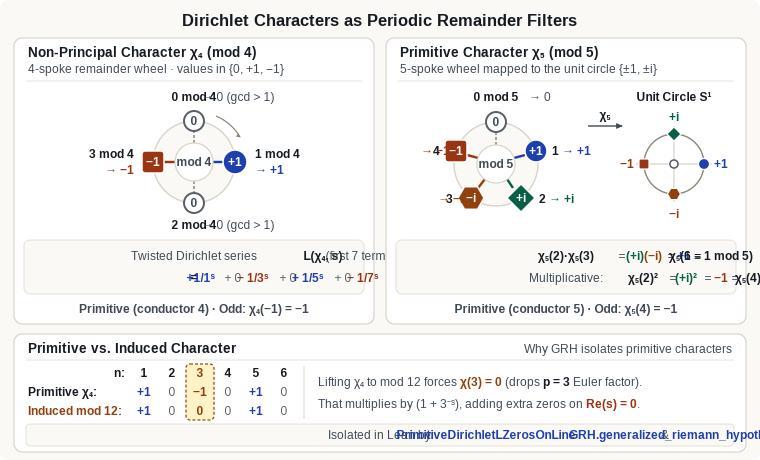
Level 1 — First-Principles
Take the modulo-
A character modulo
Limits of the intuition
Treating an imprimitive character as "essentially the same" as its primitive parent is safe inside the open strip
Level 2 — Undergrad Bridge
Let
For any
This identity explains two central steps in Stage 00:
- Inside
: For every prime , , so . Thus and have the exact same zeros inside the open critical strip. In the condensed upstream proof, New.zeros_on_line(src/New/Main.lean:29-36) deducesDirichletLZerosOnLinefor all characters directly fromDirichletLNonvanishingRightOfHalfvia the functional-equation symmetryNew.gammaFactor_eq_zero_or_LFunction_one_sub_eq_zero, and the primitive case follows immediately by specialization. - Across all of
: Because imprimitive characters pick up zeros on , formal-conjecturesrestrictsGRH.generalized_riemann_hypothesistohχ : χ.IsPrimitiveso thats ∉ Int.cast '' GRH.trivialZeros χcaptures all nontrivial zeros cleanly.
Level 3 — Formal Lean Contract
In Mathlib4 (Mathlib.NumberTheory.DirichletCharacter.Basic), χ.IsPrimitive holds when χ.conductor = N. Stage 00 anchors primitive characters in:
00_statement/statements.lean#PrimitiveDirichletLZerosOnLine(upstreamsrc/Statements.lean:18-20):leandef PrimitiveDirichletLZerosOnLine : Prop := ∀ (N : ℕ) [NeZero N] (χ : DirichletCharacter ℂ N), χ.IsPrimitive → ∀ s : ℂ, 0 < s.re → s.re < 1 → DirichletCharacter.LFunction χ s = 0 → s.re = 1 / 200_statement/main.lean#LFunction_eq_zero_re_of_isPrimitive(upstreamsrc/Main.lean:23-26), proved by the one-line lambdafun N _ χ _ ↦ LFunction_eq_zero_re N χ, which specializesLFunction_eq_zero_reand drops the unusedχ.IsPrimitivehypothesis.
In formal-conjectures (archived on upstream alpoge@c900e67c2 in comparator/FormalConjecturesBridge.lean pending re-integration on condensed main), primitiveDirichletLZerosOnLine_iff proved that PrimitiveDirichletLZerosOnLine is logically equivalent to formal-conjectures' whole-plane GRH.generalized_riemann_hypothesis. See the page's live verification banner (audit/verification-status.json) for the currently pinned upstream snapshot and local Lean build status (build_status: unverified-locally).
Where this analogy breaks
Viewing an imprimitive character as a harmless redundant copy of its primitive parent breaks down on the line
Formal Lean Anchors
def PrimitiveDirichletLZerosOnLine — Upstream source (src/Statements.lean L18-L20)
def PrimitiveDirichletLZerosOnLine : Prop :=
  ∀ (N : ℕ) [NeZero N] (χ : DirichletCharacter ℂ N), χ.IsPrimitive →
∀ s : ℂ, 0 < s.re → s.re < 1 → DirichletCharacter.LFunction χ s = 0 → s.re = 1 / 2theorem LFunction_eq_zero_re_of_isPrimitive — Upstream source (src/Main.lean L23-L26)
/-- The Generalized Riemann Hypothesis for primitive Dirichlet characters, a special case of
`LFunction_eq_zero_re`. -/
theorem LFunction_eq_zero_re_of_isPrimitive : PrimitiveDirichletLZerosOnLine := by
  sorry -- [EXTRACTED_STUB upstream=src/Main.lean:23-26 commit=41c2716658c42ba08eb0648994a2efe83082a95c body_lines=1 body_sha256=ddf20e0c95001d383f8f18dc5ad738d1111afcee8ce88a2b6be8608f7c9e4b8c]
Related Concepts
- Dirichlet character — A periodic multiplicative label χ : ℤ → ℂ modulo N that equals 0 when gcd(n, N) > 1, takes roots of unity when gcd(n, N) = 1, and satisfies χ(ab) = χ(a)χ(b).
- Dirichlet L-function — The meromorphic continuation of ∑ χ(n) n⁻ˢ associated to a Dirichlet character χ, generalizing ζ(s) to track primes across residue classes modulo N.
- trivial zero — A zero at a non-positive integer forced purely by poles of the gamma factor in the functional equation, carrying no hidden information about prime fluctuations.
Referenced By
- Stage: Formal Statement Contracts (
Statements.lean) - Stage: Independent Statement Equivalence (
FormalConjecturesStatement&FormalConjecturesChallenge) - Stage: Stage 00 — Formal Statements & Challenge Contracts
- Stage: The Five Entry Theorems (
Main.lean&Challenge.lean) - Concept: Dirichlet character
- Concept: Dirichlet L-function
Authoritative Sources
- Multiplicative Number Theory (book) — H. Davenport, 3rd ed., Springer Graduate Texts in Mathematics 74 (2000), Chapter 5: Primitive Characters.
- Introduction to Analytic Number Theory (book) — T. M. Apostol, Springer Undergraduate Texts in Mathematics (1976), Chapter 8: Gauss Sums and Quadratic Reciprocity.
- Mathlib4: DirichletCharacter.IsPrimitive (mathlib) — Mathlib.NumberTheory.DirichletCharacter.Basic (
DirichletCharacter.IsPrimitive,DirichletCharacter.conductor,DirichletCharacter.primitiveCharacter, pinned mathlib rev 31ce06eaadf4a200c0e1407c5f10953cf606b8f8).
Page Glossary
- Dirichlet character
- A periodic multiplicative label χ : ℤ → ℂ modulo N that equals 0 when gcd(n, N) > 1, takes roots of unity when gcd(n, N) = 1, and satisfies χ(ab) = χ(a)χ(b).
- Dirichlet L-function
- The meromorphic continuation of ∑ χ(n) n⁻ˢ associated to a Dirichlet character χ, generalizing ζ(s) to track primes across residue classes modulo N.
- trivial zero
- A zero at a non-positive integer forced purely by poles of the gamma factor in the functional equation, carrying no hidden information about prime fluctuations.