Gram determinant
Also known as: covolume, Hadamard's inequality.
The determinant of the matrix of pairwise inner products of a family of vectors, measuring the squared volume of the parallelotope they span and controlled by Hadamard's and Fischer's inequalities.
Level 1 — First-Principles
Take two vectors
That
Two geometric facts follow directly from thinking of a box. First, tilting the edges of a box can only flatten it, never expand it: the squared volume never exceeds the product of the squared edge lengths,
with equality precisely when the vectors meet at right angles. This bound is Hadamard's inequality; taking logarithms, if every edge has squared length at most
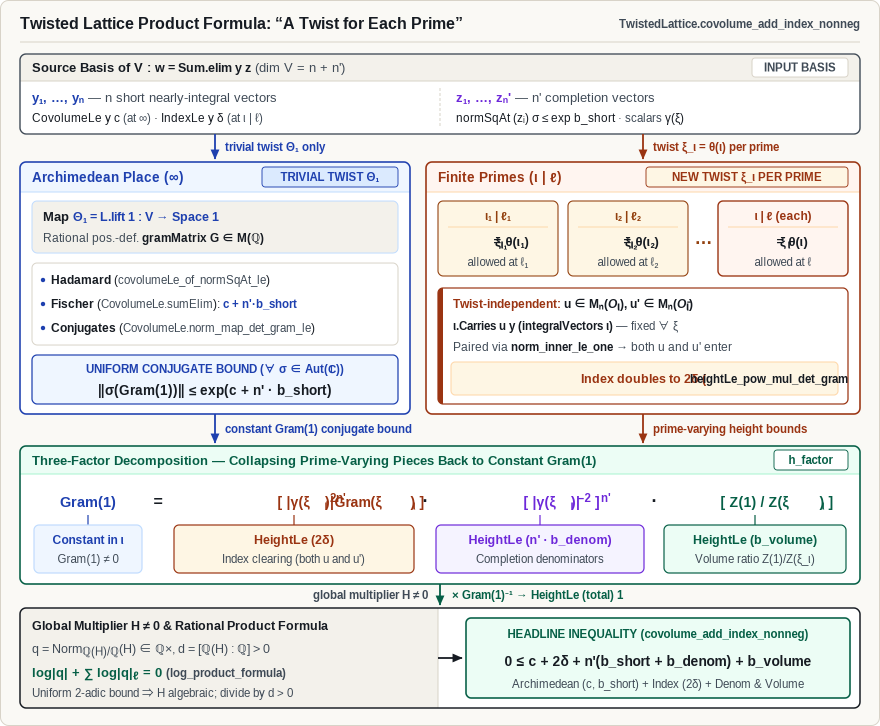
In the Stage 01 reduction, vectors live over the two-dimensional plane of numbers with real and imaginary coordinatescomplex plane inside a system of twisted linear embeddings equipped with prime-by-prime integrality rulestwisted lattice. Bounding the Gram determinant of a completed basis supplies the archimedean side of the global balance between ordinary magnitude and prime-by-prime divisibilityarithmetic height: it gives an upper cap on how large the determinant can be, which must then be compatible with how divisible the determinant is at the primes.
Limits of the intuition
Visualizing the Gram determinant as the squared volume of a real box faithfully explains why linear dependence gives zero, why orthogonal vectors maximize volume (Hadamard's inequality), and why gluing two families adds logarithmic covolumes. The picture breaks down over complex numbers once algebraic conjugates enter: to compare with prime-by-prime divisibility, we must bound not only the actual determinant
Level 2 — Undergrad Bridge
For vectors
Three determinantal theorems from Hermitian matrix analysis (Horn & Johnson 2013, §7.2 and Theorems 7.8.1, 7.8.5) govern Gram determinants:
- Hadamard's inequality: for any positive semidefinite matrix
, Applied to , if for every , then . - Fischer's inequality: if a positive semidefinite matrix is partitioned into blocks
with square diagonal blocks and , then Thus adjoining two families and multiplies their Gram determinant bounds, so logarithmic covolume bounds add: . - Cauchy–Schwarz in the exterior power: for any positive semidefinite form
and two families , the mixed pairing matrix satisfies proved by applying positive semidefiniteness to the block Gram matrix of .
In a twisted lattice
Defining a family CovolumeLe y c) by requiring
Finally, when New.det_gram_comp) gives
Level 3 — Formal Lean Contract
In skeleton/01_reduction/twisted_lattice.lean (extracted from upstream src/New/Reduction/Lattices/TwistedLattice.lean, backed by Hermitian Gram lemmas in src/Lib/General/LinearAlgebra/GramDeterminant.lean), logarithmic covolume and its Hadamard and Fischer closure properties have the following signatures:
01_reduction/twisted_lattice.lean#New.TwistedLattice.CovolumeLe(upstreamsrc/New/Reduction/Lattices/TwistedLattice.lean:262-266):leandef New.TwistedLattice.CovolumeLe (y : S → V) (c : ℝ) : Prop := ∀ σ : ℂ ≃+* ℂ, ‖(formGram (L.gramMatrix.map (↑)) (L.conjCoord σ ∘ y)).det‖ ≤ exp c01_reduction/twisted_lattice.lean#New.TwistedLattice.covolumeLe_of_normSqAt_le(upstreamsrc/New/Reduction/Lattices/TwistedLattice.lean:301-310, Hadamard's inequality):leanlemma New.TwistedLattice.covolumeLe_of_normSqAt_le {n : ℕ} {z : Fin n → V} {h : ℝ} (hz : ∀ (i : Fin n) (σ : ℂ ≃+* ℂ), L.normSqAt (z i) σ ≤ exp h) : L.CovolumeLe z (n * h)01_reduction/twisted_lattice.lean#New.TwistedLattice.CovolumeLe.sumElim(upstreamsrc/New/Reduction/Lattices/TwistedLattice.lean:312-325, Fischer's inequality):leanlemma New.TwistedLattice.CovolumeLe.sumElim {S' : Type} [Fintype S'] [DecidableEq S'] {y : S → V} {z : S' → V} {c c' : ℝ} (hy : L.CovolumeLe y c) (hz : L.CovolumeLe z c') : L.CovolumeLe (Sum.elim y z) (c + c')
Together with CovolumeLe.norm_map_det_gram_le (TwistedLattice.lean:284-299), these three declarations supply the exact archimedean bound ‖σ (Gram 1)‖ ≤ exp (c + n' * b_short) inside covolume_add_index_nonneg. See the page's live verification banner (audit/verification-status.json) for the currently pinned upstream snapshot and local Lean build status (build_status: unverified-locally).
Where this analogy breaks
Treating the Gram determinant merely as the squared Euclidean volume of a box in CovolumeLe must bound the determinant simultaneously after applying every field automorphism
Formal Lean Anchors
def New.TwistedLattice.CovolumeLe — Upstream source (src/New/Reduction/Lattices/TwistedLattice.lean L262-L266)
/-- The family `y` has covolume at most `c`: for every automorphism `σ` of `ℂ` the determinant of
the products `⟨σ Θ₁ y_i, σ Θ₁ y_k⟩`, taken by the rational Gram matrix on the coordinate vectors
`L.conjCoord σ (y i)`, has absolute value at most `exp c`. -/
def New.TwistedLattice.CovolumeLe (y : S → V) (c : ℝ) : Prop := by
sorry -- [EXTRACTED_STUB upstream=src/New/Reduction/Lattices/TwistedLattice.lean:262-266 commit=41c2716658c42ba08eb0648994a2efe83082a95c body_lines=1 body_sha256=46779ee3e42fe2502d47a1192e510d6233d1b0df80e43b99c9dd7a2910128fad]lemma New.TwistedLattice.covolumeLe_of_normSqAt_le — Upstream source (src/New/Reduction/Lattices/TwistedLattice.lean L301-L310)
/-- Let `L` be a twisted lattice on `V`, with map `Θ₁ = L.lift 1` for the trivial twist. For an
automorphism `σ` of `ℂ`, apply `σ` to the coordinates of `Θ₁ v` and pair the results by the rational
Gram matrix: `L.normSqAt v σ = ‖Θ₁ v‖_σ²` is the product of such a vector with itself, and a family
has covolume at most `c` (`CovolumeLe`) if for every `σ` the determinant of these products of its
members has absolute value at most `exp c`. If `‖Θ₁ z_i‖_σ² ≤ exp h` for all `i` and `σ`, then
`z_1, …, z_n` has covolume at most `n h`. This is Hadamard's inequality. -/
lemma New.TwistedLattice.covolumeLe_of_normSqAt_le {n : ℕ} {z : Fin n → V} {h : ℝ}
    (hz : ∀ (i : Fin n) (σ : ℂ ≃+* ℂ), L.normSqAt (z i) σ ≤ exp h) :
L.CovolumeLe z (n * h) := by
sorry -- [EXTRACTED_STUB upstream=src/New/Reduction/Lattices/TwistedLattice.lean:301-310 commit=41c2716658c42ba08eb0648994a2efe83082a95c body_lines=1 body_sha256=8195abd389c0b80c67fb4f1f66b7c53186c37bfddc08ee9ad488f8a3fd3e5450]lemma New.TwistedLattice.CovolumeLe.sumElim — Upstream source (src/New/Reduction/Lattices/TwistedLattice.lean L312-L325)
/-- **Gram determinants, adjoining vectors.** If two families have covolume at most `c` and
`c'`, their union has covolume at most `c + c'` by Fischer's inequality. -/
lemma New.TwistedLattice.CovolumeLe.sumElim {S' : Type} [Fintype S'] [DecidableEq S']
    {y : S → V} {z : S' → V} {c c' : ℝ} (hy : L.CovolumeLe y c) (hz : L.CovolumeLe z c') :
L.CovolumeLe (Sum.elim y z) (c + c') := by
sorry -- [EXTRACTED_STUB upstream=src/New/Reduction/Lattices/TwistedLattice.lean:312-325 commit=41c2716658c42ba08eb0648994a2efe83082a95c body_lines=10 body_sha256=edae3cf0717eb670961c5db9b3da7a651cd97072f01e71fe0fd0ab56cd160cd0]Related Concepts
- complex plane — The two-dimensional coordinate plane of numbers s = σ + it, where the horizontal coordinate σ = Re(s) sets decay rate and the vertical coordinate t = Im(s) sets oscillation frequency.
- twisted lattice — A family of linear lifts from one complex vector space into inner-product spaces—one per twist—equipped with prime-by-prime integrality lattices so each prime can pick its own allowed twist.
- arithmetic height — A logarithmic measure combining ordinary archimedean size with prime-by-prime p-adic divisibility, locked together by the product formula so a nonzero algebraic quantity cannot be simultaneously small at every place.
Referenced By
- Stage: Chain Determinant Factorization and Two-Grid Auxiliary Forms
- Stage: Regular Twist Families and the Assembly of Theorem C
- Stage: Short Ramified Columns & Archimedean Size Cancellation
- Stage: Stage 01 — The Theorem and Its Reduction
- Stage: Stage 03 — Upper Bound: A Composite Theta Lift (Theorem A)
- Stage: Stage 04 — Spanning: Second Moment (Theorem B)
- Stage: Stage 05 — Lower Bound: The Determinant (Theorem C, Part 1)
- Stage: Stage 06 — Lower Bound: One Lift (Theorem C, Part 2)
- Stage: The Big-Cell Kloosterman Sieve and Remaining-Term Link Bounds
- Stage: The Iterated Seesaw Identity
- Stage: The Lift Comparison Operator and Single-Lift Volume Height
- Stage: The Main Inequality & Theorems A and B
- Stage: Twisted Lattices & A Twist for Each Prime
- Concept: arithmetic height
- Concept: Hilbert–Schmidt norm
- Concept: idle direction repayment
- Concept: lift comparison operator
- Concept: link lattice
- Concept: Rallis inner product formula
- Concept: regular twist family
- Concept: twisted lattice
Authoritative Sources
- Matrix Analysis (book) — R. A. Horn and C. R. Johnson, 2nd ed., Cambridge University Press (2013), §7.2 and Theorems 7.8.1, 7.8.5.
- Heights in Diophantine Geometry (book) — E. Bombieri and W. Gubler, Cambridge University Press (2006), Chapter 1.
Page Glossary
- complex plane
- The two-dimensional coordinate plane of numbers s = σ + it, where the horizontal coordinate σ = Re(s) sets decay rate and the vertical coordinate t = Im(s) sets oscillation frequency.
- twisted lattice
- A family of linear lifts from one complex vector space into inner-product spaces—one per twist—equipped with prime-by-prime integrality lattices so each prime can pick its own allowed twist.
- arithmetic height
- A logarithmic measure combining ordinary archimedean size with prime-by-prime p-adic divisibility, locked together by the product formula so a nonzero algebraic quantity cannot be simultaneously small at every place.