Stage 03 — Upper Bound: A Composite Theta Lift (Theorem A)
Stage 03 turns the prime-counting derivative divisibility of Stage 02 into the upper bound that Stage 01 consumes as Theorem A (D.span_short_integralRamified_eq_top and D.indexLe_normalizedPoincare). Stage 02 built an integral theta vacuum
Level 1 — First-Principles
In Stage 01, the proof compares two measurements of a family of target vectors living inside a collection of inner-product spaces indexed by twisting characters, each carrying an integral latticetwisted lattice: an upper bound on how short and divisible the family can be (Theorem A), and a lower bound on how large any spanning integral family must be (Theorems B and C). Stage 03 builds the entire upper bound.
The difficulty is geometric. The target vectors in Stage 01 live on an indefinite unitary space
Stage 03 bridges the indefinite world and the definite world by running two parallel chains of
- The lower (indefinite-to-definite) chain starts from a source form
on the definite space , converts it into a form on the indefinite space via the Poincaré map , and lifts through steps until the final space is definite. - The upper (all-definite) chain starts from the same source form
on , lifts it through definite steps using translates of Stage 02's integral vacuum , and restricts the output from to the subspace .
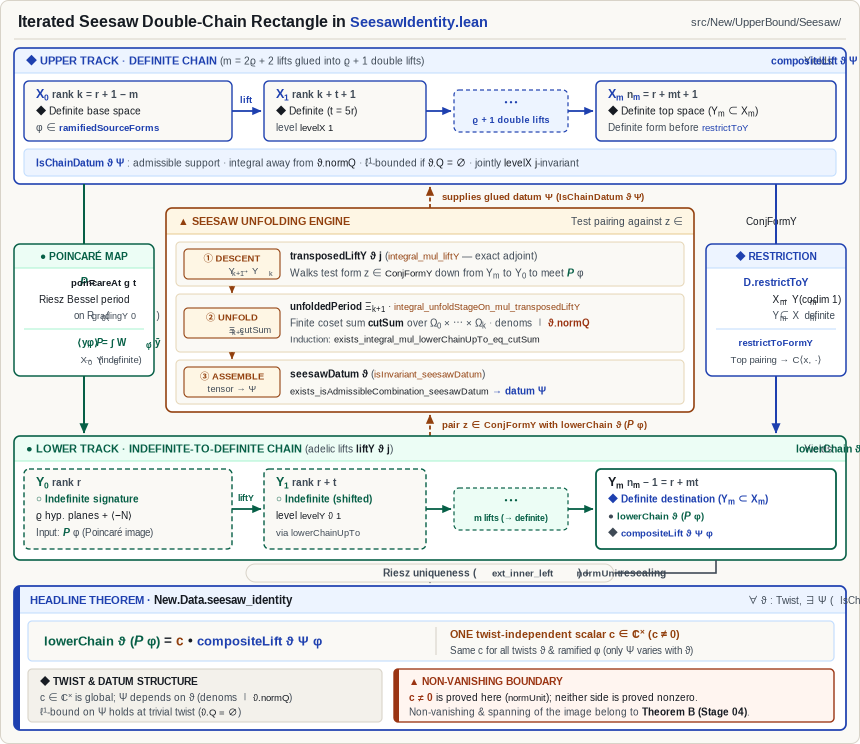
To feed Theorem A into Stage 01, Stage 03 solves three interlocking problems across five landmark files:
- Equating the two chains (
seesaw_identity): Using an integral-pairing symmetry between two dual chains of spaces that exchanges a lift on one side for a restriction on the otherseesaw duality, Stage 03 unfolds the lower chain one step at a time until both chains agree onup to a single nonzero scalar independent of the twist: This transfers every estimate proved on the definite upper chain directly onto the target forms of Stage 01. - Short spanning sources and archimedean size (
short_columns,archimedean_size): On, Stage 03 measures the size of a form's values across all primes using the prime-by-prime local size norm on modular forms, calling a form integral when this norm is at most and calling it short of bound when all its Galois conjugates also have squared norm at most Weyl gauge. It proves that the B-short ramified source forms span all ramified source forms, and then tracks how each definite lift grows the squared Euclidean norm. At the top step, the restriction injects a saving of from the level prime that cancels the excess archimedean growth of the lifts, bounding the squared volume of a basis of vectors in an inner-product space, controlling the fundamental volume of a latticeGram determinant for Stage 01. - Prime-by-prime divisibility and exceptional inert primes (
elementary_divisor_theorem,local_divisibility): At every non-split whole number greater thanwith no smaller positive divisorsprime number , Stage 02's derivative divisibility lower bound on matrix minors and Schur-matrix polynomialsSchur jet forces the definite upper chain to be divisible by a large power of . At ordinary non-split primes this gives the full requested divisibility D.gain pup to a small error. At certain exceptional inert primes, however, shifted Galois-paired infinite places where cross-place couplings collidetheta normal form cause extra deductions. Stage 03 cancels those collisions by pre-composing the source forms with a finite averaging operator on modular forms built from matrix cosets at a primeHecke operator whose action stays nearly onto modulo high powers of. Measuring that index loss requires an abstract theorem on the prime-power diagonal factors governing the quotient index of a linear operator's image inside an integral latticeelementary divisor, proved via a polynomial-counting machine over a cyclic family of Frobenius-twisted spaces with controlled polynomial defectFrobenius cycle.
Together, these three pillars prove that after dividing by the exact inverse gain factor
Explore Stage 03 across its three landmark essays, return to Stage 02 — Derivatives of Theta Functions or Stage 01 — The Theorem and Its Reduction, or view the full roadmap in the Full Proof Journey:
- The Iterated Seesaw Identity —
SeesawIdentity: the upper and lower chains, transposed lifts, iterated Bessel unfolding to finite coset sums, the chain datum, and New.Data.seesaw_identity. - Short Columns & Archimedean Size —
ShortColumnsandArchimedeanSize: prime-by-prime gains and exceptional primes,-short spanning of ramified source forms, the level- size cancellation, and passage to good target forms. - Local Divisibility & Elementary Divisors —
ElementaryDivisorTheoremandLocalDivisibility: Frobenius cycles, near inverses, edge Hecke operators, full marks at exceptional inert primes, andNew.Data.exists_colengthDvd_gaugeLe_compositeLift.
Where this analogy breaks
Describing Stage 03 as "proving an identity between two chains, then estimating size and divisibility on the easier chain" omits two essential logical boundaries. First, the seesaw identity New.Data.seesaw_identity proves that the proportionality constant 04_spanning). Second, Stage 03 is not a self-contained leaf behind Stage 01: its short_columns module defines the prime-sum gains, exceptional primes, and ramified source forms used across the rest of the proof, including an acyclic backward dependency from Stage 02's sharpness file 02_derivatives/bound_attained.
Level 2 — Undergrad Bridge
Stage 03 spans 55 upstream Lean files under src/New/UpperBound/, organized into six subdirectories — Kernels/ (3), Objects/ (12), Seesaw/ (15), Divisibility/ (11), Size/ (4), and ElementaryDivisors/ (10) — and condensed into 5 landmark nodes in dag/dag.json. The argument feeds directly into 01_reduction/short_and_enough.lean, where Theorem A (D.span_short_integralRamified_eq_top and D.indexLe_normalizedPoincare) combines the outputs of three Stage 03 pipelines:
1. The double chain and the iterated seesaw (Objects/, Seesaw/SeesawIdentity.lean)
Over the cyclotomic CM field
- Upper definite chain:
, where each is a standard definite Hermitian space of rank , so . - Lower chain:
, where is formed from by adjoining hyperbolic planes and one line of norm (rank ), and each has rank with signature shifting until is definite of rank .
The Poincaré map transposedLiftY) unfolds the Bessel period one step at a time into a finite weighted coset sum (cutSum). Collecting the translated vacuum data from those cosets yields a jointly invariant tensor seesawDatum ϑ, which rescales to an admissible chain datum New.Data.seesaw_identity:
2. Short columns, prime-sum bookkeeping, and archimedean size (Size/ShortColumns.lean, Size/ArchimedeanSize.lean)
ShortColumns.leandefines the local prime sum, the total ( localPrimeSumTotal), the requested chain divisibilitythe allowed loss unit (multiplied by when ), and the notion of an exceptional inert prime ( IsExceptional:, , and the order of in is odd with ). Using Weyl evaluation vectors and the ramifying operator on central scalings, it proves that -short forms span all source forms ( span_isShort_eq_top,) and all ramified source forms ( span_isShort_ramifiedSourceForms_eq_top,), while ramified forms retain proportion at least of the dimension. ArchimedeanSize.leanbounds the squared Weyl norm of every Galois conjugateof one definite theta kernel ( sqrt_weylNormSq_jetMap_le) byand sums over to obtain chainSizeup to . At the top restriction , the branching factor saves , cancelling the archimedean excess ( mul_jetSize_sub_mainPrimeSum_sub_le). Rewriting the prime sums viatwo_mul_sum_gain_mul_logprovesweylNormSq_compositeLift_le: if, then It then passes both integrality and size through the good projection ( goodProjTranslate_mem_integralForms,normSqAt_goodProjTranslate_le).
3. Prime-by-prime divisibility and the elementary-divisor machine (ElementaryDivisors/ElementaryDivisorTheorem.lean, Divisibility/LocalDivisibility.lean)
LocalDivisibility.leanbounds the-adic gauge of compositeLift ϑ Ψ φfor every primecoprime to ( exists_colengthDvd_gaugeLe_compositeLift):- For primes outside
smallNonsplitPrimeswith( split or , which automatically forces ), gaugeLe_restrictedChain_onegives gaugeon with ; at the level prime (where gives gain N = 0),ColengthAtLevelandValuationAtLevelpull backupIntegralFormswithand valuation loss at most . - For non-split
, Stage 02's norm_schurJet_jetSeries_le_of_chargesgives valuation at least( gaugeLe_restrictedChain_collisionSum). Whenis not exceptional, the collision sum is already negligible. - When
is exceptional, collisions occur between -places and . Picking a full mark of primes above (disjoint from and meeting every conjugate pair induced by -places) and forming the product of scaled Hecke operators restores full valuation on ( gaugeLe_compositeLift_of_isFullMark).
- For primes outside
ElementaryDivisorTheorem.leansupplies the key colength control proving thathas small index in the integral source module ( isOntoUpToColength_prod_scaledHeckeOperator_pow, colength dividingwith ). Working over a valuation domain and a FrobeniusCycle, it factors the edge Hecke operator through functions on edges, constructs a near inverse nearInversevia Levi averaging (AveragingMap), bounds the defect space using Stepanov's root count (RootLemma,DefectCount), and provesNew.FrobeniusCycle.elementary_divisors: the colength ofin divides with .
Dependency topology and the short_columns hub
In the condensed 41-landmark DAG (dag/dag.json), Stage 03 exhibits a distinctive hub-and-spoke structure:
03_upper_bound/short_columnsis a 10-consumer hub across 6 stages: It depends solely on02_derivatives/integral_vacuum, and is directly imported by:- Stage 02:
02_derivatives/bound_attained(an acyclic cross-pillar edge03_upper_bound/short_columns -> 02_derivatives/bound_attained, supplyingD.localPrimeSumTotalfor sharpness), - Stage 03:
03_upper_bound/seesaw_identity,03_upper_bound/local_divisibility, and03_upper_bound/archimedean_size, - Stage 04:
04_spanning/spanning_theorem, - Stage 05:
05_determinant/spanning_forms, - Stage 06:
06_one_lift/three_exchangesand06_one_lift/twisted_value_heights, - Stage 07:
07_congruences/fit_twists_existand07_congruences/twisting_theorem.
- Stage 02:
03_upper_bound/archimedean_sizefeeds both01_reduction/short_and_enough(for Theorem A's covolume bound) and05_determinant/long_forms(for Theorem C's comparison against archimedean size).03_upper_bound/seesaw_identityand03_upper_bound/local_divisibilityfeed directly into01_reduction/short_and_enough.03_upper_bound/elementary_divisor_theoremhas zero landmark dependencies (building purely onsrc/Lib/and local files inElementaryDivisors/) and feeds exclusively into03_upper_bound/local_divisibility.
Level 3 — Formal Lean Contract
Stage 03 covers 55 upstream files under src/New/UpperBound/, represented in the condensed 41-landmark DAG (dag/dag.json) by 5 extracted landmark skeletons totaling 173 declarations and 0 stub truncations, derived from pinned upstream commit 41c2716658c42ba08eb0648994a2efe83082a95c (41c2716658c4, leanprover/lean4:v4.37.0-rc1, Mathlib rev 31ce06eaadf4a200c0e1407c5f10953cf606b8f8):
| Skeleton File | Upstream Path | Declarations (Truncations) | Direct Landmark Dependencies (dag/dag.json) | Direct Landmark Consumers (dag/dag.json) | Headline Declarations |
|---|---|---|---|---|---|
03_upper_bound/short_columns.lean | src/New/UpperBound/Size/ShortColumns.lean | 62 (0) | 02_derivatives/integral_vacuum | 10 consumers across 6 stages (02_derivatives/bound_attained, 03_upper_bound/{seesaw_identity,local_divisibility,archimedean_size}, 04_spanning/spanning_theorem, 05_determinant/spanning_forms, 06_one_lift/{three_exchanges,twisted_value_heights}, 07_congruences/{fit_twists_exist,twisting_theorem}) | New.Data.localPrimeSum, New.Data.localPrimeSumTotal, New.Data.gain, New.Data.IsExceptional, New.IsShort, New.Data.span_isShort_eq_top, New.Data.span_isShort_ramifiedSourceForms_eq_top |
03_upper_bound/seesaw_identity.lean | src/New/UpperBound/Seesaw/SeesawIdentity.lean | 23 (0) | 02_derivatives/count, 02_derivatives/integral_vacuum, 02_derivatives/theta_products, 03_upper_bound/short_columns | 01_reduction/short_and_enough | New.Data.transposedLiftY, New.Data.integral_mul_liftY, New.Data.unfoldedPeriod, New.Data.exists_integral_mul_lowerChainUpTo_eq_cutSum, New.Data.seesawDatum, New.Data.seesaw_identity |
03_upper_bound/archimedean_size.lean | src/New/UpperBound/Size/ArchimedeanSize.lean | 19 (0) | 02_derivatives/count, 02_derivatives/integral_vacuum, 02_derivatives/theta_products, 03_upper_bound/short_columns | 01_reduction/short_and_enough, 05_determinant/long_forms | New.Data.mul_jetSize_sub_mainPrimeSum_sub_le, New.Data.two_mul_sum_gain_mul_log, New.Data.sqrt_weylNormSq_jetMap_le, New.Data.weylNormSq_compositeLift_le, New.Data.goodProjTranslate_mem_integralForms, New.Data.normSqAt_goodProjTranslate_le |
03_upper_bound/elementary_divisor_theorem.lean | src/New/UpperBound/ElementaryDivisors/ElementaryDivisorTheorem.lean | 54 (0) | (none — imports src/Lib/ and ElementaryDivisors/ helpers) | 03_upper_bound/local_divisibility | New.exists_elementary_divisors_mod_summand, New.pairingMap, New.nearInverse, New.FrobeniusCycle.exists_colengthDvd_range_pairingMap_mul_edgeRestriction, New.FrobeniusCycle.elementary_divisors |
03_upper_bound/local_divisibility.lean | src/New/UpperBound/Divisibility/LocalDivisibility.lean | 15 (0) | 02_derivatives/count, 02_derivatives/integral_vacuum, 02_derivatives/theta_products, 03_upper_bound/elementary_divisor_theorem, 03_upper_bound/short_columns | 01_reduction/short_and_enough | New.Data.IsWeakChainDatum.gaugeLe_restrictedChain_one, New.Data.IsWeakChainDatum.gaugeLe_restrictedChain_of_isFullMark, New.Data.IsMarked.isOntoUpToColength_prod_scaledHeckeOperator_pow, New.Data.exists_colengthDvd_gaugeLe_compositeLift |
Verification status (audit/verification-status.json): Local Lean compilation and kernel replay remain build_status: unverified-locally at pinned upstream commit 41c2716658c42ba08eb0648994a2efe83082a95c (41c2716658c4, leanprover/lean4:v4.37.0-rc1, Mathlib rev 31ce06eaadf4a200c0e1407c5f10953cf606b8f8). Static token scanning currently has scan_scope: entry, covering only Challenge.lean, src/Main.lean, and src/Statements.lean (0 forbidden tokens in solution files and 5 expected sorry tokens in Challenge.lean). None of the Stage 03 proof files under src/New/UpperBound/ have been locally compiled, kernel-checked, or statically scanned here; every theorem signature, dependency edge, and mathematical summary above reflects direct inspection of the pinned upstream source files and extracted skeletons (173 declarations, 0 stub truncations).
- SeesawIdentity (landmark) —
src/New/UpperBound/Seesaw/SeesawIdentity.lean(depends on:02_derivatives/count,02_derivatives/integral_vacuum,02_derivatives/theta_products,03_upper_bound/short_columns) - LocalDivisibility (landmark) —
src/New/UpperBound/Divisibility/LocalDivisibility.lean(depends on:02_derivatives/count,02_derivatives/integral_vacuum,02_derivatives/theta_products,03_upper_bound/elementary_divisor_theorem,03_upper_bound/short_columns) - ArchimedeanSize (landmark) —
src/New/UpperBound/Size/ArchimedeanSize.lean(depends on:02_derivatives/count,02_derivatives/integral_vacuum,02_derivatives/theta_products,03_upper_bound/short_columns) - ShortColumns (landmark) —
src/New/UpperBound/Size/ShortColumns.lean(depends on:02_derivatives/integral_vacuum) - ElementaryDivisorTheorem (landmark) —
src/New/UpperBound/ElementaryDivisors/ElementaryDivisorTheorem.lean(depends on: none)
Page Glossary
- twisted lattice
- A family of linear lifts from one complex vector space into inner-product spaces—one per twist—equipped with prime-by-prime integrality lattices so each prime can pick its own allowed twist.
- theta correspondence
- An integral transform built from a two-variable theta kernel that carries automorphic forms from one unitary group to another, iterated along a ladder of Hermitian spaces and packaged via admissible chain data.
- seesaw duality
- A dual-pair adjunction identity that trades an iterated lower-chain theta lift of a Poincaré series for a nonzero twist-independent scalar times the restriction of an upper-chain composite theta lift.
- Weyl gauge
- The p-adic coordinate norm of an algebraic modular form measured in the g-twisted Weyl lattice, paired with Galois-conjugate archimedean bounds to define B-short spanning sets and ramified source forms.
- Gram determinant
- The determinant of the matrix of pairwise inner products of a family of vectors, measuring the squared volume of the parallelotope they span and controlled by Hadamard's and Fischer's inequalities.
- prime number
- A whole number greater than 1 whose only positive whole-number divisors are 1 and itself; every integer above 1 factors uniquely into a product of them.
- Schur jet
- The evaluation at the origin of a symmetry-adapted Schur differential operator on a theta function's multivariate Taylor expansion, whose prime-by-prime divisibility is controlled through minor products and matched by an explicit sharpness construction.
- theta normal form
- A p-adic factorization of rescaled multivariable theta products into an integral power series times an exponential of Frobenius-power couplings pairing each infinite place with its shifted partner place.
- Hecke operator
- An averaging operator that sums values of an automorphic form over neighboring sublattices—indexed by cosets of a parahoric subgroup—which Stage 03 scales by powers of a prime to eliminate collision losses in the composite theta lift.
- elementary divisor
- The invariant prime-power factors diagonalizing a linear map between integral lattices—generalized over the non-noetherian valuation domain embValRing via determinant-divisibility colength and bounded for edge Hecke operators through a modulo-$w^c$ near inverse.
- Frobenius cycle
- A cyclic ring of $N$ Frobenius-twisted embeddings $W \to O$ alternating between standard and contragredient actions of $\mathrm{GL}_k(W)$, whose Stepanov zero counts and Levi-invariant averaging yield low-dimension edge conditions modulo $w^c$.