Dirichlet character
A periodic multiplicative label χ : ℤ → ℂ modulo N that equals 0 when gcd(n, N) > 1, takes roots of unity when gcd(n, N) = 1, and satisfies χ(ab) = χ(a)χ(b).
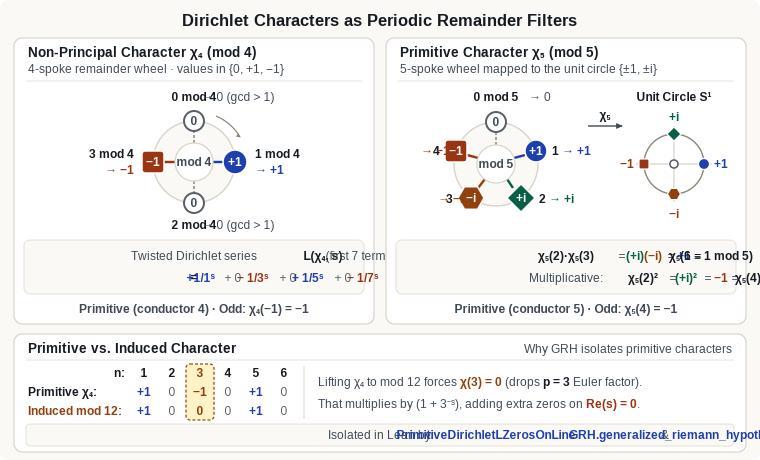
Level 1 — First-Principles
Suppose you want to count primes that leave a specific remainder when divided by
Check what happens when you multiply two numbers:
A rule
Limits of the intuition
The modulo-
Level 2 — Undergrad Bridge
Algebraically, a Dirichlet character modulo
Two structural properties drive Stage 00:
- Orthogonality: For
, equals if and otherwise. This filters arithmetic progressions into linear combinations of Dirichlet -functions. - Parity: Since
in , every character satisfies . Characters with are even and characters with are odd. Parity determines which gamma factor ( versus ) enters the functional equation, and therefore which non-positive integers are trivial zeros.
Level 3 — Formal Lean Contract
In Mathlib4 (Mathlib.NumberTheory.DirichletCharacter.Basic), DirichletCharacter R N is defined as MulChar (ZMod N) R—a multiplicative character from ZMod N to a commutative monoid with zero R (taken as ℂ in Stage 00), automatically sending non-units to 0.
Stage 00 anchors Dirichlet characters in:
00_statement/statements.lean#DirichletLNonvanishingRightOfHalf(upstreamsrc/Statements.lean:10-12): quantifies over every modulusN : ℕwith[NeZero N]and everyχ : DirichletCharacter ℂ N(likewise inDirichletLZerosOnLineatsrc/Statements.lean:14-16andPrimitiveDirichletLZerosOnLineatsrc/Statements.lean:18-20).
For the parallel formal-conjectures statement wrapper (comparator/FormalConjecturesStatement.lean, archived on upstream alpoge@c900e67c2 pending re-integration on condensed main), DirichletCharacter.instDecidablePredOddOfDecidableEq_formalConjecturesForMathlib provided the exact named DecidablePred instance for χ.Odd (χ (-1) = -1) required by the if χ.Odd then ... else ... branch inside GRH.trivialZeros. See the page's live verification banner (audit/verification-status.json) for the currently pinned upstream snapshot and local Lean build status (build_status: unverified-locally).
Where this analogy breaks
Comparing a Dirichlet character to a simple alternating
Formal Lean Anchors
def DirichletLNonvanishingRightOfHalf — Upstream source (src/Statements.lean L10-L12)
def DirichletLNonvanishingRightOfHalf : Prop :=
  ∀ (N : ℕ) [NeZero N] (χ : DirichletCharacter ℂ N) (s : ℂ),
    1 / 2 < s.re → (χ ≠ 1 ∨ s ≠ 1) → DirichletCharacter.LFunction χ s ≠ 0
Related Concepts
- complex plane — The two-dimensional coordinate plane of numbers s = σ + it, where the horizontal coordinate σ = Re(s) sets decay rate and the vertical coordinate t = Im(s) sets oscillation frequency.
- Dirichlet L-function — The meromorphic continuation of ∑ χ(n) n⁻ˢ associated to a Dirichlet character χ, generalizing ζ(s) to track primes across residue classes modulo N.
- primitive character — A Dirichlet character modulo q whose pattern does not come from any strictly smaller dividing modulus; its modulus q equals its minimal period (conductor).
Referenced By
- Stage: Formal Statement Contracts (
Statements.lean) - Stage: From a One-Sided Prime Bound to a Zero-Free Half-Plane
- Stage: Independent Statement Equivalence (
FormalConjecturesStatement&FormalConjecturesChallenge) - Stage: Stage 00 — Formal Statements & Challenge Contracts
- Stage: Stage 01 — The Theorem and Its Reduction
- Stage: The Five Entry Theorems (
Main.lean&Challenge.lean) - Concept: Dirichlet L-function
- Concept: primitive character
- Concept: quadratic twist
Authoritative Sources
- Beweis des Satzes, dass jede unbegrenzte arithmetische Progression... (paper) — P. G. L. Dirichlet, Abhandlungen der Königlichen Preussischen Akademie der Wissenschaften (1837), pp. 45–81.
- Introduction to Analytic Number Theory (book) — T. M. Apostol, Springer Undergraduate Texts in Mathematics (1976), Chapter 6: Dirichlet Characters.
- Mathlib4: DirichletCharacter (mathlib) — Mathlib.NumberTheory.DirichletCharacter.Basic (
DirichletCharacter,DirichletCharacter.Odd,DirichletCharacter.Even, pinned mathlib rev 31ce06eaadf4a200c0e1407c5f10953cf606b8f8).
Page Glossary
- complex plane
- The two-dimensional coordinate plane of numbers s = σ + it, where the horizontal coordinate σ = Re(s) sets decay rate and the vertical coordinate t = Im(s) sets oscillation frequency.
- Dirichlet L-function
- The meromorphic continuation of ∑ χ(n) n⁻ˢ associated to a Dirichlet character χ, generalizing ζ(s) to track primes across residue classes modulo N.
- primitive character
- A Dirichlet character modulo q whose pattern does not come from any strictly smaller dividing modulus; its modulus q equals its minimal period (conductor).