critical line
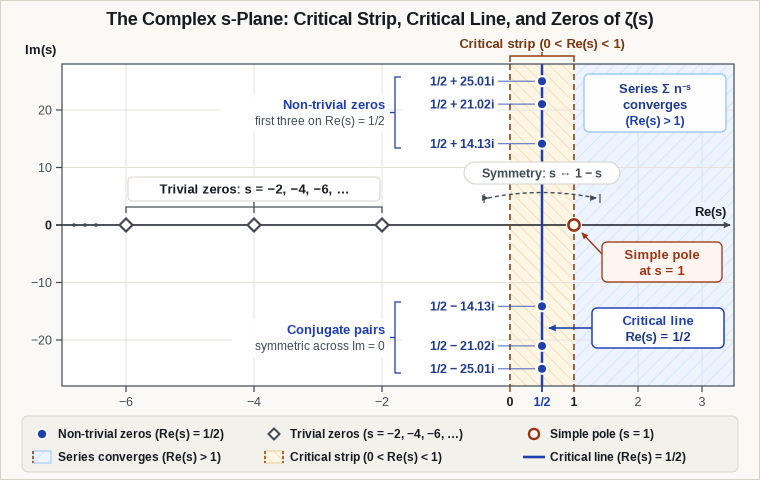
The vertical line Re(s) = 1/2 bisecting the critical strip—the axis of mirror symmetry s ↦ 1 − s where the Riemann Hypothesis asserts all nontrivial zeros lie.
Level 1 — First-Principles
Inside the two-dimensional grid of real and imaginary coordinatescomplex plane, the vertical band
The reflection
Limits of the intuition
Seeing the critical line as the balance axis of the symmetry
Level 2 — Undergrad Bridge
Writing
For prime counting, the Riemann–von Mangoldt explicit formula writes
Because
Level 3 — Formal Lean Contract
In Stage 00, the critical-line condition appears directly as the conclusion s.re = 1 / 2 in three of the four statement predicates in src/Statements.lean (RiemannZetaZerosOnLine, DirichletLZerosOnLine, and PrimitiveDirichletLZerosOnLine) as well as in the headline Mathlib statement RiemannHypothesis, while the fourth predicate (DirichletLNonvanishingRightOfHalf, src/Statements.lean:10-12) encodes the equivalent right-half-plane condition by taking 1 / 2 < s.re as a hypothesis and concluding DirichletCharacter.LFunction χ s ≠ 0:
00_statement/statements.lean#RiemannZetaZerosOnLine(upstreamsrc/Statements.lean:7-8):leandef RiemannZetaZerosOnLine : Prop := ∀ s : ℂ, riemannZeta s = 0 → (¬∃ n : ℕ, s = -2 * ((n : ℂ) + 1)) → s ≠ 1 → s.re = 1 / 200_statement/main.lean#riemannHypothesis(upstreamsrc/Main.lean:8-9):leantheorem riemannHypothesis : RiemannHypothesis := New.zeta_zeros_on_line New.grh
Here RiemannHypothesis is Mathlib's built-in definition (Mathlib.NumberTheory.LSeries.RiemannZeta), which is definitionally identical to RiemannZetaZerosOnLine, allowing src/Main.lean:11-12 to prove riemannZeta_eq_zero_re in one word (riemannHypothesis). See the page's live verification banner (audit/verification-status.json) for the currently pinned upstream snapshot and local Lean build status (build_status: unverified-locally).
Where this analogy breaks
Thinking of the critical line as a narrow target wire where zeros happen to balance under symmetry explains why
Formal Lean Anchors
def RiemannZetaZerosOnLine — Upstream source (src/Statements.lean L7-L8)
def RiemannZetaZerosOnLine : Prop :=
∀ s : ℂ, riemannZeta s = 0 → (¬∃ n : ℕ, s = -2 * ((n : ℂ) + 1)) → s ≠ 1 → s.re = 1 / 2theorem riemannHypothesis — Upstream source (src/Main.lean L8-L9)
/-- **The Riemann Hypothesis**, as stated in Mathlib. -/
theorem riemannHypothesis : RiemannHypothesis := by
  sorry -- [EXTRACTED_STUB upstream=src/Main.lean:8-9 commit=41c2716658c42ba08eb0648994a2efe83082a95c body_lines=1 body_sha256=01d0886b29436a4267de3a000dd8533fdb3cb85a2a0380e4f6bc2ee37caa10b6]
Related Concepts
- complex plane — The two-dimensional coordinate plane of numbers s = σ + it, where the horizontal coordinate σ = Re(s) sets decay rate and the vertical coordinate t = Im(s) sets oscillation frequency.
- critical strip — The open vertical band 0 < Re(s) < 1 in the complex plane that contains every nontrivial zero of ζ(s) and of every Dirichlet L-function.
- Riemann zeta function — The meromorphic function ζ(s) extending ∑ n⁻ˢ to all of ℂ ∖ {1}, linking prime numbers via its Euler product to zeros in the complex plane.
- Dirichlet L-function — The meromorphic continuation of ∑ χ(n) n⁻ˢ associated to a Dirichlet character χ, generalizing ζ(s) to track primes across residue classes modulo N.
Referenced By
- Stage: Formal Statement Contracts (
Statements.lean) - Stage: From a One-Sided Prime Bound to a Zero-Free Half-Plane
- Stage: Full Proof Journey & Alpöge's 20-Step Map
- Stage: Independent Statement Equivalence (
FormalConjecturesStatement&FormalConjecturesChallenge) - Stage: Stage 00 — Formal Statements & Challenge Contracts
- Stage: Stage 01 — The Theorem and Its Reduction
- Stage: The Five Entry Theorems (
Main.lean&Challenge.lean) - Concept: complex plane
- Concept: critical strip
- Concept: Dirichlet L-function
- Concept: Landau's lemma
- Concept: Riemann zeta function
Authoritative Sources
- Ueber die Anzahl der Primzahlen unter einer gegebenen Grösse (paper) — B. Riemann, Monatsberichte der Königlichen Preussischen Akademie der Wissenschaften zu Berlin (November 1859), pp. 671–680.
- Problems of the Millennium: The Riemann Hypothesis (reference) — E. Bombieri, Clay Mathematics Institute (2000).
- Mathlib4: RiemannHypothesis (mathlib) — Mathlib.NumberTheory.LSeries.RiemannZeta (
RiemannHypothesis, pinned mathlib rev 31ce06eaadf4a200c0e1407c5f10953cf606b8f8).
Page Glossary
- complex plane
- The two-dimensional coordinate plane of numbers s = σ + it, where the horizontal coordinate σ = Re(s) sets decay rate and the vertical coordinate t = Im(s) sets oscillation frequency.
- critical strip
- The open vertical band 0 < Re(s) < 1 in the complex plane that contains every nontrivial zero of ζ(s) and of every Dirichlet L-function.
- Riemann zeta function
- The meromorphic function ζ(s) extending ∑ n⁻ˢ to all of ℂ ∖ {1}, linking prime numbers via its Euler product to zeros in the complex plane.
- Dirichlet L-function
- The meromorphic continuation of ∑ χ(n) n⁻ˢ associated to a Dirichlet character χ, generalizing ζ(s) to track primes across residue classes modulo N.
- infinite series
- A limit of partial sums formed by adding infinitely many terms; in number theory, weighting terms by n⁻ˢ produces a Dirichlet series that turns integer arithmetic into a smooth function.