tight frame
Also known as: Parseval frame, eutactic star, resolution of the identity.
A balanced, possibly overcomplete family of vectors with integer multiplicities whose projections reconstruct the exact standard inner product—allowing integral root-of-unity spokes to pull back one-dimensional elliptic theta sections into high-dimensional integral theta functions.
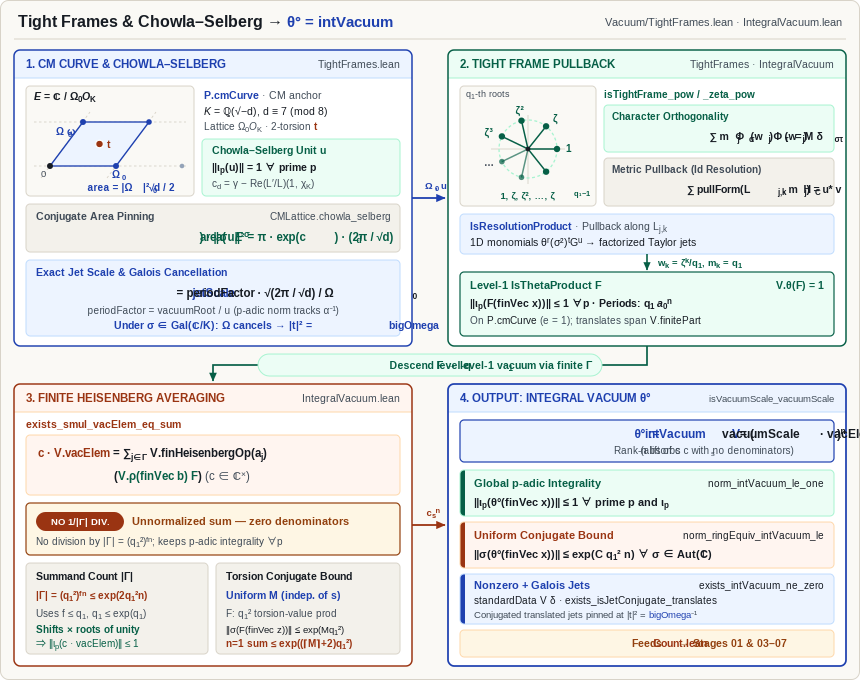
Level 1 — First-Principles
In ordinary geometry, an orthonormal basis gives the cleanest possible coordinate system: project any vector onto each perpendicular axis, square the lengths of those shadows, and their sum recovers the squared length of the vector itself. Sometimes, however, insisting on perpendicular axes is too rigid—for example, when you want every axis vector to have clean algebraic coordinates without messy square roots. You can trade minimality for symmetry by using more vectors than dimensions. Picture three equally spaced spokes of a wheel in a flat plane, or the vertices of a regular
In Stage 02 of the proof, tight frames solve a delicate geometric-versus-arithmetic dilemma. We work in a high-dimensional space over the two-dimensional plane of real and imaginary coordinatescomplex plane, whose coordinates correspond to the distinct embeddings of a cyclotomic field built over a quadratic field with an elliptic curve equipped with extra geometric symmetries beyond whole-number scalingcomplex multiplication. Our goal is to assemble high-dimensional theta functions by multiplying together one-dimensional quasi-periodic building-block functions attached to a two-dimensional latticeelliptic theta function, each evaluated along a linear slice. For the resulting product to transform like a genuine theta function and stay integral on finite-adelic lattices at every indivisible whole number
- Exact geometric balance: the weighted sum of their pulled-back Hermitian forms must reproduce the exact standard inner product, with no skew or leftover cross-terms.
- Exact algebraic integrality: every slice vector must lie in the integral adelic lattice of the field, free of prime denominators.
An orthonormal basis in general fails integrality, whereas the powers
The same resolution-of-the-identity property pays a second dividend when we reduce modulo a prime
Limits of the intuition
Picturing a tight frame as equally spaced real spokes on a circle captures overcompleteness and isotropic length recovery, but breaks down in two crucial ways here. First, the frame vectors
Level 2 — Undergrad Bridge
In a finite-dimensional complex inner product space
or equivalently, as an operator identity on
When
Stage 02 instantiates this structure arithmetically over the tower of CM fields IsTightFrame w m M when:
- Adelic integrality:
for every (i.e., ). - CM-type orthogonality: for all infinite places
,
Three structural consequences drive the Stage 02 pipeline:
- Existence from roots of unity (
isTightFrame_pow): For any primitive-th root of unity , distinct embeddings take to distinct -th roots of unity in . Hence is a nontrivial -th root of unity for and for , so geometric-series cancellation gives Since every , the powers with form a tight frame of length ; repeating each spoke times ( isTightFrame_zeta_pow) scales the frame bound to. - Pullback of Hermitian forms and resolution products (
exists_isResolutionProduct_of_isTightFrame): Fix an integerwith , a CM lattice containing of area and . For each , define the linear form Pulling back the scaled Hermitian form along and summing over cancels against via the tight-frame identity, recovering the exact standard Hermitian form ( sum_pullForm_resolutionLinearForm_apply). Consequently, for any choice of monomial sectionsof degree , there exists a vector in the finite part of the adelic Heisenberg model ( IsResolutionProduct) such that:- Every rational translate
has entire theta function equal to the product of twisted translates of along ; - All finite-adelic evaluations
satisfy at every prime and place ; is a theta function for the lattice .
- Every rational translate
- Collapse to Frobenius couplings modulo
( piPrimeInt_dvd_sum_linearSeries_sub_coupling): Passing to vectorsintegral above that form a resolution of the identity (so ), the Frobenius congruence for and implies Every dependence on the specific frame disappears modulo , feeding directly into exists_hasNormalForm.
Level 3 — Formal Lean Contract
Stage 02 extracts the tight-frame theorems into skeleton/02_derivatives/tight_frames.lean (from upstream src/New/Derivatives/Vacuum/TightFrames.lean) and the modulo-skeleton/02_derivatives/theta_products.lean (from upstream src/New/Derivatives/FormalGroup/ThetaProducts.lean):
02_derivatives/tight_frames.lean#New.Parameters.isTightFrame_pow(upstreamsrc/New/Derivatives/Vacuum/TightFrames.lean:389-405):leanlemma New.Parameters.isTightFrame_pow {z : P.E s} (hz : IsPrimitiveRoot z (P.q₁ s)) : IsTightFrame (fun i : Fin (P.q₁ s) ↦ z ^ i.val) 1 (P.q₁ s)02_derivatives/tight_frames.lean#New.Parameters.exists_isResolutionProduct_of_isTightFrame(upstreamsrc/New/Derivatives/Vacuum/TightFrames.lean:828-911):leanlemma New.Parameters.exists_isResolutionProduct_of_isTightFrame (V : Space (P.E s) n ε) [hV : V.IsStd] {M N : ℕ} {I : Type} [Fintype I] {w : I → P.E s} {m : I → ℕ} (δ : 𝓞 P.K) (hN_ne : N ≠ 0) (hN : δ * conj (δ : ℂ) = N) (hw : IsTightFrame w m M) (x : I × n → ℕ × ℕ × ℕ) (hx : ∀ i : I × n, CMLattice.monomialDeg (x i) = m i.1) ⦃C : CMLattice P.d⦄ ⦃a : ℂ⦄ (ha : a ∈ C.Λ) (h_area : C.area = ‖a‖ ^ 2 / N * M * √P.d / 2) : ∃ F : 𝒮 V, IsResolutionProduct V C (a / conj (δ : ℂ)) w m (fun i : I × n ↦ C.monomialSection (x i)) F ∧ (∀ (p : ℕ) [Fact p.Prime] [PadicPlace p] (y : n → 𝔸f (P.E s)), ‖ιₚ (F (finVec y))‖ ≤ 1) ∧ IsThetaFunction (star (algebraMap P.K (P.E s) δ) • idealLattice (P.E s) n) (entireTheta F)02_derivatives/theta_products.lean#New.Parameters.piPrimeInt_dvd_sum_linearSeries_sub_coupling(upstreamsrc/New/Derivatives/FormalGroup/ThetaProducts.lean:243-276):leanlemma New.Parameters.piPrimeInt_dvd_sum_linearSeries_sub_coupling (P : Parameters) (s : ℕ) {p : ℕ} [Fact p.Prime] [PadicPlace p] {n J : Type} [Fintype n] [Fintype J] {u : J → n → P.E s} {m : J → ℕ} [DecidableEq n] {e : ℕ} (he : e ∈ partnerExponents P.d p) (h_res : IsResolution u m) (hu : ∀ (j : J) (i : n), IsIntegralAbove p (u j i)) {μ : J → P.Φ s × n → valRingCp p} (hμ : ∀ (j : J) (x : P.Φ s × n), (μ j x : ℂ_[p]) = daggerForms u j x) : C (piPrimeInt P.d) ∣ ∑ j : J, m j * (linearSeries (μ j) ^ p ^ e * linearSeries (μ j)) - coupling (P.partner s p) e
Notice the clean structural separation across the two files: New.Parameters.sum_pullForm_resolutionLinearForm_apply turns IsTightFrame into the Hermitian form identity behind New.Parameters.IsResolutionProduct (producing integral, periodic vectors in 𝒮 V), while piPrimeInt_dvd_sum_linearSeries_sub_coupling converts the unscaled resolution property IsResolution u m into the prime-level coupling congruence feeding exists_hasNormalForm. See the page's live verification banner (audit/verification-status.json) for the currently pinned upstream snapshot and local Lean build status (build_status: unverified-locally).
Where this analogy breaks
Picturing a tight frame as equally spaced real spokes in
Formal Lean Anchors
lemma New.Parameters.isTightFrame_pow — Upstream source (src/New/Derivatives/Vacuum/TightFrames.lean L389-L405)
/-- Orthogonality of characters: for parameters `P : Parameters`, `s : ℕ` and a primitive `q₁`-th
root of unity `z` of `E = P.E s`, with `q₁ = P.q₁ s`, the powers `z ^ i`, `0 ≤ i < q₁`, are a tight
frame of length `q₁` with all multiplicities `1`. -/
lemma New.Parameters.isTightFrame_pow {z : P.E s} (hz : IsPrimitiveRoot z (P.q₁ s)) :
IsTightFrame (fun i : Fin (P.q₁ s) ↦ z ^ i.val) 1 (P.q₁ s) := by
sorry -- [EXTRACTED_STUB upstream=src/New/Derivatives/Vacuum/TightFrames.lean:389-405 commit=41c2716658c42ba08eb0648994a2efe83082a95c body_lines=13 body_sha256=8cc94b824b95d665590e0df967c31557ba8e5ecacc0a11bcc067a2d7d3608362]lemma New.Parameters.exists_isResolutionProduct_of_isTightFrame — Upstream source (src/New/Derivatives/Vacuum/TightFrames.lean L828-L911)
/-- Let `V` be a standard space (signs `1`, point the identity). Let `δ δ̄ = N ≠ 0` for an integer
`δ` of `K`, and let `w` be a tight frame of length `M` with multiplicities `m`. Let
`x i = (r, t, u)` be exponents of degree `r + 2 t + 3 u = m i.1` (`monomialDeg`). Let `C` be a CM
lattice of area `|a|² M √d / (2 N)` that contains `a`. The monomial section of `x i` is
`θ ^ r * (σ ^ 2) ^ t * G ^ u`, with `θ` the theta function and `σ` the sigma function of `C`. Here
`G = translatedYThetaCube` is the entire function equal to `C.translatedY * θ ^ 3` away from poles.
There is a vector `F` that is the resolution product of these sections along `w` at scale `a / δ̄`.
That is, for every rational vector `γ`, the theta function of the translate of `F` by the finite
image of `γ` is the product of twisted translates of the sections, evaluated at the linear forms of
the frame. The values of `F` at finite adelic vectors are integral at every `p`-adic place `ιₚ` of
`ℂ`. Let `entireTheta F` be the theta function of `F`, as an entire function on `ℂ^(Φ × n)`. It is a
theta function for the lattice `δ̄ 𝔞₀ⁿ`. That is, it is entire and fixed by the translations
`signedShift γ` (the translation by `γ` times its sign `± 1`) along the lattice. -/
lemma New.Parameters.exists_isResolutionProduct_of_isTightFrame (V : Space (P.E s) n ε) [hV : V.IsStd] {M N : ℕ}
    {I : Type} [Fintype I] {w : I → P.E s} {m : I → ℕ} (δ : 𝓞 P.K) (hN_ne : N ≠ 0)
    (hN : δ * conj (δ : ℂ) = N) (hw : IsTightFrame w m M) (x : I × n → ℕ × ℕ × ℕ)
    (hx : ∀ i : I × n, CMLattice.monomialDeg (x i) = m i.1)
    ⦃C : CMLattice P.d⦄ ⦃a : ℂ⦄ (ha : a ∈ C.Λ) (h_area : C.area = ‖a‖ ^ 2 / N * M * √P.d / 2) :
    ∃ F : 𝒮 V,
      IsResolutionProduct V C (a / conj (δ : ℂ)) w m (fun i : I × n ↦ C.monomialSection (x i)) F ∧
      (∀ (p : ℕ) [Fact p.Prime] [PadicPlace p] (y : n → 𝔸f (P.E s)), ‖ιₚ (F (finVec y))‖ ≤ 1) ∧
      IsThetaFunction (star (algebraMap P.K (P.E s) δ) • idealLattice (P.E s) n)
(entireTheta F) := by
sorry -- [EXTRACTED_STUB upstream=src/New/Derivatives/Vacuum/TightFrames.lean:828-911 commit=41c2716658c42ba08eb0648994a2efe83082a95c body_lines=61 body_sha256=cc4b8a1e8f1a2caaa192e0717fdae2b981a85cbd19863e369320ddd5d37d00c8]lemma New.Parameters.piPrimeInt_dvd_sum_linearSeries_sub_coupling — Upstream source (src/New/Derivatives/FormalGroup/ThetaProducts.lean L243-L276)
/-- Let `E = P.E s` be `K = ℚ(√-d)` (`d = P.d`) with a root of unity of order `q₁ = P.q₁ s`
adjoined, `s` being the tower level, and let `e` be in `I_p° = partnerExponents P.d p`. Let the
vectors `u_j` of `Eⁿ`, integral above `p` and each taken `m_j` times, be a resolution of the
identity: `z = ∑ m_j (u_j† z) u_j`. Then `∑ m_j (u_j† z) ^ p ^ e * (u_j† z)` is the coupling
`Γ_e = ∑ z_(τ,c) ^ p ^ e * z_(τ',c)` modulo `π_p`. -/
lemma New.Parameters.piPrimeInt_dvd_sum_linearSeries_sub_coupling (P : Parameters) (s : ℕ) {p : ℕ} [Fact p.Prime]
    [PadicPlace p]
    {n J : Type} [Fintype n] [Fintype J] {u : J → n → P.E s} {m : J → ℕ} [DecidableEq n]
    {e : ℕ} (he : e ∈ partnerExponents P.d p)
    (h_res : IsResolution u m) (hu : ∀ (j : J) (i : n), IsIntegralAbove p (u j i))
    {μ : J → P.Φ s × n → valRingCp p}
    (hμ : ∀ (j : J) (x : P.Φ s × n), (μ j x : ℂ_[p]) = daggerForms u j x) :
    C (piPrimeInt P.d) ∣
      ∑ j : J, m j * (linearSeries (μ j) ^ p ^ e * linearSeries (μ j)) -
coupling (P.partner s p) e := by
sorry -- [EXTRACTED_STUB upstream=src/New/Derivatives/FormalGroup/ThetaProducts.lean:243-276 commit=41c2716658c42ba08eb0648994a2efe83082a95c body_lines=20 body_sha256=5d3c7c31cded664942b3f6ec8e404146ad406bd465d86cc1b468d263c10af4cd]Related Concepts
- prime number — A whole number greater than 1 whose only positive whole-number divisors are 1 and itself; every integer above 1 factors uniquely into a product of them.
- complex plane — The two-dimensional coordinate plane of numbers s = σ + it, where the horizontal coordinate σ = Re(s) sets decay rate and the vertical coordinate t = Im(s) sets oscillation frequency.
- complex multiplication — Extra scaling-and-rotation symmetries of a two-dimensional lattice in ℂ preserved by the integers 𝓞_K of an imaginary quadratic field K = ℚ(√(-d)), pinning down every Galois-conjugate lattice area via the Chowla–Selberg formula.
- elliptic theta function — A quasi-periodic entire function on a CM lattice normalized at the origin, whose finite products along tight-frame projections build integral multi-variable theta functions and collapse p-adically into exponential normal forms.
- theta normal form — A p-adic factorization of rescaled multivariable theta products into an integral power series times an exponential of Frobenius-power couplings pairing each infinite place with its shifted partner place.
Referenced By
- Stage: Formal Groups, Theta Normal Form & Prime-Counting Divisibility
- Stage: Sharpness: Proving the Valuation Bound Is Attained
- Stage: Stage 02 — Derivatives of Theta Functions
- Stage: Stage 06 — Lower Bound: One Lift (Theorem C, Part 2)
- Stage: Target Dimension, Multiplicity Equality, and One Good Translate
- Stage: The Lift Comparison Operator and Single-Lift Volume Height
- Stage: Tight Frames, Chowla–Selberg Scaling & the Integral Vacuum
- Concept: elliptic theta function
- Concept: Hilbert–Schmidt norm
- Concept: lift comparison operator
- Concept: Schur jet
- Concept: theta normal form
Authoritative Sources
- Low-dimensional lattices V: Integral coordinates for integral lattices (paper) — J. H. Conway & N. J. A. Sloane, Proc. R. Soc. Lond. A 426 (1989).
- Finite normalized tight frames (paper) — J. J. Benedetto & M. Fickus, Adv. Comput. Math. 18 (2003).
Page Glossary
- complex plane
- The two-dimensional coordinate plane of numbers s = σ + it, where the horizontal coordinate σ = Re(s) sets decay rate and the vertical coordinate t = Im(s) sets oscillation frequency.
- complex multiplication
- Extra scaling-and-rotation symmetries of a two-dimensional lattice in ℂ preserved by the integers 𝓞_K of an imaginary quadratic field K = ℚ(√(-d)), pinning down every Galois-conjugate lattice area via the Chowla–Selberg formula.
- elliptic theta function
- A quasi-periodic entire function on a CM lattice normalized at the origin, whose finite products along tight-frame projections build integral multi-variable theta functions and collapse p-adically into exponential normal forms.
- prime number
- A whole number greater than 1 whose only positive whole-number divisors are 1 and itself; every integer above 1 factors uniquely into a product of them.
- theta normal form
- A p-adic factorization of rescaled multivariable theta products into an integral power series times an exponential of Frobenius-power couplings pairing each infinite place with its shifted partner place.