Landau's lemma
Also known as: one-sided criterion.
A complex-analytic theorem stating that the Laplace or Dirichlet transform of a nonnegative function must have a singularity on the real axis at its abscissa of convergence, turning one-sided error bounds into zero-free half-planes.
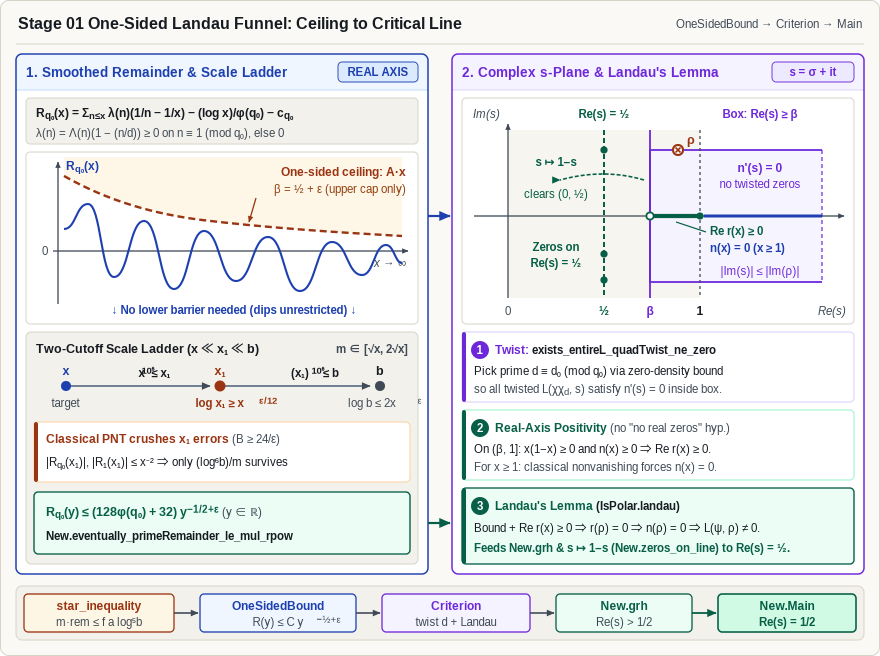
Level 1 — First-Principles
Suppose a signal
defined on a right half of the two-dimensional grid of real and imaginary coordinatescomplex plane. Because every contribution
Turn that statement around and it becomes an engine for proving zero-free regions. If
Crucially, this principle extends to oscillating error signals
Limits of the intuition
Landau's lemma turns one-sided bounds into zero-free half-planes only when the real axis stays unobstructed. If the transform
Level 2 — Undergrad Bridge
Let
If
In Stage 01, this theorem is packaged as a polar-transform criterion (New.IsPolar.landau). Suppose
Setting
For real IsPolar.landau forces
Level 3 — Formal Lean Contract
Upstream src/Lib/Analytic/EntireLFunction.lean defines New.IsPolar (E : ℝ → ℝ) (r : ℂ → ℂ) : Prop, packaging measurability, src/Lib/Analytic/Landau.lean proves the analytic engine:
New.mem_integrableExpSet_of_summable_taylor: derives real convergence ofcomplexMGF X μfrom summability of the Taylor series atvia lintegral_tsum.New.exists_measure_laplace_eq: turns∀ᶠ v in atTop, E v ≤ A * Real.exp ((β - 1) * v)into a nonnegative measureμwith density(K * Real.exp (β * v) - E v * Real.exp v).toNNReal.New.IsPolar.landau: provesr ρ = 0forβ < ρ.rewhenever∀ x : ℝ, β < x → 0 ≤ (r x).reand the one-sided exponential bound holds.
Stage 01 anchors the full criterion in:
01_reduction/criterion.lean#New.LFunction_ne_zero_of_primeRemainder_le(upstreamsrc/New/Reduction/Zeros/Criterion.lean:35-90):leantheorem New.LFunction_ne_zero_of_primeRemainder_le {q₀ : ℕ} [NeZero q₀] (hq₀ : 8 ∣ q₀) {d₀ : ℕ} (hd₀_mod : d₀ % 8 = 7) (hd₀_cop : d₀.Coprime q₀) {β : ℝ} (hβ : 1 / 2 < β) (h_bound : ∀ d : Primes, (d : ℕ) ≡ d₀ [MOD q₀] → ∃ A : ℝ, ∀ᶠ x : ℝ in atTop, primeRemainder d q₀ x ≤ A * x ^ (β - 1)) (ψ : DirichletCharacter ℂ q₀) {ρ : ℂ} (hρ_ne : ρ ≠ 1) (hρ_re : β < ρ.re) : ψ.LFunction ρ ≠ 0
See the page's live verification banner (audit/verification-status.json) for the currently pinned upstream snapshot and local Lean build status (build_status: unverified-locally).
Where this analogy breaks
Landau's lemma cannot rule out off-axis poles on its own if a real singularity sits further right: a one-sided bound
Formal Lean Anchors
theorem New.LFunction_ne_zero_of_primeRemainder_le — Upstream source (src/New/Reduction/Zeros/Criterion.lean L35-L90)
/-- **One-sided criterion.** Let `q₀` be a positive multiple of `8`, let `d₀ ≡ 7` mod `8` be prime
to `q₀`, and let `β > 1/2`. Suppose that for each prime `d ≡ d₀` mod `q₀` the remainder
`primeRemainder d q₀ x = ∑_{n ≤ x} λ(n) (1/n - 1/x) - log x / φ(q₀) - c` is at most `A * x ^ (β - 1)`
for some `A` and all large `x`. Here `λ(n) = Λ(n) (1 - (n/d))` for `n ≡ 1` mod `q₀` and `0` otherwise,
and `c` is the constant for which the remainder tends to `0`. Then `L(ρ, ψ) ≠ 0` for every
character `ψ` modulo `q₀` and every `ρ ≠ 1` with `re ρ > β`. -/
theorem New.LFunction_ne_zero_of_primeRemainder_le {q₀ : ℕ} [NeZero q₀] (hq₀ : 8 ∣ q₀) {d₀ : ℕ}
    (hd₀_mod : d₀ % 8 = 7) (hd₀_cop : d₀.Coprime q₀) {β : ℝ} (hβ : 1 / 2 < β)
    (h_bound : ∀ d : Primes, (d : ℕ) ≡ d₀ [MOD q₀] →
      ∃ A : ℝ, ∀ᶠ x : ℝ in atTop, primeRemainder d q₀ x ≤ A * x ^ (β - 1))
    (ψ : DirichletCharacter ℂ q₀) {ρ : ℂ} (hρ_ne : ρ ≠ 1) (hρ_re : β < ρ.re) :
ψ.LFunction ρ ≠ 0 := by
sorry -- [EXTRACTED_STUB upstream=src/New/Reduction/Zeros/Criterion.lean:35-90 commit=41c2716658c42ba08eb0648994a2efe83082a95c body_lines=45 body_sha256=dee53546115f07956df438a6dd34a213cb6cb1775d14fde132a1c579e7a308de]Related Concepts
- complex plane — The two-dimensional coordinate plane of numbers s = σ + it, where the horizontal coordinate σ = Re(s) sets decay rate and the vertical coordinate t = Im(s) sets oscillation frequency.
- analytic continuation — The unique extension of a complex-differentiable function from a smaller region to a larger domain, locked in place by the identity theorem.
- Dirichlet L-function — The meromorphic continuation of ∑ χ(n) n⁻ˢ associated to a Dirichlet character χ, generalizing ζ(s) to track primes across residue classes modulo N.
- von Mangoldt function — The arithmetic weight Λ(n) equal to log p when n is a prime power pᵏ (k ≥ 1) and 0 otherwise, converting multiplicative prime factorizations into additive logarithms.
- quadratic twist — Multiplying a Dirichlet character χ modulo N by the Legendre symbol (·/d) of an odd prime d coprime to N, yielding a non-principal character modulo N·d whose L-function family admits zero-density control.
- critical line — The vertical line Re(s) = 1/2 bisecting the critical strip—the axis of mirror symmetry s ↦ 1 − s where the Riemann Hypothesis asserts all nontrivial zeros lie.
Referenced By
- Stage: From a One-Sided Prime Bound to a Zero-Free Half-Plane
- Stage: Stage 01 — The Theorem and Its Reduction
- Stage: Stage 02 — Derivatives of Theta Functions
- Stage: The Main Inequality & Theorems A and B
- Concept: quadratic twist
- Concept: von Mangoldt function
Authoritative Sources
- Über einen Satz von Tschebyschef (paper) — E. Landau, Mathematische Annalen 61 (1905), pp. 527–550.
- Multiplicative Number Theory I: Classical Theory (book) — H. L. Montgomery and R. C. Vaughan, Cambridge University Press (2007), Lemma 15.1 and §§15.1–15.2.
- On variants of Chebyshev's conjecture (paper) — M. Suzuki, arXiv:2411.07436 (2024).
Page Glossary
- complex plane
- The two-dimensional coordinate plane of numbers s = σ + it, where the horizontal coordinate σ = Re(s) sets decay rate and the vertical coordinate t = Im(s) sets oscillation frequency.
- analytic continuation
- The unique extension of a complex-differentiable function from a smaller region to a larger domain, locked in place by the identity theorem.
- von Mangoldt function
- The arithmetic weight Λ(n) equal to log p when n is a prime power pᵏ (k ≥ 1) and 0 otherwise, converting multiplicative prime factorizations into additive logarithms.
- quadratic twist
- Multiplying a Dirichlet character χ modulo N by the Legendre symbol (·/d) of an odd prime d coprime to N, yielding a non-principal character modulo N·d whose L-function family admits zero-density control.
- Dirichlet L-function
- The meromorphic continuation of ∑ χ(n) n⁻ˢ associated to a Dirichlet character χ, generalizing ζ(s) to track primes across residue classes modulo N.
- critical line
- The vertical line Re(s) = 1/2 bisecting the critical strip—the axis of mirror symmetry s ↦ 1 − s where the Riemann Hypothesis asserts all nontrivial zeros lie.