prime number
A whole number greater than 1 whose only positive whole-number divisors are 1 and itself; every integer above 1 factors uniquely into a product of them.
Level 1 — First-Principles
Take any whole number greater than
Two facts make prime numbers central to the Riemann Hypothesis. First, every integer
Limits of the intuition
Comparing prime numbers to chemical atoms captures unique factorization, since every integer builds cleanly from prime factors. The analogy fails on global distribution: chemistry has finitely many elements arranged in a regular periodic table, whereas primes are infinite in number and exhibit irregular local gaps whose statistical error term is governed by complex-analytic zeros rather than any simple repeating pattern.
Level 2 — Undergrad Bridge
Formally,
Expanding each geometric series
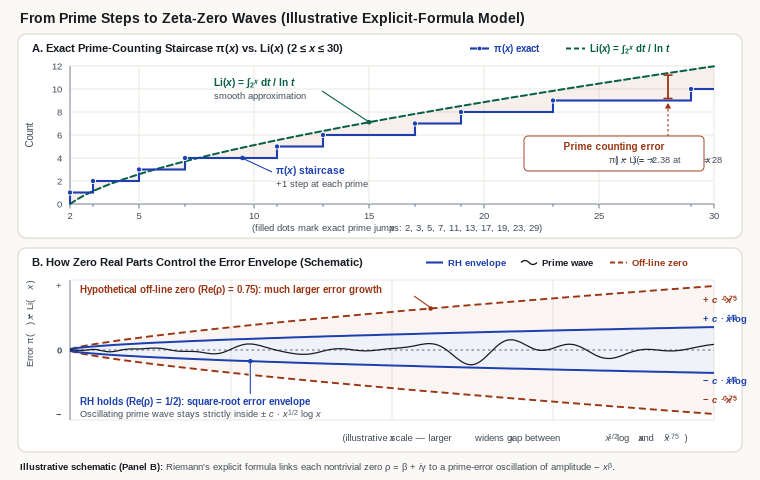
To study primes smoothly, analytic number theory replaces the step function
Perron's formula converts this identity into an explicit formula expressing
Level 3 — Formal Lean Contract
In Mathlib4 (Mathlib.Data.Nat.Prime.Basic), primality for natural numbers is defined as Nat.Prime p, requiring p ≠ 1 and irreducibility (∀ a b, p = a * b → a = 1 ∨ b = 1, packaged via Irreducible p). Stage 00 does not declare a custom prime predicate; upstream src/Statements.lean and root Challenge.lean (lines 7–20, with riemannHypothesis at lines 7–8) build directly on Mathlib's riemannZeta and DirichletCharacter.LFunction, which encode primes through Mathlib's Euler product and LSeries library (Mathlib.NumberTheory.LSeries.EulerProduct), while upstream's GUIDE.md and INDEX.md index how the prime-sum bounds and Lib/Analytic/PrimeNumberTheorem feed into New.grh. (Upstream's parallel comparator/FormalConjecturesStatement.lean wrapper is archived on alpoge@c900e67c2 pending re-integration on condensed main.) See the page's live verification banner (audit/verification-status.json) for the currently pinned upstream snapshot and local Lean build status (build_status: unverified-locally, Mathlib rev 31ce06eaadf4a200c0e1407c5f10953cf606b8f8).
Where this analogy breaks
Calling prime numbers the 'atoms' of arithmetic explains unique factorization, but unlike chemical elements there are infinitely many primes and their spacing follows no fixed periodic table—their fluctuations encode deep analytic structure.
Related Concepts
- infinite series — A limit of partial sums formed by adding infinitely many terms; in number theory, weighting terms by n⁻ˢ produces a Dirichlet series that turns integer arithmetic into a smooth function.
- Riemann zeta function — The meromorphic function ζ(s) extending ∑ n⁻ˢ to all of ℂ ∖ {1}, linking prime numbers via its Euler product to zeros in the complex plane.
Referenced By
- Stage: Chain Determinant Factorization and Two-Grid Auxiliary Forms
- Stage: Crystalline Lifting, Kummer Charts, and Local Dual Defect
- Stage: First-Order Ribet Denominator Bounds and Existence of Regular Twist Families
- Stage: Formal Groups, Theta Normal Form & Prime-Counting Divisibility
- Stage: From a One-Sided Prime Bound to a Zero-Free Half-Plane
- Stage: Full Proof Journey & Alpöge's 20-Step Map
- Stage: Galois Main Summands and the Anticyclotomic Selmer Twisting Theorem
- Stage: Prime-by-Prime Divisibility & Elementary Divisors of Edge Hecke Operators
- Stage: Regular Twist Families and the Assembly of Theorem C
- Stage: Relative-Trace Unfolding, Bessel Translates, and the Two Moment Bounds
- Stage: Sharpness: Proving the Valuation Bound Is Attained
- Stage: Short Ramified Columns & Archimedean Size Cancellation
- Stage: Stage 00 — Formal Statements & Challenge Contracts
- Stage: Stage 01 — The Theorem and Its Reduction
- Stage: Stage 02 — Derivatives of Theta Functions
- Stage: Stage 03 — Upper Bound: A Composite Theta Lift (Theorem A)
- Stage: Stage 04 — Spanning: Second Moment (Theorem B)
- Stage: Stage 05 — Lower Bound: The Determinant (Theorem C, Part 1)
- Stage: Stage 06 — Lower Bound: One Lift (Theorem C, Part 2)
- Stage: Stage 07 — Lower Bound: Congruences & Galois Representations (Theorem C, Part 3)
- Stage: The Big-Cell Kloosterman Sieve and Remaining-Term Link Bounds
- Stage: The Lift Comparison Operator and Single-Lift Volume Height
- Stage: The Main Inequality & Theorems A and B
- Stage: Three Exchanges, the Carrier Form, and Divided-Lattice Gluing
- Stage: Tight Frames, Chowla–Selberg Scaling & the Integral Vacuum
- Stage: Twisted Lattices & A Twist for Each Prime
- Stage: Vanishing Periods of False Lifts and Negative Heights of Twisted L-Values
- Concept: arithmetic height
- Concept: central idempotent
- Concept: complex multiplication
- Concept: crystalline dual defect
- Concept: elementary divisor
- Concept: formal group law
- Concept: Frobenius cycle
- Concept: Galois main summand
- Concept: Hecke operator
- Concept: infinite series
- Concept: Kloosterman sieve
- Concept: Kummer chart cup orthogonality
- Concept: quadratic twist
- Concept: regular twist family
- Concept: Riemann zeta function
- Concept: Schur jet
- Concept: seesaw duality
- Concept: Taylor–Wiles prime triangle
- Concept: theta correspondence
- Concept: theta normal form
- Concept: tight frame
- Concept: twisted lattice
- Concept: von Mangoldt function
- Concept: Weyl gauge
Authoritative Sources
- An Introduction to the Theory of Numbers (book) — G. H. Hardy and E. M. Wright, 6th ed., Oxford University Press (2008), Chapters 1, 2, and 22.
- Multiplicative Number Theory (book) — H. Davenport, 3rd ed., Springer Graduate Texts in Mathematics 74 (2000), Chapters 1–7.
- Mathlib4: Nat.Prime (mathlib) — Mathlib.Data.Nat.Prime.Basic (pinned mathlib rev 31ce06eaadf4a200c0e1407c5f10953cf606b8f8).
Page Glossary
- infinite series
- A limit of partial sums formed by adding infinitely many terms; in number theory, weighting terms by n⁻ˢ produces a Dirichlet series that turns integer arithmetic into a smooth function.
- Riemann zeta function
- The meromorphic function ζ(s) extending ∑ n⁻ˢ to all of ℂ ∖ {1}, linking prime numbers via its Euler product to zeros in the complex plane.