auxiliary spanning form
Also known as: auxiliary form, two-grid path, diagonal turn, last-path period, delta form, completion cost.
A target form whose m-step lifts stay p-integral (after a shared twist scalar) and bounded in archimedean norm by exp(2x_1^2b^2), completing an almost-spanning family to a full basis of Y_0 at total cost at most d*b.
Level 1 — First-Principles
In Stage 01's twisted-lattice inequalitytwisted lattice (TwistedLattice.covolume_add_index_nonneg), the global balance law equating archimedean size and prime-by-prime valuationsarithmetic height applies only to a full basis of the New.Data.IsAuxiliaryForm) that can fill in any
What makes a target form
- Uniform integrality up to one shared twist scalar: There is a single scalar function
(with , independent of !) such that is -integral at every prime . - Moderate untwisted archimedean size: Every Galois conjugate of
has squared norm at most .
At first sight,
since mul_completion_cost_le). The tiny fraction
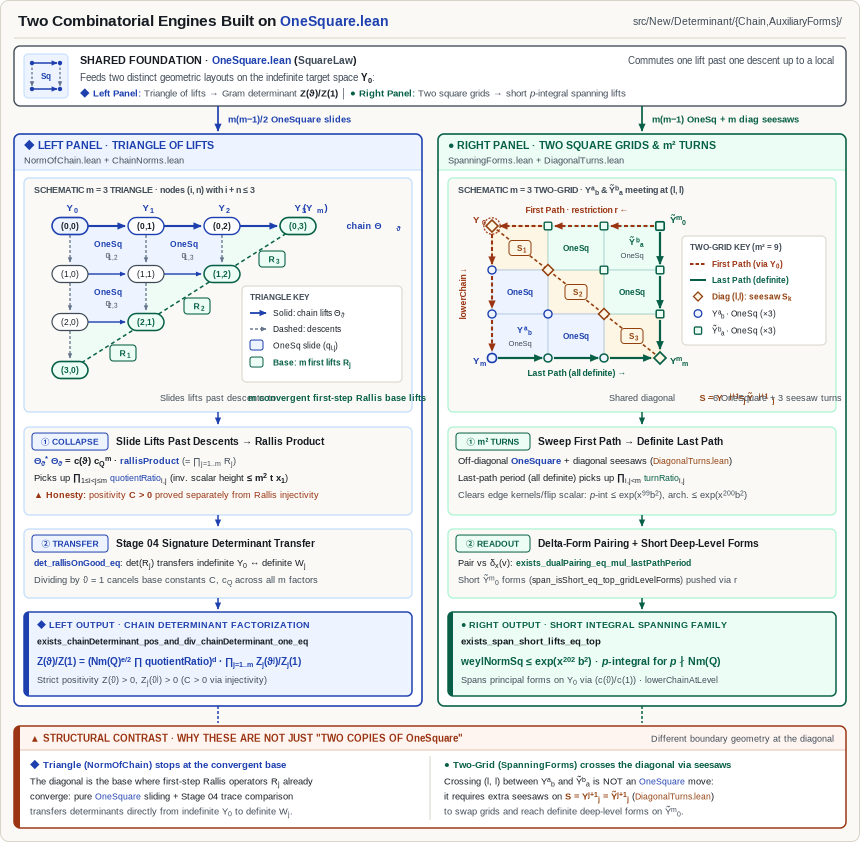
How does Stage 05 build a full spanning set of auxiliary spanning forms on the indefinite space SpanningForms.lean builds two square grids of Hermitian spaces
- The first path runs down the lower chain
paired against a restriction map from deep-level forms on onto . - By executing
turns across squares—off-diagonal turns via the theta square lawtheta square law and diagonal turns via seesaw moves on the shared space seesaw duality—the period integral along the first path transfers into a last-path period divided by , where is governed by turn ratiosHecke L-value ratio. - Along the last path, every space is definite and explicit: testing against a dual-weight delta form
supported at one finite class reads off the exact value of at ( exists_dualPairing_eq_mul_lastPathPeriod), proving both p-adic gauge integralityWeyl gauge and archimedean smallness (exists_span_short_lifts_eq_top). Finally,LongForms.leanprojects onto good forms with the good idempotentcentral idempotent (goodProjTranslate 1) to obtainexists_span_isAuxiliaryForm_eq_top.
Limits of the intuition
Calling auxiliary spanning forms "cheap filler vectors" is accurate for their total cost 8 x_1^2 + 4 b^{-1} <= b).
Level 2 — Undergrad Bridge
Building exists_span_isAuxiliaryForm_eq_top connects Stage 03's short-form infrastructure with Stage 05's square commutation law across SpanningForms.lean (29 decls) and LongForms.lean (first 3 decls):
- Last-path integrality and archimedean size (
SpanningForms.lean:63–388):liftDenominator(a product of powers ofand ) clears denominators of every theta kernel on the last path at primes ( liftDenominator_smul_lastPathEdgeDatum_mem_raises).norm_mul_det_flipScalar_zpow_le_oneandexists_norm_mul_lastPathPairing_le_oneclear the middle branching pairinglastPathPairingbywith , yielding exists_mul_lastPathPeriod_mem_embValRing(clears lastPathPeriod Ψ y).- For the trivial twist
, bounding class numbers ( card_stdClasses_lastPathLevel_le,) and single-edge kernel norms ( sqrt_weylNormSq_lastPathKernel_le,) bounds every Galois conjugate of the last-path period by ( norm_lastPathPeriod_le).
- From
grid turns to delta-form value readout ( SpanningForms.lean:392–659):exists_integral_lowerChainUpTo_eq_lastPathPeriodpackagesDiagonalTurns.lean::exists_transfersPeriods_first_last: there exist scalarssatisfying HasAbsUpToNormPowerwith, path data , a constant , and a surjective restriction map relating the first-path pairing to . - Pairing against the dual-weight delta form
supported on the class of uses Schur's orthogonality relations ( integral_lastPathConjDelta_mul) to read offdirectly as ( exists_dualPairing_eq_mul_lastPathPeriod).
- Lifting short deep-level forms (
SpanningForms.lean:663–796):mem_embValRing_of_dualPairing_eq_dualHook_mulandweylNormSq_le_of_dualPairingconvert dual-pairing integrality and bounds into pointwise integrality andweylNormSqbounds (exists_lowerChain_integral_and_weylNormSq_le, multiplying the squared norm by at mostusing dualHook_mul_exp_le).- Because
span_isShort_eq_top_gridLevelForms(from Stage 03's short-column infrastructure) spansby forms that are integral and -short, applying yields exists_span_short_lifts_eq_topwith archimedean boundon .
- Projection to
D.targetFormsand completion budget (LongForms.lean:44–134):- Applying
D.goodProjTranslate 1(surjective ontoD.targetForms, preserving integrality and adding at mostto the log norm, with ) establishes exists_span_isAuxiliaryForm_eq_topwith, , and . - Together with
HeightLe D.bon(from squaring heightLe_inv_rpow_mul_prod_turnRatioand) and mul_completion_cost_le, theauxiliary basis vectors add at most to Theorem C's inequality.
- Applying
Level 3 — Formal Lean Contract
Stage 05 anchors auxiliary spanning forms across skeleton/05_determinant/spanning_forms.lean (29 decls, 0 truncations) and skeleton/05_determinant/long_forms.lean (9 decls, 0 truncations):
05_determinant/long_forms.lean#New.Data.IsAuxiliaryForm(upstreamLongForms.lean:44-54):leanstructure New.Data.IsAuxiliaryForm (γ : D.MFoldTwist → ℂ) (y : D.targetForms) : Prop where smul_lift_mem_integralForms (ι : PrimePadicIso) (ϑ : D.MFoldTwist) (hϑ : Nat.Coprime ι.1 ϑ.normQ) : γ ϑ • D.Θ ϑ y ∈ integralForms ι.place normSqAt_lift_le (σ : ℂ ≃+* ℂ) : (D.Θ 1 y).normSqAt σ ≤ exp (2 * D.x₁ ^ 2 * D.b ^ 2)05_determinant/long_forms.lean#New.Data.exists_span_isAuxiliaryForm_eq_top(upstreamLongForms.lean:57-105): proves there existand with , , , and span ℂ {y | D.IsAuxiliaryForm γ y} = ⊤.05_determinant/long_forms.lean#New.Data.mul_completion_cost_le(upstreamLongForms.lean:121-134): proveswhenever and . - Also anchored:
05_determinant/spanning_forms.lean#New.Data.exists_span_short_lifts_eq_top(upstreamSpanningForms.lean:769-796) and05_determinant/spanning_forms.lean#New.Data.exists_dualPairing_eq_mul_lastPathPeriod(upstreamSpanningForms.lean:632-659).
See the page's live <VerificationBanner /> (audit/verification-status.json) for the pinned upstream commit and local Lean build status (build_status: unverified-locally).
Where this analogy breaks
Thinking of auxiliary spanning forms as just picking any cheap basis vectors on Y_0 misses the fundamental obstacle: Y_0 is indefinite, so you cannot read off short integral forms directly on Y_0 or control their lifts across every twist. Stage 05 must pull back short deep-level forms from the definite space Ytilde^m_0 and push their pairings across m^2 off-diagonal and diagonal turns of two square grids—paying a tiny factor b^{-2} times x_1^2 b^2 per missing basis vector only because Theorem B already leaves at most 4d/b^2 dimensions uncovered.
Formal Lean Anchors
structure New.Data.IsAuxiliaryForm — Upstream source (src/New/Determinant/Twist/LongForms.lean L44-L54)
/-- A target form `y` is auxiliary for the scalars `γ ϑ`, one for each `m`-fold twist `ϑ`, if its
lifts `γ ϑ • D.Θ ϑ y` are integral at primes not dividing `ϑ.normQ` and every conjugate of its lift
`D.Θ 1 y` has squared norm at most `exp (2 x₁² b²)`. -/
structure New.Data.IsAuxiliaryForm (γ : D.MFoldTwist → ℂ) (y : D.targetForms) : Prop where
  /-- The form `γ ϑ • Θ_ϑ y` is integral at `ι : ℂ ≃ ℚ̄_l` whenever the norm `ϑ.normQ` of the
  modulus of `ϑ` is prime to `l = ι.1`. -/
  smul_lift_mem_integralForms (ι : PrimePadicIso) (ϑ : D.MFoldTwist)
    (hϑ : Nat.Coprime ι.1 ϑ.normQ) : γ ϑ • D.Θ ϑ y ∈ integralForms ι.place
  /-- The conjugate of `Θ₁ y` by each automorphism `σ` of `ℂ` has squared norm at most
  `exp (2 x₁² b²)`. -/
  normSqAt_lift_le (σ : ℂ ≃+* ℂ) : (D.Θ 1 y).normSqAt σ ≤ exp (2 * D.x₁ ^ 2 * D.b ^ 2)
theorem New.Data.exists_span_isAuxiliaryForm_eq_top — Upstream source (src/New/Determinant/Twist/LongForms.lean L57-L105)
/-- **Auxiliary forms.** There are an integer `e` and numbers `γ ϑ ≠ 0`, for the `m`-fold twists
`ϑ`, such that `γ 1 = 1`, the absolute value of `γ ϑ` is the norm `ϑ.normQ` of the modulus of `ϑ` to
the power `e / 2` times the numbers `D.turnRatio i j ϑ` for `0 ≤ i, j < m`, and the space
`D.targetForms` is spanned by the forms `y` that are auxiliary for `γ`: each lift `γ ϑ • D.Θ ϑ y` is
integral at the primes not dividing `ϑ.normQ`, and every conjugate of `D.Θ 1 y` has squared norm at
most `exp (2 x₁² b²)`, for the scales `x₁`, `b` of `D`. -/
theorem New.Data.exists_span_isAuxiliaryForm_eq_top :
    ∃ (e : ℤ) (γ : D.MFoldTwist → ℂ),
      (∀ ϑ : D.MFoldTwist, γ ϑ ≠ 0) ∧
      γ 1 = 1 ∧
      (∀ ϑ : D.MFoldTwist, ‖γ ϑ‖ = (ϑ.normQ : ℝ) ^ (e / 2 : ℝ) *
        ∏ i ∈ Finset.range D.m, ∏ j ∈ Finset.range D.m, D.turnRatio i j ϑ) ∧
      span ℂ {y : D.targetForms | D.IsAuxiliaryForm γ y} = ⊤ := by
  sorry -- [EXTRACTED_STUB upstream=src/New/Determinant/Twist/LongForms.lean:57-105 commit=41c2716658c42ba08eb0648994a2efe83082a95c body_lines=37 body_sha256=c052d7c146bf09ed653f8de5b70e299b19caac7d57bb687e43f83170fb52d667]
lemma New.Data.mul_completion_cost_le — Upstream source (src/New/Determinant/Twist/LongForms.lean L121-L134)
/-- The cost of completing a family to a basis: if `n ≥ (1 - 4 / b²) d` and `d = n + n'`, where
`d = D.targetDim`, then `n' (2 x₁² b² + b) ≤ d b`. That is, `n'` forms, each costing `2 x₁² b² + b`,
cost at most `d b` in total. -/
lemma New.Data.mul_completion_cost_le {n n' : ℕ} (hn : (1 - 4 / D.b ^ 2) * D.targetDim ≤ n)
    (h_card : D.targetDim = n + n') :
    n' * (2 * D.x₁ ^ 2 * D.b ^ 2 + D.b) ≤ D.targetDim * D.b := by
  sorry -- [EXTRACTED_STUB upstream=src/New/Determinant/Twist/LongForms.lean:121-134 commit=41c2716658c42ba08eb0648994a2efe83082a95c body_lines=9 body_sha256=ba1c0ed98196f0767f1285d614ce782899c6827579a69760bcbe7eeb52aa8972]
lemma New.Data.exists_span_short_lifts_eq_top — Upstream source (src/New/Determinant/AuxiliaryForms/SpanningForms.lean L769-L796)
/-- The space of forms on `Y₀` of principal level at the chosen places is spanned by auxiliary forms
with integral and small lifts. There are constants `c ϑ`, whose modulus is, up to a constant and a
fixed power of the norm `ϑ.normQ` of the places of `ϑ`, the product of the ratios `turnRatio`, such
that this space is spanned by the forms `y` with two properties: for all twists `ϑ`,
`(c ϑ / c 1) • lowerChainAtLevel ϑ y` has values integral at every prime not dividing `ϑ.normQ`, and
all conjugates of the values of `lowerChain 1 y`, the chain of lifts for the trivial twist, have
squared norm `weylNormSq` at most `exp (x ^ 202 * b ^ 2)`, with `x = D.x` the length of the prime
sum and `b = D.b` the weight at the `b`-places. -/
lemma New.Data.exists_span_short_lifts_eq_top : ∃ c : D.MFoldTwist → ℂˣ,
    D.HasAbsUpToNormPower (fun ϑ : D.MFoldTwist ↦ c ϑ)
      (∏ i ∈ range D.m, ∏ j ∈ range D.m, D.turnRatio i j) ∧
    span ℂ {y : D.principalForms (D.spaceY 0) |
      (∀ (ϑ : D.MFoldTwist) (l : ℕ) [Fact l.Prime] (place : PadicPlace l), l.Coprime ϑ.normQ →
        (c ϑ / c 1 : ℂ) • D.lowerChainAtLevel ϑ y ∈ integralForms (l := l) place) ∧
      ∀ (σ : ℂ ≃+* ℂ) (g : Gf D.E (D.Y D.m)),
        weylNormSq (σ ∘ (D.lowerChain .one y).val g) ≤ exp (D.x ^ 202 * D.b ^ 2)} = ⊤ := by
  sorry -- [EXTRACTED_STUB upstream=src/New/Determinant/AuxiliaryForms/SpanningForms.lean:769-796 commit=41c2716658c42ba08eb0648994a2efe83082a95c body_lines=13 body_sha256=aa3c4704a1b8bf9cf313d228435d2c3bbfa591976d5cdc3253304459ac766ca3]
lemma New.Data.exists_dualPairing_eq_mul_lastPathPeriod — Upstream source (src/New/Determinant/AuxiliaryForms/SpanningForms.lean L632-L659)
/-- There are constants `c ϑ`, whose modulus is, up to a constant and a fixed power of the norm
`ϑ.normQ` of the places of `ϑ`, the product over the `m ^ 2` turns of `turnRatio`, functions `Ψ ϑ`
of the matrices on the edges that are path data on the last path, a number `β` and a restriction map
`r` from `gridLevelForms` onto the forms on `Y₀`, such that the pairing of `v` with the value at `x`
of `(c ϑ / c 1) • lowerChain ϑ (r φ)` is `β` times `lastPathPeriod` at the pair `(δ_x(v), φ)`: the
sum over the tuples `S` of `Ψ ϑ S` times the integrated pairing of the lifts of `φ` and of the delta
form `δ_x(v) = lastPathConjDelta ϑ x v` along the two halves of the last path. -/
lemma New.Data.exists_dualPairing_eq_mul_lastPathPeriod : ∃ c : D.MFoldTwist → ℂˣ,
    D.HasAbsUpToNormPower (fun ϑ : D.MFoldTwist ↦ c ϑ)
      (∏ i ∈ range D.m, ∏ j ∈ range D.m, D.turnRatio i j) ∧
    ∃ Ψ : ∀ ϑ : D.MFoldTwist, EdgeTuple ϑ → ℂ,
      (∀ ϑ : D.MFoldTwist, IsPathDatum (lastPathBound ϑ) (TwoGridPath.last D.m).edges (Ψ ϑ)) ∧
      ∃ (β : ℂ) (r : D.gridLevelForms D.m →ₗ[ℂ] D.principalForms (D.spaceY 0)),
        r.range = ⊤ ∧
        ∀ (ϑ : D.MFoldTwist) (φ : D.gridLevelForms D.m) (x : Gf D.E (D.Y D.m))
          (v : D.DualVector),
          v ⬝ᵥ D.dualPairing.map (↑) *ᵥ ((c ϑ / c 1 : ℂ) • D.lowerChain ϑ (r φ)).val x =
            β * lastPathPeriod (Ψ ϑ) fun z : Bool ↦ z.rec (lastPathConjDelta ϑ x v) φ.val := by
  sorry -- [EXTRACTED_STUB upstream=src/New/Determinant/AuxiliaryForms/SpanningForms.lean:632-659 commit=41c2716658c42ba08eb0648994a2efe83082a95c body_lines=11 body_sha256=4cea237c7898a1578297c64f5073b8928f73f65dcd0874f582bec29698e3ccd1]
Related Concepts
- twisted lattice — A family of linear lifts from one complex vector space into inner-product spaces—one per twist—equipped with prime-by-prime integrality lattices so each prime can pick its own allowed twist.
- Weyl gauge — The p-adic coordinate norm of an algebraic modular form measured in the g-twisted Weyl lattice, paired with Galois-conjugate archimedean bounds to define B-short spanning sets and ramified source forms.
- theta square law — Commutation of theta lifts around a four-corner square (U_1, U_2, A, A'): summing down-then-up over matched matrix data equals (kappa / c) times summing up-then-down, with |c|^2 = C * L_*(t) != 0 and kappa independent of twist.
- seesaw duality — A dual-pair adjunction identity that trades an iterated lower-chain theta lift of a Poincaré series for a nonzero twist-independent scalar times the restriction of an upper-chain composite theta lift.
- Hecke L-value ratio — The ratio |L^S(z, (nu * theta^s)^-1)| / |L^S(z, nu^-1)| of twisted to untwisted partial Hecke L-values at a critical pair (nu, z), tracking how Siegel–Weil exchange constants scale under twisting across chain quotients and grid turns.
- central idempotent — A class-function element of a finite group algebra satisfying z² = z that acts as a G-equivariant orthogonal projection, splitting good cuspidal types from rare bad types across two level primes.
Referenced By
- Stage: Chain Determinant Factorization and Two-Grid Auxiliary Forms
- Stage: Regular Twist Families and the Assembly of Theorem C
- Stage: Stage 05 — Lower Bound: The Determinant (Theorem C, Part 1)
- Concept: Hecke L-value ratio
Authoritative Sources
- Périodes et isogénies des variétés abéliennes sur les corps de nombres (paper) — J.-B. Bost, Astérisque 237 (1996), Exp. 795, 115–161.
- Heights in Diophantine Geometry (book) — E. Bombieri & W. Gubler, New Mathematical Monographs 4, Cambridge Univ. Press (2006).
- Symplectic local root numbers, central critical L-values, and restriction problems in the representation theory of classical groups (paper) — W. T. Gan, B. H. Gross & D. Prasad, Astérisque 346 (2012), 1–109.
Page Glossary
- twisted lattice
- A family of linear lifts from one complex vector space into inner-product spaces—one per twist—equipped with prime-by-prime integrality lattices so each prime can pick its own allowed twist.
- arithmetic height
- A logarithmic measure combining ordinary archimedean size with prime-by-prime p-adic divisibility, locked together by the product formula so a nonzero algebraic quantity cannot be simultaneously small at every place.
- theta square law
- Commutation of theta lifts around a four-corner square (U_1, U_2, A, A'): summing down-then-up over matched matrix data equals (kappa / c) times summing up-then-down, with |c|^2 = C * L_*(t) != 0 and kappa independent of twist.
- seesaw duality
- A dual-pair adjunction identity that trades an iterated lower-chain theta lift of a Poincaré series for a nonzero twist-independent scalar times the restriction of an upper-chain composite theta lift.
- Hecke L-value ratio
- The ratio |L^S(z, (nu * theta^s)^-1)| / |L^S(z, nu^-1)| of twisted to untwisted partial Hecke L-values at a critical pair (nu, z), tracking how Siegel–Weil exchange constants scale under twisting across chain quotients and grid turns.
- Weyl gauge
- The p-adic coordinate norm of an algebraic modular form measured in the g-twisted Weyl lattice, paired with Galois-conjugate archimedean bounds to define B-short spanning sets and ramified source forms.
- central idempotent
- A class-function element of a finite group algebra satisfying z² = z that acts as a G-equivariant orthogonal projection, splitting good cuspidal types from rare bad types across two level primes.