von Mangoldt function
The arithmetic weight Λ(n) equal to log p when n is a prime power pᵏ (k ≥ 1) and 0 otherwise, converting multiplicative prime factorizations into additive logarithms.
Level 1 — First-Principles
Counting integers greater than
Thus
This choice turns unique factorization into a clean addition law over divisors:
For example, the divisors of
In analytic number theory, weighting integers by
Limits of the intuition
Calling primeRemainder.
Level 2 — Undergrad Bridge
In the ring of arithmetic functions under Dirichlet convolution
where
with the special case
Stage 01 (New.Reduction.Zeros.PrimeError) adapts this machinery to a residue class
Because
where
Under
Level 3 — Formal Lean Contract
In Mathlib4 (Mathlib.NumberTheory.ArithmeticFunction.VonMangoldt), ArithmeticFunction.vonMangoldt : ArithmeticFunction ℝ (notation Λ) formalizes vonMangoldt_nonneg, vonMangoldt_le_log, vonMangoldt_apply_prime, vonMangoldt_apply_pow, and vonMangoldt_mul_zeta : vonMangoldt * zeta = log.
Upstream src/New/Reduction/Zeros/PrimeError.lean builds the Stage 01 weighted sum directly on vonMangoldt:
New.lambdaKResidueClass d q n : ℝ := residueClass (1 : ZMod q) n * (1 - chiK d n), whereresidueClassrestrictsvonMangoldtto. New.lambdaKResidueClass_nonnegandNew.lambdaKResidueClass_le_two_mul_vonMangoldt : lambdaKResidueClass d q n ≤ 2 * vonMangoldt n.New.primeRemainder d q x := lambdaKSum d q 0 x - lambdaKSum d q 1 x - x.log / φ q - re (logDerivMean d q 1).New.sum_vonMangoldt_div_le : ∑ n ∈ Ioc 0 N, vonMangoldt n / n ≤ 2 * Real.log N.
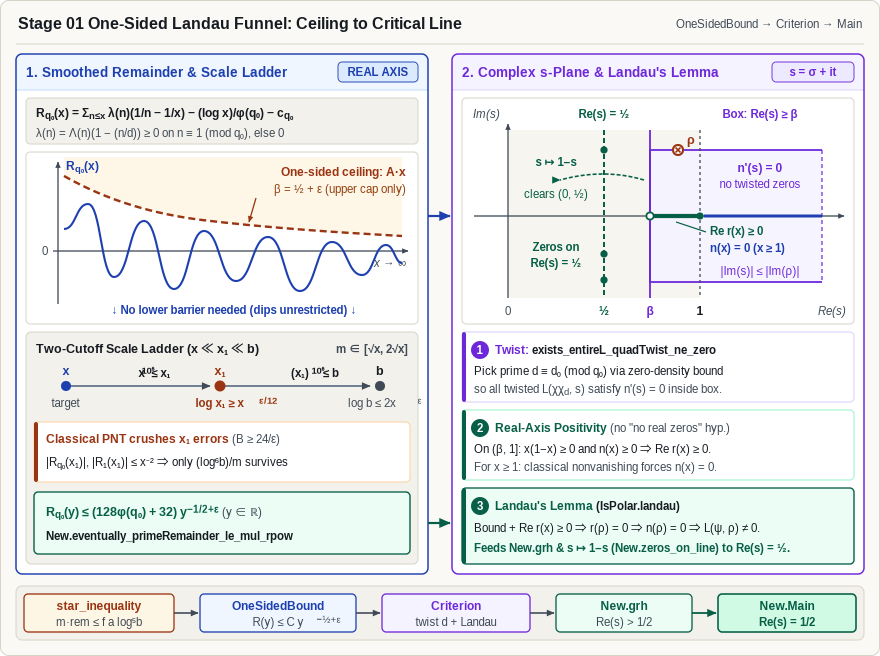
Stage 01 anchors this weighted remainder in two main theorems:
01_reduction/criterion.lean#New.LFunction_ne_zero_of_primeRemainder_le(upstreamsrc/New/Reduction/Zeros/Criterion.lean:35-90):leantheorem New.LFunction_ne_zero_of_primeRemainder_le {q₀ : ℕ} [NeZero q₀] (hq₀ : 8 ∣ q₀) {d₀ : ℕ} (hd₀_mod : d₀ % 8 = 7) (hd₀_cop : d₀.Coprime q₀) {β : ℝ} (hβ : 1 / 2 < β) (h_bound : ∀ d : Primes, (d : ℕ) ≡ d₀ [MOD q₀] → ∃ A : ℝ, ∀ᶠ x : ℝ in atTop, primeRemainder d q₀ x ≤ A * x ^ (β - 1)) (ψ : DirichletCharacter ℂ q₀) {ρ : ℂ} (hρ_ne : ρ ≠ 1) (hρ_re : β < ρ.re) : ψ.LFunction ρ ≠ 001_reduction/one_sided_bound.lean#New.eventually_primeRemainder_le_mul_rpow(upstreamsrc/New/Reduction/OneSidedBound.lean:201-235):leantheorem New.eventually_primeRemainder_le_mul_rpow {q₀ : ℕ} [NeZero q₀] (hq₀ : 18480 ∣ q₀) {d : ℕ} [hd_prime : Fact d.Prime] (hd : d ≡ q₀ / 2 - 1 [MOD q₀]) {ε : ℝ} (hε : 0 < ε) : ∀ᶠ y : ℝ in atTop, primeRemainder d q₀ y ≤ (128 * q₀.totient + 32) * y ^ (-1 / 2 + ε)
See the page's live verification banner (audit/verification-status.json) for the currently pinned upstream snapshot and local Lean build status (build_status: unverified-locally).
Where this analogy breaks
Treating
Formal Lean Anchors
theorem New.LFunction_ne_zero_of_primeRemainder_le — Upstream source (src/New/Reduction/Zeros/Criterion.lean L35-L90)
/-- **One-sided criterion.** Let `q₀` be a positive multiple of `8`, let `d₀ ≡ 7` mod `8` be prime
to `q₀`, and let `β > 1/2`. Suppose that for each prime `d ≡ d₀` mod `q₀` the remainder
`primeRemainder d q₀ x = ∑_{n ≤ x} λ(n) (1/n - 1/x) - log x / φ(q₀) - c` is at most `A * x ^ (β - 1)`
for some `A` and all large `x`. Here `λ(n) = Λ(n) (1 - (n/d))` for `n ≡ 1` mod `q₀` and `0` otherwise,
and `c` is the constant for which the remainder tends to `0`. Then `L(ρ, ψ) ≠ 0` for every
character `ψ` modulo `q₀` and every `ρ ≠ 1` with `re ρ > β`. -/
theorem New.LFunction_ne_zero_of_primeRemainder_le {q₀ : ℕ} [NeZero q₀] (hq₀ : 8 ∣ q₀) {d₀ : ℕ}
    (hd₀_mod : d₀ % 8 = 7) (hd₀_cop : d₀.Coprime q₀) {β : ℝ} (hβ : 1 / 2 < β)
    (h_bound : ∀ d : Primes, (d : ℕ) ≡ d₀ [MOD q₀] →
      ∃ A : ℝ, ∀ᶠ x : ℝ in atTop, primeRemainder d q₀ x ≤ A * x ^ (β - 1))
    (ψ : DirichletCharacter ℂ q₀) {ρ : ℂ} (hρ_ne : ρ ≠ 1) (hρ_re : β < ρ.re) :
ψ.LFunction ρ ≠ 0 := by
sorry -- [EXTRACTED_STUB upstream=src/New/Reduction/Zeros/Criterion.lean:35-90 commit=41c2716658c42ba08eb0648994a2efe83082a95c body_lines=45 body_sha256=dee53546115f07956df438a6dd34a213cb6cb1775d14fde132a1c579e7a308de]theorem New.eventually_primeRemainder_le_mul_rpow — Upstream source (src/New/Reduction/OneSidedBound.lean L201-L235)
/-- **One-sided bound.** Let `q₀ > 0` be a multiple of `18480`, let `d ≡ q₀ / 2 - 1` modulo `q₀` be
a prime, and let `ε > 0`. Then `R = primeRemainder d q₀` satisfies
`R(y) ≤ (128 φ(q₀) + 32) y ^ (-1/2 + ε)` for all large real `y`. -/
theorem New.eventually_primeRemainder_le_mul_rpow {q₀ : ℕ} [NeZero q₀] (hq₀ : 18480 ∣ q₀) {d : ℕ}
    [hd_prime : Fact d.Prime] (hd : d ≡ q₀ / 2 - 1 [MOD q₀]) {ε : ℝ} (hε : 0 < ε) :
∀ᶠ y : ℝ in atTop, primeRemainder d q₀ y ≤ (128 * q₀.totient + 32) * y ^ (-1 / 2 + ε) := by
sorry -- [EXTRACTED_STUB upstream=src/New/Reduction/OneSidedBound.lean:201-235 commit=41c2716658c42ba08eb0648994a2efe83082a95c body_lines=30 body_sha256=3c83f57c4fd982274a17d7539635c9b9dde4053c2c86ead0a79ed97a76a8f4d8]Related Concepts
- prime number — A whole number greater than 1 whose only positive whole-number divisors are 1 and itself; every integer above 1 factors uniquely into a product of them.
- infinite series — A limit of partial sums formed by adding infinitely many terms; in number theory, weighting terms by n⁻ˢ produces a Dirichlet series that turns integer arithmetic into a smooth function.
- Riemann zeta function — The meromorphic function ζ(s) extending ∑ n⁻ˢ to all of ℂ ∖ {1}, linking prime numbers via its Euler product to zeros in the complex plane.
- Dirichlet L-function — The meromorphic continuation of ∑ χ(n) n⁻ˢ associated to a Dirichlet character χ, generalizing ζ(s) to track primes across residue classes modulo N.
- quadratic twist — Multiplying a Dirichlet character χ modulo N by the Legendre symbol (·/d) of an odd prime d coprime to N, yielding a non-principal character modulo N·d whose L-function family admits zero-density control.
- Landau's lemma — A complex-analytic theorem stating that the Laplace or Dirichlet transform of a nonnegative function must have a singularity on the real axis at its abscissa of convergence, turning one-sided error bounds into zero-free half-planes.
Referenced By
- Stage: Formal Groups, Theta Normal Form & Prime-Counting Divisibility
- Stage: From a One-Sided Prime Bound to a Zero-Free Half-Plane
- Stage: Stage 01 — The Theorem and Its Reduction
- Stage: Stage 02 — Derivatives of Theta Functions
- Stage: The Main Inequality & Theorems A and B
- Concept: Landau's lemma
- Concept: quadratic twist
- Concept: Schur jet
Authoritative Sources
- Multiplicative Number Theory (book) — H. Davenport, 3rd ed., Springer Graduate Texts in Mathematics 74 (2000), Chapters 17–18.
- Multiplicative Number Theory I: Classical Theory (book) — H. L. Montgomery and R. C. Vaughan, Cambridge University Press (2007), §2.1 and Chapter 11.
- Mathlib4: ArithmeticFunction.vonMangoldt (mathlib) — Mathlib.NumberTheory.ArithmeticFunction.VonMangoldt (
ArithmeticFunction.vonMangoldt,vonMangoldt_apply_pow,vonMangoldt_mul_zeta).
Page Glossary
- prime number
- A whole number greater than 1 whose only positive whole-number divisors are 1 and itself; every integer above 1 factors uniquely into a product of them.
- infinite series
- A limit of partial sums formed by adding infinitely many terms; in number theory, weighting terms by n⁻ˢ produces a Dirichlet series that turns integer arithmetic into a smooth function.
- Riemann zeta function
- The meromorphic function ζ(s) extending ∑ n⁻ˢ to all of ℂ ∖ {1}, linking prime numbers via its Euler product to zeros in the complex plane.
- quadratic twist
- Multiplying a Dirichlet character χ modulo N by the Legendre symbol (·/d) of an odd prime d coprime to N, yielding a non-principal character modulo N·d whose L-function family admits zero-density control.
- Dirichlet L-function
- The meromorphic continuation of ∑ χ(n) n⁻ˢ associated to a Dirichlet character χ, generalizing ζ(s) to track primes across residue classes modulo N.
- Landau's lemma
- A complex-analytic theorem stating that the Laplace or Dirichlet transform of a nonnegative function must have a singularity on the real axis at its abscissa of convergence, turning one-sided error bounds into zero-free half-planes.