trivial zero
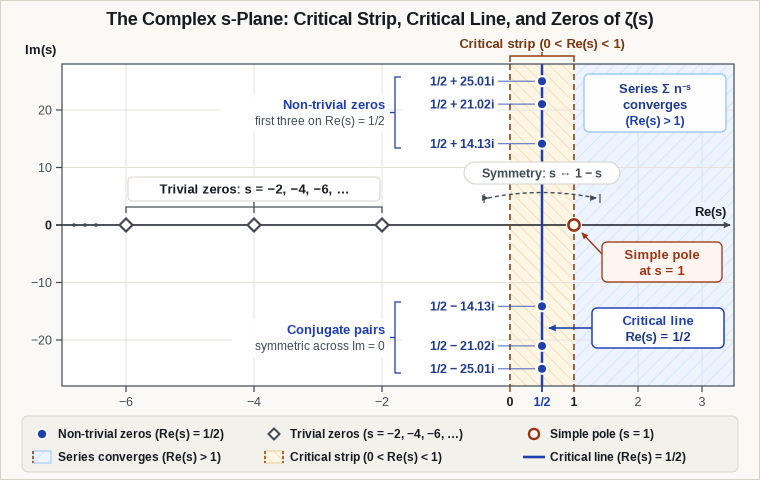
A zero at a non-positive integer forced purely by poles of the gamma factor in the functional equation, carrying no hidden information about prime fluctuations.
Level 1 — First-Principles
When the global function built from
A zero forced solely by that gamma-factor blow-up is a trivial zero. Because trivial zeros are already completely accounted for by the symmetry factor, they tell us nothing mysterious about primes. Every other zero—the ones that actually govern prime fluctuations—must live inside the vertical band
Limits of the intuition
Calling these zeros "trivial" suggests they are unimportant edge cases one can ignore casually. In formal statements, getting the exact exclusion set wrong makes the theorem either false or vacuous: for
Level 2 — Undergrad Bridge
For a primitive Dirichlet character
The functional equation relates
Hence
( , giving ): ; , odd ( ): ; , even ( ): .
For an imprimitive character formal-conjectures states GRH for primitive characters when excluding only GRH.trivialZeros.
Level 3 — Formal Lean Contract
Stage 00 anchors the explicit trivial-zero exclusion for 00_statement/statements.lean#RiemannZetaZerosOnLine (upstream src/Statements.lean:7-8), which guards against (¬∃ n : ℕ, s = -2 * ((n : ℂ) + 1)) (and s ≠ 1), while DirichletLZerosOnLine (src/Statements.lean:14-16) and PrimitiveDirichletLZerosOnLine (src/Statements.lean:18-20) exclude all trivial zeros uniformly by restricting to the open critical strip 0 < s.re and s.re < 1.
In upstream's formal-conjectures bridge (comparator/FormalConjecturesStatement.lean and comparator/FormalConjecturesBridge.lean, archived on alpoge@c900e67c2 pending re-integration on condensed main), GRH.trivialZeros classified the non-positive integer zeros across all three cases:
noncomputable def GRH.trivialZeros {q : ℕ} (χ : DirichletCharacter ℂ q) : Set ℤ :=
  if q = 1 then {-2 * (n + 1) | (n : ℕ) } else
    if χ.Odd then { -2 * n - 1 | (n : ℕ) } else
      { - 2 * n | (n : ℕ) }
and mem_trivialZeros_of_re_nonpos bridged the strip formulation PrimitiveDirichletLZerosOnLine to GRH.generalized_riemann_hypothesis. See the page's live verification banner (audit/verification-status.json) for the currently pinned upstream snapshot and local Lean build status (build_status: unverified-locally).
Where this analogy breaks
The word 'trivial' means structurally explained by the gamma factor alone, not 'absent from the function' or 'identical for every L-function': the exact set of trivial zeros shifts depending on whether the character is trivial, even, or odd, and omitting
Formal Lean Anchors
def RiemannZetaZerosOnLine — Upstream source (src/Statements.lean L7-L8)
def RiemannZetaZerosOnLine : Prop :=
  ∀ s : ℂ, riemannZeta s = 0 → (¬∃ n : ℕ, s = -2 * ((n : ℂ) + 1)) → s ≠ 1 → s.re = 1 / 2
Related Concepts
- Riemann zeta function — The meromorphic function ζ(s) extending ∑ n⁻ˢ to all of ℂ ∖ {1}, linking prime numbers via its Euler product to zeros in the complex plane.
- analytic continuation — The unique extension of a complex-differentiable function from a smaller region to a larger domain, locked in place by the identity theorem.
- Dirichlet L-function — The meromorphic continuation of ∑ χ(n) n⁻ˢ associated to a Dirichlet character χ, generalizing ζ(s) to track primes across residue classes modulo N.
- critical strip — The open vertical band 0 < Re(s) < 1 in the complex plane that contains every nontrivial zero of ζ(s) and of every Dirichlet L-function.
Referenced By
- Stage: Formal Statement Contracts (
Statements.lean) - Stage: From a One-Sided Prime Bound to a Zero-Free Half-Plane
- Stage: Independent Statement Equivalence (
FormalConjecturesStatement&FormalConjecturesChallenge) - Stage: Stage 00 — Formal Statements & Challenge Contracts
- Stage: The Five Entry Theorems (
Main.lean&Challenge.lean) - Concept: analytic continuation
- Concept: critical strip
- Concept: primitive character
- Concept: Riemann zeta function
Authoritative Sources
- The Theory of the Riemann Zeta-Function (book) — E. C. Titchmarsh, 2nd ed., Oxford University Press (1986), Chapter 2, §§2.1–2.12.
- Multiplicative Number Theory (book) — H. Davenport, 3rd ed., Springer Graduate Texts in Mathematics 74 (2000), Chapters 9 and 12.
- Analytic Number Theory (book) — H. Iwaniec and E. Kowalski, AMS Colloquium Publications Vol. 53 (2004), Chapter 5.
Page Glossary
- Riemann zeta function
- The meromorphic function ζ(s) extending ∑ n⁻ˢ to all of ℂ ∖ {1}, linking prime numbers via its Euler product to zeros in the complex plane.
- analytic continuation
- The unique extension of a complex-differentiable function from a smaller region to a larger domain, locked in place by the identity theorem.
- critical strip
- The open vertical band 0 < Re(s) < 1 in the complex plane that contains every nontrivial zero of ζ(s) and of every Dirichlet L-function.
- Dirichlet L-function
- The meromorphic continuation of ∑ χ(n) n⁻ˢ associated to a Dirichlet character χ, generalizing ζ(s) to track primes across residue classes modulo N.