Ribet clearing operator
Also known as: common Ribet element, lift generator, weak lift, lift valuation bound, clearing bound, first-order Ribet method.
A linear operator Lambda on the theta-lift subspace Z built from a common Ribet element and Taylor–Wiles tie relations whose eigenvalues satisfy liftValuationBound and whose rescaled determinant norm is at least l^(-dim Z * r * clearingBound D l), clearing all l-adic projection denominators on integral forms orthogonal to false lifts.
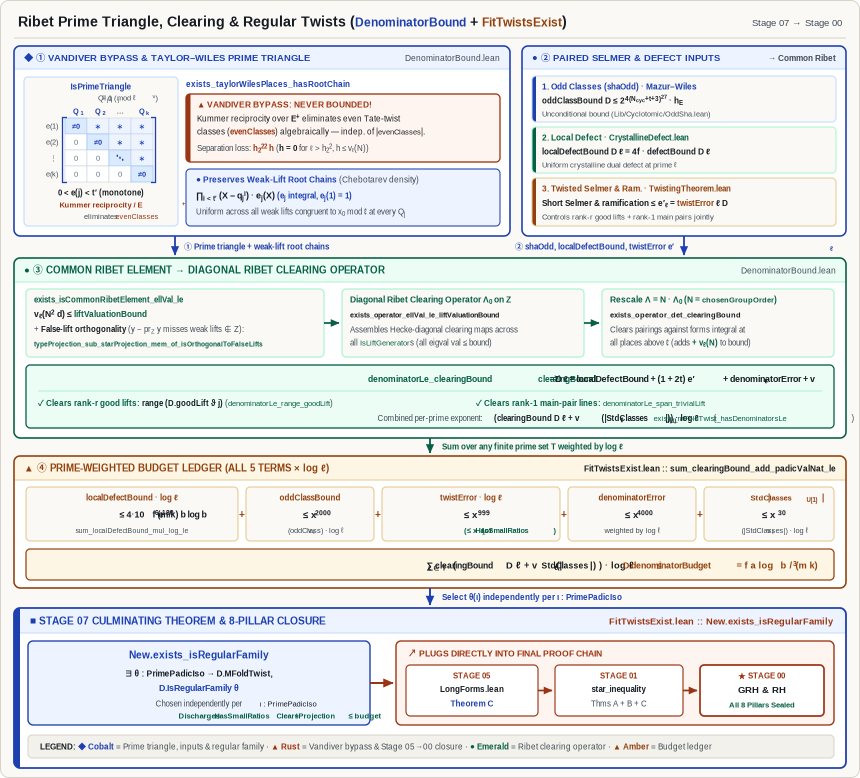
Level 1 — First-Principles
Inside a regular twist familyregular twist family, the hardest obligation to satisfy at a prime ClearsProjection): when an
Stage 07 constructs FirstOrder/DenominatorBound.lean):
- False-lift orthogonality strips away non-weak lifts: Suppose
is spanned by lift generators ( IsLiftGenerator)—forms inof admissible local type lifting Hecke eigensystems whose twisted divisible crystalline Selmer groupsanticyclotomic Selmer twisting have length at most . Because is orthogonal to every false lift, its difference from its projection has zero component on every weak lift outside ( typeProjection_sub_starProjection_mem_of_isOrthogonalToFalseLifts). - A common Ribet element (
exists_isCommonRibetElement_ellVal_le): Feeding a Taylor–Wiles prime triangleTaylor–Wiles prime triangleinto the trace ideal produces a common Ribet element—a polynomial family in the tie variables that multiplies every determinant family into , kills every monomial properly dividing on the lift eigensystems , and has leading coefficient at the target eigensystem bounded by the lift valuation bound: combining the twisted Selmer length, auxiliary ramification, local crystalline dual defectcrystalline dual defect, and odd-class/level error terms (with zero dependence on even Tate-twist classes!). - Diagonal clearing operator on
( exists_operator_ellVal_le_liftValuationBound): Turning the common Ribet element into a Hecke-diagonal operator on base-level forms (exists_ellVal_le_and_diagOp_mem_ellIntegralForms) and assembling across all lift generators builds an endomorphismon whose every eigenvalue satisfies and which sends into integralForms. - Rescaling for pairing integrality (
exists_operator_det_clearingBounddenominatorLe_clearingBound): Multiplyingby ensures that not only is integral at , but also has integral inner products against forms integral at all places above . Setting ( twistError ℓ D) folds every term into the clearing boundyielding ( New.Selmer.denominatorLe_clearingBound).
Limits of the intuition
Viewing the Ribet clearing operator as a single scalar multiple of the identity on exists_operator_ellVal_le_liftValuationBound works eigensystem by eigensystem: different lift generators in
Level 2 — Undergrad Bridge
src/New/Congruences/FirstOrder/DenominatorBound.lean (37 declarations, 0 stub truncations) builds the Ribet clearing operator from four components:
- Error constants (
TraceRelations.lean+DenominatorBound.lean):localDefectBound D ℓ = 4 * D.f * defectBound D ℓdenominatorError D ℓ = D.t * v_ℓ(oddClassBound D) + (8 * D.f * D.t + 2 + (4 * D.t + 1) * h₂²² + h₂) * v_ℓ(D.chosenGroupOrder)liftValuationBound ℓ O ram sel = sel + 2 * O.rankDiff * ram + card r * localDefectBound D ℓ + denominatorError D ℓclearingBound D ℓ = localDefectBound D ℓ + (1 + 2 * D.t) * twistError ℓ D + denominatorError D ℓ + v_ℓ(D.chosenGroupOrder)Noteadd_denominatorError_le_mul_clearingBound: whenever, , and , we have .
- Trace ideal and common Ribet element (
exists_isCommonRibetElement_ellVal_le): PairsIsPrimeTrianglewithIsTraceIdeal(containingtimes all traces plus the tie relations linking tame generators tame jto Frobeniiφ jvia polynomialse jwithe j (1) = 1), invokingRibetElement.lean::ribet_columnsto bound. - Separating non-weak lifts (
exists_heckePolyOnForms_eq_zero,typeProjection_sub_starProjection_mem_of_isOrthogonalToFalseLifts): Usesexists_prod_sub_det_one_sub_eq_zeroto kill non-weak lifts outside𝓧and uses false-lift orthogonality (O.IsOrthogonalToFalseLifts E Zᗮ y) to ensuretypeProjection O c (y - Z.starProjection y)lies strictly outside weak lifts, soexists_ellVal_le_and_diagOp_mem_ellIntegralFormsyields a diagonal operatorB.diagOp skeepingN² • B.diagOp s yintegral. - Assembly and
DenominatorLe(exists_linearMap_eq_smul_mem_integralFormsexists_operator_ellVal_le_liftValuationBoundexists_operator_det_clearingBounddenominatorLe_clearingBound): Builds one operatorGper lift generatorv₀, takes a basis ofZinexists_operator_ellVal_le_liftValuationBound, scales byvia exp_le_norm_det_smul_of_ellVal_leto clear pairing denominators inexists_operator_det_clearingBound, and packages the result asDenominatorLe ι.ιℓ O E Z (clearingBound D ℓ * log ℓ).
Level 3 — Formal Lean Contract
All six anchors extract completely untruncated in skeleton/07_congruences/denominator_bound.lean (37 declarations, 0 stub truncations):
07_congruences/denominator_bound.lean#New.Selmer.IsLiftGenerator(upstreamDenominatorBound.lean:744-764).07_congruences/denominator_bound.lean#New.Selmer.liftValuationBound(upstreamDenominatorBound.lean:179-186).07_congruences/denominator_bound.lean#New.Selmer.exists_isCommonRibetElement_ellVal_le(upstreamDenominatorBound.lean:468-521).07_congruences/denominator_bound.lean#New.Selmer.typeProjection_sub_starProjection_mem_of_isOrthogonalToFalseLifts(upstreamDenominatorBound.lean:909-940).07_congruences/denominator_bound.lean#New.Selmer.exists_operator_ellVal_le_liftValuationBound(upstreamDenominatorBound.lean:1116-1181).07_congruences/denominator_bound.lean#New.Selmer.denominatorLe_clearingBound(upstreamDenominatorBound.lean:1269-1293):leantheorem New.Selmer.denominatorLe_clearingBound {P : Parameters} {D : Data P} {ℓ : ℕ} [ThePrime ℓ] (ι : PadicIso ℓ) (ϑ : D.Twist) (hϑ : IsAuxTwist (badPlaces D ℓ) ϑ.Q ϑ.invAvatar (twistError ℓ D)) {r n : Type} [Fintype r] [DecidableEq r] [Fintype n] [DecidableEq n] {O : DescentPair D.E r n} {E : MonoidAlgebra ℂ (O.ChosenGL r)} {Z : Submodule ℂ O.FormV} (h_span : Z ≤ span ℂ {y : O.FormV | IsLiftGenerator ϑ O E Z (twistError ℓ D) y}) : DenominatorLe ι.ιℓ O E Z (clearingBound D ℓ * log ℓ)
See the page's live <VerificationBanner /> (audit/verification-status.json) for the pinned upstream commit and local Lean build status (build_status: unverified-locally).
Where this analogy breaks
Picturing the Ribet clearing operator as simply multiplying the orthogonal projection by a single scalar congruence number misses two subtleties: each lift generator v_0 may have a different Galois eigensystem, so Stage 07 constructs a diagonal operator Lambda whose eigenvalues vary by eigensystem, and pairing integrality against forms integral at all places above l requires scaling by an extra factor N = D.chosenGroupOrder (adding +v_l(N) inside clearingBound D l).
Formal Lean Anchors
structure New.Selmer.IsLiftGenerator — Upstream source (src/New/Congruences/FirstOrder/DenominatorBound.lean L744-L764)
/-- A lift generator of `Z`: a form in `Z`, in the range of an apt projection inside the image of
`E`, that lifts a system with a main summand whose twist by `ϑ.invAvatar` has a Selmer group with
divisible coefficients of length at most `sel` (`HasDivisibleSelmerLengthLe`). -/
structure New.Selmer.IsLiftGenerator {P : Parameters} {D : Data P} {ℓ : ℕ} [ThePrime ℓ] [PadicIso ℓ]
(ϑ : D.Twist) {r n : Type} [Fintype r] [DecidableEq r] [Fintype n] [DecidableEq n]
(O : DescentPair D.E r n) (E : MonoidAlgebra ℂ (O.ChosenGL r)) (Z : Submodule ℂ O.FormV)
(sel : ENNReal) (y : O.FormV) : Prop where
/-- The form lies in `Z`. -/
mem : y ∈ Z
/-- The form is in the range of `typeProjection O c` for a type `c` in lift setting, inside the
image of `E`. -/
exists_type : ∃ c : ∀ i : O.ChosenIndex, (ResField (O.chosenPlace i))[X],
y ∈ (typeProjection O c).range ∧ IsLiftSetting O c ϑ ∧
(typeProjection O c).range ≤ (O.groupAlgAction E).range
/-- The form lifts a system with a main summand `R` for a pair `V` with
`O.u1Char = V.u1Char * ϑ.toAutChar`, and the Selmer group with divisible coefficients of the
twisted main summand has length at most `sel`. -/
exists_hasLiftHeckePolynomial : ∃ z : FinPlace D.E → ℕ → ℂ, O.HasLiftHeckePolynomial y z ∧
∃ (R : GalRep ℓ D.E r) (V : DescentPair D.E r n),
IsMainSummand V z R ∧ O.u1Char = V.u1Char * ϑ.toAutChar ∧
∃ γ : AbsGal D, HasDivisibleSelmerLengthLe ϑ.invAvatar R ϑ.Q γ seldef New.Selmer.liftValuationBound — Upstream source (src/New/Congruences/FirstOrder/DenominatorBound.lean L179-L186)
/-- The bound `sel + 2 t′ ram + r′ loc + err` for the valuations of the eigenvalues of the operator
that clears denominators. Here `r′ = card r`, `t′ = O.rankDiff`, `loc = localDefectBound D ℓ` and
`err = denominatorError D ℓ`; `ram` bounds the ramification of the twist and `sel` the lengths of
the Selmer groups. -/
noncomputable def New.Selmer.liftValuationBound {P : Parameters} {D : Data P} (ℓ : ℕ) [ThePrime ℓ]
{r n : Type} [Fintype r] [DecidableEq r] [Fintype n] [DecidableEq n] (O : DescentPair D.E r n)
(ram sel : ENNReal) : ENNReal := by
sorry -- [EXTRACTED_STUB upstream=src/New/Congruences/FirstOrder/DenominatorBound.lean:179-186 commit=41c2716658c42ba08eb0648994a2efe83082a95c body_lines=1 body_sha256=9f47ca782d2b683d93da4a1abe2a38bb407565ac25fc988f784c91193d8baa99]lemma New.Selmer.exists_isCommonRibetElement_ellVal_le — Upstream source (src/New/Congruences/FirstOrder/DenominatorBound.lean L468-L521)
/-- There is a common Ribet element for a finite family `sys` of systems, with normalised Galois
representations `N x`. Assume the following. The types `c` form a lift setting for `O` and the twist
`ϑ`, whose ramification is at most `ram`. The places `w j`, with tame generators `tame j` and
Frobenius elements `φ j`, form a triangle (`IsPrimeTriangle`) with bounds `D.halfGap * h` and
`D.halfGap ^ 22 * h`, where `h` is at most the valuation of `D.chosenGroupOrder`, the product of the
orders of general linear groups over the chosen residue fields. Each `N x` has the weights `wt` and
the type made from `c` and `O.rankDiff` eigenvalues `1` (`IsRepOfType`), and
`(N x g - ϑ.invAvatar g) (N x g - 1) = 0` on inertia above `ϑ.Q` and its conjugate. Each system in
`𝓧` lifts a row with a twisted lattice, and for `sys x₀` the Selmer length of the twisted row is at
most the finite `sel` (`IsLiftWithTwistedLattice`). The module `𝒥` holds `ℓ ^ ν` times all traces of
the `N x`, and the traces of the relations, with polynomials `e j` of value `1` at `1`, that tie
`tame j` to `φ j` (`IsTraceIdeal`). Then one family `f` of polynomials in the `X j` multiplies every
family `x ↦ det (1 - N x g)` into `𝒥`, has on `𝓧` no monomial properly dividing `∏ X j`, and has at
`x₀` a coefficient `d` of `∏ X j` with `D.chosenGroupOrder ^ 2 * d` of valuation at most
`liftValuationBound ℓ O ram sel`. -/
lemma New.Selmer.exists_isCommonRibetElement_ellVal_le {P : Parameters} {D : Data P} {ℓ : ℕ} [ThePrime ℓ]
[PadicIso ℓ] {r n : Type} [Fintype r] [DecidableEq r] [Fintype n] [DecidableEq n]
{O : DescentPair D.E r n} {ϑ : D.Twist}
{c : ∀ i : O.ChosenIndex, (ResField (O.chosenPlace i))[X]} (hc : IsLiftSetting O c ϑ)
{ram : ENNReal} (hϑ : IsAuxTwist (badPlaces D ℓ) ϑ.Q ϑ.invAvatar ram)
{J : Type} [Fintype J] [LinearOrder J] {ν h : ℕ} {w : J → FinPlace D.E} {tame φ : J → AbsGal D}
{exponent : J →o {e : Fin O.rankDiff // 0 < (e : ℕ)}} {g₀ : AbsGal D}
(h_le : h ≤ padicValNat ℓ D.chosenGroupOrder)
(h_tri : IsPrimeTriangle ν w tame φ g₀ O.rankDiff exponent (D.halfGap * h) (D.halfGap ^ 22 * h))
{Y : Type} [Fintype Y] {sys : Y → Isotypic (stdSpace D.E n) (O.columnCount, O.detExp)}
{wt : (D.E →+* ℂ) → Multiset ℤ}
(h_isRepOfType : ∀ x : Y, IsRepOfType O O.rankDiff wt
(fun i : O.ChosenIndex ↦ scaledTypePoly O c i * (X - 1) ^ O.rankDiff)
(Set.conjClosure ϑ.Q ∪ (Set.range w).conjClosure) (normalisedRep O (sys x).galRep))
(h_quad : ∀ x : Y, ∀ g ∈ inertiaAbove (Set.conjClosure ϑ.Q),
((normalisedRep O (sys x).galRep g).val - ϑ.invAvatar g • 1) *
((normalisedRep O (sys x).galRep g).val - 1) = 0)
{𝓧 : Set (Isotypic (stdSpace D.E n) (O.columnCount, O.detExp))} (x₀ : sys ⁻¹' 𝓧) {sel : ENNReal}
(h_lift : ∀ x ∈ 𝓧, IsLiftWithTwistedLattice O ϑ sel (sys x₀) x)
(h_sel_ne_top : sel ≠ ⊤) {S : Subalgebra EllAdicIntegers (Y → MvPolynomial J (PadicAlgCl ℓ))}
{𝒥 : Submodule S (Y → MvPolynomial J (PadicAlgCl ℓ))} {e : J → EllAdicIntegers[X]}
(h𝒥 : IsTraceIdeal 𝒥 (fun (x : Y) (g : AbsGal D) ↦ (normalisedRep O (sys x).galRep g).val)
(ℓ ^ ν : EllAdicIntegers) tame φ (fun j : J ↦ j) e)
(he : ∀ j : J, (e j).eval 1 = 1) :
∃ d : PadicAlgCl ℓ,
IsCommonRibetElement 𝒥
(fun (g : AbsGal D) (x : Y) ↦ (1 - (normalisedRep O (sys x).galRep g).val).det) x₀ d ∧
ellVal (ℓ := ℓ) (D.chosenGroupOrder ^ 2 * d) ≤ liftValuationBound ℓ O ram sel := by
sorry -- [EXTRACTED_STUB upstream=src/New/Congruences/FirstOrder/DenominatorBound.lean:468-521 commit=41c2716658c42ba08eb0648994a2efe83082a95c body_lines=12 body_sha256=1dd0145b8b575e6ac366dc289990737bb234e9bef5dc6a6108171be6811d0f5a]lemma New.Selmer.typeProjection_sub_starProjection_mem_of_isOrthogonalToFalseLifts — Upstream source (src/New/Congruences/FirstOrder/DenominatorBound.lean L909-L940)
/-- Let the types `c` form a lift setting for the pair `O` and the twist `ϑ`, auxiliary for the bad
places with ramification at most `ram`. Let `Z` be stable under the Hecke polynomials and under
`typeProjection O c`, whose range lies in the image of `E`, and let `y` be orthogonal to the false
lifts: the forms in `Zᗮ` and the image of `E` that a Hecke polynomial at its lift Hecke root kills.
If every nonzero isotypic form in the range of `typeProjection O c` outside `M` belongs to a weak
lift, then `typeProjection O c (y - Z.starProjection y)` lies in `M`. -/
lemma New.Selmer.typeProjection_sub_starProjection_mem_of_isOrthogonalToFalseLifts {P : Parameters}
{D : Data P} {ℓ : ℕ} [ThePrime ℓ] [PadicIso ℓ] (ϑ : D.Twist) {ram : ENNReal}
(hϑ : IsAuxTwist (badPlaces D ℓ) ϑ.Q ϑ.invAvatar ram)
{r n : Type} [Fintype r] [DecidableEq r] [Fintype n] [DecidableEq n] {O : DescentPair D.E r n}
{c : ∀ i : O.ChosenIndex, (ResField (O.chosenPlace i))[X]} (hc : IsLiftSetting O c ϑ)
{E : MonoidAlgebra ℂ (O.ChosenGL r)} {Z M : Submodule ℂ O.FormV} {y : O.FormV}
(hZ_hecke : ∀ (w : FinPlace D.E) (hw : star w ≠ w) (hS : w ∉ O.places.conjClosure) (ξ : ℂ),
Z ∈ (O.heckePolyOnForms (w := w) hw hS ξ).invtSubmodule)
(hZ_type : Z ∈ (typeProjection O c).invtSubmodule)
(h_le : (typeProjection O c).range ≤ (O.groupAlgAction E).range)
(hy : O.IsOrthogonalToFalseLifts E Zᗮ y)
(h_weak : ∀ x : Isotypic (stdSpace D.E n) (O.columnCount, O.detExp),
∀ v ∈ (typeProjection O c).range,
IsNonzeroIn v x → v ∉ M → IsWeakLift O x) :
typeProjection O c (y - Z.starProjection y) ∈ M := by
sorry -- [EXTRACTED_STUB upstream=src/New/Congruences/FirstOrder/DenominatorBound.lean:909-940 commit=41c2716658c42ba08eb0648994a2efe83082a95c body_lines=12 body_sha256=a732553edc96e682e43f42e61be6ac195e8e754a8546cd4f8e183834a558965a]theorem New.Selmer.exists_operator_ellVal_le_liftValuationBound — Upstream source (src/New/Congruences/FirstOrder/DenominatorBound.lean L1116-L1181)
/-- Bound for denominators. Let the twist `ϑ` have ramification at most `ram` (`IsAuxTwist`), let
`sel` be finite, and let `Z` be spanned by lift generators: forms in `Z`, of a type compatible with
`ϑ` (a lift setting) inside the image of the group-algebra element `E`, that lift Hecke eigenvalues
with main summands whose twisted Selmer groups with divisible coefficients have length at most
`sel`. Then an operator `Λ` on `Z` has eigenvalues of valuation at most
`liftValuationBound ℓ O ram sel`, which is `sel + 2 * O.rankDiff * ram + card r * localDefectBound D
ℓ + denominatorError D ℓ`, and takes to forms integral at `ιℓ` the projections to `Z` of forms
integral at `ιℓ` and orthogonal to the false lifts, which are the forms in `Zᗮ` and the image of `E`
that, at some split place, the Hecke polynomial at `O.liftHeckeRoot`, the value expected of a lift,
kills. Here `ιℓ` is the fixed isomorphism from `ℂ` to the algebraic closure of `ℚ_ℓ`. -/
theorem New.Selmer.exists_operator_ellVal_le_liftValuationBound {P : Parameters} {D : Data P} {ℓ : ℕ}
[ThePrime ℓ] [PadicIso ℓ] (ϑ : D.Twist) {ram sel : ENNReal}
(hϑ : IsAuxTwist (badPlaces D ℓ) ϑ.Q ϑ.invAvatar ram) (h_sel_ne_top : sel ≠ ⊤)
{r n : Type} [Fintype r] [DecidableEq r] [Fintype n] [DecidableEq n] {O : DescentPair D.E r n}
{E : MonoidAlgebra ℂ (O.ChosenGL r)} {Z : Submodule ℂ O.FormV}
(h_span : Z ≤ span ℂ {y : O.FormV | IsLiftGenerator ϑ O E Z sel y}) :
∃ Λ : Module.End ℂ Z,
(∀ μ : ℂ, Λ.HasEigenvalue μ → ellVal (ℓ := ℓ) (ιℓ μ) ≤ liftValuationBound ℓ O ram sel) ∧
∀ y : O.FormV, y ∈ integralForms (PadicPlace.ofIso ιℓ) → O.IsOrthogonalToFalseLifts E Zᗮ y →
(Λ (Z.orthogonalProjectionOnto y) : O.FormV) ∈ integralForms (PadicPlace.ofIso ιℓ) := by
sorry -- [EXTRACTED_STUB upstream=src/New/Congruences/FirstOrder/DenominatorBound.lean:1116-1181 commit=41c2716658c42ba08eb0648994a2efe83082a95c body_lines=47 body_sha256=3b0854062869e0509ba44751d68525834cf58e3f5cf50d2984147affd4cb98e7]theorem New.Selmer.denominatorLe_clearingBound — Upstream source (src/New/Congruences/FirstOrder/DenominatorBound.lean L1269-L1293)
/-- Denominators for a good twist. Let `ι.ιℓ` be the isomorphism from `ℂ` to the algebraic closure
of `ℚ_ℓ` that `ι` chooses, and `ψ = ϑ.invAvatar` the `ℓ`-adic avatar of `ϑ⁻¹` for it. Let
`β = clearingBound D ℓ`, the sum of the local losses, the error terms and the valuation of
`D.chosenGroupOrder`; the small number `twistError ℓ D` is one of these terms. Assume: (i) the set
`ϑ.Q` is auxiliary for `ψ` and the places above `ℓ` and the level (`badPlaces D ℓ`), with
ramification at most `twistError ℓ D` (`IsAuxTwist`); (ii) `Z` is spanned by lift generators
(`IsLiftGenerator`): vectors of `Z` of a type `c` that forms a lift setting inside the image of `E`,
each lifting Hecke eigenvalues `z` with a main summand `R` for some pair `V` with
`O.u1Char = V.u1Char * ϑ.toAutChar`, where the Selmer group of `ψ R` with divisible coefficients has
length at most `twistError ℓ D`. Then `DenominatorLe` holds for `E` and `Z` with exponent `β log ℓ`:
some operator on `Z` with determinant of `ℓ`-adic norm at least
`exp (-(finrank ℂ Z * (card r * (β * log ℓ))))` takes the projection to `Z` of each form integral at
`ι.ιℓ` and orthogonal to the false lifts to a form that is integral at `ι.ιℓ` and has integral
pairings with the forms integral at all places above `ℓ`. -/
theorem New.Selmer.denominatorLe_clearingBound {P : Parameters} {D : Data P} {ℓ : ℕ} [ThePrime ℓ]
    (ι : PadicIso ℓ) (ϑ : D.Twist)
    (hϑ : IsAuxTwist (badPlaces D ℓ) ϑ.Q ϑ.invAvatar (twistError ℓ D))
    {r n : Type} [Fintype r] [DecidableEq r] [Fintype n] [DecidableEq n] {O : DescentPair D.E r n}
    {E : MonoidAlgebra ℂ (O.ChosenGL r)} {Z : Submodule ℂ O.FormV}
    (h_span : Z ≤ span ℂ {y : O.FormV | IsLiftGenerator ϑ O E Z (twistError ℓ D) y}) :
DenominatorLe ι.ιℓ O E Z (clearingBound D ℓ * log ℓ) := by
sorry -- [EXTRACTED_STUB upstream=src/New/Congruences/FirstOrder/DenominatorBound.lean:1269-1293 commit=41c2716658c42ba08eb0648994a2efe83082a95c body_lines=5 body_sha256=536e09db93a35e077647aed256b01b31bb94bb4a1e16f9151b732508a08f446a]Related Concepts
- Taylor–Wiles prime triangle — An upper-triangular family of auxiliary primes Q_j (norm 1 mod l^nu) ordered by Tate-twist exponent e in (0, t') whose Frobenius and tame-inertia Kummer reciprocity laws eliminate every even Tate-twist cohomology class algebraically—bypassing Vandiver's conjecture—while preserving weak-lift root chains.
- anticyclotomic Selmer twisting — Choosing one finite-order anticyclotomic m-fold twist tau on auxiliary places Q so that all powers xi = tau^j (1 <= j <= m) simultaneously keep ramification, divisible crystalline Selmer lengths of finitely many main summands, and all ramified Hecke L-value ratio valuations within twistError l D = (4f + 3)r v_l(chosenGroupOrder) + 2^(-l).
- crystalline dual defect — The normalized length of crystalline cocycles of a summand's Tate dual modulo those cup-orthogonal to congruent lattices, uniformly bounded at every prime l by [G_l : Gamma] * rank(L_c) * defectBound(D, l) / x and summing across all primes well inside D.denominatorBudget.
- false-lift period — The theta period over a complementary block I_l of an algebraic form Xi that mimics a lift in level and Hecke eigenvalue yet sits orthogonal to true lifts—forced to vanish by climbing a hyperbolic-plane descent tower when 2r + 2N + 3 < n.
- regular twist family — A prime-by-prime family of m-fold anticyclotomic twists theta(iota) with modulus coprime to l, inverse L-value ratios of height at most x_1, and lift/projection denominators summing within fa(log b)^3 / (m*k).
Referenced By
- Stage: First-Order Ribet Denominator Bounds and Existence of Regular Twist Families
- Stage: Stage 07 — Lower Bound: Congruences & Galois Representations (Theorem C, Part 3)
- Concept: Taylor–Wiles prime triangle
Authoritative Sources
- The Eisenstein ideal at prime level (reference) — S. Dasgupta, M. Kakde, J. Silliman & J. Wang, arXiv:2307.11021 (2023).
- Families of Galois Representations and Selmer Groups (book) — J. Bellaïche & G. Chenevier, Astérisque 324, Soc. Math. France (2009).
- Selmer groups and the Eisenstein–Klingen ideal (paper) — E. Urban, Duke Math. J. 106 (2001), 485–525.
Page Glossary
- regular twist family
- A prime-by-prime family of m-fold anticyclotomic twists theta(iota) with modulus coprime to l, inverse L-value ratios of height at most x_1, and lift/projection denominators summing within f*a*(log b)^3 / (m*k).
- false-lift period
- The theta period over a complementary block I_l of an algebraic form Xi that mimics a lift in level and Hecke eigenvalue yet sits orthogonal to true lifts—forced to vanish by climbing a hyperbolic-plane descent tower when 2r + 2N + 3 < n.
- anticyclotomic Selmer twisting
- Choosing one finite-order anticyclotomic m-fold twist tau on auxiliary places Q so that all powers xi = tau^j (1 <= j <= m) simultaneously keep ramification, divisible crystalline Selmer lengths of finitely many main summands, and all ramified Hecke L-value ratio valuations within twistError l D = (4f + 3)r v_l(chosenGroupOrder) + 2^(-l).
- Taylor–Wiles prime triangle
- An upper-triangular family of auxiliary primes Q_j (norm 1 mod l^nu) ordered by Tate-twist exponent e in (0, t') whose Frobenius and tame-inertia Kummer reciprocity laws eliminate every even Tate-twist cohomology class algebraically—bypassing Vandiver's conjecture—while preserving weak-lift root chains.
- crystalline dual defect
- The normalized length of crystalline cocycles of a summand's Tate dual modulo those cup-orthogonal to congruent lattices, uniformly bounded at every prime l by [G_l : Gamma] * rank(L_c) * defectBound(D, l) / x and summing across all primes well inside D.denominatorBudget.