Stage 02 — Derivatives of Theta Functions
Stage 02 is the arithmetic engine that makes prime numbers visible inside geometry. Where Stage 01 showed that a one-sided ceiling on the weighted prime-counting remainder
Level 1 — First-Principles
Why would taking repeated derivatives of a smooth periodic wave know anything about whole numbers greater than
Stage 02 breaks that symmetry by working on an elliptic curve with extra algebraic symmetries coming from the integer ring of an imaginary quadratic fieldcomplex multiplication
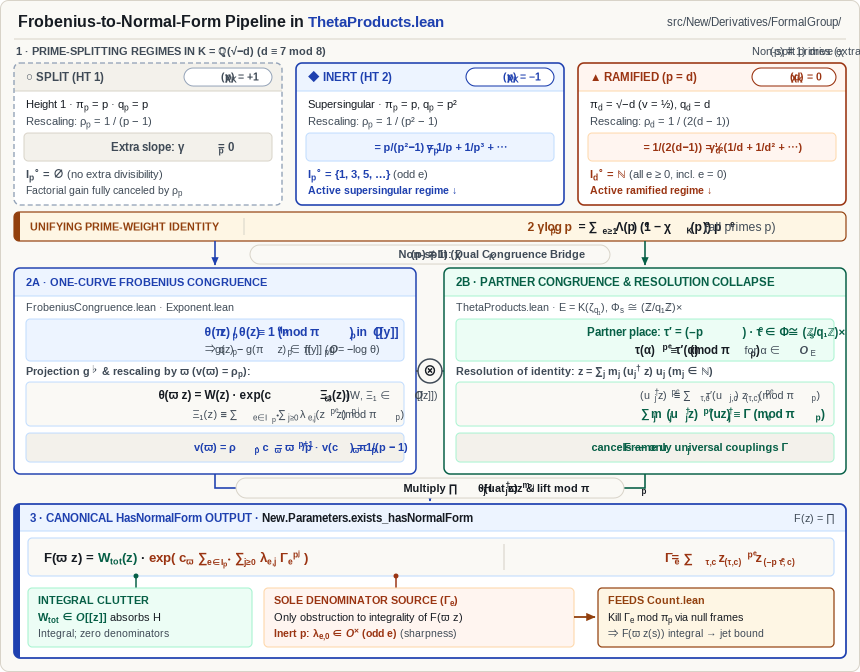
- Split primes (
): The curve behaves ordinarily modulo . The scaling radius of the local coordinate cancels the full factorial rate , leaving extra slope . - Inert primes (
): The curve becomes supersingular modulo , so multiplication by behaves like a -th power rather than a -th power. Rescaling the variable only costs per derivative, leaving a sharp extra slope - The ramified prime (
, ): Multiplication by has half a prime's divisibility ( ) and degree , costing and leaving extra slope
Multiply each slope by
combining the logarithmic step weight
To turn this one-variable mechanism into an engine for the multi-variable automorphic theta lifts of Stages 03–07 over the cyclotomic tower
- Normal form and prime-counting divisibility (
theta_products,count): Over the cyclotomic CM field, taking a product of copies of the one-variable elliptic theta function along a redundant spanning family of vectors reconstructing every vector from weighted projectionstight frame collapses its exponential factor into a canonical factorization pairing each infinite place with its shifted Galois partner through homogeneous couplingstheta normal form. A clever linear change of directions then forces those Frobenius couplings to vanish modulo , making the rescaled series integral so Legendre's factorial bound yields explicit divisibility lower bounds on every derivative of a theta Taylor series along matrix minors and Schur polynomialsSchur jet. - Tight frames and the globally integral vacuum (
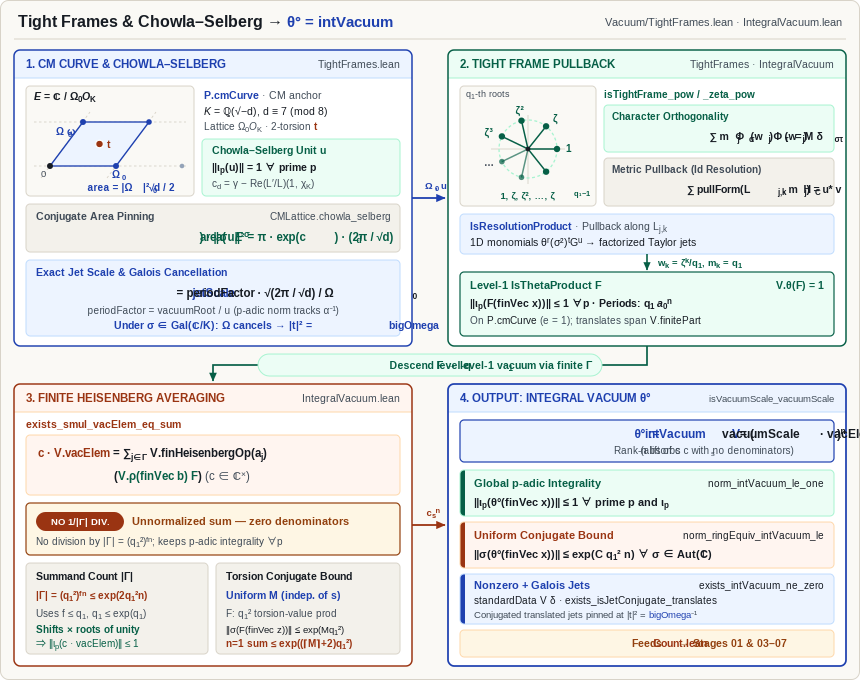
tight_frames,integral_vacuum): The multi-variable automorphic theta function of a Hermitian space starts from a Gaussian "vacuum" vector whose arithmetic values have unknown denominators. Using the powers ofas an explicit tight frame, Stage 02 expresses a multiple of the vacuum as a finite sum of translates of an integral theta product, producing a single rescaled vector — the integral vacuum — whose finite-point values are integral at every prime while all their conjugates remain bounded by . - Sharpness of the divisibility bound (
bound_attained): Knowing that derivatives are at least as divisible as the predicted prime sum feeds Theorem A (Stage 03), while Theorem C (Stages 05–06) needs the reverse direction — that no hidden extra divisibility inflates the arithmetic floor. Using a-copy construction built from a tight frame of length and Fourier inversion back to indicator data, Stage 02 proves that the predicted prime-sum divisibility is actually attained up to a tiny controlled factor.
Explore Stage 02 across its three landmark essays, return to Stage 01 — The Theorem and Its Reduction, or zoom out to the Full Proof Journey & Alpöge's 20-Step Map:
- Formal Groups, Normal Forms & Prime-Counting Divisibility —
ThetaProductsandCount: the supersingular Frobenius congruence, partner places, direction substitution, marked-place charges, and Schur jet divisibility. - Spanning Frames, Resolution Products & the Integral Vacuum —
TightFramesandIntegralVacuum: Chowla–Selberg scaling, resolution products of monomial sections, global integrality of, conjugate bounds, and Galois conjugation of jets. - Sharpness: Attaining the Divisibility Bound —
BoundAttained: the-copy construction, reduction to indicator data modulo , and attainment of D.localPrimeSumTotal.
Where this analogy breaks
Thinking of Stage 02 as a one-variable derivative slope
Level 2 — Undergrad Bridge
Stage 02 spans 23 upstream Lean files under src/New/Derivatives/, organized into five subdirectories — Divisibility/ (3), Field/ (3), FormalGroup/ (4), Vacuum/ (7), and Sharpness/ (6) — and condensed into 5 landmark nodes in dag/dag.json. Their mathematical flow forms three pipelines anchored on the CM curve P.cmCurve, with period
From formal groups to the theta normal form (
FormalGroup/FrobeniusCongruence,Exponent,Resolution,ThetaProducts,Divisibility/NormalForm): At any non-split prime( ; since , is odd, and for admissible data with , every non-split prime satisfies ), the formal group of has Frobenius norm (inert) or (ramified), uniformizer or of valuation , and scaling valuation The Frobenius congruence
in forces with , , and . Over the cyclotomic CM field with infinite places , the partner map ( P.partner s p e τ) satisfiesfor ( norm_pow_sub_conj_partner_le). For any-integral resolution of the identity , summing the exponents yields New.Parameters.exists_hasNormalForm:From normal forms to Schur-jet divisibility (
Divisibility/NullFrames,Count,Vacuum/Divisibility): Given Young diagramsof columns of height , a standard filling , and integral matrices , New.minorProd i' ybuilds the product of minorsof total degree . Applying a linear change of directions directionSubst(NullFrames.lean::exists_newDirection_dvd) forcesfor all with (using row charges on exempt pairs at marked places marked), makingintegral in degree . Legendre's factorial bound ( norm_jet_le_of_isHomogeneous) minus the chain-rule determinant cost yieldsnorm_jet_minorProd_le_of_chargesand its unmarked formnorm_jet_minorProd_le_of_hasNormalForm:Finally,
exists_norm_schurJet_le_norm_jet_minorProdbounds every entry of the Schur-matrix jetschurJet κ F i' iby some integral minor product, and Vacuum/Divisibility.lean::norm_schurJet_jetSeries_le_of_chargesapplies this directly to standard data of level one for Stage 03.From tight frames to the integral vacuum and sharpness (
Vacuum/TightFrames,IntegralVacuum,Sharpness/BoundAttained):TightFrames.leanfixes the Chowla–Selberg scalingjetScale = periodFactor * √(2π/√d) / Ω₀, proves that the powersform a tight frame ( isTightFrame_zeta_pow), and builds adelic Schwartz vectorswhose entire theta functions factor as resolution products of monomial sections ( exists_isResolutionProduct_of_isTightFrame) with globally integral finite-point values.IntegralVacuum.leanuses Fourier inversion over the lattice( exists_smul_vacElem_eq_sum) to write a nonzero multiple of the vacuum as a sum ofHeisenberg translates of a level-one theta product, yielding vacuumScaleand the integral vacuum( intVacuum) satisfyingnorm_intVacuum_le_one,norm_ringEquiv_intVacuum_le(), and Galois jet conjugation ( exists_isJetConjugate_translates). It also definesstandardData, the-integral module consumed throughout Stages 03–07. BoundAttained.leanruns the same tight-frame machine oncopies ( twelveSpace = Hom(E, E^{12})) with frame lengthand level to reduce Taylor-coefficient valuation bounds on indicator data to LeastValLEon the curve (exists_le_norm_coeff_indicatorDatum), provingNew.Data.exists_rpow_neg_localPrimeSumTotal_le_norm_coeff: for every degree vectorwith , a single nonzero with witnesses attainment of D.localPrimeSumTotal pat every prime.
Cross-pillar DAG edge on bound_attained: Notice that 02_derivatives/bound_attained sits in the 02_derivatives/ narrative folder because it proves sharpness of the Stage 02 theta-derivative bound, yet in dag/dag.json it directly imports 03_upper_bound/short_columns (for the definition and properties of D.localPrimeSumTotal) and is consumed downstream by 06_one_lift/twisted_value_heights (where sharpness bounds the heights of twisted Hecke GUIDE.md explains, folders track the conceptual narrative order of the argument rather than strict layer numbers, while the condensed dependency graph dag/dag.json remains globally acyclic.
Level 3 — Formal Lean Contract
Stage 02 covers 23 upstream files under src/New/Derivatives/, represented in the condensed 41-landmark DAG (dag/dag.json) by 5 extracted landmark skeletons derived from pinned upstream commit 41c2716658c42ba08eb0648994a2efe83082a95c (41c2716658c4, leanprover/lean4:v4.37.0-rc1, Mathlib rev 31ce06eaadf4a200c0e1407c5f10953cf606b8f8):
| Skeleton File | Upstream Path | Direct Landmark Dependencies (dag/dag.json) | Key Declarations |
|---|---|---|---|
02_derivatives/tight_frames.lean | src/New/Derivatives/Vacuum/TightFrames.lean | (none — imports src/Lib/ and Parameters) | New.Parameters.cmCurve, New.Parameters.jetScale, New.Parameters.isTightFrame_zeta_pow, New.Parameters.IsResolutionProduct, New.Parameters.exists_isResolutionProduct_of_isTightFrame |
02_derivatives/integral_vacuum.lean | src/New/Derivatives/Vacuum/IntegralVacuum.lean | 02_derivatives/tight_frames | New.Parameters.IsThetaProduct, New.Parameters.isVacuumScale_vacuumScale, New.Parameters.intVacuum, New.Parameters.standardData, New.Parameters.norm_intVacuum_le_one, New.Parameters.norm_ringEquiv_intVacuum_le, New.Parameters.exists_isJetConjugate_translates |
02_derivatives/theta_products.lean | src/New/Derivatives/FormalGroup/ThetaProducts.lean | 02_derivatives/tight_frames | New.Parameters.partner, New.Parameters.norm_pow_sub_conj_partner_le, New.Parameters.piPrimeInt_dvd_sum_linearSeries_sub_coupling, New.Parameters.exists_hasNormalForm |
02_derivatives/count.lean | src/New/Derivatives/Divisibility/Count.lean | 02_derivatives/theta_products | New.norm_jet_le_of_isHomogeneous, New.predictedDivisibility, New.mul_tsum_deductionAt, New.Parameters.norm_jet_minorProd_le_of_charges, New.Parameters.norm_jet_minorProd_le_of_hasNormalForm, New.exists_norm_schurJet_le_norm_jet_minorProd |
02_derivatives/bound_attained.lean | src/New/Derivatives/Sharpness/BoundAttained.lean | 02_derivatives/integral_vacuum, 02_derivatives/theta_products, 03_upper_bound/short_columns | New.Data.exists_integral_isThetaFunction_twelveTaylor_eq, New.Data.exists_le_norm_coeff_indicatorDatum, New.Data.norm_map_mul_intVacuum_le, New.Data.exists_rpow_neg_localPrimeSumTotal_le_norm_coeff |
Downstream consumers across Stages 01 and 03–07 (dag/dag.json): Stage 02 is the widest foundational provider in the entire condensed proof graph, feeding 19 downstream landmark nodes across six stages:
- Stage 01 (
01_reduction):one_sided_boundintegral_vacuum(admissible-data scale existence). - Stage 03 (
03_upper_bound):seesaw_identity,local_divisibility, andarchimedean_sizecount,integral_vacuum,theta_products;short_columnsintegral_vacuum(and in turn feeds02_derivatives/bound_attained). - Stage 04 (
04_spanning):spanning_theorem,equal_multiplicities, andenergy_estimateintegral_vacuum. - Stage 05 (
05_determinant):fit_twistsandnorm_of_chainintegral_vacuum;spanning_formscount,integral_vacuum. - Stage 06 (
06_one_lift):gluing_mapsintegral_vacuum;three_exchangescount,integral_vacuum;twisted_value_heightsbound_attained,count,integral_vacuum,theta_products. - Stage 07 (
07_congruences):fit_twists_exist,rows_from_eigensystems,denominator_bound, andcrystalline_defectintegral_vacuum;twisting_theoremcount,integral_vacuum,theta_products.
Verification status (audit/verification-status.json): Local Lean compilation and kernel replay remain build_status: unverified-locally at pinned commit 41c2716658c42ba08eb0648994a2efe83082a95c (41c2716658c4). Static token scanning currently has scan_scope: entry, covering only the three Stage 00 entry files (Challenge.lean, src/Main.lean, src/Statements.lean), recording 0 forbidden tokens in solution files and 5 expected sorry tokens in Challenge.lean. Stage 02 proof files under src/New/Derivatives/ have not been locally compiled, kernel-checked, or statically scanned here; every theorem statement, dependency edge, and mathematical summary above reflects direct inspection of the pinned upstream source files.
- Count (landmark) —
src/New/Derivatives/Divisibility/Count.lean(depends on:02_derivatives/theta_products) - ThetaProducts (landmark) —
src/New/Derivatives/FormalGroup/ThetaProducts.lean(depends on:02_derivatives/tight_frames) - TightFrames (landmark) —
src/New/Derivatives/Vacuum/TightFrames.lean(depends on: none) - IntegralVacuum (landmark) —
src/New/Derivatives/Vacuum/IntegralVacuum.lean(depends on:02_derivatives/tight_frames) - BoundAttained (landmark) —
src/New/Derivatives/Sharpness/BoundAttained.lean(depends on:02_derivatives/integral_vacuum,02_derivatives/theta_products,03_upper_bound/short_columns)
Page Glossary
- prime number
- A whole number greater than 1 whose only positive whole-number divisors are 1 and itself; every integer above 1 factors uniquely into a product of them.
- complex multiplication
- Extra scaling-and-rotation symmetries of a two-dimensional lattice in ℂ preserved by the integers 𝓞_K of an imaginary quadratic field K = ℚ(√(-d)), pinning down every Galois-conjugate lattice area via the Chowla–Selberg formula.
- elliptic theta function
- A quasi-periodic entire function on a CM lattice normalized at the origin, whose finite products along tight-frame projections build integral multi-variable theta functions and collapse p-adically into exponential normal forms.
- arithmetic height
- A logarithmic measure combining ordinary archimedean size with prime-by-prime p-adic divisibility, locked together by the product formula so a nonzero algebraic quantity cannot be simultaneously small at every place.
- formal group law
- A power-series addition law encoding an elliptic curve's group structure near the origin, whose Lubin–Tate scaling and Frobenius congruence isolate the exact p-adic powers controlling theta-function derivatives.
- von Mangoldt function
- The arithmetic weight Λ(n) equal to log p when n is a prime power pᵏ (k ≥ 1) and 0 otherwise, converting multiplicative prime factorizations into additive logarithms.
- quadratic twist
- Multiplying a Dirichlet character χ modulo N by the Legendre symbol (·/d) of an odd prime d coprime to N, yielding a non-principal character modulo N·d whose L-function family admits zero-density control.
- Landau's lemma
- A complex-analytic theorem stating that the Laplace or Dirichlet transform of a nonnegative function must have a singularity on the real axis at its abscissa of convergence, turning one-sided error bounds into zero-free half-planes.
- tight frame
- A balanced, possibly overcomplete family of vectors with integer multiplicities whose projections reconstruct the exact standard inner product—allowing integral root-of-unity spokes to pull back one-dimensional elliptic theta sections into high-dimensional integral theta functions.
- theta normal form
- A p-adic factorization of rescaled multivariable theta products into an integral power series times an exponential of Frobenius-power couplings pairing each infinite place with its shifted partner place.
- Schur jet
- The evaluation at the origin of a symmetry-adapted Schur differential operator on a theta function's multivariate Taylor expansion, whose prime-by-prime divisibility is controlled through minor products and matched by an explicit sharpness construction.