Galois Main Summands and the Anticyclotomic Selmer Twisting Theorem
This page explains the two representation-theoretic and twisting landmarks of Stage 07: src/New/Congruences/GaloisRepresentations/RowsFromEigensystems.lean (07_congruences/rows_from_eigensystems, 15 declarations, 0 stub truncations) — which extracts fixed, twist-independent Galois main summands from Hecke eigensystems of theta lifts — and src/New/Congruences/Selmer/TwistingTheorem.lean (07_congruences/twisting_theorem, 11 declarations, 1 let-type stub truncation documented verbatim below) — which chooses one twistError ℓ D. Return to the Stage 07 Overview, revisit Crystalline Lifting, Kummer Charts, and Local Dual Defect, or proceed to First-Order Ribet Denominator Bounds and Existence of Regular Twist Families.
Level 1 — First-Principles
Before Stage 07 can clear congruence denominators by Ribet's method, it must solve two global problems at each primeprime number
- Identify the finitely many twist-independent Galois representations whose Selmer groups govern all congruences of theta lifts across every twist
. - Find a single m-fold twistregular twist family
whose first powers ( ) simultaneously make all of those Selmer groups short and keep all ramified partial Hecke L-value ratiosHecke L-value ratio barely divisible by .
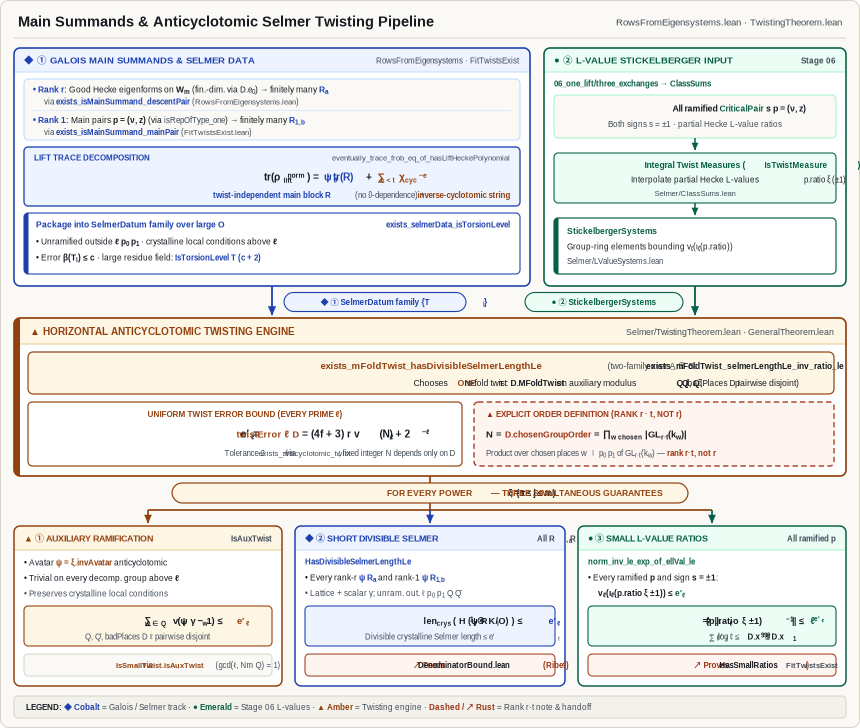
Part 1: Extracting twist-independent Galois blocks (RowsFromEigensystems.lean)
Take any good Hecke eigenform on the rank-apply_one_eq_of_heckePolyEval_eq, neg_coeff_eq_of_hasLiftHeckePolynomial) and passing to Frobenius elements along mostFrobenii D.E proves the exact lift trace decompositionGalois main summand (eventually_trace_frob_eq_of_hasLiftHeckePolynomial):
Here IsMainSummand O b T)—completely independent of
RowsFromEigensystems.lean also verifies that the Hodge–Tate jumps of both rank-IsMainSummandWeights required by CrystallineDefect.lean:
- Rank-
descent pairs ( isMainSummandWeights_descentPair): For each, the jumps split into high jumps ( ) and exactly low jumps ( ). - Rank-
main pairs ( isMainSummandWeights_mainPair): For each main pair( , ), the single jump lies within of and obeys IsMainSummandWeights D 1 (2 * p.z - 1).
Attaching a conjugate self-dual Galois representation IsLiftSetting), twisting by the algebraic character isMainSummandLike_twistByChar), and verifying Frobenius trace limits (exists_isMainSummand_of_isRepOfType) proves New.Selmer.exists_isMainSummand_descentPair. Since D.goodForms (D.spaceW D.m) is finite-dimensional, only finitely many rank-
Part 2: Simultaneous TwistingTheorem.lean)
Next, Selmer/TwistingTheorem.lean feeds finitely many main summands
- Selmer data (
exists_selmerData_isTorsionLevel): Choosing a chosen placeabove and its tame inertia generator , every admits a Selmer datum over a large coefficient ring , unramified outside , with crystalline local conditions above , normalized error , and residue field large enough to satisfy IsTorsionLevel T (c + 2). - Stickelberger systems from Stage 06 (
Selmer/ClassSums.lean+Selmer/LValueSystems.lean): Importing Stage 06 — Three Exchanges and Gluing (06_one_lift/three_exchanges) viaSelmer/ClassSums.lean, Stage 07 constructs integral twist measures (IsTwistMeasure) interpolating every ramified pair's-value ratio into a Stickelberger system of group-ring elements.
Invoking the horizontal twisting theorem (Selmer/GeneralTheorem.lean::exists_anticyclotomic_twist) with tolerance New.Selmer.exists_mFoldTwist_hasDivisibleSelmerLengthLe: there exists one
- Auxiliary ramification (
IsSmallTwist.isAuxTwist):has prime-norm places disjoint from and badPlaces D ℓ(places dividing), is anticyclotomic and trivial above , and ; - Short divisible crystalline Selmer groups (
HasDivisibleSelmerLengthLe): Everyhas a lattice with an inertial scalar element whose crystalline Selmer group with coefficients in (unramified outside ) has normalized length at most ; - Small
-value ratio valuations: For every ramified pair and sign , (so by norm_inv_le_exp_of_ellVal_le, its inverse has norm, contributing directly to global arithmetic heightarithmetic height ).
Here the explicit twist error is
Notice an important detail in that formula: isNegligible_twistError in FitTwistsExist.lean).
Where this analogy breaks
Thinking of RowsFromEigensystems.lean and TwistingTheorem.lean as "take one Galois representation, twist it once, and shrink its Selmer group" omits two crucial constraints. First, a single SelmerDatum.TwistedLengthLe.hasDivisibleSelmerLengthLe only works because the auxiliary twist character mapRel_crysRelations_subset) and on the tame inertia generator SelmerDatum.apply_γ_eq_one), preserving crystalline conditions unchanged under twisting.
Level 2 — Undergrad Bridge
1. All 15 declarations of RowsFromEigensystems.lean (0 truncations)
| Group | Declarations (Count) | Mathematical Role |
|---|---|---|
| Jump-window checks | cmSign_star, abs_descentPair_weight_add_liftWeight_le, le_natAbs_descentPair_jump_and_le, countP_low_weights_descentPair, isMainSummandWeights_descentPair, abs_mainPair_weight_add_liftWeight_le, isMainSummandWeights_mainPair (7) | Verifies IsMainSummandWeights D D.r D.t for the IsMainSummandWeights D 1 (2 * p.z - 1) for every main pair |
| Hecke-polynomial & trace factorization | apply_one_eq_of_heckePolyEval_eq, neg_coeff_eq_of_hasLiftHeckePolynomial, eventually_trace_frob_eq_of_hasLiftHeckePolynomial (3) | Converts HasLiftHeckePolynomial into the linear-coefficient identity mostFrobenii D.E. |
| Main summand construction | IsRepOfType.isMainSummandLike_twistByChar, exists_isMainSummand_of_isRepOfType, map_jumps_sub_eq_map_targetParameter, Data.isEigenform_of_hasHeckePolyAt, exists_isMainSummand_descentPair (5) | Twists an attached IsRepOfType representation by $\mu^{-1}(x/\bar x) |
2. All 11 declarations of TwistingTheorem.lean (1 truncation)
- Valuation & crystalline pushforward (5 decls):
norm_inv_le_exp_of_ellVal_le(), mapRel_crysRelations_subset,IsSmallTwist.isAuxTwist,divisibleSelmerLength_le_divisibleLength,SelmerDatum.apply_γ_eq_one. - Selmer length transfer & error bounds (4 decls):
SelmerDatum.TwistedLengthLe.hasDivisibleSelmerLengthLe,four_mul_ellVal_levelPrime_sub_one_add_le_twistError(), invAvatar_pow,tamePart_ne_one_of_invAvatar_ne_one. - Packaging & horizontal twisting theorem (2 decls):
exists_selmerData_isTorsionLevel(buildsSelmerDatumfamily overOwithIsTorsionLevel T (c + 2)) andexists_mFoldTwist_hasDivisibleSelmerLengthLe(combiningSelmer/GeneralTheorem.leanwithSelmer/LValueSystems.lean/Selmer/ClassSums.leanimported from06_one_lift/three_exchanges).
Level 3 — Formal Lean Contract
skeleton/07_congruences/rows_from_eigensystems.lean (15 declarations, 0 stub truncations) and skeleton/07_congruences/twisting_theorem.lean (11 declarations, 1 let-type stub truncation) mirror src/New/Congruences/GaloisRepresentations/RowsFromEigensystems.lean and src/New/Congruences/Selmer/TwistingTheorem.lean at pinned upstream commit 41c2716658c42ba08eb0648994a2efe83082a95c. All 15 declarations in rows_from_eigensystems.lean extract completely untruncated.
Stub-Truncation Disclosure (1 Truncation in twisting_theorem.lean; 0 in rows_from_eigensystems.lean)
In skeleton/07_congruences/twisting_theorem.lean, 1 declaration — New.Selmer.exists_mFoldTwist_hasDivisibleSelmerLengthLe (decl starts L172, truncated at let ξ : D.Twist := on L177) — is cut at its let ... := return-type binding by rh-extract's depth-0 := splitter. Its exact untruncated signature from pinned upstream src/New/Congruences/Selmer/TwistingTheorem.lean:373–386 is:
-- Verbatim from upstream src/New/Congruences/Selmer/TwistingTheorem.lean:373-386
theorem exists_mFoldTwist_hasDivisibleSelmerLengthLe {P : Parameters} (D : Data P) (ℓ : ℕ)
    [ThePrime ℓ] (ι : PadicIso ℓ) {I : Type} [Finite I] {r : I → Type} [∀ i : I, Fintype (r i)]
    [∀ i : I, DecidableEq (r i)] {R : ∀ i : I, GalRep ℓ D.E (r i)}
    (hR : ∀ i : I, ∃ (t : ℕ) (J : (D.E →+* ℂ) → Multiset ℤ), IsMainSummandLike D t J (R i)) :
    ∃ τ : D.MFoldTwist, ∀ j : D.LiftIndex,
      let ξ : D.Twist := τ.powTwist j
      -- The ramification is auxiliary and small.
      IsAuxTwist (badPlaces D ℓ) ξ.Q ξ.invAvatar (twistError ℓ D) ∧
      -- The Selmer groups of the twisted representations are short.
      (∀ i : I, ∃ γ : AbsGal D,
        HasDivisibleSelmerLengthLe ξ.invAvatar (R i) ξ.Q γ (twistError ℓ D)) ∧
      -- The ratios of `L`-values have small valuation.
      ∀ (p : D.CriticalPair) (s : ℤˣ), p.IsRamified →
        ellVal (ιℓ (p.ratio ξ s)) ≤ twistError ℓ D
All 10 remaining declarations in twisting_theorem.lean and all 15 declarations in rows_from_eigensystems.lean extract completely untruncated.
Headline Untruncated Signatures (rows_from_eigensystems.lean)
-- skeleton/07_congruences/rows_from_eigensystems.lean (upstream RowsFromEigensystems.lean:476-561)
theorem New.Selmer.exists_isMainSummand_descentPair {ℓ : ℕ} [ThePrime ℓ] (ι : PadicIso ℓ)
    {p : FinPlace D.E × ℕ → ℂ}
    (h_ne_bot : D.goodForms (D.spaceW D.m) ⊓ D.eigenPart (D.spaceW D.m) p ≠ ⊥) (j : D.LiftIndex) :
    ∃ T : GalRep ℓ D.E D.RowIndex,
      IsMainSummand (D.descentPair TameChar.one j) (fun (w : FinPlace D.E) (i : ℕ) ↦ p (w, i))
T- Verification status (
audit/verification-status.json): Local Lean compilation and kernel replay remainbuild_status: unverified-locallyat pinned commit41c2716658c42ba08eb0648994a2efe83082a95c(41c2716658c4). Static token scanning hasscan_scope: entry, covering onlyChallenge.lean,src/Main.lean, andsrc/Statements.lean. NeitherRowsFromEigensystems.leannorTwistingTheorem.leanhas been locally compiled, kernel-checked, or statically scanned here.
lemma New.Selmer.cmSign_star — Upstream source (src/New/Congruences/GaloisRepresentations/RowsFromEigensystems.lean L64-L68)
/-- The sign `cmSign` of a complex embedding (`1` on the CM type, `-1` off it) changes under complex
conjugation. -/
@[simp]
lemma New.Selmer.cmSign_star (σ : D.E →+* ℂ) : cmSign (E := D.E) (star σ) = -cmSign σ := by
  sorry -- [EXTRACTED_STUB upstream=src/New/Congruences/GaloisRepresentations/RowsFromEigensystems.lean:64-68 commit=41c2716658c42ba08eb0648994a2efe83082a95c body_lines=2 body_sha256=55de8b8124c2bd11f6cb65a8064f3904781d7d3e98909cf377f010795242e96d]
lemma New.Selmer.abs_descentPair_weight_add_liftWeight_le — Upstream source (src/New/Congruences/GaloisRepresentations/RowsFromEigensystems.lean L70-L86)
/-- Let `D` be admissible data (`Data P`) over the CM field `D.E`, with rank `r = D.r`, number of
lifts `m = D.m`, `k = D.k = r + 1 - m` and `t = D.t = 5 r`. At a complex embedding `σ` of `D.E`,
over the infinite place `v`, the `q`-th jump (Hodge–Tate weight) of the `j`-th descent pair is the
integer `u = t / 2 - ε (λ_q + w_j)`. Here `t / 2` is integer division, `ε = cmSign σ` is `1` on the
CM type and `-1` off it, `λ_q = D.targetParameter v q` is the fixed parameter of the rank `r` group
and `w_j = D.liftWeight j v` is minus the weight of the character of the `j`-th lift. For
`q + 1 < k` the jump is high: `|ε u + w_j| ≤ t`. -/
lemma New.Selmer.abs_descentPair_weight_add_liftWeight_le (j : ℕ) (σ : D.E →+* ℂ) {q : ℕ} (hq : q + 1 < D.k)
    {u : ℤ}
    (hu : u = D.t / 2 -
      cmSign σ * (D.targetParameter (InfinitePlace.mk σ) q + D.liftWeight j (InfinitePlace.mk σ))) :
    |cmSign σ * u + D.liftWeight j (InfinitePlace.mk σ)| ≤ D.t := by
  sorry -- [EXTRACTED_STUB upstream=src/New/Congruences/GaloisRepresentations/RowsFromEigensystems.lean:70-86 commit=41c2716658c42ba08eb0648994a2efe83082a95c body_lines=6 body_sha256=edece842e1dd65e7d3794c7707d4d12cbd93bd536e473fb2ed79fe1587412a16]
lemma New.Selmer.le_natAbs_descentPair_jump_and_le — Upstream source (src/New/Congruences/GaloisRepresentations/RowsFromEigensystems.lean L88-L118)
/-- Let `D` be admissible data over the CM field `D.E`, with `r = D.r`, `m = D.m`, `k = D.k` and
`Δ = D.gap`. Let `1 ≤ j ≤ m` (`D.LiftIndex`). At a complex embedding `σ` over the infinite place
`v`, the `q`-th jump (Hodge–Tate weight) of the `j`-th descent pair is the integer
`u = t / 2 - ε (λ_q + w_j)`, with `t = D.t`, `ε = cmSign σ = ±1` (`1` on the CM type),
`λ_q = D.targetParameter v q` and `w_j = D.liftWeight j v`, minus the weight of the character of
the `j`-th lift. For `k ≤ q + 1 ≤ r` the jump is low: `Δ / 4 ≤ |u| ≤ 2 m Δ`. -/
lemma New.Selmer.le_natAbs_descentPair_jump_and_le {j : ℕ} (hj : j ∈ D.LiftIndex) (σ : D.E →+* ℂ) {q : ℕ}
    (hq_ge : D.k ≤ q + 1) (hq_lt : q < D.r) {u : ℤ}
    (hu : u = D.t / 2 -
      cmSign σ * (D.targetParameter (InfinitePlace.mk σ) q + D.liftWeight j (InfinitePlace.mk σ))) :
    D.gap ≤ 4 * u.natAbs ∧ u.natAbs ≤ 2 * D.m * D.gap := by
  sorry -- [EXTRACTED_STUB upstream=src/New/Congruences/GaloisRepresentations/RowsFromEigensystems.lean:88-118 commit=41c2716658c42ba08eb0648994a2efe83082a95c body_lines=21 body_sha256=7d5d8e2418b4555f4faf15dcfcb0b13a6f6c15afe1092f1bafaf9eb965b38fab]
lemma New.Selmer.countP_low_weights_descentPair — Upstream source (src/New/Congruences/GaloisRepresentations/RowsFromEigensystems.lean L120-L144)
/-- Let `D` be admissible data, `1 ≤ j ≤ m = D.m` and `σ` a complex embedding of the CM field `D.E`
over the infinite place `v`. The jumps (Hodge–Tate weights) of the `j`-th descent pair at `σ` are
the `r = D.r` integers `t / 2 - ε (λ_q + w_j)`, `q < r`, where `t = D.t`, `ε = cmSign σ = ±1`,
`λ_q = D.targetParameter v q` and `w_j = D.liftWeight j v` is minus the weight of the character of
the `j`-th lift. If `2 m Δ ≤ B` and `B + t < w_j`, with `Δ = D.gap`, then exactly `m` of them have
modulus at most `B`. -/
lemma New.Selmer.countP_low_weights_descentPair {j : ℕ} (hj : j ∈ D.LiftIndex) (σ : D.E →+* ℂ) {B : ℕ}
    (hB_ge : 2 * D.m * D.gap ≤ B) (hB_lt : B + D.t < D.liftWeight j (InfinitePlace.mk σ)) :
    countP (fun u : ℤ ↦ u.natAbs ≤ B) ((Multiset.range D.r).map fun q : ℕ ↦ (D.t / 2 -
      cmSign σ * (D.targetParameter (InfinitePlace.mk σ) q + D.liftWeight j (InfinitePlace.mk σ)) :
        ℤ)) = D.m := by
  sorry -- [EXTRACTED_STUB upstream=src/New/Congruences/GaloisRepresentations/RowsFromEigensystems.lean:120-144 commit=41c2716658c42ba08eb0648994a2efe83082a95c body_lines=15 body_sha256=7bed125e72f73643b4c882aa9f78e7b794063709e68415a210aed4f0332fff04]
lemma New.Selmer.isMainSummandWeights_descentPair — Upstream source (src/New/Congruences/GaloisRepresentations/RowsFromEigensystems.lean L146-L174)
/-- Let `1 ≤ j ≤ m` (`D.LiftIndex`, `m = D.m`). At a complex embedding `σ`, over the infinite place
`v`, take as jumps (Hodge–Tate weights) the `r = D.r` integers `t / 2 - ε (λ_q + w_j)`, `q < r`, of
the `j`-th descent pair. Here `t = D.t`, `ε = cmSign σ` is `1` on the CM type and `-1` off it,
`λ_q = D.targetParameter v q` is the fixed parameter of the rank `r` group, and
`w_j = D.liftWeight j v` is minus the weight of the character of the lift. These jumps satisfy
`IsMainSummandWeights D r t`. -/
lemma New.Selmer.isMainSummandWeights_descentPair {j : ℕ} (hj : j ∈ D.LiftIndex) :
    IsMainSummandWeights D D.r D.t fun σ : D.E →+* ℂ ↦ (Multiset.range D.r).map fun q : ℕ ↦
      D.t / 2 -
      cmSign σ * (D.targetParameter (InfinitePlace.mk σ) q + D.liftWeight j
        (InfinitePlace.mk σ)) := by
  sorry -- [EXTRACTED_STUB upstream=src/New/Congruences/GaloisRepresentations/RowsFromEigensystems.lean:146-174 commit=41c2716658c42ba08eb0648994a2efe83082a95c body_lines=19 body_sha256=22cd7dbb4d02d3e2e87e292d2293e3412fad06ae6b95d4c5d739f025d751088f]
lemma New.Selmer.abs_mainPair_weight_add_liftWeight_le — Upstream source (src/New/Congruences/GaloisRepresentations/RowsFromEigensystems.lean L176-L194)
/-- Let `p` be a critical pair of the data `D`: an integer `z = p.z` and a character of `U(1)` of
weight `-c`, with `c = p.negWeight`. Let it be a main pair for `j` (`IsMainPair`): in particular
`m < z ≤ r` and `w_j + r - t ≤ c ≤ w_j`, where `m = D.m`, `r = D.r`, `t = D.t = 5 r` and
`w_j = D.liftWeight j` is minus the weight of the character of the `j`-th lift. At a complex
embedding `σ` over the infinite place `v`, with `ε = cmSign σ = ±1`, the jump (Hodge–Tate weight)
of `p` is `u = z - 1 - ε c v`. It is high: `|ε u + w_j v| ≤ t`. -/
lemma New.Selmer.abs_mainPair_weight_add_liftWeight_le {p : D.CriticalPair} {j : ℕ} (hp : p.IsMainPair j)
    (σ : D.E →+* ℂ) {u : ℤ} (hu : u = p.z - 1 - (cmSign σ : ℤ) * p.negWeight (InfinitePlace.mk σ)) :
    |cmSign σ * u + D.liftWeight j (InfinitePlace.mk σ)| ≤ D.t := by
  sorry -- [EXTRACTED_STUB upstream=src/New/Congruences/GaloisRepresentations/RowsFromEigensystems.lean:176-194 commit=41c2716658c42ba08eb0648994a2efe83082a95c body_lines=11 body_sha256=af9f0d07e785a0ca486224210ea2c5733c63e641bfc401c7f18b8061d61640e5]
lemma New.Selmer.isMainSummandWeights_mainPair — Upstream source (src/New/Congruences/GaloisRepresentations/RowsFromEigensystems.lean L196-L226)
/-- Let `p` be a main pair for `j` (`IsMainPair`): an integer `z = p.z` and a character of `U(1)` of
weight `-c`, `c = p.negWeight`, with in particular `m < z ≤ r` and `w_j + r - t ≤ c ≤ w_j`, where
`w_j = D.liftWeight j` is minus the weight of the character of the `j`-th lift. At a complex
embedding `σ` over the infinite place `v`, take the single jump (Hodge–Tate weight)
`z - 1 - ε c v`, with `ε = cmSign σ` equal to `1` on the CM type and `-1` off it. These jumps
satisfy `IsMainSummandWeights D 1 (2 z - 1)`, the conditions on the jumps of a rank one
representation that is paired with `2 z - 1` consecutive powers of the inverse cyclotomic character:
each is low or within `t` of `-ε w_j`, few are small, and at most one at `σ` and its conjugate is
negative. -/
lemma New.Selmer.isMainSummandWeights_mainPair {p : D.CriticalPair} {j : ℕ} (hp : p.IsMainPair j) :
    IsMainSummandWeights D 1 (2 * p.z - 1) fun σ : D.E →+* ℂ ↦
      {(p.z - 1 - cmSign σ * p.negWeight (InfinitePlace.mk σ) : ℤ)} := by
  sorry -- [EXTRACTED_STUB upstream=src/New/Congruences/GaloisRepresentations/RowsFromEigensystems.lean:196-226 commit=41c2716658c42ba08eb0648994a2efe83082a95c body_lines=20 body_sha256=a179e7a9d0337cacdfd02141bb048abdeb5e6a09da4fc84fa9dc5bfe497f5343]
lemma New.Selmer.apply_one_eq_of_heckePolyEval_eq — Upstream source (src/New/Congruences/GaloisRepresentations/RowsFromEigensystems.lean L245-L257)
/-- Let `r` and `n` be nonempty. Suppose that, for all `X`, the Hecke polynomial at `w` of rank `n`
with eigenvalues `s` equals `qPochhammer q t (α X) = ∏_{l < t} (1 - q ^ l α X)` times the Hecke
polynomial of rank `r` with eigenvalues `z` at `β X`, where `q` is the norm of `w`. Comparing the
linear terms gives `s 1 = β z 1 + (∑_{i < t} q ^ i) α z 0`. -/
lemma New.Selmer.apply_one_eq_of_heckePolyEval_eq (r_pos : 0 < Fintype.card r) (n_pos : 0 < Fintype.card n)
    {w : FinPlace D.E} {s z : ℕ → ℂ} {t : ℕ} {α β : ℂ} (h_eq : ∀ X : ℂ,
      heckePolyEval n w s X = qPochhammer w.q t (α * X) * heckePolyEval r w z (β * X)) :
    s 1 = β * z 1 + (∑ i ∈ Finset.range t, (w.q : ℂ) ^ i) * α * z 0 := by
  sorry -- [EXTRACTED_STUB upstream=src/New/Congruences/GaloisRepresentations/RowsFromEigensystems.lean:245-257 commit=41c2716658c42ba08eb0648994a2efe83082a95c body_lines=6 body_sha256=f14d2e10db1b3f044175ec17be198ac7e9870034258132d367845cbedc4f7066]
lemma New.Selmer.IsRepOfType.isMainSummandLike_twistByChar — Upstream source (src/New/Congruences/GaloisRepresentations/RowsFromEigensystems.lean L259-L295)
/-- Let `O` be a descent pair over the CM field `D.E` of the data `D`: two spaces of dimensions
`r < n`, a character `μ = O.u1Char` of `U(1)` of weight `O.weight`, and chosen places
`O.chosenPlace i`. Put `t = O.rankDiff = n - r` and assume `r - t = 2 a`. Let `c` give for each
chosen place a polynomial over its residue field, admissible for `O` and the trivial twist
(`IsLiftSetting`). Let `R` be an `r`-dimensional `ℓ`-adic Galois representation of `D.E` that is
conjugate self-dual, unramified off the places that `O` allows (empty extra level), has jumps
(Hodge–Tate weights) `J`, and whose inertia at the chosen places acts through the roots of `c`
(`IsRepOfType`). Lower the jumps at each embedding `σ` by `a - cmSign σ * O.weight v`, with `v` the
place of `σ` and `cmSign σ = ±1`, and suppose that they obey the numerical conditions
`IsMainSummandWeights`. Then `R` twisted by the avatar of `O.hasWeight.inv.toAlgebraic 0 a`, the
algebraic Hecke character `μ⁻¹(x / x̄) |x| ^ a`, is like a main summand (`IsMainSummandLike`) with
the lowered jumps and string length `t`. -/
lemma New.Selmer.IsRepOfType.isMainSummandLike_twistByChar [PadicIso ℓ]
    {c : (i : O.ChosenIndex) → (ResField (O.chosenPlace i))[X]} {J : (D.E →+* ℂ) → Multiset ℤ}
    {R : GalRep ℓ D.E r} (hR : IsRepOfType O (Fintype.card r) J c ∅ R)
    (hO : IsLiftSetting O c 1) {a : ℤ} (ha : (Fintype.card r - O.rankDiff : ℤ) = 2 * a)
    (hJ : IsMainSummandWeights D (Fintype.card r) O.rankDiff fun σ : D.E →+* ℂ ↦
      (J σ).map fun u : ℤ ↦ u - (a - cmSign σ * O.weight (NumberField.InfinitePlace.mk σ))) :
    IsMainSummandLike D O.rankDiff (fun σ : D.E →+* ℂ ↦
        (J σ).map fun u : ℤ ↦ u - (a - cmSign σ * O.weight (NumberField.InfinitePlace.mk σ)))
      (twistByChar (O.hasWeight.inv.toAlgebraic 0 a).avatar R) := by
  sorry -- [EXTRACTED_STUB upstream=src/New/Congruences/GaloisRepresentations/RowsFromEigensystems.lean:259-295 commit=41c2716658c42ba08eb0648994a2efe83082a95c body_lines=17 body_sha256=b28a960d42ea83616ab2c3232f4b2854bd1cd12cddb79d0e666cc0a42a08a361]
lemma New.Selmer.neg_coeff_eq_of_hasLiftHeckePolynomial — Upstream source (src/New/Congruences/GaloisRepresentations/RowsFromEigensystems.lean L297-L327)
/-- Let the nonzero form `y` of the descent pair `V` of ranks `0 < r < n` lift the system `b` of
Hecke eigenvalues, and let `H` be its Hecke polynomial at a split place `w` of norm `q` away from
the places of `V` and their conjugates. Then minus the coefficient of `X ^ (n - 1)` in `H` is
`q ^ t ν / ν' * b w 1 + (∑_{i < t} q ^ i) ν`. Here `t = n - r`, `ν = V.charW.frobValue r w` and
`ν' = V.charV.frobValue n w`: for a character `χ` of `U(1)` and rank `N`, `χ.frobValue` is the value
at a uniformizer at `w` of the Hecke character `x ↦ χ(x / x̄) υ(x) ^ (-N)`, times `q ^ (N / 2)`. -/
lemma New.Selmer.neg_coeff_eq_of_hasLiftHeckePolynomial [DecidableEq n] (r_pos : 0 < Fintype.card r)
    {V : DescentPair D.E r n} {y : V.FormV} {b : FinPlace D.E → ℕ → ℂ}
    (hy_lifts : V.HasLiftHeckePolynomial y b)
    (hy_ne : (y : Gf D.E n → WeylIndex n V.columnCount → ℂ) ≠ 0) {w : FinPlace D.E}
    (hw_split : star w ≠ w) (hw_off : w ∉ V.places.conjClosure) {H : ℂ[X]}
    (hH : HasHeckePolyAt (y : Gf D.E n → WeylIndex n V.columnCount → ℂ) w hw_split H) :
    -H.coeff (Fintype.card n - 1) =
      w.q ^ V.rankDiff * V.charW.frobValue r w / V.charV.frobValue n w * b w 1 +
        (∑ i ∈ Finset.range V.rankDiff, (w.q : ℂ) ^ i) * V.charW.frobValue r w := by
  sorry -- [EXTRACTED_STUB upstream=src/New/Congruences/GaloisRepresentations/RowsFromEigensystems.lean:297-327 commit=41c2716658c42ba08eb0648994a2efe83082a95c body_lines=17 body_sha256=863239ce6d2c05dc65dbce134bd8cc3b36bbbce624d5ac4906033f9c63a46950]
lemma New.Selmer.eventually_trace_frob_eq_of_hasLiftHeckePolynomial — Upstream source (src/New/Congruences/GaloisRepresentations/RowsFromEigensystems.lean L329-L381)
/-- The identity of traces at Frobenius elements. Let `O` be a descent pair over `D.E` of ranks
`r < n` with character `μ = O.u1Char`, let `c` be admissible labels for it and the trivial twist
(`IsLiftSetting`), and let `r - (n - r) = 2 a`. Let the descent pair `V` have character `μ ϑ`, with
`ϑ` tame, and let the eigenform `y` on `V` with Hecke polynomials `H` lift the system `b` of Hecke
eigenvalues. Then for most Frobenius elements `g = x.frob` at places `w = x.place`, minus the
coefficient of `X ^ (n - 1)` in `H w`, times `normalizingAvatar V g`, equals `θ₀(g) θ(g) b w 1`
plus the sum of the first `n - r` powers of the inverse cyclotomic character at `g`. An avatar is
the `ℓ`-adic Galois character of an algebraic Hecke character; `θ₀` and `θ` are those of
`ϑ.hasWeight.inv.toAlgebraic 0 0`, that is `ϑ⁻¹(x / x̄)`, and of `O.hasWeight.inv.toAlgebraic 0 a`,
that is `μ⁻¹(x / x̄) |x| ^ a`; `normalizingAvatar V` is the one made in the same way from the
inverse of the character `V.charW` of the space of rank `r`, with weight `-r`. Complex numbers are
carried to `ℓ`-adic ones by the isomorphism `ι.ιℓ`. -/
lemma New.Selmer.eventually_trace_frob_eq_of_hasLiftHeckePolynomial (ι : PadicIso ℓ) [DecidableEq n]
    {c : (i : O.ChosenIndex) → (ResField (O.chosenPlace i))[X]} (hO : IsLiftSetting O c 1) {a : ℤ}
    (ha : (Fintype.card r - O.rankDiff : ℤ) = 2 * a) {ϑ : D.TameChar} {V : DescentPair D.E r n}
    (hμ : V.u1Char = O.u1Char * ϑ.toAutChar) {y : V.FormV} {b : FinPlace D.E → ℕ → ℂ}
    (hy_lifts : V.HasLiftHeckePolynomial y b) {H : FinPlace D.E → ℂ[X]}
    (hy_eig : IsEigenform (y : Gf D.E n → WeylIndex n V.columnCount → ℂ) H) :
    ∀ᶠ x : FrobeniusDatum D.E in mostFrobenii D.E,
      -((normalizingAvatar V x.frob).val * ι.ιℓ ((H x.place).coeff (Fintype.card n - 1))) =
        ((ϑ.hasWeight.inv.toAlgebraic 0 0).avatar x.frob).val *
            (((O.hasWeight.inv.toAlgebraic 0 a).avatar x.frob).val * ι.ιℓ (b x.place 1)) +
          ∑ e ∈ Finset.range V.rankDiff, cyclotomicInv ℓ D.E (PadicAlgCl ℓ) x.frob ^ e := by
  sorry -- [EXTRACTED_STUB upstream=src/New/Congruences/GaloisRepresentations/RowsFromEigensystems.lean:329-381 commit=41c2716658c42ba08eb0648994a2efe83082a95c body_lines=31 body_sha256=884b3511954e185a0f14a3e23f243bdf9984eb401dea7181acd90fbf671db788]
lemma New.Selmer.exists_isMainSummand_of_isRepOfType — Upstream source (src/New/Congruences/GaloisRepresentations/RowsFromEigensystems.lean L383-L436)
/-- Let `O` be a descent pair of ranks `r < n`, with weight `w` and `t = n - r`. Assume that the
labels `c` are admissible for `O` and the trivial twist (`IsLiftSetting`), and that `R` is a
representation with these labels, jumps `J` and empty level (`IsRepOfType`) whose trace at each `g`
is the limit of the Hecke eigenvalues `b v 1` along most Frobenius elements tending to `g`, at
places `v`, carried to `ℓ`-adic numbers by the isomorphism `ι.ιℓ : ℂ ≃+* ℚ̄_ℓ`. Assume also that the
jumps `J σ`, lowered by `(r - t) / 2 - cmSign σ * w v` with `v` the infinite place of `σ` and
`cmSign σ` equal to `1` on the CM type and `-1` off it, obey the numerical conditions
`IsMainSummandWeights`. Then there is a `T` with `IsMainSummand O b T`: a main summand that gives
the traces of the representations attached to the lifts of `b` for all tame twists of `O`. -/
lemma New.Selmer.exists_isMainSummand_of_isRepOfType (ι : PadicIso ℓ) [DecidableEq n]
    {c : (i : O.ChosenIndex) → (ResField (O.chosenPlace i))[X]}
    (hO : IsLiftSetting O c 1) (b : FinPlace D.E → ℕ → ℂ) (J : (D.E →+* ℂ) → Multiset ℤ)
    (R : GalRep ℓ D.E r) (hR : IsRepOfType O (Fintype.card r) J c ∅ R)
    (h_trace : ∀ g : Gal(Ω/D.E), Tendsto (fun x : FrobeniusDatum D.E ↦ ι.ιℓ (b x.place 1))
      (mostFrobeniiAt D.E g) (nhds (R g).val.trace))
    (hJ : IsMainSummandWeights D (Fintype.card r) O.rankDiff fun σ : D.E →+* ℂ ↦
      (J σ).map fun u : ℤ ↦ u - ((Fintype.card r - O.rankDiff) / 2 -
        cmSign σ * O.weight (NumberField.InfinitePlace.mk σ))) :
    ∃ T : GalRep ℓ D.E r, IsMainSummand O b T := by
  sorry -- [EXTRACTED_STUB upstream=src/New/Congruences/GaloisRepresentations/RowsFromEigensystems.lean:383-436 commit=41c2716658c42ba08eb0648994a2efe83082a95c body_lines=36 body_sha256=96183547bd21a962e040f79d9fab9562adb278eb2b383e78885b767ab74d3916]
lemma New.Selmer.map_jumps_sub_eq_map_targetParameter — Upstream source (src/New/Congruences/GaloisRepresentations/RowsFromEigensystems.lean L438-L459)
/-- Let the weight `(d, κ)` give at each infinite place `v` of the CM field `D.E` (the type `D.Φ`) a
shape `d v` and an integer `κ v`, and suppose that its doubled Harish-Chandra parameter is
`D.paramW`, twice the target parameter `λ_q = D.targetParameter v q` in rank `r = D.r`. Put
`t = D.t`, and at a complex embedding `σ` over `v` let `ε = cmSign σ` be `1` on the CM type and
`-1` off it. Then the jumps (Hodge–Tate weights) of `(d, κ)` at `σ`, lowered by
`(r - t) / 2 + ε w` for any integer `w`, are the numbers `t / 2 - ε (λ_q + w)` for `q < r`. -/
lemma New.Selmer.map_jumps_sub_eq_map_targetParameter {d : D.Φ → ℕ → ℕ} {κ : D.Φ → ℤ}
    (hκ : IsHCParam d κ D.paramW) (σ : D.E →+* ℂ) (w : ℤ) :
    (jumps (d, κ) D.r σ).map (fun u : ℤ ↦ u - ((D.r - D.t) / 2 + cmSign σ * w)) =
      (Multiset.range D.r).map fun q : ℕ ↦
        (D.t / 2 - cmSign σ * (D.targetParameter (NumberField.InfinitePlace.mk σ) q + w) : ℤ) := by
  sorry -- [EXTRACTED_STUB upstream=src/New/Congruences/GaloisRepresentations/RowsFromEigensystems.lean:438-459 commit=41c2716658c42ba08eb0648994a2efe83082a95c body_lines=12 body_sha256=bb229b673b0ded7d7f3f154c81b38b3aa55a86c590a6e5b1a70436608bb6dfb6]
theorem New.Data.isEigenform_of_hasHeckePolyAt — Upstream source (src/New/Congruences/GaloisRepresentations/RowsFromEigensystems.lean L461-L470)
/-- A nonzero function with Hecke polynomial `Q w` at every split place `w` off the chosen places
and their conjugates is an eigenform for the system `Q`. -/
theorem New.Data.isEigenform_of_hasHeckePolyAt [DecidableEq n] (D : Data P) {M : Type}
    {f : Gf D.E n → M → ℂ} (hf : f ≠ 0) {Q : FinPlace D.E → ℂ[X]}
    (h_eig : ∀ (w : FinPlace D.E) (hw : D.IsSplitOffLevel w), HasHeckePolyAt f w hw.isSplit (Q w)) :
    IsEigenform f Q := by
  sorry -- [EXTRACTED_STUB upstream=src/New/Congruences/GaloisRepresentations/RowsFromEigensystems.lean:461-470 commit=41c2716658c42ba08eb0648994a2efe83082a95c body_lines=5 body_sha256=b3c5254a76bae93a5bb418523aac699340a8f8465ffa7ddf51fe939d06941652]
theorem New.Selmer.exists_isMainSummand_descentPair — Upstream source (src/New/Congruences/GaloisRepresentations/RowsFromEigensystems.lean L476-L561)
/-- Let the Hecke eigenvalues `p (w, i)` occur in a nonzero good form on `D.spaceW D.m`: a form of
principal level at the chosen places, in the image of the idempotent `D.e₀`. Let `O` be the `j`-th
descent pair of the trivial twist, `1 ≤ j ≤ m = D.m`: its two spaces have dimensions `r = D.r` and
`r + t`, `t = D.t`, and its character has weight `-D.liftWeight j`. Then some `r`-dimensional
`ℓ`-adic Galois representation `T` of `D.E` has `IsMainSummand O` for `p`. -/
theorem New.Selmer.exists_isMainSummand_descentPair {ℓ : ℕ} [ThePrime ℓ] (ι : PadicIso ℓ)
    {p : FinPlace D.E × ℕ → ℂ}
    (h_ne_bot : D.goodForms (D.spaceW D.m) ⊓ D.eigenPart (D.spaceW D.m) p ≠ ⊥) (j : D.LiftIndex) :
    ∃ T : GalRep ℓ D.E D.RowIndex,
      IsMainSummand (D.descentPair TameChar.one j) (fun (w : FinPlace D.E) (i : ℕ) ↦ p (w, i))
        T := by
  sorry -- [EXTRACTED_STUB upstream=src/New/Congruences/GaloisRepresentations/RowsFromEigensystems.lean:476-561 commit=41c2716658c42ba08eb0648994a2efe83082a95c body_lines=76 body_sha256=433888dcb6e7eac0982f75f276fecde9af1ecf47fd18f9a9481e1fa69f67707f]
lemma New.Selmer.norm_inv_le_exp_of_ellVal_le — Upstream source (src/New/Congruences/Selmer/TwistingTheorem.lean L57-L66)
/-- If the image of a complex number `x` under `ιℓ : ℂ ≃ ℚ̄_ℓ` has `ℓ`-adic valuation at most `c`,
then the image of `x⁻¹` has norm at most `ℓ ^ c`. -/
lemma New.Selmer.norm_inv_le_exp_of_ellVal_le {ℓ : ℕ} [ThePrime ℓ] {ι : PadicIso ℓ} {x : ℂ} {c : ℝ≥0}
    (h_val : ellVal (ιℓ x : PadicAlgCl ℓ) ≤ c) :
    ‖(ιℓ x⁻¹ : PadicAlgCl ℓ)‖ ≤ exp (c * log ℓ) := by
  sorry -- [EXTRACTED_STUB upstream=src/New/Congruences/Selmer/TwistingTheorem.lean:57-66 commit=41c2716658c42ba08eb0648994a2efe83082a95c body_lines=6 body_sha256=7f5dd1db33d1ae6a22aed2e097dddc754c9e7403d3fd746377db4ce6f9fcebc8]
lemma New.Selmer.mapRel_crysRelations_subset — Upstream source (src/New/Congruences/Selmer/TwistingTheorem.lean L73-L116)
/-- Let `u` be a Galois representation over a coefficient ring `O ≤ O'`, and let `ψ` be an
`O'`-valued character that is trivial on the chosen decomposition groups above `ℓ`. A linear
relation that holds on the crystalline cocycles of `u` at a place above `ℓ`, with its coefficients
mapped to `O'`, is such a relation for the twist by `ψ` of the extension of `u` to `O'`. -/
lemma New.Selmer.mapRel_crysRelations_subset [DecidableEq n] {O' : CoeffRing ℓ} (hO : O ≤ O')
    (u : Gal(Ω/E) →* Matrix n n O) {ψ : Gal(Ω/E) →* O'}
    (hψ : ∀ v ∈ placesDividing E ℓ, ∀ g ∈ decompGroup Gal(Ω/E) (placeOver v), ψ g = 1) :
    mapRel (inclusion hO).toRingHom '' crysRelations u ⊆
      crysRelations
        (twistRep (.id O') ψ ((inclusion hO).toRingHom.mapMatrix.toMonoidHom.comp u)) := by
  sorry -- [EXTRACTED_STUB upstream=src/New/Congruences/Selmer/TwistingTheorem.lean:73-116 commit=41c2716658c42ba08eb0648994a2efe83082a95c body_lines=35 body_sha256=cd3c21f6065b9b5252286bb7d611a5be05ad7f26a46e5bb8365c27ebfe1f0a9b]
lemma New.Selmer.IsSmallTwist.isAuxTwist — Upstream source (src/New/Congruences/Selmer/TwistingTheorem.lean L118-L145)
/-- Let `S₀` be a finite set of places of `E` containing those above `ℓ`, and let `Q` be auxiliary
for `S₀`: its places have prime norm, and `Q`, its conjugate `Q̄` and `S₀` are pairwise disjoint.
Let `ψ` satisfy `IsSmallTwist T Y ε Q ψ`, the list of conclusions of `exists_anticyclotomic_twist`
for Galois lattices with local conditions `T i` and families `Y k` of group ring elements, both
attached to `S₀` and `g₀ ∈ Gal(Ω/E)`. Only two clauses are used, which involve neither `T` nor `Y`:
`ψ` comes by `x ↦ x / x̄` from an idele class character of modulus `Q` trivial above `ℓ`, and the
valuations of `ψ γ_w - 1` for tame inertia generators `γ_w`, `w ∈ Q ∪ Q̄`, have sum at most `ε`.
Then `IsAuxTwist S₀ Q ψ ε` holds: `Q` is auxiliary for `S₀` and prime to `ℓ`, `ψ` has the form
above, and the sum of these valuations over `w ∈ Q` is at most `ε`. -/
lemma New.Selmer.IsSmallTwist.isAuxTwist {S₀ Q : Finset (FinPlace E)} {g₀ : Gal(Ω/E)} {ι κ : Type}
    {r : ι → Type} [∀ i : ι, Fintype (r i)] [∀ i : ι, DecidableEq (r i)]
    {T : ∀ i : ι, SelmerDatum ℓ S₀ g₀ O (r i)} {Y : κ → StickelbergerSystem ℓ S₀ g₀} {ε : ℝ≥0}
    {ψ : Gal(Ω/E) →* PadicAlgCl ℓ} (hψ : IsSmallTwist T Y ε Q ψ) (hS₀ : placesDividing E ℓ ⊆ S₀)
    (hQ : IsAuxiliary S₀ Q) :
    IsAuxTwist S₀ Q ψ ε := by
  sorry -- [EXTRACTED_STUB upstream=src/New/Congruences/Selmer/TwistingTheorem.lean:118-145 commit=41c2716658c42ba08eb0648994a2efe83082a95c body_lines=14 body_sha256=973a2aedc9e49ab42e1523d9c7444345b81bf77ca83b86a83244866e26764bb5]
lemma New.Selmer.divisibleSelmerLength_le_divisibleLength — Upstream source (src/New/Congruences/Selmer/TwistingTheorem.lean L149-L168)
/-- Let `T` be a Selmer datum over `O₀`: a Galois lattice `T.ρ` unramified outside the finite set
`T.places ⊆ S₀`, with modules of local cocycles at the places above `ℓ` and an inertial element
`T.γ` that acts by a scalar. Let `O` be a discrete valuation ring, `e : O₀ → O` a ring map, `ρ` the
twist by the `O`-valued character `ψ` of `T.ρ` extended along `e`, and `S = T.places ∪ Q ∪ Q̄`. The
group `Sel_Q(T ψ)`, of length `T.divisibleLength Q e ψ`, consists of the cocycles for `ρ` unramified
outside `S` that obey the images under `e` of the relations `T.classRelations`. If the set of linear
relations `L` contains these images, then the module of cocycles for `ρ` unramified outside `S` that
obey `L` is at most as long as `Sel_Q(T ψ)`, both with coefficients in `Frac(O) / O`. -/
lemma New.Selmer.divisibleSelmerLength_le_divisibleLength {ℓ : ℕ} [ThePrime ℓ] {E O n : Type} [Field E]
    [CMFieldWithRoot5040 E] [CommRing O] [DVR O] [Fintype n] [DecidableEq n]
    {ρ : Gal(Ω/E) → Matrix n n O} {S : Set (FinPlace E)} {L : Set (Gal(Ω/E) →₀ Matrix n n O)}
    {O₀ : Type} [CommRing O₀] [PadicIntegerRing O₀ ℓ]
    {S₀ : Finset (FinPlace E)} {g₀ : Gal(Ω/E)} (T : SelmerDatum ℓ S₀ g₀ O₀ n)
    {Q : Finset (FinPlace E)} {e : O₀ →+* O} {ψ : Gal(Ω/E) →* O}
    (hρ : ρ = twistRep e ψ T.ρ) (hS : S = unionWithConj T.places Q)
    (hL : mapRel e '' T.classRelations ⊆ L) :
    divisibleSelmerLength ρ S L ≤ T.divisibleLength Q e ψ := by
  sorry -- [EXTRACTED_STUB upstream=src/New/Congruences/Selmer/TwistingTheorem.lean:149-168 commit=41c2716658c42ba08eb0648994a2efe83082a95c body_lines=4 body_sha256=ab623224ac87819716cc91fd17c720ca3ce98e15862f50e3bbcb6a73ffb5ed6b]
lemma New.Selmer.SelmerDatum.apply_γ_eq_one — Upstream source (src/New/Congruences/Selmer/TwistingTheorem.lean L170-L187)
/-- Let `T` be a Selmer datum for `S₀`: a Galois lattice unramified outside `S₀` with local
conditions above `ℓ` and an element `T.γ`, inertial at a place of `S₀`, that acts by a scalar. Let
`Q` be auxiliary for `S₀`, so that neither `Q` nor `Q̄` meets `S₀`. A character `ψ` that comes by
`x ↦ x / x̄` from an idele class character of modulus `Q` trivial above `ℓ` is trivial at `T.γ`. -/
lemma New.Selmer.SelmerDatum.apply_γ_eq_one {ℓ : ℕ} [ThePrime ℓ] {E O n : Type} [Field E]
    [CMFieldWithRoot5040 E] [CommRing O] [PadicIntegerRing O ℓ] [Fintype n] [DecidableEq n]
    {S₀ Q : Finset (FinPlace E)} {g₀ : Gal(Ω/E)} (T : SelmerDatum ℓ S₀ g₀ O n)
    {ψ : Gal(Ω/E) →* PadicAlgCl ℓ} (hQ : IsAuxiliary S₀ Q)
    (hψ : IsFromU1 (placesDividing E ℓ) Q ψ) : ψ T.γ = 1 := by
  sorry -- [EXTRACTED_STUB upstream=src/New/Congruences/Selmer/TwistingTheorem.lean:170-187 commit=41c2716658c42ba08eb0648994a2efe83082a95c body_lines=10 body_sha256=087f63f824b94d92bd2776e23f737bfa7b705fb6bb8d2821579fd7976fd118fa]
lemma New.Selmer.SelmerDatum.TwistedLengthLe.hasDivisibleSelmerLengthLe — Upstream source (src/New/Congruences/Selmer/TwistingTheorem.lean L189-L240)
/-- Let `D` be admissible data, with CM field `D.E`, primes `p₀, p₁` and level `D.N`;
`badPlaces D ℓ` is the set of places dividing `ℓ p₀ p₁ D.N`. Let `R` be an `ℓ`-adic representation
of the Galois group of `D.E`, and `T` a Selmer datum over `O` whose representation `T.ρ` is
conjugate to `R` over `ℚ̄_ℓ`, whose places are those above `ℓ p₀ p₁` and whose local conditions are
the crystalline ones; the inertial element `T.γ` acts by the scalar `T.ζ`. Let the places of `Q`
have prime norm, with `Q`, `Q̄` and the bad places pairwise disjoint, and let `ψ` come by
`x ↦ x / x̄` from an idele class character of modulus `Q` trivial above `ℓ`. Suppose that for all
large coefficient rings `O' ⊇ O` the character `ψ` has values in `O'` and `Sel_Q(T ψ)` has length at
most `b`, where `O' / ℓ` has length `1`. Then for all large `O'` there is a lattice in `ψ R` on
which `T.γ` acts by `T.ζ` and whose crystalline Selmer group for `Q` and `T.γ` has length at most
`b`. -/
lemma New.Selmer.SelmerDatum.TwistedLengthLe.hasDivisibleSelmerLengthLe {ℓ : ℕ} [ThePrime ℓ] {P : Parameters}
    {D : Data P} {n : Type} [Fintype n] [DecidableEq n]
    {O : CoeffRing ℓ} {g₀ : AbsGal D} {T : SelmerDatum ℓ (badPlaces D ℓ) g₀ O n}
    {Q : Finset (FinPlace D.E)} {ψ : AbsGal D →* PadicAlgCl ℓ} {b : ℝ≥0∞}
    (hT_length : T.TwistedLengthLe Q ψ b) {R : GalRep ℓ D.E n} (h_lattice : IsLatticeIn R T.ρ)
    (hT_places : (T.places : Set (FinPlace D.E)) = placesDividing D.E ℓ ∪ placesAboveM D)
    (hT_crys : T.localRelations = crysRelations T.ρ) (hQ : IsAuxiliary (badPlaces D ℓ) Q)
    (hψ : IsFromU1 (placesDividing D.E ℓ) Q ψ) :
    HasDivisibleSelmerLengthLe ψ R Q T.γ b := by
  sorry -- [EXTRACTED_STUB upstream=src/New/Congruences/Selmer/TwistingTheorem.lean:189-240 commit=41c2716658c42ba08eb0648994a2efe83082a95c body_lines=33 body_sha256=cf8f57239914c70e43f6446b30df00cdb68f8cd4b5262a57e1ef37fffc572b32]
lemma New.Selmer.four_mul_ellVal_levelPrime_sub_one_add_le_twistError — Upstream source (src/New/Congruences/Selmer/TwistingTheorem.lean L242-L259)
/-- For each of the two primes `p_i = D.levelPrime i` of the admissible data `D`, the number
`4 v(p_i - 1) + 2 ^ (-ℓ)` is at most
`twistError ℓ D = (4 D.f + 3) D.r v(D.chosenGroupOrder) + 2 ^ (-ℓ)`, where `v` is the `ℓ`-adic
valuation with `v(ℓ) = 1`. -/
lemma New.Selmer.four_mul_ellVal_levelPrime_sub_one_add_le_twistError {ℓ : ℕ} [ThePrime ℓ] {P : Parameters}
    {D : Data P} (i : Fin 2) :
    4 * ellVal (D.levelPrime i - 1 : PadicAlgCl ℓ) + ((1 / 2) ^ ℓ : ℝ≥0) ≤ twistError ℓ D := by
  sorry -- [EXTRACTED_STUB upstream=src/New/Congruences/Selmer/TwistingTheorem.lean:242-259 commit=41c2716658c42ba08eb0648994a2efe83082a95c body_lines=12 body_sha256=bf1c247e8e8cb8fc8ac4ef85815f7819726dd375954d6bb797b87e7ac6b30385]
lemma New.Selmer.invAvatar_pow — Upstream source (src/New/Congruences/Selmer/TwistingTheorem.lean L261-L269)
/-- For a tame character `τ` and `j : ℕ`, `(τ.pow j).invAvatar`, the `ℓ`-adic Galois character
attached to the inverse of `τ ^ j`, is the `j`-th power of `τ.invAvatar`. -/
lemma New.Selmer.invAvatar_pow {ℓ : ℕ} [ThePrime ℓ] {P : Parameters} {D : Data P} [PadicIso ℓ]
    (τ : D.TameChar) (j : ℕ) :
    (τ.pow j).invAvatar = (τ.invAvatar : AbsGal D →* PadicAlgCl ℓ) ^ j := by
  sorry -- [EXTRACTED_STUB upstream=src/New/Congruences/Selmer/TwistingTheorem.lean:261-269 commit=41c2716658c42ba08eb0648994a2efe83082a95c body_lines=5 body_sha256=2ec8b4a7251ebbebd5c2331998545e924ec7c33e2731ab66c6af6eb2163fcc1f]
lemma New.Selmer.tamePart_ne_one_of_invAvatar_ne_one — Upstream source (src/New/Congruences/Selmer/TwistingTheorem.lean L271-L291)
/-- Let `τ` be a character of `U(1)(𝔸)` of weight `0` for the CM field `D.E` whose tame part, a
character `τ.tamePart w` of the residue field at each finite place `w`, is supported on `τ.Q`. Let
`τ.invAvatar` be the `ℓ`-adic Galois character that class field theory and the fixed isomorphism
`ℂ ≃ ℚ̄_ℓ` attach to the base change of `τ⁻¹` to `D.E`. If it is non-trivial at an element `g` of an
inertia group above a place `w` of `τ.Q`, then the tame part of `τ` at `w` is non-trivial. -/
lemma New.Selmer.tamePart_ne_one_of_invAvatar_ne_one {ℓ : ℕ} [ThePrime ℓ] {P : Parameters} {D : Data P}
    [PadicIso ℓ] (τ : D.TameChar) {w : FinPlace D.E}
    (hw : w ∈ τ.Q) {g : AbsGal D} (hg : g ∈ inertiaAbove ({w} : Set (FinPlace D.E)))
    (h_ne : (τ.invAvatar : AbsGal D →* PadicAlgCl ℓ) g ≠ 1) : τ.tamePart w ≠ 1 := by
  sorry -- [EXTRACTED_STUB upstream=src/New/Congruences/Selmer/TwistingTheorem.lean:271-291 commit=41c2716658c42ba08eb0648994a2efe83082a95c body_lines=13 body_sha256=9be0c3c3b2cc3d69729ebd7436bccb391a43174a48bcc6e33777d79f8e559000]
lemma New.Selmer.exists_selmerData_isTorsionLevel — Upstream source (src/New/Congruences/Selmer/TwistingTheorem.lean L294-L345)
/-- Let `D` be admissible data, with CM field `D.E` and primes `p₀, p₁`, and let `badPlaces D ℓ` be
the places dividing `ℓ p₀ p₁ D.N`. Fix an isomorphism `ℂ ≃ ℚ̄_ℓ` and finitely many `ℓ`-adic
representations `R i` of the Galois group of `D.E` that satisfy `IsMainSummandLike`. Let `w` be a
chosen place, that is, one dividing the factor `D.piM` of `p₀ p₁`, prime to `ℓ`. Let
`c = (4 f + 3) · D.r · v(D.chosenGroupOrder)`, where `f = D.f` is the number of infinite places of
`D.E`, `v` is the `ℓ`-adic valuation and `D.chosenGroupOrder` is the product of the orders of
`GL (D.r * D.t)` over the residue fields of the chosen places. Over some coefficient ring `O` every
`R i` has a lattice that carries a Selmer datum `T i` for the bad places and a generator `g₀` of
tame inertia at `w`. It is unramified outside `ℓ p₀ p₁` and its local conditions are the crystalline
ones. Its error term `(T i).β`, a sum of a global term and of local terms among which is the
valuation of `det((T i).ρ g₀ - 1)`, is at most `c` when `O / ℓ` is given length `1`. Finally
`IsTorsionLevel T (c + 2)` holds: `c + 2` exceeds each such `β` by more than `1`, and the residue
field of `O` has more than `2 rank(T i) len(O / ℓ ^ (c + 2)) + 1` elements. -/
lemma New.Selmer.exists_selmerData_isTorsionLevel {ℓ : ℕ} [ThePrime ℓ] {P : Parameters} {D : Data P}
    [PadicIso ℓ] {I : Type} [Finite I] {r : I → Type}
    [∀ i : I, Fintype (r i)] [∀ i : I, DecidableEq (r i)] {R : ∀ i : I, GalRep ℓ D.E (r i)}
    (hR : ∀ i : I, ∃ (t : ℕ) (J : (D.E →+* ℂ) → Multiset ℤ), IsMainSummandLike D t J (R i))
    {w : FinPlace D.E} (hw : D.IsChosen w) (hwℓ : w ∈ placesAboveM D \ placesDividing D.E ℓ)
    {c : ℕ} (hc : c = (4 * D.f + 3) * D.r * padicValNat ℓ D.chosenGroupOrder) :
    ∃ (O : CoeffRing ℓ) (T : ∀ i : I,
        SelmerDatum ℓ (badPlaces D ℓ) w.isPlaceOver_placeOver.tameGenerator O (r i)),
      (∀ i : I, IsLatticeIn (R i) (T i).ρ) ∧
      (∀ i : I, ((T i).places : Set (FinPlace D.E)) = placesDividing D.E ℓ ∪ placesAboveM D) ∧
      (∀ i : I, (T i).localRelations = crysRelations (T i).ρ) ∧
      (∀ i : I, O.normLength (T i).β ≤ c) ∧
      IsTorsionLevel T (c + 2) := by
  sorry -- [EXTRACTED_STUB upstream=src/New/Congruences/Selmer/TwistingTheorem.lean:294-345 commit=41c2716658c42ba08eb0648994a2efe83082a95c body_lines=27 body_sha256=fa166d738add3d7bae88ed684b07d12b7a835869bbcb1264156dacd69b0aea64]
theorem New.Selmer.exists_mFoldTwist_hasDivisibleSelmerLengthLe — Upstream source (src/New/Congruences/Selmer/TwistingTheorem.lean L349-L452)
/-- The twisting theorem. Let `D` be admissible data for the parameters `P` (a modulus and the field
`K = ℚ(√-d)`), with CM field `D.E`, primes `p₀, p₁` and level `D.N`. The bad places are those
dividing `ℓ p₀ p₁ D.N`; the chosen places are those dividing the factor `D.piM` of `p₀ p₁` from `K`.
Fix an isomorphism `ιℓ : ℂ ≃ ℚ̄_ℓ` (the datum `ι`) and finitely many `ℓ`-adic representations `R i`
of the Galois group of `D.E` that satisfy `IsMainSummandLike D t J` for some `t` and `J`:
`R^c ≅ R^∨(1 - t)`, `J` gives the jumps at the complex embeddings, the image is large and inertia
above `p₀ p₁` is controlled. Let
`e'_ℓ = twistError ℓ D = (4 D.f + 3) D.r v(D.chosenGroupOrder) + 2 ^ (-ℓ)`, with `v` the `ℓ`-adic
valuation. Then there is a character `τ` of `U(1)(𝔸)` of weight `0`, tamely ramified on a finite set
`Q` of places, such that each power `ξ = τ ^ j` with `1 ≤ j ≤ D.m` is ramified at every place of
`Q = ξ.Q` (`D.MFoldTwist`) and satisfies:
* the `ℓ`-adic Galois character `ψ = ξ.invAvatar` attached to `ξ⁻¹` is anticyclotomic and trivial
  above `ℓ`; the places of `Q` have prime norm, and `Q`, `Q̄` and the bad places are pairwise
  disjoint; `∑ v(ψ γ_w - 1) ≤ e'_ℓ` for some tame inertia generators `γ_w`, `w ∈ Q`;
* for each `i` there are an inertial element `γ` away from `ℓ` and a scalar `ζ`, with `ζ - 1` a
  unit, such that over all large coefficient rings `O` the element `γ` acts by `ζ` on a lattice in
  `ψ R i`, and the module of cocycles with coefficients in `Frac(O) / O` that are unramified outside
  `ℓ p₀ p₁`, `Q`, `Q̄`, crystalline above `ℓ` and zero at `γ` has length at most `e'_ℓ` (`O / ℓ` has
  length `1`);
* for each pair `p = (ν, z)` of a character `ν` of `U(1)(𝔸)` of weight `-c` and an integer
  `1 ≤ z ≤ D.t` with `z ≤ c ≤ 4 D.b`, the tame part of `ν` being non-trivial exactly at the chosen
  places, and each sign `s = ±1`, the image under `ιℓ` of `|L(z, (ν ξ^s)⁻¹)| / |L(z, ν⁻¹)|` has
  valuation at most `e'_ℓ`. The Euler factors at the chosen places, in the numerator also at `Q`,
  and at their conjugates are omitted. -/
theorem New.Selmer.exists_mFoldTwist_hasDivisibleSelmerLengthLe {P : Parameters} (D : Data P) (ℓ : ℕ)
    [ThePrime ℓ] (ι : PadicIso ℓ) {I : Type} [Finite I] {r : I → Type} [∀ i : I, Fintype (r i)]
    [∀ i : I, DecidableEq (r i)] {R : ∀ i : I, GalRep ℓ D.E (r i)}
    (hR : ∀ i : I, ∃ (t : ℕ) (J : (D.E →+* ℂ) → Multiset ℤ), IsMainSummandLike D t J (R i)) :
    ∃ τ : D.MFoldTwist, ∀ j : D.LiftIndex,
      let ξ : D.Twist := by
  sorry -- [EXTRACTED_STUB upstream=src/New/Congruences/Selmer/TwistingTheorem.lean:349-452 commit=41c2716658c42ba08eb0648994a2efe83082a95c body_lines=75 body_sha256=3a54849ae0dc14c0226bb1e77184cc0e43eda35f8db098d7e41c53bbe11aae0e]
Page Glossary
- prime number
- A whole number greater than 1 whose only positive whole-number divisors are 1 and itself; every integer above 1 factors uniquely into a product of them.
- regular twist family
- A prime-by-prime family of m-fold anticyclotomic twists theta(iota) with modulus coprime to l, inverse L-value ratios of height at most x_1, and lift/projection denominators summing within f*a*(log b)^3 / (m*k).
- Hecke L-value ratio
- The ratio |L^S(z, (nu * theta^s)^-1)| / |L^S(z, nu^-1)| of twisted to untwisted partial Hecke L-values at a critical pair (nu, z), tracking how Siegel–Weil exchange constants scale under twisting across chain quotients and grid turns.
- central idempotent
- A class-function element of a finite group algebra satisfying z² = z that acts as a G-equivariant orthogonal projection, splitting good cuspidal types from rare bad types across two level primes.
- Hecke operator
- An averaging operator that sums values of an automorphic form over neighboring sublattices—indexed by cosets of a parahoric subgroup—which Stage 03 scales by powers of a prime to eliminate collision losses in the composite theta lift.
- theta correspondence
- An integral transform built from a two-variable theta kernel that carries automorphic forms from one unitary group to another, iterated along a ladder of Hermitian spaces and packaged via admissible chain data.
- Galois main summand
- The fixed, twist-independent rank-r (or rank-1) l-adic Galois representation R extracted from a Hecke eigensystem whose trace, after twisting by theta^(-1) and adding the inverse-cyclotomic string sum_{e < t} chi_cyc^(-e), matches every twisted theta lift.
- anticyclotomic Selmer twisting
- Choosing one finite-order anticyclotomic m-fold twist tau on auxiliary places Q so that all powers xi = tau^j (1 <= j <= m) simultaneously keep ramification, divisible crystalline Selmer lengths of finitely many main summands, and all ramified Hecke L-value ratio valuations within twistError l D = (4f + 3)r v_l(chosenGroupOrder) + 2^(-l).
- arithmetic height
- A logarithmic measure combining ordinary archimedean size with prime-by-prime p-adic divisibility, locked together by the product formula so a nonzero algebraic quantity cannot be simultaneously small at every place.