anticyclotomic Selmer twisting
Also known as: divisible crystalline Selmer group, twisting theorem, Selmer datum, Stickelberger system, auxiliary twist modulus, twist error.
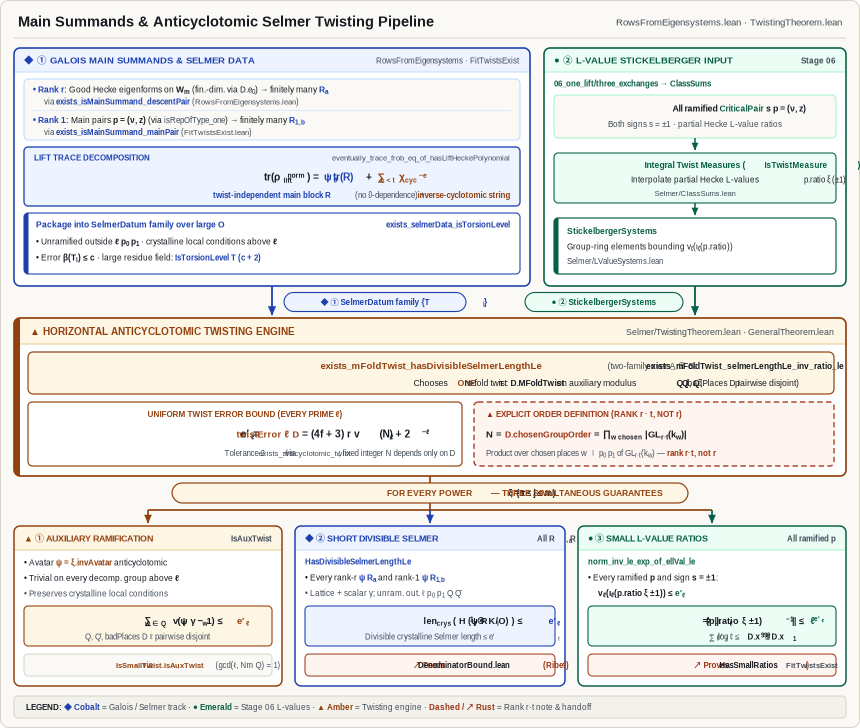
Choosing one finite-order anticyclotomic m-fold twist tau on auxiliary places Q so that all powers xi = tau^j (1 <= j <= m) simultaneously keep ramification, divisible crystalline Selmer lengths of finitely many main summands, and all ramified Hecke L-value ratio valuations within twistError l D = (4f + 3)r v_l(chosenGroupOrder) + 2^(-l).
Level 1 — First-Principles
For an untwisted theta lift, congruences between lifted forms and non-lifted forms can be large because the Galois cohomology group governing extensions between a fixed Galois main summandGalois main summand
Anticyclotomic Selmer twisting (New.Selmer.exists_mFoldTwist_hasDivisibleSelmerLengthLe) is the horizontal twisting engine that finds such a
- A finite list of Selmer data (
SelmerDatum): Each Selmer datum fixes an integral latticeinside over a large coefficient ring , unramified outside , equipped with crystalline local conditions above and a tame inertia generator at a chosen place acting by a scalar ( exists_selmerData_isTorsionLevel). - A finite list of Stickelberger systems (
StickelbergerSystem): Using Stage 06's three-exchange class-sum machinerycarrier form (imported viaSelmer/ClassSums.lean), each ramified critical pairis interpolated by an integral twist measure whose evaluations at tame twists produce a Stickelberger system of group-ring elements encoding the -adic valuations of .
Feeding both lists into the general horizontal twisting theorem (Selmer/GeneralTheorem.lean) chooses an auxiliary twist modulus
Specifically:
- Small auxiliary ramification (
IsAuxTwist):is trivial above , its auxiliary twist modulus avoids all bad places, and . - Short divisible crystalline Selmer groups (
HasDivisibleSelmerLengthLe): For every, there is an inertial element away from acting by a scalar ( a unit) such that over every large coefficient ring , the divisible crystalline Selmer group of —cocycles valued in , unramified outside , crystalline above , and vanishing at —has normalized length at most . - Small
-value ratio valuations: For every ramified pair and sign , , so its inverse has -adic norm at most , directly feeding HasSmallRatiosin global arithmetic heightarithmetic height.
Limits of the intuition
Calling this "killing the Selmer group by twisting" overstates what is proved and obscures where the twist error comes from. The constant
Level 2 — Undergrad Bridge
src/New/Congruences/Selmer/TwistingTheorem.lean (11 declarations, 1 let-type stub truncation) bridges Selmer/GeneralTheorem.lean and Selmer/LValueSystems.lean (which imports 06_one_lift/three_exchanges via Selmer/ClassSums.lean) to FitTwistsExist.lean:
- Packaging main summands (
exists_selmerData_isTorsionLevel): Picks a chosen placeand its tame inertia generator . Over a sufficiently large O : CoeffRing ℓ, eachR isatisfyingIsMainSummandLikereceives aSelmerDatumT iunramified outsidewith crystalline local conditions ( crysRelations), normalized error termO.normLength (T i).β ≤ cwherec = (4 * D.f + 3) * D.r * padicValNat ℓ D.chosenGroupOrder, andIsTorsionLevel T (c + 2)(so the residue field ofhas strictly more than elements). - Transferring Selmer length bounds (
mapRel_crysRelations_subset,divisibleSelmerLength_le_divisibleLength,SelmerDatum.apply_γ_eq_one,SelmerDatum.TwistedLengthLe.hasDivisibleSelmerLengthLe): Becauseis trivial on the decomposition groups above and on , crystalline relations push forward cleanly under extension of scalars and twisting by , turning T.TwistedLengthLe Q ψ bintoHasDivisibleSelmerLengthLe ψ R Q T.γ b. - Simultaneous
-fold twisting ( IsSmallTwist.isAuxTwist,four_mul_ellVal_levelPrime_sub_one_add_le_twistError,exists_mFoldTwist_hasDivisibleSelmerLengthLe): Applyingexists_anticyclotomic_twistwith toleranceproduces whose first powers satisfy IsAuxTwist,HasDivisibleSelmerLengthLe, andellVal (ιℓ (p.ratio ξ s)) ≤ twistError ℓ Dsimultaneously for all, all , and all ramified pairs . - Two-family wrapper (
FitTwistsExist.lean::exists_mFoldTwist_selmerLengthLe_inv_ratio_le): Takes the disjoint unionof rank- main summands and rank- main summands , invokes exists_mFoldTwist_hasDivisibleSelmerLengthLe, and convertsellVal ≤ twistErrorvianorm_inv_le_exp_of_ellVal_leinto‖ι.ιℓ (p.ratio ϑ s)⁻¹‖ ≤ exp (twistError ℓ D * log ℓ).
Level 3 — Formal Lean Contract
Five verified anchors span skeleton/07_congruences/twisting_theorem.lean (11 declarations, 1 let-type stub truncation) and skeleton/07_congruences/fit_twists_exist.lean (1 let-type stub truncation):
07_congruences/twisting_theorem.lean#New.Selmer.IsSmallTwist.isAuxTwist(upstreamTwistingTheorem.lean:118-145).07_congruences/twisting_theorem.lean#New.Selmer.SelmerDatum.TwistedLengthLe.hasDivisibleSelmerLengthLe(upstreamTwistingTheorem.lean:189-240).07_congruences/twisting_theorem.lean#New.Selmer.exists_selmerData_isTorsionLevel(upstreamTwistingTheorem.lean:294-345).07_congruences/twisting_theorem.lean#New.Selmer.exists_mFoldTwist_hasDivisibleSelmerLengthLe(skeleton decl L172, truncated atlet ξ : D.Twist :=on L177; complete conclusion from upstreamTwistingTheorem.lean:377-386):lean∃ τ : D.MFoldTwist, ∀ j : D.LiftIndex, let ξ : D.Twist := τ.powTwist j IsAuxTwist (badPlaces D ℓ) ξ.Q ξ.invAvatar (twistError ℓ D) ∧ (∀ i : I, ∃ γ : AbsGal D, HasDivisibleSelmerLengthLe ξ.invAvatar (R i) ξ.Q γ (twistError ℓ D)) ∧ ∀ (p : D.CriticalPair) (s : ℤˣ), p.IsRamified → ellVal (ιℓ (p.ratio ξ s)) ≤ twistError ℓ D07_congruences/fit_twists_exist.lean#New.Selmer.exists_mFoldTwist_selmerLengthLe_inv_ratio_le(skeleton decl L183, truncated atlet ϑ : D.Twist :=on L189; complete conclusion from upstreamFitTwistsExist.lean:387-395, quoted verbatim in Ribet Denominators and Regular Twists).
See the page's live <VerificationBanner /> (audit/verification-status.json) for the pinned upstream commit and local Lean build status (build_status: unverified-locally).
Where this analogy breaks
Thinking of anticyclotomic Selmer twisting as killing every Selmer group completely to zero is slightly too strong: local inertia at the chosen level primes p_0, p_1 leaves an irreducible floor bounded by (4f + 3) r v_l(D.chosenGroupOrder) (where chosenGroupOrder is the product over chosen places of |GL_{r*t}(k_w)|, not |GL_r|), plus an exponentially tiny tail 2^(-l), which is still tiny enough to be negligible when summed over all primes l.
Formal Lean Anchors
lemma New.Selmer.IsSmallTwist.isAuxTwist — Upstream source (src/New/Congruences/Selmer/TwistingTheorem.lean L118-L145)
/-- Let `S₀` be a finite set of places of `E` containing those above `ℓ`, and let `Q` be auxiliary
for `S₀`: its places have prime norm, and `Q`, its conjugate `Q̄` and `S₀` are pairwise disjoint.
Let `ψ` satisfy `IsSmallTwist T Y ε Q ψ`, the list of conclusions of `exists_anticyclotomic_twist`
for Galois lattices with local conditions `T i` and families `Y k` of group ring elements, both
attached to `S₀` and `g₀ ∈ Gal(Ω/E)`. Only two clauses are used, which involve neither `T` nor `Y`:
`ψ` comes by `x ↦ x / x̄` from an idele class character of modulus `Q` trivial above `ℓ`, and the
valuations of `ψ γ_w - 1` for tame inertia generators `γ_w`, `w ∈ Q ∪ Q̄`, have sum at most `ε`.
Then `IsAuxTwist S₀ Q ψ ε` holds: `Q` is auxiliary for `S₀` and prime to `ℓ`, `ψ` has the form
above, and the sum of these valuations over `w ∈ Q` is at most `ε`. -/
lemma New.Selmer.IsSmallTwist.isAuxTwist {S₀ Q : Finset (FinPlace E)} {g₀ : Gal(Ω/E)} {ι κ : Type}
    {r : ι → Type} [∀ i : ι, Fintype (r i)] [∀ i : ι, DecidableEq (r i)]
    {T : ∀ i : ι, SelmerDatum ℓ S₀ g₀ O (r i)} {Y : κ → StickelbergerSystem ℓ S₀ g₀} {ε : ℝ≥0}
    {ψ : Gal(Ω/E) →* PadicAlgCl ℓ} (hψ : IsSmallTwist T Y ε Q ψ) (hS₀ : placesDividing E ℓ ⊆ S₀)
    (hQ : IsAuxiliary S₀ Q) :
    IsAuxTwist S₀ Q ψ ε := by
  sorry -- [EXTRACTED_STUB upstream=src/New/Congruences/Selmer/TwistingTheorem.lean:118-145 commit=41c2716658c42ba08eb0648994a2efe83082a95c body_lines=14 body_sha256=973a2aedc9e49ab42e1523d9c7444345b81bf77ca83b86a83244866e26764bb5]
lemma New.Selmer.SelmerDatum.TwistedLengthLe.hasDivisibleSelmerLengthLe — Upstream source (src/New/Congruences/Selmer/TwistingTheorem.lean L189-L240)
/-- Let `D` be admissible data, with CM field `D.E`, primes `p₀, p₁` and level `D.N`;
`badPlaces D ℓ` is the set of places dividing `ℓ p₀ p₁ D.N`. Let `R` be an `ℓ`-adic representation
of the Galois group of `D.E`, and `T` a Selmer datum over `O` whose representation `T.ρ` is
conjugate to `R` over `ℚ̄_ℓ`, whose places are those above `ℓ p₀ p₁` and whose local conditions are
the crystalline ones; the inertial element `T.γ` acts by the scalar `T.ζ`. Let the places of `Q`
have prime norm, with `Q`, `Q̄` and the bad places pairwise disjoint, and let `ψ` come by
`x ↦ x / x̄` from an idele class character of modulus `Q` trivial above `ℓ`. Suppose that for all
large coefficient rings `O' ⊇ O` the character `ψ` has values in `O'` and `Sel_Q(T ψ)` has length at
most `b`, where `O' / ℓ` has length `1`. Then for all large `O'` there is a lattice in `ψ R` on
which `T.γ` acts by `T.ζ` and whose crystalline Selmer group for `Q` and `T.γ` has length at most
`b`. -/
lemma New.Selmer.SelmerDatum.TwistedLengthLe.hasDivisibleSelmerLengthLe {ℓ : ℕ} [ThePrime ℓ] {P : Parameters}
    {D : Data P} {n : Type} [Fintype n] [DecidableEq n]
    {O : CoeffRing ℓ} {g₀ : AbsGal D} {T : SelmerDatum ℓ (badPlaces D ℓ) g₀ O n}
    {Q : Finset (FinPlace D.E)} {ψ : AbsGal D →* PadicAlgCl ℓ} {b : ℝ≥0∞}
    (hT_length : T.TwistedLengthLe Q ψ b) {R : GalRep ℓ D.E n} (h_lattice : IsLatticeIn R T.ρ)
    (hT_places : (T.places : Set (FinPlace D.E)) = placesDividing D.E ℓ ∪ placesAboveM D)
    (hT_crys : T.localRelations = crysRelations T.ρ) (hQ : IsAuxiliary (badPlaces D ℓ) Q)
    (hψ : IsFromU1 (placesDividing D.E ℓ) Q ψ) :
    HasDivisibleSelmerLengthLe ψ R Q T.γ b := by
  sorry -- [EXTRACTED_STUB upstream=src/New/Congruences/Selmer/TwistingTheorem.lean:189-240 commit=41c2716658c42ba08eb0648994a2efe83082a95c body_lines=33 body_sha256=cf8f57239914c70e43f6446b30df00cdb68f8cd4b5262a57e1ef37fffc572b32]
lemma New.Selmer.exists_selmerData_isTorsionLevel — Upstream source (src/New/Congruences/Selmer/TwistingTheorem.lean L294-L345)
/-- Let `D` be admissible data, with CM field `D.E` and primes `p₀, p₁`, and let `badPlaces D ℓ` be
the places dividing `ℓ p₀ p₁ D.N`. Fix an isomorphism `ℂ ≃ ℚ̄_ℓ` and finitely many `ℓ`-adic
representations `R i` of the Galois group of `D.E` that satisfy `IsMainSummandLike`. Let `w` be a
chosen place, that is, one dividing the factor `D.piM` of `p₀ p₁`, prime to `ℓ`. Let
`c = (4 f + 3) · D.r · v(D.chosenGroupOrder)`, where `f = D.f` is the number of infinite places of
`D.E`, `v` is the `ℓ`-adic valuation and `D.chosenGroupOrder` is the product of the orders of
`GL (D.r * D.t)` over the residue fields of the chosen places. Over some coefficient ring `O` every
`R i` has a lattice that carries a Selmer datum `T i` for the bad places and a generator `g₀` of
tame inertia at `w`. It is unramified outside `ℓ p₀ p₁` and its local conditions are the crystalline
ones. Its error term `(T i).β`, a sum of a global term and of local terms among which is the
valuation of `det((T i).ρ g₀ - 1)`, is at most `c` when `O / ℓ` is given length `1`. Finally
`IsTorsionLevel T (c + 2)` holds: `c + 2` exceeds each such `β` by more than `1`, and the residue
field of `O` has more than `2 rank(T i) len(O / ℓ ^ (c + 2)) + 1` elements. -/
lemma New.Selmer.exists_selmerData_isTorsionLevel {ℓ : ℕ} [ThePrime ℓ] {P : Parameters} {D : Data P}
    [PadicIso ℓ] {I : Type} [Finite I] {r : I → Type}
    [∀ i : I, Fintype (r i)] [∀ i : I, DecidableEq (r i)] {R : ∀ i : I, GalRep ℓ D.E (r i)}
    (hR : ∀ i : I, ∃ (t : ℕ) (J : (D.E →+* ℂ) → Multiset ℤ), IsMainSummandLike D t J (R i))
    {w : FinPlace D.E} (hw : D.IsChosen w) (hwℓ : w ∈ placesAboveM D \ placesDividing D.E ℓ)
    {c : ℕ} (hc : c = (4 * D.f + 3) * D.r * padicValNat ℓ D.chosenGroupOrder) :
    ∃ (O : CoeffRing ℓ) (T : ∀ i : I,
        SelmerDatum ℓ (badPlaces D ℓ) w.isPlaceOver_placeOver.tameGenerator O (r i)),
      (∀ i : I, IsLatticeIn (R i) (T i).ρ) ∧
      (∀ i : I, ((T i).places : Set (FinPlace D.E)) = placesDividing D.E ℓ ∪ placesAboveM D) ∧
      (∀ i : I, (T i).localRelations = crysRelations (T i).ρ) ∧
      (∀ i : I, O.normLength (T i).β ≤ c) ∧
      IsTorsionLevel T (c + 2) := by
  sorry -- [EXTRACTED_STUB upstream=src/New/Congruences/Selmer/TwistingTheorem.lean:294-345 commit=41c2716658c42ba08eb0648994a2efe83082a95c body_lines=27 body_sha256=fa166d738add3d7bae88ed684b07d12b7a835869bbcb1264156dacd69b0aea64]
theorem New.Selmer.exists_mFoldTwist_hasDivisibleSelmerLengthLe — Upstream source (src/New/Congruences/Selmer/TwistingTheorem.lean L349-L452)
/-- The twisting theorem. Let `D` be admissible data for the parameters `P` (a modulus and the field
`K = ℚ(√-d)`), with CM field `D.E`, primes `p₀, p₁` and level `D.N`. The bad places are those
dividing `ℓ p₀ p₁ D.N`; the chosen places are those dividing the factor `D.piM` of `p₀ p₁` from `K`.
Fix an isomorphism `ιℓ : ℂ ≃ ℚ̄_ℓ` (the datum `ι`) and finitely many `ℓ`-adic representations `R i`
of the Galois group of `D.E` that satisfy `IsMainSummandLike D t J` for some `t` and `J`:
`R^c ≅ R^∨(1 - t)`, `J` gives the jumps at the complex embeddings, the image is large and inertia
above `p₀ p₁` is controlled. Let
`e'_ℓ = twistError ℓ D = (4 D.f + 3) D.r v(D.chosenGroupOrder) + 2 ^ (-ℓ)`, with `v` the `ℓ`-adic
valuation. Then there is a character `τ` of `U(1)(𝔸)` of weight `0`, tamely ramified on a finite set
`Q` of places, such that each power `ξ = τ ^ j` with `1 ≤ j ≤ D.m` is ramified at every place of
`Q = ξ.Q` (`D.MFoldTwist`) and satisfies:
* the `ℓ`-adic Galois character `ψ = ξ.invAvatar` attached to `ξ⁻¹` is anticyclotomic and trivial
  above `ℓ`; the places of `Q` have prime norm, and `Q`, `Q̄` and the bad places are pairwise
  disjoint; `∑ v(ψ γ_w - 1) ≤ e'_ℓ` for some tame inertia generators `γ_w`, `w ∈ Q`;
* for each `i` there are an inertial element `γ` away from `ℓ` and a scalar `ζ`, with `ζ - 1` a
  unit, such that over all large coefficient rings `O` the element `γ` acts by `ζ` on a lattice in
  `ψ R i`, and the module of cocycles with coefficients in `Frac(O) / O` that are unramified outside
  `ℓ p₀ p₁`, `Q`, `Q̄`, crystalline above `ℓ` and zero at `γ` has length at most `e'_ℓ` (`O / ℓ` has
  length `1`);
* for each pair `p = (ν, z)` of a character `ν` of `U(1)(𝔸)` of weight `-c` and an integer
  `1 ≤ z ≤ D.t` with `z ≤ c ≤ 4 D.b`, the tame part of `ν` being non-trivial exactly at the chosen
  places, and each sign `s = ±1`, the image under `ιℓ` of `|L(z, (ν ξ^s)⁻¹)| / |L(z, ν⁻¹)|` has
  valuation at most `e'_ℓ`. The Euler factors at the chosen places, in the numerator also at `Q`,
  and at their conjugates are omitted. -/
theorem New.Selmer.exists_mFoldTwist_hasDivisibleSelmerLengthLe {P : Parameters} (D : Data P) (ℓ : ℕ)
    [ThePrime ℓ] (ι : PadicIso ℓ) {I : Type} [Finite I] {r : I → Type} [∀ i : I, Fintype (r i)]
    [∀ i : I, DecidableEq (r i)] {R : ∀ i : I, GalRep ℓ D.E (r i)}
    (hR : ∀ i : I, ∃ (t : ℕ) (J : (D.E →+* ℂ) → Multiset ℤ), IsMainSummandLike D t J (R i)) :
    ∃ τ : D.MFoldTwist, ∀ j : D.LiftIndex,
      let ξ : D.Twist := by
  sorry -- [EXTRACTED_STUB upstream=src/New/Congruences/Selmer/TwistingTheorem.lean:349-452 commit=41c2716658c42ba08eb0648994a2efe83082a95c body_lines=75 body_sha256=3a54849ae0dc14c0226bb1e77184cc0e43eda35f8db098d7e41c53bbe11aae0e]
lemma New.Selmer.exists_mFoldTwist_selmerLengthLe_inv_ratio_le — Upstream source (src/New/Congruences/FitTwistsExist.lean L361-L408)
/-- **The twisting theorem for two families of main summands.** Let `ℓ` be a prime,
`ι : ℂ ≃ ℚ̄_ℓ`, and `e = twistError ℓ D = (4 f + 3) r v_ℓ(D.chosenGroupOrder) + 2 ^ (-ℓ)`, where
`f` is the number of infinite places of `D.E` and `D.chosenGroupOrder` the order of a product of
general linear groups over residue fields. Let `R a` and `R₁ b` be finitely many Galois
representations of rank `r` and one, each satisfying the conditions `IsMainSummandLike` on main
summands for some self-duality parameter `t` and some multisets `J` of Hodge–Tate jumps. There is a
twist `τ`, whose tame part has nontrivial powers up to `m` at each place of its modulus
(`MFoldTwist`), such that each power `ϑ = τ ^ j`, `1 ≤ j ≤ m`, has the following properties, where
`ψ = ϑ.invAvatar` is the `ℓ`-adic Galois character of `ϑ⁻¹`.
* The modulus `ϑ.Q` is auxiliary for the places dividing `ℓ p₀ p₁ N`, for the two level primes
  `p₀, p₁` and the level `N` (`badPlaces`): its places have prime norm, avoid these places and
  their conjugates, and no two are conjugate. The character `ψ` comes from the norm-one torus, and
  the valuations of `ψ σ - 1`, for tame generators `σ` at the places of `ϑ.Q`, sum to at most `e`
  (`IsAuxTwist`).
* For each given representation, some Galois element `γ` acts on a lattice in its twist by `ψ` as a
  scalar `ζ`, and the crystalline Selmer group of that lattice with coefficients in `Frac O / O`
  has length at most `e`, normalised so that `O / ℓ` has length one, for all large coefficient
  rings `O` (`HasDivisibleSelmerLengthLe`).
* For each pair `p = (ν, z)` ramified exactly at the chosen places and each sign `s`, the inverse of
  `p.ratio ϑ s = |L(z, (ν ϑ ^ s)⁻¹)| / |L(z, ν⁻¹)|`, a ratio of partial `L`-values, has norm at most
  `ℓ ^ e` at `ι`. -/
lemma New.Selmer.exists_mFoldTwist_selmerLengthLe_inv_ratio_le {P : Parameters} (D : Data P) {ℓ : ℕ}
    [ThePrime ℓ] (ι : PadicIso ℓ) {A B : Type} [Finite A] [Finite B]
    {R : A → GalRep ℓ D.E D.RowIndex} {R₁ : B → GalRep ℓ D.E Unit}
    (hR : ∀ a : A, ∃ (t : ℕ) (J : (D.E →+* ℂ) → Multiset ℤ), IsMainSummandLike D t J (R a))
    (hR₁ : ∀ b : B, ∃ (t : ℕ) (J : (D.E →+* ℂ) → Multiset ℤ), IsMainSummandLike D t J (R₁ b)) :
    ∃ τ : D.MFoldTwist, ∀ j : D.LiftIndex,
      let ϑ : D.Twist := by
  sorry -- [EXTRACTED_STUB upstream=src/New/Congruences/FitTwistsExist.lean:361-408 commit=41c2716658c42ba08eb0648994a2efe83082a95c body_lines=21 body_sha256=44efb89fe62d1ce2d4120e132f11dd79986bbf7aa8f81a90c8ac43f3a7ac06d0]
Related Concepts
- Galois main summand — The fixed, twist-independent rank-r (or rank-1) l-adic Galois representation R extracted from a Hecke eigensystem whose trace, after twisting by theta^(-1) and adding the inverse-cyclotomic string sum_{e < t} chi_cyc^(-e), matches every twisted theta lift.
- regular twist family — A prime-by-prime family of m-fold anticyclotomic twists theta(iota) with modulus coprime to l, inverse L-value ratios of height at most x_1, and lift/projection denominators summing within fa(log b)^3 / (m*k).
- Hecke L-value ratio — The ratio |L^S(z, (nu * theta^s)^-1)| / |L^S(z, nu^-1)| of twisted to untwisted partial Hecke L-values at a critical pair (nu, z), tracking how Siegel–Weil exchange constants scale under twisting across chain quotients and grid turns.
- carrier form — The fixed, nonzero, full-level holomorphic theta lift of 1 from U(0, m) to U(2m, m) onto which the first two Siegel–Weil exchanges collapse a twisted class sum, letting a third exchange turn the entire twist dependence into a scalar c(theta) controlled by the raw Hecke value product Gamma_j(theta).
- arithmetic height — A logarithmic measure combining ordinary archimedean size with prime-by-prime p-adic divisibility, locked together by the product formula so a nonzero algebraic quantity cannot be simultaneously small at every place.
Referenced By
- Stage: First-Order Ribet Denominator Bounds and Existence of Regular Twist Families
- Stage: Galois Main Summands and the Anticyclotomic Selmer Twisting Theorem
- Stage: Stage 07 — Lower Bound: Congruences & Galois Representations (Theorem C, Part 3)
- Concept: crystalline dual defect
- Concept: Ribet clearing operator
Authoritative Sources
- Diophantine stability (paper) — B. Mazur & K. Rubin, Amer. J. Math. 140 (2018), 571–616.
- Anticyclotomic twists of Selmer groups (reference) — D. Kriz & A. Nordentoft, arXiv:2305.00297 (2023).
- Non-vanishing modulo p of Hecke L-values (paper) — H. Hida, in Geometric Aspects of Dwork Theory, Vol. II, de Gruyter (2004), 735–784.
Page Glossary
- Galois main summand
- The fixed, twist-independent rank-r (or rank-1) l-adic Galois representation R extracted from a Hecke eigensystem whose trace, after twisting by theta^(-1) and adding the inverse-cyclotomic string sum_{e < t} chi_cyc^(-e), matches every twisted theta lift.
- regular twist family
- A prime-by-prime family of m-fold anticyclotomic twists theta(iota) with modulus coprime to l, inverse L-value ratios of height at most x_1, and lift/projection denominators summing within f*a*(log b)^3 / (m*k).
- Hecke L-value ratio
- The ratio |L^S(z, (nu * theta^s)^-1)| / |L^S(z, nu^-1)| of twisted to untwisted partial Hecke L-values at a critical pair (nu, z), tracking how Siegel–Weil exchange constants scale under twisting across chain quotients and grid turns.
- carrier form
- The fixed, nonzero, full-level holomorphic theta lift of 1 from U(0, m) to U(2m, m) onto which the first two Siegel–Weil exchanges collapse a twisted class sum, letting a third exchange turn the entire twist dependence into a scalar c(theta) controlled by the raw Hecke value product Gamma_j(theta).
- arithmetic height
- A logarithmic measure combining ordinary archimedean size with prime-by-prime p-adic divisibility, locked together by the product formula so a nonzero algebraic quantity cannot be simultaneously small at every place.