Kloosterman sieve
Also known as: one-sided Poisson summation, Siegel's step, big cell, open reduction, band-limited kernel.
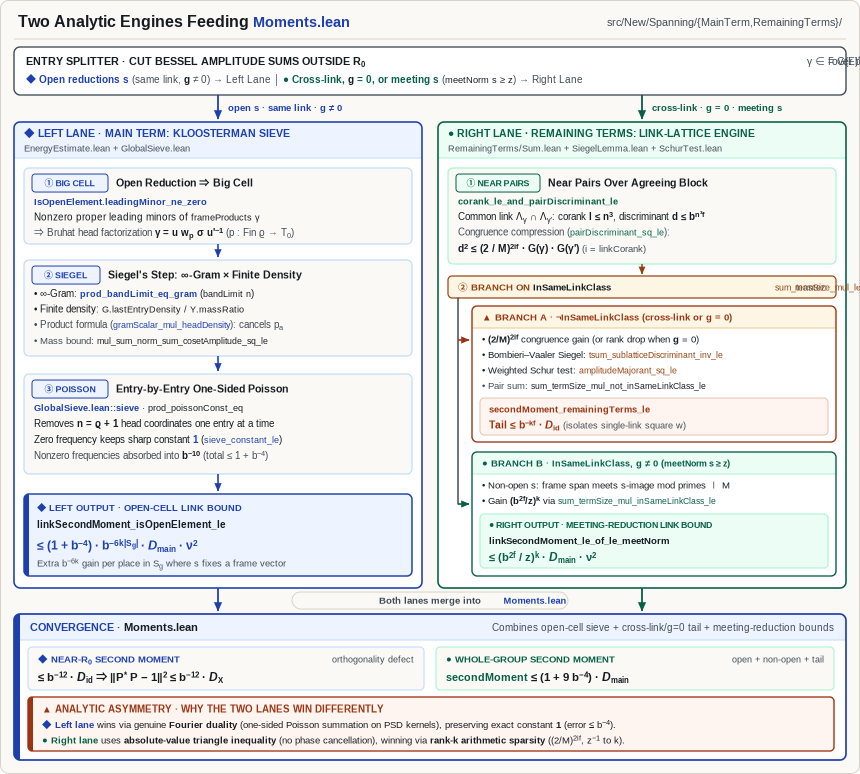
A global entry-by-entry one-sided Poisson summation engine pairing archimedean band-limited Bessel Gram matrices with finite Kloosterman densities to bound the big-cell second moment by (1 + b⁻⁴) b⁻⁶ᵏ|S_g| D_main ν².
Level 1 — First-Principles
When Stage 04 unfolds the second moment IsOpenElement.leadingMinor_ne_zero). Because Theorem B needs the second moment to overshoot the theoretical baseline
The Kloosterman sieve achieves that sharp constant in three coordinated stages:
- Siegel's step (
mul_sum_norm_sum_cosetAmplitude_sq_le): Every big-cell element factors as a Weyl head(indexed by a tuple of units plus a last entry ) times an element of the floor group. At the infinite places, the Gram matrix of weighted cut Bessel orbital integrals is dominated by a positive-semidefinite band-limited kernel bandLimit n(prod_bandLimit_eq_gram). At the finite places(covering the level primesprime number and auxiliary places), summing over cosets of the floor group via Siegel's mass formula replaces the global sum of squared coset amplitudes by a Hermitian pairing of bandLimit nagainst a finite-place Kloosterman densityG.lastEntryDensity. By the product formula equating archimedean sizes with finite-place moduli on unitsarithmetic height, all intermediate powers of the head unitscancel cleanly between the archimedean scalar and G.headDensity(gramScalar_mul_headDensity). - One-sided Poisson summation (
GlobalSieve.lean::sieve): Rather than evaluating the coupled sum over allhead coordinates at once, the sieve peels off one coordinate at a time. At each step, the positive-semidefinite kernel lets one-sided Poisson summation replace a discrete sum over -integral rational numbers by its zero-frequency integral (the next lower-order kernel in the SieveSystemhierarchy) plus a rapidly decaying sum over nonzero frequencies (frequencyDecay). - Collecting the sharp constant (
sieve_constant_lelinkSecondMoment_isOpenElement_le): After allcoordinates are removed, the product of the Poisson summation constants cancels the normalizing scalar , the infinite-place degree factors give , the finite-place mass gives (gaining a sharp decay factor for every place in where the reduction fixes a frame vector), and the nonzero-frequency tail is crushed by . The total open-cell second moment lands below , leaving non-open and cross-link terms to the common-link sublattice and weighted Schur test boundslink lattice.
Limits of the intuition
Picturing the Kloosterman sieve as standard Poisson summation on a box—where the zero mode gives the main term and higher modes oscillate away—captures why the leading constant comes out sharp (frameScaleSq v a = κ_v^{2(ϱ - a)} / N depends on the coordinate index GlobalSieve.lean must work with a multiplicative SieveSystem of nested positive-semidefinite kernels rather than a single Schwartz function. Second, linkSecondMoment_isOpenElement_le bounds only the cut Bessel function on open reductions with termDisc γ ≠ 0, grouped one link at a time; passing back to the full second moment over all RemainingTerms/Sum.lean and the cut-tail bounds in Moments.lean.
Level 2 — Undergrad Bridge
Classical spectral large sieves via Kloosterman sums (Deshouillers & Iwaniec 1982; Blomer & Buttcane 2020) and Jacquet's inductive Kloosterman transfer (Jacquet 2003) typically lose a constant factor or SieveSystem over the product of all infinite places and a finite set MainTerm/{SieveSystem,GlobalSieve,SiegelTopBound,EnergyEstimate}.lean).
1. Open reductions and the big Bruhat cell (IsOpenElement.leadingMinor_ne_zero)
For a rational element S.frameProducts γ are integral and reduce modulo each chosen place exists_leadingMinor_reduceAt_eq). Whenever S.IsOpenElement s—at some chosen place above
2. Siegel's step and product-formula cancellation (EnergyEstimate.lean:371–551)
Given a finite set
prod_bandLimit_eq_gram: Forwith last frame product , the product equals the Gram matrix Matrix.gram ℂof the cut Bessel orbital integrals at, each weighted by the archimedean scalar where ( ) and . gramScalar_mul_headDensity: Multiplyingby the finite-place modulus factor G.headDensity ϱcancels every power ofvia the global product formula ( ), leaving , where is independent of and . IsFillingData.mul_sum_norm_sum_cosetAmplitude_sq_le(Siegel's step): Grouping distinct classesby their last entry (with ) and applying SiegelTopBound.leanbounds
3. Global one-sided Poisson summation and constant assembly (GlobalSieve.lean, EnergyEstimate.lean)
The finite-place densities G.lastEntryDensity / Y.massRatio form a SieveSystem of mass at most Frames/FixedLines.lean, MainTerm/FiniteSieveSystem.lean). Multiplying by the archimedean bandLimit systems (mass GlobalSieve.lean::sieve yields
Using prod_poissonConst_eq to pull out scaledSiegelConst_mul_decayConst_le to absorb the error into one_add_pow_six_mul_add_pow_ten_le_one_add_pow_four (sieve_constant_le), dividing by sum_norm_sum_cosetAmplitude_sq_le and, summing over all links, New.Filling.linkSecondMoment_isOpenElement_le:
Level 3 — Formal Lean Contract
Stage 04 extracts the main-term energy estimate into skeleton/04_spanning/energy_estimate.lean (note that three intermediate let-in-type lemmas in that skeleton are truncated by rh-extract's depth-0 := splitter and are quoted in full from upstream src/New/Spanning/MainTerm/EnergyEstimate.lean:371–510 in the Stage 04 essay; all four anchors below are complete, untruncated declarations):
04_spanning/energy_estimate.lean#New.Filling.IsOpenElement.leadingMinor_ne_zero(upstreamsrc/New/Spanning/MainTerm/EnergyEstimate.lean:91-100):leanlemma New.Filling.IsOpenElement.leadingMinor_ne_zero {c c' : S.Classes} {s : S.ResidueGL} (hs : S.IsOpenElement s) {γ : S.G E} (hγ : γ ∈ S.termsOver c s c') (l : Fin 𝔰.n) : leadingMinor (S.frameProducts γ) l.castSucc ≠ 004_spanning/energy_estimate.lean#New.Filling.sieve_constant_le(upstreamsrc/New/Spanning/MainTerm/EnergyEstimate.lean:264-348):leanlemma New.Filling.sieve_constant_le [S.IsAdmissible] {kPred numSieved : ℕ} (hk : 𝔰.k = kPred + 1) (h_numSieved : numSieved ≤ Core.numInfPlaces E) : (1 + S.b⁻¹ ^ 6) * S.scaledSiegelConst * ((∏ i ∈ Finset.range 𝔰.n, S.poissonConst i) * ((∏ v : NumberField.InfinitePlace E, (1 + S.b⁻¹ ^ 10) / (S.besselSystem v).deg) * ((1 + S.b⁻¹ ^ 6) / (S.b ^ (6 * 𝔰.k)) ^ numSieved) + S.b ^ (2403 * 𝔰.n ^ 9 * Core.numInfPlaces E) * S.decayConst)) ≤ S.normalizingConst kPred ^ 2 * ((1 + (S.b ^ 4)⁻¹) * (S.b ^ (6 * 𝔰.k))⁻¹ ^ numSieved * S.mainSecondMoment * S.unipotentCovolume ^ 2)04_spanning/energy_estimate.lean#New.Filling.sum_norm_sum_cosetAmplitude_sq_le(upstreamsrc/New/Spanning/MainTerm/EnergyEstimate.lean:553-618):leanlemma New.Filling.sum_norm_sum_cosetAmplitude_sq_le [S.IsAdmissible] (Sg : Finset (S.chosenPlaces 0)) (D : ∀ w : S.chosenPlaces 0, S.FrameVector w) {ι : Type} [Fintype ι] {c c' : ι → S.Classes} {σ : ι → S.G E} {n : ι → S.latticeStabilizer} {t : ι → Eˣ} (h_inj : (fun i : ι ↦ (c i, c' i, S.reduction (n i), σ i)).Injective) (hσ : ∀ i : ι, σ i ∈ Shape.Form.floorGroup 𝔰.ϱ) (h_tail : ∀ i : ι, S.frameProducts (σ i) 𝔰.top 𝔰.top = t i) (h_large : ∀ (i : ι) (v : NumberField.InfinitePlace E), S.N ^ 2 < ‖Φ v (t i).val‖ ^ 2) (hn_fix : ∀ i : ι, S.reduction (n i) ∈ S.fixer Sg D) {T₀ : Finset Eˣ} (ht : ∀ i : ι, t i ∈ T₀) {T : Finset (FinPlace E)} [T.StarStable] (hT₀ : ∀ x ∈ T₀, x.val ∈ ratIntegralOff T ∧ x⁻¹.val ∈ ratIntegralOff T) [hT_M : Fact (S.ideleM⁻¹.val ∈ integralOff T)] (hT_basis : S.latticeBasis ∈ intGL 𝔰.BesselIndex (integralOff T)) (hT_N : (S.N : E)⁻¹ ∈ ratIntegralOff T) (h_off : ∀ i : ι, S.IsIntegralOff T (S.translateByClassReps (c i) (c' i) (σ i))) : ∑ i : ι, ‖∑ p : Fin 𝔰.ϱ → T₀, S.cosetAmplitude .cut (c i) (S.reduction (n i)) (c' i) (Floors.FloorGroups.weylElem 𝔰.ϱ (padTuple (fun a : Fin 𝔰.ϱ ↦ (p a).val) (t i)) * σ i)‖ ^ 2 ≤ (1 + (S.b ^ 4)⁻¹) * (S.b ^ (6 * 𝔰.k))⁻¹ ^ #Sg * S.mainSecondMoment * S.unipotentCovolume ^ 204_spanning/energy_estimate.lean#New.Filling.linkSecondMoment_isOpenElement_le(upstreamsrc/New/Spanning/MainTerm/EnergyEstimate.lean:620-685):leantheorem New.Filling.linkSecondMoment_isOpenElement_le [S.IsAdmissible] (Sg : Finset (S.chosenPlaces 0)) (D : ∀ w : S.chosenPlaces 0, S.FrameVector w) : linkSecondMoment {γ : S.G E | S.termDisc γ ≠ 0} {s : S.ResidueGL | s ∈ S.fixer Sg D ∧ S.IsOpenElement s} ≤ .ofReal ((1 + (S.b ^ 4)⁻¹) * (S.b ^ (6 * 𝔰.k))⁻¹ ^ #Sg * S.mainSecondMoment * S.unipotentCovolume ^ 2)
See the page's live <VerificationBanner /> (audit/verification-status.json) for the pinned upstream commit and local Lean build status (build_status: unverified-locally).
Where this analogy breaks
Picturing the Kloosterman sieve as ordinary Poisson summation over a rectangular grid where the zero frequency gives the main term and all nonzero frequencies cancel misses two decisive mechanisms: first, the sieve operates inductively one Bruhat head coordinate at a time (densitySum_succ_le_mul_densitySum_add in GlobalSieve.lean) using a positive-semidefinite band-limited majorant rather than an exact equality; second, finite-prime Kloosterman densities enter through Siegel's step (mul_sum_norm_sum_cosetAmplitude_sq_le), which requires the product formula to cancel the head powers p_a between the archimedean orbital-integral scalars and G.headDensity.
Formal Lean Anchors
lemma New.Filling.IsOpenElement.leadingMinor_ne_zero — Upstream source (src/New/Spanning/MainTerm/EnergyEstimate.lean L91-L100)
/-- If `s` is open, that is, at some chosen place above the first prime none of its proper leading
minors of frame products vanishes, then for every term `γ` over a block `(c, s, c')` no proper
leading minor of the frame products of `γ` vanishes: `γ` lies in the big cell. -/
lemma New.Filling.IsOpenElement.leadingMinor_ne_zero {c c' : S.Classes} {s : S.ResidueGL}
    (hs : S.IsOpenElement s) {γ : S.G E} (hγ : γ ∈ S.termsOver c s c') (l : Fin 𝔰.n) :
leadingMinor (S.frameProducts γ) l.castSucc ≠ 0 := by
sorry -- [EXTRACTED_STUB upstream=src/New/Spanning/MainTerm/EnergyEstimate.lean:91-100 commit=41c2716658c42ba08eb0648994a2efe83082a95c body_lines=5 body_sha256=d029e606f1cad6337b7022d2c89cdfe664b26a9c3f63291ac683d2e4d03f1265]lemma New.Filling.sieve_constant_le — Upstream source (src/New/Spanning/MainTerm/EnergyEstimate.lean L264-L348)
/-- Let `S` be admissible with size parameter `b`, `kPred = 𝔰.k - 1`, and let the number `numSieved`
of places at which vectors are fixed be at most `f`, the number of infinite places. The theorem
`sieve` bounds a sum of last entry densities over pairs of heads by `(∏ i, poissonConst i) * ((∏ v,
(1 + b⁻¹⁰) / deg v) * m + ε)`. Here `poissonConst i`, the constant of Poisson summation in entry
`i`, is vol(Ô) over the Jacobian of the scaling at the infinite places; `deg v` is the degree of the
Bessel system at `v`; `m` bounds the mass at the finite places; and
`ε = b^(2403 𝔰.n⁹ f) * decayConst` is the error, `decayConst` being the product of the constants in
the decay at the infinite places. For `m = (1 + b⁻⁶) / b^(6 𝔰.k numSieved)`, this bound times the
constant `(1 + b⁻⁶) * scaledSiegelConst` of Siegel's step is at most `r² (1 + b⁻⁴) b^(-6 𝔰.k
numSieved) * mainSecondMoment * unipotentCovolume²`, where `r = S.normalizingConst kPred` and
`mainSecondMoment = sourceDim² / ((∏ v, deg v) * mass)`, with the mass of the genus of the standard
Hermitian lattice of rank `𝔰.r`. -/
lemma New.Filling.sieve_constant_le [S.IsAdmissible] {kPred numSieved : ℕ} (hk : 𝔰.k = kPred + 1)
    (h_numSieved : numSieved ≤ Core.numInfPlaces E) :
    (1 + S.b⁻¹ ^ 6) * S.scaledSiegelConst *
        ((∏ i ∈ Finset.range 𝔰.n, S.poissonConst i) *
          ((∏ v : NumberField.InfinitePlace E, (1 + S.b⁻¹ ^ 10) / (S.besselSystem v).deg) *
              ((1 + S.b⁻¹ ^ 6) / (S.b ^ (6 * 𝔰.k)) ^ numSieved) +
            S.b ^ (2403 * 𝔰.n ^ 9 * Core.numInfPlaces E) * S.decayConst)) ≤
      S.normalizingConst kPred ^ 2 *
        ((1 + (S.b ^ 4)⁻¹) * (S.b ^ (6 * 𝔰.k))⁻¹ ^ numSieved * S.mainSecondMoment *
S.unipotentCovolume ^ 2) := by
sorry -- [EXTRACTED_STUB upstream=src/New/Spanning/MainTerm/EnergyEstimate.lean:264-348 commit=41c2716658c42ba08eb0648994a2efe83082a95c body_lines=64 body_sha256=e2d73ecdb833e64687b78264c5a9b50c7f188966d7f1eb958d4c9e44cf59b176]lemma New.Filling.sum_norm_sum_cosetAmplitude_sq_le — Upstream source (src/New/Spanning/MainTerm/EnergyEstimate.lean L553-L618)
/-- Let `S` be an admissible filling of shape `𝔰` over a CM field `E` with Weil data, with size
parameter `b = S.b`, and `Sg` a set of chosen places above the first level prime p₀
(`S.chosenPlaces 0`). Take finitely many distinct classes `(c i, S.reduction (n i), c' i, σ i)`
whose last entries `t i` lie in a finite set `T₀` of units off `T`, whose positions are integral off
`T` and whose reductions are in `S.fixer Sg D`. Here `σ i` is in the floor group, its last frame
product is `t i`, and ‖t i‖² > N² at every infinite place; `1 / M`, `1 / N`, the lattice basis and
its inverse are integral off `T`. The double coset sum `S.cosetAmplitude .cut c s c' γ` adds the
amplitudes of the cut Bessel function at `u γ u'⁻¹` over the rational unipotent `u`, `u'` for which
this element lies over `(c, s, c')`. These sums, added over the heads with entries in `T₀`, have
total square norm at most `(1 + b⁻⁴) b^(-6 𝔰.k |Sg|)` times
`mainSecondMoment = sourceDim² / (besselDegree * mass)` times `unipotentCovolume²`. -/
lemma New.Filling.sum_norm_sum_cosetAmplitude_sq_le [S.IsAdmissible] (Sg : Finset (S.chosenPlaces 0))
    (D : ∀ w : S.chosenPlaces 0, S.FrameVector w) {ι : Type} [Fintype ι] {c c' : ι → S.Classes}
    {σ : ι → S.G E} {n : ι → S.latticeStabilizer} {t : ι → Eˣ}
    (h_inj : (fun i : ι ↦ (c i, c' i, S.reduction (n i), σ i)).Injective)
    (hσ : ∀ i : ι, σ i ∈ Shape.Form.floorGroup 𝔰.ϱ)
    (h_tail : ∀ i : ι, S.frameProducts (σ i) 𝔰.top 𝔰.top = t i)
    (h_large : ∀ (i : ι) (v : NumberField.InfinitePlace E), S.N ^ 2 < ‖Φ v (t i).val‖ ^ 2)
    (hn_fix : ∀ i : ι, S.reduction (n i) ∈ S.fixer Sg D)
    {T₀ : Finset Eˣ} (ht : ∀ i : ι, t i ∈ T₀) {T : Finset (FinPlace E)} [T.StarStable]
    (hT₀ : ∀ x ∈ T₀, x.val ∈ ratIntegralOff T ∧ x⁻¹.val ∈ ratIntegralOff T)
    [hT_M : Fact (S.ideleM⁻¹.val ∈ integralOff T)]
    (hT_basis : S.latticeBasis ∈ intGL 𝔰.BesselIndex (integralOff T))
    (hT_N : (S.N : E)⁻¹ ∈ ratIntegralOff T)
    (h_off : ∀ i : ι, S.IsIntegralOff T (S.translateByClassReps (c i) (c' i) (σ i))) :
    ∑ i : ι, ‖∑ p : Fin 𝔰.ϱ → T₀, S.cosetAmplitude .cut (c i) (S.reduction (n i)) (c' i)
        (Floors.FloorGroups.weylElem 𝔰.ϱ (padTuple (fun a : Fin 𝔰.ϱ ↦ (p a).val) (t i)) *
          σ i)‖ ^ 2 ≤
      (1 + (S.b ^ 4)⁻¹) * (S.b ^ (6 * 𝔰.k))⁻¹ ^ #Sg * S.mainSecondMoment *
S.unipotentCovolume ^ 2 := by
sorry -- [EXTRACTED_STUB upstream=src/New/Spanning/MainTerm/EnergyEstimate.lean:553-618 commit=41c2716658c42ba08eb0648994a2efe83082a95c body_lines=37 body_sha256=3afe984e37324c52f99e852795d1c732e7d5a8d2870da26c4007b86fd80b0b80]theorem New.Filling.linkSecondMoment_isOpenElement_le — Upstream source (src/New/Spanning/MainTerm/EnergyEstimate.lean L620-L685)
/-- Let `S` be an admissible filling of shape `𝔰` over a CM field `E` with Weil data, `Sg` a set of
chosen places above the first level prime p₀, and `D w` a nonzero vector of the span of the frame
modulo `w` or modulo its conjugate. On the left, `linkSecondMoment` sums the squared norms of the
class sums of the cut function over all links, pairs of classes, and reductions `s` that are open
and fix `D w` for `w ∈ Sg`. With `X` the isotropic span of `e₁, …, e_ϱ`, the link of a term `γ` is
the module of pairs of classes in `X^⊥/X` of `t` and `γ⁻¹ t`, for `t` orthogonal to `X` and `γ X`;
each class sum runs over the terms of one link. Only terms `γ` with
`termDisc γ = |Δ|² - N² |Δ'|² ≠ 0` enter, where `Δ` is the determinant and `Δ'` the leading minor of
size ϱ of the frame products of `γ`. The bound is `(1 + b⁻⁴) b^(-6 𝔰.k |Sg|)` times
`mainSecondMoment = sourceDim² / (besselDegree * mass)` times `unipotentCovolume²`. Here `b` is the
size parameter of `S`, `𝔰.k` is the rank of X₀, `mass` is the mass of the genus of the standard
Hermitian lattice of rank `𝔰.r`, and `unipotentCovolume` is an explicit number which, if `E`
contains a primitive 5040th root of unity, is the integral of the cutoff `S.classCutoff c` over the
real unipotent group, for every class `c` (`lintegral_classCutoff_eq_unipotentCovolume`). -/
theorem New.Filling.linkSecondMoment_isOpenElement_le [S.IsAdmissible] (Sg : Finset (S.chosenPlaces 0))
    (D : ∀ w : S.chosenPlaces 0, S.FrameVector w) :
    linkSecondMoment {γ : S.G E | S.termDisc γ ≠ 0}
      {s : S.ResidueGL | s ∈ S.fixer Sg D ∧ S.IsOpenElement s} ≤
      .ofReal ((1 + (S.b ^ 4)⁻¹) * (S.b ^ (6 * 𝔰.k))⁻¹ ^ #Sg * S.mainSecondMoment *
S.unipotentCovolume ^ 2) := by
sorry -- [EXTRACTED_STUB upstream=src/New/Spanning/MainTerm/EnergyEstimate.lean:620-685 commit=41c2716658c42ba08eb0648994a2efe83082a95c body_lines=47 body_sha256=3b0372a0a8a8c603695b2e60d28eef62edc72a6774c7c0f3664e4a1f5d92a5ef]Related Concepts
- Bessel orbital integral — An archimedean correlation integral ∫ β_c(y) β_{c'}(γ⁻¹ y) W(y) ⊗ W(γ⁻¹ y)* dy unfolding Petersson inner products P* ρ(s) P into class-indexed amplitude blocks.
- link lattice — The Hermitian sublattice shared by two rational filling terms over one reduction block, whose discriminant and Bombieri–Vaaler Siegel's lemma counts crush cross-link and non-open terms via a weighted Schur test.
- prime number — A whole number greater than 1 whose only positive whole-number divisors are 1 and itself; every integer above 1 factors uniquely into a product of them.
- arithmetic height — A logarithmic measure combining ordinary archimedean size with prime-by-prime p-adic divisibility, locked together by the product formula so a nonzero algebraic quantity cannot be simultaneously small at every place.
Referenced By
- Stage: Relative-Trace Unfolding, Bessel Translates, and the Two Moment Bounds
- Stage: Stage 04 — Spanning: Second Moment (Theorem B)
- Stage: The Big-Cell Kloosterman Sieve and Remaining-Term Link Bounds
- Concept: Bessel orbital integral
- Concept: link lattice
Authoritative Sources
- Über die analytische Theorie der quadratischen Formen (paper) — C. L. Siegel, Ann. of Math. 36 (1935), 527–606.
- Smooth transfer of Kloosterman integrals (paper) — H. Jacquet, Duke Math. J. 120 (2003), 121–152.
- Kloosterman sums and Fourier coefficients of cusp forms (paper) — J.-M. Deshouillers & H. Iwaniec, Invent. Math. 70 (1982), 219–288.
- On the subconvexity problem for L-functions on GL(3) (paper) — V. Blomer & J. Buttcane, Ann. Sci. ÉNS 53 (2020), 1441–1500.
Page Glossary
- Bessel orbital integral
- An archimedean correlation integral ∫ β_c(y) β_{c'}(γ⁻¹ y) W(y) ⊗ W(γ⁻¹ y)* dy unfolding Petersson inner products P* ρ(s) P into class-indexed amplitude blocks.
- prime number
- A whole number greater than 1 whose only positive whole-number divisors are 1 and itself; every integer above 1 factors uniquely into a product of them.
- arithmetic height
- A logarithmic measure combining ordinary archimedean size with prime-by-prime p-adic divisibility, locked together by the product formula so a nonzero algebraic quantity cannot be simultaneously small at every place.
- link lattice
- The Hermitian sublattice shared by two rational filling terms over one reduction block, whose discriminant and Bombieri–Vaaler Siegel's lemma counts crush cross-link and non-open terms via a weighted Schur test.