seesaw duality
Also known as: seesaw dual pair, Bessel period, unfolded period.
A dual-pair adjunction identity that trades an iterated lower-chain theta lift of a Poincaré series for a nonzero twist-independent scalar times the restriction of an upper-chain composite theta lift.
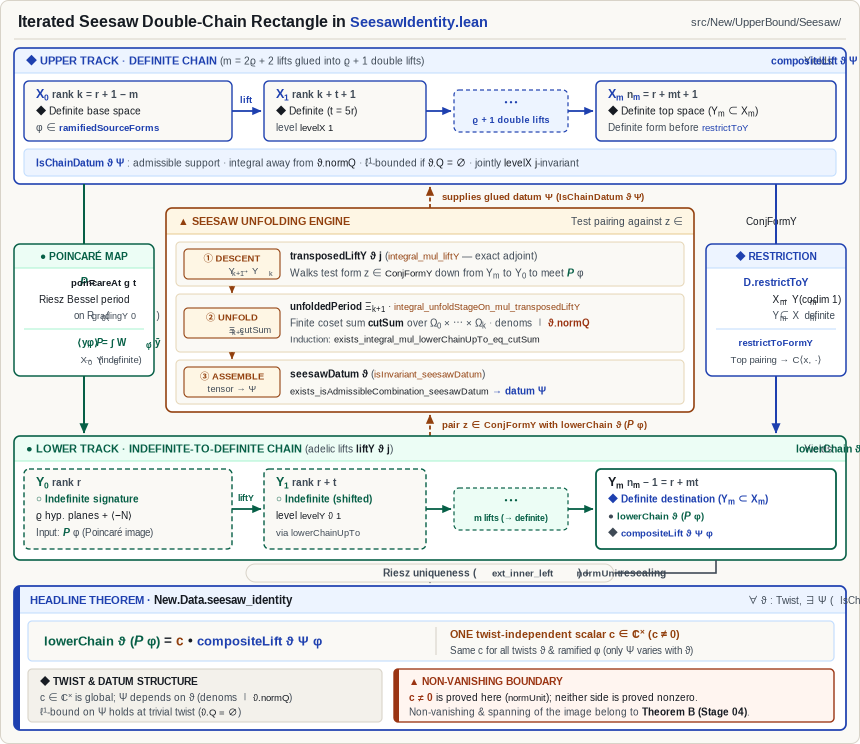
Level 1 — First-Principles
Imagine four unitary groups arranged at the four corners of a crossing diagram—a seesaw dual pair—where the left-hand column has a smaller group sitting inside a larger one (
In Stage 03, this idea is scaled up from a single crossing to a full double chain of
- Along the lower chain
, we start with a source form on , turn it into a Poincaré series on , and send it through consecutive lifts. This lower chain is the object that later stages pair against twists to extract global lower-bound information. - Along the upper chain
, we lift directly up the larger definite unitary groups and restrict to only at the very end. Because the upper chain stays on definite groups, Stage 03 can control both its geometric growth and its divisibility at every small non-split indivisible whole number prime number via moving-lattice -adic coordinate norms and Galois-conjugate size bounds on algebraic modular formsWeyl gauge, feeding the global balance between ordinary magnitude and prime-by-prime divisibilityarithmetic height.
How do we prove that the lower chain of a Poincaré series equals a scalar multiple of the restricted upper chain? We pair the lower chain with an arbitrary conjugate test form
One caveat is essential: the theorem seesaw_identity proves that the proportionality constant
Limits of the intuition
Picturing seesaw duality as a single one-step adjoint equation integral_unfoldStageOn_mul_transposedLiftY), keeping track of finite-place coset cuts (cutPoints, cutSum) and multiplicities at every rung of the ladder. Second, uniformity holds for the scalar seesaw_identity is strictly an equality of two linear maps up to a nonzero scalar
Level 2 — Undergrad Bridge
In Kudla's classical framework (Kudla 1984), a seesaw dual pair consists of two dual reductive pairs
Stage 03 executes this seesaw across a double chain of length lastGrading):
Unfolded periods (
unfoldedPeriod): Fix a tame character, a linear functional on values of forms on , a source form , and outer variables . For , a grading of with Bessel group , and a conjugate form , the -st unfolded period is the absolutely convergent integral ( integrable_unfoldStage_mul)where
is the function remaining on after unfolding steps. Iterated Bessel unfolding (
integral_unfoldStageOn_mul_transposedLiftY): At step, integrating the restricted function unfoldStageOnoveragainst the transposed descent of shifts the integral one rung up the ladder: At
, the Poincaré series unfolds into a sum over the finite cut points ( integral_mul_liftY_poincareAt). Repeating( exists_integral_mul_lowerChainUpTo_eq_cutSum) expresses the pairing ofwith lowerChainUpTo ϑ (2ϱ + 2) (𝒫 φ)as a twist-independent constant timescutSum, which aggregates the evaluated upper-chain tensors (evaluatedTensor) into the jointly level-invariant tensorseesawDatum ϑ(isInvariant_seesawDatum).Automorphic and algebraic seesaw (
exists_lowerChainUpTo_poincareAt_eq,seesaw_identity): At the final step( ), comparing against exists_integral_eq_mul_inner_restrictToFormYgives a twist-independent scalarsuch that for every tame character and every ramified source form , By
exists_isAdmissibleCombination_seesawDatum,seesawDatum ϑis an admissible linear combination of translated glued vacuum data scaled by a uniform constant. Passing from automorphic to algebraic forms ( lowerChain_eq_of_lowerChainUpTo_eq) yields the main seesaw identity: there exists a nonzero scalar(independent of and ) such that every twist admits a chain datum ( IsChainDatum ϑ Ψ) satisfyingfor all
. Note carefully the logical boundary: seesaw_identityguarantees, which makes the identity non-degenerate, but does not prove that either or is nonzero; non-vanishing is proved separately in Theorem B (Stage 04).
Level 3 — Formal Lean Contract
Stage 03 extracts the entire seesaw unfolding chain and final identity into skeleton/03_upper_bound/seesaw_identity.lean (from upstream src/New/UpperBound/Seesaw/SeesawIdentity.lean):
03_upper_bound/seesaw_identity.lean#New.Data.unfoldedPeriod(upstreamsrc/New/UpperBound/Seesaw/SeesawIdentity.lean:272-283):leandef New.Data.unfoldedPeriod (ϑ : D.TameChar) (t : (WeylIndex (D.X 0) D.columnCount → ℂ) →ₗ[ℂ] ℂ) (φ : D.SourceForm) (ξ : ∀ i : ℕ, GInf D.E (D.signsY i)) (y : ∀ i : ℕ, Gf D.E (D.Y i)) (k : ℕ) (hk : k ≤ 2 * D.ϱ + 1) {X : Type} {s : ℕ} [Fintype X] [DecidableEq X] (Y : Grading (D.spaceY (k + 1)) D.N X s) (z : D.ConjFormY (k + 1)) : ℂ03_upper_bound/seesaw_identity.lean#New.Data.integral_unfoldStageOn_mul_transposedLiftY(upstreamsrc/New/UpperBound/Seesaw/SeesawIdentity.lean:302-326):leanlemma New.Data.integral_unfoldStageOn_mul_transposedLiftY (ϑ : D.TameChar) (t : (WeylIndex (D.X 0) D.columnCount → ℂ) →ₗ[ℂ] ℂ) (φ : D.SourceForm) (ξ : ∀ i : ℕ, GInf D.E (D.signsY i)) (y : ∀ i : ℕ, Gf D.E (D.Y i)) {k : ℕ} (hk : k ≤ 2 * D.ϱ + 1) {X : Type} [Fintype X] [DecidableEq X] (Y : Grading (D.spaceY (k + 1)) D.N X (2 * D.ϱ + 1 - (k + 1))) (z : D.ConjFormY (k + 1)) : ∫ r : (gradingY k hk).besselGroup, unfoldStageOn ϑ t φ ξ y k hk r * transposedLiftY ϑ k z (r.val * (ξ k, y k)) ∂(D.gradingY k hk).besselMeasure = stdLevelIndex (levelY ϑ k) * unfoldedPeriod ϑ t φ ξ y k hk Y z03_upper_bound/seesaw_identity.lean#New.Data.exists_lowerChainUpTo_poincareAt_eq(upstreamsrc/New/UpperBound/Seesaw/SeesawIdentity.lean:540-585):leanlemma New.Data.exists_lowerChainUpTo_poincareAt_eq (t : (WeylIndex (D.X 0) D.columnCount → ℂ) →ₗ[ℂ] ℂ) (g : GInf D.E (D.signsY 0)) : ∃ c₀ : ℂ, ∀ (ϑ : D.TameChar) (φ : D.ramifiedSourceForms), lowerChainUpTo ϑ (2 * D.ϱ + 2) (D.poincareAt g t φ) = c₀ • restrictToFormY D.m_eq_two_mul_varrho_add_two (chainOfTensor ϑ φ (seesawDatum ϑ))03_upper_bound/seesaw_identity.lean#New.Data.seesaw_identity(upstreamsrc/New/UpperBound/Seesaw/SeesawIdentity.lean:617-665):leantheorem New.Data.seesaw_identity {P : Parameters} {D : Data P} (t : (WeylIndex (D.X 0) D.columnCount → ℂ) →ₗ[ℂ] ℂ) (g : GInf D.E (D.signsY 0)) : ∃ c : ℂˣ, ∀ ϑ : D.Twist, ∃ Ψ : D.Translations →₀ ℂ, IsChainDatum ϑ Ψ ∧ ∀ φ : D.ramifiedSourceForms, lowerChain ϑ (D.poincareAt g t φ) = (c : ℂ) • compositeLift ϑ Ψ φ
Observe the return type ∃ c : ℂˣ: Lean certifies that ϑ and φ, while deliberately making no claim that either lowerChain ϑ (D.poincareAt g t φ) or compositeLift ϑ Ψ φ is nonzero (non-vanishing is established separately in Theorem B / Stage 04). See the page's live <VerificationBanner /> (audit/verification-status.json) for the currently pinned upstream snapshot and local Lean build status (build_status: unverified-locally).
Where this analogy breaks
Picturing seesaw duality as a single one-step adjoint identity integral_unfoldStageOn_mul_transposedLiftY) and aggregating finite-place cut classes (cutSum) into a twisted tensor seesawDatum ϑ; the proportionality constant seesaw_identity is twist-independent whereas the upper-chain datum seesaw_identity proves
Formal Lean Anchors
def New.Data.unfoldedPeriod — Upstream source (src/New/UpperBound/Seesaw/SeesawIdentity.lean L272-L283)
/-- The integral `Ξ_{k+1}` of the product `𝒲_{k+1} z` over `R_{k+1}(F) \ G_{k+1}(𝔸)`, where
`𝒲_{k+1} = unfoldStage ϑ t φ ξ y k hk Y` is the function on `G_{k+1}` left by the first `k + 1`
steps of unfolding for the source form `φ`, the linear form `t` and the outer variables
`g_i = (ξ i, y i)`, and `R_{k+1}(F) = Y.ratBessel` consists of the rational points of the Bessel
group of `Y`. -/
def New.Data.unfoldedPeriod (ϑ : D.TameChar)
    (t : (WeylIndex (D.X 0) D.columnCount → ℂ) →ₗ[ℂ] ℂ) (φ : D.SourceForm)
    (ξ : ∀ i : ℕ, GInf D.E (D.signsY i)) (y : ∀ i : ℕ, Gf D.E (D.Y i))
    (k : ℕ) (hk : k ≤ 2 * D.ϱ + 1) {X : Type} {s : ℕ} [Fintype X] [DecidableEq X]
(Y : Grading (D.spaceY (k + 1)) D.N X s) (z : D.ConjFormY (k + 1)) : ℂ := by
sorry -- [EXTRACTED_STUB upstream=src/New/UpperBound/Seesaw/SeesawIdentity.lean:272-283 commit=41c2716658c42ba08eb0648994a2efe83082a95c body_lines=2 body_sha256=abfad6039a408b74e8c70979fb7e423cb701e93c0e7fcd93e5ee5b9017e16aa1]lemma New.Data.integral_unfoldStageOn_mul_transposedLiftY — Upstream source (src/New/UpperBound/Seesaw/SeesawIdentity.lean L302-L326)
/-- The recursion of the iterated unfolding, for the tame character `ϑ`, the source form `φ` on
`X_0`, the linear form `t` on its values and the outer variables `g_i = (ξ i, y i)`, points of
`U(Y_i)` split into archimedean and finite part. Let `k ≤ 2 ϱ + 1`, where `m = 2 ϱ + 2` is the
number of lifts, let `Y` be a grading of `Y_{k+1}`, and let `z` be a conjugate form on `Y_{k+1}`.
The function `unfoldStageOn` on the Bessel group `R_k` of the standard grading `D.gradingY k` is the
Bessel function of `φ` for `k = 0`, and for `k > 0` the function left by `k` steps of unfolding,
translated by `g_k`. Integrate it at `r ∈ [R_k]` times the descent of `z` at `r g_k`. The result is
the index of `levelY ϑ k` in the lattice stabiliser times `Ξ_{k+1}` (`unfoldedPeriod`): the integral
of `z` times the function left by `k + 1` steps over the quotient of `U(Y_{k+1})` by the rational
Bessel group of `Y`. -/
lemma New.Data.integral_unfoldStageOn_mul_transposedLiftY (ϑ : D.TameChar)
    (t : (WeylIndex (D.X 0) D.columnCount → ℂ) →ₗ[ℂ] ℂ) (φ : D.SourceForm)
    (ξ : ∀ i : ℕ, GInf D.E (D.signsY i)) (y : ∀ i : ℕ, Gf D.E (D.Y i))
    {k : ℕ} (hk : k ≤ 2 * D.ϱ + 1) {X : Type} [Fintype X] [DecidableEq X]
    (Y : Grading (D.spaceY (k + 1)) D.N X (2 * D.ϱ + 1 - (k + 1))) (z : D.ConjFormY (k + 1)) :
    ∫ r : (gradingY k hk).besselGroup,
      unfoldStageOn ϑ t φ ξ y k hk r * transposedLiftY ϑ k z (r.val * (ξ k, y k))
        ∂(D.gradingY k hk).besselMeasure =
stdLevelIndex (levelY ϑ k) * unfoldedPeriod ϑ t φ ξ y k hk Y z := by
sorry -- [EXTRACTED_STUB upstream=src/New/UpperBound/Seesaw/SeesawIdentity.lean:302-326 commit=41c2716658c42ba08eb0648994a2efe83082a95c body_lines=7 body_sha256=aebd9ab679e1a98bbecaa6eb7d6ed89ea9acea37b520892a4ac439ca680b1f50]lemma New.Data.exists_lowerChainUpTo_poincareAt_eq — Upstream source (src/New/UpperBound/Seesaw/SeesawIdentity.lean L540-L585)
/-- Fix an archimedean point `g` of `U(Y_0)` and a linear form `t`, and let `m = 2 ϱ + 2`. There is
a number `c₀` such that, for every tame character `ϑ` and every ramified source form `φ` on `X_0`,
the `m` lifts along `Y_0, …, Y_m` take the Poincaré series `D.poincareAt g t φ` to `c₀` times the
restriction to `Y_m` of the image of `φ` under the chain of lifts `X_0 → ⋯ → X_m` with twist `ϑ` and
tensor of finite data `seesawDatum ϑ`. -/
lemma New.Data.exists_lowerChainUpTo_poincareAt_eq (t : (WeylIndex (D.X 0) D.columnCount → ℂ) →ₗ[ℂ] ℂ)
    (g : GInf D.E (D.signsY 0)) :
    ∃ c₀ : ℂ, ∀ (ϑ : D.TameChar) (φ : D.ramifiedSourceForms),
      lowerChainUpTo ϑ (2 * D.ϱ + 2) (D.poincareAt g t φ) =
c₀ • restrictToFormY D.m_eq_two_mul_varrho_add_two (chainOfTensor ϑ φ (seesawDatum ϑ)) := by
sorry -- [EXTRACTED_STUB upstream=src/New/UpperBound/Seesaw/SeesawIdentity.lean:540-585 commit=41c2716658c42ba08eb0648994a2efe83082a95c body_lines=37 body_sha256=4452abd5dcc204e1a124850a874320a46b89ecf3ab976eedaf3970910164e381]theorem New.Data.seesaw_identity — Upstream source (src/New/UpperBound/Seesaw/SeesawIdentity.lean L617-L665)
/-- **Seesaw identity**. Let `D` be admissible data, with field `E = D.E`, number of lifts
`m = D.m`, and hermitian spaces `X_j` (upper chain) and `Y_j` over `E`. Let `t` be a linear form on
the values of forms on `X_0` and `g` an archimedean point of `U(Y_0)`. Then there is a number
`c ≠ 0` such that every twist `ϑ` has a chain datum `Ψ` with
`lowerChain ϑ (𝒫 φ) = c • compositeLift ϑ Ψ φ` for all ramified source forms `φ` on `X_0`, where
`𝒫 = D.poincareAt g t` is the Poincaré map from forms on `X_0` to forms on `Y_0`. The datum
`Ψ` is a finitely supported function on `D.Translations`, the tuples of finite adelic matrices, one
for each lift of the upper chain; its glued tensor is the sum of `Ψ x` times the vacuum data
translated by `x`, and `compositeLift ϑ Ψ` is the upper chain from `X_0` to `X_m` with this tensor
as data, restricted to `Y_m`. That `Ψ` is a chain datum (`IsChainDatum`) means that its support is
admissible and supported at the level, its values are integral away from the modulus of `ϑ` and
bounded if this is empty, and its glued tensor is invariant under the levels of the `X_j`. -/
theorem New.Data.seesaw_identity {P : Parameters} {D : Data P}
    (t : (WeylIndex (D.X 0) D.columnCount → ℂ) →ₗ[ℂ] ℂ) (g : GInf D.E (D.signsY 0)) :
    ∃ c : ℂˣ, ∀ ϑ : D.Twist, ∃ Ψ : D.Translations →₀ ℂ, IsChainDatum ϑ Ψ ∧
      ∀ φ : D.ramifiedSourceForms,
lowerChain ϑ (D.poincareAt g t φ) = (c : ℂ) • compositeLift ϑ Ψ φ := by
sorry -- [EXTRACTED_STUB upstream=src/New/UpperBound/Seesaw/SeesawIdentity.lean:617-665 commit=41c2716658c42ba08eb0648994a2efe83082a95c body_lines=33 body_sha256=2badaf8080327e7b09106b42a82ba163bb56d6f6270e5eb804d872670307e8b0]Related Concepts
- theta correspondence — An integral transform built from a two-variable theta kernel that carries automorphic forms from one unitary group to another, iterated along a ladder of Hermitian spaces and packaged via admissible chain data.
- Weyl gauge — The p-adic coordinate norm of an algebraic modular form measured in the g-twisted Weyl lattice, paired with Galois-conjugate archimedean bounds to define B-short spanning sets and ramified source forms.
- prime number — A whole number greater than 1 whose only positive whole-number divisors are 1 and itself; every integer above 1 factors uniquely into a product of them.
- arithmetic height — A logarithmic measure combining ordinary archimedean size with prime-by-prime p-adic divisibility, locked together by the product formula so a nonzero algebraic quantity cannot be simultaneously small at every place.
Referenced By
- Stage: Chain Determinant Factorization and Two-Grid Auxiliary Forms
- Stage: Short Ramified Columns & Archimedean Size Cancellation
- Stage: Siegel–Weil Exchange and the Commuting Theta Square
- Stage: Stage 03 — Upper Bound: A Composite Theta Lift (Theorem A)
- Stage: Stage 05 — Lower Bound: The Determinant (Theorem C, Part 1)
- Stage: Stage 06 — Lower Bound: One Lift (Theorem C, Part 2)
- Stage: The Iterated Seesaw Identity
- Stage: Three Exchanges, the Carrier Form, and Divided-Lattice Gluing
- Concept: auxiliary spanning form
- Concept: Bessel orbital integral
- Concept: divided-lattice gluing
- Concept: Siegel–Weil exchange
- Concept: theta correspondence
- Concept: theta square law
Authoritative Sources
- Seesaw dual reductive pairs (paper) — S. S. Kudla, Automorphic Forms of Several Variables, Progr. Math. 46 (1984).
- The Gross–Prasad conjecture and local theta correspondence (paper) — W. T. Gan & A. Ichino, Invent. Math. 206 (2016).
- Local theta lifting of generalized Whittaker models (paper) — R. Gomez & C.-B. Zhu, GAFA 24 (2014).
Page Glossary
- theta correspondence
- An integral transform built from a two-variable theta kernel that carries automorphic forms from one unitary group to another, iterated along a ladder of Hermitian spaces and packaged via admissible chain data.
- prime number
- A whole number greater than 1 whose only positive whole-number divisors are 1 and itself; every integer above 1 factors uniquely into a product of them.
- Weyl gauge
- The p-adic coordinate norm of an algebraic modular form measured in the g-twisted Weyl lattice, paired with Galois-conjugate archimedean bounds to define B-short spanning sets and ramified source forms.
- arithmetic height
- A logarithmic measure combining ordinary archimedean size with prime-by-prime p-adic divisibility, locked together by the product formula so a nonzero algebraic quantity cannot be simultaneously small at every place.