Stage 01 — The Theorem and Its Reduction
Stage 01 is the architectural bridge between the formal statement contracts of Stage 00 and the deep automorphic,
Level 1 — First-Principles
Finding every zero of a function across an entire two-dimensional plane looks hopeless if you try to hunt them one point at a time. Stage 01 trades that hunt for a much sharper target: controlling how far the distribution of whole numbers greater than
The bridge runs in four linked steps, reading from the final headline theorems back down to the core inequality:
- Mirror reflection to the right half-plane: Across the two-dimensional grid of points
combining a real horizontal coordinate and an imaginary vertical coordinatecomplex plane, each periodic multiplicative weight modulo Dirichlet character defines a global function built by extending Dirichlet L-function, with modulus giving the global function Riemann zeta function. As Stage 00 establishes, ruling out zeros anywhere strictly to the right of the central vertical line critical line automatically forces every zero inside the open vertical band critical strip onto the critical line by functional-equation symmetry. - One-sided prime bound to zero-free half-plane: Rather than bounding prime fluctuations from both sides, Stage 01 uses a classical analytic principle turning a one-sided ceiling on a weighted prime error into a zero-free vertical stripLandau's lemma. Specifically, Stage 01 weighs prime powers by the logarithmic weight
equal to on prime powers and elsewherevon Mangoldt function multiplied by a sign-flipping factor built from quadratic residues modulo an auxiliary prime quadratic twist that keeps every weight nonnegative. If the resulting smoothed prime remainder stays bounded above by a constant times for all large and every prime in a chosen residue class, then no Dirichlet L-function modulo vanishes with . - Two-cutoff reduction from the main inequality: The core engine does not isolate
directly; it bounds a combination pairing at a primary cutoff against remainders at a vastly larger second cutoff (with and ). Because is so huge relative to , the classical Prime Number Theorem crushes the remainders far below , leaving only the target ceiling on with a saving of from running a chain of lifts. - The three-way cancellation balance: Inside the main inequality, Stage 01 builds a vector space equipped with an ordinary inner product for sizes alongside prime-by-prime integrality rules across a family of character twiststwisted lattice. A family of
lifted target vectors has a combined squared volume measured by its squared parallelotope volume computed as the determinant of pairwise inner productsGram determinant, corrected by an index tracking the denominators needed to make those vectors integral. Three theorems then collide: - Theorem A (Shortness & Small Index): A spanning set of integral source forms maps into lifted target vectors whose ordinary lengths shrink whenever the prime remainder
is large, while their denominator index stays small. - Theorem B (Enough Translates): A small collection of group translates of those source forms spans almost the entire target space, supplying
linearly independent short vectors. - Theorem C (Longness): Powered by the global balance law stating that a nonzero algebraic number cannot simultaneously be tiny in ordinary size and divisible by huge prime powersarithmetic height, any spanning integral family has combined volume plus twice its index at least a large baseline called the main amount.
- Theorem A (Shortness & Small Index): A spanning set of integral source forms maps into lifted target vectors whose ordinary lengths shrink whenever the prime remainder
When Theorems A and B supply the upper ceiling and Theorem C supplies the lower floor on the same volume-plus-index quantity, the huge main amount cancels identically from both sides. What remains is an upper bound on
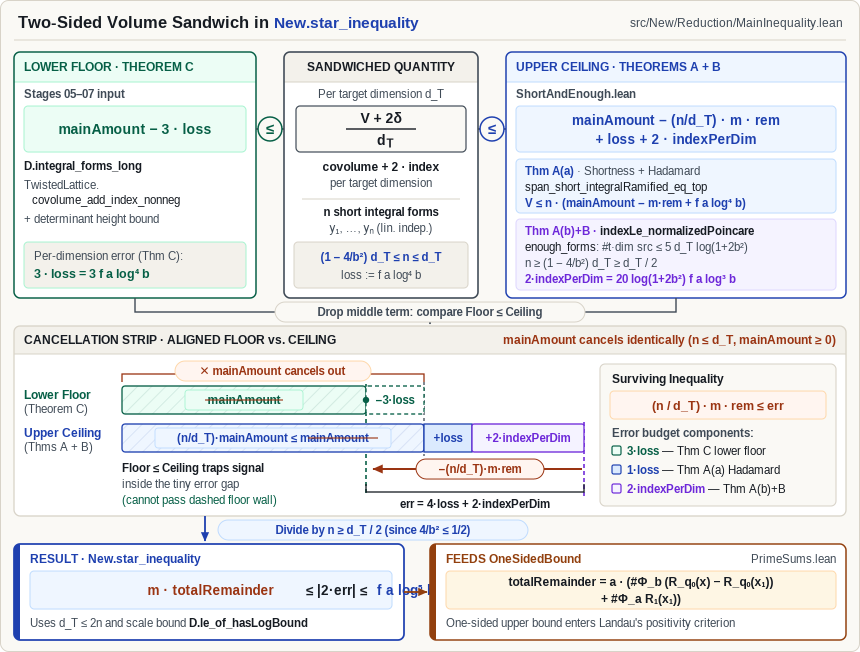
What Stage 01 proves in full versus what Stages 02–07 supply: Stage 01 proves the entire reduction shell end to end — the twisted lattice height and product formula, the assembly of Theorems A and B from their automorphic inputs, the cancellation in the main inequality, the two-cutoff passage via the Prime Number Theorem to the one-sided bound, the quadratic-twist zero-free half-plane criterion, and the final reflection to the critical line. Four deeper engines are taken here as typed black-box inputs and unpacked in later stages:
- Stage 02 (
02_derivatives): Taylor-coefficient ("jet")-adic divisibility and integral vacuum bounds for theta functions on cyclotomic CM fields. - Stage 03 (
03_upper_bound): Prime-by-prime composite-lift divisibility, the iterated seesaw identity, and archimedean size estimates feeding Theorem A. - Stage 04 (
04_spanning): Second-moment Petersson unfolding and sieve estimates proving that few translates of the Poincaré map spread across almost all of the target space (feeding Theorem B). - Stage 05 (
05_determinant), Stage 06 (06_one_lift), and Stage 07 (07_congruences): Chain determinant factorization, single-lift volume height ratios, and existence of regular-fold twist families proving Theorem C ( D.integral_forms_long).
Explore Stage 01 across its three landmark essays, or zoom out to the Full Proof Journey & Alpöge's 20-Step Map:
- From a One-Sided Prime Bound to a Zero-Free Half-Plane —
Criterion,OneSidedBound, andNew.Main: how the smoothed prime remainder, quadratic-twist zero avoidance, two-cutoff elimination, and functional-equation reflection turnstar_inequalityintoNew.grhand zeros on the critical line. - The Main Cancellation Inequality and Theorems A & B —
MainInequalityandShortAndEnough: howD.mainAmountcancels between Theorems A, B, and C to yield, and how the error budget closes. - Twisted Lattices, Covolumes, and the Arithmetic Product Formula —
TwistedLattice: how twist-independent denominator clearing combines untwisted complex sizes with twisted-adic valuations in TwistedLattice.covolume_add_index_nonneg.
Where this analogy breaks
Describing the main inequality as a single balance scale where a large baseline cancels out cleanly captures the exact cancellation structure of New.star_inequality. The picture breaks on uniformity of scales and spaces: the cancellation does not take place on one fixed Euclidean space, nor at a single prime cutoff. The number of lifts
Level 2 — Undergrad Bridge
Stage 01 organizes the top-down reduction into six landmark modules inside src/New/Main.lean and src/New/Reduction/, forming a direct chain of implications:
Reading each layer in mathematical detail:
Twisted lattices (
New/Reduction/Lattices/TwistedLattice.lean): Given a complex vector spacewith linear lifts indexed by twists , integral lattices at every prime-place isomorphism , and a rational inner product on , TwistedLattice.covolume_add_index_nonnegproves a Bost–Laurent type height inequality: the untwisted squared Gram covolume plus twice the twist-independent index of a familyis bounded below by completing to a basis and comparing the resulting determinant against the twisted volume ratio via the product formula. This single lemma underpins Theorem C ( D.integral_forms_longin Stage 05) and supplies Hadamard's upper bound (TwistedLattice.covolumeLe_of_normSqAt_le) for Theorem A.Theorems A and B (
New/Reduction/ShortAndEnough.lean): For admissible data(fixing a multiple of , prime , scales , , , , , and infinite places of the CM field ): - Theorem A combines
03_upper_bound/local_divisibility,03_upper_bound/seesaw_identity, and03_upper_bound/archimedean_sizewith05_determinant/norm_of_chainto define the normalized Poincaré translatesD.normalizedPoincare g(rescaled by the rational inverse gain factor) and prove: D.span_short_integralRamified_eq_top: integral ramified source forms whose liftssatisfy for all and span the entire ramified source space; D.indexLe_normalizedPoincare: any family selected fromtranslates has twisted-lattice index at most , where .
- Theorem B (
D.enough_forms) invokes04_spanning/spanning_theoremto produce a finite subsetwith whose translates span a subspace of dimension at least in the target space of dimension .
- Theorem A combines
The Main Inequality (
New/Reduction/MainInequality.lean):New.star_inequalityselects a linearly independent familyof short images from with . Hadamard's inequality gives a covolume bound , Theorem A(b) + Theorem B give an index bound , and Theorem C ( D.integral_forms_longfrom05_determinant/long_forms) gives the lower bound:Dividing by
, canceling D.mainAmountusingmainAmount_nonnegand, and using yields: Two-cutoff prime-remainder bound (
New/Reduction/OneSidedBound.lean): ExpandingD.totalRemainderover the-places and -places isolates up to and ( New.Data.primeRemainder_le). Choosing scales with, , and ( New.eventually_exists_data_scales, relying on admissible-data existence and the theta vacuum input02_derivatives/integral_vacuum), and applying the classical Prime Number Theorem atwith exponent ( New.eventually_abs_primeRemainder_exp_le) suppresses bothterms below . Passing from integer to all real yields New.eventually_primeRemainder_le_mul_rpow:One-sided criterion and half-plane GRH (
New/Reduction/Zeros/Criterion.lean,New/Reduction/OneSidedBound.lean,New/Main.lean): For anyand with , New.grhhandlesby Dirichlet's theorem, induces to with , applies New.LFunction_ne_zero_of_primeRemainder_le(which uses quadratic-twist zero avoidance to remove twisted poles and Landau's lemma to rule out poles at), and peels off the finite Euler factor by LFunction_changeLevel. Finally,New.zeros_on_lineandNew.zeta_zeros_on_lineinsrc/New/Main.leanreflectacross to complete all five entry theorems of Stage 00.
Level 3 — Formal Lean Contract
Stage 01 covers 18 upstream files (src/New/Main.lean plus 17 files under src/New/Reduction/), represented in the condensed 41-landmark DAG (dag/dag.json) by 6 extracted landmark skeletons derived from pinned upstream commit 41c2716658c42ba08eb0648994a2efe83082a95c (41c2716658c4, leanprover/lean4:v4.37.0-rc1, Mathlib rev 31ce06eaadf4a200c0e1407c5f10953cf606b8f8):
| Skeleton File | Upstream Path | Direct Landmark Dependencies (dag/dag.json) | Key Declarations |
|---|---|---|---|
01_reduction/new_main.lean | src/New/Main.lean | 01_reduction/one_sided_bound | New.zeros_on_line, New.zeta_zeros_on_line |
01_reduction/one_sided_bound.lean | src/New/Reduction/OneSidedBound.lean | 00_statement/statements, 01_reduction/criterion, 01_reduction/main_inequality, 02_derivatives/integral_vacuum | New.Data.primeRemainder_le, New.eventually_primeRemainder_le_mul_rpow, New.grh |
01_reduction/criterion.lean | src/New/Reduction/Zeros/Criterion.lean | (none — imports src/Lib/ and PrimeError) | New.LFunction_ne_zero_of_primeRemainder_le |
01_reduction/main_inequality.lean | src/New/Reduction/MainInequality.lean | 01_reduction/short_and_enough, 05_determinant/long_forms | New.star_inequality |
01_reduction/short_and_enough.lean | src/New/Reduction/ShortAndEnough.lean | 01_reduction/twisted_lattice, 03_upper_bound/{archimedean_size,local_divisibility,seesaw_identity}, 04_spanning/spanning_theorem, 05_determinant/norm_of_chain | New.Data.span_short_integralRamified_eq_top, New.Data.indexLe_normalizedPoincare, New.Data.enough_forms |
01_reduction/twisted_lattice.lean | src/New/Reduction/Lattices/TwistedLattice.lean | (none — imports src/Lib/ and Lattices/{Colength,Heights}) | New.TwistedLattice, New.TwistedLattice.IndexLe, New.TwistedLattice.CovolumeLe, New.TwistedLattice.covolume_add_index_nonneg |
Typed black-box boundary into Stages 02–07: Every external proof dependency entering Stage 01 in dag/dag.json lands on an explicit landmark node from downstream stages:
02_derivatives/integral_vacuum01_reduction/one_sided_bound(viaNew.Reduction.Data.Existence),03_upper_bound/local_divisibility,03_upper_bound/seesaw_identity,03_upper_bound/archimedean_size01_reduction/short_and_enough,04_spanning/spanning_theorem01_reduction/short_and_enough,05_determinant/norm_of_chain01_reduction/short_and_enoughand05_determinant/long_forms(Theorem C, backed by06_one_liftand07_congruences)01_reduction/main_inequality.
Verification status (audit/verification-status.json): Local Lean compilation and kernel replay remain unverified-locally at pinned commit 41c2716658c42ba08eb0648994a2efe83082a95c (41c2716658c4). Static token scanning in this repository currently has scan_scope: entry, covering only the three Stage 00 entry files (Challenge.lean, src/Main.lean, src/Statements.lean), where it records 0 forbidden tokens in solution files and 5 expected sorry tokens in Challenge.lean. Stage 01 proof files under src/New/Main.lean and src/New/Reduction/ have not been locally compiled, kernel-checked, or statically scanned here; every theorem signature and proof outline above reflects direct source inspection of the pinned upstream files.
- Main (landmark) —
src/New/Main.lean(depends on:01_reduction/one_sided_bound) - OneSidedBound (landmark) —
src/New/Reduction/OneSidedBound.lean(depends on:00_statement/statements,01_reduction/criterion,01_reduction/main_inequality,02_derivatives/integral_vacuum) - MainInequality (landmark) —
src/New/Reduction/MainInequality.lean(depends on:01_reduction/short_and_enough,05_determinant/long_forms) - ShortAndEnough (landmark) —
src/New/Reduction/ShortAndEnough.lean(depends on:01_reduction/twisted_lattice,03_upper_bound/archimedean_size,03_upper_bound/local_divisibility,03_upper_bound/seesaw_identity,04_spanning/spanning_theorem,05_determinant/norm_of_chain) - TwistedLattice (landmark) —
src/New/Reduction/Lattices/TwistedLattice.lean(depends on: none) - Criterion (landmark) —
src/New/Reduction/Zeros/Criterion.lean(depends on: none)
Page Glossary
- prime number
- A whole number greater than 1 whose only positive whole-number divisors are 1 and itself; every integer above 1 factors uniquely into a product of them.
- complex plane
- The two-dimensional coordinate plane of numbers s = σ + it, where the horizontal coordinate σ = Re(s) sets decay rate and the vertical coordinate t = Im(s) sets oscillation frequency.
- Dirichlet character
- A periodic multiplicative label χ : ℤ → ℂ modulo N that equals 0 when gcd(n, N) > 1, takes roots of unity when gcd(n, N) = 1, and satisfies χ(ab) = χ(a)χ(b).
- Dirichlet L-function
- The meromorphic continuation of ∑ χ(n) n⁻ˢ associated to a Dirichlet character χ, generalizing ζ(s) to track primes across residue classes modulo N.
- Riemann zeta function
- The meromorphic function ζ(s) extending ∑ n⁻ˢ to all of ℂ ∖ {1}, linking prime numbers via its Euler product to zeros in the complex plane.
- critical line
- The vertical line Re(s) = 1/2 bisecting the critical strip—the axis of mirror symmetry s ↦ 1 − s where the Riemann Hypothesis asserts all nontrivial zeros lie.
- critical strip
- The open vertical band 0 < Re(s) < 1 in the complex plane that contains every nontrivial zero of ζ(s) and of every Dirichlet L-function.
- Landau's lemma
- A complex-analytic theorem stating that the Laplace or Dirichlet transform of a nonnegative function must have a singularity on the real axis at its abscissa of convergence, turning one-sided error bounds into zero-free half-planes.
- von Mangoldt function
- The arithmetic weight Λ(n) equal to log p when n is a prime power pᵏ (k ≥ 1) and 0 otherwise, converting multiplicative prime factorizations into additive logarithms.
- quadratic twist
- Multiplying a Dirichlet character χ modulo N by the Legendre symbol (·/d) of an odd prime d coprime to N, yielding a non-principal character modulo N·d whose L-function family admits zero-density control.
- twisted lattice
- A family of linear lifts from one complex vector space into inner-product spaces—one per twist—equipped with prime-by-prime integrality lattices so each prime can pick its own allowed twist.
- Gram determinant
- The determinant of the matrix of pairwise inner products of a family of vectors, measuring the squared volume of the parallelotope they span and controlled by Hadamard's and Fischer's inequalities.
- arithmetic height
- A logarithmic measure combining ordinary archimedean size with prime-by-prime p-adic divisibility, locked together by the product formula so a nonzero algebraic quantity cannot be simultaneously small at every place.