Sharpness: Proving the Valuation Bound Is Attained
This page explains how Stage 02 proves that its prime-by-prime divisibility rate src/New/Derivatives/Sharpness/BoundAttained.lean, built on LeastValuation.lean and Cases.lean), producing a single global nonzero scalar
Level 1 — First-Principles
Earlier in Stage 02, the counting argument proved a divisibility lower bound: for any integral theta function, every derivative of degree
At first glance, proving sharpness looks straightforward: on a single one-dimensional elliptic curve with extra imaginary-quadratic symmetriescomplex multiplication (a CM curve), you can write down a power series in the curve's power-series addition law near the origin encoding arithmetic congruences modulo a primeformal group law whose formal parameter achieves the exact Katz divisibility limit. The catch is that an honest adelic theta function never looks like an arbitrary power series in that coordinate: it always comes multiplied by an unavoidable prefactor
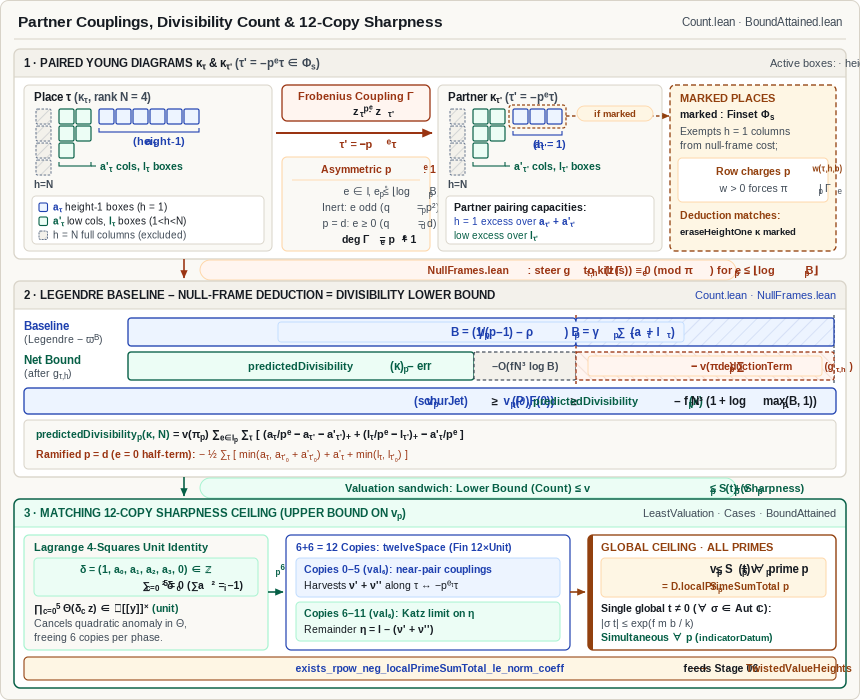
The solution is a 6 + 6 = 12 copy cancellation construction powered by Lagrange's four-square theorem:
- Neutralize
with six copies. By Lagrange's theorem extended to -adic integers, is always a sum of four -adic squares . Taking the six -adic scales gives . When you multiply six scaled copies , the quadratic anomaly in the exponent is proportional to and cancels identically—turning the 6-copy product into an invertible unit in the integral power-series ring. - Spend the first 6 copies on partner couplings. Neutralizing
once frees the first 6 copies to implement the canonical coordinate form aligning a place with its Frobenius partnertheta normal form, capturing all the valuation savings from near pairs of partner places for the coupled degree . - Spend the second 6 copies on the remainder. Neutralizing
a second time frees the remaining 6 copies to achieve the single-curve Katz limit on the leftover degree . Multiplying the two 6-copy series gives copies, attaining the sharp valuation bound in total degree at every prime . - Lift back to one global multiplier
. Finally, the proof lifts these 12-copy monomial products back from the CM curve into a 12-copy adelic space ( twelveSpace) using the tight frame resolution theorem, applies finite Fourier inversion modulo the level idealto isolate an explicit congruence indicator ( indicatorDatum) whose multivariate Taylor series recording all partial derivatives at the originSchur jet attains the bound, and collects the level factor, the squared factorial-bridging loss products , and a single nonzero value of the integral vacuum into one single nonzero number with real and imaginary partscomplex plane . Every conjugate of is bounded by , yet that one fixed works simultaneously at every prime and every -adic embedding.
Where this analogy breaks
Saying that six copies "cancel copySubst) to bound the least valuation among the coefficients of an unscaled 12-copy product
Nor are the witnessing derivative multi-index
Finally, the attained valuation is
Level 2 — Undergrad Bridge
1. Why sharpness is needed and the cross-pillar DAG edge
Stage 02's divisibility count (Count.lean) establishes a lower bound on 06_one_lift/twisted_value_heights), however, controlling the arithmetic height of rank-one theta-lift Hecke
This creates an explicit cross-pillar DAG edge in the proof architecture:
Here 03_upper_bound/short_columns defines the purely combinatorial prime-sum rate 02_derivatives/bound_attained proves that 06_one_lift/twisted_value_heights consumes New.Data.exists_rpow_neg_localPrimeSumTotal_le_norm_coeff to bound rank-one lift heights.
2. Why 12 copies: Lagrange's four-square theorem and the 6 + 6 decomposition
In src/New/Derivatives/Sharpness/LeastValuation.lean, for a CM lattice C.LeastValLE μ m n ν r (written
Why 6 copies cancel LeastValuation.lean:489–505). By Lagrange's four-square theorem on New.padicInt_sum_four_squares represents
gives exists_scaledThetaProd_mem_mul_eq_one, this zero sum of squares cancels the quadratic exponential factor in
an element of C.multiSeriesRing μ with constant term
Single-curve Katz limit on 6 copies (leastValLE_of_unit_coefficients, LeastValuation.lean:513–545). If some form C.katz_divisibility_limit in degree norm_coeff_copySubst_le / leastValLE_of_rescale), this yields
where
Combining 6 + 6 = 12 copies across all primes (Cases.lean:505–670). For any degree D.IsNearWeights l):
- Non-split primes
( leastValLE_twelve_localPrimeSumTotal_of_le,Cases.lean:602–650): Letbe the starts of near pairs, and couple each with its partner exactly times. Writing and for the two coupled multi-indices, split the target degree as - The first 6 copies harvest the Frobenius partner couplings via
leastValLE_six_of_isNearPair: - The second 6 copies supply the remaining degree
at the single-curve Katz rate via leastValLE_of_unit_coefficients: - Combining the two via
LeastValLE.addproduces a 12-copy bound for, and comparing against introduces the loss products (with , ), giving .
- The first 6 copies harvest the Frobenius partner couplings via
- Split primes (
leastValLE_twelve_of_split): Hereand , so leastValLE_of_unit_coefficientson 6 copies plusleastValLE_zeroon 6 copies gives. - Large inert primes
( leastValLE_twelve_of_lt): All places are coupled atin the first 6 copies ( leastValLE_six_of_isCouplingFamily), while the second 6 copies absorbat valuation ( leastValLE_six_zero_of_inert), yielding.
Unifying all three regimes gives New.Data.leastValLE_twelve (Cases.lean:655–669): for every prime
3. Lifting val₁₂ from the curve back to adelic Schwartz data
src/New/Derivatives/Sharpness/BoundAttained.lean translates leastValLE_twelve from P.cmCurve back to explicit adelic Schwartz functions on 12 copies:
New.Data.twelveSpace: the standard hermitian spaceindexed by Fin 12 × Unitwith all signs. New.Data.twelveTaylor:Space.jetSeriesonD.twelveSpaceat scale. New.Data.indicatorDatum 𝔪 y₀: the vector inthat is the Gaussian Fock.vacVectorat infinity, the indicator of the matrix classat places dividing , and Space.vacElemat all other finite places.
Three lemmas carry the bound from the curve to indicatorDatum:
- Tight-frame realization (
exists_integral_isThetaFunction_twelveTaylor_eq,BoundAttained.lean:158–218): Whenever, applying exists_isResolutionProduct_of_isTightFramebuilds a vectorthat is -adically integral at all finite points, is a theta function for , and satisfies (assembled via map_subst_linearSeries_copyandcoeff_prod_rename_copyEmbedding). - Finite Fourier inversion (
exists_norm_le_norm_indicatorDatum,BoundAttained.lean:220–274): Becauseis integral at finite adelic vectors and fixed by signed translations along , expanding modulo shows that for every linear form and every finite adelic vector , there exists with - Reduction to the curve (
exists_le_norm_coeff_indicatorDatum,BoundAttained.lean:276–325): Taking, assuming and LeastValLE ... 12 l r, and multiplying through byvacuumScale ^ 12(turningvacElemintointVacuum), there existsumming across the 12 copies to and such that
4. One global conjugate-bounded scalar
Pick once and for all a finite adelic vector exists_intVacuum_ne_zero), and define the single global nonzero scalar
By New.Data.norm_map_mul_intVacuum_le (BoundAttained.lean:327–371), combining norm_ringEquiv_intVacuum_le (D.le_of_hasLogBound) bounds every automorphism conjugate uniformly:
Finally, D.exists_isTightFrame supplies a single tight frame with multiplicities leastValLE_twelve into exists_le_norm_coeff_indicatorDatum and rewriting the norm_natCast_prod_eq_rpow_neg_sum proves the headline sharpness theorem New.Data.exists_rpow_neg_localPrimeSumTotal_le_norm_coeff (BoundAttained.lean:375–448): for every degree
Level 3 — Formal Lean Contract
The extracted Stage 02 skeleton below reproduces the complete public API of src/New/Derivatives/Sharpness/BoundAttained.lean (lines 54–448) at pinned upstream commit 41c2716658c42ba08eb0648994a2efe83082a95c (41c2716658c4), backed by the 6-copy unit lemma (exists_scaledThetaProd_mem_mul_eq_one, leastValLE_of_unit_coefficients) in LeastValuation.lean (lines 489–556) and the 12-copy unification (leastValLE_twelve) in Cases.lean (lines 505–670). Across the proof DAG, this node imports D.localPrimeSumTotal from 03_upper_bound/short_columns and exports New.Data.exists_rpow_neg_localPrimeSumTotal_le_norm_coeff directly to 06_one_lift/twisted_value_heights.
Verification status (audit/verification-status.json): build_status: unverified-locally; scan_scope: entry covering only Challenge.lean, src/Main.lean, and src/Statements.lean (0 forbidden tokens in solution files, 5 expected sorry tokens in Challenge.lean) at pinned commit 41c2716658c42ba08eb0648994a2efe83082a95c (41c2716658c4). Stage 02 proof bodies have not been locally compiled or verified.
def New.copyEmbedding — Upstream source (src/New/Derivatives/Sharpness/BoundAttained.lean L54-L56)
/-- The embedding of the variables of one copy as the `b`-th of `k` copies. -/
def New.copyEmbedding {X : Type} {k : ℕ} (b : Fin k) : X × Unit ↪ X × Fin k × Unit := by
  sorry -- [EXTRACTED_STUB upstream=src/New/Derivatives/Sharpness/BoundAttained.lean:54-56 commit=41c2716658c42ba08eb0648994a2efe83082a95c body_lines=1 body_sha256=06d216ac9e0a00c0a94e444f028ab085d543e359df1d998603184580ff56046f]
lemma New.copyEmbedding_apply — Upstream source (src/New/Derivatives/Sharpness/BoundAttained.lean L58-L59)
lemma New.copyEmbedding_apply {X : Type} {k : ℕ} (b : Fin k) (x : X × Unit) :
    copyEmbedding b x = (x.1, b, ()) := by
  sorry -- [EXTRACTED_STUB upstream=src/New/Derivatives/Sharpness/BoundAttained.lean:58-59 commit=41c2716658c42ba08eb0648994a2efe83082a95c body_lines=1 body_sha256=5a633da644c1afc6f5222be040e6a19d687c01104c0263cce32773e07376dfa8]
def New.copyExponent — Upstream source (src/New/Derivatives/Sharpness/BoundAttained.lean L61-L64)
/-- The exponent in `k` copies of the variables whose part in the `b`-th copy is `α b`. -/
noncomputable def New.copyExponent {X : Type} {k : ℕ} (α : Fin k → X × Unit →₀ ℕ) :
    X × Fin k × Unit →₀ ℕ := by
  sorry -- [EXTRACTED_STUB upstream=src/New/Derivatives/Sharpness/BoundAttained.lean:61-64 commit=41c2716658c42ba08eb0648994a2efe83082a95c body_lines=1 body_sha256=c0fb1668adb2470704c7b16f96a20363fb8ddde9f5747546a121bb3972262e4e]
lemma New.copyExponent_apply — Upstream source (src/New/Derivatives/Sharpness/BoundAttained.lean L66-L71)
/-- The part of `copyExponent α` in the `b`-th copy is `α b`. -/
lemma New.copyExponent_apply {X : Type} {k : ℕ} (α : Fin k → X × Unit →₀ ℕ) (x : X) (b : Fin k) :
    copyExponent α (x, b, ()) = α b (x, ()) := by
  sorry -- [EXTRACTED_STUB upstream=src/New/Derivatives/Sharpness/BoundAttained.lean:66-71 commit=41c2716658c42ba08eb0648994a2efe83082a95c body_lines=4 body_sha256=be1f0ce92100840092043db23916b8b30ca0cca185d1419ed744a33a2012f68a]
lemma New.coeff_prod_rename_copyEmbedding — Upstream source (src/New/Derivatives/Sharpness/BoundAttained.lean L73-L96)
/-- The coefficient at `copyExponent α` of a product of series, each in the variables of its own
copy, is the product of the coefficients at the exponents `α b` of the copies. -/
lemma New.coeff_prod_rename_copyEmbedding {X R : Type} [CommRing R] {k : ℕ}
    (α : Fin k → X × Unit →₀ ℕ) (Ψ : Fin k → MvPowerSeries (X × Unit) R) :
    coeff (copyExponent α) (∏ b : Fin k, rename (copyEmbedding b) (Ψ b)) =
      ∏ b : Fin k, coeff (α b) (Ψ b) := by
  sorry -- [EXTRACTED_STUB upstream=src/New/Derivatives/Sharpness/BoundAttained.lean:73-96 commit=41c2716658c42ba08eb0648994a2efe83082a95c body_lines=19 body_sha256=a31b0a566906029830c2f9c2028cc123ef67a81479d0e9e3dc8d1a79b42d740d]
lemma New.Data.map_subst_linearSeries_copy — Upstream source (src/New/Derivatives/Sharpness/BoundAttained.lean L104-L120)
/-- Substitute the linear form `∑ x, μ x • X_(x, b)` (`linearSeries`) in the variables of copy
`b` into the Taylor series of `f`, and apply `ιₚ : ℂ → ℂ_[p]` to the coefficients. The result is
the series `taylorVia ιₚ f` along the form `ιₚ ∘ μ` of one copy, renamed into copy `b`. -/
lemma New.Data.map_subst_linearSeries_copy {p : ℕ} [Fact p.Prime] [PadicPlace p] {X : Type} [Fintype X]
    {k : ℕ} (f : ℂ → ℂ) (μ : X → ℂ) (b : Fin k) :
    ((taylorAtZero f).subst
      (linearSeries fun y : X × Fin k × Unit ↦ if y.2 = (b, ()) then μ y.1 else 0)).map ιₚ =
      rename (copyEmbedding b) ((taylorVia ιₚ f).subst
        (linearSeries fun x : X × Unit ↦ (ιₚ (μ x.1) : ℂ_[p]))) := by
  sorry -- [EXTRACTED_STUB upstream=src/New/Derivatives/Sharpness/BoundAttained.lean:104-120 commit=41c2716658c42ba08eb0648994a2efe83082a95c body_lines=9 body_sha256=7c9fbdfd2a81bab82f25fb15883bf64ea783d64ff1ae43cda6b552ac1011ecef]
lemma New.Data.norm_natCast_prod_eq_rpow_neg_sum — Upstream source (src/New/Derivatives/Sharpness/BoundAttained.lean L122-L128)
/-- The `p`-adic norm of a product of nonzero natural numbers is `p` to minus the sum of their
valuations. -/
lemma New.Data.norm_natCast_prod_eq_rpow_neg_sum {p : ℕ} [hp : Fact p.Prime] [PadicPlace p] {X : Type}
    [Fintype X] {n : X → ℕ} (hn : ∀ x : X, n x ≠ 0) :
    ‖(ιₚ (∏ x : X, n x : ℕ) : ℂ_[p])‖ = p ^ (-∑ x : X, (padicValNat p (n x) : ℝ)) := by
  sorry -- [EXTRACTED_STUB upstream=src/New/Derivatives/Sharpness/BoundAttained.lean:122-128 commit=41c2716658c42ba08eb0648994a2efe83082a95c body_lines=3 body_sha256=a3fbe857c7e688ab2eb719ae0965792d1ebda7804b6be2b40151b24339d97c45]
abbrev New.Data.twelveSpace — Upstream source (src/New/Derivatives/Sharpness/BoundAttained.lean L130-L137)
/-- The hermitian space `Hom(E, E¹²)` of `12 × 1` matrices over `E = D.E`, where `E` and `E¹²` carry
the sum of the norms of the coordinates (`stdSpace`). The sign of a coordinate is the product of
the signs of its row and column, here always `+1` (`homSigns 1 1`). The vectors of this file lie
in `𝒮 D.twelveSpace`, the space of functions on adelic vectors that models the adelic Heisenberg
representation. -/
noncomputable abbrev New.Data.twelveSpace {P : Parameters} (D : Data P) :
    Space D.E (Fin 12 × Unit) (homSigns 1 1) := by
  sorry -- [EXTRACTED_STUB upstream=src/New/Derivatives/Sharpness/BoundAttained.lean:130-137 commit=41c2716658c42ba08eb0648994a2efe83082a95c body_lines=1 body_sha256=3ad4fe07571743a5d2d4532b60031d57c3fd6cbb3ea319f78523019635390d83]
abbrev New.Data.twelveTaylor — Upstream source (src/New/Derivatives/Sharpness/BoundAttained.lean L139-L148)
/-- The series `Space.jetSeries` of a vector `F` on `Hom(E, E¹²)` at the scale `a = π_M * jetScale`:
for `F` in the finite part it is the Taylor series at `0` of `z ↦ Θ_F(a z)`, where `Θ_F` is the
theta function `Space.entireTheta F`. Here `π_M` is the conjugate of `D.piMBar` and
`jetScale = periodFactor * areaScale / cmPeriod`, where `cmPeriod 𝓞_K` is the lattice of the curve
`P.cmCurve`, `areaScale = √(2π / √d)` for `d = P.d`, and
`periodFactor = vacuumRoot / chowlaSelbergUnit` is a constant of the field `D.E = P.E D.towerExp`,
the cyclotomic extension of `K` at the level `D.towerExp` of the tower. -/
noncomputable abbrev New.Data.twelveTaylor {P : Parameters} (D : Data P) :
    𝒮 D.twelveSpace →ₗ[ℂ] MvPowerSeries (D.Φ × Fin 12 × Unit) ℂ := by
  sorry -- [EXTRACTED_STUB upstream=src/New/Derivatives/Sharpness/BoundAttained.lean:139-148 commit=41c2716658c42ba08eb0648994a2efe83082a95c body_lines=1 body_sha256=2ecf8c64109a37f9362a86c839a6db78333373d03a972f21239fbef08a8061f9]
abbrev New.Data.indicatorDatum — Upstream source (src/New/Derivatives/Sharpness/BoundAttained.lean L150-L156)
/-- The vector on `Hom(E, E¹²)` whose part at infinity is the Gaussian `exp(-|x|² / 2)`
(`Fock.vacVector`), whose part at the places dividing `𝔪` is the indicator of the class `y₀` of
matrices over the residue ring `𝔪.ResidueRing = O_E/𝔪`, and which agrees with the vacuum
`Space.vacElem` at the other finite places. The three parts are put together by `modDatum`. -/
noncomputable abbrev New.Data.indicatorDatum {P : Parameters} (D : Data P) (𝔪 : Modulus D.E)
    (y₀ : Matrix (Fin 12) Unit 𝔪.ResidueRing) : 𝒮 D.twelveSpace := by
  sorry -- [EXTRACTED_STUB upstream=src/New/Derivatives/Sharpness/BoundAttained.lean:150-156 commit=41c2716658c42ba08eb0648994a2efe83082a95c body_lines=1 body_sha256=339f1528b4d865c899d9292aefd3001d48f08f57633fcbacb8d13373ff641ed9]
lemma New.Data.exists_integral_isThetaFunction_twelveTaylor_eq — Upstream source (src/New/Derivatives/Sharpness/BoundAttained.lean L158-L218)
/-- Let `D` be admissible data for the parameters `P`, with `K = P.K = ℚ(√-d)` and `E = D.E` the
cyclotomic extension `P.E D.towerExp` of `K`; `D.Φ` is the set of its infinite places `τ`. Let `w`
be a tight frame of length `M = D.M` with multiplicities `c`. Let
`μ_i(z) = periodFactor * ∑ conj(Φ_τ(w i)) z_τ` be its linear forms (`resolutionForms`, read through
an embedding `ιₚ : ℂ → ℂ_[p]`). Let `θ` be the theta function of the elliptic curve
`P.cmCurve = ℂ / cmPeriod 𝓞_K`, let `y(z) = ½(℘′(z + t) - a₁(℘(z + t) - ℘(t)))` for its point `t`
and coefficient `a₁` (`translatedY`), and `Θ = ∏ θ(μ_i z) ^ c i` (`thetaProd`).

If `3 e b i ≤ c i`, there is a vector `F` of `𝒮 D.twelveSpace`, the Heisenberg model of functions on
the adelic `12 × 1` matrices over `E`, such that
* the rescaled Taylor series `twelveTaylor F` of its theta function `Space.entireTheta F` is the
  product over twelve copies `b` of the variables of the series `∏ y(μ_i z) ^ e b i * Θ`;
* its values at the adelic vectors `finVec x = (0, α x)`, for `x` over the finite adeles `𝔸f E`, are
  integral at `ιₚ`;
* its theta function is fixed by the signed translations along `π_M 𝔞₀¹²` (`IsThetaFunction`). -/
lemma New.Data.exists_integral_isThetaFunction_twelveTaylor_eq {P : Parameters} {p : ℕ} [Fact p.Prime]
    [PadicPlace p] (D : Data P) {J : Type} [Fintype J] {w : J → D.E} {c : J → ℕ}
    (hw : IsTightFrame w c D.M) {e : Fin 12 → J → ℕ}
    (he : ∀ (b : Fin 12) (i : J), e b i * 3 ≤ c i) : ∃ F : 𝒮 D.twelveSpace,
    (D.twelveTaylor F).map ιₚ = ∏ b : Fin 12, rename (copyEmbedding b)
      ((∏ i : J, (taylorVia ιₚ P.cmCurve.translatedY).subst
        (linearSeries (P.resolutionForms (p := p) D.towerExp w i)) ^ e b i) *
        P.cmCurve.thetaProd (P.resolutionForms D.towerExp w) c) ∧
    (∀ x : Fin 12 × Unit → 𝔸f D.E, ‖(ιₚ (F (finVec x)) : ℂ_[p])‖ ≤ 1) ∧
    IsThetaFunction (star (algebraMap P.K D.E D.piMBar) • idealLattice D.E (Fin 12 × Unit))
      (Space.entireTheta F) := by
  sorry -- [EXTRACTED_STUB upstream=src/New/Derivatives/Sharpness/BoundAttained.lean:158-218 commit=41c2716658c42ba08eb0648994a2efe83082a95c body_lines=36 body_sha256=008994eb150e45a1dff1a4e5b41db274c402960b6edf86a4e974d1bad70c1d7c]
lemma New.Data.exists_norm_le_norm_indicatorDatum — Upstream source (src/New/Derivatives/Sharpness/BoundAttained.lean L220-L274)
/-- Let `D` be admissible data for the parameters `P`, with CM field `E = D.E` over `K = P.K`, and
let `F` lie in `𝒮 D.twelveSpace`, the Heisenberg model of functions on the adelic `12 × 1` matrices
over `E`. Let `F` have integral values at the adelic vectors `finVec x = (0, α x)`, for `x` over the
finite adeles `𝔸f E` and `α` the finite idele of the Weil data of `E`. Let its theta function be
fixed by the signed translations along `π_M 𝔞₀¹²`. Let `𝔪 = (π_M)`. For every linear form `L` and
every vector `y` over `𝔸f E` there is a class `y₀` modulo `𝔪` such that the valuation of
`L (indicatorDatum 𝔪 y₀)` is at most that of `M ^ (12 f) L(F)` times the value of the vacuum at
`finVec y`. -/
lemma New.Data.exists_norm_le_norm_indicatorDatum {P : Parameters} {p : ℕ} [Fact p.Prime] [PadicPlace p]
    (D : Data P) {F : 𝒮 D.twelveSpace}
    (hF_int : ∀ x : Fin 12 × Unit → 𝔸f D.E, ‖(ιₚ (F (finVec x)) : ℂ_[p])‖ ≤ 1)
    (h_periods : IsThetaFunction
      (star (algebraMap P.K D.E D.piMBar) • idealLattice D.E (Fin 12 × Unit)) (Space.entireTheta F))
    {𝔪 : Modulus D.E} (h𝔪 : 𝔪.ideal = .span {D.piM}) (L : 𝒮 D.twelveSpace →ₗ[ℂ] ℂ)
    (y : Fin 12 × Unit → 𝔸f D.E) : ∃ y₀ : Matrix (Fin 12) Unit 𝔪.ResidueRing,
    ‖(ιₚ (D.M ^ (D.f * 12) * L F * D.twelveSpace.vacElem (finVec y)) : ℂ_[p])‖ ≤
      ‖(ιₚ (L (D.indicatorDatum 𝔪 y₀)) : ℂ_[p])‖ := by
  sorry -- [EXTRACTED_STUB upstream=src/New/Derivatives/Sharpness/BoundAttained.lean:220-274 commit=41c2716658c42ba08eb0648994a2efe83082a95c body_lines=39 body_sha256=7aa846cd932e214d954fe91eac9fb2ceda23100e4e38945c814ebae7bc22a31c]
lemma New.Data.exists_le_norm_coeff_indicatorDatum — Upstream source (src/New/Derivatives/Sharpness/BoundAttained.lean L276-L325)
/-- Reduction to the curve. Let `D` be admissible data for the parameters `P`, with CM field
`E = D.E = P.E D.towerExp`, whose `f = D.f` infinite places form `D.Φ`; valuations are taken at
`ιₚ : ℂ → ℂ_[p]`. Let `w` be a tight frame of length `M = D.M` with linear forms `μ_i`
(`resolutionForms`) and multiplicities `c i ≥ 3 |l|`. Suppose `val₁₂(l) ≤ r` (`LeastValLE`): some
coefficient of degree `l` in some product over twelve copies of the variables of series `H Θ` has
valuation at most `r`, where `Θ = ∏ θ(μ_i z) ^ c i` and each `H` is an integral series in the
`y(μ_i z)`, for the functions `θ` and `y` of the elliptic curve `P.cmCurve`. Then for some class
`y₀` modulo `𝔪 = (π_M)`, `π_M = D.piM`, some coefficient of degree `l` of the rescaled Taylor series
(`twelveTaylor`) of the theta function of `indicatorDatum 𝔪 y₀`, times `vacuumScale ^ 12`, has
valuation at most `r + v(M ^ (12 f) c₀)`.

The vacuum is the Gaussian times the twisted indicator of the standard lattice, on the adelic
`12 × 1` matrices over `E` (`twelveSpace`); `indicatorDatum 𝔪 y₀` is the vacuum with its part at the
places dividing `𝔪` replaced by the indicator of `y₀`. The integral vacuum `intVacuum` is the vacuum
times `vacuumScale ^ 12`, a constant that makes its values integral, and `c₀` is its value at the
adelic vector `finVec y` with zero part at infinity. -/
lemma New.Data.exists_le_norm_coeff_indicatorDatum {P : Parameters} {p : ℕ} [Fact p.Prime] [PadicPlace p]
    (D : Data P) {J : Type} [Fintype J] {w : J → D.E} {c : J → ℕ}
    (hw : IsTightFrame w c D.M) {l : D.Φ × Unit →₀ ℕ} (hc : ∀ i : J, l.degree * 3 ≤ c i) {r : ℝ}
    (h_val : P.cmCurve.LeastValLE (p := p) (P.resolutionForms D.towerExp w) c 12 l r)
    {𝔪 : Modulus D.E} (h𝔪 : 𝔪.ideal = .span {D.piM}) (y : Fin 12 × Unit → 𝔸f D.E) :
    ∃ (γ : D.Φ × Fin 12 × Unit →₀ ℕ) (y₀ : Matrix (Fin 12) Unit 𝔪.ResidueRing),
      (∀ σ : D.Φ, ∑ b : Fin 12, γ (σ, b, ()) = l (σ, ())) ∧
      p ^ (-r) * ‖(ιₚ (D.M ^ (D.f * 12) * intVacuum D.twelveSpace (finVec y)) : ℂ_[p])‖ ≤
        ‖(ιₚ (P.vacuumScale D.towerExp ^ 12 * coeff γ (D.twelveTaylor (D.indicatorDatum 𝔪 y₀))) :
          ℂ_[p])‖ := by
  sorry -- [EXTRACTED_STUB upstream=src/New/Derivatives/Sharpness/BoundAttained.lean:276-325 commit=41c2716658c42ba08eb0648994a2efe83082a95c body_lines=25 body_sha256=21e3f641b81ca62c53a2b3cdbe9ffeac1eeaa84fe61d2da288ce2bc5465579ce]
lemma New.Data.norm_map_mul_intVacuum_le — Upstream source (src/New/Derivatives/Sharpness/BoundAttained.lean L327-L371)
/-- Let `D` be admissible data for the parameters `P`, with CM field `E = D.E`, whose `f = D.f`
infinite places form `D.Φ`. For degrees `l ≤ κ + x ^ 42` at the weights `κ = D.weight`, all
conjugates of `t = M ^ (12 f) c₀ ∏ B_τ ^ 2` are at most `exp (f m b / k)` in absolute value. Here
`x`, `b` are scales and `m`, `r` ranks of `D`, with `k = D.k = r + 1 - m` and `M = D.M`. Further
`B_τ = D.lossProduct (l τ) = (l⁻ + 1) ⋯ (l⁻ + n)` with `n = D.lossFactorCount = ⌈6 b / k⌉` and
`l⁻ = (l τ - n)₊`. The number `c₀` is the value at `finVec y`, an adelic vector with zero part at
infinity, of the integral vacuum `intVacuum`: the Gaussian times the twisted indicator of the
standard lattice on the adelic `12 × 1` matrices over `E` (`twelveSpace`), multiplied by the
constant `vacuumScale ^ 12` that makes its values integral. -/
lemma New.Data.norm_map_mul_intVacuum_le {P : Parameters} (D : Data P) {l : D.Φ → ℕ}
    (hl : ∀ τ : D.Φ, (l τ : ℝ) ≤ D.weight τ + D.x ^ 42)
    (y : Fin 12 × Unit → 𝔸f D.E) (σ : ℂ ≃+* ℂ) :
    ‖σ ((D.M ^ (D.f * 12) * ∏ τ : D.Φ, D.lossProduct (l τ) ^ 2 : ℕ) *
      intVacuum D.twelveSpace (finVec y))‖ ≤ exp (D.f * D.m / D.k * D.b) := by
  sorry -- [EXTRACTED_STUB upstream=src/New/Derivatives/Sharpness/BoundAttained.lean:327-371 commit=41c2716658c42ba08eb0648994a2efe83082a95c body_lines=32 body_sha256=434d711f804a57fca9ca0b48f9f5477ef676b1431b95d74277ce020674a893c7]
theorem New.Data.exists_rpow_neg_localPrimeSumTotal_le_norm_coeff — Upstream source (src/New/Derivatives/Sharpness/BoundAttained.lean L375-L448)
/-- Sharpness. Let `D` be admissible data for the parameters `P`, with `K = ℚ(√-d)` for the prime
`d = P.d` and `E = D.E = P.E D.towerExp` the extension of `K` by the roots of unity of order
`q₁ = D.q₁`. For degrees `l` with `κ ≤ l ≤ κ + x ^ 42` at the weights `κ = D.weight` there is a
number `t ≠ 0` with all conjugates at most `exp (f m b / k)` such that, at every prime `p` and
embedding `ιₚ : ℂ → ℂ_[p]`, for some exponent `γ` of degree `l` and some class `y₀` modulo
`𝔪 = (π_M)` the valuation of the coefficient at `γ` of `twelveTaylor (indicatorDatum 𝔪 y₀)`, times
`vacuumScale ^ 12 ∏ l!`, is at most `S_p + v(t)`.

The numbers `x`, `b` are scales and `m`, `r` ranks of `D`, `k = r + 1 - m`, and `π_M = D.piM` is an
integer of `K` of norm `D.M`. -/
theorem New.Data.exists_rpow_neg_localPrimeSumTotal_le_norm_coeff {P : Parameters} (D : Data P) (l : D.Φ → ℕ)
    (hl : ∀ τ : D.Φ, (D.weight τ : ℝ) ≤ l τ ∧ l τ ≤ (D.weight τ : ℝ) + D.x ^ 42) :
    ∃ t : ℂ, t ≠ 0 ∧
      (∀ σ : ℂ ≃+* ℂ, ‖σ t‖ ≤ exp (D.f * D.m / D.k * D.b)) ∧
      ∀ 𝔪 : Modulus D.E, 𝔪.ideal = .span {D.piM} → ∀ (p : ℕ) [Fact p.Prime] [PadicPlace p],
        ∃ (γ : D.Φ × Fin 12 × Unit →₀ ℕ) (y₀ : Matrix (Fin 12) Unit 𝔪.ResidueRing),
          (∀ τ : D.Φ, ∑ b : Fin 12, γ (τ, b, ()) = l τ) ∧
          p ^ (-D.localPrimeSumTotal p) ≤ ‖ιₚ
            (P.vacuumScale D.towerExp ^ 12 / t * (∏ τ : D.Φ, (l τ)!) *
            coeff γ (D.twelveTaylor (D.indicatorDatum 𝔪 y₀)))‖ := by
  sorry -- [EXTRACTED_STUB upstream=src/New/Derivatives/Sharpness/BoundAttained.lean:375-448 commit=41c2716658c42ba08eb0648994a2efe83082a95c body_lines=55 body_sha256=5153b21ddb2d145e2be16e77503f3cc137054458e02b43b8fc445dfcd6611597]
Page Glossary
- prime number
- A whole number greater than 1 whose only positive whole-number divisors are 1 and itself; every integer above 1 factors uniquely into a product of them.
- twisted lattice
- A family of linear lifts from one complex vector space into inner-product spaces—one per twist—equipped with prime-by-prime integrality lattices so each prime can pick its own allowed twist.
- arithmetic height
- A logarithmic measure combining ordinary archimedean size with prime-by-prime p-adic divisibility, locked together by the product formula so a nonzero algebraic quantity cannot be simultaneously small at every place.
- complex multiplication
- Extra scaling-and-rotation symmetries of a two-dimensional lattice in ℂ preserved by the integers 𝓞_K of an imaginary quadratic field K = ℚ(√(-d)), pinning down every Galois-conjugate lattice area via the Chowla–Selberg formula.
- formal group law
- A power-series addition law encoding an elliptic curve's group structure near the origin, whose Lubin–Tate scaling and Frobenius congruence isolate the exact p-adic powers controlling theta-function derivatives.
- elliptic theta function
- A quasi-periodic entire function on a CM lattice normalized at the origin, whose finite products along tight-frame projections build integral multi-variable theta functions and collapse p-adically into exponential normal forms.
- tight frame
- A balanced, possibly overcomplete family of vectors with integer multiplicities whose projections reconstruct the exact standard inner product—allowing integral root-of-unity spokes to pull back one-dimensional elliptic theta sections into high-dimensional integral theta functions.
- theta normal form
- A p-adic factorization of rescaled multivariable theta products into an integral power series times an exponential of Frobenius-power couplings pairing each infinite place with its shifted partner place.
- Schur jet
- The evaluation at the origin of a symmetry-adapted Schur differential operator on a theta function's multivariate Taylor expansion, whose prime-by-prime divisibility is controlled through minor products and matched by an explicit sharpness construction.
- complex plane
- The two-dimensional coordinate plane of numbers s = σ + it, where the horizontal coordinate σ = Re(s) sets decay rate and the vertical coordinate t = Im(s) sets oscillation frequency.