divided-lattice gluing
Also known as: divided lattice, first factor, period lift, glued form.
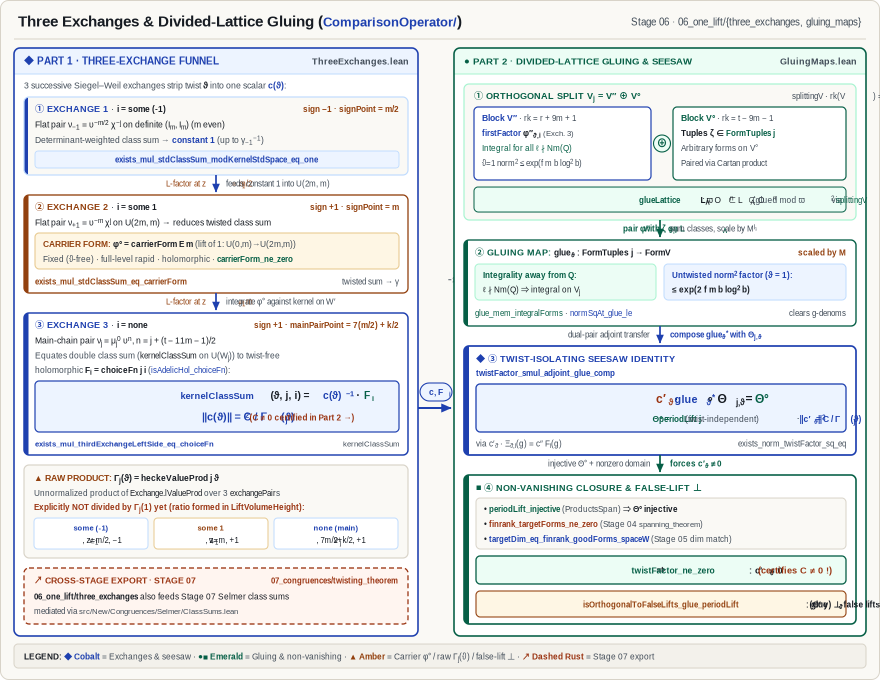
Splitting the definite target space V_j = V'' + V^o along a congruence-glued lattice to pair a twist-carrying first factor on V'' with arbitrary forms on V^o, producing a linear map glue_theta whose adjoint isolates the twist as a single nonzero scalar in c'theta * glue_theta^* * Theta = Theta^o.
Level 1 — First-Principles
Suppose we have a single-step theta lift
Divided-lattice gluing achieves this by cutting the target space into two complementary orthogonal blocks:
Rather than taking the naive direct sum of the standard lattices on glueLattice) lying between isGlued_glueLattice).
On the first block firstFactorScale) to form the first factor
Given a tuple D.M ^ denominatorExponent) to repay the denominators of
- Twist-isolating seesaw identity (
twistFactor_smul_adjoint_glue_comp): Applying dual-pair adjoint transferseesaw duality toyields where is the period lift into —completely independent of the twist —and . - Injectivity and non-vanishing (
periodLift_injective,twistFactor_ne_zero): Because products of good forms with the twist-free choice functions span (ProductsSpan.lean), the period liftis injective. Combining injectivity with Stage 04's guarantee that the target space is nonzero ( D.finrank_targetForms_ne_zero) proves, retroactively certifying from ThreeExchanges! - Integrality and smallness (
glue_mem_integralForms,normSqAt_glue_le): At any prime, maps integral tuples on into integral forms on ; at , it inflates squared norms by at most . - Orthogonality to false lifts (
isOrthogonalToFalseLifts_glue_periodLift): Because false-lift periods over the complementary blockvanishfalse-lift period, every glued form is orthogonal to all false lifts on .
Limits of the intuition
Calling divided-lattice gluing a "block-diagonal product map" glosses over why the congruence matrix gluingLevel glue has to multiply by M_pow_denominatorExponent_sq_mul_le_exp).
Level 2 — Undergrad Bridge
In Prasanna (2006), Harris–Li–Skinner (2005), and Böcherer–Dummigan–Schulze-Pillot (2012), pullback and seesaw identities pair a theta lift on a larger group against a fixed form on a split subgroup to extract special src/New/OneLift/ComparisonOperator/GluingMaps.lean (68 declarations, 0 stub truncations) builds this in full rank:
- Splitting and glued lattices (
splittingV,gluingLevel,glueLattice,isGlued_glueLattice): The splittingsplittingV j ϑdivides( D.RowIndex ⊕ Fin D.t, rank) into ( FirstFactorIndex j, rank) and ( D.SecondFactorIndex, rank), with the divided directions D.CarrierIndexembedded in. Both Young diagrams ( colsPlus) and( colsMinus) satisfyHasColumnsBelow, so Cartan products embed cleanly. The latticeglueLattice j ϑ iis chosen once atand reused across all twists ( isGlued_splittingV_of_isGlued). - First factor arithmetic (
firstFactorScale,firstFactor,isIntegralAndSmall_firstFactor,weylGauge_firstFactor_le_one,weylNormSq_firstFactor_le): Settingwith makes , so twistFactor j ϑ() satisfies and ( exists_norm_twistFactor_sq_eq). - Seesaw adjoint computation (
inner_adjoint_glue,conj_normalizedDescent_glue,inner_adjoint_glue_goodLift_eq_sum_integral,twistFactor_smul_adjoint_glue_comp): Writing the descent ofas a sum over and (using invariance of good forms under via goodForm_mul_liftMod_congruenceGroup) giveswhere ( glueFactor_ne_zero). - False-lift orthogonality, injectivity, and
( sum_slice_eq_zero_of_mem_falseLiftsAt,thetaKernelPairing_adjoint_glue_eq_zero,isOrthogonalToFalseLifts_glue_periodLift,periodLift_injective,twistFactor_ne_zero): For any false lift, PeriodsOfFalseLiftsforces every-slice of against to vanish, hence thetaKernelPairingofis zero, making . Finally, ProductsSpan.lean'seq_zero_of_integral_choiceFn_thetaKernelPairingprovesperiodLift_injective, andD.finrank_targetForms_ne_zero+D.targetDim_eq_finrank_goodForms_spaceWrule out, proving twistFactor_ne_zero.
Level 3 — Formal Lean Contract
All six anchors live in skeleton/06_one_lift/gluing_maps.lean (68 declarations, 0 stub truncations):
06_one_lift/gluing_maps.lean#New.Rows.firstFactor(upstreamGluingMaps.lean:242-246),06_one_lift/gluing_maps.lean#New.Rows.glue(upstreamGluingMaps.lean:344-385), and06_one_lift/gluing_maps.lean#New.Rows.periodLift(upstreamGluingMaps.lean:1009-1013).06_one_lift/gluing_maps.lean#New.Rows.twistFactor_smul_adjoint_glue_comp(upstreamGluingMaps.lean:1024-1030):leantheorem New.Rows.twistFactor_smul_adjoint_glue_comp : twistFactor j ϑ • (glue j ϑ).adjoint ∘ₗ D.goodLift ϑ j = periodLift j06_one_lift/gluing_maps.lean#New.Rows.periodLift_injective(upstreamGluingMaps.lean:1046-1059):leantheorem New.Rows.periodLift_injective : Function.Injective (periodLift j)06_one_lift/gluing_maps.lean#New.Rows.twistFactor_ne_zero(upstreamGluingMaps.lean:1061-1067):leantheorem New.Rows.twistFactor_ne_zero : twistFactor j ϑ ≠ 0
See the page's live <VerificationBanner /> (audit/verification-status.json) for the pinned upstream commit and local Lean build status (build_status: unverified-locally).
Where this analogy breaks
Imagining divided-lattice gluing as a plain tensor product of two independent spaces misses why the lattice L_Lambda must sit strictly between varpi O^n and O^n at the chosen places: without congruence gluing across V'' and V^o, the theta kernel would not decouple cleanly modulo varpi^2, and scaling by M^{l_1} is required to repay the denominators of the gluing matrix while keeping the map integral away from Q.
Formal Lean Anchors
def New.Rows.glue — Upstream source (src/New/OneLift/ComparisonOperator/GluingMaps.lean L344-L385)
/-- The gluing map `glue_ϑ`. For `ζ` in the copy `i` of the forms on `V°` it is `M ^ l₁` times the
sum, over the classes `h` of level `J_Λ` and `h°` of level `J (ϖ²)`, of the forms supported on the
class of `(h, h°) 𝗀` formed from the product vector `φ″ (h) · ζ (h°)` (`productForm`). Here `𝗀`
is the matrix of `glueLattice j ϑ i`, `M = D.M`, and `l₁` is
`DividedSplitting.denominatorExponent`, the exponent that repays the denominators of `𝗀`. -/
@[simps -isSimp] def New.Rows.glue : FormTuples j →ₗ[ℂ] (D.descentPair ϑ j).FormV := by
sorry -- [EXTRACTED_STUB upstream=src/New/OneLift/ComparisonOperator/GluingMaps.lean:344-385 commit=41c2716658c42ba08eb0648994a2efe83082a95c body_lines=37 body_sha256=8b964561a7d2ce493d174ed689fe185f4f38cb4f7cad4fcbff2a4a1a4179f0ba]def New.Rows.firstFactor — Upstream source (src/New/OneLift/ComparisonOperator/GluingMaps.lean L242-L246)
/-- The first factor `φ″_{ϑ,i}`, the complex conjugate of `c″ Υ_{ϑ,i}`, where `Υ_{ϑ,i}`
(`leftSideSeries`) is a function on the finite points of `U(V″)` and `c″ = firstFactorScale j`. -/
def New.Rows.firstFactor (i : ChoiceIndex j) (h : Gf D.E (FirstFactorIndex j)) :
WeylIndex (FirstFactorIndex j) (untwistedDescentPair j).colsPlus → ℂ := by
sorry -- [EXTRACTED_STUB upstream=src/New/OneLift/ComparisonOperator/GluingMaps.lean:242-246 commit=41c2716658c42ba08eb0648994a2efe83082a95c body_lines=1 body_sha256=a5ee23470e1c9d179a798ab4ed7bc10cab7dd57aa4ffd66247142e81f300b5db]def New.Rows.periodLift — Upstream source (src/New/OneLift/ComparisonOperator/GluingMaps.lean L1009-L1013)
/-- The map `Θ°` from the good forms on `W_j` to tuples of forms on `V°` whose copy `i` is
`c°_i ∫ y (g) 𝖥_i (g) θ° (g, ·) dg` (`inner_periodLift`). It is defined as `c′_1 glue_1* Θ_{j,1}`,
the left side of the seesaw identity at the trivial twist. -/
def New.Rows.periodLift : D.goodForms (D.spaceW j) →ₗ[ℂ] FormTuples j := by
sorry -- [EXTRACTED_STUB upstream=src/New/OneLift/ComparisonOperator/GluingMaps.lean:1009-1013 commit=41c2716658c42ba08eb0648994a2efe83082a95c body_lines=1 body_sha256=aeaa93f3b6e98c8752c8d29ca00f4b66bc54bfd7223b59890ed3522c5020eba5]theorem New.Rows.twistFactor_smul_adjoint_glue_comp — Upstream source (src/New/OneLift/ComparisonOperator/GluingMaps.lean L1024-L1030)
/-- The seesaw identity `c′_ϑ glue_ϑ* Θ_{j,ϑ} = Θ°`: the number `twistFactor j ϑ` times the
composite of the lift `goodLift` with the adjoint of the gluing map `glue` is the map
`periodLift`, which does not depend on the twist. -/
theorem New.Rows.twistFactor_smul_adjoint_glue_comp :
twistFactor j ϑ • (glue j ϑ).adjoint ∘ₗ D.goodLift ϑ j = periodLift j := by
sorry -- [EXTRACTED_STUB upstream=src/New/OneLift/ComparisonOperator/GluingMaps.lean:1024-1030 commit=41c2716658c42ba08eb0648994a2efe83082a95c body_lines=3 body_sha256=aa44f710548bd9ca718f97caa44c04d4c3324d09c479b4fbd8a60a31dd533601]theorem New.Rows.periodLift_injective — Upstream source (src/New/OneLift/ComparisonOperator/GluingMaps.lean L1046-L1059)
/-- The map `periodLift j` from good forms on `W_j` to tuples of forms on `V°` is injective. -/
theorem New.Rows.periodLift_injective : Function.Injective (periodLift j) := by
  sorry -- [EXTRACTED_STUB upstream=src/New/OneLift/ComparisonOperator/GluingMaps.lean:1046-1059 commit=41c2716658c42ba08eb0648994a2efe83082a95c body_lines=13 body_sha256=177cde8d20b322648ff0605eb27b13dd3e110d26c3f6b1f953d690d9f73c3cb1]
theorem New.Rows.twistFactor_ne_zero — Upstream source (src/New/OneLift/ComparisonOperator/GluingMaps.lean L1061-L1067)
/-- The number `twistFactor j ϑ` is not `0`, since `Θ° = periodLift j` is injective and there is a
nonzero good form. -/
theorem New.Rows.twistFactor_ne_zero : twistFactor j ϑ ≠ 0 := by
  sorry -- [EXTRACTED_STUB upstream=src/New/OneLift/ComparisonOperator/GluingMaps.lean:1061-1067 commit=41c2716658c42ba08eb0648994a2efe83082a95c body_lines=5 body_sha256=d29c183be38d6e00cb1e4d52247d10ee18e19be2e1d348a05a2594b68977145f]
Related Concepts
- seesaw duality — A dual-pair adjunction identity that trades an iterated lower-chain theta lift of a Poincaré series for a nonzero twist-independent scalar times the restriction of an upper-chain composite theta lift.
- Weyl gauge — The p-adic coordinate norm of an algebraic modular form measured in the g-twisted Weyl lattice, paired with Galois-conjugate archimedean bounds to define B-short spanning sets and ramified source forms.
- carrier form — The fixed, nonzero, full-level holomorphic theta lift of 1 from U(0, m) to U(2m, m) onto which the first two Siegel–Weil exchanges collapse a twisted class sum, letting a third exchange turn the entire twist dependence into a scalar c(theta) controlled by the raw Hecke value product Gamma_j(theta).
- false-lift period — The theta period over a complementary block I_l of an algebraic form Xi that mimics a lift in level and Hecke eigenvalue yet sits orthogonal to true lifts—forced to vanish by climbing a hyperbolic-plane descent tower when 2r + 2N + 3 < n.
Referenced By
- Stage: Stage 06 — Lower Bound: One Lift (Theorem C, Part 2)
- Stage: The Lift Comparison Operator and Single-Lift Volume Height
- Stage: Three Exchanges, the Carrier Form, and Divided-Lattice Gluing
- Stage: Vanishing Periods of False Lifts and Negative Heights of Twisted L-Values
- Concept: lift comparison operator
Authoritative Sources
- Integrality of a ratio of Petersson norms and level-lowering congruences (paper) — K. Prasanna, Ann. of Math. 163 (2006), 901–941.
- Yoshida lifts and Selmer groups (paper) — S. Böcherer, N. Dummigan & R. Schulze-Pillot, J. Math. Soc. Japan 64 (2012), 1353–1401.
- The Rallis inner product formula and p-adic L-functions (paper) — M. Harris, J.-S. Li & C. M. Skinner, Automorphic Representations, L-functions and Applications, OSU Math. Res. Inst. Publ. 11 (2005), 225–255.
Page Glossary
- carrier form
- The fixed, nonzero, full-level holomorphic theta lift of 1 from U(0, m) to U(2m, m) onto which the first two Siegel–Weil exchanges collapse a twisted class sum, letting a third exchange turn the entire twist dependence into a scalar c(theta) controlled by the raw Hecke value product Gamma_j(theta).
- Weyl gauge
- The p-adic coordinate norm of an algebraic modular form measured in the g-twisted Weyl lattice, paired with Galois-conjugate archimedean bounds to define B-short spanning sets and ramified source forms.
- seesaw duality
- A dual-pair adjunction identity that trades an iterated lower-chain theta lift of a Poincaré series for a nonzero twist-independent scalar times the restriction of an upper-chain composite theta lift.
- false-lift period
- The theta period over a complementary block I_l of an algebraic form Xi that mimics a lift in level and Hecke eigenvalue yet sits orthogonal to true lifts—forced to vanish by climbing a hyperbolic-plane descent tower when 2r + 2N + 3 < n.