Taylor–Wiles prime triangle
Also known as: Taylor-Wiles prime triangle, prime triangle, even Tate-twist class, Kummer reciprocity map, weak-lift root chain, tied auxiliary prime.
An upper-triangular family of auxiliary primes Q_j (norm 1 mod l^nu) ordered by Tate-twist exponent e in (0, t') whose Frobenius and tame-inertia Kummer reciprocity laws eliminate every even Tate-twist cohomology class algebraically—bypassing Vandiver's conjecture—while preserving weak-lift root chains.
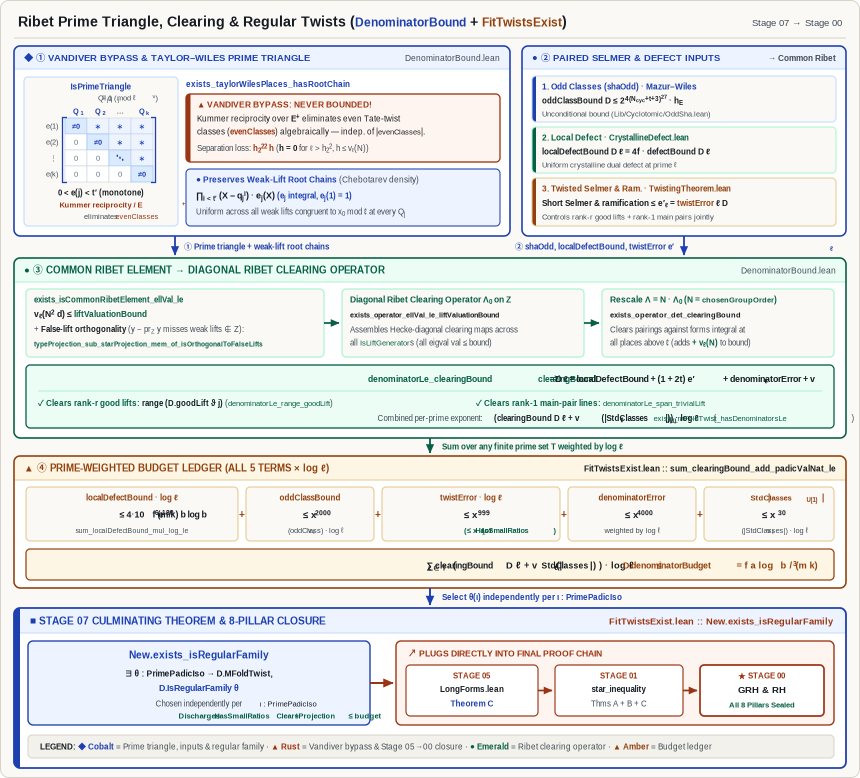
Level 1 — First-Principles
When Stage 07 uses Ribet's method to bound congruences between lifted forms and non-lifted forms, the Galois representation of a lift mixes its fixed main summandGalois main summand with the inverse-cyclotomic string
Under complex conjugation, those cohomology classes split into two opposite parities:
- Odd classes (
shaOdd): Controlled unconditionally by the Mazur–Wiles / Greither main conjecture (Lib/Cyclotomic/OddSha.lean::exists_length_shaOdd_le), bounded byoddClassBound D. - Even Tate-twist classes (
evenClasses): Living on the totally real subfield, where bounding their orders unconditionally is equivalent to Vandiver's conjecture—a famously open problem!
How does the proof clear congruence denominators without ever solving Vandiver's conjecture? It builds a Taylor–Wiles prime triangle (New.Selmer.exists_taylorWilesPlaces_hasRootChain): a finite linearly ordered family of tied auxiliary primes exists_eventually_hasRootChain_mostFrobeniiAt) to satisfy two joint properties:
- Upper-triangular elimination of even classes (
IsPrimeTriangle): Ordering the tied auxiliary primes by exponentcreates a triangular system under the Kummer reciprocity map over : any even Tate-twist class of exponent that vanishes on all earlier tame generators ( ) and all earlier Frobenius elements of the same exponent has its value at killed by a tiny explicit power (where separates the powers of a cyclotomic generator exists_cyclotomicChar_pow_sub_one_dvd, andwhenever ). The size of evenClassescompletely drops out of the denominator bound! - Preservation of weak-lift root chains (
HasRootChain): For every systemthat is a system whose normalized Galois characteristic polynomials all have root Ribet clearing operator ( IsWeakLift) congruent moduloto the target lift , the rescaled Hecke polynomialHecke operator at every auxiliary primeprime number factors as a weak-lift root chain with an integral polynomial satisfying independent of . This ties each tame inertia generator to via the relation inside Ribet's trace ideal without disturbing any true lift.
Limits of the intuition
Do not read the Taylor–Wiles prime triangle as a trick that secretly proves even Tate-twist classes are small. It never bounds the cardinality of evenClasses at all. Instead, it trades an unknown global class-group order for a finite family of auxiliary places exists_cyclotomicChar_pow_sub_one_dvd), which vanishes identically for all primes
Level 2 — Undergrad Bridge
In src/New/Congruences/FirstOrder/DenominatorBound.lean (37 declarations, 0 stub truncations), three lemmas construct the Taylor–Wiles prime triangle before passing it to Ribet's element:
- Cyclotomic separation (
exists_isUnit_cyclotomicChar_pow_sub_one,exists_cyclotomicChar_pow_sub_one_dvd_pow_padicValNat,exists_cyclotomicChar_pow_sub_one_dvd): Finds a topological generatorof modulo and an integer (with whenever ) such that in for all . - Dense Frobenius test points (
exists_eventually_hasRootChain_mostFrobeniiAt): For anyand , picks so that along mostFrobeniiAt D.E (δ ^ ℓ ^ ν * g), placesavoid badPlaces D ℓand base level, keep, and force every weak lift ( IsWeakLift O x.val) whose characteristic polynomial modulofactors as (with ) to have a rescaled Hecke polynomial with weak-lift root chain HasRootChaintimes a divisor of an integralwith . - Assembling the triangle (
exists_taylorWilesPlaces_hasRootChain): Produces a finite linear orderand monotone map exponent : J →o {e : Fin O.rankDiff // 0 < e}such that for every, there exist Q : TaylorWilesPlaces D.E J (ℓ ^ ν)(so) satisfying: - (a)
IsPrimeTriangle ν Q.place tame frob g₁⁻¹ O.rankDiff exponent (D.halfGap * h) (D.halfGap ^ 22 * h); - (b) Every
avoids badPlaces D ℓand is off the base levelB.IsOffLevel ![]; - (c) One tuple of integral polynomials
e : J → EllAdicIntegers[X]with(e j).eval 1 = 1witnessesHasRootChainuniformly for every weak liftcongruent to modulo .
- (a)
Level 3 — Formal Lean Contract
All four anchors extract completely untruncated in skeleton/07_congruences/denominator_bound.lean (37 declarations, 0 stub truncations):
07_congruences/denominator_bound.lean#New.Selmer.exists_cyclotomicChar_pow_sub_one_dvd(upstreamDenominatorBound.lean:124-146).07_congruences/denominator_bound.lean#New.Selmer.IsWeakLift(upstreamDenominatorBound.lean:148-153).07_congruences/denominator_bound.lean#New.Selmer.exists_eventually_hasRootChain_mostFrobeniiAt(upstreamDenominatorBound.lean:209-281).07_congruences/denominator_bound.lean#New.Selmer.exists_taylorWilesPlaces_hasRootChain(upstreamDenominatorBound.lean:283-391):leanlemma New.Selmer.exists_taylorWilesPlaces_hasRootChain ... : ∃ (J : Type) (_ : Fintype J) (_ : LinearOrder J) (exponent : J →o {e : Fin O.rankDiff // 0 < (e : ℕ)}), ∀ ν > (0 : ℕ), ∃ Q : TaylorWilesPlaces D.E J (ℓ ^ ν), IsPrimeTriangle ν Q.place (fun j : J ↦ (Q.frobData j).isPlaceOver.tameGenerator) (fun j : J ↦ (Q.frobData j).frob) g₁⁻¹ O.rankDiff exponent (D.halfGap * h) (D.halfGap ^ 22 * h) ∧ (∀ j : J, Q.place j ∉ badPlaces D ℓ) ∧ (∀ j : J, B.IsOffLevel ![] (Q.place j)) ∧ ∃ e : J → EllAdicIntegers[X], (∀ j : J, (e j).eval 1 = 1) ∧ ∀ (j : J) (x : B.Eigensystem ![]), (∀ (g : Gal(Ω/D.E)) (k : ℕ), ‖(normalisedRep O x.val.galRep g).val.charpoly.coeff k - (normalisedRep O x₀.galRep g).val.charpoly.coeff k‖ < 1) → IsWeakLift O x.val → HasRootChain (x.val.heckePolyAt (Q.place j)) ((e j).map (algebraMap EllAdicIntegers ℂ)) (Q.place j).q (ιℓ.symm (normalizingAvatar O (Q.frobData j).frob).val)⁻¹ O.rankDiff
See the page's live <VerificationBanner /> (audit/verification-status.json) for the pinned upstream commit and local Lean build status (build_status: unverified-locally).
Where this analogy breaks
Thinking of a Taylor–Wiles prime triangle as proving that the even Tate-twist cohomology groups (and Vandiver's conjecture) are small is completely backwards: Stage 07 never bounds the order of the even classes at all—instead, adding tied auxiliary primes in an upper-triangular order detects and clears even classes through polynomial tie relations whose valuations depend only on cyclotomic separation (halfGap^22 * h), never on the size of the even class group.
Formal Lean Anchors
lemma New.Selmer.exists_cyclotomicChar_pow_sub_one_dvd — Upstream source (src/New/Congruences/FirstOrder/DenominatorBound.lean L124-L146)
/-- There are `h`, at most the `ℓ`-adic valuation of `D.chosenGroupOrder` and zero unless
`ℓ ≤ D.halfGap ^ 2`, and a topological generator `γ` of the Galois group of `D.E` modulo the kernel
of the cyclotomic character such that `u ^ a - 1` divides `ℓ ^ h` in `ℤ_ℓ` for `0 < a < D.t`, where
`u` is the cyclotomic character of `γ`. -/
lemma New.Selmer.exists_cyclotomicChar_pow_sub_one_dvd {P : Parameters} (D : Data P) (ℓ : ℕ) [ThePrime ℓ] :
    ∃ h ≤ padicValNat ℓ D.chosenGroupOrder,
      (ℓ ≤ D.halfGap ^ 2 ∨ h = 0) ∧
      ∃ γ : AbsGal D, (cyclotomicChar Ω ℓ).IsGeneratorModKer γ ∧
        ∀ a ∈ Set.Ioo 0 D.t, (cyclotomicChar Ω ℓ γ ^ a).val - 1 ∣ ℓ ^ h := by
  sorry -- [EXTRACTED_STUB upstream=src/New/Congruences/FirstOrder/DenominatorBound.lean:124-146 commit=41c2716658c42ba08eb0648994a2efe83082a95c body_lines=15 body_sha256=26cffa53e6ab9e1c86e715ed7d2a89f1b4649d14ba07db3257f5186cdaaecd7f]
lemma New.Selmer.exists_eventually_hasRootChain_mostFrobeniiAt — Upstream source (src/New/Congruences/FirstOrder/DenominatorBound.lean L209-L281)
/-- Let `ϑ` be an auxiliary twist of ramification at most `ram` and `B` base data whose systems, the
Hecke eigenspaces of level `![]`, have normalised Galois representations with integral
characteristic polynomials. Let `R` be a row of weights `wt` (`IsMainSummandLike`). For every `ν`
and `g` there is `δ` with trivial cyclotomic character such that, along the filter `mostFrobeniiAt`
at `δ ^ ℓ ^ ν * g`, a place `y.place` with Frobenius `y.frob` satisfies: (a) the place avoids
`badPlaces D ℓ` and is off the base level; (b) if the system `x` is a weak lift and its polynomial
at the Frobenius is congruent to `∏ (X - cyclotomicInv φ ^ i)`, `φ = y.frob`, `i < O.rankDiff`,
times some `S` with `1 ≤ ‖S 1‖`, then its Hecke polynomial at the place, with the variable rescaled
by `normalizingAvatar O φ` read in `ℂ` by the fixed isomorphism `ιℓ`, is the chain `∏ (X - q ^ i)`,
`q` the norm of the place, times a divisor of an integral `e` with `e 1 = 1`; (c) the characteristic
polynomial of the twist of `R` by `ϑ.invAvatar` at the Frobenius has a value of norm at least `1` at
`1`. -/
lemma New.Selmer.exists_eventually_hasRootChain_mostFrobeniiAt {P : Parameters} {D : Data P} {ℓ : ℕ}
    [ThePrime ℓ]
    [PadicIso ℓ] {r n : Type} [Fintype r] [DecidableEq r] [Fintype n] [DecidableEq n] [Nonempty n]
    {O : DescentPair D.E r n} {ϑ : D.Twist} {ram : ENNReal}
    (hϑ : IsAuxTwist (badPlaces D ℓ) ϑ.Q ϑ.invAvatar ram)
    (B : BaseLevel (stdSpace D.E n) (O.columnCount, O.detExp) D.chosenGroupOrder)
    (h_int : ∀ (x : B.Eigensystem ![]) (g : Gal(Ω/D.E)) (i : ℕ),
      ‖(normalisedRep O x.val.galRep g).val.charpoly.coeff i‖ ≤ 1)
    {wt : (D.E →+* ℂ) → Multiset ℤ} {R : GalRep ℓ D.E r} (hR : IsMainSummandLike D O.rankDiff wt R)
    (ν : ℕ) (g : AbsGal D) :
    ∃ δ : Gal(Ω/D.E), cyclotomicChar Ω ℓ δ = 1 ∧
      ∀ᶠ y : FrobeniusDatum D.E in mostFrobeniiAt D.E (δ ^ ℓ ^ ν * g),
        -- (a)
        y.place ∉ badPlaces D ℓ ∧
        B.IsOffLevel ![] y.place ∧
        -- (b)
        (∀ x : B.Eigensystem ![], IsWeakLift O x.val →
          ∀ S : (PadicAlgCl ℓ)[X], 1 ≤ ‖S.eval 1‖ →
          (∀ k : ℕ, ‖(normalisedRep O x.val.galRep y.frob).val.charpoly.coeff k -
            (S * ∏ i ∈ Finset.range O.rankDiff,
              (X - C (cyclotomicInv ℓ D.E (PadicAlgCl ℓ) y.frob ^ i))).coeff k‖ < 1) →
          ∃ e : EllAdicIntegers[X],
            HasRootChain (x.val.heckePolyAt y.place) (e.map (algebraMap EllAdicIntegers ℂ))
              y.place.q (ιℓ.symm (normalizingAvatar O y.frob).val)⁻¹ O.rankDiff ∧
            e.eval 1 = 1) ∧
        -- (c)
        1 ≤ ‖(ϑ.invAvatar y.frob • (R y.frob).val).charpoly.eval 1‖ := by
  sorry -- [EXTRACTED_STUB upstream=src/New/Congruences/FirstOrder/DenominatorBound.lean:209-281 commit=41c2716658c42ba08eb0648994a2efe83082a95c body_lines=35 body_sha256=a3de459db5a92297e9a58c094c205fabe6b9c11c78efcc1ba72eff5964cc9435]
lemma New.Selmer.exists_taylorWilesPlaces_hasRootChain — Upstream source (src/New/Congruences/FirstOrder/DenominatorBound.lean L283-L391)
/-- The auxiliary places of the Taylor–Wiles method. Let the types `c` form a lift setting for the
pair of hermitian spaces `O` and the auxiliary twist `ϑ` of ramification at most `ram`, and let the
systems of the base data `B` have integral characteristic polynomials. Let `x₀` lift the row `R` of
weights `wt`: the trace of its normalised representation is that of the twist of `R` plus the powers
`cyclotomicInv ^ e`, `e < O.rankDiff` (`HasLiftTrace`). Let `g₁` generate the Galois group of `D.E`
topologically modulo the kernel of the cyclotomic character, let `u ^ a - 1` divide `ℓ ^ h` in `ℤ_ℓ`
for `0 < a < D.t = 5 * D.r`, where `u` is the cyclotomic character of `g₁`, and let
`ℓ ≤ D.halfGap ^ 2` (`D.halfGap = D.r ^ 8`) or `h = 0`. Then there are a finite linear order `J` and
a monotone map `exponent` to the exponents `0 < e < O.rankDiff` such that for each `ν > 0` some
places `Q` of norm `1` modulo `ℓ ^ ν`, indexed by `J`, satisfy: (a) they form a triangle for the
generator `g₁⁻¹` (`IsPrimeTriangle`): the Frobenius elements of exponent `e` and finitely many test
points detect the Galois cohomology classes of twist `-e` unramified off `ℓ`, the powers `u ^ e`
being separated up to `ℓ ^ (D.halfGap * h)`, with total loss `D.halfGap ^ 22 * h`; (b) they avoid
`badPlaces D ℓ` and are off the base level, so are unramified for the forms of `B`; (c) for every
weak lift `x` of base level congruent to `x₀`, the Hecke polynomial at the place of index `j` and
norm `q`, with the variable rescaled by the normalising character, is the chain `∏ (X - q ^ i)`,
`i < O.rankDiff`, times a divisor of an integral `e j` that has value `1` at `1` and does not depend
on `x`. -/
lemma New.Selmer.exists_taylorWilesPlaces_hasRootChain {P : Parameters} {D : Data P} {ℓ : ℕ} [ThePrime ℓ]
    [PadicIso ℓ] {r n : Type} [Fintype r] [DecidableEq r] [Fintype n] [DecidableEq n] [Nonempty n]
    {O : DescentPair D.E r n} {ϑ : D.Twist}
    {c : ∀ i : O.ChosenIndex, (ResField (O.chosenPlace i))[X]} (hc : IsLiftSetting O c ϑ)
    {ram : ENNReal} (hϑ : IsAuxTwist (badPlaces D ℓ) ϑ.Q ϑ.invAvatar ram)
    (B : BaseLevel (stdSpace D.E n) (O.columnCount, O.detExp) D.chosenGroupOrder)
    (h_int : ∀ (x : B.Eigensystem ![]) (g : Gal(Ω/D.E)) (i : ℕ),
      ‖(normalisedRep O x.val.galRep g).val.charpoly.coeff i‖ ≤ 1)
    {x₀ : Isotypic (stdSpace D.E n) (O.columnCount, O.detExp)} {wt : (D.E →+* ℂ) → Multiset ℤ}
    {R : GalRep ℓ D.E r} (hR : IsMainSummandLike D O.rankDiff wt R)
    (h_trace : HasLiftTrace ϑ.invAvatar R O.rankDiff (normalisedRep O x₀.galRep))
    {h : ℕ} {g₁ : AbsGal D} (hℓ : ℓ ≤ D.halfGap ^ 2 ∨ h = 0)
    (hg₁_gen : (cyclotomicChar Ω ℓ).IsGeneratorModKer g₁)
    (hg₁ : ∀ a ∈ Set.Ioo 0 D.t, (cyclotomicChar Ω ℓ g₁ ^ a).val - 1 ∣ ℓ ^ h) :
    ∃ (J : Type) (_ : Fintype J) (_ : LinearOrder J)
      (exponent : J →o {e : Fin O.rankDiff // 0 < (e : ℕ)}),
      ∀ ν > (0 : ℕ), ∃ Q : TaylorWilesPlaces D.E J (ℓ ^ ν),
      -- (a)
      IsPrimeTriangle ν Q.place (fun j : J ↦ (Q.frobData j).isPlaceOver.tameGenerator)
        (fun j : J ↦ (Q.frobData j).frob) g₁⁻¹ O.rankDiff exponent (D.halfGap * h)
        (D.halfGap ^ 22 * h) ∧
      -- (b)
      (∀ j : J, Q.place j ∉ badPlaces D ℓ) ∧
      (∀ j : J, B.IsOffLevel ![] (Q.place j)) ∧
      -- (c)
      ∃ e : J → EllAdicIntegers[X], (∀ j : J, (e j).eval 1 = 1) ∧
        ∀ (j : J) (x : B.Eigensystem ![]),
        (∀ (g : Gal(Ω/D.E)) (k : ℕ), ‖(normalisedRep O x.val.galRep g).val.charpoly.coeff k -
          (normalisedRep O x₀.galRep g).val.charpoly.coeff k‖ < 1) →
        IsWeakLift O x.val →
        HasRootChain (x.val.heckePolyAt (Q.place j)) ((e j).map (algebraMap EllAdicIntegers ℂ))
          (Q.place j).q (ιℓ.symm (normalizingAvatar O (Q.frobData j).frob).val)⁻¹ O.rankDiff := by
  sorry -- [EXTRACTED_STUB upstream=src/New/Congruences/FirstOrder/DenominatorBound.lean:283-391 commit=41c2716658c42ba08eb0648994a2efe83082a95c body_lines=60 body_sha256=ff99eae0a0371b324965781bb13b9994eb4df164d920db05273abc016f1b9b40]
def New.Selmer.IsWeakLift — Upstream source (src/New/Congruences/FirstOrder/DenominatorBound.lean L148-L153)
/-- The system `x` (an isotypic space of forms for the descent pair `O`) is a weak lift: at every
Galois element the characteristic polynomial of its normalised representation has the root `1`. -/
def New.Selmer.IsWeakLift {P : Parameters} {D : Data P} {ℓ : ℕ} [ThePrime ℓ] [PadicIso ℓ] {r n : Type}
    [Fintype r] [DecidableEq r] [Fintype n] [DecidableEq n] (O : DescentPair D.E r n)
    (x : Isotypic (stdSpace D.E n) (O.columnCount, O.detExp)) : Prop := by
  sorry -- [EXTRACTED_STUB upstream=src/New/Congruences/FirstOrder/DenominatorBound.lean:148-153 commit=41c2716658c42ba08eb0648994a2efe83082a95c body_lines=1 body_sha256=d77095378da645d252e6351172666da7b56d5f0062551566d7edff322b8ebdb9]
Related Concepts
- Galois main summand — The fixed, twist-independent rank-r (or rank-1) l-adic Galois representation R extracted from a Hecke eigensystem whose trace, after twisting by theta^(-1) and adding the inverse-cyclotomic string sum_{e < t} chi_cyc^(-e), matches every twisted theta lift.
- prime number — A whole number greater than 1 whose only positive whole-number divisors are 1 and itself; every integer above 1 factors uniquely into a product of them.
- Hecke operator — An averaging operator that sums values of an automorphic form over neighboring sublattices—indexed by cosets of a parahoric subgroup—which Stage 03 scales by powers of a prime to eliminate collision losses in the composite theta lift.
- arithmetic height — A logarithmic measure combining ordinary archimedean size with prime-by-prime p-adic divisibility, locked together by the product formula so a nonzero algebraic quantity cannot be simultaneously small at every place.
Referenced By
- Stage: First-Order Ribet Denominator Bounds and Existence of Regular Twist Families
- Stage: Stage 07 — Lower Bound: Congruences & Galois Representations (Theorem C, Part 3)
- Concept: Ribet clearing operator
Authoritative Sources
- Ring-theoretic properties of certain Hecke algebras (paper) — R. Taylor & A. Wiles, Ann. of Math. 141 (1995), 553–572.
- Extensions cycliques T-ramifiées (paper) — G. Gras & A. Munnier, Publ. Math. Fac. Sci. Besançon (1998), 1–17.
- Cutting towers of number fields (paper) — F. Hajir, C. Maire & R. Ramakrishna, Ann. Inst. Fourier 72 (2022), 2059–2095.
Page Glossary
- Galois main summand
- The fixed, twist-independent rank-r (or rank-1) l-adic Galois representation R extracted from a Hecke eigensystem whose trace, after twisting by theta^(-1) and adding the inverse-cyclotomic string sum_{e < t} chi_cyc^(-e), matches every twisted theta lift.
- Ribet clearing operator
- A linear operator Lambda on the theta-lift subspace Z built from a common Ribet element and Taylor–Wiles tie relations whose eigenvalues satisfy liftValuationBound and whose rescaled determinant norm is at least l^(-dim Z * r * clearingBound D l), clearing all l-adic projection denominators on integral forms orthogonal to false lifts.
- Hecke operator
- An averaging operator that sums values of an automorphic form over neighboring sublattices—indexed by cosets of a parahoric subgroup—which Stage 03 scales by powers of a prime to eliminate collision losses in the composite theta lift.
- prime number
- A whole number greater than 1 whose only positive whole-number divisors are 1 and itself; every integer above 1 factors uniquely into a product of them.
- arithmetic height
- A logarithmic measure combining ordinary archimedean size with prime-by-prime p-adic divisibility, locked together by the product formula so a nonzero algebraic quantity cannot be simultaneously small at every place.